
Aztec symbols offer a fascinating look into the beliefs, traditions, and everyday life of one of ancient Mexico’s most influential civilizations. The Aztecs used meaningful signs, patterns, and illustrations to represent gods, nature, warfare, love, strength, protection, and the movement of the universe. Each design carried a story connected to their religious beliefs and cultural identity.
From the famous Ollin symbol to the Aztec Sun Stone, these ancient designs continue to attract people interested in Mexican history, traditional artwork, tattoos, and meaningful decorations. Some symbols represented powerful warriors and gods, while others expressed life, fertility, beauty, and natural forces. Their meanings often depended on their historical and religious context.
In this guide, you’ll discover important Aztec symbols and their meanings, including traditional patterns, warrior designs, and symbols associated with different aspects of life. You’ll also learn about Aztec-inspired letters, simple designs, tattoo ideas, and symbols connected with love, strength, and protection.
Aztec Symbols And Meanings
Aztec symbols were visual representations of religious beliefs, natural forces, important events, and social traditions. The Mexica people, commonly known as the Aztecs, used these images in temples, sculptures, clothing, pottery, and illustrated manuscripts called codices.
Unlike modern alphabets, the Aztec writing system relied heavily on pictures and symbolic signs. Some images represented objects, while others communicated ideas, names, places, or sounds.
Here are some well-known Aztec symbols and their meanings:
| Symbol Name | Nahuatl Name | Meaning |
| Sun | Tonatiuh | Solar power, warmth, and life |
| Movement | Ollin | Change, movement, and earthquakes |
| Eagle | Cuauhtli | Eagle imagery and warrior prestige |
| Jaguar | Ocelotl | Power, strength, and military status |
| Flower | Xochitl | Flowers, beauty, and artistic expression |
| Serpent | Coatl | Serpents and divine imagery |
| Water | Atl | Water, fertility, and agriculture |
| Flint | Tecpatl | Flint blades and ritual symbolism |
| Wind | Ehecatl | Wind and natural forces |
| House | Calli | Home and shelter |
These symbols appeared in different combinations, and their meanings depended on their surroundings. For example, eagle and jaguar imagery connected with prestigious warrior groups, while water and fire together formed an important metaphor for warfare.
The symbols also appeared in the Aztec calendar. Each sign had a particular place within a system that connected time, religion, and the natural world.
Important Aztec Symbols
Several Aztec symbols stand out because of their religious, political, and cultural importance. They appeared on major monuments, ceremonial objects, and historical manuscripts.
Here are five particularly significant examples:
1. Aztec Sun Stone: The famous Sun Stone contains detailed carvings associated with the sun, calendar signs, and the different ages of the world. Its central figure is connected with the Fifth Sun in Aztec cosmology.
2. Quetzalcoatl: Known as the Feathered Serpent, Quetzalcoatl was a major Mesoamerican deity associated with wind, knowledge, and creation. His imagery combines serpent features with precious feathers.
3. Huitzilopochtli: This important Mexica deity was associated with the sun and warfare. He played a central role in the religious identity of the Mexica people.
4. Tlaloc: Tlaloc was the god of rain and water. People associated him with agricultural fertility, storms, and the rainfall necessary for growing crops.
5. Eagle Warrior: The eagle warrior represented one of the prestigious military orders of the Mexica. Eagle imagery communicated courage, military status, and solar associations.
The Sun Stone is particularly important because its carved details connect religious beliefs with the Aztec calendar and their understanding of cosmic history.
Ancient Aztec Symbols
Ancient Aztec symbols provide valuable information about how the Mexica understood their world. Their artists carved images into stone, painted them on pottery, and included them in manuscripts.
Some historically significant examples include:
- Cipactli: A crocodilian or earth-monster creature associated with the beginning of the sacred calendar.
- Ehecatl: The wind sign, connected with wind and the deity Ehecatl-Quetzalcoatl.
- Calli: The house sign, representing shelter and domestic life.
- Coatl: The serpent sign, associated with snakes and their symbolic importance.
- Miquiztli: The death sign, connected with mortality and the sacred calendar.
- Mazatl: The deer sign, representing an animal important in the natural world.
- Atl: The water sign, associated with water and its life-supporting properties.
- Acatl: The reed sign, representing a reed or cane.
- Cuauhtli: The eagle sign, connected with the powerful bird and warrior imagery.
- Xochitl: The flower sign, associated with beauty and artistic expression.
These examples belong to the 20 day signs of the sacred Aztec calendar, known as the tonalpohualli. Each sign had a specific place within the calendar system.
Ancient codices also recorded historical events, tribute, genealogy, and religious practices. Studying these surviving manuscripts helps historians understand how the Aztecs organized their society.
Mexican Aztec Symbols

Mexican Aztec symbols remain recognizable elements of Mexico’s cultural heritage. Their influence appears in national imagery, traditional artwork, museums, architecture, and contemporary designs.
Some popular examples include:
- Eagle And Snake: The Mexican national coat of arms features an eagle holding a serpent while standing on a prickly pear cactus. This image connects with the traditional founding story of Tenochtitlan.
- Nopal Cactus: The cactus connects with the landscape and the traditional imagery associated with the Mexica capital.
- Feathered Serpent: Quetzalcoatl represents an important part of ancient Mesoamerican religious traditions.
- Sun Imagery: Solar designs reflect the importance of the sun in ancient Mexican civilizations.
- Ollin: This movement glyph appears in traditional and modern Aztec-inspired artwork.
One important distinction is that Mexican culture includes many Indigenous traditions. Not every traditional Mexican symbol is Aztec. The Maya, Zapotec, Mixtec, and other civilizations developed their own artistic and symbolic systems.
Aztec Symbols And Patterns
Aztec patterns combine geometric shapes, natural imagery, and religious elements. Artists used repeating designs to decorate buildings, textiles, pottery, shields, and ceremonial objects.
Some common Aztec-inspired patterns include:
| Pattern | Visual Features | Common Interpretation |
| Stepped Fret | Repeated angular steps | Movement and architectural decoration |
| Sun Pattern | Circular shapes and rays | Solar imagery |
| Serpent Pattern | Curved and interlocking forms | Serpent symbolism |
| Diamond Pattern | Repeating diamond shapes | Geometric decoration |
| Feather Pattern | Layered feather-like details | Prestige and ceremonial beauty |
| Wave Pattern | Curved and flowing lines | Water and movement |
Stepped geometric patterns are especially recognizable in ancient Mesoamerican architecture. Artists often repeated angular shapes to create borders and decorative surfaces.
These patterns work well in clothing, jewelry, wallpapers, home decorations, and tattoos. You can also combine geometric borders with an eagle, jaguar, or sun-inspired centerpiece.
However, modern Aztec-style patterns aren’t automatically authentic historical designs. If historical accuracy matters, compare your chosen design with surviving codices and archaeological objects.
Aztec Symbols Letters
People often search for Aztec letters because they want to write names, initials, or short messages using ancient-looking characters.
However, the Aztecs didn’t use a standard alphabet like the modern English alphabet. Their writing system relied on pictorial signs, ideograms, and logograms. Some signs also represented sounds.
For example:
| Nahuatl Word | Meaning | Symbolic Representation |
| Atl | Water | Water streams |
| Calli | House | A house |
| Coatl | Serpent | A snake |
| Xochitl | Flower | A flower |
| Ehecatl | Wind | Wind-related imagery |
| Cuauhtli | Eagle | An eagle |
| Ollin | Movement | Movement glyph |
| Tecpatl | Flint | Flint blade |
If you want to write your name in an Aztec-inspired style, you can use a combination of meaningful pictures rather than directly translating English letters.
For instance, you could represent a name using an eagle, flower, sun, or another image that reflects your personality. However, this would be a modern artistic interpretation, not a verified historical spelling.
Unicode Note: Traditional Aztec glyphs don’t have a complete dedicated Unicode alphabet. Historical signs are generally shared as images rather than standard copy-and-paste text characters.
Aztec Symbols For Life
Aztec beliefs connected life with nature, fertility, the sun, water, and the changing cycles of the universe. Several symbols can represent these ideas in historical or modern artwork.
Here are some meaningful examples:
- Sun: Represents light, energy, and the life-sustaining power of the sun.
- Atl (Water): Symbolizes water, fertility, agriculture, and survival.
- Xochitl (Flower): Represents flowers and can suggest beauty, creativity, and natural growth.
- Maize: Corn was essential to Mesoamerican agriculture and carried deep cultural and religious significance.
- Ollin: Represents movement, change, and the dynamic nature of existence.
- Tlaloc: The rain deity was connected with agricultural fertility and the water needed for crops.
For a meaningful design about life, consider combining the sun with water or flowers. This creates a visual connection between nature, growth, and human existence.
Remember that these are different symbols with distinct historical associations. They don’t form one single ancient symbol meaning life.
Aztec Symbols For Love
Aztec-inspired love symbols are popular in tattoos, jewelry, gifts, and personal artwork. However, historical sources don’t establish one universally recognized Aztec love symbol comparable to the modern heart.
Instead, you can explore natural and artistic imagery associated with affection, beauty, relationships, and fertility.
Some suitable designs include:
- Xochitl (Flower): Flowers can communicate beauty, affection, and appreciation in modern designs.
- Xochiquetzal: This deity was associated with beauty, flowers, fertility, and feminine creative power.
- Paired Flowers: Two flowers can represent partnership, affection, or a lasting relationship in contemporary artwork.
- Sun And Flower: This combination can express warmth, growth, and emotional connection.
- Floral Geometric Patterns: These designs offer an attractive way to represent love without claiming a specific ancient translation.
If you want an Aztec-inspired love tattoo, a flower motif or Xochiquetzal-inspired design may be a meaningful choice.
Just remember that the modern interpretation of love isn’t necessarily the original historical meaning of these images.
Aztec Symbols of Strength
Strength was an important theme in Aztec society. It appeared in warrior traditions, religious imagery, royal authority, and representations of powerful animals.
Here are several designs associated with strength:
- Jaguar: Represents powerful animal imagery, military prestige, and the elite jaguar warrior tradition.
- Eagle: Associated with the sun and the prestigious eagle warrior order.
- Sun Stone: Its impressive size and complex carvings make it a powerful representation of Aztec religious and political culture.
- Serpent: Feathered serpent imagery can represent divine authority and powerful natural forces.
- Huitzilopochtli: This deity was strongly associated with the sun and warfare.
The jaguar and eagle are especially popular in contemporary strength tattoos. Their historical connections with elite warriors make them meaningful choices for people who appreciate courage and determination.
You can also combine these symbols with geometric borders or traditional warrior-inspired elements to create a more detailed design.
Aztec Symbols for Protection
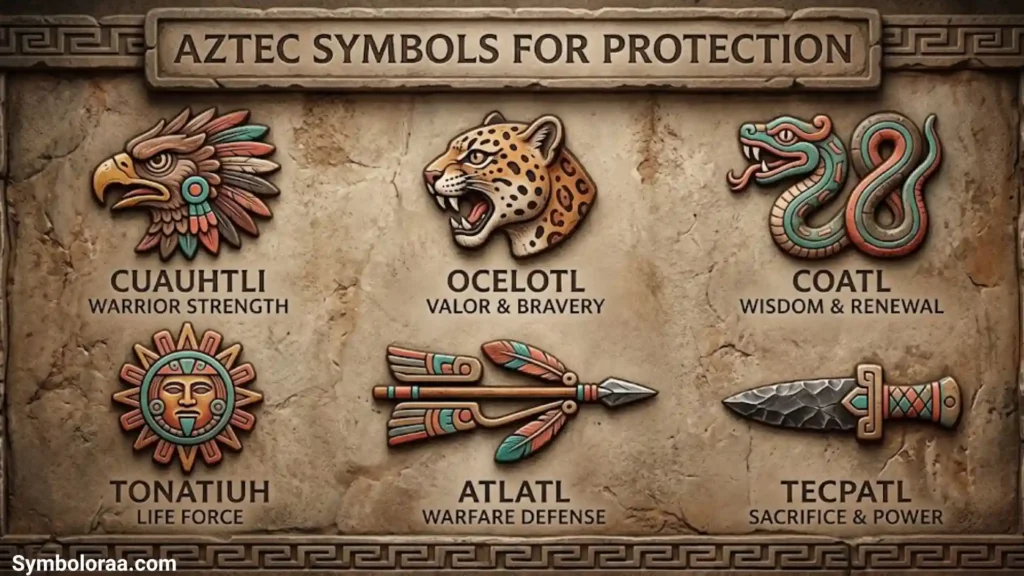
Protection played an important role in Aztec religious life. People honored deities and performed ceremonies to seek protection from danger, illness, drought, and other threats.
Consider these historical images when exploring protective themes:
- Tlaloc: People associated this rain deity with water and agricultural fertility. His worship reflected the importance of rain for survival.
- Quetzalcoatl: The Feathered Serpent was a major deity connected with creation, knowledge, and the natural world.
- Eagle: Eagle imagery appeared in military and ceremonial contexts and can represent vigilance and courage.
- Serpent: Serpent imagery carried religious significance and appeared in representations of powerful deities.
- Sun: Solar imagery reflected the importance of maintaining cosmic order and the continuation of life.
There isn’t a single historically established Aztec protection glyph that works like a universal protective charm. Modern artists often use these images to express safety, resilience, and spiritual connection.
If you choose one for jewelry or a tattoo, research its original context before assigning it a specific meaning.
Aztec Symbols Ollin
Ollin is one of the most recognizable Aztec calendar symbols. The Nahuatl word means movement, and its glyph is associated with motion, change, and earthquakes.
Ollin appears as the 17th day sign in the 20-day sequence of the sacred Aztec calendar. Its design typically includes four directional elements arranged around a central movement motif.
The symbol also appears on the famous Aztec Sun Stone. In this monument, the central calendar imagery connects with the Fifth Sun, called Nahui Ollin, or Four Movement.
What Does the Ollin Symbol Represent?
The Ollin glyph carries several related ideas:
- Movement: The continuous motion of the world and natural forces.
- Change: Transformation and the shifting conditions of life.
- Earthquakes: The sign’s association with seismic movement.
- Cosmic Cycles: The changing ages of the world in Aztec beliefs.
- Four Directions: Its surrounding elements connect with the organization of the universe.
Ollin is particularly popular in contemporary tattoos because people interpret it as a reminder to keep moving, adapt, and overcome difficult situations.
However, its historical meaning is more specific than simply motivation or personal growth. It belongs to a religious and calendrical system that connected movement with the fate of the world.
Aztec Symbols for War
War had a major influence on Aztec political power, military traditions, and religious practices. The Mexica used particular images to communicate warfare, military status, and the relationship between battle and religious life.
Some important war-related symbols include:
- Atl-Tlachinolli: This Nahuatl expression means water and burned things or fire. It was a metaphor for warfare and appeared in warrior-related imagery.
- Eagle: Associated with the prestigious eagle warrior order and solar symbolism.
- Jaguar: Connected with the elite jaguar warriors and military prestige.
- Shield (Chimalli): A recognizable military object that represented defense and battle.
- Macuahuitl: A wooden weapon fitted with sharp obsidian blades, closely associated with Mexica warfare.
- Flint (Tecpatl): A calendrical sign and ritual image that also carried associations with blades and sacrifice.
The water-and-fire metaphor is particularly interesting because it combines two opposing natural elements to express warfare.
It also demonstrates how Aztec symbols could communicate abstract ideas through recognizable images.
Warrior Fighter Aztec Symbols
Warrior symbols are among the most recognizable elements of Aztec-inspired artwork. The Mexica had prestigious military orders whose members were associated with distinctive animal imagery and ceremonial clothing.
Eagle Warrior Symbol
Eagle warriors belonged to an elite military order. They wore eagle-inspired costumes, including helmets and other ceremonial elements.
The eagle was associated with the sun and carried strong military significance. Today, its image often represents courage, ambition, discipline, and leadership.
Jaguar Warrior Symbol
Jaguar warriors formed another prestigious military order. Their distinctive costumes imitated the appearance of jaguars, powerful animals associated with the earth and nighttime.
A jaguar design can represent:
- Strength and physical power.
- Military prestige.
- Courage and determination.
- Connection with powerful animal imagery.
- Leadership and warrior identity.
Other Warrior Elements
| Design | Historical Connection | Modern Interpretation |
| Chimalli (Shield) | Military defense | Protection and resilience |
| Macuahuitl | Traditional weapon | Warrior spirit |
| Eagle Helmet | Eagle warrior clothing | Courage and leadership |
| Jaguar Costume | Jaguar warrior clothing | Strength and confidence |
| Feathered Headdress | Ceremonial and elite clothing | Prestige and identity |
These designs work particularly well in traditional illustrations, clothing, posters, and body art. For an authentic historical representation, use references from Mexica sculptures and codices rather than relying entirely on modern fantasy artwork.
Aztec Symbols Tattoos

Aztec tattoos are popular because they combine detailed artwork with historical and cultural imagery. Their designs can range from small geometric symbols to elaborate full-sleeve compositions.
Here are some popular Aztec tattoo ideas:
- Ollin Tattoo: A meaningful choice for movement, change, and personal transformation.
- Aztec Sun Stone Tattoo: A detailed design associated with solar imagery, cosmic cycles, and ancient beliefs.
- Jaguar Tattoo: A bold option for expressing strength, confidence, and warrior imagery.
- Eagle Tattoo: A popular design associated with courage, leadership, and the eagle warrior tradition.
- Quetzalcoatl Tattoo: A detailed Feathered Serpent design inspired by an important Mesoamerican deity.
- Aztec Calendar Tattoo: A complex circular design featuring calendar signs and other symbolic details.
- Aztec Warrior Tattoo: A dramatic choice featuring traditional armor, helmets, shields, and weapons.
Where to Place an Aztec Tattoo
Your preferred design can help determine the best placement.
| Tattoo Placement | Suitable Designs |
| Forearm | Ollin, eagle, small geometric patterns |
| Upper Arm | Jaguar, warrior helmet, serpent |
| Chest | Sun Stone, large circular designs |
| Back | Full warrior scenes and detailed compositions |
| Shoulder | Feathered serpent and eagle designs |
| Calf | Repeating geometric patterns |
Before getting an Aztec tattoo, research its historical meaning and cultural background. These symbols aren’t simply decorative shapes. Many have religious or ceremonial significance within Indigenous Mexican heritage.
Also, ask your tattoo artist to preserve the important details of the original glyph. A small change in its structure can make a historical symbol difficult to recognize.
Easy Aztec Symbols
If you prefer simple Aztec symbols, start with designs that have recognizable shapes and fewer details. These symbols are easier to draw, use in small decorations, or adapt into minimalist tattoos.
Here are some easy designs to explore:
| Symbol Name | Simple Design Idea | Meaning or Association |
| Ollin | Four-part movement shape | Movement and change |
| Atl | Three flowing water streams | Water and life |
| Xochitl | Simple flower | Beauty and creativity |
| Calli | Basic house outline | Home and shelter |
| Coatl | Curved serpent | Serpent imagery |
| Cuauhtli | Eagle outline | Eagle and warrior symbolism |
| Tonatiuh | Circular sun design | Solar imagery |
| Ehecatl | Wind-inspired curves | Wind and movement |
How to Create Simple Aztec-Inspired Designs
You don’t need complicated artwork to create an attractive Aztec-inspired design.
Follow these tips:
- Use basic geometric shapes such as circles, diamonds, and squares.
- Choose one main symbol instead of combining too many elements.
- Keep the original structure of historical glyphs recognizable.
- Use black-and-white outlines for minimalist designs.
- Add repeating borders for a traditional geometric appearance.
- Use contrasting colors when creating digital artwork.
You can use these designs in notebooks, social media graphics, wallpapers, jewelry concepts, and personalized artwork.
Remember that simplified drawings are modern adaptations. They shouldn’t be presented as exact historical reproductions unless you’ve checked their original forms.
FAQs About Aztec Symbols
What is the most famous Aztec symbol?
The Aztec Sun Stone is probably the most recognizable Aztec monument. Its detailed carvings represent solar imagery, calendar signs, and beliefs about the different ages of the world. The Ollin glyph is another widely recognized symbol associated with movement and the Fifth Sun.
What does the Aztec Ollin symbol mean?
Ollin means movement in Nahuatl. It represents movement, change, and earthquakes within the Aztec religious and calendrical system. It also appears in the name Nahui Ollin, associated with the Fifth Sun.
Did the Aztecs have their own alphabet?
No, the Aztecs didn’t use an alphabet like modern English. They communicated through a pictorial writing system that combined images, ideograms, logograms, and signs representing sounds. These appeared in manuscripts, monuments, and other historical objects.
Which Aztec symbol represents strength?
The jaguar and eagle are two important symbols associated with strength. Both animals were connected with prestigious Mexica warrior orders. Their images remain popular in modern artwork and tattoos.
Can you copy and paste Aztec symbols?
Most historical Aztec glyphs aren’t available as standard Unicode text characters. You can copy modern decorative symbols, but authentic Aztec glyphs generally need to be shared as images. You can also use historical references to recreate them in digital artwork.
Conclusion
Aztec symbols reveal how the Mexica understood nature, religion, warfare, and the universe. From the powerful eagle and jaguar to the meaningful Ollin glyph, every historical design offers a glimpse into their cultural traditions. These images also help us understand the importance of the sun, water, flowers, and other natural elements in ancient Mexican life.
You can explore these symbols through tattoos, geometric patterns, decorative artwork, and personalized designs. Whether you prefer a simple flower glyph or a detailed warrior illustration, understanding its historical background makes your chosen design more meaningful.
Before using any symbol, take time to learn its original significance. This helps you appreciate the artwork while respecting the history and cultural traditions behind it. The best Aztec-inspired design is one that combines visual beauty with an accurate understanding of its meaning.

I’m Madison Reed, a contemporary American author who writes about love, family, friendship, and second chances. I’m fascinated by the choices that shape our lives and the moments that change us forever. My goal is to create honest, emotional stories with characters readers can connect with long after finishing each book.
Three Books:
When We Find Our Way
The Things We Never Said
Summer in September