
Gender symbols are simple characters used to represent male, female, transgender, nonbinary, and other gender identities. These symbols appear in everyday communication, scientific information, educational materials, public facilities, social media profiles, and digital platforms. Some have been used for centuries, while others have become widely recognized through modern discussions about gender identity and inclusion.
If you are searching for gender symbols to copy and paste, you can find several useful characters, including ♀, ♂, ⚧, ⚥, ⚢, and ⚣. Each symbol has a different appearance and meaning, making it useful in particular situations. Some represent traditional gender categories, while others are connected with gender diversity and LGBTQ+ communities.
This complete guide covers gender symbols, their meanings, Unicode characters, male and female signs, nonbinary representations, and symbols used in Pokémon, Planet Zoo, and public bathrooms. You will also find additional gender-related characters, practical examples, and copy-and-paste collections to help you find the right symbol.
What Are The Gender Symbols?
Gender symbols are visual characters used to represent gender categories, sex-related classifications, or gender identities. They provide a simple way to communicate information without writing a complete description.
The two most recognizable gender symbols are the female sign (♀) and male sign (♂). These traditional characters are commonly used in biology, education, scientific diagrams, and public information. However, gender representation extends beyond these two signs.
Other symbols, such as ⚧ and ⚲, are used in discussions about transgender identities, gender diversity, and neuter representation.
Here are some commonly recognized gender symbols:
| Symbol | Name | Common Meaning |
| ♀ | Female Sign | Female or woman |
| ♂ | Male Sign | Male or man |
| ⚧ | Transgender Symbol | Transgender identity |
| ⚥ | Male And Female Sign | Male and female combination |
| ⚢ | Doubled Female Sign | Female-female association |
| ⚣ | Doubled Male Sign | Male-male association |
| ⚤ | Interlocked Female And Male Sign | Male and female combination |
| ⚲ | Neuter Sign | Neuter or genderless representation |
| ⚦ | Male With Stroke Sign | Specialized gender-related representation |
| 🚹 | Men’s Room | Men’s restroom |
| 🚺 | Women’s Room | Women’s restroom |
Gender symbols are not all interchangeable. Their meanings depend on historical background, community preferences, and the situation in which they appear.
Gender Symbols Text
Gender symbols text refers to Unicode characters that can be inserted directly into written content. Unlike pictures or illustrations, these characters are recognized as text by compatible devices and applications.
They are useful for people who want simple gender signs for usernames, social media biographies, messages, documents, educational notes, and online discussions.
Here is a collection of gender-related text symbols:
Basic Gender Text Symbols
| Symbol | Symbol Name |
| ♀ | Female Sign |
| ♂ | Male Sign |
| ⚧ | Transgender Symbol |
| ⚥ | Male And Female Sign |
| ⚢ | Doubled Female Sign |
| ⚣ | Doubled Male Sign |
| ⚤ | Interlocked Female And Male Sign |
| ⚦ | Male With Stroke Sign |
| ⚨ | Vertical Male With Stroke Sign |
| ⚩ | Horizontal Male With Stroke Sign |
| ⚲ | Neuter Sign |
Gender And Identity Emoji
| Symbol | Meaning |
| 👨 | Man |
| 👩 | Woman |
| 🧑 | Person |
| 👦 | Boy |
| 👧 | Girl |
| 🧒 | Child |
| 🧔 | Person With Beard |
| 👨🦰 | Man With Red Hair |
| 👩🦰 | Woman With Red Hair |
| 🏳️🌈 | Rainbow Pride Flag |
| 🏳️⚧️ | Transgender Pride Flag |
These characters provide different ways to communicate gender-related information. Traditional signs are useful for simple classifications, while emoji and pride flags can represent individuals and communities more directly.
Female Gender Symbols

The female gender symbol is represented by ♀. It is one of the oldest and most recognizable characters associated with women and female representation.
The design consists of a circle with a small cross extending downward. Its historical association comes from Venus, the Roman goddess of love and beauty, and the planet Venus.
Female Symbol: ♀
- Unicode name: Female Sign
- Unicode code point: U+2640
- HTML entity: ♀
- Common association: Female or woman
The female symbol appears in several contexts:
- Biology and scientific diagrams.
- Women’s restroom signs.
- Educational materials.
- Medical and informational charts.
- Gender selection forms.
- Social media usernames and biographies.
- Animal classification and breeding information.
You may also encounter two female signs together in the doubled female symbol (⚢). This character has historically been associated with female-female relationships and lesbian representation.
Although ♀ is widely understood as the female sign, it should not automatically be used to describe every woman’s gender identity. Individual preferences and contexts matter.
Male Symbol
The male symbol is represented by ♂. It is traditionally associated with men, boys, and male classifications.
Its design includes a circle with an arrow pointing diagonally upward and to the right. The symbol has a historical connection with Mars, the Roman god of war, and the planet Mars.
Male Symbol: ♂
- Unicode name: Male Sign
- Unicode code point: U+2642
- HTML entity: ♂
- Common association: Male or man
The male sign is commonly used in:
- Biology and scientific information.
- Educational diagrams.
- Men’s restroom signs.
- Animal classification.
- Gender-related forms.
- Social media profiles.
- Gaming interfaces.
The symbol can also appear in combinations with other characters. For example, ⚣ is known as the doubled male sign and has historically been associated with male-male relationships.
The male sign and female sign are often displayed together when information compares male and female categories.
All 72 Gender Symbols
Many people search for all 72 gender symbols because they want a large collection of gender-related characters for copying, learning, or personal use.
However, Unicode does not define an official collection known as the 72 gender symbols. Online collections sometimes combine standard gender characters, people emoji, pride flags, decorative designs, and custom combinations to create larger lists.
To understand these characters accurately, it is helpful to separate established Unicode gender signs from other gender-related symbols.
Standard Unicode Gender Symbols
The following characters belong to the Unicode Miscellaneous Symbols block and include several established gender-related signs.
| Symbol | Official Unicode Name | Code Point |
| ♀ | Female Sign | U+2640 |
| ♂ | Male Sign | U+2642 |
| ⚢ | Doubled Female Sign | U+26A2 |
| ⚣ | Doubled Male Sign | U+26A3 |
| ⚤ | Interlocked Female And Male Sign | U+26A4 |
| ⚥ | Male And Female Sign | U+26A5 |
| ⚦ | Male With Stroke Sign | U+26A6 |
| ⚧ | Male With Stroke And Male And Female Sign | U+26A7 |
| ⚨ | Vertical Male With Stroke Sign | U+26A8 |
| ⚩ | Horizontal Male With Stroke Sign | U+26A9 |
| ⚲ | Neuter | U+26B2 |
These characters have different historical and technical meanings. Some are associated with traditional gender classifications, while others have been adopted in discussions about gender diversity.
Other Gender-Related Unicode Characters
The following characters are also useful when discussing gender, people, and public facilities.
| Symbol | Name | Common Use |
| 👨 | Man | Represents an adult man |
| 👩 | Woman | Represents an adult woman |
| 🧑 | Person | Gender-neutral person |
| 👦 | Boy | Represents a boy |
| 👧 | Girl | Represents a girl |
| 🧒 | Child | Gender-neutral child |
| 🚹 | Men’s Room | Men’s facilities |
| 🚺 | Women’s Room | Women’s facilities |
| 🚻 | Restroom | Public restroom |
| 🚼 | Baby Symbol | Baby-related facilities |
| 🏳️🌈 | Rainbow Pride Flag | LGBTQ+ pride |
| 🏳️⚧️ | Transgender Pride Flag | Transgender pride |
These are not all official gender signs. Some are emoji representing people, while others are public information symbols or pride flags.
Why Do People Search For 72 Gender Symbols?
The number 72 often appears in online searches because users want to explore a wide range of gender identities and representations.
A larger collection may include:
- Traditional male and female signs.
- Transgender and nonbinary representations.
- Intersex-related symbols.
- Gender-neutral characters.
- LGBTQ+ community symbols.
- Pride flags.
- People emoji.
- Custom identity combinations.
However, there is no universally accepted list of exactly 72 official gender symbols. It is better to identify each character by its actual Unicode name or recognized community meaning rather than assigning invented meanings to random combinations.
Gender Symbols And Their Meanings
Understanding the meaning of each symbol helps you choose the correct character for your content. Some signs represent traditional gender categories, while others have specialized meanings.
Here is a detailed reference table:
| Symbol | Name | Meaning Or Association |
| ♀ | Female Sign | Female or woman |
| ♂ | Male Sign | Male or man |
| ⚢ | Doubled Female Sign | Female-female association |
| ⚣ | Doubled Male Sign | Male-male association |
| ⚤ | Interlocked Female And Male Sign | Female and male combination |
| ⚥ | Male And Female Sign | Male and female representation |
| ⚦ | Male With Stroke Sign | Specialized gender-related sign |
| ⚧ | Transgender Symbol | Transgender identity |
| ⚨ | Vertical Male With Stroke Sign | Historical gender-related sign |
| ⚩ | Horizontal Male With Stroke Sign | Historical gender-related sign |
| ⚲ | Neuter | Neuter or genderless representation |
Understanding Traditional Gender Symbols
The female sign ♀ and male sign ♂ originally developed from astronomical and astrological associations. Their connection with Venus and Mars influenced their later use in biology and gender classification.
Understanding Modern Gender Representations
The transgender symbol ⚧ is widely recognized in discussions about transgender identity. Other representations, including nonbinary pride flags and community-specific designs, provide additional ways to communicate gender diversity.
Do All Gender Symbols Have Universal Meanings?
No. A character may have a historical meaning, a scientific use, and a modern community association. Its interpretation can change according to the context.
For example, a doubled female sign may have a historical association with lesbian relationships, but it should not be assumed to represent every lesbian person.
Male And Female Symbols Meaning
Male and female symbols are traditionally used to distinguish male and female categories in scientific, educational, and everyday situations.
The two primary characters are:
| Symbol | Name | Traditional Association |
| ♂ | Male Sign | Mars and masculinity |
| ♀ | Female Sign | Venus and femininity |
The male symbol has a circle with an arrow pointing upward and right. The female symbol has a circle with a small cross extending downward.
When displayed together, these characters can communicate a comparison between male and female categories.
Some related combinations include:
- ♂ / ♀ — Male and female.
- ♀ + ♂ — Female and male combination.
- ⚥ — Male and female sign.
- ⚤ — Interlocked female and male sign.
These symbols are especially useful in educational diagrams, animal classification, and scientific records.
However, biological sex and gender identity are not identical concepts. Traditional male and female signs do not represent every person’s identity. For personal communication, it is better to respect the terms and pronouns someone uses for themselves.
Boy Gender Symbol
The traditional symbol used to represent boys is the male sign (♂). It is also used for men and other male classifications, so it is not specifically a symbol for young boys.
For a clearer representation of a male child, the boy emoji (👦) is usually more suitable.
Here are some useful characters:
| Symbol | Name | Meaning |
| ♂ | Male Sign | Male category |
| 👦 | Boy Emoji | Young boy |
| 👨 | Man Emoji | Adult man |
| 🧒 | Child Emoji | Gender-neutral child |
| 🚹 | Men’s Room | Men’s facilities |
Male Symbol Vs Boy Emoji
The male sign is a traditional gender-related character. It is useful in charts, forms, and scientific information.
The boy emoji represents a young male child more directly. It is often better for family messages, children’s content, and informal communication.
For example:
- My little boy 👦
- Boys’ category: ♂
- Men’s facilities: 🚹
Choose the character according to the age group and meaning you want to communicate.
Pokemon Gender Symbols
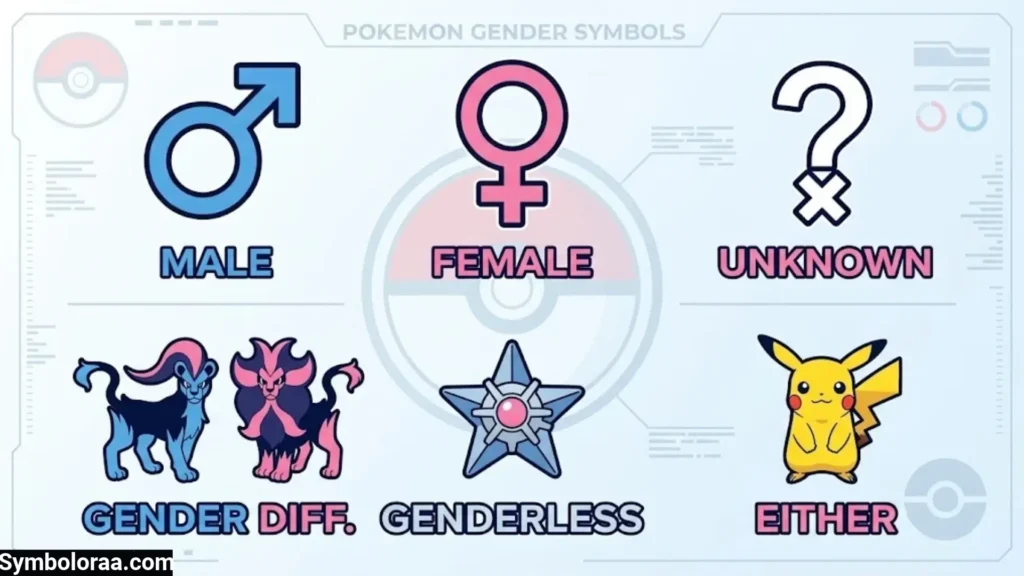
Pokémon games use male and female symbols to display the gender of Pokémon that have gender classifications.
The two familiar indicators are:
- ♂ — Male Pokémon.
- ♀ — Female Pokémon.
These characters generally appear near a Pokémon’s name or within its information screen, depending on the game.
Male Pokémon Symbol
The male sign (♂) identifies a Pokémon classified as male. It can help players understand the Pokémon’s gender when checking its information.
Female Pokémon Symbol
The female sign (♀) identifies a Pokémon classified as female. Some Pokémon species have visible differences between their male and female forms.
Genderless Pokémon
Not every Pokémon has a male or female classification. Certain species are genderless, meaning they do not belong to either category in the game’s gender system.
Gender can also influence breeding compatibility and some evolution methods. However, these mechanics depend on the particular Pokémon species and game.
The symbols used in Pokémon are the same familiar male and female Unicode characters found in other applications. Their purpose in the game is to provide a quick indication of a Pokémon’s classification.
Bathroom Gender Symbols
Bathroom gender symbols help people identify public restrooms and understand which facilities are available.
Traditional restroom signs usually display male and female pictograms. Some modern facilities also use gender-neutral signs to make their facilities easier to identify.
Here are the most common restroom-related symbols:
| Symbol | Name | Meaning |
| 🚹 | Men’s Room | Men’s restroom |
| 🚺 | Women’s Room | Women’s restroom |
| 🚻 | Restroom | General restroom |
| 🚼 | Baby Symbol | Baby-changing facilities |
Men’s Bathroom Symbol
The men’s bathroom symbol is commonly represented by a standing human figure or the Unicode character 🚹. It identifies restroom facilities designated for men.
Women’s Bathroom Symbol
The women’s bathroom symbol is commonly represented by a human figure wearing a dress or the Unicode character 🚺. It identifies restroom facilities designated for women.
Gender-Neutral Bathroom Symbol
Gender-neutral restrooms may use a simple person pictogram, a toilet icon, or a combination of different figures.
Their purpose is to identify facilities available without separating visitors into traditional male and female categories.
Why Are Bathroom Gender Symbols Important?
Bathroom signs provide quick visual information. They help visitors locate the correct facilities in shopping centers, restaurants, schools, airports, offices, and other public buildings.
Clear written labels alongside pictograms can make restroom information easier to understand for people from different backgrounds.
Planet Zoo Gender Symbols
Planet Zoo is a zoo management simulation game where players create habitats, care for animals, and manage different species.
Gender indicators help players identify the sex of animals and understand the population of their habitats.
The familiar characters are:
| Symbol | Meaning |
| ♂ | Male animal |
| ♀ | Female animal |
Male Animal Symbol In Planet Zoo
The male sign (♂) identifies an animal classified as male. Players can use this information when reviewing animal details and managing their zoo population.
Female Animal Symbol In Planet Zoo
The female sign (♀) identifies an animal classified as female. This information can be helpful when managing animal groups and breeding arrangements.
Why Does Animal Gender Matter In Planet Zoo?
Animal gender can affect breeding management and population planning. Players may need to understand the sex of individual animals when managing habitats and maintaining suitable animal groups.
However, breeding requirements differ between species. Not every animal can reproduce under identical conditions.
The symbols provide a simple visual distinction, making animal information easier to understand while managing a zoo.
LGBT Gender Symbols
LGBTQ+ symbols represent different identities, communities, and experiences related to sexual orientation and gender identity.
Some are Unicode characters, while others are pride flags and specially designed symbols.
Here are several widely recognized examples:
| Symbol | Name | Association |
| ⚧ | Transgender Symbol | Transgender identity |
| ⚢ | Doubled Female Sign | Historical lesbian association |
| ⚣ | Doubled Male Sign | Historical male-male association |
| 🏳️🌈 | Rainbow Pride Flag | LGBTQ+ community |
| 🏳️⚧️ | Transgender Pride Flag | Transgender community |
| ♀ | Female Sign | Female representation |
| ♂ | Male Sign | Male representation |
Rainbow Pride Flag
The rainbow pride flag is one of the most recognizable symbols of LGBTQ+ visibility and inclusion. Its colors represent diversity and the wider LGBTQ+ community.
Transgender Pride Flag
The transgender pride flag features five horizontal stripes in light blue, pink, and white.
Its colors are commonly interpreted as follows:
- Light blue represents traditional colors associated with boys.
- Light pink represents traditional colors associated with girls.
- White represents people who are transitioning, intersex, or identify outside the traditional gender categories.
Other LGBTQ+ Pride Symbols
Different communities have their own flags and visual representations.
Examples include:
- Lesbian pride flag.
- Bisexual pride flag.
- Asexual pride flag.
- Pansexual pride flag.
- Nonbinary pride flag.
- Genderfluid pride flag.
- Intersex pride flag.
Each flag has its own design and community significance. These flags should not be confused with individual Unicode gender characters.
Non Binary Gender Symbols
Nonbinary gender symbols represent people whose gender identity does not fit exclusively into the traditional categories of male or female.
Nonbinary is an umbrella term that includes several identities. Some nonbinary people identify with multiple genders, while others identify with neither male nor female. Some describe their gender as fluid or outside conventional classifications.
There is no single universally accepted Unicode symbol specifically designated as the nonbinary sign.
However, several characters and representations are used in gender-diversity discussions.
| Symbol | Name | Association |
| ⚧ | Transgender Symbol | Gender-diverse communities |
| ⚲ | Neuter | Neuter or genderless representation |
| ⚥ | Male And Female Sign | Combined gender representation |
| 🏳️⚧️ | Transgender Pride Flag | Transgender community |
| 🏳️🌈 | Rainbow Pride Flag | LGBTQ+ community |
Nonbinary Pride Flag
The nonbinary pride flag consists of four horizontal stripes:
| Color | Common Meaning |
| Yellow | Genders outside the traditional binary |
| White | People with multiple or many genders |
| Purple | A mixture of male and female identities |
| Black | People who identify without gender |
Other Nonbinary Representations
Some nonbinary people prefer the transgender symbol, while others use a custom design or their community’s pride flag.
There is no requirement for every nonbinary person to use the same character. Personal preference is important when selecting a symbol for an individual.
Nonbinary Vs Gender-Neutral Symbols
Nonbinary and gender-neutral are related terms, but they are not identical.
Nonbinary describes gender identities outside the exclusively male or female categories.
Gender-neutral describes something that does not specifically refer to one gender. For example, the person emoji (🧑) can be used as a gender-neutral representation.
Gender Symbols Copy Paste
If you need gender symbols for social media, usernames, messages, or documents, you can use the following copy-and-paste collection.
The characters are displayed separately so you can find the one you need quickly.
Male And Female Symbols Copy Paste
| Symbol | Name |
| ♀ | Female |
| ♂ | Male |
| ⚥ | Male And Female |
| ⚤ | Interlocked Female And Male |
| ⚢ | Doubled Female |
| ⚣ | Doubled Male |
Transgender And Gender-Diverse Symbols
| Symbol | Name |
| ⚧ | Transgender |
| ⚲ | Neuter |
| ⚦ | Male With Stroke |
| ⚨ | Vertical Male With Stroke |
| ⚩ | Horizontal Male With Stroke |
Gender Emoji Copy Paste
| Symbol | Name |
| 👨 | Man |
| 👩 | Woman |
| 🧑 | Person |
| 👦 | Boy |
| 👧 | Girl |
| 🧒 | Child |
| 👨🦰 | Man With Red Hair |
| 👩🦰 | Woman With Red Hair |
| 🧔 | Person With Beard |
| 🧑🤝🧑 | People Holding Hands |
Bathroom And Pride Symbols Copy Paste
| Symbol | Name |
| 🚹 | Men’s Room |
| 🚺 | Women’s Room |
| 🚻 | Restroom |
| 🚼 | Baby Symbol |
| 🏳️🌈 | Rainbow Pride Flag |
| 🏳️⚧️ | Transgender Pride Flag |
How To Copy And Paste Gender Symbols
You can use these symbols on most devices through a simple copy-and-paste process.
- Find the gender symbol you want to use.
- Select the character with your mouse or touch screen.
- Press Ctrl + C on Windows or use your device’s copy option.
- Open the application where you want to insert the symbol.
- Press Ctrl + V or select Paste.
On mobile devices, press and hold the character to select it, then choose Copy. Open your desired application and paste the character into the text field.
Where Can You Use Gender Symbols?
Gender-related characters can be useful in many places:
- Social media bios and profiles.
- WhatsApp messages and conversations.
- Educational assignments.
- Digital documents.
- Personal usernames.
- Gaming profiles.
- Scientific charts.
- Website content.
- Informational forms.
Why Are Some Gender Symbols Not Displaying?
Some symbols may appear differently depending on the device, font, browser, or application.
If a character appears as an empty square or question mark, the selected font may not support it.
Emoji sequences can also behave differently across platforms. For example, a pride flag may require multiple Unicode code points to display correctly.
For better results, test the symbol in the application where you plan to publish it before using it in important content.
What Do Gender Symbols Mean?

Gender symbols communicate different ideas depending on their design and context. Understanding their meanings helps prevent confusion between traditional classifications, gender identities, and sexual orientation.
The female sign (♀) and male sign (♂) are traditionally associated with female and male classifications. They are commonly found in scientific diagrams, educational resources, and public information.
The transgender symbol (⚧) is widely recognized as a representation of transgender identity. It is frequently used in discussions about gender diversity and transgender visibility.
Other characters have more specialized associations:
- ⚥ — Male and female sign, historically associated with combined male and female representation.
- ⚢ — Doubled female sign, historically associated with female-female relationships.
- ⚣ — Doubled male sign, historically associated with male-male relationships.
- ⚤ — Interlocked female and male sign.
- ⚲ — Neuter sign, associated with neuter or genderless representation.
- 🏳️🌈 — Rainbow pride flag, representing LGBTQ+ diversity.
- 🏳️⚧️ — Transgender pride flag, representing transgender communities.
Gender Identity Vs Biological Sex
Gender identity and biological sex are related but different concepts.
Biological sex generally refers to physical and biological characteristics. Gender identity refers to a person’s internal understanding and experience of their gender.
This distinction matters because traditional male and female symbols do not describe every aspect of gender identity.
Gender Identity Vs Sexual Orientation
Gender identity describes who someone is in terms of gender. Sexual orientation describes patterns of romantic, emotional, or sexual attraction.
For example, a transgender person may identify as a man, woman, or nonbinary person and may have any sexual orientation.
Understanding these differences makes it easier to use gender-related symbols correctly and respectfully.
FAQs
What is the most common gender symbol?
The most common traditional gender symbols are ♀ for female and ♂ for male. The transgender symbol ⚧ is another widely recognized gender-related character.
Is there a universal symbol for nonbinary gender?
No single Unicode character is universally accepted as the nonbinary symbol. Some people use ⚧, while others prefer the nonbinary pride flag or personal designs.
What are the Unicode codes for male and female symbols?
The male symbol ♂ has the Unicode code point U+2642, while the female symbol ♀ has U+2640. Both are standard Unicode characters.
Are gender symbols and LGBTQ+ symbols the same?
No. Gender symbols represent gender-related categories or identities, while LGBTQ+ symbols and pride flags represent different communities, identities, visibility, and inclusion.
Can I use gender symbols on social media?
Yes. You can use supported Unicode gender characters in social media bios, captions, usernames, and messages. Their appearance may vary depending on the platform and font support.
Conclusion
Gender symbols provide a simple way to represent male, female, transgender, nonbinary, and other gender-related concepts. Traditional characters such as ♀ and ♂ remain widely recognized, while ⚧, ⚥, and other signs offer additional representations. Understanding their differences helps you choose the correct character for different situations.
These symbols are useful across many areas, including education, science, gaming, public facilities, social media, and digital communication. Characters used in Pokémon and Planet Zoo also show how male and female signs can help organize information about animals. Pride flags and nonbinary representations provide further ways to communicate identity and inclusion.
When using gender symbols, consider their actual meanings rather than choosing characters only because they look attractive. You can copy and paste the Unicode characters from this guide into compatible applications, profiles, and documents. Choosing symbols carefully makes your content clearer, more accurate, and respectful of different identities.

I’m Madison Reed, a contemporary American author who writes about love, family, friendship, and second chances. I’m fascinated by the choices that shape our lives and the moments that change us forever. My goal is to create honest, emotional stories with characters readers can connect with long after finishing each book.
Three Books:
When We Find Our Way
The Things We Never Said
Summer in September