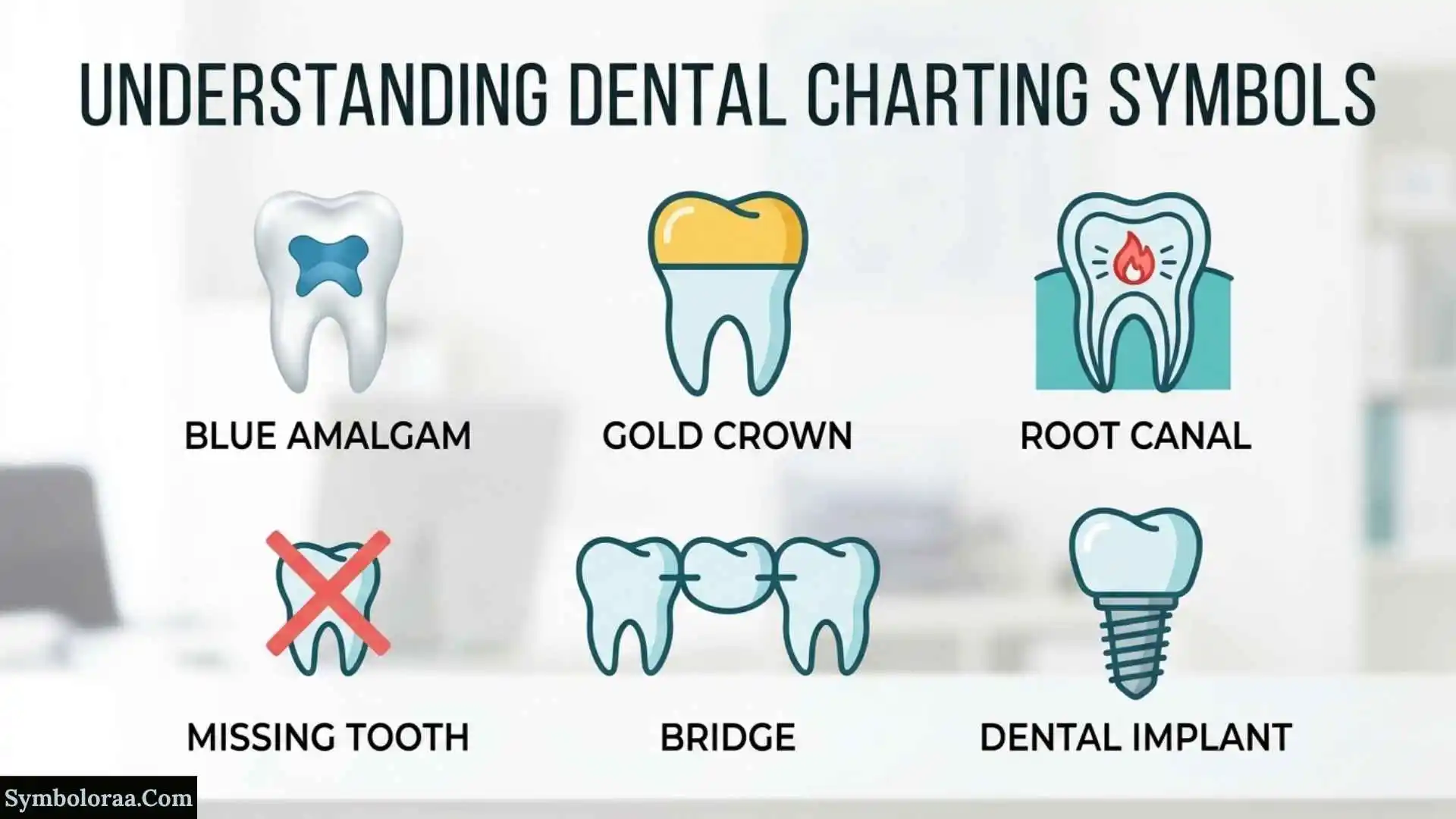
If you are trying to understand dental charting symbols, a tooth chart can seem like a confusing mix of numbers, letters, colors, lines, abbreviations, and shaded areas. The good news is that most dental charts follow a logical system. Once you understand tooth numbering, tooth surfaces, common abbreviations, restorations, periodontal measurements, and chart legends, the information becomes much easier to read.
Dental charting symbols are used to record the condition of teeth, previous dental treatment, findings from an examination, periodontal measurements, and planned procedures. However, there is no single visual symbol that every dentist or dental software program uses in exactly the same way.
This guide explains the most common dental charting terminology, including FDI tooth numbers, Universal tooth numbers, Palmer notation, tooth surface abbreviations, restoration symbols, periodontal charting terms, color coding, treatment-status markings, common mistakes, and practical examples.
Quick answer:
A dental chart uses numbers, letters, abbreviations, colors, and graphical marks to identify teeth and document conditions or treatment. Always identify the numbering system and check the chart legend before interpreting an unfamiliar symbol.
What Are Dental Charting Symbols?
Dental charting symbols are visual or written notations used by dental professionals to document information about a patient’s teeth and oral tissues.
A chart may record:
- Tooth number
- Tooth surface
- Missing teeth
- Dental caries
- Existing fillings
- Crowns
- Bridges
- Implants
- Root canal treatment
- Sealants
- Dentures
- Tooth mobility
- Periodontal probing measurements
- Gingival recession
- Bleeding on probing
- Planned treatment
- Completed treatment
- Other clinical findings
The purpose is not simply to make a diagram of the mouth. A dental record should allow relevant information to be documented consistently and communicated between members of the dental team.
The American Dental Association maintains standardized terminology and tooth-designation systems for dental records and claims. Its Universal Tooth Designation System assigns numbers to permanent teeth and letters to primary teeth.
Why Dental Charting Matters
A dental chart provides a record that can be reviewed during future appointments.
For example, a dentist may need to know whether:
- A filling was already present before today’s examination
- A tooth was previously treated with root canal therapy
- A tooth is missing because it was extracted
- A crown is existing or only recommended
- Periodontal measurements have changed
- A restoration involves one or several tooth surfaces
Without clear charting, it would be difficult to distinguish historical information from new findings.
The ADA also describes the CDT Code as a system intended to support consistency in documenting dental treatment.
Dental Charting Is Not the Same as Diagnosis
A chart symbol does not necessarily represent a complete diagnosis.
For example, a mark indicating a restoration tells you something about the tooth’s treatment history, but it does not by itself tell you whether the restoration is clinically satisfactory today.
Likewise, a periodontal measurement is one part of a periodontal examination rather than a complete diagnosis.
This distinction is important when patients read their own dental records. A dental chart should be interpreted together with examination findings, radiographs, medical and dental history, symptoms, and the dentist’s clinical assessment.
Also Check This Post: 79+ Symbols in Spanish: What Do These Common Signs Mean?
Dental Tooth Numbering Systems You Need to Know
One of the first things to identify on a dental chart is the tooth numbering system.
The three systems you are most likely to encounter are:
| System | Basic format | Common use |
| Universal/National | 1–32 for permanent teeth | Common in the United States |
| FDI/ISO | Two-digit numbers | Widely used internationally |
| Palmer | Quadrant + position | Used in some dental and orthodontic settings |
The ADA notes that Universal/National, International, and Palmer systems are all used around the world.
Universal Tooth Numbering System
The Universal system assigns numbers 1 through 32 to permanent teeth.
The sequence begins at the upper-right third molar from the patient’s perspective, continues across the upper arch to #16, then moves to the lower-left third molar at #17 and continues around to #32. Primary teeth use letters A through T.
Some examples are:
- #1 — upper-right third molar
- #8 — upper-right central incisor
- #9 — upper-left central incisor
- #16 — upper-left third molar
- #17 — lower-left third molar
- #24 — lower-left central incisor
- #25 — lower-right central incisor
- #32 — lower-right third molar
A useful memory point is that #8 and #9 are the two upper central incisors, while #24 and #25 are the two lower central incisors.
FDI Two-Digit Tooth Numbering
The FDI system uses two digits.
The first digit identifies the quadrant, while the second identifies the tooth’s position within that quadrant.
For permanent teeth:
| First digit | Quadrant |
| 1 | Upper right |
| 2 | Upper left |
| 3 | Lower left |
| 4 | Lower right |
The second digit identifies the tooth:
| Second digit | Tooth |
| 1 | Central incisor |
| 2 | Lateral incisor |
| 3 | Canine |
| 4 | First premolar |
| 5 | Second premolar |
| 6 | First molar |
| 7 | Second molar |
| 8 | Third molar |
Therefore:
- 11 = upper-right central incisor
- 21 = upper-left central incisor
- 36 = lower-left first molar
- 46 = lower-right first molar
- 48 = lower-right third molar
FDI’s two-digit notation was introduced as a worldwide standard in 1971, according to an FDI historical publication.
Palmer Tooth Notation
Palmer notation divides the mouth into four quadrants.
A tooth is identified by its position within the quadrant and a symbol showing the quadrant.
For example, a central incisor is identified as position 1 within its quadrant.
Palmer notation can be particularly useful in orthodontic records and educational settings, although the exact presentation can vary.
Why You Should Never Guess From a Tooth Number
Consider the number 36.
Under FDI notation, it means the lower-left first permanent molar.
But someone accustomed only to the Universal system might incorrectly assume that 36 is simply a tooth number from 1 to 32.
That is why the first step in reading an unfamiliar chart should always be:
Identify the numbering system → locate the tooth → interpret the notation.
Common Dental Charting Symbols and What They Represent
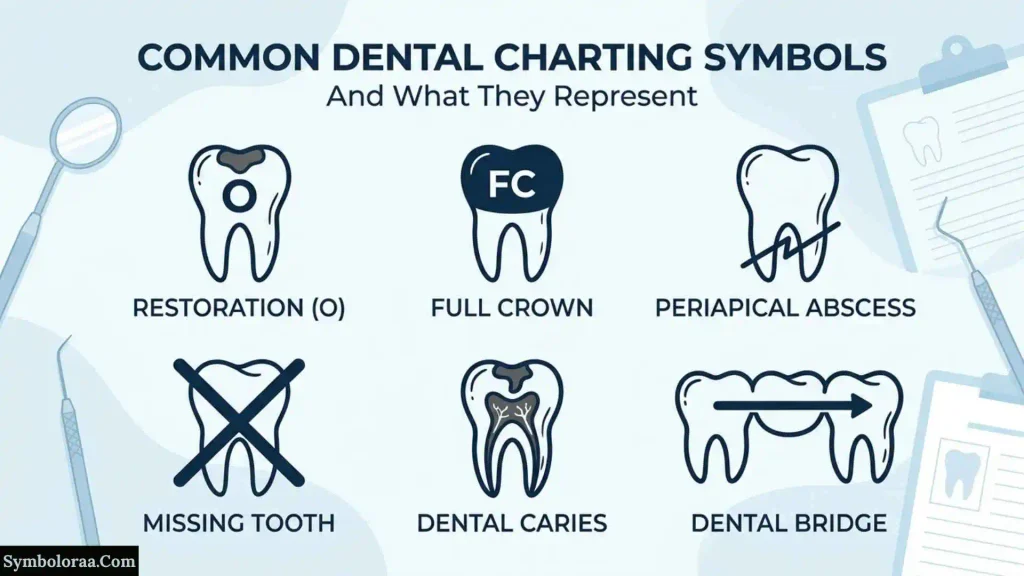
The visual appearance of a symbol can vary by dental software or practice. The safest approach is to understand the clinical concept represented by the notation rather than assuming that one drawing or color is universal.
Missing or Extracted Teeth
A missing tooth may be represented by:
- An X
- A crossed-out tooth
- An empty tooth position
- A missing-tooth status
- An abbreviation
- A software-specific icon
An extraction may also be documented separately as a procedure.
Important: An X is not guaranteed to mean the same thing in every chart. Always check the legend or accompanying notes.
Existing Restorations
A dental restoration may be shown by shading or a colored area on the tooth diagram.
It can represent treatments such as:
- Composite restoration
- Amalgam restoration
- Inlay
- Onlay
- Crown
- Other restorative work
The chart may distinguish existing work from proposed treatment.
Dental Caries
Caries may be documented by marking a particular tooth or surface.
The chart may identify the affected surface using abbreviations such as:
- M — mesial
- D — distal
- O — occlusal
- B — buccal
- L — lingual
- F — facial
- I — incisal
The exact notation depends on the practice and record system.
FDI has emphasized that modern caries classification should provide clinically useful information about lesions, management, prevention, monitoring, and treatment rather than simply describing a cavity by appearance.
Crown
A crown may be recorded as existing treatment or proposed treatment.
Depending on the charting software, it may appear as:
- A line around the tooth
- A colored tooth
- A crown icon
- A written abbreviation
- A treatment entry
A crown marking should therefore be interpreted with the chart legend and treatment history.
Bridge
A bridge replaces one or more missing teeth using artificial teeth supported by other structures.
A chart may document:
- Abutment teeth
- Pontic
- Crowns
- Bridge status
Because a bridge can involve several teeth, it is important not to interpret each marked tooth as an independent restoration without reading the accompanying notes.
Implant
Dental implants may be recorded with:
- An implant icon
- A special tooth symbol
- “IMP”
- A treatment record
An implant-supported crown may involve more than one entry in the record, so the chart should be read as a complete treatment history.
Root Canal Treatment
RCT commonly means root canal treatment.
A tooth with previous endodontic treatment may also have separate notation for:
- Crown
- Post
- Core restoration
- Existing filling
For example:
RCT + crown
does not mean one procedure. It records two related pieces of treatment information.
Dental Surface Abbreviations Explained
Understanding tooth surfaces is essential for interpreting dental charting.
| Abbreviation | Meaning | Simple explanation |
| M | Mesial | Toward the center line of the dental arch |
| D | Distal | Away from the center line |
| O | Occlusal | Chewing surface of posterior teeth |
| I | Incisal | Cutting edge of anterior teeth |
| B | Buccal | Toward the cheek |
| L | Lingual | Toward the tongue |
| F | Facial | Toward the lips/face |
| P | Palatal | Toward the palate |
Some practices may use a slightly different convention for particular teeth or charting tasks.
What Does MOD Mean in Dental Charting?
MOD means:
Mesial + Occlusal + Distal
It identifies three surfaces of a posterior tooth.
For example:
MOD restoration
means the restoration involves the mesial, occlusal, and distal surfaces.
What Does MO Mean?
MO means:
Mesial + Occlusal
It describes a finding or restoration involving those two surfaces.
What Does DO Mean?
DO means:
Distal + Occlusal
Again, the abbreviation tells you where the finding or restoration is located, not necessarily what caused it.
Why Surface Notation Is Useful
Surface notation makes a dental record much more precise.
Compare:
“Filling on tooth 19”
with:
“MOD restoration on tooth 19.”
The second description communicates much more information about the location of the restoration.
Common Dental Abbreviations in Dental Records
Dental records use abbreviations to save space and document clinical information efficiently.
| Abbreviation | Common meaning |
| RCT | Root canal treatment |
| EXT | Extraction |
| MOD | Mesial-occlusal-distal |
| MO | Mesial-occlusal |
| DO | Distal-occlusal |
| BOP | Bleeding on probing |
| PD | Probing depth |
| CAL | Clinical attachment level/loss, depending on context |
| PPD | Periodontal probing depth |
| RPD | Removable partial denture |
| FPD | Fixed partial denture |
| PFM | Porcelain-fused-to-metal |
| SRP | Scaling and root planing |
| TMJ | Temporomandibular joint |
| PA | Periapical radiograph |
| BWX | Bitewing radiographs |
| FMX | Full-mouth radiographic series |
| IMP | Implant, depending on chart convention |
Abbreviations can be context-dependent. A notation should therefore be interpreted alongside the section of the dental record where it appears.
Periodontal Charting Symbols and Measurements
A periodontal chart is different from a simple tooth chart.
Instead of focusing only on tooth restorations and missing teeth, periodontal charting records the condition of the tissues supporting the teeth.
Common periodontal information includes:
- Probing depths
- Bleeding on probing
- Gingival recession
- Clinical attachment measurements
- Tooth mobility
- Furcation findings
- Plaque or other clinical observations
Probing Depth
PD, or probing depth, is a measurement obtained during periodontal examination.
Dental professionals use a periodontal probe to measure around the tooth.
The number should not be interpreted in isolation. Periodontal assessment considers several clinical findings together.
Bleeding on Probing
BOP means bleeding on probing.
It records whether bleeding occurs during periodontal probing.
The American Academy of Periodontology describes bleeding on probing as an important component of routine periodontal examination while also emphasizing its limitations and the importance of interpreting it within the broader clinical picture.
Gingival Recession
Gingival recession refers to the position of the gum margin relative to the tooth.
A periodontal chart may record recession separately from probing depth.
This distinction matters because two patients can have similar probing depths but different relationships between the gum margin and the tooth.
Clinical Attachment Level
CAL is used to describe the level of periodontal attachment relative to a reference point on the tooth.
It provides information that is not identical to probing depth.
A complete periodontal assessment may combine:
- Probing depth
- Recession
- Bleeding
- Clinical attachment
- Tooth mobility
- Furcation involvement
- Radiographic findings
Tooth Mobility
Mobility describes how much movement a tooth has when assessed clinically.
A dental record may use:
- Grade
- Number
- Abbreviation
- Software-specific indicator
The grading convention should be interpreted according to the system used by the clinician.
Also Check This Post: 93+ Iphone Weather Symbols: Icons and Their Real Meanings
Dental Chart Colors: What Do Red, Blue, and Other Colors Mean?
Color coding is one of the areas where patients most often make incorrect assumptions.
Some dental charting systems use colors to distinguish:
- Existing treatment
- Planned treatment
- Completed procedures
- Conditions
- Different types of restorations
However, there is no single universal rule that says one color always has one meaning in every dental charting program.
Why the Chart Legend Matters
Suppose a tooth is colored blue.
It could represent an existing restoration in one system and something different in another.
Therefore:
Never diagnose a condition from color alone.
Instead, check:
- The chart legend
- The practice’s notation system
- Treatment history
- Clinical notes
- The date of the entry
This is especially important with electronic dental records because software companies can design their own graphical interfaces.
Existing Treatment vs. Recommended Treatment
One of the most important things to determine when reading a dental chart is whether the notation describes something already present or something the dentist recommends.
For example:
Existing crown
means a crown is already present.
Planned crown
means a crown has been recommended or entered into a treatment plan. It does not necessarily mean the procedure has been completed.
Why This Distinction Matters
Imagine a patient opens a treatment plan and sees five teeth highlighted.
It would be incorrect to automatically assume that all five teeth already have problems that were treated.
Some markings could represent:
- Existing restorations
- New findings
- Recommended treatment
- Procedures completed today
- Future procedures
The treatment plan, procedure history, and clinical notes help establish the status.
How to Read a Dental Chart Step by Step
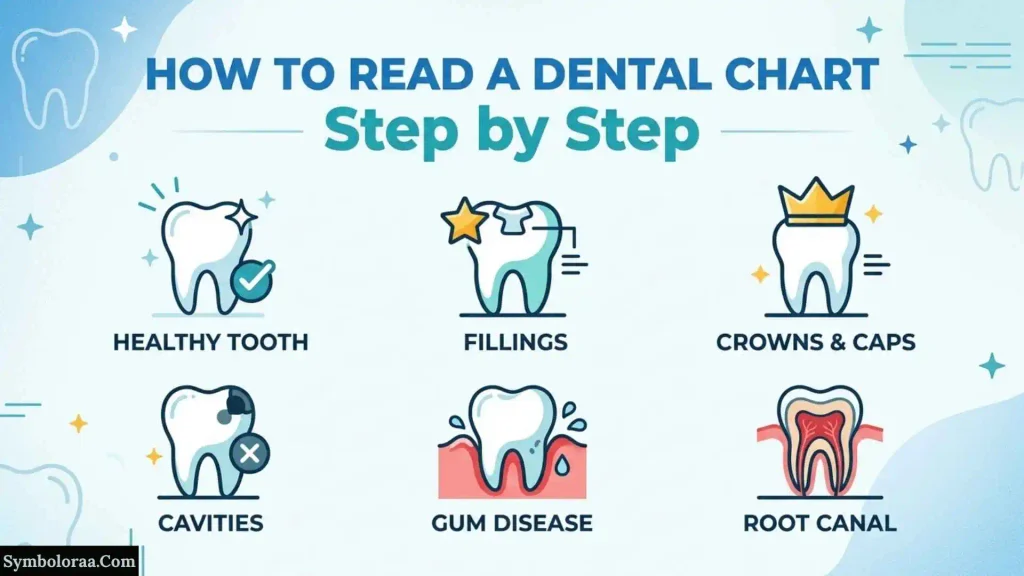
If you have a dental chart in front of you, use this process rather than trying to identify individual symbols randomly.
Step 1: Identify the Numbering System
Ask:
Does the chart use Universal, FDI, Palmer, or another system?
This prevents tooth-numbering errors.
Step 2: Confirm the Patient’s Right and Left
Dental diagrams are normally oriented according to the patient’s anatomy.
This can be confusing when looking directly at a chart because your visual right side may correspond to the patient’s left.
Step 3: Locate the Tooth
Use the numbering system to identify the tooth.
For example:
FDI 46 → lower-right first permanent molar.
Step 4: Identify the Surface
Look for:
- M
- D
- O
- I
- B
- L
- F
- P
This tells you the location on the tooth.
Step 5: Check the Chart Legend
If you see:
- Color
- Cross
- Circle
- Shading
- Special line
- Icon
check the legend before deciding what it means.
Step 6: Determine the Treatment Status
Ask:
Is this existing, planned, completed, or historical?
This step can completely change the interpretation.
Step 7: Read the Written Notes
The graphical chart is only one component of a dental record.
Written notes can provide information about:
- Symptoms
- Findings
- Diagnosis
- Procedure
- Materials
- Follow-up
- Treatment recommendations
Step 8: Compare With Previous Records When Available
A previous chart can help establish whether a finding is:
- New
- Existing
- Resolved
- Restored
- Under observation
This is one reason accurate dental records are valuable over time.
Real-World Example: Decoding a Dental Chart Entry
Imagine a dental record says:
36 — MOD — RCT — Crown
If the chart uses FDI notation:
36 = lower-left first permanent molar.
MOD = mesial, occlusal, and distal surfaces.
RCT = root canal treatment.
Crown = crown treatment is associated with the tooth.
However, the notation alone does not tell you whether the crown is already present or planned. You would need to check the treatment status and clinical notes.
This illustrates an important principle:
Read dental charting as a combination of tooth + surface + procedure + status, not as isolated symbols.
Another Example: Understanding a Periodontal Entry
Suppose a periodontal chart contains several probing measurements and BOP markings around one tooth.
Do not interpret one number as a complete diagnosis.
Instead, consider:
- The probing measurements
- Whether bleeding was recorded
- Recession
- Clinical attachment
- Mobility
- Furcation findings
- Radiographs
- Other teeth
- The dentist’s assessment
This prevents the common mistake of treating one chart entry as a complete clinical conclusion.
Dental Charting for Students and New Dental Assistants
Students and new dental staff can learn charting faster by understanding the underlying structure rather than memorizing dozens of isolated symbols.
A useful learning sequence is:
First: Learn tooth numbering
Universal → FDI → Palmer.
Second: Learn tooth surfaces
M → D → O → I → B → L → F → P.
Third: Learn common procedures
Restoration → crown → bridge → implant → extraction → root canal treatment.
Fourth: Learn periodontal notation
Probing depth → BOP → recession → CAL → mobility → furcation.
Finally: Learn the software
Once the clinical concepts are understood, learning a particular electronic charting interface becomes much easier.
Best Practice for Accurate Charting
Good dental charting should be:
- Accurate
- Consistent
- Clear
- Timely
- Clinically meaningful
- Understandable to other members of the dental team
Dental standards and terminology are designed in part to improve consistency and communication. The ADA and FDI both maintain or support systems intended to make dental information easier to document and communicate.
Common Mistakes When Interpreting Dental Charting Symbols
Assuming Every Dentist Uses the Same Symbols
Dental notation can vary between countries, practices, educational institutions, and software platforms.
Better approach: Identify the charting convention first.
Confusing FDI With Universal Numbering
Seeing a number such as 46 does not automatically mean it is a Universal tooth number.
Better approach: Determine the numbering system before interpreting the number.
Assuming an X Always Means an Extraction
An X may have a specific meaning in a particular chart, but it should not be treated as universal.
Better approach: Check the legend and clinical notes.
Assuming Every Color Has a Universal Meaning
Colors can be software-specific.
Better approach: Use the chart’s own color key.
Confusing Existing Treatment With Planned Treatment
A marked crown or filling may represent treatment that is planned rather than already completed.
Better approach: Check treatment status and procedure history.
Reading a Dental Chart Without the Clinical Notes
The diagram does not necessarily contain the complete clinical picture.
Better approach: Read the chart together with notes and relevant diagnostic records.
Interpreting a Periodontal Number in Isolation
A single probing measurement does not provide the complete periodontal assessment.
Better approach: Consider all relevant periodontal findings.
Dental Charting Symbols vs. Dental Procedure Codes
These two concepts are related but not identical.
Dental Charting Symbols
These generally describe:
- Tooth location
- Tooth surfaces
- Conditions
- Existing treatment
- Planned treatment
- Clinical findings
Dental Procedure Codes
Procedure codes are used to identify dental services for documentation, billing, claims, and related administrative purposes.
The ADA’s CDT system is specifically designed to support consistent documentation of dental treatment.
Therefore:
A tooth symbol tells you about the tooth or finding.
A procedure code identifies a service or procedure.
They can appear together in a patient’s dental record but serve different purposes.
Paper Dental Charts vs. Digital Dental Charts
Paper Dental Charts
Traditional paper records may use:
- Hand-drawn tooth diagrams
- Colored pencils
- Abbreviations
- Handwritten notes
- Manually recorded periodontal measurements
Because the notation can be handwritten, the practice’s own conventions are particularly important.
Digital Dental Charts
Electronic dental records can include:
- Interactive tooth diagrams
- Automatic tooth numbering
- Surface selection
- Treatment history
- Periodontal charting
- Color coding
- Procedure records
- Radiograph integration
Digital systems can make charting more structured, but they may also introduce software-specific icons and colors.
Why Digital Symbols Can Be Confusing
A patient may see an unfamiliar icon that looks like a standard dental symbol.
It may actually be an interface element created by the software.
That is why the software’s chart legend and the dental office’s documentation should take priority over a generic online symbol list.
Decision Guide: What Should You Do When You See an Unknown Dental Symbol?
Use this simple decision tree:
Do you recognize the tooth number?
↓ No
Identify whether the chart uses Universal, FDI, or Palmer notation.
↓ Yes
Is the symbol located on a specific tooth surface?
↓ Yes
Check M, D, O, I, B, L, F, or P terminology.
↓ No
Is it a color, line, cross, circle, or icon?
↓ Yes
Check the chart legend.
↓ No
Is it an abbreviation?
↓ Yes
Read the surrounding clinical notes and terminology.
↓ Still unclear?
Ask the dental professional or office that created the record.
This method is safer than assuming that every dental chart uses one universal set of symbols.
Dental Charting Checklist for Patients
If you receive a copy of your dental chart, check these items:
- What tooth-numbering system is being used?
- Which teeth are missing?
- Which teeth have existing restorations?
- Which teeth have crowns?
- Are implants or bridges recorded?
- Are any procedures marked as planned?
- What do the colors mean?
- Which tooth surfaces are involved?
- Are periodontal measurements included?
- Are there written clinical notes?
- Are the dates of treatment shown?
- Is there a chart legend?
- Are unfamiliar abbreviations explained?
This checklist can help you prepare better questions for your dentist.
Key Takeaways About Dental Charting Symbols
The most important points are:
- Dental charting symbols document teeth, conditions, treatment, and clinical findings.
- Universal, FDI, and Palmer are major tooth-identification systems.
- The Universal system uses numbers 1–32 for permanent teeth and A–T for primary teeth.
- FDI uses a two-digit system that identifies quadrant and tooth position.
- M, D, O, I, B, L, F, and P identify common tooth surfaces.
- MOD means mesial, occlusal, and distal.
- RCT commonly means root canal treatment.
- BOP means bleeding on probing.
- PD commonly refers to probing depth.
- Dental chart colors are not universally standardized across all software.
- A chart may distinguish existing, planned, and completed treatment.
- A dental diagram should be interpreted together with clinical notes and other diagnostic information.
- An unfamiliar symbol should be checked against the chart legend rather than guessed.
Frequently Asked Questions About Dental Charting Symbols
What are dental charting symbols used for?
They are used to document tooth location, tooth surfaces, existing restorations, missing teeth, clinical findings, periodontal measurements, treatment history, and planned procedures.
What are the most common dental chart symbols?
Common charting notation may represent missing teeth, restorations, crowns, bridges, implants, root canal treatment, caries, periodontal findings, and treatment plans. The exact visual symbol can vary by charting system.
What does an X mean on a dental chart?
An X can indicate a missing or extracted tooth in some charting conventions, but it is not a universal rule. Check the specific chart legend before interpreting it.
What does RCT mean on a dental chart?
RCT commonly means root canal treatment.
What does MOD mean in dental charting?
MOD means mesial, occlusal, and distal. It identifies three surfaces of a posterior tooth.
What does MO mean?
MO means mesial-occlusal.
What does DO mean?
DO means distal-occlusal.
What does BOP mean on a dental chart?
BOP means bleeding on probing. It records whether bleeding is observed during periodontal probing. The American Academy of Periodontology considers BOP an important part of periodontal examination while noting that it has limitations and must be interpreted in context.
What does PD mean in periodontal charting?
PD commonly means probing depth, a measurement obtained during periodontal examination.
What does CAL mean in a dental chart?
CAL commonly refers to clinical attachment level or clinical attachment loss, depending on the terminology used in the record.
What are the main tooth numbering systems?
The major systems you may encounter are the Universal/National system, FDI/ISO two-digit notation, and Palmer notation. The ADA recognizes the use of multiple tooth-numbering systems.
What is tooth 36?
In FDI notation, 36 is the lower-left first permanent molar.
What is tooth 46?
In FDI notation, 46 is the lower-right first permanent molar.
What is tooth #8?
In the Universal system, #8 is the upper-right central incisor from the patient’s perspective. The ADA’s Universal Tooth Designation System places permanent teeth in the 1–32 sequence.
What does M mean on a dental chart?
M means mesial, referring to the surface toward the midline of the dental arch.
What does D mean?
D means distal, referring to the surface away from the midline.
What does O mean?
O means occlusal, the chewing surface of a posterior tooth.
What do I mean?
I commonly mean incisal, referring to the cutting edge of an anterior tooth.
What does B mean?
B commonly means buccal, referring to the surface toward the cheek.
What does L mean?
L commonly means lingual, referring to the surface toward the tongue.
Are dental chart colors standardized?
No. Colors can vary between dental practices and electronic record systems. The chart’s own legend should be treated as the authoritative guide for that record.
How do I know whether a filling or crown is existing or planned?
Check the chart legend, treatment status, procedure history, and clinical notes. A graphical mark alone may not provide enough information.
Can two dentists use different dental charting symbols?
Yes. Tooth-numbering systems and graphical conventions can vary by country, institution, practice, and software.
Is a dental chart the same as a dental X-ray?
No. A chart records clinical and treatment information, while radiographs provide diagnostic images. They complement each other rather than serving the same purpose.
Can patients read their own dental charts?
Patients can understand many basic parts of a dental chart after learning the numbering system, surface abbreviations, and legend. However, clinical interpretation should be left to the dental professional who has the complete examination and diagnostic information.
Conclusion
Dental charting symbols become much easier to understand once the chart is broken into four basic elements: which tooth, which surface, what finding or treatment, and what treatment status.
Start by identifying the numbering system. Then locate the tooth and learn the surface abbreviations. After that, check the chart legend to determine what colors or graphical symbols mean. Finally, read the clinical notes and treatment history so you do not confuse existing findings with planned procedures.
For students and dental professionals, mastering Universal, FDI, and Palmer notation provides a strong foundation for accurate documentation. For patients, understanding the basics can make dental records less intimidating and help them ask more useful questions during appointments.
The most important rule is simple: do not guess an unfamiliar dental charting symbol. Identify the charting system, check the legend, review the surrounding notes, and ask the dental professional when the meaning remains unclear.
Also Check This Post: 67+ Symbols of Jesus: Powerful Christian Symbols Explained

I’m Jackson Miller, an American author inspired by mystery, adventure, and the unpredictable nature of life. I enjoy writing fast-moving stories filled with memorable characters, unexpected choices, and meaningful moments. Through my books, I want readers to experience new worlds while discovering something about courage, determination, and themselves.
Three Books:
The Edge of Tomorrow
Under a Broken Sky
The Road We Chose
 Madison Reed