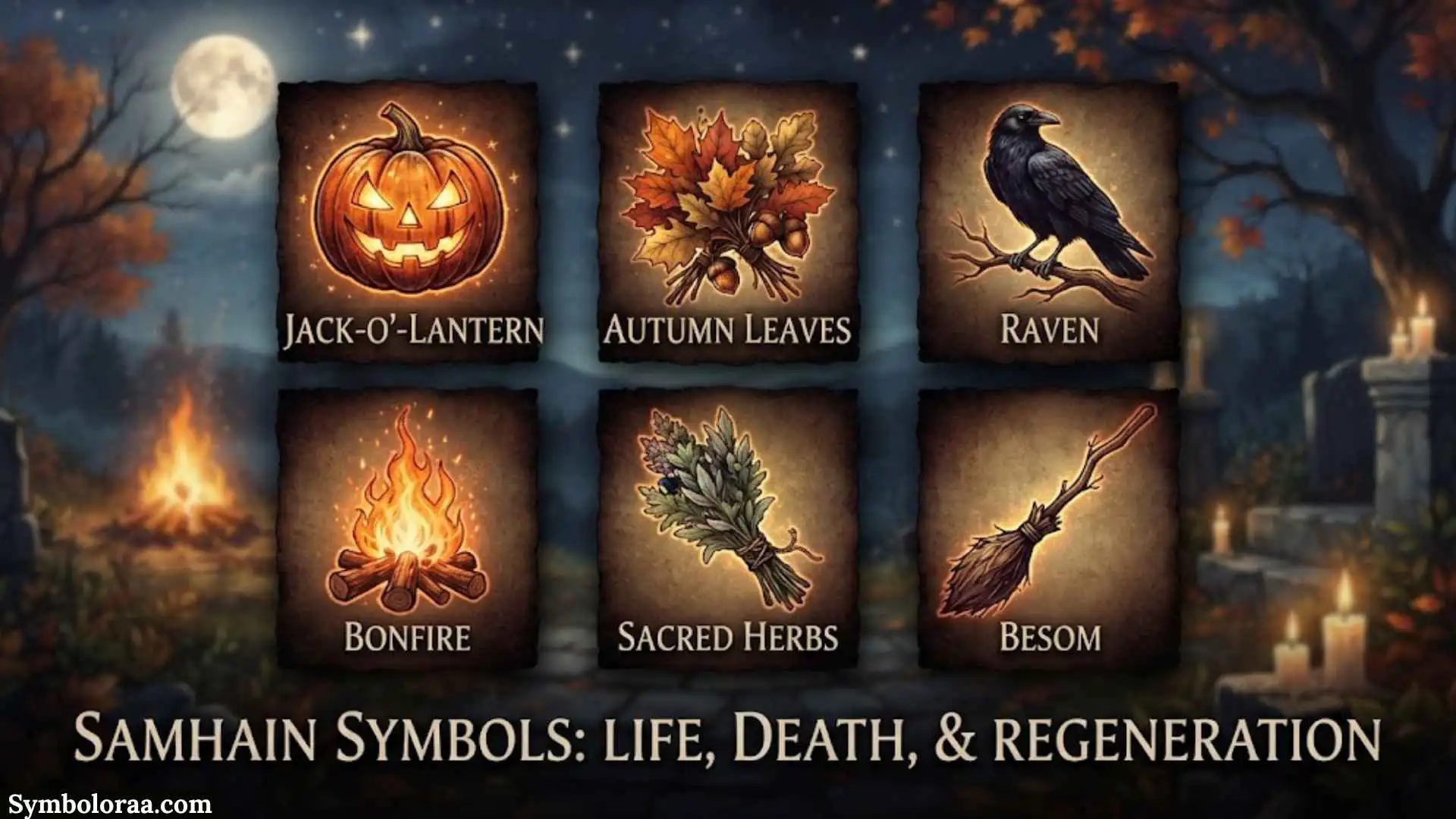
Samhain symbols are connected with a traditional Gaelic seasonal festival marking the transition into winter and with the Irish and Scottish folklore that developed around it. Some of the strongest documented symbols and customs include bonfires, carved turnips, masks and disguises, apples, nuts, harvest foods, protective crosses, divination games, spirits, the Otherworld, and the Púca.
But there is an important distinction that many articles miss: not everything now called a “Samhain symbol” has the same historical status.
A carved turnip has a documented place in Irish Halloween tradition. Apples, nuts, masks, bonfires, fortune-telling games, protective customs, and stories about supernatural beings are also well documented in Irish folklore. By contrast, some popular internet lists combine Samhain with generic “Celtic symbols,” modern Pagan practices, modern Halloween decorations, or symbols that have no clear historical connection to the festival.
The National Museum of Ireland identifies Samhain as a major seasonal marker associated with November 1 and documents traditions including feasting, games, disguises, carved turnip lanterns, protection, divination, supernatural folklore, and bonfires.
This guide separates historically documented traditions from later folklore and modern interpretations. It explains what the most important Samhain symbols mean, where they come from, how Samhain relates to Halloween, what “Celtic” really means in this context, and how to choose an appropriate symbol for tattoos, artwork, education, decorations, or modern seasonal practice.
Quick Answer: What Are Samhain Symbols?
Samhain symbols are objects, customs, natural images, foods, supernatural figures, and ideas associated with Samhain and the Gaelic traditions surrounding the transition into winter.
Some of the strongest examples are:
- Bonfire — seasonal transition, community, protection, and light during the dark season
- Carved turnip lantern — Irish Halloween tradition, frightening imagery, and light in darkness
- Masks and disguises — concealment, transformation, mischief, and interaction with supernatural folklore
- Apples — harvest, games, love, marriage, and divination
- Nuts — harvest, food, games, and seasonal abundance
- Barmbrack — Halloween food associated with fortune-telling
- Protective cross — household protection and good luck in Irish folk tradition
- Spirits of the dead — death, remembrance, and supernatural folklore
- The Otherworld — a supernatural realm and a boundary between human and supernatural worlds
- Púca — a supernatural figure from Irish folklore
- Autumn and winter imagery — seasonal change, darkness, mortality, and the end of the agricultural year
There is no official list of “the seven Samhain symbols” or “the ten ancient Samhain symbols.” Symbolism varies by period, region, source, and modern interpretation.
Key Takeaways About Samhain Symbolism
- Samhain was a major seasonal festival in the traditional Gaelic calendar.
- November 1 marked the beginning of winter in the traditional Irish calendar described by the National Museum of Ireland.
- The major celebration traditionally took place on the evening before, known as Oíche Shamhna.
- Many surviving customs come from Irish and Scottish Gaelic folklore, rather than from a single unchanged ancient ritual system.
- Turnip lanterns have a strong documented Irish connection; pumpkins are a later North American development of the lantern tradition.
- Apples, nuts, masks, games, divination, protective customs, and supernatural stories are documented in Irish Halloween folklore.
- Samhain should not simply be treated as another name for modern Halloween.
- The popular phrase “Celtic New Year” needs historical qualification rather than being presented as an unquestioned fact.
- “Celtic symbol” is a broad category and should not automatically be treated as “Samhain symbol.”
- Modern Pagan Samhain practices can be inspired by historical traditions without being identical to ancient practices.
- The strongest interpretation of Samhain symbolism centers on seasonal transition, harvest, darkness, supernatural folklore, protection, community, death, and the future.
What Was Samhain?
Samhain was one of the important seasonal markers of the traditional Gaelic year.
The National Museum of Ireland describes Samhain as the festival marking the first day of winter on November 1, with the main festivities taking place on the preceding evening.
This seasonal setting is essential for understanding its symbols.
Samhain was not simply a festival about ghosts. It belonged to a world in which the agricultural year, weather, livestock, food supplies, darkness, family life, and supernatural folklore were closely connected.
Samhain as a Seasonal Boundary
The festival marked a movement from one part of the year into another:
Harvest → Winter
Light → Darkness
Outdoor work → Winter life
Abundance → Preparation
One season → Another season
This helps explain why fire, food, darkness, death, protection, and supernatural beings appear so frequently in related traditions.
Samhain in the Gaelic World
It is more accurate to discuss Samhain primarily in relation to Gaelic-speaking cultures, especially Ireland and Scotland, rather than treating every historical Celtic society as though it followed one identical Samhain tradition.
“Celtic” describes a much wider collection of languages and cultures. Historical evidence for Samhain is particularly strong in Irish and Scottish Gaelic contexts.
That distinction matters because many modern websites use “Celtic” as a broad label for anything ancient, mystical, Irish-looking, or decorated with knots.
Was Samhain the Celtic New Year?
This is one of the most repeated claims online, but it deserves caution.
Samhain certainly marked a major seasonal transition. However, describing it simply as “the Celtic New Year” can make the historical picture seem more certain and uniform than the evidence supports.
A better description is:
Samhain was a major Gaelic seasonal festival marking the transition into winter.
That wording communicates the important historical fact without turning a complicated calendar tradition into a modern slogan.
The Historical Evidence Behind Samhain Symbols
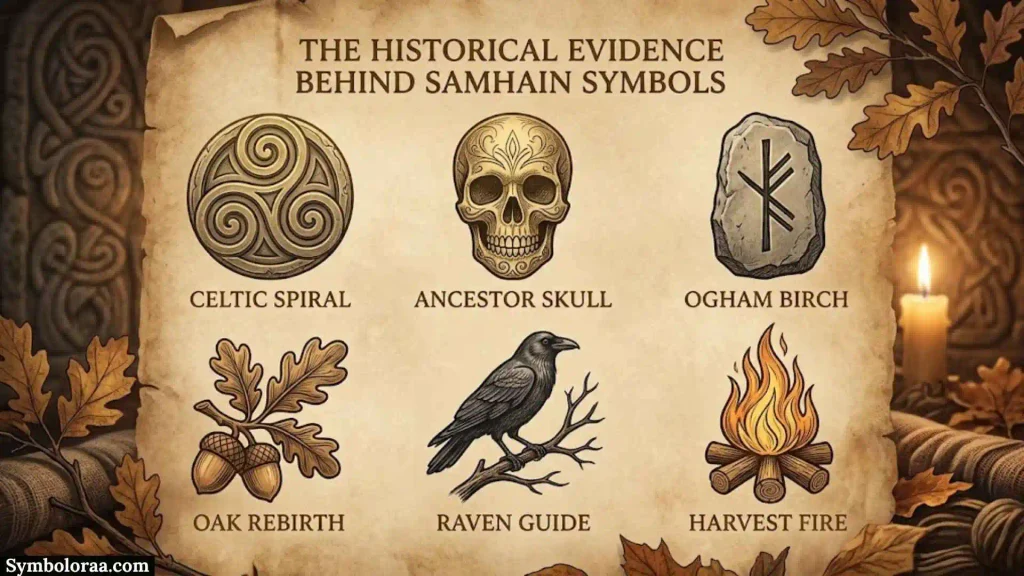
One of the biggest problems with online Samhain articles is that they often place every modern symbol into an imaginary ancient list.
A more reliable approach is to divide evidence into categories.
Historically Documented or Strongly Attested Traditions
These include:
- Seasonal celebration around Samhain
- Feasting
- Fruit and nuts
- Games
- Disguises
- Masks
- Fortune-telling
- Spirits and supernatural folklore
- Protective practices
- Turnip lanterns
- Bonfires in Irish tradition
The National Museum of Ireland documents many of these practices in its Folklife Collection.
Medieval and Literary Evidence
Irish medieval literature also associates Samain with supernatural events and encounters.
University College Cork’s Department of Early and Medieval Irish explains that Samain appears in Irish legendary material as a time when the natural and supernatural worlds could come unusually close. It also discusses medieval stories connecting Samain with supernatural knowledge and the Otherworld.
This is important because it gives the supernatural symbolism a deeper historical context than simply saying “Samhain was a spooky festival.”
Later Irish Folk Tradition
Many customs were recorded much later through oral history and folklore collection.
The Dúchas Schools’ Collection, gathered in Ireland in the 1930s, preserves accounts of Halloween customs including games, divination, crosses, apples, candles, and other practices.
These records are extremely valuable, but they should not automatically be described as unchanged practices from pre-Christian Ireland.
Modern Pagan Samhain
Modern Pagan communities may observe Samhain through practices involving:
- Ancestor remembrance
- Seasonal reflection
- Fire
- Divination
- Ritual gatherings
- Nature
- Honoring the dead
These practices can be meaningful modern traditions, but historians should distinguish them from customs that can be directly documented in ancient or medieval sources.
Editorial note: When discussing Samhain, it is best to label a practice according to its evidence—ancient/medieval literary evidence, later Irish folklore, modern Pagan practice, or modern Halloween culture—rather than presenting all four as the same historical tradition.
The Most Important Samhain Symbols
Bonfire
Fire is one of the most recognizable elements associated with Samhain and Irish Halloween traditions.
The National Museum of Ireland describes Halloween bonfires as community traditions associated with community identity, protection, and the movement into the season of darkness.
What Does the Bonfire Symbolize?
A Samhain bonfire can represent:
- Seasonal transition
- Light in darkness
- Protection
- Community
- Gathering
- The arrival of winter
The fire is especially powerful symbolically because Samhain occurs at a time when nights become longer and winter begins.
Historical Caution About Bonfires
It is tempting to claim that every modern Halloween bonfire is an unchanged survival of an ancient Samhain ritual.
That is too simple.
Bonfires have existed in many seasonal traditions, and practices varied by locality and period. The evidence supports a strong connection between fires and Irish Halloween traditions, but individual modern customs should not automatically be projected backward into prehistoric times.
Turnip Lantern
The turnip lantern is one of the strongest symbols for anyone looking specifically for an Irish historical connection to Halloween and Samhain traditions.
The National Museum of Ireland preserves a traditional “ghost turnip” from County Donegal. It records that turnips were carved into frightening faces, illuminated with candles, and used around October 31. The museum also explains that the pumpkin became prevalent later as an American development of the tradition.
What Does a Turnip Lantern Symbolize?
It can represent:
- Irish Halloween tradition
- Harvest
- Light in darkness
- Protection
- Frightening supernatural forces
- Seasonal change
Turnip vs. Pumpkin
| Turnip Lantern | Pumpkin Lantern |
| Strong Irish folk connection | Strong modern North American connection |
| Traditionally carved in Ireland | Became dominant in modern American Halloween |
| Smaller and harder to carve | Larger and easier to carve |
| Associated with Irish Halloween customs | Global Halloween symbol today |
If your goal is historical Irish symbolism, a turnip is often a better choice than a pumpkin.
Masks and Disguises
Masks are another important part of documented Irish Halloween traditions.
The National Museum of Ireland records ghostly masks made to frighten people and describes disguises worn by groups who went from house to house.
What Do Masks Represent?
A mask can symbolize:
- Concealment
- Anonymity
- Transformation
- Mischief
- Fear
- Protection
- Interaction with supernatural folklore
The mask also creates an interesting symbolic boundary: the person remains physically present but temporarily takes on another identity.
Guising
Disguising oneself became an important part of Irish and Scottish Halloween traditions.
In practical terms, guising allowed people to move through the community while hiding their ordinary identity.
For modern symbolic artwork, this makes the mask useful for themes of:
- Identity
- Transformation
- Mystery
- The unknown
Apples
Apples have a strong place in Irish Halloween customs.
The National Museum of Ireland documents apple games such as bobbing for apples and “apples on a string,” along with marriage divination traditions.
What Do Apples Symbolize?
An apple can represent:
- Harvest
- Autumn
- Abundance
- Love
- Marriage
- Fortune-telling
- The future
Apples therefore connect two important themes: the harvest of the present and curiosity about the future.
Apple Divination
Historical Irish folklore contains many forms of apple-related fortune-telling.
Dúchas records customs in which apples were involved in attempts to discover information about a future spouse.
These practices should be described as folklore and divination traditions, not as scientifically verified predictions.
Nuts
Nuts were another part of traditional Halloween food and games.
They can symbolize:
- Harvest
- Abundance
- Food storage
- Preparation for winter
- Community
- Seasonal celebration
The National Museum of Ireland specifically notes the gathering of fruit and nuts for festive food and games.
Nuts may not be as visually famous as pumpkins today, but they provide a more historically grounded connection to the agricultural side of the festival.
Barmbrack
Báirín breac, commonly called barmbrack, is a traditional Irish Halloween fruit bread.
It became associated with fortune-telling through objects hidden inside the cake.
The National Museum of Ireland records objects such as:
- Ring
- Coin
- Button
- Thimble
- Stick
- Rag
- Crucifix
as objects that could carry different traditional meanings.
What Does Barmbrack Symbolize?
It can represent:
- Harvest food
- Family gatherings
- Fortune
- Marriage
- Uncertainty about the future
- Traditional Irish Halloween culture
The Ring
A ring hidden in barmbrack traditionally suggested marriage for the person who found it.
As a symbol, it can therefore represent:
- Love
- Marriage
- Commitment
- Future relationships
This is an excellent example of why context matters. The ring itself is not uniquely a “Samhain symbol.” Its connection comes from a particular Irish Halloween divination practice.
The Coin
A coin traditionally suggested wealth or prosperity in barmbrack folklore.
It can symbolize:
- Money
- Prosperity
- Fortune
- Financial hope
Again, this is a folk interpretation, not a prediction with scientific validity.
The Button and Thimble
Traditional barmbrack symbolism sometimes assigned relationship meanings to objects such as buttons and thimbles.
The National Museum of Ireland records the button as associated with bachelorhood and the thimble with spinsterhood.
These meanings are useful historically because they show how ordinary household objects became part of playful fortune-telling.
Spirits of the Dead
Death and supernatural beings are among the most important themes in Samhain-related folklore.
The National Museum of Ireland records the traditional belief that the souls of the dead might return to the family home and that supernatural beings could be active during the night.
What Do Spirits Symbolize?
They can represent:
- Death
- Ancestors
- Memory
- The unknown
- The boundary between life and death
- Supernatural danger
This symbolism should not be reduced to “Samhain worshipped ghosts.” The surviving evidence is much more varied.
The Otherworld
The Otherworld is a major concept in Irish mythology and is particularly relevant to understanding Samhain symbolism.
University College Cork explains that Samain appears in Irish legendary material as a time when the natural and supernatural dimensions could come especially close. Mortals could encounter beings from the Otherworld, and supernatural knowledge could become available.
What Does the Otherworld Symbolize?
It can represent:
- Mystery
- Supernatural knowledge
- Another realm of existence
- Transformation
- The unknown
- The boundary between worlds
This is one of the most meaningful concepts for understanding why Samhain developed such a strong supernatural reputation.
Púca
The Púca is a supernatural figure in Irish folklore.
The National Museum of Ireland records stories told to children about the Púca going around on Halloween night and damaging or spitting on wild fruits, which served as a warning against eating them after a certain point in the season.
What Does the Púca Represent?
The Púca can symbolize:
- Wildness
- Trickery
- Supernatural danger
- Mystery
- The unpredictable natural world
It is better to call the Púca an Irish folkloric supernatural being than to describe it simply as “the Samhain animal.”
Protective Crosses
Protection was another important part of Irish Halloween folklore.
The National Museum of Ireland records small wooden or straw crosses placed above doors for protection and luck.
What Does the Protective Cross Symbolize?
It can represent:
- Household protection
- Good luck
- Religious belief
- Safety
- Protection during winter
This is also an excellent example of cultural layering.
The practice belongs to Irish folk tradition that existed within a Christian environment, showing why it is misleading to divide all traditions into a simple “pagan versus Christian” binary.
Holy Water
The National Museum of Ireland also records the use of holy water as a protective practice around people, homes, animals, and thresholds.
Holy water therefore belongs primarily to the Christian folk layer of Irish Halloween tradition, rather than being described as an ancient pre-Christian Samhain symbol.
That distinction improves historical accuracy.
Autumn Leaves and Seasonal Decay
Autumn leaves are commonly used in modern Samhain artwork.
They are useful symbols of:
- Seasonal change
- Aging
- The end of summer
- Winter
- Mortality
- Natural cycles
However, autumn leaves should be classified as modern symbolic imagery inspired by Samhain’s seasonal meaning, not as a specific ancient Samhain artifact.
Darkness
Darkness is another strong interpretive symbol.
Samhain marked the beginning of winter, and Irish folklore associated the period with supernatural activity and the dead.
Darkness can therefore represent:
- Winter
- The unknown
- Mortality
- Mystery
- Supernatural activity
- The end of one seasonal phase
But darkness should not automatically mean evil.
That is a modern horror interpretation, not the only way to understand the symbolism.
Samhain Symbols and Their Evidence Levels
One of the best ways to avoid misinformation is to distinguish the strength of the historical connection.
| Symbol | Evidence/Context | Meaning or Interpretation |
| Samhain seasonal transition | Strong historical context | Beginning of winter |
| Turnip lantern | Strong Irish folk documentation | Light, disguise, frightening imagery |
| Masks | Strong Irish folklore documentation | Disguise and transformation |
| Apples | Strong Irish folklore documentation | Harvest, games, marriage/divination |
| Nuts | Strong Irish tradition | Harvest and food |
| Barmbrack | Strong later Irish tradition | Fortune-telling and community |
| Bonfires | Documented Irish tradition | Community, protection, seasonal transition |
| Spirits | Irish folklore and mythology | Dead, supernatural activity |
| Otherworld | Irish literary/mythological tradition | Supernatural realm |
| Púca | Irish folklore | Supernatural danger and trickery |
| Protective cross | Irish Christian folk tradition | Protection and luck |
| Holy water | Christian Irish folk tradition | Protection |
| Autumn leaves | Modern symbolic interpretation | Seasonal change |
| Black clothing | Modern aesthetic interpretation | Darkness and mourning |
| Pumpkin | Later North American Halloween tradition | Modern Halloween |
This classification is more useful than simply calling all of these “ancient Celtic symbols.”
Samhain Symbols by Theme
Symbols of the Harvest
Use:
- Apples
- Nuts
- Barmbrack
- Potatoes
- Autumn produce
These communicate the agricultural side of the season.
Symbols of Winter
Use:
- Darkness
- Bare branches
- Cold landscapes
- Fire
- Autumn leaves
These emphasize the movement into winter.
Symbols of the Supernatural
Use:
- Spirits
- Otherworld imagery
- Púca
- Masks
- Dark landscapes
These communicate the folkloric belief that supernatural activity became especially important around this time.
Symbols of Protection
Use:
- Bonfire
- Protective cross
- Holy water
- Household threshold imagery
These represent efforts to protect people and homes.
Symbols of Divination
Use:
- Apples
- Ring
- Coin
- Barmbrack
- Water
- Earth or clay
These represent attempts to discover information about the future.
A Complete Samhain Symbols and Meanings Table
| Symbol | Main Meaning | Historical Status | Best Modern Use |
| Bonfire | Light, community, protection | Documented Irish tradition | Festivals, artwork |
| Turnip lantern | Irish Halloween tradition | Strongly documented | Tattoos, displays |
| Mask | Disguise and transformation | Documented folklore | Art, costumes |
| Apple | Harvest and divination | Documented folklore | Seasonal artwork |
| Nuts | Harvest and abundance | Documented tradition | Educational displays |
| Barmbrack | Fortune and marriage | Documented Irish tradition | Food/history content |
| Ring | Marriage | Barmbrack folklore | Jewelry, tattoos |
| Coin | Wealth | Barmbrack folklore | Symbolic artwork |
| Spirit | Death and supernatural activity | Folklore/literature | Art and storytelling |
| Otherworld | Supernatural realm | Irish mythology | Literary/artistic themes |
| Púca | Trickery and wildness | Irish folklore | Folklore artwork |
| Protective cross | Safety and luck | Christian Irish folk tradition | Historical displays |
| Holy water | Protection | Christian folk tradition | Religious context |
| Autumn leaves | Change | Modern interpretation | Decorations |
| Darkness | Winter and mystery | Interpretive | Artwork |
| Pumpkin | Halloween | Later development | Modern Halloween |
| Celtic knot | General Celtic art | Not specifically Samhain | Decorative use |
Samhain and the Four Seasonal Divisions
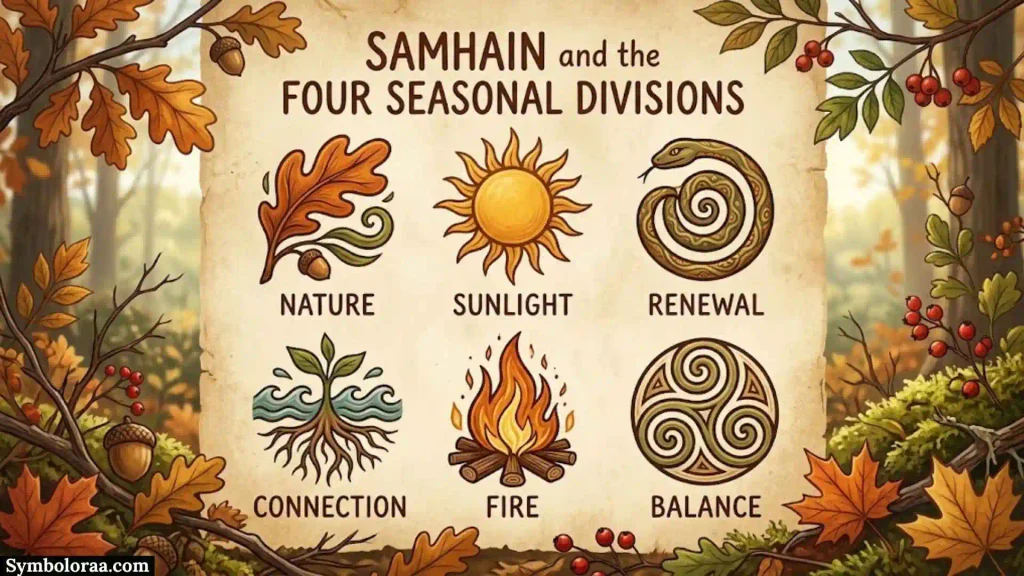
Traditional Gaelic calendars are important for understanding why Samhain had such a strong seasonal identity.
Irish tradition recognized major seasonal festivals, and Samhain was one of the important points in that cycle.
Dúchas records Irish folklore describing Samhain in terms of the Gaelic division of the year and connecting it with the end of the harvest and the last major festive period before Christmas.
This makes Samhain symbolism fundamentally different from a purely modern horror holiday.
It was tied to:
- Time
- Agriculture
- Weather
- Food
- Community
- Winter
- Folklore
Samhain and the Supernatural in Medieval Irish Tradition
The supernatural connection is not simply a modern Halloween invention.
University College Cork notes medieval Irish literary material in which Samain is associated with supernatural knowledge and encounters with beings of the Otherworld. It even discusses an entry in the Annals of Tigernach concerning a man who was said to visit Newgrange at Samain to seek supernatural knowledge.
This is significant because it shows that the association between Samain and supernatural boundaries appears in medieval Irish sources, not only in modern Halloween culture.
At the same time, literary evidence should not automatically be treated as a direct record of everyday ritual practice.
That distinction is essential for responsible historical writing.
Samhain, Halloween, and All Saints’ Day
Modern Halloween developed through layers of cultural and religious history.
The Library of Congress explains the connection between Samhain and Halloween while also discussing the role of Christian observances such as All Saints’ Day and All Souls’ Day.
The relationship can be understood broadly as:
Gaelic seasonal traditions + Christian calendar + later Irish and European folklore + North American development = modern Halloween
This was a long cultural process rather than a single event.
Samhain vs. Halloween
| Samhain | Modern Halloween |
| Gaelic seasonal festival | Global modern holiday |
| Strongly connected with winter transition | Strongly connected with October 31 |
| Agricultural and seasonal context | Entertainment and social celebration |
| Irish/Scottish Gaelic roots | Many cultural influences |
| Supernatural folklore | Horror, costumes, candy, media |
| Traditional foods and games | Commercial products and parties |
| Turnip lanterns in Irish tradition | Pumpkins widely used today |
The two traditions overlap, but they should not be treated as identical.
Samhain vs. “Celtic” Symbols
The phrase “Celtic symbols” creates another common problem.
A Celtic knot, spiral, cross, or triskele may have a rich history in Celtic art and Christian contexts, but that does not automatically make it a Samhain symbol.
Celtic Knot
Celtic knotwork is strongly associated with Irish and other Insular artistic traditions.
It can be used in a Samhain-inspired design, but it should be described as Celtic or Irish decorative symbolism, not automatically as an ancient Samhain symbol.
Triskele or Triple Spiral
The triple spiral is famous from prehistoric Irish monuments such as Newgrange.
It is an important Irish archaeological symbol, but it is thousands of years older than the historical evidence for medieval Samhain traditions.
Therefore, placing a triskele next to a turnip lantern may create a beautiful Irish-inspired design, but claiming that the triskele was specifically a Samhain symbol would require evidence that is not established simply by its presence in Ireland.
This is an important example of why Irish symbol ≠ Samhain symbol.
What About Druids?
Druids are frequently mentioned in modern articles about Samhain.
However, caution is needed.
Ancient Druids are known from historical and classical sources, but modern claims about exactly what Druids did during Samhain often go far beyond the surviving evidence.
Claims such as:
- “Druids always performed this exact ritual”
- “Druids worshipped this exact symbol”
- “This modern ceremony is an unchanged Druid ritual”
should not be presented as established facts without strong primary evidence.
A better approach is to say:
Samhain was part of the traditional Gaelic seasonal calendar, while claims about specific ancient Druid rituals at Samhain should be treated cautiously because surviving evidence is limited.
This distinction greatly improves historical credibility.
Was Samhain a Festival of Death?
Death is certainly an important part of Samhain-related folklore, but calling Samhain simply a “festival of death” is incomplete.
The surviving traditions also emphasize:
- Harvest
- Food
- Games
- Marriage
- Fortune
- Protection
- Community
- Seasonal change
The National Museum of Ireland records beliefs about the dead alongside feasting, games, disguises, protection, and divination.
A better description is:
Samhain was a seasonal boundary associated with winter, supernatural folklore, mortality, harvest, community, and uncertainty about the future.
Samhain Divination and Fortune-Telling
Divination is one of the most interesting parts of the surviving folklore.
Three-Saucer Divination
Dúchas records Irish Halloween customs in which participants selected between objects such as:
- Water
- Earth or clay
- A ring
- A coin
Different selections were associated with different possible futures.
Yarrow Divination
Another Dúchas record describes a Halloween custom involving yarrow and dreaming about a future spouse.
Apple Divination
Apples were also involved in games and fortune-telling.
These examples demonstrate something important:
Samhain-related folklore was not only about frightening supernatural beings. It also involved curiosity about love, marriage, wealth, travel, and the future.
Practical Example: Choosing a Historically Informed Symbol
Imagine someone wants an Irish Halloween tattoo.
They have three choices:
Pumpkin
This communicates modern Halloween very effectively, but has a later North American history.
Turnip lantern
This communicates a much stronger connection with Irish Halloween tradition.
Generic Celtic knot
This communicates Irish/Celtic visual heritage but does not specifically identify Samhain.
Therefore, if the intended message is “Irish Halloween/Samhain tradition,” the turnip lantern is the clearest choice.
If the intended message is simply “Irish heritage,” the Celtic knot may be more appropriate.
That distinction helps prevent symbolic designs from becoming historically confusing.
Samhain Symbols for Tattoos
Turnip Lantern Tattoo
Best for:
- Irish heritage
- Halloween history
- Protection
- Seasonal tradition
Bonfire Tattoo
Best for:
- Transformation
- Community
- Seasonal change
- Light during darkness
Apple Tattoo
Best for:
- Harvest
- Love
- Marriage
- Divination
Púca Tattoo
Best for:
- Irish folklore
- Mystery
- Wildness
- Supernatural themes
Otherworld-Inspired Tattoo
Best for:
- Mystery
- Transformation
- Spiritual themes
- Mythological storytelling
A good tattoo should communicate one primary idea rather than combining every “Celtic” symbol available.
Samhain Symbols for Home Decorations
For a historically informed display, consider combining:
- A carved turnip lantern
- Apples
- Nuts
- Autumn leaves
- Safe candlelight
- Natural branches
- A mask
- Traditional Irish food
- A small explanatory card about the symbolism
For example:
Turnip + candle
→ Irish Halloween lantern tradition
Apple + ring
→ traditional marriage divination
Autumn leaves + fire
→ seasonal transition
Protective cross near a doorway
→ documented Irish household protection tradition
This creates a display with cultural meaning rather than simply a generic horror theme.
Samhain Symbols for a Classroom or Educational Project
A classroom project should focus on evidence.
A useful display could divide symbols into four categories:
Seasonal
- Harvest
- Autumn
- Winter
- Fire
Social
- Food
- Games
- Masks
- Guising
Supernatural
- Spirits
- Otherworld
- Púca
Divination
- Apples
- Ring
- Coin
- Barmbrack
A final panel could explain:
“Which traditions are documented, which are later folklore, and which are modern interpretations?”
That question teaches students historical thinking rather than simply memorizing a list.
Samhain Symbols in Modern Pagan Practice
Modern Pagan communities may use Samhain as a seasonal and spiritual observance.
Modern practices can include:
- Remembering ancestors
- Lighting candles
- Seasonal altars
- Divination
- Fire ceremonies
- Harvest foods
- Meditation
- Nature-based reflection
These practices can be meaningful today.
However, an important historical distinction should remain:
A modern Pagan Samhain ritual can be inspired by historical tradition without being an unchanged ancient ritual.
This distinction respects both modern practitioners and historical evidence.
Ancient, Historical, Later, and Modern: A Useful Classification
When researching any Samhain symbol, ask four questions.
Was It Part of the Historical Festival?
If reliable evidence exists, describe it as historically documented.
Was It Recorded in Later Irish Folklore?
If the evidence comes from nineteenth- or twentieth-century folklore collections, label it as later folk tradition.
Is It a Modern Pagan Practice?
If it comes from contemporary spiritual practice, identify it as modern.
Is It Modern Halloween Imagery?
If it developed through modern commercial or popular culture, do not call it an ancient Samhain symbol.
This four-part test is one of the easiest ways to avoid misinformation.
Common Misconceptions About Samhain Symbols
“Samhain and Halloween Are Exactly the Same”
They are historically related but not identical.
Halloween developed through several layers of religious, folk, regional, and commercial history.
“Pumpkins Were Ancient Samhain Symbols”
Traditional Irish lanterns were made from turnips. Pumpkins became prevalent later in the American development of Halloween.
“Samhain Was Only About Death”
Death is important, but harvest, food, games, protection, community, marriage, and fortune-telling are also prominent in documented traditions.
“Samhain Was Definitely the Celtic New Year”
This is an oversimplification. It is safer to describe Samhain as a major Gaelic seasonal transition marking the beginning of winter.
“Every Celtic Symbol Is a Samhain Symbol”
False.
A Celtic knot or triskele may be culturally relevant to Ireland but does not automatically have a Samhain-specific connection.
“All Samhain Rituals Were Performed by Druids”
There is not enough reliable evidence to make such a broad claim.
“Modern Pagan Samhain Rituals Are Exactly Ancient Rituals”
Modern practices may draw inspiration from historical traditions but should not automatically be presented as unchanged survivals.
“Every Ghost Symbol Is an Ancient Samhain Symbol”
Ghost imagery has become central to modern Halloween, but specific symbols need historical evidence before being labeled ancient Samhain traditions.
Common Mistakes When Writing About Samhain
Using “Celtic” as a Catch-All Term
Be specific whenever possible.
Prefer:
- Irish
- Scottish Gaelic
- Gaelic
- Irish folklore
- Celtic art
rather than using “Celtic” for every historical claim.
Presenting Modern Interpretations as Historical Facts
A modern artist may use black candles, ravens, skulls, moons, or crystals in a Samhain design.
That can be beautiful and meaningful.
But it does not automatically prove that these were ancient Samhain symbols.
Ignoring Christian Influence
Later Irish Halloween customs developed within a Christian cultural environment.
Protective crosses and holy water are good examples.
Treating Folklore as Scientific Fact
Divination traditions should be described as folklore.
They provide insight into cultural beliefs, not scientifically demonstrated predictions.
Confusing Archaeological Symbols With Samhain Symbols
A prehistoric Irish symbol can be culturally fascinating without having a documented connection to Samhain.
Chronology matters.
Expert Tips for Using Samhain Symbols Accurately
Start With the Meaning
Ask:
What am I trying to communicate?
Then choose the symbol.
Check the Historical Layer
Ask:
Is this ancient, medieval, later folklore, modern Pagan, or modern Halloween?
Prefer Specific Evidence
A museum object or archived folklore account is stronger evidence than an unsourced social-media graphic.
Avoid “Ancient Celtic” Without Context
If a symbol’s date, location, and purpose are unknown, do not give it an invented ancient meaning.
Separate Inspiration From History
It is completely acceptable to create a modern Samhain-inspired design.
Just label it honestly as modern inspiration.
A Simple Samhain Symbol Decision Tree
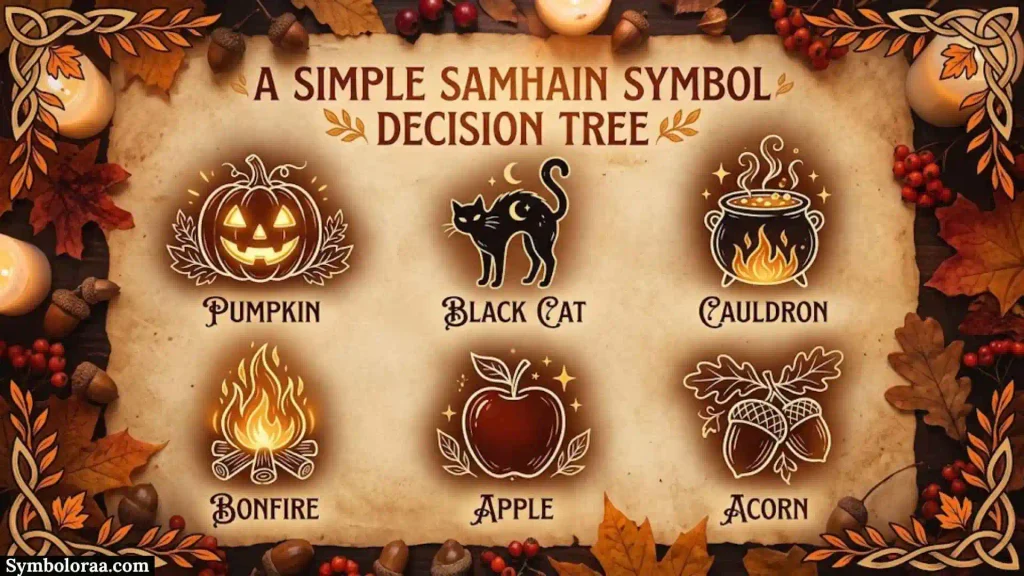
Do you want a symbol specifically connected with Irish Halloween tradition?
↓
Choose a turnip lantern, mask, apple, or traditional food.
Do you want to represent seasonal change?
↓
Choose fire, autumn leaves, harvest imagery, or winter darkness.
Do you want supernatural symbolism?
↓
Choose spirits, the Otherworld, or a Púca-inspired figure.
Do you want protection?
↓
Choose a documented protective cross or another clearly identified folk-protection motif.
Do you want fortune-telling?
↓
Choose an apple, ring, coin, barmbrack, or divination-game imagery.
Do you want general Irish heritage rather than Samhain specifically?
↓
Consider Celtic or Irish artistic motifs, but do not automatically label them Samhain symbols.
Do you want modern Halloween rather than historical Samhain?
↓
Pumpkins, ghosts, bats, candy, witches, and modern horror imagery may be more appropriate.
Frequently Asked Questions About Samhain Symbols
What is the main symbol of Samhain?
There is no single official symbol. The bonfire, turnip lantern, masks, apples, harvest foods, supernatural beings, and seasonal imagery are among the strongest symbols associated with Samhain and Irish Halloween traditions.
What is the most historically specific Samhain symbol?
If the goal is specifically an Irish Halloween/Samhain-related object with strong museum documentation, the carved turnip lantern is an excellent choice. The National Museum of Ireland preserves a turnip lantern and documents its use around October 31.
What does a Samhain bonfire symbolize?
It can symbolize community, protection, seasonal transition, and light entering the darker winter period. The exact practice varied by location and historical period.
What did people carve before pumpkins?
In Irish Halloween tradition, turnips were carved into frightening lanterns and illuminated with candles. Pumpkins became prevalent later in North American Halloween culture.
What does the turnip lantern symbolize?
It can represent Irish Halloween tradition, harvest, light in darkness, protection, and frightening supernatural forces.
What does a mask symbolize at Samhain?
Masks and disguises can represent concealment, transformation, anonymity, mischief, and interaction with supernatural folklore. Irish museum collections document traditional Halloween masks.
What does an apple symbolize?
An apple can represent harvest, abundance, games, love, marriage, and divination in Irish Halloween traditions.
What does barmbrack symbolize?
Barmbrack is associated with Irish Halloween food and fortune-telling. Objects hidden inside it could traditionally be interpreted as signs about marriage, wealth, or other aspects of the future.
What does the Púca symbolize?
The Púca is a supernatural figure in Irish folklore associated with wildness, trickery, mystery, and supernatural danger. Irish Halloween stories connected the Púca with wild fruits.
What is the Otherworld in Samhain tradition?
The Otherworld is a supernatural realm in Irish mythology. Medieval Irish material associates Samain with a time when the human and supernatural worlds could come particularly close.
Why is Samhain associated with the dead?
Irish Halloween folklore included beliefs that the dead might return to the family home and that supernatural beings could be active during the night.
Was Samhain a festival of death?
Death and the supernatural were important themes, but Samhain was also connected with harvest, food, games, community, protection, seasonal change, and divination.
Was Samhain a pagan festival?
Samhain was a traditional Gaelic seasonal festival that predates modern Christianity, but surviving evidence does not justify reducing every later Samhain or Halloween practice to one unchanged “pagan ritual.”
Did Druids celebrate Samhain?
Samhain belongs to the historical Gaelic seasonal tradition, but specific claims about exactly what ancient Druids did at Samhain should be treated cautiously because the evidence is limited.
Is Samhain the Celtic New Year?
That phrase is common in modern descriptions, but it is better to say that Samhain was a major Gaelic seasonal transition marking the beginning of winter rather than treating “Celtic New Year” as an undisputed historical fact.
Is a Celtic knot a Samhain symbol?
Not specifically.
A Celtic knot is associated with Celtic and especially Insular artistic traditions, but that does not establish a direct Samhain connection.
Is the triskele a Samhain symbol?
The triskele or triple spiral is an important ancient Irish archaeological motif, particularly associated with sites such as Newgrange, but its great antiquity does not prove that it was specifically a Samhain symbol.
What colors are associated with Samhain?
There is no historically established official Samhain color palette. Modern designs often use black, orange, brown, red, gold, and deep autumn colors to communicate darkness, fire, harvest, and seasonal change.
What is a good Samhain tattoo?
A turnip lantern, bonfire, apple, Púca-inspired figure, or Otherworld-inspired design can work well. Choose based on the meaning you want rather than simply selecting a generic “Celtic” design.
What is a good Samhain symbol for protection?
Historically documented Irish Halloween traditions include protective crosses and the use of holy water.
What is a good symbol for Samhain divination?
Good historically grounded choices include apples, rings, coins, barmbrack, water, and earth/clay, because these appear in recorded Irish Halloween divination traditions.
What is the difference between Samhain and Halloween?
Samhain was a traditional Gaelic seasonal festival, while modern Halloween developed through a mixture of Samhain-related traditions, Christian observances, later Irish and European folklore, and North American cultural development.
Can modern Pagan Samhain practices be considered authentic?
They can be meaningful contemporary religious or spiritual practices. However, authenticity should not require claiming that every modern practice is an unchanged survival from ancient Ireland.
References
- National Museum of Ireland — Traditions and Customs of Halloween / Samhain: Documentation of Samhain’s seasonal position, Irish Halloween customs, food, masks, spirits, protection, and games.
- National Museum of Ireland — Ghost Turnips, the Púca, Fortune-Telling and Halloween Traditions: Detailed discussion of turnip lanterns, Púca folklore, barmbrack, divination, protection, and bonfires.
- National Museum of Ireland — Ghost Turnip: Museum evidence for carved turnip lanterns in Ireland and the later development of the pumpkin tradition.
- National Museum of Ireland — Winter Traditions: Context for Samhain, winter, spirits, food, games, and protective customs.
- University College Cork — Secrets at Samhain: Scholarly context for Samain, the Otherworld, supernatural encounters, and medieval Irish literary evidence.
- Library of Congress — Halloween & Día de Muertos Resources: Historical overview of Samhain, Christian observances, and the development of Halloween.
- Dúchas — The Schools’ Collection: Archival Irish folklore records documenting Halloween games, divination, food, masks, candles, crosses, and local customs collected in the twentieth century.
Conclusion
Samhain symbols are best understood as part of a seasonal, agricultural, social, folkloric, and supernatural tradition, rather than as a simple list of spooky objects.
The strongest documented symbols and customs include bonfires, carved turnips, masks, apples, nuts, barmbrack, divination games, protective practices, spirits, the Otherworld, and the Púca. These elements connect Samhain with the beginning of winter, the end of the harvest, community life, protection, supernatural folklore, remembrance, and uncertainty about the future.
The turnip lantern is particularly useful when you want a symbol with a strong Irish Halloween connection. The bonfire represents seasonal change and community. Apples and barmbrack reveal the importance of games and fortune-telling. Masks represent disguise and transformation, while the Otherworld and supernatural beings explain why Samhain became so strongly associated with the boundary between ordinary and supernatural existence.
At the same time, historical accuracy requires separating different layers of tradition. A Celtic knot is not automatically a Samhain symbol. A modern Pagan ritual is not automatically an unchanged ancient ritual. A pumpkin is not an ancient Irish lantern. And claims about Druids performing specific Samhain ceremonies should not be stated as fact without reliable evidence.
That distinction is what makes a Samhain article genuinely useful.
If you are choosing a symbol for a tattoo, artwork, classroom project, seasonal display, educational article, or modern spiritual practice, begin by asking what you want it to communicate: harvest, winter, protection, remembrance, supernatural folklore, divination, Irish heritage, or modern Halloween.
Then choose the symbol whose historical and cultural context actually matches that meaning.
Samhain is not simply about darkness. It is about a boundary between seasons, the end of one cycle and beginning of another, the uncertainty of the future, the memory of the dead, the protection of the living, and the stories people tell when the nights become longer.

I’m Jackson Miller, an American author inspired by mystery, adventure, and the unpredictable nature of life. I enjoy writing fast-moving stories filled with memorable characters, unexpected choices, and meaningful moments. Through my books, I want readers to experience new worlds while discovering something about courage, determination, and themselves.
Three Books:
The Edge of Tomorrow
Under a Broken Sky
The Road We Chose
 Madison Reed