
Masonic symbols have fascinated people for centuries. From the familiar square and compasses to the mysterious all-seeing eye, these emblems carry meanings rooted in history, architecture, geometry, and moral philosophy. However, their meanings often differ from popular interpretations.
Freemasonry uses symbols to communicate ideas that ordinary words sometimes struggle to express. Many of these images come from the practical tools and materials of medieval stonemasons. Others draw inspiration from biblical stories, mathematics, classical architecture, and traditional religious imagery.
A Masonic symbol rarely serves as decoration alone. A measuring instrument can teach self-discipline. A rough stone can represent an individual’s unfinished character. Even a simple evergreen branch can communicate ideas about mortality and the hope of immortality.
The 24 Masonic symbols in this guide explore the traditions, meanings, and historical connections behind some of Freemasonry’s best-known emblems. You’ll also discover how these symbols relate to the three Masonic degrees, why certain conspiracy theories misunderstand them, and how their interpretations vary across different Masonic traditions.
What Are Masonic Symbols?
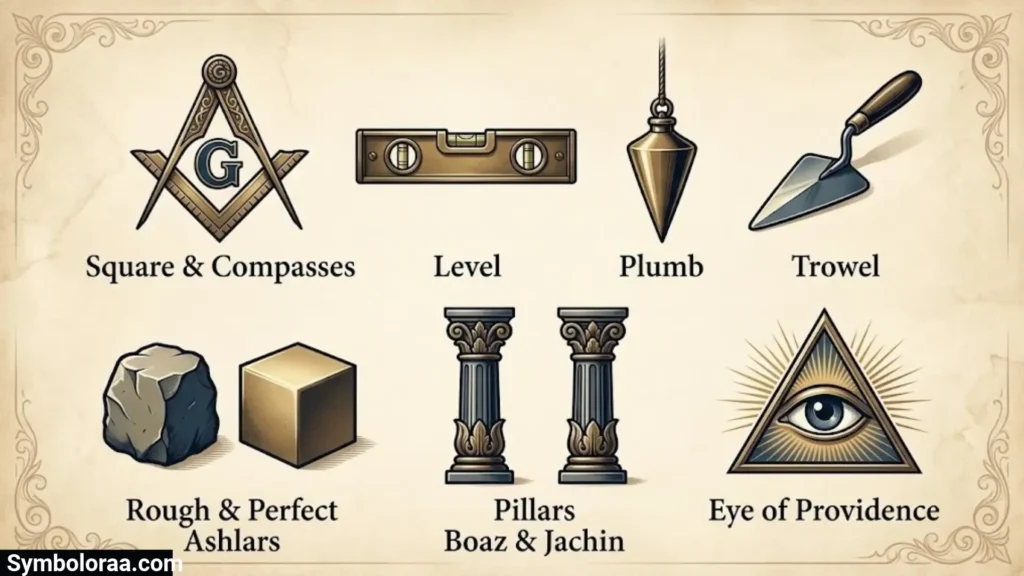
Masonic symbols are images, objects, geometric figures, and architectural elements that Freemasonry uses to communicate moral, philosophical, and spiritual lessons. They form an important part of the fraternity’s educational tradition.
Many symbols originate from operative masonry, the practical craft of cutting, shaping, and assembling stones. Medieval stonemasons relied on tools such as squares, compasses, levels, plumbs, and gavels to construct buildings. Speculative Freemasonry later adapted these familiar objects into teaching devices.
For example, a stonemason uses a square to check whether two surfaces meet at a right angle. A Freemason can interpret that same instrument as a reminder to act honestly and fairly.
This approach creates a connection between physical construction and personal development.
Freemasonry symbolism generally communicates several recurring themes:
- Morality: Acting honestly and treating others fairly.
- Brotherhood: Supporting fellow members and maintaining unity.
- Self-improvement: Removing personal weaknesses and developing better habits.
- Knowledge: Pursuing education, wisdom, and intellectual growth.
- Faith: Reflecting on spiritual beliefs and the relationship between humanity and a higher power.
- Responsibility: Recognizing personal duties toward family, society, and fellow human beings.
Not every Masonic emblem has one universally accepted interpretation. Different Masonic jurisdictions, rituals, and educational traditions sometimes explain the same image differently.
Therefore, understanding a symbol requires looking at its historical background and the particular Masonic tradition in which it appears.
24 Masonic Symbols and Their Meanings
Freemasonry incorporates symbols from several sources, including stonemasonry, biblical traditions, geometry, and classical architecture. The following emblems illustrate how these different influences contribute to Masonic philosophy.
Square and Compasses
The square and compasses form the most recognizable emblem of Freemasonry. The design combines two traditional instruments that once helped stonemasons measure, mark, and shape building materials.
The square checks right angles and helps establish accurate construction. The compasses draw circles and measure distances.
Within Freemasonry, these practical functions carry moral lessons.
The square traditionally represents honesty, fairness, and upright conduct. It reminds members to measure their actions against ethical standards.
The compasses represent self-restraint and the ability to control personal desires. Their circular movement also provides a useful image for understanding boundaries and moderation.
Two familiar expressions summarize these lessons:
- Square your actions: Conduct yourself honestly and fairly.
- Circumscribe your desires: Keep personal ambitions and passions within reasonable limits.
The arrangement of the square and compasses can vary across Masonic jurisdictions and degree representations. Some designs include the letter G between the instruments.
You’ll also find this emblem on Masonic rings, lapel pins, aprons, lodge buildings, and other fraternal objects.
Although its visual design is simple, the square and compasses communicate two central ideas: act with integrity and exercise self-control.
The Letter G
The letter G frequently appears inside the square and compasses in American Masonic imagery. It carries two major traditional associations: Geometry and God.
Geometry connects directly with the historical work of stonemasons. Builders used geometric principles to measure distances, establish proportions, calculate angles, and create stable structures.
For speculative Freemasons, geometry also represents order, knowledge, and the mathematical principles underlying the natural world.
The letter G can also refer to God or the Great Architect of the Universe, a traditional Masonic expression for the supreme creative principle.
This title allows members from different religious backgrounds to discuss spiritual ideas without requiring one particular religious name or doctrine.
However, the letter G doesn’t appear in every Masonic emblem. Its use also differs between American and European traditions.
Its central message connects intellectual knowledge with spiritual reflection.
The All-Seeing Eye
The All-Seeing Eye, also called the Eye of Providence, depicts an eye surrounded by rays or placed inside a triangle.
In Masonic symbolism, some interpretations associate the eye with divine watchfulness and the awareness that human actions carry moral consequences.
The image also appears in Christian religious art and other historical traditions. Its use isn’t exclusive to Freemasonry.
The eye generally communicates ideas such as:
- Divine providence.
- Spiritual awareness.
- Moral accountability.
- Divine guidance.
- Knowledge and watchfulness.
One common misconception connects the Masonic eye directly with the Illuminati. However, the historical Eye of Providence predates the modern conspiracy theories surrounding that organization.
The eye also appears above an unfinished pyramid on the reverse of the Great Seal of the United States. Congress adopted the Great Seal on June 20, 1782. Its original explanation associates the eye with providence and the pyramid with strength and duration.
Importantly, the Great Seal’s documented history doesn’t establish that the design represents a secret Masonic code. Its official symbolism concerns American independence, unity, and national aspirations.
The Plumb, Level, and Square
The plumb, level, and square are important Masonic working tools. Each instrument performs a different construction task and communicates a distinct moral lesson.
The Plumb
A plumb consists of a weighted object suspended from a cord. Builders use it to establish true vertical lines.
In Freemasonry, the plumb represents uprightness of conduct, integrity, and moral consistency.
The Level
A level helps builders establish horizontal surfaces. Its Masonic meaning traditionally concerns equality.
It reminds members that people deserve respect regardless of wealth, social position, or personal status.
The Square
The square checks right angles and represents fairness, honesty, and ethical behavior.
Together, these instruments communicate three important principles:
| Working tool | Traditional meaning |
| Plumb | Uprightness and integrity |
| Level | Equality and fairness |
| Square | Honest and moral conduct |
These tools have a particularly important place in the Fellow Craft degree. They also connect with the traditional jewels of the principal lodge officers.
The Masonic Trowel
A Masonic trowel is a building instrument used to spread mortar between bricks or stones. In Freemasonry, it represents the symbolic cement of brotherly love.
Just as mortar joins individual stones into a stronger structure, brotherly love brings members together through mutual respect and shared responsibility.
The trowel therefore represents:
- Unity among Freemasons.
- Brotherly love and friendship.
- Fraternal cooperation.
- Social harmony.
- Mutual assistance.
The instrument provides a powerful comparison between construction and human relationships. Individual stones cannot create a stable wall without something holding them together.
Likewise, a fraternity needs trust, respect, and cooperation to remain strong.
The trowel is traditionally associated with the Master Mason degree in several American Masonic teachings.
The Point Within a Circle
The Point Within a Circle is a geometric Masonic symbol consisting of one central point surrounded by a circle. Two parallel lines traditionally stand on either side of the circle.
The point can represent an individual Mason, while the circle symbolizes the boundaries within which personal conduct should remain.
The parallel lines are commonly associated with the two Saints John in traditional Masonic explanations.
This arrangement communicates a lesson about personal responsibility. Every individual must recognize the limits of acceptable behavior and remain faithful to moral duties.
The symbol also illustrates how geometry can communicate philosophical ideas.
Its traditional interpretation connects the individual, personal boundaries, and the responsibilities of membership.
The Beehive
The Masonic Beehive represents industry, diligence, cooperation, and productive labor.
A beehive offers a natural example of organized effort. Each bee contributes to the survival and productivity of the colony.
Masonic teachings use this image to encourage members to contribute positively to their communities rather than remain idle.
The beehive traditionally communicates several lessons:
- Hard work creates meaningful results.
- Cooperation makes collective achievements possible.
- Everyone has responsibilities.
- Productive activity benefits society.
- Personal abilities should serve useful purposes.
The symbol also challenges laziness and unnecessary idleness.
Its central message is straightforward: a meaningful life requires useful work and consideration for others.
Acacia
The Acacia is an evergreen plant whose sprig holds special significance in Master Mason traditions.
Its lasting greenery makes it a natural symbol of endurance and continued life. In Masonic teachings, acacia commonly represents the immortality of the soul.
The symbol connects with the Hiramic legend, an important part of the traditional Master Mason degree.
In this context, the acacia represents remembrance, fidelity, and hope beyond physical death.
It also appears in some Masonic funeral and commemorative traditions.
The symbolism draws strength from the plant’s evergreen character. While many plants lose their leaves during seasonal changes, evergreen foliage retains its appearance.
For Freemasons, this provides an image of spiritual continuity and enduring principles.
The Masonic Apron
The Masonic Apron is one of the oldest and most recognizable objects associated with Freemasonry.
Its historical connection comes from operative stonemasons who wore protective aprons while working with stone and construction materials.
Modern Masonic aprons preserve this practical association while adding symbolic meaning.
A traditional white lambskin apron represents purity, innocence, and honorable conduct. It also serves as a badge of membership.
The apron commonly appears during Masonic ceremonies and lodge activities.
Different designs communicate different roles and levels of responsibility.
| Apron type | Common association |
| Plain white apron | Entered Apprentice or basic lodge membership |
| Decorated apron | Additional Masonic status or distinction |
| Officer apron | Specific lodge office |
| Past Master apron | Former service as Worshipful Master |
Colors, borders, embroidery, and decorative details vary between jurisdictions.
The apron reminds members that Masonic membership carries responsibilities rather than simply granting social recognition.
The Twenty-Four Inch Gauge
The Twenty-Four Inch Gauge is a traditional measuring instrument associated with the Entered Apprentice degree.
Operative stonemasons used measuring rules and gauges to establish accurate dimensions. Freemasonry adapted this practical function into a lesson about using time wisely.
The traditional interpretation divides the 24 hours of a day into three broad portions:
- Eight hours for useful labor.
- Eight hours for personal recreation and refreshment.
- Eight hours for rest.
The exact wording and presentation can vary between Masonic jurisdictions.
The broader lesson concerns balance. A responsible person must make room for work, health, family, rest, and service to others.
The gauge also reminds members that time remains limited. Once an hour passes, nobody can recover it.
The Common Gavel
The Common Gavel is a traditional stonemason’s tool used to break away unwanted material and help shape rough stone.
In Freemasonry, it represents the removal of personal weaknesses and unnecessary habits.
Its symbolic lesson encourages members to examine their behavior and improve their character.
The Common Gavel traditionally appears among the working tools of the Entered Apprentice degree.
It represents:
- Self-discipline.
- Personal improvement.
- Removal of vice.
- Moral refinement.
- Control over harmful habits.
The instrument offers a simple comparison. A builder removes unwanted stone to prepare a suitable building material. An individual must also work to remove harmful attitudes and behaviors.
The goal isn’t to become flawless overnight. Rather, it encourages steady progress through honest self-examination.
Rough Ashlar and Perfect Ashlar
The Rough Ashlar and Perfect Ashlar are two important stone symbols in Freemasonry.
An ashlar is a block of stone prepared for construction.
The Rough Ashlar represents a stone in its natural or unfinished state. The Perfect Ashlar represents stone shaped into a form suitable for more precise building work.
Their symbolic meanings relate to personal development.
Rough Ashlar
The Rough Ashlar represents an individual at the beginning of a journey toward knowledge and self-improvement.
It suggests that everyone has weaknesses and areas requiring attention.
Perfect Ashlar
The Perfect Ashlar represents the result of education, discipline, and sustained personal effort.
It symbolizes a character shaped through experience and moral development.
| Symbol | Traditional interpretation |
| Rough Ashlar | Undeveloped character |
| Perfect Ashlar | Improved character |
| Common Gavel | Removing personal weaknesses |
| Twenty-Four Inch Gauge | Using time wisely |
These symbols demonstrate how Freemasonry turns ordinary building materials into lessons about human development.
The Mosaic Pavement
The Mosaic Pavement is a checkered floor featuring alternating black and white squares. It appears in traditional Masonic lodge imagery.
The contrasting colors provide a visual representation of life’s changing experiences.
Some Masonic interpretations associate the black and white pattern with opposing conditions, including prosperity and adversity, happiness and sorrow, and other contrasting aspects of human existence.
The pavement also reminds members that life contains both favorable and difficult circumstances.
Its regular geometric arrangement suggests that people must maintain balance and sound judgment while navigating these experiences.
The Mosaic Pavement may appear alongside a tessellated border in traditional lodge designs.
The border and surrounding decorations can carry additional meanings depending on the jurisdiction and ritual tradition.
The Blazing Star
The Blazing Star is a radiant star appearing in traditional Masonic symbolism. It often takes the form of a five-pointed star surrounded by rays.
Its interpretation varies across historical Masonic sources and jurisdictions.
Common associations include divine guidance, spiritual light, knowledge, and the pursuit of truth.
The star can also represent the idea that knowledge illuminates the path toward better judgment.
Some Masonic traditions connect it with divine providence and the presence of a guiding spiritual principle.
Its appearance alongside other lodge symbols reinforces the recurring Masonic theme of moving from ignorance toward knowledge.
The Three Great Lights of Freemasonry
The Three Great Lights of Freemasonry are the Volume of Sacred Law, Square, and Compasses.
Together, these objects hold a central place in traditional Masonic lodge symbolism.
The Volume of Sacred Law
The Volume of Sacred Law represents spiritual and moral authority.
In many American lodges, this volume is the Bible. Other Masonic traditions may use different sacred texts according to their membership and customs.
The purpose is to recognize the importance of religious or spiritual principles without requiring every Mason to follow the same religion.
The Square
The Square represents morality, honesty, and fairness.
It reminds members to conduct their affairs according to ethical standards.
The Compasses
The Compasses represent self-control and restraint.
They encourage members to regulate personal desires and maintain appropriate boundaries.
These three objects are commonly displayed together on the Masonic altar.
They communicate an important relationship between spiritual guidance, ethical behavior, and personal discipline.
The Hourglass and Scythe
The Hourglass and Scythe are traditional symbols associated with the passage of time and human mortality.
An hourglass contains sand that gradually moves from one chamber to another. It represents the limited nature of human life and the steady passage of time.
A scythe is an agricultural cutting tool that became a traditional symbol of death in various artistic traditions.
Together, these images encourage reflection on mortality.
Their symbolic lessons include:
- Human life has a limited duration.
- Time should be used responsibly.
- Death is a natural part of human existence.
- Personal actions contribute to a lasting legacy.
- People should reflect on their responsibilities while they have time.
These symbols appear in some Masonic funerary and commemorative imagery and connect with traditional Master Mason teachings.
The Two Pillars: Boaz and Jachin
The pillars Boaz and Jachin come from biblical descriptions of King Solomon’s Temple.
According to the biblical account in 1 Kings 7, the temple featured two prominent bronze pillars near its entrance.
Their names carry important traditional associations.
- Boaz: Commonly associated with strength.
- Jachin: Commonly associated with establishment or stability.
Freemasonry incorporates these pillars into lodge symbolism as important architectural elements.
They often appear near the symbolic entrance of a Masonic lodge.
Some traditional depictions include decorative capitals and celestial or terrestrial globes.
The pillars communicate ideas about strength, stability, and the establishment of an ordered structure.
Their connection with Solomon’s Temple also helps explain why biblical architecture plays such an important role in Masonic imagery.
The Winding Stairs
The Winding Stairs are an important symbol associated with the Fellow Craft degree.
They represent a symbolic journey toward knowledge, understanding, and intellectual improvement.
Traditional Masonic explanations discuss groups of three, five, and seven steps.
Each group connects with different educational and philosophical ideas.
Three Steps
The three steps are commonly associated with the three Craft degrees:
- Entered Apprentice.
- Fellow Craft.
- Master Mason.
Five Steps
The five steps traditionally connect with the five senses and the classical orders of architecture.
The five classical orders are:
- Tuscan.
- Doric.
- Ionic.
- Corinthian.
- Composite.
Seven Steps
The seven steps connect with the Seven Liberal Arts and Sciences:
- Grammar.
- Rhetoric.
- Logic.
- Arithmetic.
- Geometry.
- Music.
- Astronomy.
These subjects formed an important part of traditional education.
The Winding Stairs therefore represent intellectual advancement through learning and disciplined effort.
Jacob’s Ladder
Jacob’s Ladder comes from the biblical story in Genesis 28.
In the account, Jacob dreams of a ladder reaching from earth to heaven. Angels ascend and descend along it, while God communicates a promise to Jacob.
The location later becomes associated with Bethel.
In Masonic symbolism, the ladder represents spiritual aspiration and the journey toward higher moral understanding.
Three principal rounds traditionally represent:
- Faith: Trust in spiritual principles and divine guidance.
- Hope: Confidence in the possibility of a better future.
- Charity: Love, generosity, and concern for others.
The ladder provides an image of progress. Each step represents an effort to develop greater understanding and stronger moral character.
It also connects biblical tradition with the broader Masonic emphasis on faith, hope, charity, and personal improvement.
The Anchor and Ark
The Anchor and Ark represent hope, stability, and spiritual security in traditional Masonic imagery.
An anchor prevents a vessel from drifting away. It therefore provides a natural image of stability during difficult circumstances.
In Masonic interpretations, the anchor often represents well-grounded hope and confidence in spiritual principles.
The Ark connects with preservation, safety, and the idea of reaching a secure destination through uncertainty.
Together, these images can represent a well-spent life guided by faith and moral responsibility.
They also appear in some Masonic commemorative and funerary traditions.
The central lesson encourages individuals to remain steady when facing life’s difficulties.
The Broken Column
The Broken Column is a traditional funerary and commemorative symbol found in some Masonic monuments.
It usually depicts a pillar with a broken upper section. Certain nineteenth-century American memorials also show a mourning figure standing nearby.
The broken pillar represents interrupted life, unfinished work, and the loss of a person before completing their responsibilities.
Its meaning can include:
- Human mortality.
- Untimely death.
- Remembrance of a departed Mason.
- Unfinished personal work.
- The importance of legacy.
The symbol became particularly recognizable in some nineteenth-century American Masonic memorial designs.
However, it isn’t a universal feature of every Masonic lodge or funeral tradition.
Its emotional message is simple: a person’s life may end before every responsibility or ambition reaches completion.
The Cable Tow
The Cable Tow is a symbolic rope associated with Masonic initiation and obligations.
Historically, ropes served practical purposes in construction, transport, and everyday work. Freemasonry uses the cable tow as an image of connection, responsibility, and commitment.
Traditional interpretations associate it with a Mason’s willingness to respond to a fellow member’s legitimate need for assistance.
The symbol also connects with the obligations accepted during Masonic initiation.
Its meaning involves several ideas:
- Duty toward fellow members.
- Brotherhood and mutual assistance.
- Personal responsibility.
- Commitment to Masonic obligations.
- Trust and accountability.
Some Masonic explanations discuss the length of a cable tow as a representation of the limits of a person’s ability to fulfill an obligation.
The central lesson is that genuine brotherhood involves practical support rather than words alone.
The Sun, Moon, and Worshipful Master
The Sun, Moon, and Worshipful Master form the traditional Three Lesser Lights of Freemasonry.
They appear in lodge symbolism and communicate ideas about light, order, and leadership.
The Sun
The Sun represents light, warmth, and the regular movement of the natural world.
The Moon
The Moon reflects the changing cycles of nature and the passage of time.
The Worshipful Master
The Worshipful Master is the elected or appointed presiding officer of a Masonic lodge, depending on its governing rules.
In traditional symbolism, the Master’s role connects with leadership, direction, and the orderly conduct of lodge proceedings.
The three Lesser Lights should not be confused with the Three Great Lights.
The Great Lights are the Volume of Sacred Law, Square, and Compasses. The Lesser Lights are the Sun, Moon, and Worshipful Master.
The 47th Problem of Euclid
The 47th Problem of Euclid is a geometric figure associated with the Pythagorean theorem.
It demonstrates the mathematical relationship between the sides of a right triangle.
The theorem states:
a² + b² = c²
Here:
- a represents one shorter side.
- b represents the other shorter side.
- c represents the hypotenuse, the longest side.
The area of the square constructed on the hypotenuse equals the combined areas of the squares constructed on the other two sides.
The mathematical principle is much older than modern Freemasonry. Ancient Babylonian mathematical records already demonstrate knowledge of relationships involving right triangles.
Within Freemasonry, the figure appears on aprons, jewels, tracing boards, and other historical Masonic objects.
It is traditionally associated with the pursuit of geometry and intellectual knowledge. Some Masonic traditions introduce it in the Master Mason degree.
The Scottish Rite Masonic Museum and Library documents examples of this figure on historical Masonic objects, including an English Past Master’s jewel from 1823.
Masonic Symbols Associated With the Three Degrees of Freemasonry

Traditional Craft Freemasonry consists of three degrees. Each degree introduces particular lessons and working tools that contribute to a member’s symbolic education.
The three degrees are Entered Apprentice, Fellow Craft, and Master Mason.
Although their rituals differ across jurisdictions, they share a general progression from introductory instruction toward greater responsibility and understanding.
First Degree: Entered Apprentice
The Entered Apprentice degree introduces a candidate to the basic principles of Freemasonry.
Its working tools traditionally include the Twenty-Four Inch Gauge and Common Gavel. Some jurisdictions also include a chisel in their educational explanations.
The Rough Ashlar provides another important image of this degree.
These symbols encourage members to:
- Use time wisely.
- Develop self-discipline.
- Remove harmful habits.
- Begin improving personal character.
- Recognize the importance of honest labor.
The white Masonic apron also holds special significance during this introductory stage.
Second Degree: Fellow Craft
The Fellow Craft degree focuses heavily on knowledge, education, and intellectual development.
Its traditional working tools are the Plumb, Level, and Square.
The Winding Stairs provide another major symbol associated with this degree.
The Seven Liberal Arts and Sciences also feature prominently in traditional Fellow Craft instruction.
These subjects emphasize the value of learning and the importance of developing an informed understanding of the world.
Geometry receives particular attention because of its historical connection with architecture and stonemasonry.
Third Degree: Master Mason
The Master Mason degree completes the traditional three-degree progression of Craft Freemasonry.
It introduces the Hiramic legend and explores themes involving fidelity, mortality, remembrance, and the immortality of the soul.
The Acacia is especially important in this degree.
Other symbols associated with Master Mason traditions include the Trowel and certain funerary emblems.
The degree encourages reflection on:
- The meaning of human mortality.
- Loyalty and fidelity.
- The importance of moral responsibility.
- Brotherhood and mutual respect.
- The lasting influence of personal conduct.
The three degrees therefore create a symbolic progression from self-improvement toward knowledge, responsibility, and reflection on human existence.
The Three Great Lights and Three Lesser Lights of Freemasonry
The Great Lights and Lesser Lights are two important groups in Masonic symbolism.
Their names sometimes create confusion because both groups contain three elements.
However, they serve different symbolic purposes.
| Three Great Lights | Three Lesser Lights |
| Volume of Sacred Law | Sun |
| Square | Moon |
| Compasses | Worshipful Master |
The Three Great Lights communicate spiritual guidance and moral principles. The Three Lesser Lights traditionally communicate natural order and lodge leadership.
The Volume of Sacred Law may be the Bible or another sacred text appropriate to a lodge’s customs.
The Square and Compasses provide practical geometric imagery that encourages ethical conduct and personal restraint.
Meanwhile, the Sun and Moon represent the regular movement of the natural world. The Worshipful Master represents leadership within the lodge.
Together, these symbols demonstrate how Freemasonry connects spiritual reflection, personal behavior, and organized community life.
Historical Origins of Masonic Symbols
Masonic symbols didn’t all originate during the same historical period. Some developed from practical construction tools, while others came from biblical stories, mathematics, and religious imagery.
Understanding their origins helps separate documented history from later interpretations.
Symbols From Medieval Stonemasonry
The practical roots of many Freemason symbols lie in the building trades.
Medieval stonemasons needed accurate tools to construct churches, castles, bridges, and other major structures.
Their work required knowledge of measurements, angles, proportions, and stone preparation.
Common instruments included:
- Square.
- Compasses.
- Plumb line.
- Level.
- Measuring gauge.
- Gavel.
- Trowel.
These tools eventually became important symbolic teaching devices.
A square could communicate honesty. A plumb line could represent upright conduct. A gavel could illustrate the removal of personal weaknesses.
The transformation from practical instruments into moral symbols forms one of the defining features of Masonic symbolism.
The Development of Speculative Freemasonry
Operative masonry refers to the practical building trade. Speculative masonry uses the language and tools of construction to communicate philosophical and moral ideas.
Over time, Freemasonry developed into an organized fraternity whose members included people beyond the traditional building trades.
The early eighteenth century marked an important period in the development of organized modern Freemasonry.
In England, four London lodges formed the first Grand Lodge in 1717, according to the traditional historical account.
The publication of James Anderson’s The Constitutions of the Free-Masons in 1723 became another important milestone.
As speculative Freemasonry developed, building tools and architectural imagery became central elements of lodge instruction.
Biblical and Architectural Influences
Biblical stories contributed many recognizable symbols to Freemasonry.
The most important architectural connection involves King Solomon’s Temple.
Its descriptions in the biblical books of Kings and Chronicles provide the background for the pillars Boaz and Jachin.
Other biblical influences include:
- Jacob’s dream in Genesis.
- The story of Noah and the Ark.
- The symbolism of faith, hope, and charity.
- Biblical ideas about wisdom, morality, and divine guidance.
These stories became part of Masonic educational traditions through ritual, lectures, and symbolic illustrations.
The Evolution of Masonic Emblems
Masonic symbols also changed in appearance over time.
Historical aprons, engraved jewels, tracing boards, lodge decorations, and printed illustrations provide evidence of these developments.
During the eighteenth and nineteenth centuries, Masonic imagery appeared on many decorative and ceremonial objects.
The same symbol could take different visual forms depending on its creator, location, and intended use.
For example, square and compasses designs appear on jewelry, documents, aprons, furniture, and architectural decorations.
Historical collections help researchers understand how Freemasonry used these emblems across different periods.
What Do Masonic Symbols Represent?
Although individual symbols have distinct meanings, many communicate similar philosophical themes.
These recurring ideas connect the different parts of Masonic symbolism.
Morality and Personal Conduct
Morality is one of the strongest themes in Freemasonry.
The Square encourages honest behavior. The Plumb represents uprightness, while the Compasses encourage self-restraint.
The Rough and Perfect Ashlars also demonstrate the importance of improving personal character.
Together, these symbols encourage members to examine their decisions and take responsibility for their actions.
Brotherhood and Unity
Brotherly love and fraternity form important parts of Masonic philosophy.
The Trowel symbolizes the bond that joins members together. The Beehive communicates cooperation and shared effort.
These symbols encourage members to support one another and contribute positively to their communities.
Brotherhood, in this context, involves responsibility and practical assistance rather than simply belonging to an organization.
Knowledge and Enlightenment
Geometry, mathematics, and education appear throughout Masonic symbolism.
The Letter G connects geometry with spiritual reflection. The Winding Stairs represent intellectual progress, while the 47th Problem of Euclid celebrates mathematical knowledge.
The Blazing Star also carries associations with light, guidance, and understanding.
These symbols reflect the traditional Masonic emphasis on learning throughout life.
Faith and Spiritual Development
Freemasonry uses several symbols to encourage spiritual reflection.
The Volume of Sacred Law recognizes the importance of religious and moral principles.
Jacob’s Ladder represents spiritual aspiration, while the All-Seeing Eye can communicate divine providence.
The Great Architect of the Universe provides a traditional expression for discussing a supreme creative principle.
However, Freemasonry isn’t itself a single religion. Its religious requirements and approaches to spiritual symbolism differ among jurisdictions.
Life, Death, and Immortality
Some Masonic symbols encourage members to consider the temporary nature of human life.
The Acacia represents the immortality of the soul in traditional Master Mason teachings.
The Hourglass and Scythe communicate the passage of time and mortality.
The Anchor and Ark can represent hope and spiritual security.
Together, these symbols encourage reflection on how people use their time and the legacy they leave behind.
Common Masonic Symbols on Rings, Jewelry, and Clothing
Masonic emblems appear on several personal and ceremonial objects. Their designs often identify membership, lodge affiliation, or an officer’s position.
Masonic Rings
The Masonic ring is one of the most recognizable forms of personal Masonic jewelry.
Many rings feature the square and compasses. Others include the letter G, lodge-specific designs, or decorative inscriptions.
Common styles include:
- Gold square and compasses rings.
- Silver Masonic rings.
- Signet-style rings.
- Rings with blue enamel.
- Rings featuring lodge or officer emblems.
Some members wear these rings as personal expressions of their fraternal affiliation.
Masonic Lapel Pins and Badges
Masonic lapel pins display recognizable emblems in a smaller format.
The square and compasses remain the most common design, although pins may also feature lodge names, officer jewels, or other Masonic imagery.
Members commonly wear them on jackets, suits, and ceremonial clothing.
Masonic Aprons and Regalia
Masonic regalia includes aprons, collars, jewels, and other ceremonial clothing.
Aprons hold particular historical importance because of their connection with operative stonemasons.
Different apron decorations can indicate lodge offices, service, or membership in particular Masonic bodies.
A blue lodge apron, for example, may feature decorative embroidery or colored borders according to local customs.
Regalia varies significantly between jurisdictions. A design used by one Grand Lodge may not have the same meaning in another.
Masonic Symbols and Their Meanings: Common Myths and Misconceptions

Masonic imagery often appears in conspiracy theories and popular culture. However, many claims confuse documented history with speculation.
Understanding the actual historical background helps clear up these misunderstandings.
Is the All-Seeing Eye an Illuminati Symbol?
The All-Seeing Eye appears in several historical traditions, including religious art and Masonic imagery.
The historical Bavarian Illuminati was founded by Adam Weishaupt in 1776. It was a separate organization from Freemasonry, although some individuals had connections with both movements.
The Eye of Providence also predates many modern conspiracy claims.
Therefore, seeing an eye inside a triangle doesn’t prove that an image belongs to the Illuminati or identifies a secret organization.
Its meaning depends on the historical setting and the organization using it.
Is the Pyramid on the Dollar Bill a Masonic Symbol?
The unfinished pyramid and Eye of Providence appear on the reverse of the Great Seal of the United States.
The Continental Congress adopted the Great Seal on June 20, 1782.
Its official historical explanation identifies the pyramid with strength and duration. The eye and accompanying motto refer to providence favoring the American cause.
The reverse design appears on the one-dollar bill.
Although some historical figures involved in American public life were Freemasons, that fact doesn’t establish that the pyramid and eye were created as exclusively Masonic symbols.
The National Archives preserves the original Great Seal design and its historical documentation.
Are All Masonic Symbols Secret?
No. Many Masonic symbols are publicly visible and extensively documented.
You can find them in historical books, museum collections, lodge buildings, jewelry, and publicly available educational materials.
The square and compasses, Masonic apron, and several working tools are familiar examples.
Freemasonry does maintain private ceremonies and certain traditional practices. However, this doesn’t mean every symbol or its general meaning is secret.
Published Masonic literature has discussed symbolic meanings for generations.
Do All Freemasons Interpret Symbols the Same Way?
Not necessarily.
Different Grand Lodges operate under their own constitutions, regulations, and ritual traditions.
A symbol may have one established explanation in an American jurisdiction and a somewhat different emphasis in a European tradition.
For example, the letter G is prominent in many American Masonic designs but doesn’t appear in every version of the square and compasses emblem.
The same applies to tracing boards, apron decorations, and degree-specific symbols.
Understanding the jurisdiction behind a symbol helps avoid treating one interpretation as universal.
Are Masonic Symbols the Same Around the World?
Many Masonic symbols appear internationally, but their visual forms and traditional interpretations aren’t identical.
The square and compasses remain widely recognizable. Working tools, aprons, and references to Solomon’s Temple also appear across many Craft traditions.
However, individual jurisdictions establish their own ritual practices and educational explanations.
Some important differences include:
- American Freemasonry: The letter G often appears within the square and compasses.
- English Freemasonry: Traditional working tools and degree lectures have their own established presentation.
- European Freemasonry: Symbolic interpretations and ritual systems vary between national and continental traditions.
- Lodge-specific customs: Aprons, officer jewels, tracing boards, and decorative details can differ considerably.
The distinction matters because Freemasonry doesn’t operate as one worldwide organization with a single central authority.
Grand Lodges govern their respective jurisdictions, and their traditions can develop independently.
Therefore, the meaning of a particular Masonic emblem should always be understood within its historical and organizational context.
Frequently Asked Questions About Masonic Symbols
What Is the Most Recognizable Masonic Symbol?
The square and compasses are the most recognizable Masonic symbol. The emblem combines two traditional stonemasonry instruments and represents moral conduct, honesty, self-restraint, and ethical behavior.
What Does the Square and Compasses Mean?
The square traditionally represents fairness and honest actions. The compasses represent self-control and the ability to regulate personal desires. Together, they communicate important principles of Masonic morality.
What Does the Letter G Stand for in Freemasonry?
The letter G commonly represents Geometry and God in Masonic symbolism. Geometry connects with the historical building trade, while God relates to the Great Architect of the Universe.
What Does the All-Seeing Eye Represent?
The All-Seeing Eye, also called the Eye of Providence, commonly represents divine awareness, providence, and moral accountability. Its meaning depends on the historical and religious context in which it appears.
What Are the Three Great Lights of Freemasonry?
The Three Great Lights are the Volume of Sacred Law, Square, and Compasses. They represent spiritual guidance, morality, and personal restraint.
What Are the Three Degrees of Freemasonry?
The three traditional Craft degrees are:
- Entered Apprentice.
- Fellow Craft.
- Master Mason.
Each degree introduces different lessons and symbolic teachings.
What Are the Main Working Tools of a Freemason?
Important Masonic working tools include the Twenty-Four Inch Gauge, Common Gavel, Square, Level, Plumb, and Trowel. Their meanings relate to time management, self-improvement, equality, integrity, and brotherly love.
What Does the Masonic Apron Represent?
The Masonic apron traditionally represents purity, innocence, and honorable conduct. Its origins connect with the protective aprons worn by operative stonemasons.
What Does the Masonic Beehive Symbolize?
The Beehive represents industry, diligence, cooperation, and productive labor. It encourages members to contribute positively to their communities and avoid idleness.
What Does Acacia Mean in Freemasonry?
Acacia traditionally represents the immortality of the soul, remembrance, and enduring spiritual principles. It holds particular importance in the Master Mason degree.
What Is the Difference Between Operative and Speculative Masonry?
Operative masonry involves the practical construction trade, including cutting and shaping stone. Speculative Freemasonry uses the tools and language of that trade to communicate philosophical and moral lessons.
Are Masonic Symbols Connected to the Illuminati?
Some symbols appear in discussions about both organizations, but this doesn’t establish a direct connection. The historical Bavarian Illuminati and Freemasonry were separate organizations.
Can Non-Masons Wear Masonic Symbols?
People can generally purchase and wear jewelry featuring familiar geometric designs. However, official Masonic insignia, lodge-specific emblems, and certain regalia may be subject to organizational rules or trademark protections. Wearing an emblem doesn’t automatically establish Masonic membership.
Do Masonic Symbols Have the Same Meaning in Every Country?
No. Many symbols are shared internationally, but their explanations and ritual associations can differ between Grand Lodges and Masonic jurisdictions.
Conclusion
Masonic symbols provide a fascinating look into the history, philosophy, and traditions of Freemasonry. Their origins range from medieval stonemasonry and biblical architecture to geometry, mathematics, and religious imagery.
The square and compasses encourage honest conduct and self-restraint. The Rough and Perfect Ashlars represent personal improvement, while the working tools communicate lessons about discipline, equality, and responsibility.
Other emblems explore deeper subjects. Acacia represents the immortality of the soul, Jacob’s Ladder communicates spiritual aspiration, and the Hourglass reminds people that time is limited.
Although popular culture often surrounds Freemason symbols with mystery, many of their meanings appear in publicly available historical records and Masonic educational literature.
Understanding these emblems requires looking beyond their appearance. Each one reflects a broader tradition of using familiar objects to explore character, knowledge, brotherhood, and the responsibilities of everyday life.

I’m Madison Reed, a contemporary American author who writes about love, family, friendship, and second chances. I’m fascinated by the choices that shape our lives and the moments that change us forever. My goal is to create honest, emotional stories with characters readers can connect with long after finishing each book.
Three Books:
When We Find Our Way
The Things We Never Said
Summer in September