If you are searching for symbols in Spanish, you may want to know which special characters Spanish uses, what they mean, and how to type them. The most distinctive ones are ¿, ¡, ñ, á, é, í, ó, ú, and ü, but Spanish also has specific conventions for punctuation, quotation marks, accents, and other written symbols.
The quickest answer is this: Spanish direct questions use ¿ ?, direct exclamations use ¡ !, the letter ñ is part of the Spanish alphabet, and the tilde appears on vowels when Spanish accentuation rules require it. The ü is used in certain words to show that the u is pronounced, such as pingüino and vergüenza.
This guide explains the symbols you are most likely to encounter in Spanish, including their names, meanings, correct usage, examples, common mistakes, typing tips, and a practical copy-and-paste cheat sheet.
Quick Answer: What Are the Main Spanish Symbols?
Here are the most important Spanish-specific characters:
| Character | Spanish name or description | Main purpose | Example |
| ¿ | Signo de interrogación de apertura | Opens a direct question | ¿Cómo estás? |
| ? | Signo de interrogación de cierre | Closes a direct question | ¿Cómo estás? |
| ¡ | Signo de exclamación de apertura | Opens an exclamation | ¡Hola! |
| ! | Signo de exclamación de cierre | Closes an exclamation | ¡Hola! |
| á | a con tilde | Accentuation | mamá |
| é | e con tilde | Accentuation | café |
| í | i con tilde | Accentuation | país |
| ó | o con tilde | Accentuation | canción |
| ú | u con tilde | Accentuation | música |
| ñ | eñe | Spanish letter | niño |
| Ñ | Eñe mayúscula | Capital form of ñ | España |
| ü | u con diéresis | Shows pronounced u in certain combinations | pingüino |
| Ü | U con diéresis | Capital form | BILINGÜE |
| « » | Comillas angulares | Quotation marks | «Hola» |
| … | Puntos suspensivos | Omission, pause, or hesitation | Bueno… |
| — | Raya | Dialogue or parenthetical use | —Hola |
| € | Euro | Currency | 25 € |
| % | Porcentaje | Percentage | 50 % |
Not all of these characters are unique to Spanish. For example, €, %, and … are used in many languages. What makes Spanish distinctive is the way certain marks are used, especially the opening question and exclamation signs.
Why Spanish Uses Special Symbols
Spanish punctuation is designed to help readers understand sentence structure and expression while reading.
The clearest example is the opening question mark.
In English, a reader may not know that a sentence is a question until reaching its end:
How are you?
In Spanish, the question is marked from the beginning:
¿Cómo estás?
The same principle applies to exclamations:
¡Qué sorpresa!
The opening sign gives the reader an immediate signal about how the sentence functions.
This is why replacing Spanish punctuation with English-style punctuation can make otherwise correct Spanish writing look incomplete. FundéuRAE states that direct Spanish questions and exclamations require an opening and a closing sign, and that omitting the opening sign is an orthographic error in standard writing.
Spanish Question Mark Symbols: ¿ and ?
The two question marks work together:
¿ … ?
The first mark opens the question, while the second closes it.
How to Use ¿ Correctly
Use the opening question mark at the point where the direct question begins.
Examples:
- ¿Cómo te llamas?
- ¿Dónde vives?
- ¿Qué hora es?
- ¿Cuándo empieza la película?
- ¿Por qué estás aquí?
- ¿Quieres café?
A common mistake is to write:
Como estas?
The standard form is:
¿Cómo estás?
There are two separate issues here: the opening question mark is required, and cómo and estás need their appropriate accents.
Questions Inside a Larger Sentence
A question does not always have to begin the entire sentence.
Examples:
Pero ¿qué quieres hacer?
No sé, ¿dónde está María?
Siempre me pregunto: ¿qué habrá pasado?
The capitalization depends on the larger grammatical structure. RAE guidance explains that when a question or exclamation is only part of a larger sentence, the word after the opening sign can begin with lowercase.
Multiple Questions
Several questions can appear together:
¿Qué pasó? ¿Cuándo ocurrió? ¿Quién estaba allí?
Each independent question has its own opening and closing signs.
This is more readable than placing one pair of question marks around several separate questions.
Spanish Exclamation Marks: ¡ and !
Spanish exclamations use:
¡ … !
Examples:
- ¡Hola!
- ¡Cuidado!
- ¡Qué bonito!
- ¡No puede ser!
- ¡Felicidades!
- ¡Qué sorpresa!
Why the Opening Exclamation Mark Matters
The opening ¡ tells the reader immediately that the sentence is exclamatory.
For example:
¡Qué día tan hermoso!
The reader does not need to wait until the final character to understand the sentence’s tone.
Can Spanish Combine Question and Exclamation Marks?
Yes.
Examples include:
¿¡En serio!?
¡¿En serio?!
Spanish orthographic guidance allows the two types of signs to be combined when a sentence has both interrogative and exclamatory force. The opening and closing signs should correspond appropriately.
In informal writing, you may also see repeated marks such as:
¡¡¡Qué gol!!!
This can express strong emotion, although it is more appropriate for informal contexts than formal writing.
Spanish Accent Marks: á, é, í, ó, and ú
The accent mark used in Spanish is called a tilde.
The accented vowels are:
á é í ó ú
and their capital forms are:
Á É Í Ó Ú
A tilde is not added simply because a word is Spanish. Its use follows Spanish accentuation rules.
Examples:
- mamá
- café
- país
- canción
- música
- teléfono
- información
The RAE explains detailed rules for placing the tilde, including rules involving diphthongs, triphthongs, and hiatuses.
Why Accent Marks Matter
Accent marks can show where a word receives stress and can sometimes distinguish words with different grammatical functions or meanings.
Compare:
tú — you
tu — your
Another example:
sí — yes
si — if
This is called tilde diacrítica when the accent distinguishes certain otherwise identical forms. FundéuRAE explains several of these contrasts, including sí/si, té/te, dé/de, sé/se, and más/mas.
Important Interrogative and Exclamatory Words
Several Spanish words receive a tilde when they have interrogative or exclamatory value:
- qué
- cuál
- quién
- cómo
- cuándo
- cuánto
- dónde
- adónde
Examples:
¿Qué quieres?
¿Cómo lo hiciste?
¿Dónde vives?
¡Qué bonito!
¡Cuánto has crecido!
The RAE specifically identifies these forms as taking a diacritical tilde when they function interrogatively or exclamatively, including in indirect questions.
The Tilde Does Not Depend Only on the Sentence Type
A common misconception is that cómo, cuándo, or dónde always receives a tilde whenever it appears in a question.
That is not correct.
Compare:
¿Cómo lo hiciste?
with:
Hazlo como quieras.
In the first sentence, cómo is interrogative. In the second, como has a different grammatical function and does not take the tilde. FundéuRAE explains this distinction clearly.
The Ñ: One of the Most Important Spanish Characters
The letter ñ is called eñe.
It has two forms:
ñ
Ñ
Examples:
- niño
- niña
- año
- mañana
- España
- español
- señor
Is Ñ a Symbol or a Letter?
Technically, ñ is a letter, not simply a decorative symbol.
It represents its own sound and can distinguish words.
For example:
año
is different from:
ano
Removing the tilde from ñ can therefore change the word entirely.
Should Ñ Keep Its Tilde in Capital Letters?
Yes.
Correct:
ESPAÑA
Incorrect:
ESPANA
The mark remains when the letter is capitalized.
This is an important detail for:
- Logos
- Headings
- Posters
- Government documents
- School work
- Website titles
- Graphic design
If a Spanish name contains Ñ, do not remove it merely because the word is written in uppercase.
The Ü Symbol and Spanish Diéresis
The character ü uses two dots called a diéresis.
Examples:
- pingüino
- vergüenza
- bilingüe
- lingüística
The diaeresis tells the reader that the u should be pronounced in specific gue and gui sequences.
RAE explains that the diéresis is used over u to indicate pronunciation in combinations such as güe and güi. It also remains on uppercase letters when required.
Why Is the Ü Necessary?
Compare:
guerra
with:
vergüenza
In guerra, the u in gue is not pronounced separately.
In vergüenza, the diaeresis signals that the u is pronounced.
This makes ü a useful pronunciation guide, not merely a visual decoration.
Does Ü Appear in Capital Letters?
Yes.
For example:
BILINGÜE
and:
LINGÜÍSTICA
The diacritic should not disappear simply because the word is uppercase.
Spanish Punctuation Marks You Should Know
Spanish uses many punctuation marks that are also familiar in English, but their names and conventions are worth learning.
Period: Punto
Symbol:
.
Spanish name:
punto
Example:
Hoy es lunes.
It normally marks the end of a statement.
Comma: Coma
Symbol:
,
Spanish name:
coma
Example:
María, ven aquí.
The comma has many grammatical functions, including separating certain elements within a sentence.
Colon: Dos Puntos
Symbol:
:
Example:
Necesito tres cosas: agua, pan y fruta.
It can introduce lists, explanations, or information that follows from the preceding statement.
Semicolon: Punto y Coma
Symbol:
;
Example:
Llegó tarde; el autobús se había retrasado.
It can connect closely related clauses while providing a stronger pause than a comma.
Ellipsis: Puntos Suspensivos
Symbol:
…
Example:
Bueno… no estoy seguro.
Ellipses can indicate hesitation, interruption, suspense, or omitted material depending on context.
Spanish question and exclamation marks can also appear with ellipses. FundéuRAE explains that these punctuation marks are compatible when their meanings require them.
Parentheses: Paréntesis
Symbols:
( )
Example:
Madrid (la capital de España) recibe millones de visitantes.
Parentheses can add supplementary information without making it part of the main grammatical flow.
Brackets: Corchetes
Symbols:
[ ]
They are called corchetes.
They can be useful for editorial additions, clarifications, and situations where parentheses are already being used.
Quotation Marks: Comillas
Spanish writing can use several quotation-mark styles.
The angular form is:
« »
Example:
Ella dijo: «Volveré mañana».
You may also encounter:
“ ”
and:
” “
The appropriate style can depend on the publication or formatting system being used.
Dash: Raya
Symbol:
—
The Spanish name is raya.
It is commonly used for dialogue:
—¿Vienes mañana?
—Sí, por la tarde.
It can also be used to set off parenthetical material.
Do not confuse the raya with the shorter hyphen:
–
which is the guion.
Spanish Symbols for Currency, Numbers, and Technology
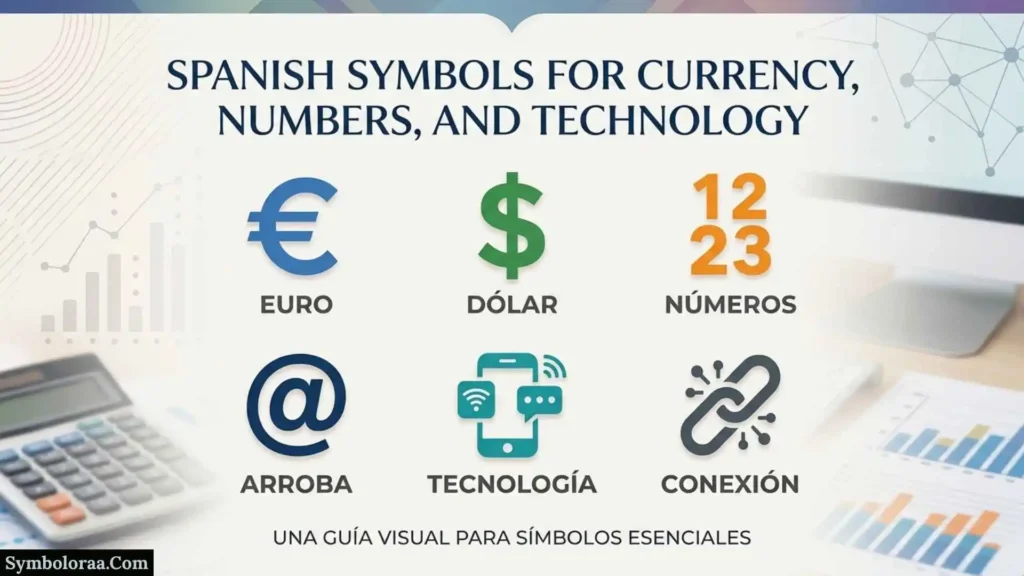
Not every symbol used in Spanish is a Spanish-specific symbol. Many are international symbols that appear in Spanish writing.
Euro Symbol: €
The euro symbol is:
€
Example:
25 €
In Spanish-language contexts, the euro is especially common in Spain and other countries that use the euro.
Dollar Symbol: $
The dollar sign is:
$
However, $ does not identify one universal Spanish-speaking currency.
Depending on the country, it may refer to:
- US dollars
- Mexican pesos
- other currencies using the dollar/peso symbol
When the context could be unclear, writing the currency name is better:
500 pesos
rather than simply:
$500
Percentage Symbol: %
The percentage sign is:
%
Example:
50 %
The exact typographic spacing conventions can depend on the style guide being followed, so professional publishing should use a consistent Spanish-language style.
Degree Symbol: °
The degree sign is:
°
It appears in contexts such as temperature and angles.
Example:
20 °C
or:
90°
At Sign: @
Symbol:
@
Spanish name:
arroba
It is common in:
- Email addresses
- Social media usernames
- Digital communication
Example:
nombre@example.com
The symbol has a much broader role in modern digital writing than its traditional uses.
Hashtag:
Symbol:
#
It is widely used in social media:
#España
#Viajes
#AprenderEspañol
The terminology used for this symbol can vary by region and context.
Ampersand: &
Symbol:
&
It is known as ampersand.
It is common in:
- Brand names
- Business names
- Technical writing
- Specialized notation
In ordinary Spanish prose, the normal word for “and” is y.
For example:
Juan y María
rather than replacing y with & in ordinary sentences.
Spanish Mathematical Symbols
Mathematical symbols are mostly international, but their Spanish names are useful for students and professionals.
| Symbol | Spanish name | Example |
| + | más | 5 + 3 |
| − | menos | 8 − 2 |
| × | por | 4 × 5 |
| ÷ | dividido entre | 10 ÷ 2 |
| = | igual | 5 + 5 = 10 |
| < | menor que | 3 < 5 |
| > | mayor que | 8 > 4 |
| ≤ | menor o igual que | x ≤ 10 |
| ≥ | mayor o igual que | x ≥ 5 |
| ≠ | distinto de | 5 ≠ 6 |
| % | porcentaje | 25 % |
| √ | raíz cuadrada | √16 = 4 |
| ∞ | infinito | ∞ |
These are not exclusively Spanish symbols. Their value for Spanish learners comes from knowing the Spanish terminology used to describe them.
Spanish Symbols You Can Copy and Paste
If your main goal is simply to copy and paste Spanish symbols, this section provides the most useful characters in one place.
Questions and Exclamations
¿ ?
¡ !
Accented Lowercase Letters
á é í ó ú
Accented Uppercase Letters
Á É Í Ó Ú
Ñ
ñ Ñ
Ü
ü Ü
Common Punctuation
. , ; : …
« » “ ”
( ) [ ]
— –
Common Digital Symbols
@ # & / %
Currency and Other Common Marks
€ $ £ ¥ °
A copy-and-paste list like this is useful for people creating:
- Spanish social media posts
- Website content
- School assignments
- Posters
- Invitations
- Product descriptions
- Business documents
- Spanish-language usernames
- Graphic designs
How to Type Spanish Symbols
Knowing the characters is only half the problem. Many users search for Spanish symbols because they cannot find them on their keyboard.
On Windows
The easiest long-term solution for frequent Spanish writing is usually to add a Spanish keyboard layout through Windows language settings.
Once the Spanish keyboard is active, Spanish-specific characters and punctuation become easier to access.
Keyboard shortcuts can also be used, but they vary according to the keyboard layout and Windows configuration.
On Mac
macOS supports accented characters through keyboard input methods, and users can add Spanish as a keyboard input source.
For someone who writes Spanish regularly, switching to or adding a Spanish keyboard layout is usually more convenient than repeatedly searching for characters online.
On iPhone and Android
On most mobile keyboards, pressing and holding a letter reveals related accented characters.
For example:
a → á
e → é
n → ñ
The exact interface depends on the keyboard and operating system.
If You Type Spanish Frequently
Use this simple approach:
Occasional Spanish
↓
Copy and paste the needed characters.
Regular Spanish
↓
Add Spanish as a keyboard language.
Professional Spanish writing
↓
Use a Spanish keyboard layout + spelling/grammar review.
This saves time and reduces errors.
Spanish Symbols vs. Spanish Letters vs. Diacritics
One useful distinction is that these terms are not interchangeable.
Symbol
A symbol can represent an idea, function, or convention.
Examples:
% € @
Letter
A letter is part of the writing system.
Example:
ñ
The ñ is a Spanish letter.
Diacritic
A diacritic is a mark added to a letter to provide information about pronunciation, stress, or grammatical distinction.
Examples:
á
ü
The tilde and diéresis are examples of diacritical marks.
Punctuation Mark
A punctuation mark helps organize written language.
Examples:
¿ ? ¡ ! , . ; :
Understanding these categories prevents a common mistake: calling every special Spanish character a “symbol.”
For search purposes, however, people commonly use the broad phrase Spanish symbols to refer to all of these characters.
Common Mistakes When Using Spanish Symbols
Mistake 1: Writing Only the Closing Question Mark
Incorrect:
Dónde estás?
Correct:
¿Dónde estás?
Mistake 2: Writing Only the Closing Exclamation Mark
Incorrect:
Qué bonito!
Correct:
¡Qué bonito!
Mistake 3: Removing the Ñ
Incorrect:
España → Espana
Correct:
España
The ñ is a letter, so removing its mark changes the spelling.
Mistake 4: Removing All Accent Marks
Incorrect:
Mi mama preparo cafe.
Correct:
Mi mamá preparó café.
Accent marks should follow Spanish spelling rules.
Mistake 5: Adding Tildes Automatically to Question Words
Incorrect assumption:
“Every cómo in a question must be cómo.”
Correct:
¿Cómo lo hiciste?
but:
Hazlo como quieras.
The grammatical function determines the spelling.
Mistake 6: Treating Ü as Decorative
Incorrect:
pinguino
Correct:
pingüino
The diaeresis has a pronunciation function in the standard spelling.
Mistake 7: Removing Diacritics From Capital Letters
Incorrect:
ESPANA
Correct:
ESPAÑA
Incorrect:
BILINGUE
Correct:
BILINGÜE
Spanish diacritics do not disappear simply because the word is uppercase.
A Simple Decision Guide for Choosing the Right Symbol

When you are unsure which Spanish character you need, use this quick decision tree.
Are you writing a direct question?
↓ Yes
Use ¿ … ?
Example: ¿Dónde estás?
↓ No
Are you expressing an exclamation?
↓ Yes
Use ¡ … !
Example: ¡Qué bonito!
↓ No
Does the word require a Spanish accent?
↓ Yes
Use the appropriate vowel:
á é í ó ú
↓ No
Does the word contain the Spanish letter ñ?
↓ Yes
Use:
ñ / Ñ
↓ No
Does a gue/gui sequence require the u to be pronounced?
↓ Yes
Check whether ü is required.
Example:
pingüino
↓ No
Use the normal letter or punctuation mark required by the sentence.
This guide is more useful than memorizing a random collection of characters because it connects each symbol to its function.
When Spanish Symbols Matter Most
Correct symbols are especially important in situations where spelling and presentation affect credibility.
School and Academic Writing
A missing accent or opening question mark can make otherwise good Spanish look careless.
Example:
¿Cuál es la respuesta correcta?
is preferable to:
¿Cuál es la respuesta correcta?
Business Communication
Professional emails, websites, and documents should follow standard spelling conventions.
Example:
Are Spanish Symbols Different Across Spanish-Speaking Countries?
The core Spanish writing system is shared across Spanish-speaking countries, so characters such as ñ, ¿, ¡, and accented vowels are broadly recognized.
However, vocabulary, punctuation preferences, keyboard layouts, currencies, and digital conventions can vary by region.
For example, the symbol:
$
may refer to different currencies depending on the country.
That means a reader in Mexico, Argentina, the United States, or another Spanish-speaking context may interpret the same currency symbol differently.
For international content, use the currency name when there is a risk of confusion.
The same principle applies to regional terminology for certain symbols. A symbol may have several names even though its written form is the same.
Frequently Asked Questions About Spanish Symbols
What are the most common symbols in Spanish?
The most recognizable Spanish-specific characters are ¿, ¡, ñ, á, é, í, ó, ú, and ü. Spanish also uses many standard punctuation and mathematical symbols.
What does ¿ mean?
¿ is the opening question mark used in Spanish direct questions.
Example:
¿Cómo estás?
Why does Spanish use an upside-down question mark?
The opening mark signals the beginning of a question so the reader can recognize the sentence’s interrogative nature from the start. Standard Spanish requires opening and closing signs for direct questions.
What does ¡ mean?
¡ is the opening exclamation mark.
Example:
¡Qué alegría!
Is ñ a Spanish symbol?
More precisely, ñ is a Spanish letter called eñe. It is part of the Spanish alphabet and should not be treated as a decorative version of n.
What is the Spanish accent mark called?
The mark ´ is called a tilde.
It appears in forms such as:
á, é, í, ó, ú
What is the difference between á and a?
á contains a written accent mark, while a does not.
Whether a Spanish word requires á depends on Spanish accentuation rules.
What is the difference between ñ and n?
They are different letters.
For example:
año
and:
ano
do not mean the same thing.
What does ü mean in Spanish?
The ü is a diéresis. It indicates that the u is pronounced in certain gue/güi sequences, as in pingüino.
Do capital Spanish letters keep their accents?
Yes.
Examples:
Á, É, Í, Ó, Ú, Ñ, Ü
A capital letter does not automatically lose its diacritic.
Does every Spanish question need ¿?
Standard direct questions use the opening ¿ and closing ?.
Example:
¿Dónde vives?
Does every Spanish exclamation need ¡?
Standard direct exclamations use the opening ¡ and closing !.
Example:
¡Excelente!
¿Qué, cómo, cuándo, y dónde hay accidentes?
No.
They take a tilde when they have interrogative or exclamative value, including indirect interrogative or exclamative uses. Other grammatical uses do not necessarily take the tilde.
What are Spanish quotation marks?
Spanish can use angular quotation marks:
« »
They are commonly called comillas angulares.
What is the Spanish symbol for “and”?
The normal Spanish word for “and” is:
y
The symbol & exists but is not normally used as a replacement for y in ordinary Spanish prose.
What is the Spanish currency symbol?
There is no single currency symbol for all Spanish-speaking countries. Common symbols include € and $, but the meaning of $ depends on context.
How can I type Spanish symbols?
You can use a Spanish keyboard layout, keyboard shortcuts, character selection tools, or press and hold letters on a mobile keyboard to access characters such as á and ñ.
Can I copy and paste Spanish symbols?
Yes. The most useful characters to copy are:
¿ ¡ á é í ó ú ñ Ñ ü Ü
Spanish Symbols Cheat Sheet
For quick reference, here is the complete essential list:
Question marks:
¿ ?
Exclamation marks:
¡ !
Lowercase accented vowels:
á é í ó ú
Uppercase accented vowels:
Á É Í Ó Ú
Spanish letter:
ñ Ñ
Diaeresis:
ü Ü
Quotation marks:
« » “ ”
Ellipsis:
…
Dash and hyphen:
— –
Common digital symbols:
@ # & / %
Currency symbols:
€ $ £ ¥
Mathematical symbols:
- − × ÷ = ≠ < > ≤ ≥ √ ∞
Key Takeaways About Spanish Symbols
The most important points to remember are:
- ¿ ? are used for direct questions.
- ¡ ! are used for direct exclamations.
- ñ is a Spanish letter, not merely a decorated n.
- á é í ó ú use the tilde when required by Spanish accentuation rules.
- ü indicates that the u is pronounced in specific spelling patterns.
- Spanish diacritics remain in capital letters.
- Interrogative and exclamative words such as qué, cómo, cuándo, dónde, cuál, quién, cuánto, and adónde take a tilde when they have that function.
- Not every symbol used in Spanish is unique to Spanish.
- The same symbol, such as $, can represent different things in different countries.
- Correct symbols matter in academic, business, website, social media, and graphic-design content.
- When in doubt, follow the grammatical function of the word rather than adding or removing a mark based only on appearance.
Conclusion
Symbols in Spanish include much more than the familiar upside-down question and exclamation marks. Spanish writing combines distinctive letters, diacritics, punctuation, currency marks, mathematical notation, and digital symbols.
The characters worth learning first are ¿, ¡, ñ, á, é, í, ó, ú, and ü. Once you understand what each one does, Spanish writing becomes much easier to read and type.
The key is not simply to memorize special characters. Learn the rule behind each character. Use ¿ when a direct question begins, ¡ when an exclamation begins, keep ñ wherever the spelling requires it, apply tildes according to Spanish accentuation rules, and use ü when the spelling requires the pronunciation of the u.
That approach produces Spanish that is not only easier to understand but also more accurate and professional.

I’m Madison Reed, a contemporary American author who writes about love, family, friendship, and second chances. I’m fascinated by the choices that shape our lives and the moments that change us forever. My goal is to create honest, emotional stories with characters readers can connect with long after finishing each book.
Three Books:
When We Find Our Way
The Things We Never Said
Summer in September
 Jackson Miller
[…] Dental Charting Symbols: A Quick Guide for Dental Students 79+ Symbols in Spanish: What Do These Common Signs Mean? 93+ Iphone Weather Symbols: Icons and Their Real Meanings 91+ Symbols of Hecate: Important […]
[…] Guide for Engineers 87+ Dental Charting Symbols: A Quick Guide for Dental Students 79+ Symbols in Spanish: What Do These Common Signs Mean? 93+ Iphone Weather Symbols: Icons and Their Real Meanings 91+ Symbols of Hecate: Important […]