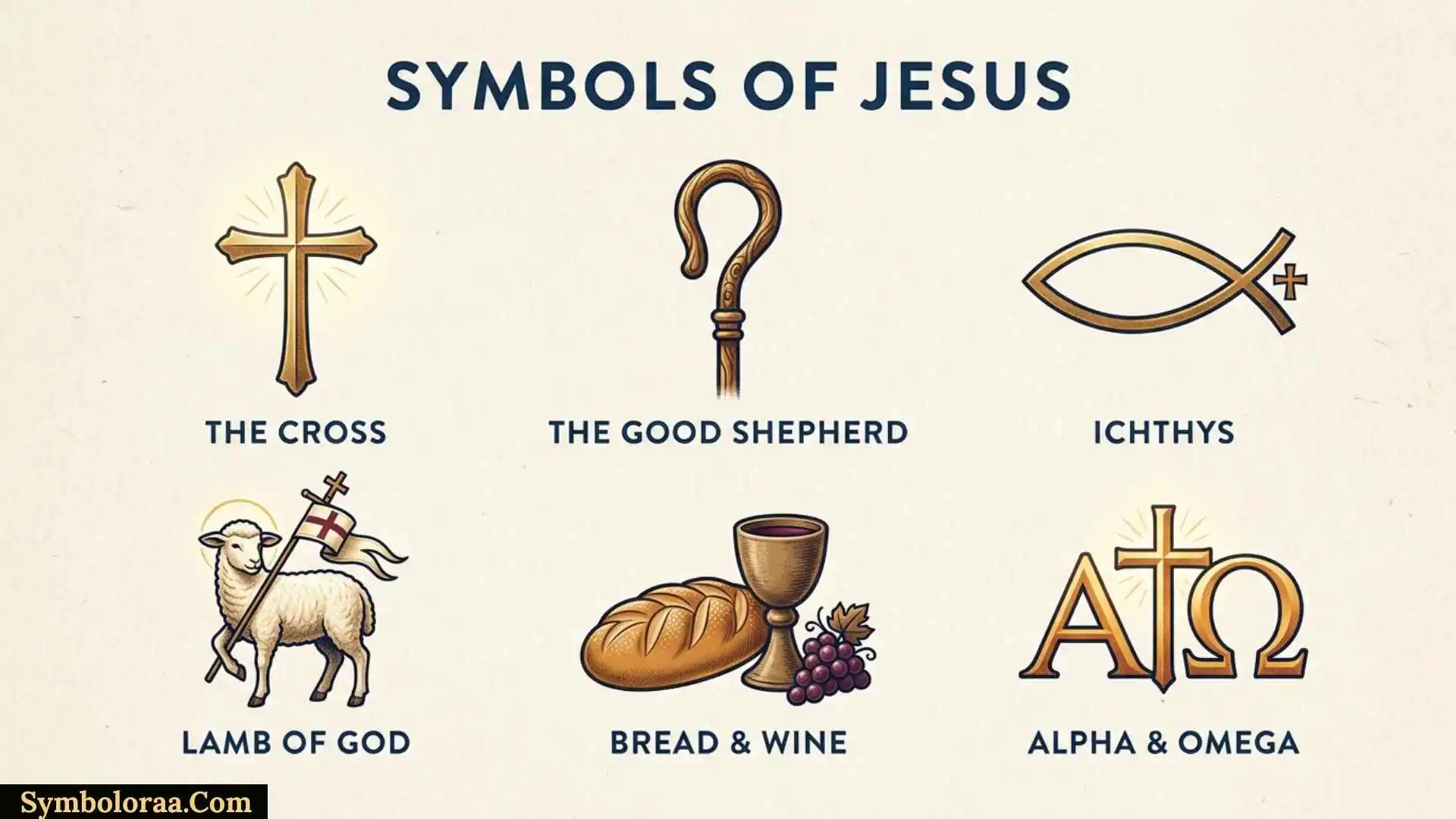
When people search for symbols of Jesus, they are usually looking for more than a simple list of Christian images. They want to know which symbols actually represent Jesus, what each one means, where the symbolism comes from, and which symbol is best for a particular idea such as love, sacrifice, salvation, guidance, or eternal life.
The most recognizable symbol of Jesus is the cross, because it directly represents his crucifixion and is central to Christian faith. But it is not the only symbol associated with Christ. The Ichthys fish, Chi-Rho, Lamb of God, Good Shepherd, vine, light, bread, Alpha and Omega, crown of thorns, Sacred Heart, and IHS all communicate different aspects of Jesus’ identity, teachings, ministry, suffering, or Christian devotion.
There is also an important distinction to make. Not every Christian symbol is specifically a symbol of Jesus. For example, the dove primarily represents the Holy Spirit, while the anchor is associated with Christian hope. They may appear alongside Jesus in Christian art, but their meanings are not identical.
This guide explains the major symbols of Jesus and their meanings, gives biblical references where appropriate, explains their historical development, and provides a practical guide for choosing the right symbol.
Quick Answer: What Are the Main Symbols of Jesus?
The most important symbols associated with Jesus include:
| Symbol | Main meaning | Biblical or traditional connection |
| Cross | Crucifixion, sacrifice, redemption, hope | Jesus’ crucifixion |
| Crucifix | Christ’s suffering and death | Passion narratives |
| Ichthys/Fish | Jesus Christ, Son of God, Savior | Early Christian tradition |
| Chi-Rho | Christ | Greek Christogram |
| Lamb of God | Sacrifice and salvation | John 1:29 |
| Good Shepherd | Care, guidance, sacrifice | John 10:11 |
| Vine | Union with Christ and spiritual growth | John 15:1–5 |
| Light | Truth, life, guidance | John 8:12 |
| Bread of Life | Spiritual nourishment and life | John 6:35 |
| Alpha and Omega | Eternity and beginning/end | Revelation |
| Crown of Thorns | Suffering, mockery, kingship | Matthew 27:29 |
| Sacred Heart | Christ’s love and compassion | Christian devotional tradition |
| IHS | The name of Jesus | Christian tradition |
| Bread and wine | Last Supper and Eucharist/Communion | Gospel and Pauline tradition |
| Shepherd and sheep | Christ’s relationship with believers | John 10 |
| Door/Gate | Access to salvation and life | John 10 |
| King and crown | Christ’s kingship | New Testament and Christian art |
| Monogram of Christ | Identity of Christ | Christian art and tradition |
| Halo/Nimbus | Holiness and divine glory | Christian artistic tradition |
| Empty tomb | Resurrection and victory over death | Gospel resurrection accounts |
The cross is generally the strongest single symbol of Jesus, but the best symbol depends on the meaning you want to communicate.
Why Are There So Many Symbols of Jesus?
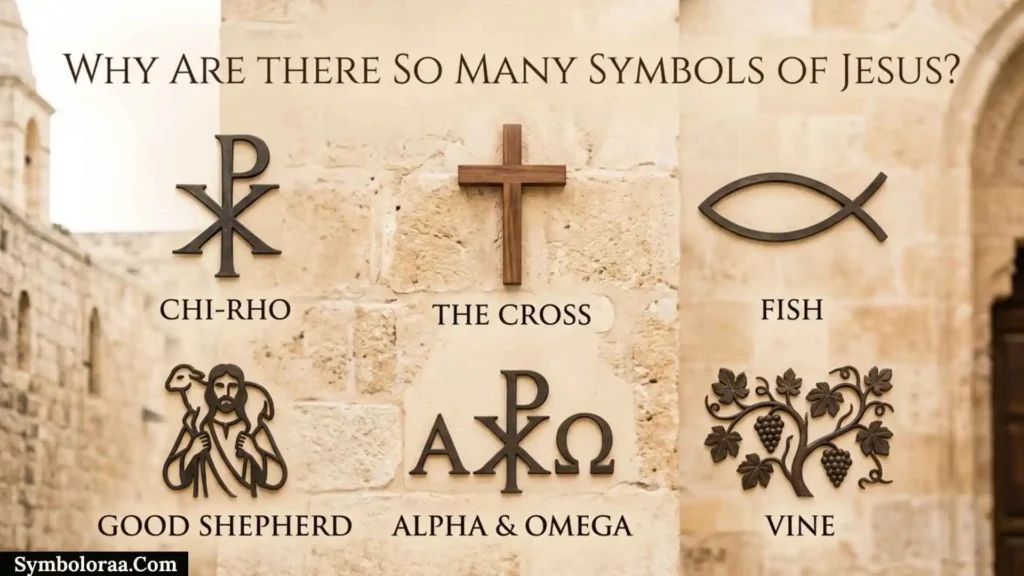
Jesus is represented through many symbols because no single image communicates every aspect of his identity.
The cross emphasizes his death and sacrifice. The empty tomb emphasizes resurrection. The Good Shepherd communicates care and guidance. The Lamb of God emphasizes sacrifice. The vine illustrates spiritual connection. Light communicates truth and life.
This symbolic language developed from two overlapping sources:
- Biblical imagery and titles associated with Jesus
- Christian artistic and devotional traditions that developed over centuries
That distinction is important when studying Christian symbolism. A symbol can be deeply established in Christian art without being a literal object or sign that Jesus himself instructed his followers to use.
For example, Jesus explicitly uses images such as the shepherd, vine, bread, and light in the Gospel of John. By contrast, symbols such as the Chi-Rho and IHS developed as visual representations of Christ’s name and identity.
Also Check This Post: Faith Symbols: Exploring Belief, Hope, and Spiritual Meaning
The Cross: The Most Recognized Symbol of Jesus
The cross is the central and most recognizable visual symbol associated with Jesus.
Its meaning comes directly from the crucifixion. According to the New Testament accounts, Jesus was executed by crucifixion, and Christians came to understand his death as central to salvation and reconciliation with God.
The cross therefore carries several connected meanings:
- Jesus’ crucifixion
- Sacrifice
- Redemption
- Forgiveness
- Suffering
- God’s love
- Hope
- Victory over death
- Christian faith
The meaning of the cross is especially powerful because Christianity does not treat Jesus’ death as the end of the story. The crucifixion is understood together with the resurrection.
Cross versus crucifix
A cross is usually an empty cross, while a crucifix includes a representation of Jesus’ body.
The difference can affect the emphasis of the image.
An empty cross can visually point toward:
- Resurrection
- Victory
- Hope
- Christ’s continuing life
A crucifix places greater visual emphasis on:
- Jesus’ suffering
- The Passion
- His death
- Sacrificial love
Both are important Christian representations of Jesus, but they communicate slightly different aspects of the story.
The Ichthys or Jesus Fish
The Ichthys, commonly called the Jesus fish or Christian fish, is one of the best-known symbols associated with Jesus.
The word ichthys comes from Greek and means “fish.” In Christian tradition, the letters of the Greek word were also understood as an acronym referring to Jesus Christ, Son of God, Savior.
The fish has an especially important connection with early Christianity and with Gospel stories involving fish, fishermen, and Jesus’ disciples.
What does the Jesus fish mean?
The Ichthys can represent:
- Jesus Christ
- The Son of God
- Savior
- Christian identity
- Faith in Christ
- Early Christian tradition
The fish is often seen on:
- Car decals
- Jewelry
- Church materials
- Christian artwork
- Clothing
- Logos
- Decorative objects
Is the fish actually a symbol of Jesus?
Yes, in Christian tradition the Ichthys is strongly associated with Jesus Christ. However, its modern use should not be confused with the claim that it was the only secret sign used by every early Christian community.
Its importance comes from the combination of Greek language, Christian confession, Gospel imagery, and early Christian artistic tradition.
The Chi-Rho: An Ancient Symbol for Christ
The Chi-Rho (☧) is one of the most important early Christian Christograms.
It combines the Greek letters Chi (Χ) and Rho (Ρ), which are the first two letters of Christos, the Greek word for Christ.
Instead of spelling out “Christ,” the Chi-Rho creates a compact visual representation of the title.
The symbol appears in early Christian and later Byzantine and European art. A Metropolitan Museum of Art object from the Late Roman or Byzantine period, for example, includes a Chi-Rho with Alpha and Omega alongside a cross, demonstrating how these symbols could be combined in Christian visual culture.
What does Chi-Rho symbolize?
The Chi-Rho represents:
- Christ
- Jesus as the Messiah
- Christian faith
- Christ’s authority
- The identity of Jesus
It is particularly useful when someone wants a symbol that represents Christ himself rather than focusing specifically on the crucifixion.
The Lamb of God
The Lamb of God is one of the most important biblical images for Jesus.
John the Baptist identifies Jesus with the phrase “Lamb of God” in the Gospel of John. This image became closely associated with Christian understandings of Jesus’ sacrificial role.
The lamb can represent:
- Innocence
- Sacrifice
- Redemption
- Salvation
- Jesus’ Passion
- Victory
- Resurrection
The image draws on the wider biblical significance of lambs and sacrifice while taking on a specific Christological meaning in the New Testament.
Why is Jesus called the Lamb of God?
The title connects Jesus with sacrificial imagery. In Christian theology, Jesus’ death is understood as an act with saving significance.
That is why Christian art sometimes depicts a lamb carrying a cross or a banner. The combination allows one image to communicate both sacrifice and triumph.
The Lamb of God is therefore one of the strongest symbols to choose when the intended message is Jesus’ sacrifice and salvation.
Jesus as the Good Shepherd
The Good Shepherd is not merely a later artistic symbol. It comes directly from Jesus’ own teaching.
In John 10, Jesus describes himself as the Good Shepherd and connects the shepherd’s role with knowing, protecting, and laying down his life for the sheep.
This makes the shepherd one of the clearest symbols for Jesus’ relationship with his followers.
What does the Good Shepherd symbolize?
It represents:
- Protection
- Guidance
- Care
- Love
- Leadership
- Personal relationship
- Sacrifice
- Faithfulness
Imagine a Christian looking for a symbol to represent Jesus’ guidance during a difficult period. The cross would communicate sacrifice, but the Good Shepherd would communicate care and guidance more directly.
That difference is useful when choosing a symbol for artwork, teaching materials, or devotional designs.
The Vine and Branches
The vine is another symbol directly connected with Jesus’ teaching.
In John 15, Jesus describes himself as the true vine and his followers as branches. The image emphasizes remaining connected to Christ and producing spiritual fruit.
What does the vine symbolize?
The vine represents:
- Union with Christ
- Dependence on Jesus
- Spiritual growth
- Discipleship
- Fruitfulness
- Christian community
- Continuing faith
This symbol is particularly appropriate when the intended message is spiritual growth or remaining connected to Jesus.
A vine can also work well in Christian artwork because its branches naturally create a visual connection between separate elements.
Jesus as the Light of the World
Light is one of the strongest biblical images associated with Jesus.
In John 8:12, Jesus describes himself as the Light of the World and connects following him with moving away from darkness.
Christian art uses light in many forms:
- Rays around Christ
- Glowing halos
- Candles
- Sunrise imagery
- Golden backgrounds
- Light emerging from darkness
What does light symbolize?
When associated with Jesus, light can communicate:
- Truth
- Hope
- Guidance
- Life
- Revelation
- Holiness
- Victory over darkness
The light symbol is especially appropriate when someone wants to communicate hope, direction, truth, or spiritual illumination rather than suffering.
The Bread of Life
Bread is another symbol that comes directly from Jesus’ teaching.
In John 6:35, Jesus identifies himself as the Bread of Life. The image communicates spiritual nourishment and life.
The symbol can therefore point to:
- Spiritual nourishment
- Life
- Faith
- Dependence on Christ
- Communion
- Christian worship
Bread also connects with the Last Supper and the Eucharist or Communion traditions of Christianity.
Why is bread important in Christian symbolism?
Bread was an ordinary and essential food in the ancient Mediterranean world. Using bread as an image made the teaching understandable in everyday terms.
That gives this symbol an important practical dimension: it connects a theological idea with something people encountered every day.
Alpha and Omega
Alpha (Α) and Omega (Ω) are the first and last letters of the Greek alphabet.
The expression “Alpha and Omega” is used in Revelation in connection with divine identity and the beginning and end. Revelation 22:13 combines the expression with “the First and the Last” and “the Beginning and the End.”
Christian art frequently places Alpha and Omega beside a cross or Christogram.
What does Alpha and Omega mean?
The symbol communicates:
- Eternity
- Beginning and end
- Divine sovereignty
- Completeness
- Christ’s eternal significance
- God’s authority over history
It is especially suitable for artwork intended to communicate eternity or Christ’s sovereignty.
An important biblical nuance
It is worth being precise here. Revelation 1:8 explicitly has the speaker say “Alpha and Omega” in a context where the verse identifies the speaker as the Lord God, while Revelation 22:13 contains the same expression in the closing vision. Christian interpretation connects the language with the divine and Christological claims of Revelation, but readers should avoid presenting every occurrence as though the text uses exactly the same speaker designation in every verse.
That distinction is an example of why biblical symbolism should be explained carefully rather than reduced to a simple slogan.
The Crown of Thorns
The crown of thorns is directly associated with Jesus’ Passion.
Matthew 27:29 describes soldiers placing a crown of thorns on Jesus’ head and mocking him as “King of the Jews.”
The crown therefore has a double meaning:
- Suffering and humiliation
- Kingship and mockery
It is a particularly powerful symbol because the soldiers intended the crown as an act of ridicule, while Christian interpretation sees Jesus’ kingship through a very different lens.
What does the crown of thorns symbolize?
It can represent:
- Jesus’ suffering
- The Passion
- Humiliation
- Sacrifice
- Kingship
- Endurance
- The contrast between worldly power and Christ’s kingdom
For artwork about Good Friday, the Passion, or Christ’s suffering, the crown of thorns is more specific than a general cross.
The Sacred Heart of Jesus
The Sacred Heart is a major devotional symbol, particularly within Catholic Christianity.
The image commonly shows a heart associated with Jesus, often surrounded by flames, rays of light, a crown of thorns, or a cross.
The heart represents Christ’s love and compassion, while the surrounding elements can connect that love with sacrifice and suffering.
What does the Sacred Heart symbolize?
The Sacred Heart can represent:
- Jesus’ love
- Mercy
- Compassion
- Devotion
- Sacrificial love
- Christ’s relationship with humanity
It is important to describe the Sacred Heart as a Christian devotional tradition, rather than claiming that the visual image itself appears as a symbol in the New Testament.
That distinction strengthens historical accuracy while still recognizing its importance in Christian practice and art.
IHS: A Symbol of the Holy Name of Jesus
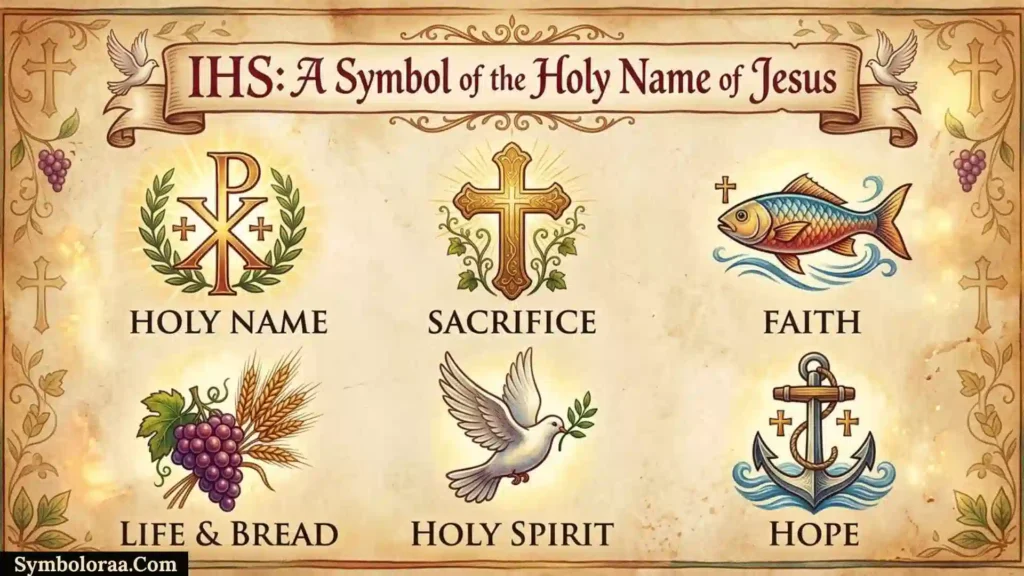
IHS is a traditional Christian monogram associated with Jesus’ name.
It is frequently found in:
- Churches
- Altars
- Vestments
- Religious paintings
- Christian books
- Monuments
- Devotional objects
IHS is particularly useful as a symbol when the goal is simply to represent the name of Jesus.
Unlike the cross, which points strongly toward the Passion, IHS focuses on Jesus’ identity through his name.
Also Check This Post: Taoist Symbols: Hidden Meanings Behind Ancient Images
Bread and Wine: Symbols Connected With the Last Supper
Bread and wine have a central place in Christian symbolism because of Jesus’ Last Supper with his disciples.
The Gospel traditions connect Jesus’ words and actions at the meal with the bread and cup. Paul also refers to the tradition in 1 Corinthians 11.
Different Christian denominations interpret the Eucharist or Communion in different theological ways. Because of those differences, it is better to describe bread and wine as symbols and sacramental elements associated with Jesus’ Last Supper and Christian worship rather than assuming that every Christian tradition explains them identically.
What do bread and wine represent?
Depending on Christian tradition and context, they can point to:
- The Last Supper
- Jesus’ self-giving
- Communion
- The new covenant
- Remembrance
- Christian unity
- Eucharistic worship
This makes bread and wine particularly relevant to church art and worship rather than simply being decorative symbols.
The Door or Gate
The door or gate is another image Jesus applies to himself in John 10.
In the same teaching where Jesus describes himself as the Good Shepherd, he also uses the imagery of the gate for the sheep.
The symbol can therefore represent:
- Access
- Salvation
- Protection
- Entry into life
- Jesus as the way to God
A doorway is particularly effective as a visual metaphor because it naturally represents movement from one state to another—from outside to inside, darkness to light, or danger to safety.
The Empty Tomb
The empty tomb is not a traditional “logo” for Jesus, but it is one of the clearest visual representations of the resurrection.
It can be represented through:
- An open stone tomb
- The rolled-away stone
- Light emerging from the tomb
- Grave cloths
- Angels near the tomb
What does the empty tomb symbolize?
It represents:
- Resurrection
- Victory over death
- New life
- Hope
- Christian faith
- The central resurrection claim of Christianity
If the cross emphasizes Jesus’ crucifixion, the empty tomb emphasizes what Christians believe happened afterward.
For that reason, using both together can communicate the broader Christian story more completely than either symbol alone.
The Halo or Nimbus Around Jesus
The halo, also called a nimbus, is common in Christian art.
It is not an object described as surrounding Jesus in the Gospel narratives. Instead, it is an artistic convention developed to visually communicate holiness, glory, or sacred status.
In Christian art, Jesus may be shown with:
- A circular halo
- A cross-shaped halo
- Golden rays
- A luminous background
Is the halo specifically a symbol of Jesus?
It is better described as a visual convention used to identify holiness or divine glory.
The halo can appear around Jesus, Mary, saints, angels, and other sacred figures. Therefore, it is not exclusive to Jesus.
This is another useful distinction between a symbol associated with Jesus and a visual device used in Christian art.
The King and Crown
Jesus is frequently represented as King, especially in Christian art depicting Christ’s glory and reign.
Symbols may include:
- Crown
- Throne
- Royal robes
- Scepter
- Orb
- Majestic posture
The crown of thorns creates an especially powerful contrast with this theme. Jesus is mocked as a king during the Passion, while Christian theology understands him as genuinely royal.
What does the crown symbolize?
In this context, it can represent:
- Christ’s kingship
- Authority
- Victory
- Divine rule
- The Kingdom of God
The meaning depends heavily on context. A crown of thorns emphasizes suffering and mockery; a royal crown emphasizes glory and kingship.
A Practical Comparison of Jesus Symbols
The easiest way to choose among symbols is to begin with the message you want the image to communicate.
| If you want to represent… | Best symbol | Why |
| Jesus generally | Cross | Most universally recognized |
| Jesus Christ by name/title | Chi-Rho | Christogram for Christ |
| Jesus as Savior | Ichthys | Traditional Christ symbol |
| Sacrifice | Cross or Lamb | Direct connection with Jesus’ death |
| Love | Sacred Heart | Strong devotional association |
| Guidance | Good Shepherd | Jesus leads and protects |
| Spiritual growth | Vine | Connection between Christ and believers |
| Hope | Cross or Light | Both connect with Christian hope |
| Resurrection | Empty tomb | Directly communicates resurrection |
| Eternality | Alpha and Omega | Beginning and end |
| Suffering | Crown of Thorns | Direct Passion imagery |
| Jesus’ name | IHS | Traditional monogram |
| Spiritual nourishment | Bread | “Bread of Life” imagery |
| Last Supper | Bread and wine | Direct Eucharistic connection |
| Christ’s kingship | Crown/King imagery | Represents royal authority |
| Protection and entry | Door/Gate | Based on Jesus’ teaching in John 10 |
Which Symbol of Jesus Should You Choose?
Use this simple decision guide.
If your main message is sacrifice
Choose the cross or Lamb of God.
The cross is more universally recognizable. The lamb gives the image a stronger biblical-sacrificial emphasis.
If your message is love
Choose the Sacred Heart.
It is particularly appropriate for devotional artwork focused on Christ’s love and mercy.
If your message is guidance
Choose the Good Shepherd.
This is the strongest choice when you want to communicate Jesus caring for, leading, and protecting his followers.
If your message is resurrection
Choose the empty tomb or an empty cross.
The empty tomb is more explicit about resurrection, while the empty cross can communicate both crucifixion and victory.
If your message is eternity
Choose Alpha and Omega.
This symbol communicates beginning, end, completeness, and eternal significance.
If your message is Christ himself
Choose the Chi-Rho.
It is a concise historical Christogram rather than a scene representing a particular event.
Biblical Symbols vs. Later Christian Symbols
One of the most common mistakes in articles about Christian symbolism is treating every traditional image as though it originated directly in the Bible.
A better approach is to divide symbols into categories.
Symbols directly rooted in Jesus’ words or biblical imagery
These include:
- Good Shepherd
- Vine
- Light
- Bread of Life
- Door/Gate
- Lamb of God
- Alpha and Omega
These have clear textual connections to the New Testament.
Symbols representing events in Jesus’ life
These include:
- Cross
- Crucifix
- Crown of Thorns
- Empty Tomb
- Bread and Wine
- Baptismal imagery
These point to important events in the Gospel story.
Symbols developed through Christian tradition and art
These include:
- Chi-Rho as a formal Christogram
- IHS
- Sacred Heart as a devotional image
- Halo/nimbus
- Many specialized artistic forms of Christ’s monogram
These are still important Christian symbols, but their historical development should be acknowledged.
This three-part distinction makes the subject much easier to understand and prevents the common mistake of claiming that every Christian symbol has exactly the same biblical status.
Common Misconceptions About Symbols of Jesus
The cross is not the only symbol of Jesus
The cross is the most recognizable, but biblical and Christian tradition contains many other symbols.
A reader searching for “symbols of Jesus” may specifically be looking for a symbol of love, guidance, salvation, or eternity. In those cases, another image may communicate the intended meaning better.
The dove is primarily a symbol of the Holy Spirit
The dove is strongly connected with Jesus’ baptism, but it is more accurate to identify the dove as a symbol of the Holy Spirit rather than a direct symbol of Jesus.
Not every fish image means exactly the same thing
The Ichthys has a specific Christian history, but fish imagery also appears in Gospel stories for other reasons. Context matters.
Alpha and Omega requires careful interpretation
Alpha and Omega is unquestionably important in Christian symbolism, but the biblical passages should be read in their literary context rather than reduced to a single isolated quotation. Revelation uses highly symbolic language, and identifying the speaker in each passage matters.
The halo is artistic rather than a literal object around Jesus
A halo is a visual convention used to communicate holiness or glory. It should not be presented as though the Gospels describe Jesus walking around with a visible circular halo.
How Jesus Symbols Are Used in Christian Art
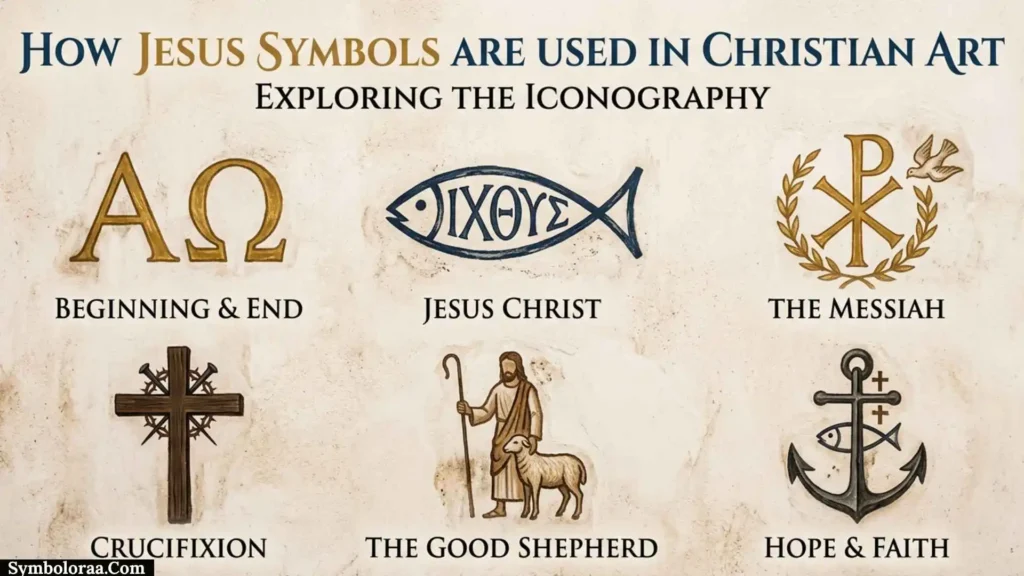
Symbols of Jesus appear in many forms of Christian visual culture.
Churches and stained glass
Churches often combine several symbols in one design. A stained-glass window might show Christ as the Good Shepherd, a cross above him, and Alpha and Omega around the composition.
Jewelry
Crosses, fish, Chi-Rho designs, Sacred Heart imagery, and IHS are frequently adapted into necklaces, rings, bracelets, and pendants.
The choice of symbol can communicate a specific personal meaning. Someone choosing a cross may be emphasizing Christian faith broadly, while someone choosing a Good Shepherd design may want to express trust in Christ’s guidance.
Paintings and icons
Christian paintings often combine symbolic elements rather than relying on one image.
For example, Christ may be shown with:
- A halo
- A cross-shaped nimbus
- A book
- A shepherd’s staff
- Alpha and Omega
- A crown
- Specific hand gestures
The meaning comes from the combination of symbols, not necessarily from one isolated object.
Christian logos and modern designs
Modern churches and Christian organizations sometimes simplify ancient symbols into clean graphic forms.
The Chi-Rho, fish, cross, crown, and Alpha-Omega combination can all be adapted into modern logos without losing their historical associations.
How to Interpret a Symbol of Jesus Correctly
When you encounter an unfamiliar Christian symbol, ask five questions:
- What does the image show?
- Does it come directly from Scripture or later Christian tradition?
- Which part of Jesus’ story or identity does it represent?
- What other symbols appear beside it?
- Which Christian tradition or historical period is using it?
This method is more reliable than assuming that every symbol has one universal definition.
For example, a lamb by itself could have several meanings. A lamb carrying a cross or banner is much more specifically associated with Christ as the Lamb of God.
Likewise, Alpha and Omega next to a cross or Chi-Rho can communicate a much more specific Christian message than the letters alone.
Why Context Matters in Christian Symbolism
Symbols rarely operate in isolation.
A cross + Alpha and Omega can communicate Christ, crucifixion, eternity, and divine authority.
A shepherd + sheep points toward Jesus’ Good Shepherd teaching.
A lamb + cross emphasizes sacrifice and Christ as the Lamb of God.
A heart + crown of thorns strongly suggests the Sacred Heart and sacrificial love.
A vine + grapes can point toward Jesus’ teaching about the vine and branches.
This is why identifying a symbol requires more than recognizing its shape. The surrounding imagery, historical period, denomination, and artistic setting can change or refine the meaning.
Key Takeaways About Symbols of Jesus
The most important points are:
- The cross is the most widely recognized symbol of Jesus.
- The crucifix emphasizes Jesus’ suffering and death.
- The Ichthys represents Jesus Christ and became an important Christian symbol.
- The Chi-Rho is an ancient Christogram based on the Greek word for Christ.
- The Lamb of God represents Jesus’ sacrificial and saving role.
- The Good Shepherd represents Christ’s care, guidance, and self-giving love.
- The vine represents remaining connected to Christ and spiritual fruitfulness.
- Light represents Jesus as the source of truth and life.
- Bread of Life represents spiritual nourishment and life.
- Alpha and Omega communicates beginning, end, and eternity.
- The crown of thorns represents Jesus’ Passion, suffering, mockery, and kingship.
- The Sacred Heart is a later Christian devotional symbol of Christ’s love.
- IHS is a traditional monogram associated with Jesus’ name.
- The dove primarily represents the Holy Spirit, although it is closely associated with Jesus’ baptism.
- The empty tomb communicates resurrection and victory over death.
- Not every Christian symbol is specifically a symbol of Jesus.
- The meaning of a symbol can change or become more specific depending on its surrounding imagery and historical context.
Frequently Asked Questions About Symbols of Jesus
What is the most famous symbol of Jesus?
The cross is the most famous and widely recognized symbol associated with Jesus. It represents his crucifixion and, within Christianity, is closely connected with sacrifice, redemption, and resurrection.
What is the symbol of Jesus Christ?
Several symbols represent Jesus Christ, including the cross, Ichthys, Chi-Rho, Lamb of God, Alpha and Omega, and IHS. The cross is the most universal, while the Chi-Rho is a particularly direct Christogram.
What animal represents Jesus?
The lamb is one of the strongest animal symbols associated with Jesus because of the title Lamb of God. The shepherd is also an important image because Jesus describes himself as the Good Shepherd in John 10.
What symbol represents Jesus’ love?
The Sacred Heart is one of the clearest traditional symbols of Jesus’ love and compassion. The cross can also represent sacrificial love, while the Good Shepherd communicates Christ’s caring relationship with his followers.
What symbol represents Jesus’ sacrifice?
The cross is the clearest symbol of Jesus’ sacrifice. The Lamb of God is another major symbol because it connects Jesus with sacrificial imagery.
What symbol represents Jesus’ resurrection?
The empty tomb is the most direct visual symbol of the resurrection. An empty cross can also represent resurrection because it combines the crucifixion with the Christian belief in Christ’s victory over death.
What symbol represents Jesus’ guidance?
The Good Shepherd is the strongest choice. Jesus explicitly uses shepherd imagery and describes the shepherd as knowing, leading, and laying down his life for the sheep.
What does the Jesus fish mean?
The Ichthys, or Jesus fish, is a traditional Christian symbol associated with Jesus Christ. Its Greek name also became a Christian acronym referring to Jesus Christ, Son of God, Savior.
What does the Chi-Rho mean?
The Chi-Rho is a Christogram formed from the Greek letters Chi and Rho. Together they abbreviate Christos, meaning Christ. It became an important symbol in early Christian and later Christian art.
What does IHS mean?
IHS is a traditional Christian monogram associated with the name of Jesus. It appears in churches, religious artwork, vestments, and devotional objects.
Is the dove a symbol of Jesus?
Not primarily. The dove is more accurately associated with the Holy Spirit, particularly because of the account of Jesus’ baptism. It is therefore closely connected with Jesus but is not normally classified as his primary personal symbol.
What does the Lamb of God symbolize?
The Lamb of God represents Jesus’ sacrificial role and is associated with themes of salvation, redemption, innocence, and victory. It is one of the most important biblical images used to explain Jesus’ significance.
What does Alpha and Omega mean in Christianity?
Alpha and Omega are the first and last letters of the Greek alphabet. In Christian symbolism, they communicate ideas of beginning and end, eternity, completeness, and divine authority. Revelation 22:13 combines the terms with “the First and the Last” and “the Beginning and the End.”
What does the crown of thorns symbolize?
The crown of thorns represents Jesus’ suffering and humiliation during the Passion. It also carries an important irony: Jesus was mocked as a king, while Christian belief understands him as the true King. Matthew 27:29 describes the crown and the soldiers’ mockery.
What symbol represents Jesus’ eternal nature?
Alpha and Omega is the strongest traditional choice for representing eternity and the beginning and end. The symbol is based on the first and last letters of the Greek alphabet and is used prominently in Revelation.
What symbol represents Jesus as a source of spiritual life?
The Bread of Life and vine are especially appropriate. Jesus calls himself the Bread of Life in John 6 and the vine in John 15.
Are all Christian symbols symbols of Jesus?
No. Some symbols are associated with Christianity more generally. The dove, for example, primarily represents the Holy Spirit, while the anchor can represent Christian hope. A symbol can belong to Christian visual language without being specifically a symbol of Jesus.
Conclusion
The symbols of Jesus help express key parts of his life, teachings, and Christian faith. The cross is the central symbol, representing Jesus’ crucifixion and salvation, while the Lamb of God, Good Shepherd, Light, vine, and Bread of Life highlight sacrifice, guidance, truth, connection, and spiritual nourishment.
There is no single symbol for every meaning. If you need one universal choice, the cross is the clearest option; for a specific message, choose the symbol that best represents the quality or teaching you want to express.
Also Check This Post: 75+ Bravery Symbols: Powerful Designs and Their Meanings

I’m Madison Reed, a contemporary American author who writes about love, family, friendship, and second chances. I’m fascinated by the choices that shape our lives and the moments that change us forever. My goal is to create honest, emotional stories with characters readers can connect with long after finishing each book.
Three Books:
When We Find Our Way
The Things We Never Said
Summer in September
 Jackson Miller
[…] Also Check This Post: 67+ Symbols of Jesus: Powerful Christian Symbols Explained […]