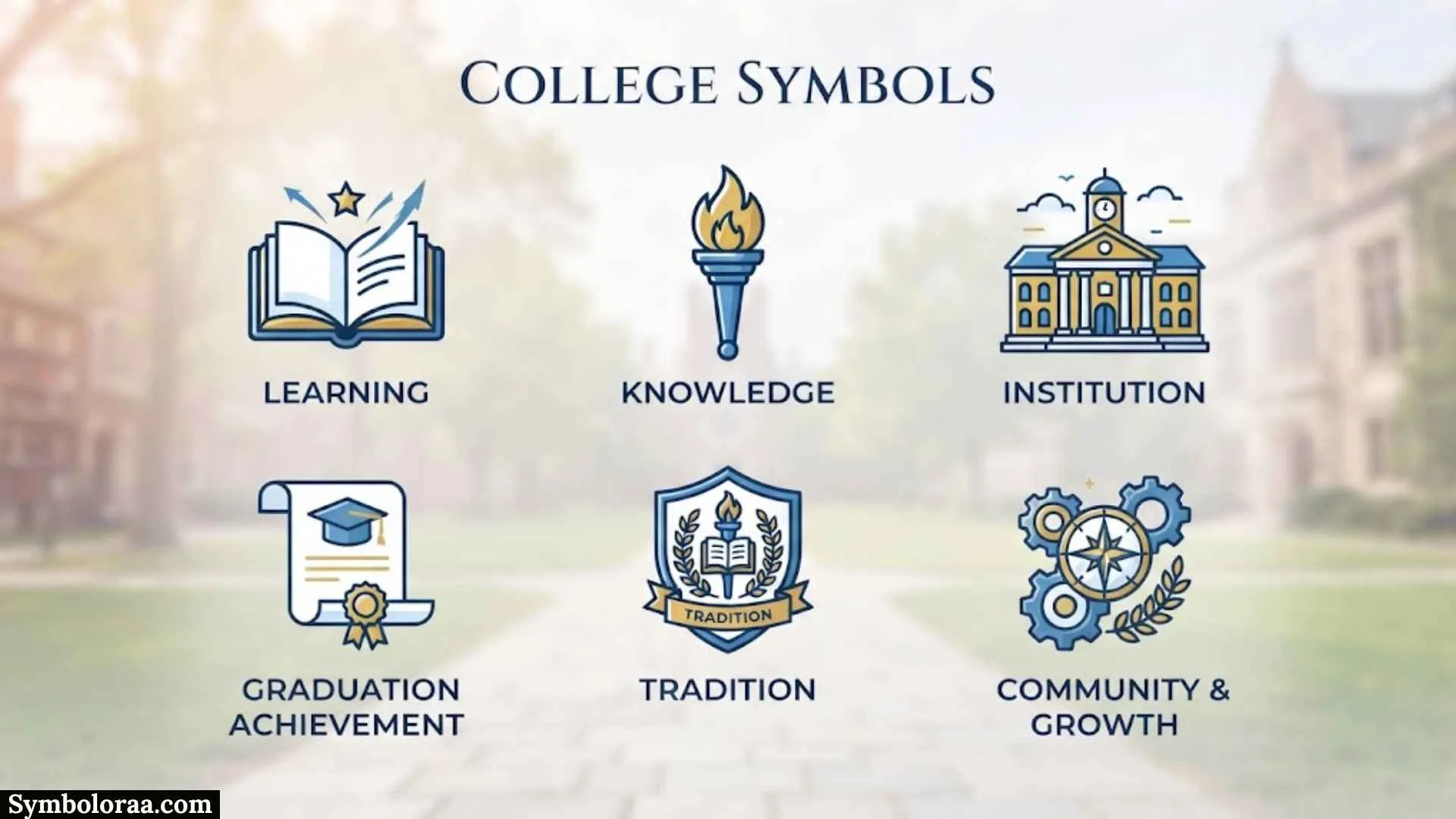
If you are searching for college symbols, you may want to know what different academic symbols mean, which symbols represent college life, what graduation symbols stand for, or how colleges use seals, logos, mascots, colors, and crests to build their identity. This guide covers all of these areas and explains the difference between general academic symbols and official institutional marks.
College symbolism is broader than a graduation cap or university logo. A college may use a seal, crest, shield, mascot, school colors, motto, book, torch, owl, globe, laurel, academic gown, hood, class ring, or ceremonial mace. Each can communicate a different idea, from knowledge and achievement to heritage, community, school spirit, and institutional authority.
Historical academic traditions also matter. Modern academic regalia can be traced to medieval universities, while universities later developed their own seals, colors, mascots, and visual identities. Indiana University of Pennsylvania notes that academic regalia has roots in medieval university life and that modern academic dress developed from clothing associated with medieval scholars and teachers.
Quick Answer: What Are College Symbols?
College symbols are visual elements, objects, colors, words, or traditions that represent higher education, academic achievement, institutional identity, school spirit, history, or campus culture.
Common examples include:
- College seals
- University logos
- Crests and shields
- Mascots
- School colors
- Books
- Torches
- Owls
- Graduation caps
- Diplomas
- Academic gowns
- Hoods
- Laurel wreaths
- Class rings
- Maces
- Globes
- Institutional mottos
The important distinction is that some are general academic symbols, while others are official symbols of a particular college or university.
What Do College Symbols Represent?
College symbols can communicate several different ideas. Understanding the purpose behind a symbol makes it easier to interpret or choose the right one.
Knowledge and Learning
Books, torches, lamps, owls, and similar imagery can represent knowledge, scholarship, discovery, and learning.
For example, Johns Hopkins University’s visual identity explains that the open book in its shield represents knowledge and discovery, while the globe represents the university’s worldwide reach and responsibility.
Academic Achievement
Graduation caps, diplomas, medals, laurel wreaths, and class rings can communicate academic achievement or the completion of an educational milestone.
A graduation cap usually communicates completion of study, while a diploma represents the qualification itself.
Institutional Heritage
Seals, crests, shields, mottos, historical buildings, and ceremonial objects can connect a college with its history.
For example, the University of Colorado Boulder explains that its seal appears on diplomas and other formal university objects and has been part of the institution’s visual history since the early twentieth century.
School Spirit and Community
Mascots, athletic marks, pennants, team colors, and spirit symbols are commonly used to create a shared identity among students, athletes, alumni, and supporters.
Rice University provides a useful example: its Athenian owl appears in its academic symbolism and also became the mascot of its athletic teams.
Main Types of College Symbols
College symbols can be organized into several categories. This classification makes it easier to understand why a college may use several different symbols instead of one universal emblem.
| Type of Symbol | Main Purpose | Common Examples |
| Academic | Represents learning | Book, torch, owl |
| Institutional | Identifies the institution | Seal, logo, crest |
| Ceremonial | Represents academic tradition | Gown, hood, mace |
| Graduation | Represents completion | Cap, diploma, tassel |
| Athletic | Represents school spirit | Mascot, team mark |
| Heritage | Represents history | Shield, motto, historical emblem |
| Community | Represents belonging | Colors, class ring, traditions |
| Global | Represents international education | Globe, map |
| Achievement | Represents success | Laurel, medal, honors cord |
This classification also prevents a common mistake: treating every educational image as if it were an official institutional symbol.
College Seals and Their Meaning
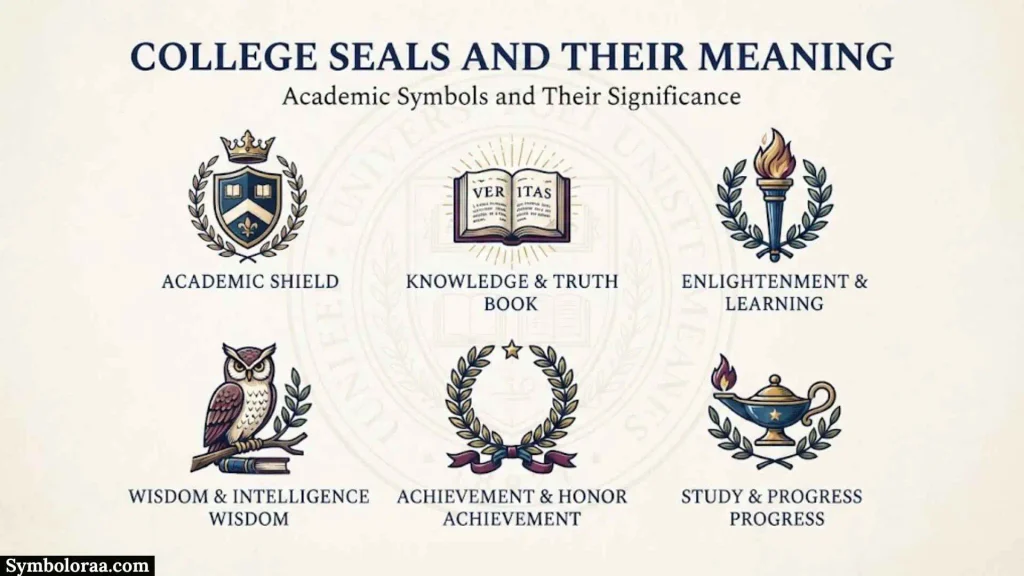
A college seal is a formal institutional emblem that often combines the college’s name, history, motto, symbols, and founding traditions.
Seals are usually more formal than everyday logos.
What Does a College Seal Represent?
A college seal may communicate:
- Institutional history
- Academic authority
- Educational mission
- Heritage
- Founding traditions
- Institutional values
- Formal recognition
The specific meaning comes from the individual institution rather than from a universal rule.
For example, Johns Hopkins University states that its academic seal was adopted in 1885 and represents the university’s dedication to advancing knowledge in service to the community and the world. Its full-color seal is reserved for formal uses such as diplomas and official university documentation.
A Real Example: University of Colorado Boulder
The University of Colorado Boulder’s seal includes a classical figure, scroll, torch, and laurel branches.
The university explains that the scroll represents knowledge and written language, the laurel represents honor or success, and the torch is part of the seal’s symbolism of light and knowledge. The current seal was designed in 1908.
This example shows why the meaning of a college symbol should ideally be taken from the institution’s own historical explanation rather than assumed from appearance alone.
College Logo vs Seal vs Crest vs Shield
These terms are related, but they should not be treated as interchangeable.
| Symbol Type | Typical Function |
| Logo | Everyday institutional identification |
| Seal | Formal or ceremonial institutional mark |
| Crest | Heraldic or heritage-oriented identity |
| Shield | Symbolic or heraldic component |
| Wordmark | Institution name presented as a designed mark |
| Mascot | School spirit and community identity |
| Spirit Mark | Informal or athletic identity |
Why the Difference Matters
A university may deliberately restrict its seal to diplomas, official documents, ceremonies, or other formal situations while using a simpler logo for websites and everyday communications.
Johns Hopkins, for example, describes its primary logo as the core visual identity and separately identifies academic and spirit marks with different purposes.
Rice University similarly distinguishes its primary shield logo, academic seal, Athenian Owl, and athletics logos. Its brand guide states that the academic seal is reserved for select purposes and is not intended for general use.
College Crests and Shields
A crest or shield often gives a college design a traditional or heritage-oriented appearance.
These symbols may contain:
- Books
- Animals
- Stars
- Plants
- Crowns
- Crosses
- Initials
- Dates
- Mottos
- Heraldic patterns
What Does a Shield Represent?
A shield can suggest:
- Heritage
- Protection
- Strength
- Responsibility
- Institutional identity
- Tradition
However, the meaning of a shield is not universal. Its specific imagery should be interpreted using the institution’s own history and brand documentation.
The Book as a College Symbol
The open book is one of the clearest general symbols of education.
It can represent:
- Knowledge
- Reading
- Scholarship
- Research
- Learning
- Written communication
- Academic discovery
Because the image is easy to understand, books are common in educational illustrations, academic logos, library graphics, student projects, and college-related designs.
Book Symbol in a Real University Identity
The Johns Hopkins University shield includes an open book. Its official brand guide identifies the book with knowledge and discovery.
This demonstrates an important principle: a symbol can have a general meaning while also carrying a specific institutional interpretation.
The Torch as a College Symbol
A torch commonly represents:
- Knowledge
- Enlightenment
- Guidance
- Discovery
- Learning
- Intellectual growth
The metaphor is straightforward: light makes it possible to see, while education can be understood as helping people discover and understand the world.
Torch Symbol in University Seals
The University of Colorado Boulder’s official seal includes a burning torch framed by laurel branches. The university connects the seal’s imagery with knowledge, honor, success, and its motto about letting one’s light shine.
The exact meaning of a torch can therefore vary by institution, even though “knowledge” and “enlightenment” are common interpretations.
The Owl as a College Symbol
The owl is widely associated with:
- Wisdom
- Knowledge
- Scholarship
- Learning
- Observation
It is especially interesting in college symbolism because it can function as both an academic symbol and an institutional mascot.
Rice University’s Owl Example
Rice University provides a documented example of this dual role.
Its academic seal contains Athenian owls, which the university says were selected as symbols of wisdom. The owl later became the mascot of Rice’s athletic teams.
This shows how one symbol can move across different parts of university identity while retaining a connection to the institution’s history.
Graduation Cap and Mortarboard
The graduation cap, often called a mortarboard, is one of the most recognizable symbols of academic completion.
It commonly represents:
- Graduation
- Academic achievement
- Completion of a degree
- Scholarship
- A transition to a new stage of life
Historical Meaning of the Academic Cap
Academic headwear has a longer history than modern graduation photographs suggest.
Indiana University of Pennsylvania explains that academic regalia developed from medieval university traditions. Its account also describes different interpretations of the square academic cap and notes the traditional movement of the tassel when a degree is conferred.
Because historical interpretations can differ, it is better to describe the cap’s symbolism carefully rather than claim that one explanation is universally accepted.
Diploma as a College Symbol
A diploma represents an academic qualification awarded after completing a program.
As a symbolic image, it can communicate:
- Graduation
- Qualification
- Achievement
- Academic completion
- Educational accomplishment
A diploma may be illustrated as a formal document, certificate, or rolled paper.
Unlike a graduation cap, which represents the ceremony or academic milestone broadly, the diploma is more directly associated with the credential that has been awarded.
Laurel Wreath as a Symbol of Achievement
Laurel has a long history of association with achievement, honor, and victory.
In academic contexts, it can symbolize:
- Excellence
- Recognition
- Achievement
- Honor
- Success
The University of Colorado Boulder’s official explanation provides a concrete example: its seal uses laurel branches to represent honor or success.
This is an example of why historical or institutional sources are useful when explaining symbols. The same visual element may have different meanings in different settings.
Academic Gown as a College Symbol
The academic gown is more than graduation clothing. It is part of the historical visual language of higher education.
Indiana University of Pennsylvania explains that modern academic regalia developed from medieval university traditions and that the gown, cap, and hood are principal components of academic dress.
What Does the Academic Gown Represent?
The gown can represent:
- Academic membership
- Scholarship
- Institutional tradition
- Equality within the academic ceremony
- Completion of a degree
Some traditions also use differences in sleeve shape, trim, and color to distinguish degree levels or academic disciplines.
Academic Hood and Its Meaning
The academic hood is another important college symbol.
It can communicate information about:
- Academic degree
- Discipline
- Institution
- Academic tradition
Indiana University of Pennsylvania explains that the hood’s facing color can indicate the discipline represented by the degree, while the lining identifies the institution from which the degree was granted.
This makes academic hoods particularly useful examples of how color can communicate information rather than simply decorate clothing.
Academic Colors and Their Meaning
Academic colors can have several different functions.
They may identify:
- A college
- A university
- A school or faculty
- A degree discipline
- An athletic program
- A graduation class
However, color meanings are not universal.
Academic color systems may follow particular institutional or academic traditions. For example, IUP’s commencement information associates specific colors with disciplines such as education, engineering, business, medicine, music, law, and other fields.
Therefore, a reader should not assume that a particular color always represents the same academic field everywhere.
Academic Mace as a Symbol of Authority
The academic mace is a ceremonial object used by some universities during formal academic events.
It can symbolize:
- Institutional authority
- Academic tradition
- University governance
- Ceremonial leadership
Indiana University of Pennsylvania describes its mace as a ceremonial staff carried by a senior faculty member serving as grand marshal. The mace’s design incorporates elements of the institution’s state and university identity.
This is a good example of a college symbol that is not primarily a logo or graphic but a physical ceremonial object.
President’s Medallion
A president’s medallion can represent the office and responsibilities of institutional leadership.
IUP describes its President’s Medallion as a symbol of the leadership responsibilities vested in the university presidency. Its design incorporates the university seal.
This type of symbol is generally ceremonial rather than a general symbol that represents college education as a whole.
College Mascots
A college mascot is a character, animal, person, or other figure connected with school identity and spirit.
Common mascot types include:
- Owls
- Eagles
- Tigers
- Lions
- Bears
- Bulldogs
- Hawks
- Wolves
- Wildcats
- Knights
What Does a College Mascot Represent?
A mascot can represent:
- School spirit
- Community
- Athletic identity
- Alumni connection
- Tradition
- Competition
Mascots differ from academic symbols because their primary function is often identity and community rather than education itself.
Real Example: Rice Owl
Rice University selected the owl from its academic seal as the mascot of its athletic teams when athletic activities began in 1912.
This is an example of an institutional symbol that connects academic history and athletics.
School Colors as Symbols
College colors are a major part of institutional identity.
They appear on:
- Sports uniforms
- Flags
- Websites
- Clothing
- Graduation decorations
- Campus signs
- Social-media graphics
- Printed materials
Do College Colors Have Universal Meanings?
Usually, no.
A college’s official colors primarily identify that institution. A color may also have cultural or academic associations, but those meanings should not be assumed to apply everywhere.
Rice University, for example, officially identifies blue and gray as its school colors.
The key point is that institutional color meaning comes from the college’s own identity system.
College Mottos as Symbols
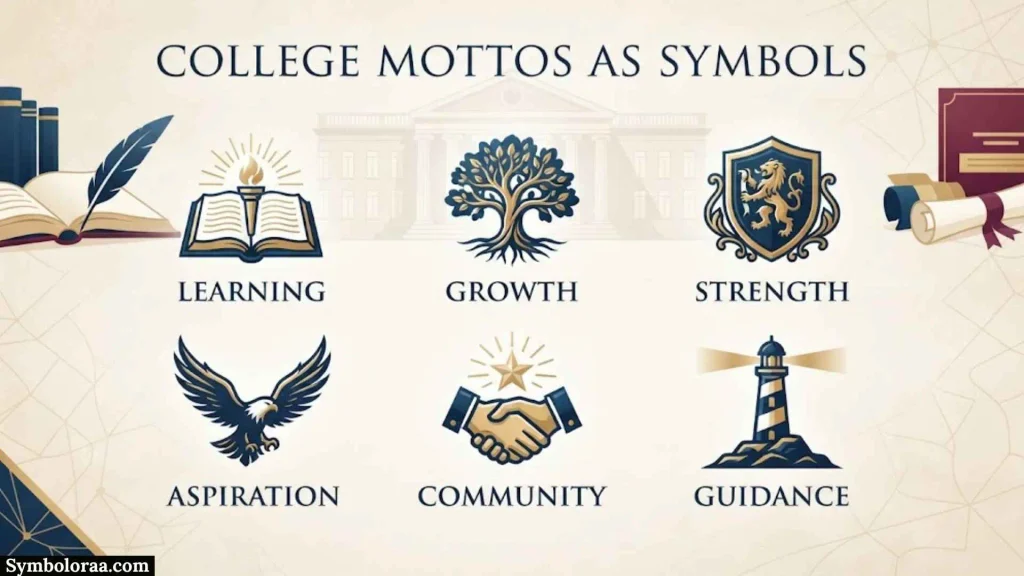
A college motto is a short statement that expresses an institution’s values, philosophy, mission, or educational purpose.
Common themes include:
- Knowledge
- Truth
- Service
- Leadership
- Excellence
- Discovery
- Community
- Responsibility
A motto can become part of a seal or crest and therefore function as part of the institution’s symbolic identity.
For example, the University of Colorado Boulder explains that the inscription on its seal translates to “Let Your Light Shine.”
Globe as a Symbol of Higher Education
A globe can represent:
- Global education
- International study
- Cultural exchange
- Worldwide responsibility
- International research
- Global citizenship
This symbol is particularly suitable when the subject involves international programs or worldwide academic collaboration.
Johns Hopkins provides a concrete example because its brand guide explains that the globe in its shield signifies the university’s worldwide reach and responsibility.
Quill Pen as an Academic Symbol
The quill pen is an older symbol associated with writing and scholarship.
It can represent:
- Literature
- Writing
- History
- Scholarship
- Communication
- Academic research
A quill may be particularly appropriate for a literature department, writing program, journalism project, historical society, or academic publication.
Unlike a college seal, however, a quill is usually a general academic symbol unless a particular institution has officially adopted it.
College Bell as a Symbol
A bell can represent:
- Classes
- Academic schedules
- Campus traditions
- Ceremonies
- Important milestones
- Community gatherings
The meaning is highly context-dependent.
A bell in a college illustration may simply suggest campus life, while a historic campus bell can have a much more specific institutional meaning.
Columns and Classical Architecture
Columns are common in traditional academic architecture and can therefore evoke:
- Heritage
- Stability
- Tradition
- Classical education
- Institutional continuity
Their meaning is usually contextual rather than official.
A college using columns in its visual identity may be referencing its architecture or a broader classical academic tradition.
Class Rings as College Symbols
A class ring is a personal symbol of college membership and achievement.
It can represent:
- A graduating class
- Institutional affiliation
- Academic achievement
- Campus memories
- Alumni identity
- Shared student experience
Class rings are particularly interesting because they sit between institutional symbolism and personal symbolism.
Real Example: Rice University Ring
Rice University states that its ring tradition dates to the inaugural graduating class of 1916, with the original rings featuring an owl. The university describes the ring as a long-standing tradition connecting graduates with the institution.
This demonstrates how an object can become a meaningful college symbol through repeated tradition rather than simply through graphic design.
College Symbols in Campus Architecture
College symbolism is not limited to logos.
Symbols can appear in:
- Buildings
- Doorways
- Statues
- Cornerstones
- Windows
- Gates
- Sculptures
- Libraries
- Courtyards
- Memorials
Rice University documents examples of campus symbols including owl sculptures, a cornerstone, writing-related architectural artwork, and other elements connected with university history.
This creates another important search-intent area: college symbols can be physical parts of a campus, not just images on a website.
Historical Development of College Symbols
College symbolism has developed over centuries.
Medieval Academic Roots
Academic regalia can be traced to medieval universities of the 11th and 12th centuries. Academic dress developed from clothing associated with scholars and teachers, and later systems created rules governing academic dress.
Development of Institutional Seals
As universities developed their own identities, seals became useful formal marks for identifying institutional authority, documents, and traditions.
The history of individual seals can vary greatly.
For example, Johns Hopkins adopted its academic seal in 1885, while the University of Colorado Boulder describes multiple seal designs throughout its history, including its current seal from 1908.
Modern College Branding
Modern institutions now use more than seals.
A contemporary identity system can include:
- Primary logo
- Wordmark
- Seal
- Secondary marks
- Mascot
- Spirit marks
- Color palette
- Typography
- Social-media graphics
Johns Hopkins describes separate primary, division, university, and spirit marks, while Rice distinguishes its shield, academic seal, owl, and athletics marks.
This shows how modern college symbolism combines historical tradition with modern branding.
Official College Symbols vs General Academic Symbols
This distinction is essential when researching or designing college-related graphics.
General Academic Symbols
These commonly include:
- Book
- Torch
- Graduation cap
- Diploma
- Laurel
- Owl
- Globe
- Quill
- Gown
Their meanings are broad and can be used to communicate education or achievement.
Official Institutional Symbols
These may include:
- Official seal
- Primary logo
- Wordmark
- Mascot
- School colors
- Institutional crest
- Spirit mark
- Official motto
Their use can be controlled by the specific college.
Why This Difference Matters
Using a general book icon in an educational presentation is different from reproducing a university’s official seal.
For example, Johns Hopkins says its academic seal may only be used with permission and cannot be altered, while Rice states that its academic seal is reserved for select purposes.
Therefore, symbolic meaning and legal or branding permission are separate questions.
College Logo and Trademark Considerations
If you are creating a college project, website, poster, merchandise, or social-media design, check whether the symbol belongs to a real institution.
Important questions include:
- Is the symbol an official logo?
- Is it a registered or protected institutional mark?
- Is the use educational, personal, editorial, or commercial?
- Does the college provide brand guidelines?
- Does the institution require permission?
- Are modifications prohibited?
Johns Hopkins, for example, states that its official logo elements cannot be altered and that individuals should use the official artwork supplied by the university.
Rice similarly provides separate usage rules for its shield, academic seal, owl, and athletics logos.
The safest approach is to consult the specific institution’s official brand or trademark guidelines before reproducing an official mark.
College Symbols for School Projects
Students often need college symbols for presentations, posters, essays, art projects, or educational assignments.
A simple way to choose symbols is to match the image to the idea.
| If Your Topic Is About… | Consider… |
| Learning | Open book |
| Knowledge | Torch or book |
| Wisdom | Owl |
| Graduation | Cap or diploma |
| Academic achievement | Laurel or medal |
| College history | Seal or crest |
| School spirit | Mascot |
| International education | Globe |
| Writing | Quill |
| Academic tradition | Gown or hood |
| Leadership | Medallion or ceremonial emblem |
| Alumni identity | Class ring |
The important step is to explain why the symbol fits the topic, rather than simply placing decorative images on the page.
College Symbols for Logo Design
When designing an original college-style logo, begin with the message rather than the artwork.
Step 1: Define the Identity
Decide whether the design should communicate:
- Traditional education
- Modern learning
- Research
- Community
- Achievement
- Global education
- School spirit
Step 2: Select One Primary Concept
For example:
Learning → book
Knowledge → torch
Wisdom → owl
Achievement → laurel
Global education → globe
Heritage → shield
Graduation → cap
Using one clear concept often produces a stronger visual message than combining many unrelated objects.
Step 3: Add Supporting Elements Carefully
A book could be combined with a torch.
A shield could contain a book.
A laurel wreath could surround an academic emblem.
A globe could be combined with an open book for an international education concept.
The supporting element should reinforce the main idea rather than compete with it.
Step 4: Keep the Design Recognizable
A useful college symbol should remain understandable when used as:
- Website icon
- Social-media image
- Printed document
- Poster
- T-shirt
- Sign
- Small digital graphic
Excessive detail can make a symbol difficult to recognize at small sizes.
College Symbols for Graduation Designs
If the purpose is a graduation announcement, poster, or social-media graphic, the most recognizable choices are:
- Graduation cap
- Diploma
- Tassel
- Gown
- Laurel wreath
- Class year
- School colors
- College initials
- Mascot
A formal graduation design can combine the institution’s approved identity elements with general academic imagery, but official brand rules should be checked first.
College Symbols for Sports and School Spirit
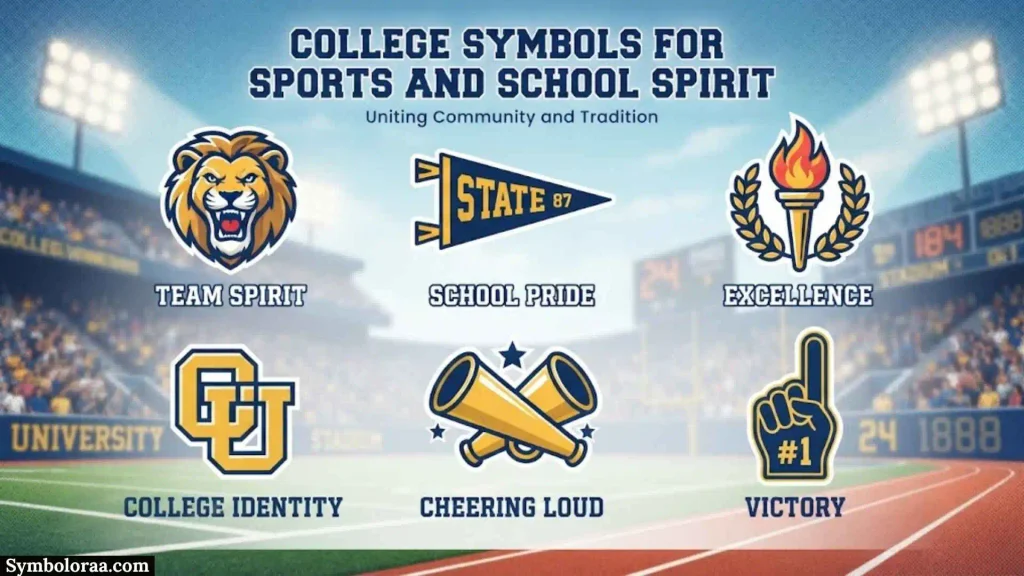
For athletics, the strongest visual elements are usually:
- Mascot
- Team logo
- School colors
- Athletic wordmark
- Pennant
- Team initials
Sports symbols emphasize identity, competition, and community more than academic learning.
Johns Hopkins, for example, distinguishes its academic and spirit marks and explains that its Blue Jay marks are intended to evoke school energy and athletic identity.
College Symbols for Tattoos and Personal Artwork
College symbols can also become personal reminders of an educational experience.
Common choices include:
- College initials
- Class year
- Mascot
- School colors
- Graduation cap
- College crest
- Class ring design
- Academic quote or motto
A personal design can represent graduation, friendship, academic achievement, or connection to a campus.
If the artwork reproduces an official logo or mascot, however, it is still wise to check the institution’s rules, particularly if the design will be sold or used commercially.
Common Mistakes When Interpreting College Symbols
Assuming Every Academic Image Is Official
A book may represent education without being an official symbol of any college.
Calling a Mascot a Seal
A mascot and a seal perform different functions. A mascot usually supports school spirit, while a seal is generally a formal institutional mark.
Assuming Colors Have Universal Meanings
A color may represent one academic discipline at one institution and something completely different elsewhere.
Treating Every Owl as a College Mascot
Owls have broad associations with wisdom and learning. Only some colleges officially use an owl as their mascot.
Copying an Institutional Logo
A college’s logo or seal may have specific usage restrictions. Always consult the institution’s brand guidelines before reproducing it.
Using Too Many Symbols
A design containing a book, torch, owl, globe, shield, cap, diploma, mascot, and several colors can become visually confusing.
Ignoring Historical Context
Some symbols have meanings that developed over many years. A symbol should be interpreted using reliable institutional or historical sources when its exact meaning matters.
A Simple Decision Guide for Choosing a College Symbol
Use this quick framework when you need to select a symbol.
What are you trying to represent?
↓
Learning or knowledge?
→ Choose a book or torch.
Wisdom or scholarship?
→ Consider an owl.
Graduation or degree completion?
→ Use a graduation cap or diploma.
Achievement or honor?
→ Consider a laurel wreath or medal.
Institutional history?
→ Consider an official seal or crest, if you have permission to use it.
School spirit?
→ Use the official mascot or spirit mark according to the institution’s guidelines.
Global education?
→ Consider a globe.
Academic tradition?
→ Consider academic regalia, a gown, hood, or ceremonial object.
This decision framework is useful because it starts with the meaning and only then selects the visual symbol.
How to Research the Meaning of a College Symbol
When the meaning of a specific university symbol is unclear, use this research process.
Start With the University’s Official Website
Look for:
- Brand guidelines
- University archives
- Commencement pages
- Alumni pages
- History pages
- Traditions pages
Official sources are especially valuable for institution-specific claims.
Look for the Symbol’s History
A university may explain:
- When the symbol was adopted
- Who designed it
- Why certain objects were selected
- How the symbol changed
- Where it is used today
For example, the University of Colorado Boulder provides historical information about several versions of its university seal.
Separate Documented Meaning From Interpretation
If an institution officially explains that a book represents knowledge, that is a documented interpretation.
If you personally think a shield “looks prestigious,” that is an interpretation rather than an official meaning.
Keeping these categories separate makes a symbol explanation more trustworthy.
Frequently Asked Questions About College Symbols
What Is the Most Common Symbol for College?
There is no single universal college symbol. Books, graduation caps, torches, seals, mascots, diplomas, and school colors are among the most recognizable symbols associated with higher education.
What Symbol Represents College Education?
An open book is one of the clearest general symbols of college education because it is associated with learning, reading, scholarship, and knowledge. A torch can also represent knowledge and enlightenment.
What Symbol Represents Graduation?
The graduation cap, academic gown, diploma, and tassel are widely recognized graduation symbols.
What Does a College Seal Represent?
A college seal generally represents institutional identity, history, values, authority, or heritage. The specific meaning depends on the institution’s own history and explanation.
What Is the Difference Between a College Seal and a Logo?
A seal is often a more formal institutional mark used for official or ceremonial purposes. A logo is generally designed for broader everyday identification and communication. Individual colleges establish their own rules.
What Does an Owl Represent in College Symbols?
An owl is commonly associated with wisdom, scholarship, and knowledge. Some universities also use owls as official mascots. Rice University is one documented example.
What Does a Torch Represent in College?
A torch commonly represents knowledge, enlightenment, learning, and guidance. Its exact meaning may differ according to the institution.
What Does a Laurel Wreath Represent in Education?
A laurel wreath can represent honor, achievement, recognition, and success. The University of Colorado Boulder specifically identifies laurel as representing honor or success within its seal.
What Does a Graduation Cap Symbolize?
A graduation cap generally symbolizes academic completion, achievement, scholarship, and the transition associated with graduation.
What Does an Academic Hood Represent?
An academic hood can communicate information about the degree, discipline, and institution. In some academic-regalia systems, different colors identify different disciplines and institutions.
What Does an Academic Gown Represent?
The academic gown is part of the historical tradition of university dress and can represent scholarship, academic membership, and degree achievement. Its form and decoration can vary by degree and institution.
What Does a College Mascot Represent?
A mascot generally represents school spirit, community, athletics, tradition, and institutional identity rather than academic learning alone.
Do College Colors Have Standard Meanings?
Not always. Institutional colors are primarily part of a college’s visual identity. Academic-regalia colors may have more specific meanings within particular systems, but those meanings are not universal across every institution.
Can I Use a College Logo for a School Project?
Possibly, depending on the institution, purpose, and circumstances. Official logos, seals, and mascots may have usage rules. Check the specific college’s official brand or trademark guidance before reproducing or modifying the mark.
Are College Symbols the Same as University Symbols?
They can be similar. Both colleges and universities may use seals, logos, mascots, colors, mottos, academic regalia, and other symbols. The terminology depends on the institution and educational system.
Why Do Colleges Have So Many Different Symbols?
Different symbols serve different purposes. A seal may be formal, a logo may support everyday communication, a mascot may represent athletics and school spirit, and academic regalia may serve ceremonial purposes.
What Is the Best Symbol for a College Logo?
The appropriate symbol depends on the identity the logo needs to communicate. A book can emphasize learning, a torch can suggest knowledge, a shield can suggest heritage, and a mascot can emphasize community or school spirit. For an existing college, its official brand system should take priority over creating a new interpretation.
Key Takeaways About College Symbols
- College symbols can represent learning, achievement, heritage, community, identity, and school spirit.
- A book commonly represents knowledge and education.
- A torch can represent knowledge, enlightenment, and discovery.
- An owl can represent wisdom and scholarship and may also serve as a mascot.
- A graduation cap represents academic completion and graduation.
- A diploma represents an earned academic qualification.
- A laurel wreath can represent achievement, honor, or success.
- An academic gown and hood belong to a long tradition of university regalia.
- A college seal is generally more formal than an everyday logo.
- A mascot primarily supports school identity and spirit.
- School colors help create recognizable institutional branding.
- Class rings can become lasting symbols of student and alumni identity.
- Academic symbolism has roots reaching back to medieval university traditions.
- Official institutional symbols can have specific usage restrictions.
- General academic symbols and official college marks should not be treated as the same thing.
Conclusion
College symbols form a broad visual language that connects education, achievement, tradition, identity, and community. Some symbols have general academic meanings: an open book can represent learning, a torch can suggest knowledge, a graduation cap can represent completion, and a laurel wreath can represent achievement.
Other symbols are much more specific. A college seal, official logo, mascot, school color system, or spirit mark can represent a particular institution and may be governed by formal brand guidelines. Examples from Johns Hopkins, Rice University, Stanford, and the University of Colorado Boulder show how individual universities give their symbols meanings connected to their own histories and missions.
Academic regalia adds another layer. Gowns, caps, hoods, ceremonial maces, and medallions connect modern college ceremonies with much older academic traditions.
When choosing or interpreting a college symbol, the most reliable approach is to start with purpose and context. Ask whether the symbol is meant to represent knowledge, graduation, achievement, school spirit, heritage, or a specific institution. Then verify the symbol’s documented meaning and, when using an official institutional mark, check the college’s current brand or trademark guidelines.

I’m Jackson Miller, an American author inspired by mystery, adventure, and the unpredictable nature of life. I enjoy writing fast-moving stories filled with memorable characters, unexpected choices, and meaningful moments. Through my books, I want readers to experience new worlds while discovering something about courage, determination, and themselves.
Three Books:
The Edge of Tomorrow
Under a Broken Sky
The Road We Chose
 Ethan Brooks