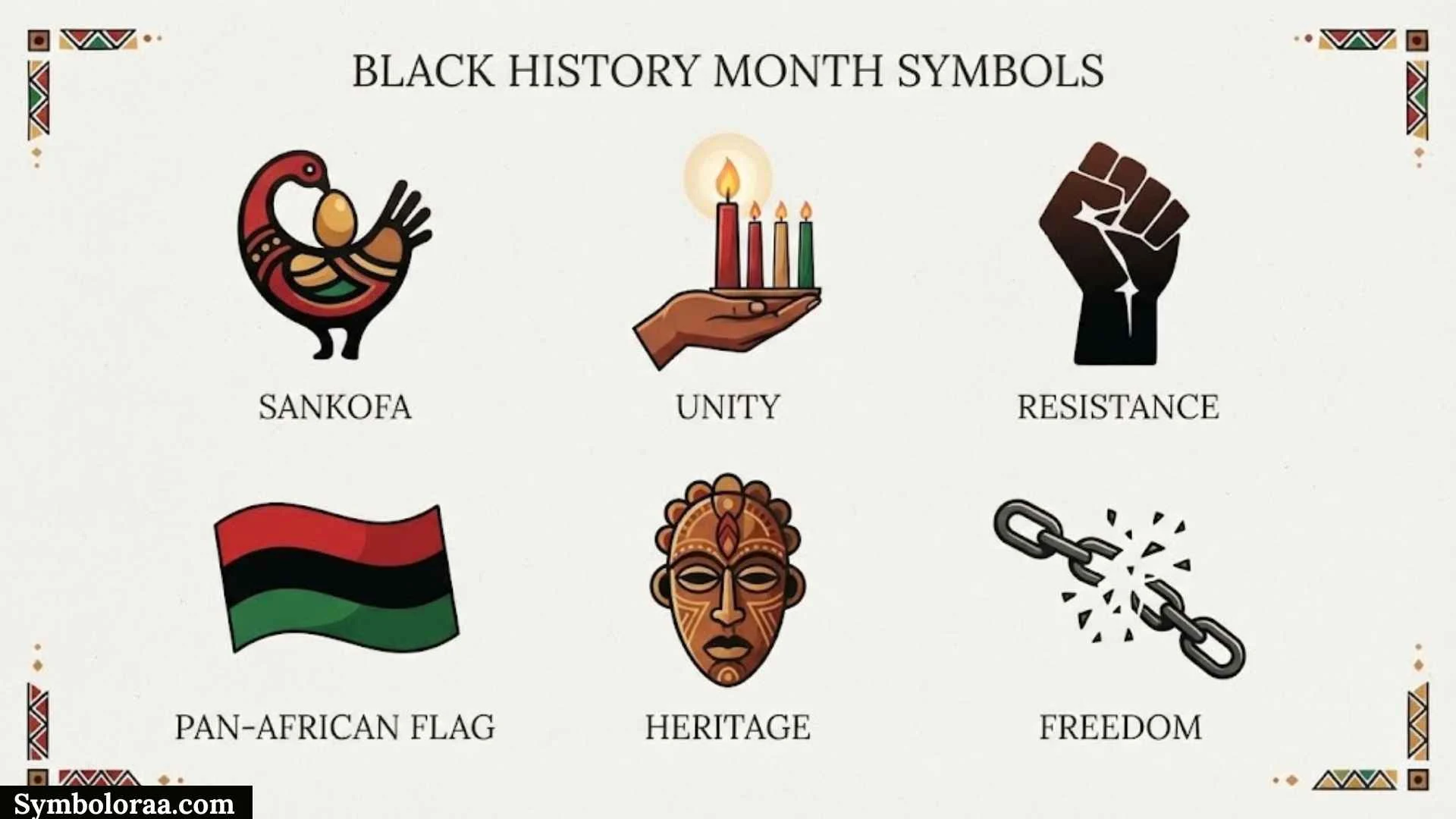
Black History Month symbols are widely used to represent African American history, heritage, culture, achievement, remembrance, freedom, identity, and community. Common visual elements include Pan-African colors, flags, raised-fist symbols, African imagery, books, stars, hearts, historical figures, and decorative designs. Some are closely connected to Black history, while others have broader African or Pan-African meanings.
There is no single Unicode character that officially represents Black History Month. Instead, people use a combination of text symbols, emoji, colors, artwork, flags, and graphics depending on the message they want to communicate. This makes it useful to understand the difference between a general symbol, a cultural symbol, a historical flag, and an official annual Black History Month graphic.
This guide explains Black History Month symbols and meanings in detail, including African American symbols, the Black History Month flag, the 2026 theme and logo, older 2021 references, transparent PNG graphics, and copy-and-paste symbols. It also explains how to use these symbols accurately in social media posts, school projects, websites, presentations, posters, and other designs.
Black History Month Symbols And Meanings
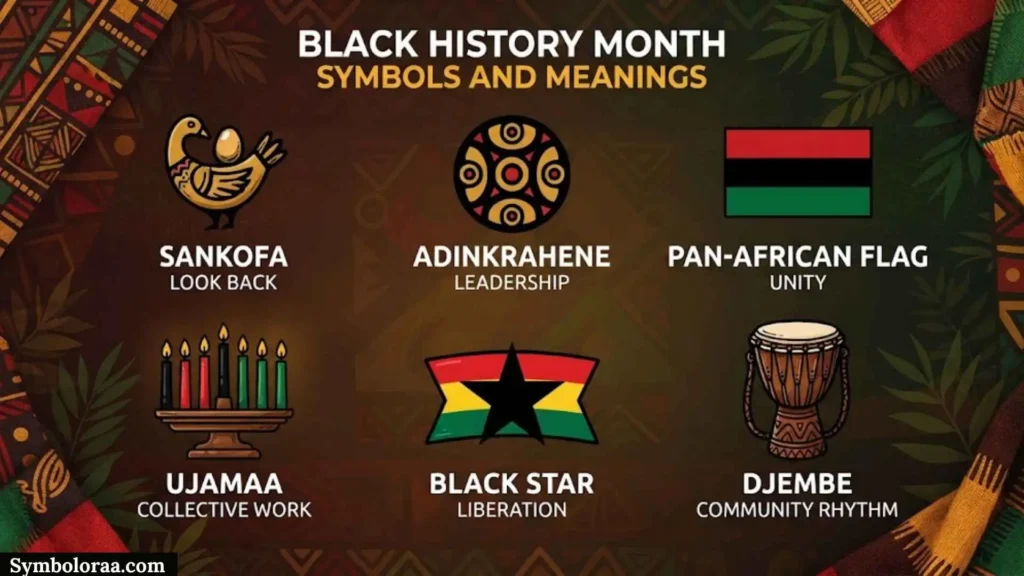
Black History Month does not have one universally recognized Unicode symbol or one single symbol that represents every part of Black history. Instead, different visual elements are used to express different ideas such as heritage, education, freedom, achievement, remembrance, solidarity, and cultural pride.
The history of Black History Month is closely connected to historian Carter G. Woodson. The first Negro History Week was established in 1926, and the observance eventually developed into Black History Month. In 1976, President Gerald Ford recognized the month-long observance.
Because Black History Month covers many subjects, its symbols also vary.
Common Black History Month Symbols
| Symbol | Common Meaning Or Use |
| 🖤 | Black heart; love, remembrance, pride, support, or solidarity |
| ✊🏿 | Raised fist; strength, solidarity, resistance, or liberation |
| ★ | Achievement, excellence, recognition, or decoration |
| ♡ | Love, care, appreciation, or remembrance |
| 🌍 | Africa, global heritage, ancestry, or the African diaspora |
| 📚 | Education, history, learning, and scholarship |
| 👑 | Dignity, leadership, pride, or achievement |
| ✨ | Celebration, recognition, or emphasis |
| 🖤❤️💚 | Pan-African-inspired color combination |
| ✓ | Confirmation, recognition, or decorative list element |
These are not all official Black History Month symbols. Many are ordinary Unicode characters or emoji that can take on a Black History Month-related meaning when they are used with appropriate text and imagery.
For example, 🖤 can represent many different emotions in everyday communication. When combined with a message about African American history, it may communicate remembrance, pride, love, or solidarity.
Copy-And-Paste Black History Month Symbols
If you need simple symbols for a caption, message, heading, or design, these can be copied directly:
🖤 ✊🏿 ★ ♡ 🌍 📚 👑 ✨
You can also combine them with text:
★ Black History Month ★
🖤 Black History Month ✊🏿
✊🏿 Black History • Heritage • Culture 🖤
❤️ Black History Month 💚
The appearance of emoji can vary between devices and operating systems. A Unicode character may look slightly different on an iPhone, Android phone, Windows computer, or another platform.
Black History Month Symbols For Social Media
For social media, short combinations usually work better than large collections of symbols. A raised-fist emoji can emphasize solidarity, while a black heart can add a commemorative or supportive tone.
Examples include:
- 🖤✊🏿 Black History Month
- ★ Black Excellence ★
- ✊🏿 Heritage • History • Strength
- 🖤 History • Culture • Community
- 🌍 African Heritage 🌍
The words around a symbol are important because a symbol by itself may have several meanings.
African American Symbols And Meanings
African American symbols come from many different historical, cultural, artistic, and social traditions. There is no single symbol that represents every African American person or experience.
Some symbols are connected with African heritage, while others developed through African American history in the United States. Their meanings should therefore be understood in context.
Pan-African Colors
Red, black, and green are strongly associated with Pan-African identity. The Smithsonian’s National Museum of African American History and Culture explains that Marcus Garvey associated these colors with people of the African diaspora. In the Smithsonian’s explanation of Kwanzaa symbolism, red represents the struggle, black represents the people, and green represents the future.
These colors are frequently seen in Black History Month artwork:
- Red — Often connected with struggle, sacrifice, and historical resistance.
- Black — Associated with Black people and African heritage.
- Green — Often associated with the future, growth, land, or hope.
These meanings can vary according to the specific tradition or artwork, so they should not be treated as universal definitions for every use.
Raised Fist Symbol
The raised fist is one of the most recognizable symbols associated with solidarity and collective strength. It has been used by different political, social, and cultural movements, meaning its exact interpretation depends on the context.
The emoji ✊🏿 provides a skin-tone variation of the raised-fist character for digital communication. It can be useful in Black History Month captions, but it is not an official Unicode symbol specifically created for Black History Month.
African Continent Symbol
An outline or silhouette of Africa is often used in artwork related to African heritage, ancestry, African identity, and the African diaspora.
Unlike a text character such as ★ or 🖤, an Africa silhouette is normally an image, icon, SVG, or graphic. That means it cannot generally be copied and pasted as ordinary Unicode text.
Books And Education
Books are particularly suitable for Black History Month educational content because the observance has a strong connection to the study and teaching of African American history.
Useful symbols include:
📚 — books and learning
📖 — reading and education
✎ — writing or study
🎓 — education and academic achievement
These symbols work well in classroom posters, history projects, educational articles, presentations, and school social media graphics.
Historical Figures And Portraits
Images of influential African American figures are another common visual element. Portraits can represent particular achievements, movements, periods, or areas of history.
However, a portrait of one person should not automatically be described as a universal symbol of Black History Month. It is more accurate to identify the person and explain the historical connection.
Black History Month Flag
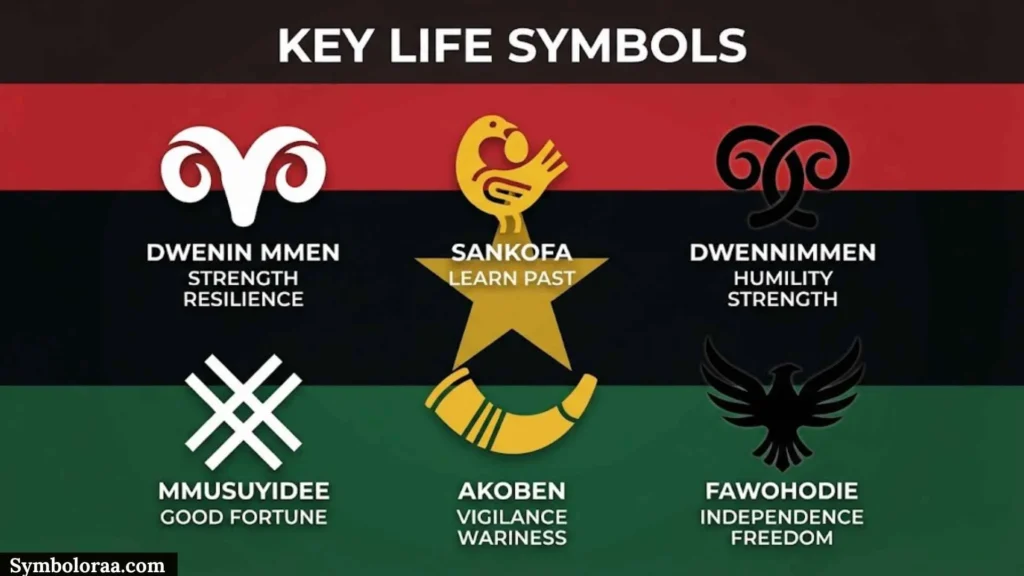
The phrase “Black History Month flag” can refer to several different designs. There is not one universally designated flag that serves as the official flag of Black History Month.
The Pan-African flag is commonly used in Black History Month designs because its red, black, and green colors have a long association with African and African-diaspora identity. Another important design is David Hammons’s alternative Flag, a specific artwork created in 1990.
Pan-African Flag
The Pan-African flag uses three horizontal colors:
🟥 Red
⬛ Black
🟩 Green
The colors have been interpreted in different ways, but the Smithsonian identifies red with struggle, black with the people, and green with the future in its discussion of Pan-African colors used in Kwanzaa.
Because of its history and visual identity, the Pan-African flag frequently appears in Black History Month posters, banners, educational graphics, and social media designs.
African-American Flag By David Hammons
David Hammons created the African-American Flag in 1990. The artwork uses the familiar stars-and-stripes structure of the United States flag but replaces its traditional colors with green, red, and black. It also uses black stars on a green canton.
The Smithsonian explains that Hammons’s artwork brings together elements of the Pan-African flag and the American flag. The combination can be understood in relation to Black identity, heritage, freedom, American identity, and the history of African Americans in the United States.
This artwork should not be confused with the Pan-African flag. They are related visually, but they are separate designs with different histories.
Black History Month Flag Ideas
For an original Black History Month design, creators often combine:
- Red, black, and green colors
- Stars
- African continent imagery
- Raised fists
- Books
- Historical photographs
- “Black History Month” lettering
- The annual theme
- Decorative borders
If you are using a historical artwork such as Hammons’s African-American Flag, check the applicable rights and permissions before reproducing it commercially. The Smithsonian collection record identifies copyright restrictions for the artwork.
Black History Month Logo 2026
For 2026, the official national theme from the Association for the Study of African American Life and History (ASALH) is “A Century of Black History Commemorations.” The theme marks a century of national Black history commemorations, tracing the history of Negro History Week established in 1926.
This makes 2026 especially significant for people searching for a Black History Month logo 2026, because current designs may include the centennial theme rather than older annual themes.
2026 Black History Month Theme
A Century of Black History Commemorations
The theme looks back at the development of organized Black history commemorations from Negro History Week to the modern observance of Black History Month. ASALH’s 2026 theme materials connect the centennial with Carter G. Woodson and the long tradition of studying, teaching, preserving, and commemorating Black history.
2026 Logo And Graphic Resources
When searching for a 2026 Black History Month logo, it is useful to distinguish between:
- Official ASALH theme graphics
- School-created logos
- Business promotional designs
- Social media templates
- Generic Black History Month logos
- Historical logos from previous years
ASALH provides official materials connected with the 2026 theme. Its materials identify “A Century of Black History Commemorations” as the 2026 theme.
A graphic should not be described as an official 2026 logo simply because it contains the words “Black History Month 2026.” If authenticity matters, use the organization’s own published materials.
2026 Black History Month Design Ideas
For a modern 2026 design, you can combine the theme with:
A Century Of Black History Commemorations
1926 → 2026
100 Years Of Black History Commemorations
A simple design can use red, black, and green accents alongside a historical photograph, educational imagery, or typography. The annual theme should remain clearly separated from decorative elements so readers can identify the official wording.
Black History Month Symbols 2021
The search phrase “Black History Month symbols 2021” usually indicates interest in older Black History Month graphics, logos, posters, icons, or designs created for the 2021 observance.
Historical material can still be useful, especially when researching how Black History Month was represented visually during a particular year. However, a 2021 design should not be presented as a current 2026 logo.
2021 Black History Month Graphics
Older designs may include:
- Black History Month lettering
- African continent graphics
- Pan-African colors
- Historical portraits
- Raised fists
- Stars
- Books
- African-inspired patterns
- Year-specific typography
The important point is to label older material with its year.
For example, “Black History Month Symbols 2021” clearly identifies the content as historical, while “Black History Month Symbols 2026” suggests current material.
Why Year-Specific Symbols Matter
Annual Black History Month themes can change. ASALH’s 2026 theme is different from the themes used in previous years, so an older logo or poster may contain wording that is no longer current.
If you are creating a website article, archive, classroom presentation, or historical collection, keeping the year visible prevents confusion.
Black History Month Symbols Transparent
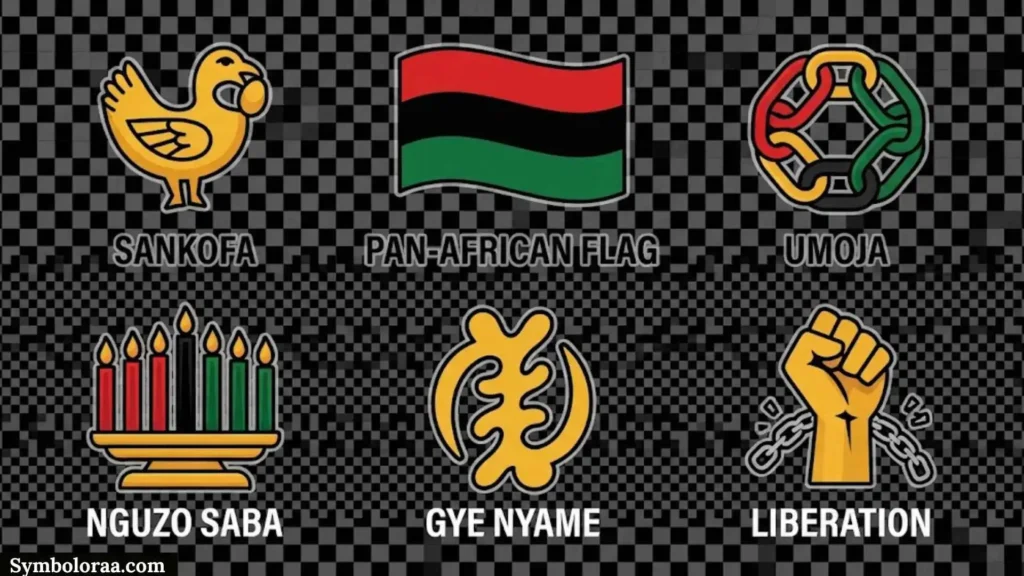
Transparent Black History Month symbols are useful when you need to place a design over another background. A transparent PNG can be layered on photographs, colored backgrounds, posters, websites, presentations, and social media graphics without displaying a solid rectangular background.
Common transparent graphics include:
- Black History Month lettering
- African continent silhouettes
- Raised-fist illustrations
- Pan-African color designs
- Stars
- Hearts
- Historical portraits
- Decorative borders
- Books and education icons
- 2026 theme graphics
Transparent PNG Vs Unicode Symbol
A transparent PNG and a Unicode symbol are completely different types of content.
A Unicode symbol is a text character that can be copied and pasted:
★ ✊🏿 🖤 ♡ 🌍 📚
A transparent PNG is an image file containing transparent areas. It is normally uploaded into an image editor, website, presentation, or design program.
For example:
★ Black History Month ★
is ordinary text.
A transparent Black History Month logo containing decorative lettering is an image that can be positioned over another design.
Best Uses For Transparent Graphics
Transparent symbols are useful for:
- Social media posts — Layer graphics over photos or colored backgrounds.
- School projects — Add visual elements to presentations and worksheets.
- Event flyers — Combine symbols with dates, locations, and event information.
- Website banners — Place decorative elements beside or behind text.
- Posters — Build a layered composition without a white image box.
- Video thumbnails — Add decorative symbols without covering the entire background.
Transparent Black History Month Symbols For WordPress
If you are adding transparent graphics to a WordPress website, PNG images with transparent backgrounds can be useful for banners, featured graphics, article sections, and decorative elements.
Before uploading, check the image dimensions and file size. A very large PNG can make a webpage heavier than necessary. Compressing an image while preserving transparency can help reduce unnecessary file weight.
Also check the copyright or license. Transparent describes the background of an image; it does not mean the image is automatically free to copy or publish.
Text Symbols Vs Image Symbols
Choose a Unicode symbol when you need something that works directly inside text, such as a social media caption or heading.
Choose a transparent image when you need a specific visual design, custom typography, African continent artwork, a flag graphic, or a detailed illustration.
Using the correct format makes your content easier to edit and more practical across different platforms.
FAQ
What are the most common Black History Month symbols?
Common visual elements include Pan-African colors, raised fists, African continent imagery, books, stars, hearts, historical portraits, and flags. There is no single Unicode character that officially represents the entire observance.
What do red, black, and green mean in Black History Month designs?
The colors are strongly associated with Pan-African identity. Common interpretations connect red with struggle, black with the people, and green with the future. Meanings can vary by cultural context.
Is there an official Black History Month flag?
There is no single universally designated Black History Month flag. The Pan-African flag is frequently used, while David Hammons’s African-American Flag is a separate 1990 artwork that combines Pan-African and American flag elements.
What is the Black History Month theme for 2026?
ASALH’s 2026 theme is “A Century of Black History Commemorations.” The theme recognizes a century of national Black history commemorations beginning with Negro History Week in 1926.
Can I copy and paste Black History Month symbols?
Yes. General Unicode and emoji characters such as 🖤, ✊🏿, ★, ♡, 🌍, and 📚 can be copied and pasted into many compatible apps and websites. Their exact appearance may vary between platforms.
Conclusion
Black History Month symbols provide simple visual ways to communicate history, heritage, education, remembrance, pride, solidarity, and cultural identity. Popular choices include Pan-African colors, raised-fist emoji, books, stars, hearts, African imagery, flags, and historical artwork.
It is useful to understand the difference between these elements. The Pan-African flag has its own history, while David Hammons’s African-American Flag is a specific artwork that combines Pan-African colors with the structure of the U.S. flag. Likewise, the 2026 Black History Month theme is distinct from general decorative logos and symbols.
For text-based content, copy-and-paste characters such as 🖤 ✊🏿 ★ ♡ 🌍 are convenient for captions, messages, and headings. For posters, websites, and professional designs, transparent PNGs and properly licensed graphics offer more flexibility. Choosing symbols according to their real history and context helps keep Black History Month content both useful and accurate.

I’m Jackson Miller, an American author inspired by mystery, adventure, and the unpredictable nature of life. I enjoy writing fast-moving stories filled with memorable characters, unexpected choices, and meaningful moments. Through my books, I want readers to experience new worlds while discovering something about courage, determination, and themselves.
Three Books:
The Edge of Tomorrow
Under a Broken Sky
The Road We Chose
 Ethan Brooks