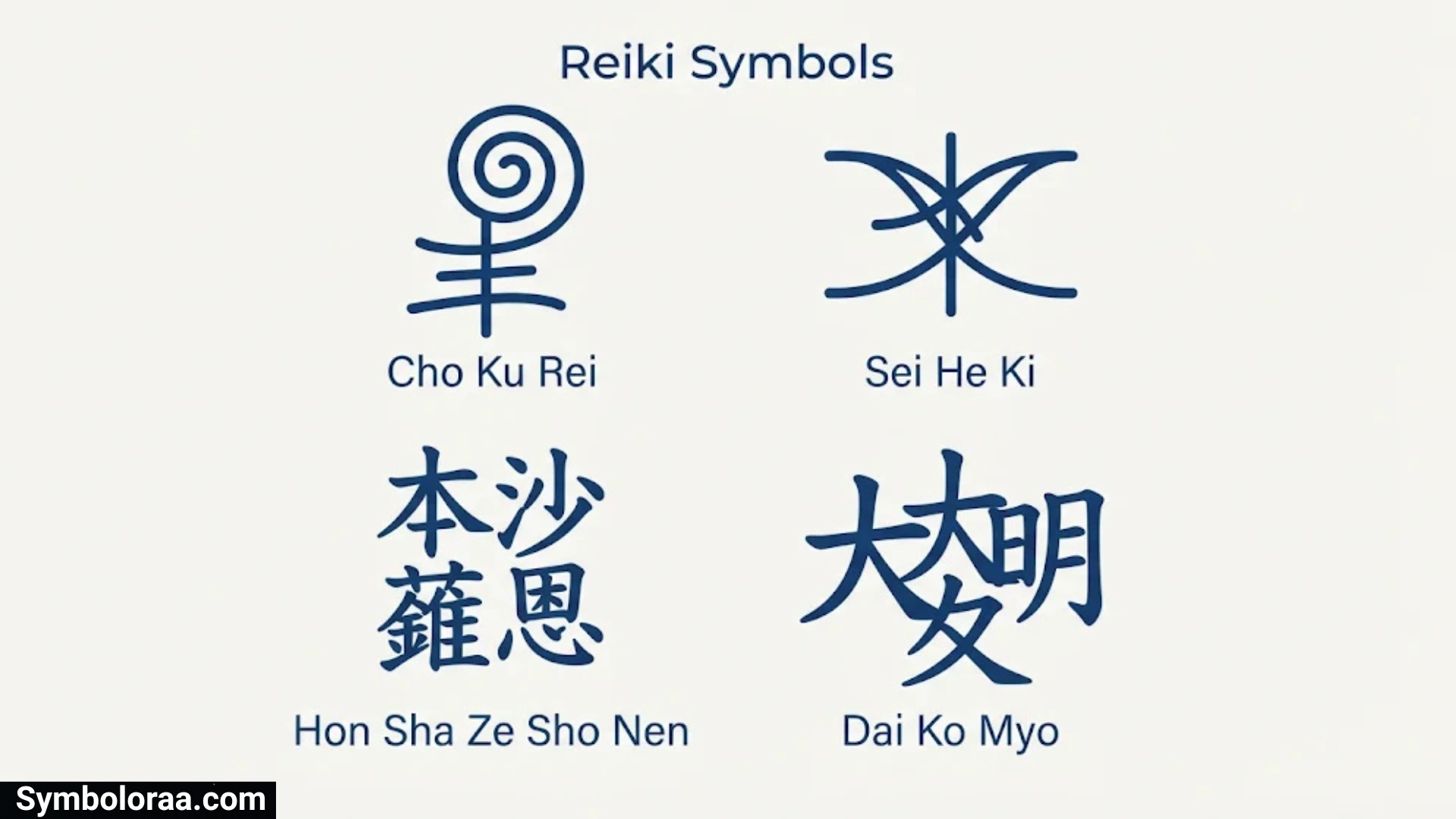
Reiki symbols hold an important place in the practice of Reiki healing. Practitioners use these symbols to focus their intentions, support meditation, and guide different aspects of their spiritual practice. Each symbol carries a traditional meaning and serves a particular purpose within the Reiki system.
Whether you’re new to Reiki or already practicing it, understanding these symbols can help you appreciate their role in this Japanese healing tradition. From the Cho Ku Rei power symbol to the Hon Sha Ze Sho Nen distance symbol, each one has its own history, interpretation, and traditional application.
However, not every Reiki tradition teaches the same symbols. The commonly taught Usui system includes four principal symbols, while some Western and Tibetan-influenced traditions also teach Raku as an additional symbol.
This guide explores the five Reiki symbols, their meanings, traditional uses, origins, and relationship to Reiki training. You’ll also learn how practitioners draw, visualize, activate, and combine these symbols during Reiki sessions.
What Are Reiki Symbols?
Reiki symbols are visual representations used in Reiki practice to focus attention and intention. Practitioners traditionally associate each symbol with a particular aspect of Reiki, such as power, emotional harmony, distance healing, or spiritual development.
The word Reiki comes from two Japanese terms:
- Rei: Often translated as universal or spiritual.
- Ki: Refers to life energy or vital energy.
Together, Reiki is commonly interpreted as universal life energy. This concept forms the foundation of the traditional Reiki belief that an unseen energy supports life and well-being.
Developed by Mikao Usui in Japan during the early twentieth century, Usui Reiki combines spiritual principles, meditation, hand placements, and other practices. Symbols later became important tools within its teaching systems.
Why Do Reiki Practitioners Use Symbols?
Reiki practitioners use symbols to give structure and direction to their practice. Each symbol has a specific traditional association that helps the practitioner focus on a particular intention.
For example, a practitioner might use Cho Ku Rei when focusing on a particular area during a session. Sei He Ki is traditionally associated with emotional and mental harmony. Hon Sha Ze Sho Nen is used in distance Reiki practices.
Common purposes include:
- Focusing attention during Reiki treatments.
- Supporting meditation and visualization.
- Setting intentions for a session.
- Practicing traditional distance Reiki.
- Supporting emotional and spiritual reflection.
- Incorporating specific techniques into advanced Reiki training.
These uses reflect traditional Reiki teachings. They don’t establish that symbols produce measurable energy or treat medical conditions.
Are Reiki Symbols Sacred?
Many Reiki teachers consider symbols sacred because they form part of a student’s spiritual training. Traditionally, some teachers introduced them during specific Reiki courses rather than sharing them with beginners.
This practice reflects the belief that students should learn the symbols alongside their meanings, techniques, and associated training.
However, confidentiality isn’t universal. Some Reiki teachers openly share symbols in books and educational materials. Others prefer to preserve the traditional teacher-to-student approach.
How Many Reiki Symbols Are There?
The number of Reiki symbols depends on the tradition being practiced.
The commonly taught Western Usui system includes four principal symbols. Three are generally introduced during Level 2 training, while the fourth appears in Master-level training.
Some Reiki schools also teach Raku, which is associated with completion and grounding.
| Reiki symbol | Common name | Traditional association | Common training level |
| Cho Ku Rei | Power Symbol | Focus and concentration | Level 2 |
| Sei He Ki | Harmony Symbol | Mental and emotional harmony | Level 2 |
| Hon Sha Ze Sho Nen | Distance Symbol | Distance Reiki | Level 2 |
| Dai Ko Myo | Master Symbol | Spiritual development | Master Level |
| Raku | Completion Symbol | Grounding and completion | Certain advanced traditions |
An important historical distinction: Raku isn’t one of the four principal symbols in the commonly taught Usui system. Its use is associated with particular later Reiki traditions, including Tibetan-influenced approaches.
There are also historical differences surrounding Dai Ko Myo. Some Western Usui lineages teach it as the fourth principal symbol, while accounts of earlier Japanese Reiki training describe a different approach to master-level instruction.
Therefore, it’s helpful to understand which Reiki lineage a particular teacher follows.
The Five Reiki Symbols and Their Meanings
Each Reiki symbol represents a different concept within the spiritual framework of Reiki. Understanding their traditional meanings makes it easier to recognize why practitioners use them in different situations.
Let’s explore all five symbols individually.
Cho Ku Rei: The Reiki Power Symbol
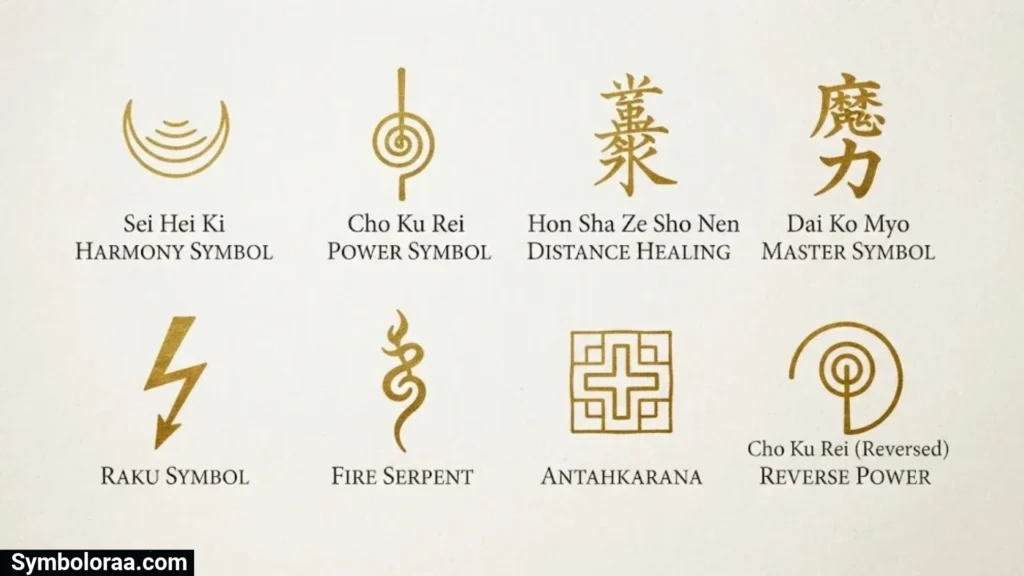
Cho Ku Rei is commonly known as the Reiki Power Symbol. It is associated with focusing Reiki energy and strengthening the practitioner’s intention during a session.
Among the commonly taught Reiki symbols, Cho Ku Rei is often one of the first symbols students learn during Level 2 training.
What Does Cho Ku Rei Mean?
Cho Ku Rei is a Japanese phrase whose interpretation varies depending on translation and teaching tradition.
A common interpretation is “Place the power of the universe here.”
This interpretation reflects its traditional association with concentration, focus, and directing attention toward a particular purpose.
Practitioners often describe Cho Ku Rei as a way to bring greater focus to their Reiki practice.
Traditional Uses of Cho Ku Rei
Cho Ku Rei has several applications within Reiki traditions.
Common traditional uses include:
- Focusing Reiki energy: Practitioners use the symbol when concentrating on a specific area during a session.
- Symbolic protection: Some practitioners visualize it when preparing a treatment space.
- Grounding: It may accompany meditation or other grounding practices.
- Session preparation: Practitioners sometimes use it at the beginning of a Reiki session.
- Session completion: Some teachers recommend it when bringing a session to an end.
- Self-treatment: Students may incorporate it into their personal Reiki routines.
These applications describe spiritual practices rather than proven physical effects.
How Is Cho Ku Rei Used?
Practitioners commonly incorporate Cho Ku Rei through three methods:
Drawing: The practitioner traces the symbol in the air or over their palms using a finger or hand.
Visualization: The practitioner imagines the symbol while focusing on a particular intention.
Mantra repetition: The practitioner repeats the symbol’s associated name as part of the exercise.
Some teachers also explain clockwise and counterclockwise variations. However, these variations don’t have one universally accepted interpretation across all Reiki lineages.
When Do Practitioners Choose Cho Ku Rei?
A practitioner might choose Cho Ku Rei when they want to:
- Begin a Reiki session with focused intention.
- Concentrate on a particular hand position.
- Include symbolic protection in their routine.
- Support a personal meditation practice.
- Combine a power-focused symbol with another Reiki symbol.
Cho Ku Rei is frequently combined with Sei He Ki and Hon Sha Ze Sho Nen in Western Reiki teachings.
Sei He Ki: The Mental and Emotional Harmony Symbol
Sei He Ki is commonly known as the Mental and Emotional Symbol or Harmony Symbol.
It represents mental and emotional harmony within traditional Reiki teachings. Practitioners use it when focusing on emotional concerns, thought patterns, and personal reflection.
What Does Sei He Ki Mean?
The name Sei He Ki is Japanese. Its exact interpretation can vary across different translations and Reiki schools.
It is commonly associated with harmony, balance, and the relationship between the mind and emotions.
The symbol is traditionally used to focus on the emotional and mental aspects of a Reiki session.
Traditional Uses of Sei He Ki
Practitioners associate Sei He Ki with several areas of personal and spiritual development.
These include:
- Emotional balance: Setting intentions around emotional awareness and stability.
- Mental clarity: Supporting reflective meditation and focused attention.
- Negative thought patterns: Working with unwanted thinking habits through personal reflection.
- Stress management: Incorporating the symbol into relaxation practices.
- Personal habits: Focusing on intentions related to changing unwanted behaviors.
- Self-awareness: Encouraging a deeper understanding of emotional responses.
Some practitioners also associate Sei He Ki with creativity, intuition, and affirmations.
However, it shouldn’t be presented as a proven treatment for depression, anxiety, addiction, or psychological trauma.
How Is Sei He Ki Used in Reiki?
Practitioners generally use the symbol through visualization, drawing, or mantra repetition.
For example, someone might incorporate Sei He Ki into a self-Reiki session while reflecting on a stressful experience.
The practitioner may:
- Prepare a quiet space for the session.
- Set an intention related to emotional well-being.
- Visualize or draw Sei He Ki according to their training.
- Repeat its name if that forms part of their tradition.
- Continue with their usual Reiki hand positions.
- Spend a few moments reflecting on the experience.
The process offers a structured spiritual exercise rather than a guaranteed emotional outcome.
Sei He Ki and Emotional Healing
Many Reiki practitioners associate this symbol with emotional reflection.
For example, someone experiencing everyday stress might use it during meditation while focusing on patience, acceptance, or gratitude.
The symbol provides a visual point of focus. Its traditional meaning also gives the practitioner a framework for exploring personal emotions.
However, Reiki doesn’t replace psychotherapy, counseling, or appropriate medical care. People dealing with serious emotional distress should seek support from qualified professionals.
Hon Sha Ze Sho Nen: The Reiki Distance Symbol
Hon Sha Ze Sho Nen is commonly called the Distance Healing Symbol.
It has a special place in Level 2 Reiki training because practitioners traditionally use it when performing distance or absentee Reiki.
Unlike an in-person session, distance Reiki doesn’t require the practitioner and recipient to occupy the same physical location.
What Does Hon Sha Ze Sho Nen Mean?
Hon Sha Ze Sho Nen consists of Japanese characters, and its interpretation varies among teachers and translations.
A common spiritual interpretation is:
“Neither past, present, nor future.”
This interpretation reflects the traditional Reiki belief that distance practice can extend beyond ordinary physical separation.
The symbol is also associated with the idea that spiritual connection isn’t limited by geographical distance.
Traditional Uses of Hon Sha Ze Sho Nen
Practitioners commonly associate this symbol with:
- Distance Reiki sessions.
- Absentee Reiki treatments.
- Setting intentions for someone in another location.
- Spiritual reflection on past experiences.
- Preparing intentions for future situations.
- Practicing Reiki without physical contact.
Some traditions also teach its use for working with memories, personal experiences, and inner-child reflection.
These applications belong to Reiki’s spiritual framework. There is no established scientific evidence that the symbol transmits healing energy across physical distances.
How Do Practitioners Use the Distance Symbol?
Hon Sha Ze Sho Nen is usually introduced during Level 2 Reiki training.
A practitioner may follow these general steps:
- Prepare for the distance Reiki session.
- Establish a clear intention.
- Identify the intended recipient according to the teaching method.
- Visualize or draw Hon Sha Ze Sho Nen.
- Follow the distance Reiki technique taught by their instructor.
- Complete the session according to their lineage.
Some practitioners use a photograph, written name, or another symbolic representation as a focus.
The exact procedure differs between Reiki schools.
How Does Distance Reiki Work According to Traditional Beliefs?
Traditional Reiki teachings describe distance Reiki as a practice that isn’t restricted by physical location.
Practitioners believe they can direct Reiki toward someone who isn’t physically present.
For example, a practitioner might arrange a session for someone living in another city. They would follow their usual distance Reiki method while holding the recipient in mind.
The practice can be meaningful as a spiritual or relaxation ritual. However, scientific research hasn’t established that Reiki symbols transmit energy or produce healing effects over distance.
Dai Ko Myo: The Reiki Master Symbol
Dai Ko Myo is commonly called the Reiki Master Symbol.
It holds an important place in many Western Usui Reiki traditions. Teachers generally introduce it during advanced or Master-level training.
The symbol is associated with spiritual development, awareness, and Reiki mastery.
What Does Dai Ko Myo Mean?
Dai Ko Myo is commonly translated as “Great Bright Light.”
The phrase carries spiritual meaning in Japanese Buddhist contexts and is associated with enlightenment and the recognition of one’s true nature.
Within Reiki, practitioners interpret it as a symbol of spiritual awareness and advanced practice.
Its traditional meaning extends beyond ordinary physical well-being.
Traditional Uses of Dai Ko Myo
Practitioners commonly associate Dai Ko Myo with:
- Spiritual development: Supporting meditation and spiritual reflection.
- Master-level practice: Incorporating the symbol into advanced Reiki sessions.
- Attunement ceremonies: Using it in traditions that include the symbol in Reiki initiation.
- Personal awareness: Focusing on spiritual growth and mindfulness.
- Advanced training: Learning additional Reiki techniques under a qualified teacher.
Some practitioners also associate Dai Ko Myo with the crown chakra and higher consciousness.
These associations reflect spiritual interpretations rather than established medical or biological processes.
How Is Dai Ko Myo Used?
Its use depends on the Reiki lineage and the practitioner’s level of training.
In many Western Usui traditions, students learn the symbol during Master-level instruction.
A teacher might demonstrate how to incorporate it into meditation, advanced treatments, or attunement ceremonies.
Practitioners may also combine it with other Reiki symbols when following a specific teaching method.
Different Versions of Dai Ko Myo
One important detail is that Dai Ko Myo doesn’t look identical in every Reiki tradition.
Some systems teach the traditional Usui Master Symbol, while others introduce a Tibetan version.
These variations may have different shapes and teaching applications.
Therefore, students should learn the version associated with their particular Reiki lineage rather than assuming every version is interchangeable.
Raku: The Reiki Completion Symbol
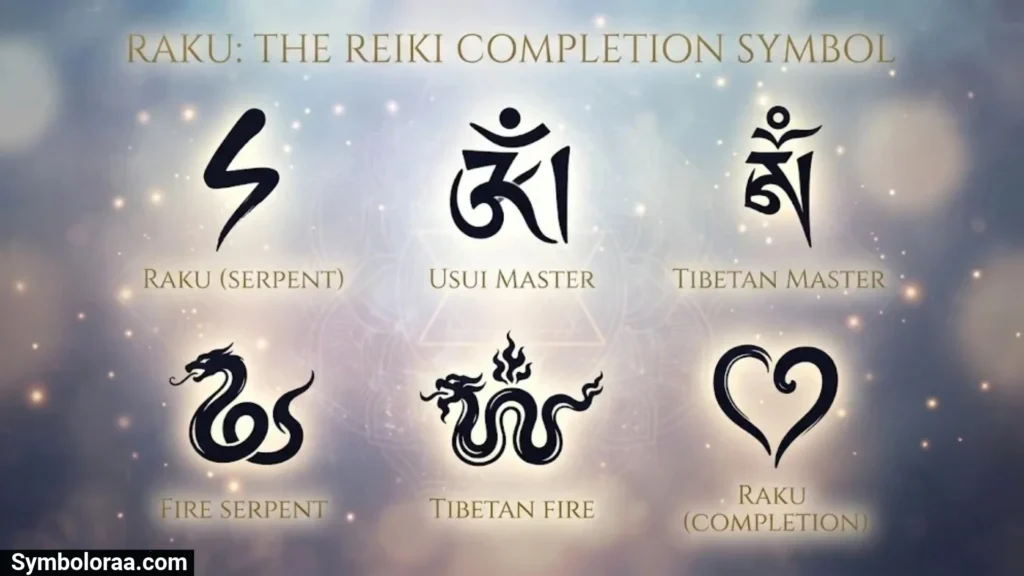
Raku is commonly known as the Reiki Completion Symbol or Fire Serpent.
Unlike the four principal symbols taught in many Usui Reiki systems, Raku belongs to certain additional Reiki traditions.
It is particularly associated with some Tibetan-influenced Reiki practices.
What Does Raku Mean?
Raku is commonly interpreted as a symbol of grounding, completion, and the downward movement of energy.
Some practitioners refer to it as the Fire Serpent because of its distinctive traditional form.
Its use is closely associated with particular attunement methods and the completion of Reiki ceremonies.
Traditional Uses of Raku
Practitioners commonly associate Raku with:
- Completing certain Reiki attunement ceremonies.
- Grounding after an advanced Reiki practice.
- Symbolically concluding an energy session.
- Returning attention to ordinary awareness.
- Supporting the transition after spiritual exercises.
Its purpose depends on the teaching tradition.
How Is Raku Used?
In some Reiki schools, practitioners draw Raku vertically from the top downward.
They associate this movement with grounding and completion.
Raku may also appear in particular attunement ceremonies. However, not every Reiki teacher includes it in their training.
Is Raku an Original Usui Reiki Symbol?
No. Raku isn’t generally classified among the four principal symbols of the commonly taught Usui system.
Some later Reiki traditions incorporated it into their symbol systems.
This explains why certain teachers describe Reiki as having five main symbols while others teach only four.
Both descriptions need context.
The important distinction is that Raku belongs to certain Reiki lineages rather than being a universally recognized fifth Usui symbol.
Reiki Symbols Comparison Chart: Meaning and Uses
Although all five symbols belong to the broader world of Reiki practice, each has a different traditional association.
The following table provides a quick reference.
| Symbol | Traditional meaning | Main focus | Common application |
| Cho Ku Rei | Power | Focus and concentration | Reiki sessions |
| Sei He Ki | Harmony | Mental and emotional awareness | Emotional reflection |
| Hon Sha Ze Sho Nen | Distance | Distance practice | Remote Reiki |
| Dai Ko Myo | Great Bright Light | Spiritual development | Master-level practice |
| Raku | Completion | Grounding and completion | Certain attunement traditions |
Understanding these differences helps students recognize why Reiki teachers introduce symbols at different stages of training.
How Do Reiki Symbols Work?
Reiki symbols are traditionally understood as tools that help practitioners focus their attention and intentions.
Their meaning comes from the spiritual beliefs and teaching methods associated with Reiki.
To understand their role, it’s useful to explore three important concepts: universal life energy, symbolic intention, and attunement.
Understanding Universal Life Energy
Reiki is based on the belief that universal life energy supports living beings.
Practitioners use the Japanese concept of ki to describe this vital energy.
According to traditional Reiki teachings, practitioners connect with this energy through meditation, hand positions, and other techniques.
Symbols help organize the practitioner’s intention during these exercises.
However, the proposed Reiki energy field hasn’t been scientifically established.
The Role of Intention and Visualization
Intention is an important part of Reiki practice.
When practitioners use a symbol, they often connect its traditional meaning with a specific purpose.
For example:
- Cho Ku Rei may represent focused attention.
- Sei He Ki may represent emotional harmony.
- Hon Sha Ze Sho Nen may represent distance connection.
- Dai Ko Myo may represent spiritual awareness.
- Raku may represent completion.
Visualization gives the practitioner something specific to concentrate on during meditation or a Reiki session.
This can provide structure to a personal spiritual practice without requiring claims about invisible energy transmission.
The Importance of Reiki Attunement
Many Reiki schools teach symbols through a process called Reiki attunement.
Attunement is a traditional ceremony performed by a Reiki teacher to introduce students to a particular level of Reiki practice.
Depending on the lineage, the ceremony may involve meditation, specific hand movements, symbols, and other teaching methods.
Some traditions regard attunement as essential before using Reiki symbols as part of formal Reiki practice.
Others take a more flexible approach.
The difference is mainly about spiritual teaching and lineage rather than a scientifically established activation process.
How to Use Reiki Symbols in Practice
Learning the meanings of Reiki symbols is only one part of understanding them. Students also need to learn how their teachers incorporate the symbols into actual practice.
The following methods describe common approaches within Reiki traditions.
Preparing for a Reiki Session
Preparation helps create a calm and focused environment.
Practitioners often begin by:
- Choosing a quiet and comfortable space.
- Washing their hands.
- Taking a few moments to relax.
- Practicing Gassho meditation.
- Setting an intention for the session.
- Explaining the process to the recipient.
Some practitioners also use breathing exercises or quiet reflection.
The goal is to approach the session with attention and respect.
How to Draw Reiki Symbols
Reiki students traditionally learn symbol drawings from their teachers.
Each symbol has a particular structure and sequence of strokes. Learning the correct form helps students follow their chosen lineage.
Common learning methods include:
Observing: Watch the instructor demonstrate the symbol.
Practicing: Reproduce its strokes on paper or in the air.
Memorizing: Learn the sequence and associated name.
Visualizing: Practice recalling the symbol mentally.
Reviewing: Compare your practice with the version taught by your instructor.
Some symbols have multiple accepted drawing variations. This is especially relevant when studying different Western Reiki lineages.
Students should avoid assuming that one drawing method represents every Reiki tradition.
How to Activate Reiki Symbols
The phrase Reiki symbol activation has different meanings across Reiki schools.
In traditional teachings, activation often refers to the relationship between learning a symbol, receiving attunement, and incorporating it into practice.
Common methods include:
- Receiving the relevant Reiki attunement.
- Drawing the symbol according to the teacher’s instructions.
- Visualizing its form.
- Repeating its associated name.
- Connecting the symbol with a clear intention.
Some modern practitioners use the term activation simply to describe focusing on a symbol during meditation.
It’s important to understand that these are traditional spiritual methods. There is no scientifically established mechanism through which drawing or repeating a symbol activates a measurable healing force.
How to Combine Reiki Symbols
Some Reiki traditions teach practitioners to combine symbols during a session.
For example, a practitioner might use Cho Ku Rei alongside Sei He Ki when focusing on mental and emotional intentions.
Another practitioner might incorporate Hon Sha Ze Sho Nen into a distance Reiki session.
Common combinations include:
| Combination | Traditional purpose |
| Cho Ku Rei + Sei He Ki | Focused emotional practice |
| Cho Ku Rei + Hon Sha Ze Sho Nen | Focused distance Reiki |
| Sei He Ki + Hon Sha Ze Sho Nen | Distance practice involving emotional intentions |
| Dai Ko Myo + other symbols | Advanced Reiki practice in certain lineages |
These combinations aren’t universal requirements. Their use depends on the practitioner’s training and teacher.
Do You Need Reiki Attunement to Use Reiki Symbols?
This is one of the most common questions among people learning about Reiki.
The answer depends on what you mean by using the symbols.
Anyone can study the names, meanings, and historical background of Reiki symbols. However, traditional Reiki schools generally teach that students should receive the appropriate attunement before incorporating particular symbols into formal Reiki practice.
What Happens During Reiki Attunement?
A Reiki attunement is a ceremony performed by a qualified teacher within a particular Reiki lineage.
The teacher guides the student through a process intended to establish or strengthen their connection to Reiki practice.
Depending on the school, the ceremony may include:
- Meditation.
- Symbol visualization.
- Specific hand movements.
- Spiritual intention.
- Traditional initiation techniques.
- Instructions for continued practice.
Students may describe different personal experiences during attunement. Some feel relaxed, while others report warmth, emotional responses, or no unusual sensations.
There is no single experience that every student must have.
Can You Learn Reiki Symbols Without Attunement?
Yes. You can study their history, meanings, names, and cultural background without receiving formal Reiki training.
However, studying a symbol is different from practicing Reiki according to a traditional lineage.
Some teachers believe symbols should only be used after attunement. Others share symbols openly and encourage independent study.
If you want to learn traditional Reiki, choose a teacher who explains their lineage, training requirements, and approach to attunement.
Reiki Levels and When Symbols Are Introduced
Reiki training often follows a progression of levels. Each stage introduces different techniques and responsibilities.
Although training structures vary, the following arrangement is common in Western Usui Reiki.
Reiki Level 1: Shoden
Level 1 introduces students to the foundations of Reiki.
Students commonly learn:
- The history and philosophy of Reiki.
- The five Reiki principles.
- Basic hand positions.
- Self-treatment methods.
- Basic treatment techniques.
- Introductory meditation practices.
Traditional Level 1 courses generally focus on developing a foundation rather than teaching the full symbol system.
Reiki Level 2: Okuden
Level 2 introduces more advanced techniques.
Students commonly learn three symbols:
- Cho Ku Rei.
- Sei He Ki.
- Hon Sha Ze Sho Nen.
Training usually covers their traditional meanings, drawing methods, visualization, and applications.
Distance Reiki is another important part of many Level 2 courses.
Students also learn how to incorporate symbols into their sessions while maintaining clear intentions.
Reiki Level 3: Shinpiden or Master Level
Master-level training focuses on advanced Reiki practice.
Many Western Usui lineages introduce Dai Ko Myo at this stage.
Students may learn:
- Advanced Reiki techniques.
- Master Symbol applications.
- Additional meditation practices.
- Attunement procedures.
- Spiritual development.
- Advanced practitioner responsibilities.
Some schools separate Master training from Master Teacher training.
Reiki Master Teacher Training
A Reiki Master Teacher receives additional instruction in teaching Reiki and performing attunements.
The course may cover:
- Teaching Reiki principles.
- Demonstrating symbols.
- Explaining treatment techniques.
- Guiding student practice.
- Performing traditional attunements.
- Maintaining ethical relationships with students.
Not every Reiki Master automatically has the same teaching qualifications. Training requirements depend on the school and lineage.
The Five Reiki Principles and Their Connection to Reiki Symbols
Reiki symbols are only one part of Reiki practice. The five Reiki principles, also called the Reiki precepts, provide a philosophical foundation for daily life.
Mikao Usui’s teachings emphasized personal development alongside spiritual practice.
The principles are commonly expressed as follows:
| Reiki principle | Main lesson |
| Just for today, do not anger | Practice patience and emotional awareness |
| Just for today, do not worry | Develop trust and mindfulness |
| Just for today, be grateful | Appreciate everyday experiences |
| Just for today, do your work honestly | Act with integrity |
| Just for today, be kind to every living thing | Practice compassion |
How Do the Reiki Principles Relate to Symbol Practice?
The principles and symbols serve different purposes.
Symbols provide a visual and meditative focus. The precepts guide personal behavior and spiritual development.
For example, someone practicing Sei He Ki might reflect on patience when dealing with difficult emotions.
A practitioner using Cho Ku Rei might begin a session by focusing on honesty, gratitude, and kindness.
These connections help practitioners integrate Reiki teachings into everyday routines.
Other Reiki Symbols Found in Different Traditions
Modern Reiki includes several systems that developed from or alongside the commonly taught Usui approach.
These traditions sometimes introduce additional symbols, techniques, and interpretations.
Understanding these differences prevents confusion when comparing Reiki courses.
Tibetan Reiki Symbols
Tibetan-influenced Reiki systems incorporate additional teachings and symbols that aren’t part of every Usui Reiki curriculum.
Some approaches include Raku and other symbols associated with spiritual development and attunement.
The exact techniques vary by school.
Students should check which tradition their teacher follows before assuming that all Reiki courses use the same symbols.
Karuna Reiki Symbols
Karuna Reiki is a separate Reiki system developed by William Lee Rand.
The name Karuna is commonly associated with compassion.
This system includes additional symbols and techniques designed for its own training structure.
Karuna Reiki courses generally build on previous Reiki experience and introduce their own approaches to practice.
Its symbols shouldn’t be confused with the four principal Usui Reiki symbols.
Why Do Different Reiki Traditions Use Different Symbols?
Reiki developed through teacher-to-student transmission.
As practitioners introduced the practice to new communities, different schools formed their own teaching structures.
Several factors contributed to these differences:
- Changes in teaching methods.
- Variations in symbol drawing.
- Differences in translation.
- Additional spiritual influences.
- New Reiki training systems.
- Teacher-specific interpretations.
This explains why two experienced Reiki practitioners might describe the same symbol differently.
Reiki Symbols and the Chakra System
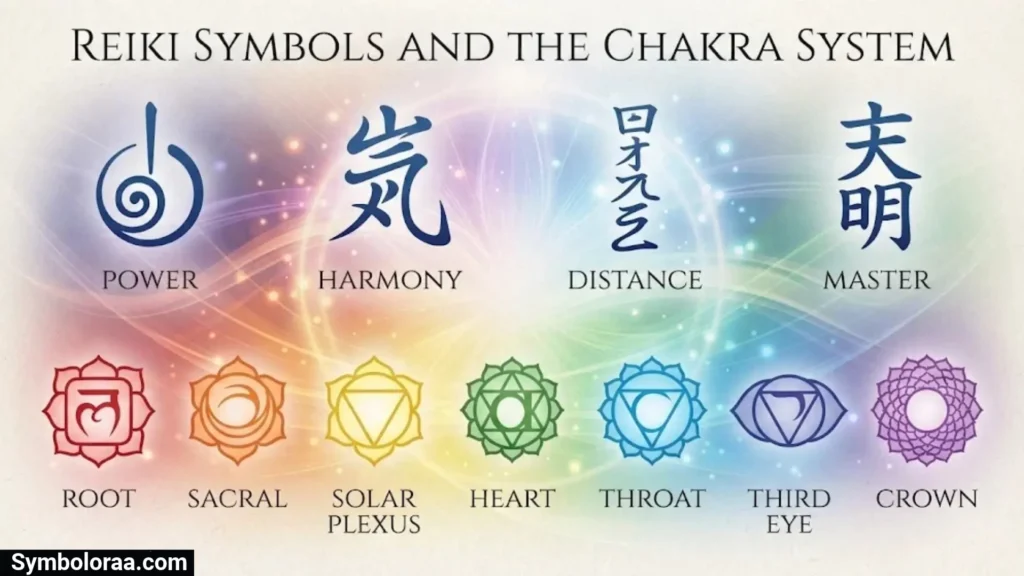
The chakra system is another spiritual framework that some Reiki practitioners incorporate into their sessions.
Chakras are traditionally described as energy centers within the subtle body.
The seven commonly discussed chakras are:
| Chakra | Traditional location | Common association |
| Root Chakra | Base of the spine | Stability and security |
| Sacral Chakra | Lower abdomen | Creativity and emotions |
| Solar Plexus Chakra | Upper abdomen | Confidence and personal power |
| Heart Chakra | Center of the chest | Love and compassion |
| Throat Chakra | Throat | Communication and expression |
| Third Eye Chakra | Forehead | Intuition and awareness |
| Crown Chakra | Top of the head | Spiritual connection |
How Do Practitioners Combine Reiki Symbols With Chakras?
Some Reiki practitioners visualize symbols while focusing on particular chakras.
For example, they might use Cho Ku Rei while focusing on the root chakra and personal grounding.
Others might incorporate Sei He Ki into meditation focused on emotional awareness.
Dai Ko Myo may appear in spiritual practices associated with the crown chakra.
However, these combinations aren’t universal Reiki requirements. They reflect approaches used by particular practitioners and schools.
It’s also important to distinguish the spiritual chakra system from human anatomy. Chakras aren’t recognized as physical organs or scientifically established energy centers.
Common Myths and Misconceptions About Reiki Symbols
Reiki symbols are often surrounded by claims that go beyond their established history or traditional uses.
Understanding the facts helps readers approach the subject with realistic expectations.
Myth: There Are Exactly Five Traditional Usui Reiki Symbols
Fact: Many Western Usui Reiki schools teach four principal symbols. Raku appears in certain additional traditions.
Myth: Reiki Symbols Have Scientifically Proven Healing Powers
Fact: Scientific research hasn’t established that Reiki symbols produce specific healing effects or transmit measurable energy.
Myth: Anyone Who Draws a Reiki Symbol Automatically Practices Reiki
Fact: Drawing a symbol is not the same as completing traditional Reiki training or receiving an attunement.
Myth: Every Reiki Teacher Uses Identical Symbols
Fact: Symbol drawings and interpretations can differ between lineages. Historical transmission has contributed to these variations.
Myth: Reiki Symbols Can Replace Medical Treatment
Fact: Reiki is a complementary practice. It shouldn’t replace medical diagnosis, medication, psychotherapy, or other appropriate healthcare.
Myth: All Reiki Symbols Must Remain Secret
Fact: Some teachers maintain confidentiality while others share symbols openly. Practices differ between schools.
Myth: Each Reiki Symbol Has Only One Meaning
Fact: Traditional interpretations vary. A symbol may have several related meanings depending on its lineage and teaching context.
Benefits and Limitations of Reiki Symbol Practice
People explore Reiki symbols for different reasons. Some want to learn traditional Japanese spiritual practices, while others enjoy meditation and personal reflection.
It’s useful to separate the potential value of the practice from claims that lack scientific support.
Traditionally Described Benefits
Reiki practitioners commonly describe several benefits associated with symbol practice.
These include:
- Focused meditation: Symbols provide a clear visual point of concentration.
- Mindfulness: Repeating symbol names can become part of a reflective routine.
- Personal development: Symbol meanings encourage reflection on patience, harmony, and compassion.
- Spiritual exploration: Students can use symbols to explore traditional Reiki teachings.
- Structured practice: Different symbols provide a framework for organizing Reiki sessions.
- Personal intention: Symbols can help practitioners clarify what they want to focus on during meditation.
These are potential personal and spiritual benefits. Individual experiences vary.
What Reiki Symbols Cannot Guarantee
Reiki symbols haven’t been scientifically established as treatments for medical conditions.
They cannot guarantee:
- A cure for physical illness.
- Recovery from depression.
- Relief from severe anxiety.
- Elimination of psychological trauma.
- Removal of measurable energy blockages.
- Prevention of future medical problems.
- Guaranteed spiritual awakening.
The National Center for Complementary and Integrative Health reports that Reiki hasn’t been clearly shown to be effective for any health-related purpose. Research results remain inconsistent, and scientific evidence doesn’t support the proposed energy field involved in Reiki.
Is Reiki Safe as a Complementary Practice?
Reiki is generally considered a low-risk complementary practice when provided appropriately.
Many sessions involve light touch or hands held slightly above the recipient’s body.
However, people should communicate their preferences before a session. Practitioners should respect physical boundaries and avoid making unsupported medical claims.
Most importantly, Reiki shouldn’t delay or replace appropriate healthcare.
Frequently Asked Questions About Reiki Symbols
What Are the Five Reiki Symbols?
The five symbols commonly discussed in Western Reiki content are Cho Ku Rei, Sei He Ki, Hon Sha Ze Sho Nen, Dai Ko Myo, and Raku.
However, the first four are commonly taught as the principal Usui Reiki symbols. Raku belongs to certain additional Reiki traditions.
What Is the Most Powerful Reiki Symbol?
Cho Ku Rei is commonly called the Power Symbol because practitioners associate it with focus and concentration.
However, Reiki traditions don’t establish a universal ranking of symbols by power. Each symbol serves a different purpose within its traditional teaching system.
What Is Cho Ku Rei Used For?
Cho Ku Rei is traditionally associated with focusing Reiki energy and intention. Practitioners may incorporate it into self-treatment, meditation, and Reiki sessions.
What Does Sei He Ki Mean?
Sei He Ki is commonly known as the Mental and Emotional Harmony Symbol. Practitioners associate it with emotional balance, mental awareness, and personal reflection.
What Is Hon Sha Ze Sho Nen Used For?
Hon Sha Ze Sho Nen is traditionally used in distance Reiki. Practitioners incorporate it into sessions involving recipients who aren’t physically present.
What Does Dai Ko Myo Mean?
Dai Ko Myo is commonly translated as Great Bright Light. It is associated with spiritual awareness, advanced Reiki practice, and Master-level training.
What Is the Raku Symbol Used For?
Raku is commonly known as the Completion Symbol. Some Reiki traditions use it during attunement ceremonies and grounding practices.
Do Reiki Symbols Need Attunement?
Traditional Reiki schools generally teach that students should receive the appropriate attunement before using symbols as part of formal Reiki practice.
However, anyone can study their history and meanings independently.
Can Beginners Use Reiki Symbols?
Beginners can learn about the symbols and their traditional meanings. In many Usui Reiki schools, students first learn the principal symbols during Level 2 training.
How Do You Activate Reiki Symbols?
Depending on the lineage, activation may involve attunement, drawing, visualization, mantra repetition, and focused intention.
Different Reiki teachers follow different methods.
Are Reiki Symbols Written in Japanese?
Many Reiki symbol names come from Japanese words and expressions. Several symbols are connected to Japanese kanji, although the origins and forms of individual symbols differ.
Can You Combine Different Reiki Symbols?
Yes. Some Reiki traditions teach combinations of symbols during particular sessions. For example, practitioners may combine Cho Ku Rei with Sei He Ki or Hon Sha Ze Sho Nen.
The exact combinations depend on the teacher’s instructions.
Are Reiki Symbols Scientifically Proven to Work?
No. Current scientific evidence hasn’t established that Reiki symbols transmit healing energy or treat medical conditions.
Some people find Reiki sessions relaxing or personally meaningful. Those experiences don’t prove the proposed energy mechanism.
Conclusion: Understanding the Meaning and Uses of Reiki Symbols
Reiki symbols represent an important part of many Reiki traditions. They provide practitioners with a structured way to focus attention, explore spiritual teachings, and incorporate specific intentions into their practice.
The four principal symbols commonly taught in Western Usui Reiki are Cho Ku Rei, Sei He Ki, Hon Sha Ze Sho Nen, and Dai Ko Myo. Each carries a different traditional association, ranging from focused intention and emotional harmony to distance practice and spiritual development.
Raku adds another dimension to the broader Reiki tradition. Although some teachers include it in five-symbol systems, it isn’t one of the four principal Usui symbols.
Understanding these distinctions makes it easier to appreciate the history and variety of Reiki.
If you’re researching Reiki for personal interest or considering formal training, start by learning the meanings and traditional applications of each symbol. Pay attention to the lineage behind your instruction and approach spiritual claims with an open but thoughtful mind.
Most importantly, remember that Reiki symbols are tools within a spiritual practice, not scientifically proven medical treatments. Their value lies in their traditional meanings, personal significance, and the role they play in the wider practice of Reiki.

I’m Jackson Miller, an American author inspired by mystery, adventure, and the unpredictable nature of life. I enjoy writing fast-moving stories filled with memorable characters, unexpected choices, and meaningful moments. Through my books, I want readers to experience new worlds while discovering something about courage, determination, and themselves.
Three Books:
The Edge of Tomorrow
Under a Broken Sky
The Road We Chose
 Madison Reed