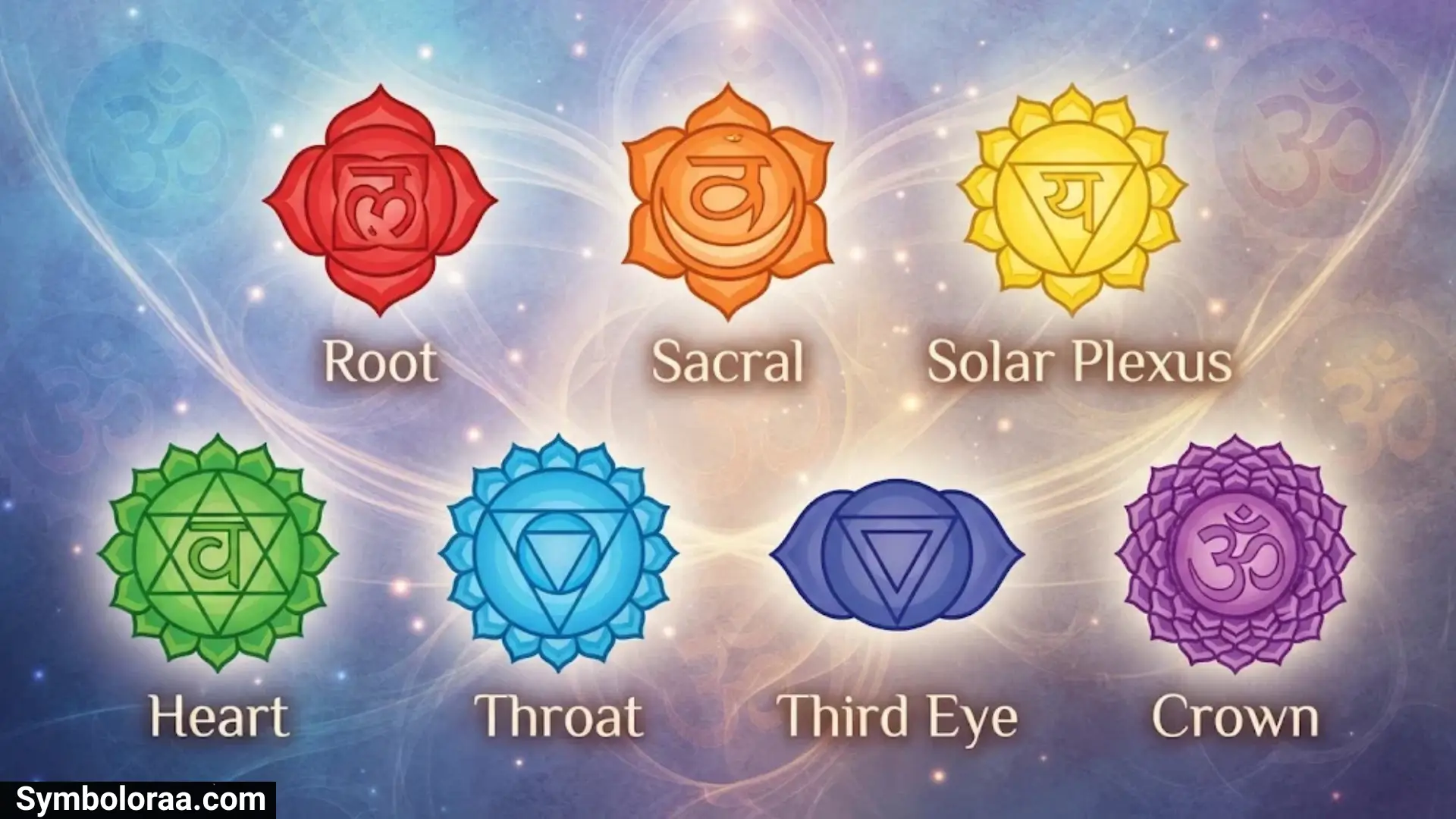
Chakra symbols offer a fascinating way to explore ancient Indian spiritual traditions. Each symbol contains distinctive shapes, lotus petals, Sanskrit letters, and geometric patterns. Together, these elements represent different aspects of consciousness, spiritual development, and the subtle body.
The seven chakra symbols are commonly associated with grounding, creativity, confidence, love, communication, intuition, and spiritual awareness. Each chakra also has a Sanskrit name, a traditional seed mantra, and a specific number of lotus petals.
From the four-petaled Root Chakra to the thousand-petaled Crown Chakra, every design carries its own symbolic meaning. Understanding these details helps you appreciate the deeper ideas behind chakra symbolism rather than viewing the symbols as colorful spiritual decorations.
Although modern chakra illustrations often use seven rainbow colors, traditional Indian descriptions contain more complex details. Different Hindu and Buddhist traditions also use different chakra arrangements.
In this guide, you’ll discover the meanings of all seven chakra symbols, their colors, geometric shapes, lotus petals, and Sanskrit mantras. You’ll also learn about their historical origins and their relationship with meditation, yoga, and modern chakra-balancing practices.
What Are the Seven Chakra Symbols?
The word chakra comes from Sanskrit and means wheel or disc. In Indian spiritual traditions, chakras describe subtle-body centers associated with spiritual awareness, meditation, and the movement of life-force energy.
Traditional Tantric and yogic teachings describe these centers through symbolic lotus flowers. Each lotus contains a particular number of petals, Sanskrit letters, geometric shapes, and other spiritual elements.
The familiar seven-chakra arrangement includes:
- Root Chakra (Muladhara): Represents grounding, stability, and security.
- Sacral Chakra (Svadhisthana): Represents creativity, pleasure, and emotional expression.
- Solar Plexus Chakra (Manipura): Represents personal power, confidence, and determination.
- Heart Chakra (Anahata): Represents love, compassion, and harmony.
- Throat Chakra (Vishuddha): Represents communication, honesty, and self-expression.
- Third Eye Chakra (Ajna): Represents intuition, insight, and awareness.
- Crown Chakra (Sahasrara): Represents spiritual realization and higher consciousness.
Each symbol has distinctive visual features. For example, the Root Chakra contains a four-petaled lotus and an Earth-associated square. The Heart Chakra features two intersecting triangles that form a six-pointed star.
The lotus petals also have deeper significance. Traditional descriptions associate them with Sanskrit letters and specific aspects of the subtle body.
Seven Chakra Symbols and Their Meanings at a Glance
The following chart summarizes the commonly presented seven-chakra system.
| Chakra | Sanskrit Name | Modern Color | Lotus Petals | Element | Seed Mantra |
| Root | Muladhara | Red | 4 | Earth | LAM |
| Sacral | Svadhisthana | Orange | 6 | Water | VAM |
| Solar Plexus | Manipura | Yellow | 10 | Fire | RAM |
| Heart | Anahata | Green | 12 | Air | YAM |
| Throat | Vishuddha | Blue | 16 | Space | HAM |
| Third Eye | Ajna | Indigo | 2 | Beyond the five elements | OM |
| Crown | Sahasrara | Violet or white | 1,000 | Beyond the elements | Varies |
Important: This chart combines traditional symbolic details with familiar modern color associations. The traditional chakra diagrams do not always follow the rainbow color sequence used in contemporary wellness illustrations.
Root Chakra Symbol (Muladhara): Meaning, Color, and Shape
The Root Chakra symbol, known as Muladhara, represents the foundation of the traditional chakra system. Its Sanskrit name combines Mula, meaning root, and Adhara, meaning support or foundation.
This chakra sits at the base of the subtle-body system, traditionally associated with the area between the anus and genitals. Modern illustrations commonly place it at the base of the spine.
Its symbolism centers on stability, physical existence, grounding, and the connection with the Earth element.
Meaning of the Root Chakra Symbol
The traditional Muladhara symbol features a four-petaled lotus surrounding a square and an inverted triangle.
Each element contributes to the symbol’s meaning:
- Four-petaled lotus: Represents the Root Chakra’s four-petal structure and its associated Sanskrit letters.
- Yellow square: Represents the Earth element, traditionally called Prithvi.
- Inverted triangle: Appears within the central design and carries specific Tantric symbolic associations.
- Elephant: The traditional diagram includes an elephant associated with strength and the Earth element.
- Seed mantra LAM (लं): Represents the Earth-associated sound used in traditional mantra practices.
The square is particularly important because it expresses solidity, structure, and stability. These qualities connect naturally with the Root Chakra’s symbolic role.
The four petals contain the Sanskrit letters वं, शं, षं, and सं in the commonly described traditional arrangement.
Root Chakra Color and Its Meaning
Red is the familiar modern color of the Root Chakra. It symbolizes vitality, grounding, strength, and physical connection.
However, traditional chakra illustrations do not always use the same color conventions found in modern posters. The original symbolic description gives more attention to the lotus, Sanskrit letters, geometric patterns, and associated deities.
Root Chakra Symbol Meaning in Everyday Life
The Root Chakra represents the foundation on which other aspects of personal development rest.
Its common symbolic associations include:
- Feeling secure and supported.
- Developing stability in everyday life.
- Building healthy routines and responsibilities.
- Maintaining a connection with nature.
- Understanding basic needs and personal boundaries.
- Developing resilience during difficult situations.
For example, someone facing major life changes might use the Root Chakra as a meditation symbol for stability and grounding.
Root Chakra Balancing Practices
Modern chakra practices often associate Muladhara with grounding activities and gentle physical movement.
Useful examples include:
- Mountain Pose (Tadasana): Encourages awareness of posture, balance, and contact with the ground.
- Tree Pose (Vrikshasana): Develops physical balance and concentration.
- Grounding meditation: Directs attention toward breathing and bodily sensations.
- Mindful walking: Encourages awareness of movement and the surrounding environment.
- Root Chakra affirmations: Uses statements such as “I am safe and supported.”
- Crystal associations: Hematite and red jasper commonly appear in modern Root Chakra practices.
These activities can support relaxation and self-reflection. However, crystals and chakra rituals have not been scientifically established as treatments for physical or psychological conditions.
Sacral Chakra Symbol (Svadhisthana): Meaning, Color, and Shape
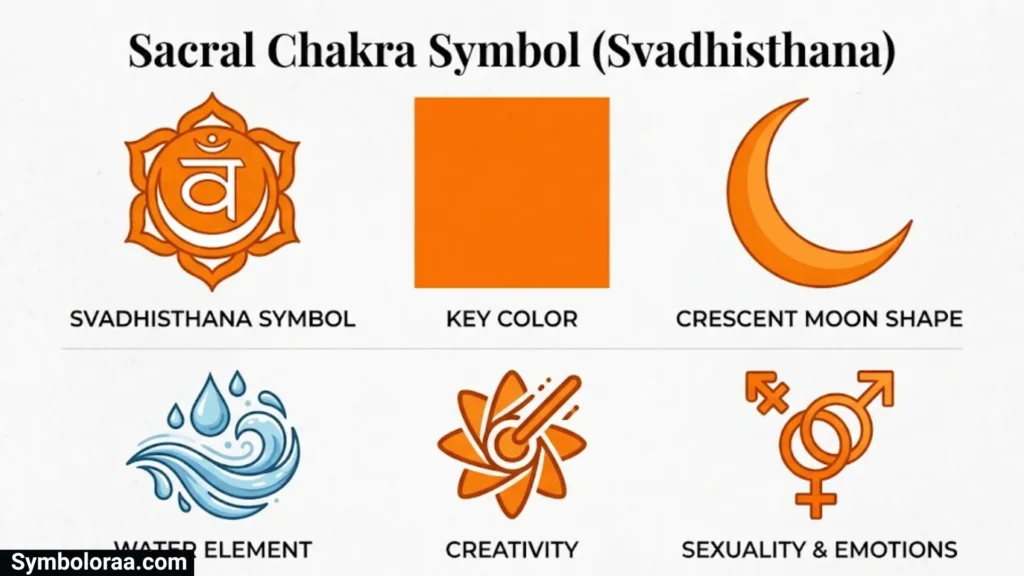
The Sacral Chakra symbol, called Svadhisthana, represents the second center in the commonly presented seven-chakra arrangement.
Its Sanskrit name is often translated as “one’s own abode” or “one’s own dwelling.” The chakra traditionally occupies the genital or pelvic region of the subtle body.
Its central symbolic association is the water element. Water represents movement, fluidity, and transformation.
Meaning of the Sacral Chakra Symbol
The traditional Svadhisthana design contains a six-petaled lotus and a crescent moon inside its central geometric arrangement.
Its main elements include:
- Six-petaled lotus: Represents the chakra’s six petals and associated Sanskrit letters.
- Crescent moon: Represents the water element and its symbolic relationship with fluidity.
- Circular geometric design: Appears around the central water-associated symbolism.
- White crocodile: A traditional animal associated with the water element and the chakra’s imagery.
- Seed mantra VAM (वं): Represents the traditional seed sound of the water element.
The six petals carry the Sanskrit letters बं, भं, मं, यं, रं, and लं in the traditional diagram.
The crescent moon makes this chakra especially recognizable. Its curved shape reflects the changing and flowing nature associated with water.
Sacral Chakra Color and Its Meaning
Orange is the common modern color of the Sacral Chakra. It represents creativity, pleasure, emotional expression, and enthusiasm.
This color association appears widely in contemporary chakra artwork. However, traditional chakra diagrams often describe more detailed visual features than a single color.
Sacral Chakra Symbol Meaning in Everyday Life
The Sacral Chakra connects with experiences involving emotions, creativity, relationships, and pleasure.
Its common symbolic associations include:
- Creativity and imagination.
- Emotional awareness.
- Healthy personal relationships.
- Sensuality and intimacy.
- Enjoyment and pleasure.
- Flexibility and adaptability.
Consider someone who enjoys painting, dancing, writing, or creating music. These activities fit the modern symbolic interpretation of the Sacral Chakra because they encourage creative expression.
Sacral Chakra Balancing Practices
Contemporary chakra-balancing practices often focus on movement and creative activities.
You can explore these practices through:
- Hip-opening yoga: Gentle movements encourage mobility and body awareness.
- Swimming: Connects naturally with the water symbolism of Svadhisthana.
- Dance: Provides an expressive way to explore movement.
- Creative activities: Painting, writing, music, and crafts encourage imagination.
- Journaling: Helps you explore emotional experiences.
- Mantra meditation: Repeating VAM provides a traditional sound-based meditation focus.
- Crystal associations: Carnelian and moonstone frequently appear in modern chakra practices.
The goal of these activities is personal reflection and relaxation rather than a guaranteed energetic or medical effect.
Solar Plexus Chakra Symbol (Manipura): Meaning, Color, and Shape
The Solar Plexus Chakra symbol, known as Manipura, represents the third center in the commonly taught chakra system.
Its Sanskrit name means “city of jewels.” Traditional descriptions place this chakra around the navel region and associate it with the fire element.
Fire symbolizes transformation, heat, and the power of change. These qualities explain why modern interpretations connect Manipura with confidence, determination, and personal power.
Meaning of the Solar Plexus Chakra Symbol
The Manipura symbol features a ten-petaled lotus surrounding a downward-pointing triangle.
Its important visual elements include:
- Ten-petaled lotus: Represents ten petals carrying their associated Sanskrit letters.
- Downward-pointing triangle: Represents the fire element in the traditional diagram.
- Ram: The traditional animal associated with the fire center.
- Seed mantra RAM (रं): Represents the fire element’s traditional seed sound.
- Yellow color: Appears frequently in modern Solar Plexus Chakra illustrations.
The ten lotus petals contain the Sanskrit letters डं, ढं, णं, तं, थं, दं, धं, नं, पं, and फं.
The triangle is an important geometric feature because it represents the fire-associated principle within the chakra.
Solar Plexus Chakra Color and Its Meaning
Yellow is the commonly recognized color of the Solar Plexus Chakra.
Its modern symbolic associations include:
- Confidence.
- Personal power.
- Willpower.
- Determination.
- Mental clarity.
- Self-discipline.
Yellow also suggests warmth and brightness, making it a natural visual choice for contemporary representations of the fire-associated Manipura.
Solar Plexus Chakra Symbol Meaning in Everyday Life
Manipura is often associated with how people understand their identity and make personal decisions.
Its symbolic meanings include:
- Developing self-confidence.
- Taking responsibility for decisions.
- Building healthy boundaries.
- Strengthening determination.
- Developing independence.
- Recognizing personal abilities.
For example, preparing for an important presentation can involve the same qualities that modern chakra interpretations associate with Manipura.
Solar Plexus Chakra Balancing Practices
Modern practices commonly focus on confidence, movement, and self-discipline.
Examples include:
- Boat Pose (Navasana): Engages the core and develops physical balance.
- Cobra Pose (Bhujangasana): Encourages spinal movement and chest opening.
- Core exercises: Develop physical strength and body awareness.
- Goal setting: Encourages purposeful decision-making.
- Confidence-building activities: Help develop communication and personal responsibility.
- RAM chanting: Provides a mantra-based meditation practice.
- Crystal associations: Citrine and tiger’s eye commonly appear in modern Manipura collections.
Heart Chakra Symbol (Anahata): Meaning, Color, and Shape
The Heart Chakra symbol, called Anahata, represents the fourth center in the familiar seven-chakra arrangement.
Its Sanskrit name means “unstruck” or “unstruck sound.” Traditional descriptions place it in the heart region and associate it with the air element.
Anahata has one of the most recognizable designs among the seven chakra symbols. Its twelve-petaled lotus surrounds two intersecting triangles that create a six-pointed star.
Meaning of the Heart Chakra Symbol
The traditional Heart Chakra diagram contains several meaningful elements:
- Twelve-petaled lotus: Represents the twelve petals and their associated Sanskrit letters.
- Six-pointed star: Formed by two intersecting triangles.
- Two triangles: Represent complementary principles within the traditional Tantric symbolism.
- Air element: Represents movement and openness.
- Antelope: Appears as the traditional animal associated with this chakra.
- Seed mantra YAM (यं): Represents the air element’s traditional seed sound.
The twelve petals contain the Sanskrit letters कं, खं, गं, घं, ङं, चं, छं, जं, झं, ञं, टं, and ठं.
The six-pointed star is particularly distinctive. It comes from the intersection of an upward-pointing and a downward-pointing triangle.
Modern interpretations often describe this design as a symbol of harmony and the relationship between opposing forces.
Heart Chakra Color and Its Meaning
Green is the familiar modern color of Anahata. Pink also appears in contemporary spiritual illustrations and Heart Chakra practices.
Green commonly represents:
- Love and compassion.
- Growth and renewal.
- Emotional harmony.
- Kindness and acceptance.
- Connection with nature.
Pink often represents affection, tenderness, and unconditional love.
Heart Chakra Symbol Meaning in Everyday Life
The Heart Chakra represents the emotional and relational qualities that help people build meaningful connections.
Its common associations include:
- Loving and accepting others.
- Developing compassion.
- Practicing forgiveness.
- Maintaining healthy relationships.
- Showing kindness.
- Balancing personal needs with care for others.
For example, forgiving someone doesn’t mean accepting harmful behavior. Instead, it can represent a personal decision to release resentment and establish healthier boundaries.
Heart Chakra Balancing Practices
Modern Anahata practices often emphasize compassion, meditation, and gentle chest-opening movements.
Useful examples include:
- Fish Pose (Matsyasana): Encourages chest expansion and spinal movement.
- Gentle backbends: Develop awareness of posture and movement.
- Loving-kindness meditation: Encourages compassion toward yourself and others.
- Gratitude journaling: Helps identify meaningful relationships and positive experiences.
- YAM chanting: Uses the traditional Heart Chakra seed mantra.
- Crystal associations: Rose quartz and green aventurine are popular modern choices.
Throat Chakra Symbol (Vishuddha): Meaning, Color, and Shape
The Throat Chakra symbol, known as Vishuddha, represents the fifth center in the familiar chakra arrangement.
The Sanskrit name is associated with purification. Traditional descriptions place this chakra at the throat and connect it with the space element, also called Akasha.
Its symbolic themes include communication, sound, honesty, and expression.
Meaning of the Throat Chakra Symbol
Vishuddha has a sixteen-petaled lotus surrounding a circular design and an inverted triangle.
Its main elements include:
- Sixteen-petaled lotus: Represents sixteen petals containing traditional Sanskrit vowel sounds.
- Circle: Represents the space element.
- Inverted triangle: Appears within the traditional geometric arrangement.
- White elephant: Represents the traditional animal associated with this center.
- Seed mantra HAM (हं): Represents the traditional seed sound of the space element.
The sixteen petals contain Sanskrit vowel forms in the traditional diagram.
The circle is especially important because Akasha represents space or ether in Indian philosophical traditions. Sound is also associated with this element.
Throat Chakra Color and Its Meaning
Blue is the common modern color of the Throat Chakra.
Its symbolic associations include:
- Communication.
- Honesty.
- Truthfulness.
- Authentic self-expression.
- Listening.
- Clear speech.
The blue color also appears in contemporary illustrations as a visual representation of openness and expression.
Throat Chakra Symbol Meaning in Everyday Life
The Throat Chakra represents how people communicate thoughts, feelings, and ideas.
Its common symbolic meanings include:
- Speaking honestly.
- Expressing emotions appropriately.
- Listening carefully.
- Communicating personal boundaries.
- Sharing ideas with confidence.
- Developing authentic relationships.
For example, explaining your needs clearly during a difficult conversation reflects the modern symbolic qualities associated with Vishuddha.
Throat Chakra Balancing Practices
Contemporary Throat Chakra practices often involve sound and communication.
Useful examples include:
- Chanting: Repeating HAM as a traditional seed mantra.
- Singing: Exploring sound and vocal expression.
- Reading aloud: Developing awareness of speech and pronunciation.
- Journaling: Expressing thoughts through writing.
- Active listening: Giving others your full attention.
- Gentle neck movements: Encouraging comfortable mobility.
- Crystal associations: Aquamarine and lapis lazuli commonly appear in modern practices.
Third Eye Chakra Symbol (Ajna): Meaning, Color, and Shape
The Third Eye Chakra symbol, called Ajna, represents the sixth center in the familiar seven-chakra arrangement.
Its Sanskrit name is commonly translated as “command” or “authority.” Traditional descriptions place this chakra between the eyebrows.
Ajna has a distinctive two-petaled lotus and a central geometric arrangement. Its symbolism relates to the mind, awareness, and spiritual insight.
Meaning of the Third Eye Chakra Symbol
The traditional Ajna symbol contains two lotus petals surrounding a central design.
Its main features include:
- Two-petaled lotus: Represents the two petals of Ajna.
- Sanskrit letters HA and KṢA: Appear on the two petals in traditional descriptions.
- Central geometric design: Includes a downward-pointing triangle in common representations.
- OM (ॐ): Appears as an important central mantra in familiar diagrams.
- White or luminous imagery: Appears in traditional descriptions of this center.
Unlike the five lower chakras, Ajna does not correspond to one of the five gross elements in the same way.
Its symbolism moves toward subtler concepts involving awareness and spiritual realization.
Third Eye Chakra Color and Its Meaning
Indigo is the familiar modern color of the Third Eye Chakra. Some illustrations use deep blue or violet instead.
Its symbolic associations include:
- Intuition.
- Insight.
- Wisdom.
- Mental clarity.
- Self-awareness.
- Spiritual perception.
The indigo association is particularly common in contemporary chakra charts.
Third Eye Chakra Symbol Meaning in Everyday Life
The Third Eye Chakra represents reflection and the ability to examine experiences beyond immediate reactions.
Its modern interpretations include:
- Developing concentration.
- Recognizing personal thought patterns.
- Improving self-awareness.
- Practicing thoughtful decision-making.
- Exploring intuition.
- Developing a deeper understanding of personal experiences.
For example, pausing before making an important decision allows you to consider different possibilities rather than reacting immediately.
Third Eye Chakra Balancing Practices
Modern Ajna practices often emphasize concentration and meditation.
Examples include:
- Mindfulness meditation: Encourages awareness of thoughts and sensations.
- Visualization: Uses mental imagery as a concentration exercise.
- Breath awareness: Helps maintain attention during meditation.
- Dream journaling: Provides a way to reflect on dreams and personal experiences.
- OM chanting: Uses a traditional sacred sound.
- Crystal associations: Amethyst and sodalite commonly appear in modern Third Eye Chakra practices.
Crown Chakra Symbol (Sahasrara): Meaning, Color, and Shape
The Crown Chakra symbol, known as Sahasrara, represents the highest center in the commonly presented seven-chakra arrangement.
Its Sanskrit name means thousand, referring to the thousand-petaled lotus associated with this center.
Traditional descriptions place Sahasrara at or above the crown of the head. Unlike the lower six centers, it represents a level of spiritual realization beyond the ordinary elemental framework.
Meaning of the Crown Chakra Symbol
The Crown Chakra features a thousand-petaled lotus.
Its major symbolic features include:
- Thousand-petaled lotus: Represents spiritual completeness and expansive awareness.
- White or luminous appearance: Represents purity and spiritual realization in common descriptions.
- Violet color: Appears frequently in modern chakra illustrations.
- Sanskrit alphabet: The traditional thousand-petaled lotus is associated with the full range of Sanskrit sounds.
- Spiritual liberation: Represents the highest spiritual goal in this particular system.
The thousand petals are symbolic rather than a literal botanical measurement.
Traditional descriptions associate Sahasrara with spiritual realization and the culmination of Kundalini’s ascent. It is often treated as distinct from the six lower chakras.
Crown Chakra Color and Its Meaning
Violet and white are the two most familiar modern colors associated with Sahasrara.
Violet commonly represents spiritual awareness and higher consciousness. White symbolizes purity, completeness, and illumination.
Some illustrations use a combination of both colors to create a luminous crown-like appearance.
Crown Chakra Symbol Meaning in Everyday Life
The Crown Chakra represents spiritual reflection and the search for a deeper understanding of existence.
Its symbolic associations include:
- Spiritual awareness.
- Self-realization.
- Contemplation.
- Inner peace.
- Universal consciousness.
- Liberation and enlightenment.
In everyday life, these ideas may encourage reflection, humility, and a broader understanding of personal experiences.
Crown Chakra Balancing Practices
Modern Crown Chakra practices often involve quiet contemplation and meditation.
Examples include:
- Silent meditation.
- Mindfulness practices.
- Spiritual study.
- Reflective journaling.
- Gentle yoga.
- Contemplative breathing.
- Crystal associations such as clear quartz and selenite.
Spiritual fasting appears in some religious traditions, but it isn’t necessary for Crown Chakra meditation. Anyone considering fasting should account for their health and nutritional needs.
Chakra Symbols, Lotus Petals, and Their Geometric Shapes
The chakra symbols and shapes contain more meaning than their colorful appearance suggests. Traditional Tantric diagrams combine lotus flowers, geometric figures, Sanskrit letters, animals, and seed mantras.
Each feature contributes to the overall symbolism of its chakra.
Why Do Chakra Symbols Have Different Numbers of Lotus Petals?
The number of lotus petals changes from one chakra to another. These numbers are part of the traditional symbolic structure.
| Chakra | Lotus Petals | Traditional Association |
| Muladhara | 4 | Four Sanskrit petal letters |
| Svadhisthana | 6 | Six Sanskrit petal letters |
| Manipura | 10 | Ten Sanskrit petal letters |
| Anahata | 12 | Twelve Sanskrit petal letters |
| Vishuddha | 16 | Sixteen Sanskrit petal letters |
| Ajna | 2 | Two Sanskrit petal letters |
| Sahasrara | 1,000 | Symbolic fullness of Sanskrit sounds |
One interesting detail emerges when you add the petals of the six lower chakras:
4 + 6 + 10 + 12 + 16 + 2 = 50 petals.
Traditional descriptions associate these fifty petals with the Sanskrit alphabet or its sacred sound forms.
This connection explains why the petals often contain individual Devanagari letters rather than decorative patterns.
The Crown Chakra’s thousand petals represent a different symbolic level of completeness and spiritual realization.
Meaning of Geometric Shapes in Chakra Symbols
Geometric shapes represent elements and spiritual principles within traditional chakra diagrams.
Square: Earth Element
The square appears in the Root Chakra. It symbolizes solidity, structure, and stability.
Crescent Moon: Water Element
The crescent appears in the Sacral Chakra’s traditional design. It connects with water and the qualities of movement and fluidity.
Triangle: Fire Element
The downward-pointing triangle appears prominently in the Solar Plexus Chakra. It represents the fire element.
Triangles also appear in other chakra diagrams, so their meaning depends on their specific context.
Six-Pointed Star: Heart Chakra
Two intersecting triangles form the six-pointed star in the Heart Chakra. This design represents a relationship between complementary principles.
Circle: Space Element
The circle appears in the Throat Chakra and represents Akasha, or space.
Lotus Flower: Spiritual Development
The lotus is a recurring symbol throughout Indian spiritual traditions. Its unfolding petals provide a visual language for spiritual development and consciousness.
Why Do Chakra Symbols Contain Sanskrit Letters?
Sanskrit letters play an important role in traditional chakra diagrams.
The letters appear on lotus petals and represent sacred sound forms. They connect the visual structure of each chakra with traditional mantra practices.
The central seed syllable is called a Bija Mantra.
For example:
- LAM appears in the Root Chakra.
- VAM appears in the Sacral Chakra.
- RAM appears in the Solar Plexus Chakra.
- YAM appears in the Heart Chakra.
- HAM appears in the Throat Chakra.
- OM appears in the Third Eye Chakra.
These syllables have specific places within the traditional diagrams. They aren’t interchangeable decorative letters.
Seven Chakra Colors and Their Symbolic Meanings
The seven chakra colors are among the most recognizable features of modern chakra illustrations.
Most contemporary charts arrange them according to the visible spectrum, beginning with red and ending with violet.
Each color has a commonly assigned symbolic meaning.
| Chakra | Color | Common Symbolic Meaning |
| Root | Red | Grounding, stability, and survival |
| Sacral | Orange | Creativity, pleasure, and emotions |
| Solar Plexus | Yellow | Confidence, determination, and power |
| Heart | Green | Love, compassion, and harmony |
| Throat | Blue | Communication and truth |
| Third Eye | Indigo | Intuition and insight |
| Crown | Violet or white | Spiritual awareness and purity |
Why Are Chakra Colors Arranged Like a Rainbow?
The modern rainbow arrangement creates an easy visual system for remembering the seven chakras.
Red appears at the bottom, while violet appears at the top. This progression also makes chakra illustrations easier to recognize.
However, the rainbow system is not a universal feature of historical Indian chakra diagrams.
Research into the development of modern Western chakra teachings shows that their familiar spectrum-based colors developed through modern spiritual and color-healing movements, particularly during the twentieth century.
Can Chakra Colors Change?
Yes. Different modern illustrations sometimes use different colors.
For example:
- The Heart Chakra may appear green or pink.
- The Crown Chakra may appear white, violet, or a combination.
- The Third Eye Chakra may appear indigo, deep blue, or purple.
These variations usually reflect different modern interpretations rather than a single universal traditional standard.
Seven Chakra Seed Mantras and Their Meanings
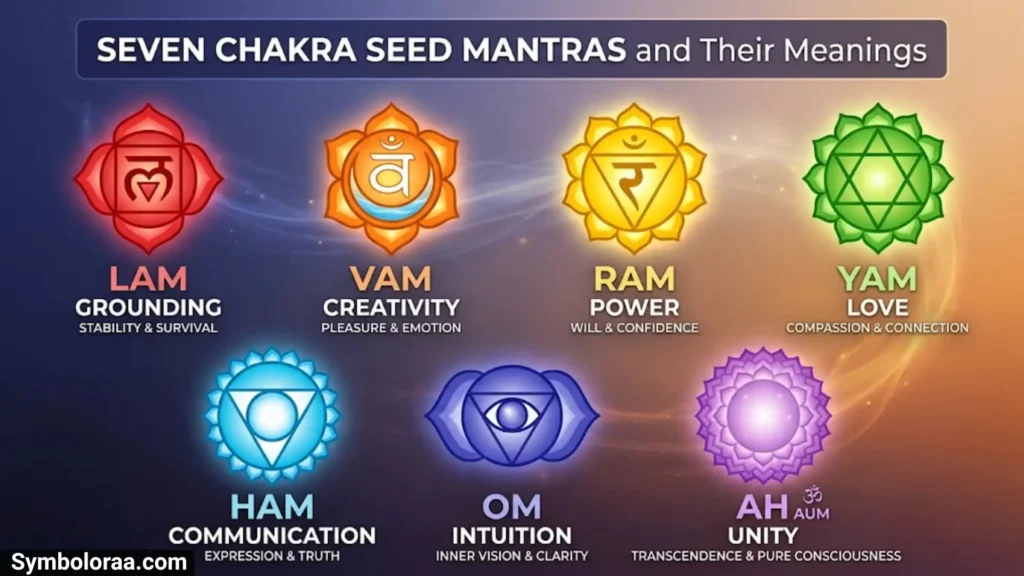
A Bija Mantra is a seed syllable used in Hindu and Buddhist spiritual practices.
The Sanskrit word Bija means seed. These syllables represent sacred sounds associated with particular deities, elements, and spiritual concepts.
Traditional chakra diagrams place specific seed syllables within their geometric centers.
Seven Chakra Seed Mantra Chart
| Chakra | Seed Mantra | Sanskrit | Traditional Association |
| Root | LAM | लं | Earth |
| Sacral | VAM | वं | Water |
| Solar Plexus | RAM | रं | Fire |
| Heart | YAM | यं | Air |
| Throat | HAM | हं | Space |
| Third Eye | OM | ॐ | Subtle awareness |
| Crown | Varies | Varies | Beyond ordinary sound |
The first five seed mantras correspond to the five traditional elements.
Ajna has a different symbolic position. Sahasrara is generally described beyond the ordinary elemental structure and doesn’t have one universally assigned seed mantra in this scheme.
How to Use Chakra Seed Mantras
Mantra meditation offers a traditional way to work with chakra symbolism.
A simple practice involves:
- Choose a quiet place where you can sit comfortably.
- Select the chakra you want to explore.
- Bring your attention to its traditional location.
- Repeat its associated seed mantra slowly.
- Notice your breathing and maintain comfortable concentration.
- Finish by sitting quietly for a few moments.
You don’t need elaborate equipment to practice mantra meditation. Consistency and comfortable concentration matter more than creating a complicated routine.
History and Origins of the Seven Chakra System
The history of chakra symbols reaches into Indian religious and philosophical traditions. However, the familiar seven-chakra chart developed through a long process rather than appearing as one fixed system in the earliest Vedic literature.
The Sanskrit word cakra appears in different contexts across Indian traditions. Its use in subtle-body teachings became especially important in Tantric and yogic literature.
These traditions describe subtle-body structures through concepts such as Prana, Nadis, Kundalini, and Chakras.
Chakras in Hinduism
Chakras feature prominently in several Hindu Tantric and yogic traditions.
These systems describe subtle centers along a central pathway called Sushumna Nadi.
Two other important channels are:
- Ida Nadi: Traditionally associated with lunar symbolism.
- Pingala Nadi: Traditionally associated with solar symbolism.
- Sushumna Nadi: The central subtle channel associated with spiritual ascent.
In Kundalini traditions, Kundalini Shakti represents a latent spiritual power traditionally pictured as a coiled serpent at the base of the subtle-body system.
Certain practices describe Kundalini rising through the chakras toward Sahasrara.
This ascent represents spiritual transformation and realization within those traditions.
Chakras in Buddhism
Chakra concepts also appear in Buddhist Tantric traditions, especially Vajrayana.
Buddhist subtle-body teachings discuss channels, winds, and energy centers. However, their arrangements don’t always match the familiar Hindu seven-chakra chart.
Some Buddhist tantric systems describe four or five main centers instead of seven.
Therefore, it’s more accurate to discuss Buddhist chakra symbolism as part of its own religious and meditation traditions rather than treating every system as identical.
Are the Seven Chakra Symbols Found in the Vedas?
The popular claim that the complete modern seven-chakra chart appears unchanged in the ancient Vedas needs clarification.
Vedic literature and later Tantric texts belong to different historical periods and contain different teachings.
The detailed lotus diagrams commonly used today are associated with later Tantric subtle-body traditions.
One influential source is the Ṣaṭ-Cakra-Nirūpaṇa, a sixteenth-century Sanskrit work attributed to Pūrṇānanda.
Its title means “Description of the Six Chakras.” It describes six main centers and the thousand-petaled Sahasrara above them.
Arthur Avalon, the pen name of John Woodroffe, helped introduce these teachings to English-speaking readers through The Serpent Power, published in 1919.
This historical distinction matters because the modern seven-chakra chart represents one influential lineage rather than every Indian spiritual tradition.
Chakra Healing and Balancing: Understanding the Practices
Chakra healing refers to spiritual and wellness practices intended to support harmony among the seven symbolic energy centers.
People often use chakra symbolism to explore emotions, personal development, meditation, and spiritual awareness.
In traditional Indian teachings, concepts such as Prana, Nadis, and Kundalini explain subtle-body processes. Modern wellness practices often reinterpret these concepts through the language of emotional and energetic balance.
However, chakras aren’t medically established anatomical structures. Terms such as blocked chakra or chakra imbalance describe spiritual interpretations rather than recognized medical diagnoses.
What Does It Mean When a Chakra Is Blocked?
In modern chakra terminology, a blocked chakra describes a perceived imbalance associated with a particular energy center.
Different interpretations connect these imbalances with emotional or behavioral experiences.
| Chakra | Commonly Described Imbalance | Positive Symbolic Quality |
| Root | Insecurity or instability | Grounding |
| Sacral | Emotional disconnection | Creativity |
| Solar Plexus | Low confidence | Self-assurance |
| Heart | Difficulty with emotional connection | Compassion |
| Throat | Difficulty expressing thoughts | Communication |
| Third Eye | Confusion or lack of focus | Insight |
| Crown | Disconnection from spiritual reflection | Awareness |
These descriptions can serve as prompts for personal reflection.
For example, someone who struggles to communicate might use Throat Chakra symbolism to explore honesty and self-expression.
That doesn’t mean a physical energy blockage exists in the throat.
How to Balance All Seven Chakras
A simple chakra-inspired routine can combine meditation, movement, breathing, and self-reflection.
Consider these practical activities:
- Yoga: Explore comfortable physical movements and body awareness.
- Meditation: Develop concentration and mindfulness.
- Breathwork: Practice slow, comfortable breathing.
- Mantra chanting: Use traditional seed syllables as meditation focuses.
- Visualization: Picture the traditional chakra symbols during quiet reflection.
- Journaling: Explore personal emotions, thoughts, and goals.
- Mindful habits: Build routines that support emotional and physical well-being.
The most useful approach is one you can practice comfortably and consistently.
Chakra Meditation and Spiritual Development
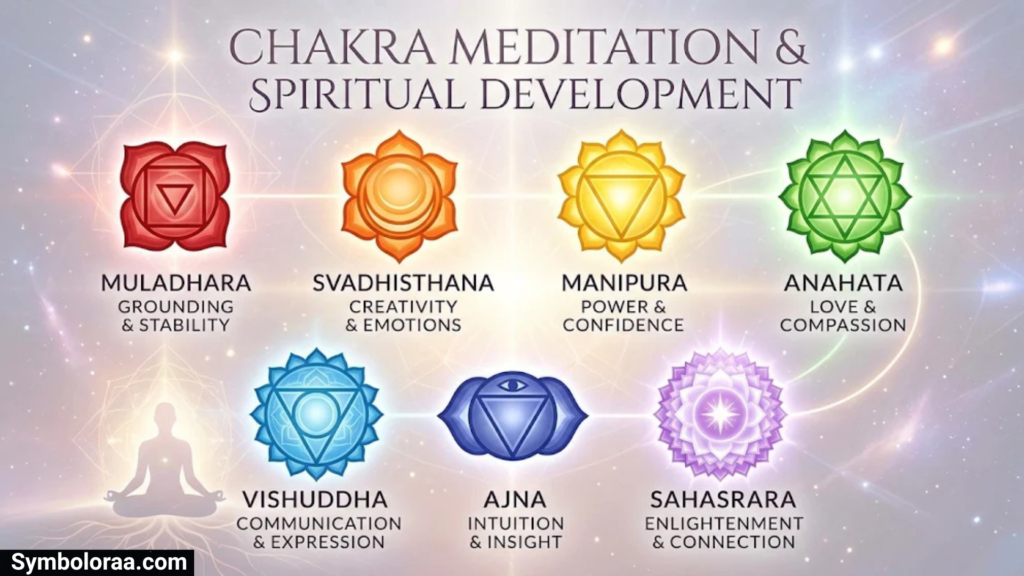
Chakra meditation combines attention, breathing, visualization, and traditional chakra symbolism.
Different schools use different meditation methods. Some focus on individual energy centers, while others incorporate mantra chanting and Kundalini-related practices.
Beginners can start with a simple mindfulness-based approach.
Chakra Meditation for Beginners
Follow these steps to create a basic chakra-inspired meditation routine.
Step One: Find a Comfortable Position
Sit on a cushion or chair. Keep your posture comfortable and your breathing natural.
Step Two: Understand the Seven Chakra Locations
Become familiar with the commonly described chakra positions, beginning at the base of the subtle-body system and moving upward.
Step Three: Focus on One Chakra
Choose one symbol rather than trying to concentrate on all seven immediately.
For example, select the Heart Chakra when exploring compassion and emotional connection.
Step Four: Visualize Its Symbol
Picture its lotus petals, geometric design, and central Sanskrit mantra.
Step Five: Practice Gentle Breathing
Breathe naturally without forcing deep inhalations or holding your breath.
Step Six: Repeat Its Seed Mantra
If appropriate to your practice, repeat the associated traditional mantra quietly or aloud.
Step Seven: Finish With Quiet Reflection
Allow yourself a few moments of silence before returning to ordinary activities.
A short meditation can be enough for beginners. You don’t need to force unusual sensations or expect an immediate spiritual experience.
Other Chakra-Related Practices
Several traditional and contemporary practices incorporate chakra symbolism.
| Practice | Purpose or Common Use |
| Yoga asanas | Physical movement and body awareness |
| Pranayama | Traditional breathing practices |
| Nadi Shodhana | Alternate Nostril Breathing |
| Mantra chanting | Sound-based concentration |
| Mindfulness | Awareness of present experiences |
| Visualization | Mental focus on symbolic imagery |
| Loving-kindness meditation | Developing compassion |
| Reiki | Contemporary energy-healing practice |
| Sound meditation | Relaxation and focused listening |
Some practices have established benefits for relaxation or general well-being. Others make spiritual claims that lack strong scientific evidence.
Crystals and Healing Stones Associated With the Seven Chakras
Chakra crystals are popular in modern spiritual and wellness practices.
Practitioners often choose stones according to their colors and symbolic associations. For example, red jasper is commonly connected with the Root Chakra, while amethyst is frequently associated with the Third Eye and Crown Chakras.
These connections belong primarily to contemporary crystal-healing traditions. They aren’t required elements of every historical chakra system.
Crystals Associated With Each Chakra
| Chakra | Commonly Associated Stones | Modern Symbolic Association |
| Root | Hematite, red jasper | Stability and grounding |
| Sacral | Carnelian, moonstone | Creativity and emotions |
| Solar Plexus | Citrine, tiger’s eye | Confidence and determination |
| Heart | Rose quartz, green aventurine | Love and compassion |
| Throat | Lapis lazuli, aquamarine | Communication |
| Third Eye | Amethyst, sodalite | Insight and awareness |
| Crown | Clear quartz, selenite | Spiritual reflection |
How to Use Chakra Crystals
You can incorporate crystals into a personal meditation routine in several ways.
- Hold a stone while practicing mindfulness.
- Place a crystal near your meditation space.
- Arrange stones according to the seven chakra colors.
- Use individual stones as reminders of personal intentions.
- Keep your collection clean and stored safely.
Crystal healing hasn’t been scientifically established as a treatment for illness or a method of changing measurable bodily energy.
Essential Oils and Aromatherapy for Chakra Practices
Aromatherapy uses fragrant plant-derived oils to create particular sensory experiences.
Modern chakra-inspired wellness practices sometimes associate specific scents with individual energy centers.
For example, cedarwood commonly appears in Root Chakra practices, while rose and lavender appear in Heart Chakra rituals.
These associations are contemporary wellness interpretations rather than universal traditional chakra teachings.
Essential Oils Associated With Each Chakra
| Chakra | Common Aromatherapy Associations |
| Root | Cedarwood, patchouli, sandalwood |
| Sacral | Ylang-ylang, jasmine, sweet orange |
| Solar Plexus | Peppermint, ginger, chamomile |
| Heart | Rose, lavender, geranium |
| Throat | Eucalyptus, chamomile |
| Third Eye | Frankincense, sandalwood, clary sage |
| Crown | Lavender, frankincense |
How to Incorporate Essential Oils Into Meditation
You can use aromatherapy to create a pleasant meditation environment.
Consider these simple methods:
- Use a suitable essential oil diffuser.
- Choose scents you personally enjoy.
- Follow the manufacturer’s dilution instructions.
- Avoid applying undiluted oils directly to your skin.
- Never assume that natural oils are automatically safe to ingest.
- Consider allergies, respiratory sensitivities, and household pets.
A pleasant scent can make meditation more enjoyable. It doesn’t prove that a particular chakra has opened or become balanced.
Benefits and Spiritual Significance of Working With Chakra Symbols
Chakra symbols provide a visual framework for exploring different aspects of personal and spiritual development.
Each symbol represents a particular group of ideas. Together, they offer a structured way to think about grounding, emotions, confidence, relationships, communication, insight, and spiritual awareness.
People may incorporate these symbols into meditation, yoga, journaling, and personal reflection.
Symbolic Associations Across the Seven Chakras
Root Chakra: Encourages reflection on safety, stability, and physical grounding.
Sacral Chakra: Provides a symbolic focus for creativity, emotional expression, and relationships.
Solar Plexus Chakra: Represents confidence, personal responsibility, and determination.
Heart Chakra: Encourages compassion, kindness, and meaningful relationships.
Throat Chakra: Represents honest communication and authentic self-expression.
Third Eye Chakra: Provides a focus for concentration, insight, and self-awareness.
Crown Chakra: Represents spiritual contemplation, realization, and liberation.
How Chakra Symbols Support Meditation
The visual details of chakra symbols can provide useful meditation anchors.
For example, someone exploring the Heart Chakra might concentrate on its twelve-petaled lotus. Another person might use the Root Chakra’s square as a visual reminder of stability.
This symbolic approach gives meditation a clear focus.
However, chakra symbols should not replace medical treatment or professional mental health support. Their value lies in spiritual practice, cultural meaning, and personal reflection rather than proven medical healing.
Traditional Chakra Symbols vs. Modern Chakra Illustrations
One important distinction separates traditional chakra diagrams from contemporary chakra artwork.
Modern illustrations often show seven brightly colored circles arranged along the body. Each circle contains a lotus, geometric shapes, and a Sanskrit seed mantra.
These illustrations make chakra symbolism easy to recognize. However, they simplify a much broader collection of historical teachings.
Traditional Tantric systems differ in several ways:
- Some describe five main chakras.
- Others describe six, seven, nine, or more centers.
- The number of centers varies across religious lineages.
- Traditional diagrams include specific Sanskrit letters and deities.
- Elemental associations are important in certain systems.
- Modern rainbow colors aren’t universal historical features.
- Sahasrara may be treated separately from the six lower centers.
The Ṣaṭ-Cakra-Nirūpaṇa is particularly influential because it provides detailed descriptions of six chakras and the thousand-petaled lotus above them.
Its symbolism helped shape many modern chakra illustrations.
Are Chakra Symbols Universal?
No. Chakra symbols vary across historical texts, spiritual traditions, and modern interpretations.
Hindu Tantric traditions and Vajrayana Buddhist teachings both discuss subtle-body concepts. However, their diagrams, practices, and arrangements aren’t identical.
Even within Hindu traditions, different texts describe different numbers and characteristics of chakras.
Therefore, it’s best to understand the familiar seven-chakra chart as one influential symbolic system rather than a universal map shared by every Indian spiritual tradition.
Frequently Asked Questions About Chakra Symbols
What Are the Seven Chakra Symbols?
The seven commonly recognized chakra symbols represent Muladhara, Svadhisthana, Manipura, Anahata, Vishuddha, Ajna, and Sahasrara. Each has distinctive lotus petals, geometric patterns, and traditional symbolic associations. Together, they form an influential chakra system used in modern yoga, meditation, and spiritual practices.
What Do the Seven Chakra Symbols Mean?
Each chakra represents different spiritual and symbolic qualities. The Root Chakra represents grounding, the Sacral Chakra represents creativity, and the Solar Plexus represents personal power. The Heart represents compassion, the Throat represents communication, the Third Eye represents insight, and the Crown represents spiritual realization.
What Are the Seven Chakras and Their Colors?
The familiar modern color sequence includes red for Root, orange for Sacral, yellow for Solar Plexus, green for Heart, blue for Throat, indigo for Third Eye, and violet or white for Crown. These are modern color associations rather than universal features of every traditional chakra diagram.
Why Do Chakra Symbols Have Different Numbers of Lotus Petals?
Traditional chakra descriptions associate different numbers of petals with each center. The six lower chakras have four, six, ten, twelve, sixteen, and two petals. Their petals contain Sanskrit letters connected with traditional sound symbolism. The Crown Chakra features a symbolic thousand-petaled lotus.
What Do the Geometric Shapes Inside Chakra Symbols Mean?
The shapes represent different elements and symbolic principles. A square represents Earth, a crescent moon represents Water, a triangle represents Fire, and a circle represents Space. The Heart Chakra’s intersecting triangles create a six-pointed star. These meanings depend on the traditional diagram being discussed.
What Is a Chakra Seed Mantra?
A chakra seed mantra is a sacred Sanskrit syllable associated with a particular chakra or element. These syllables are called Bija Mantras. The familiar sequence includes LAM, VAM, RAM, YAM, HAM, and OM. Crown Chakra practices vary and don’t share one universally assigned seed syllable.
Which Chakra Represents Love?
The Heart Chakra, or Anahata, represents love and compassion in modern chakra interpretations. Its twelve-petaled lotus and six-pointed star make it one of the most recognizable chakra symbols. It also represents kindness, forgiveness, emotional connection, and harmony.
Which Chakra Represents Confidence?
The Solar Plexus Chakra, or Manipura, represents confidence and personal power. Its ten-petaled lotus and fire-associated triangle symbolize transformation and determination. Modern interpretations connect it with self-esteem, independence, willpower, and decision-making.
Which Chakra Represents Intuition?
The Third Eye Chakra, or Ajna, represents intuition, insight, and inner awareness. Its traditional symbol contains a two-petaled lotus. Modern illustrations commonly use indigo to represent its association with wisdom and perception.
Which Chakra Represents Spiritual Enlightenment?
The Crown Chakra, or Sahasrara, represents spiritual realization and liberation in the familiar chakra system. Its thousand-petaled lotus symbolizes spiritual completeness and awareness beyond ordinary experience.
Are Chakra Symbols Part of Hinduism or Buddhism?
Chakra symbolism appears in Hindu Tantric and yogic traditions as well as Buddhist Tantric teachings. However, these traditions use different subtle-body systems and meditation methods. Their chakra diagrams aren’t always identical.
Are the Seven Chakra Colors Traditional?
The familiar rainbow sequence is largely a modern convention. Traditional chakra descriptions focus more on lotus petals, Sanskrit letters, geometric designs, deities, and elemental associations. Historical texts don’t consistently use the modern red-to-violet arrangement.
How Can You Use Chakra Symbols in Meditation?
Choose a chakra symbol and study its visual features. Sit comfortably and concentrate on its lotus, geometric shape, or seed mantra. You can also use gentle breathing and visualization to maintain attention during meditation.
Can Chakra Symbols Be Used for Healing?
People use chakra symbols in spiritual practices, meditation, and personal reflection. They can provide meaningful visual reminders of qualities such as compassion, confidence, and awareness. However, scientific evidence doesn’t establish chakra symbols as medical treatments or prove that they remove physical energy blockages.
What Is the Difference Between a Blocked Chakra and a Balanced Chakra?
A blocked chakra describes a perceived imbalance in modern spiritual language. A balanced chakra represents harmony with its associated symbolic qualities. Neither term represents a recognized medical diagnosis or measurable physical condition.
Are Chakra Symbols the Same in Every Tradition?
No. Different Hindu and Buddhist traditions describe different chakra arrangements, numbers, and symbolic details. Modern chakra illustrations also introduce variations in colors and interpretations. The familiar seven-chakra chart represents one influential system rather than every traditional teaching.
Final Thoughts on the Seven Chakra Symbols
The seven chakra symbols combine lotus flowers, geometric shapes, Sanskrit letters, and spiritual ideas into a distinctive visual system.
Each symbol represents a different center within the subtle-body teachings of Indian spiritual traditions. Muladhara emphasizes grounding, Svadhisthana represents creativity, and Manipura symbolizes personal power. Anahata represents compassion, Vishuddha represents communication, Ajna represents insight, and Sahasrara represents spiritual realization.
Understanding their details makes the symbols far more meaningful. The number of lotus petals, the elemental shapes, and the seed mantras all contribute to their traditional significance.
Although modern chakra illustrations simplify these teachings through rainbow colors and familiar emotional associations, their historical roots are much richer.
If you explore chakra symbols through yoga, meditation, Sanskrit symbolism, or Indian spiritual history, each design offers another way to understand this fascinating tradition.

I’m Madison Reed, a contemporary American author who writes about love, family, friendship, and second chances. I’m fascinated by the choices that shape our lives and the moments that change us forever. My goal is to create honest, emotional stories with characters readers can connect with long after finishing each book.
Three Books:
When We Find Our Way
The Things We Never Said
Summer in September
 Jackson Miller