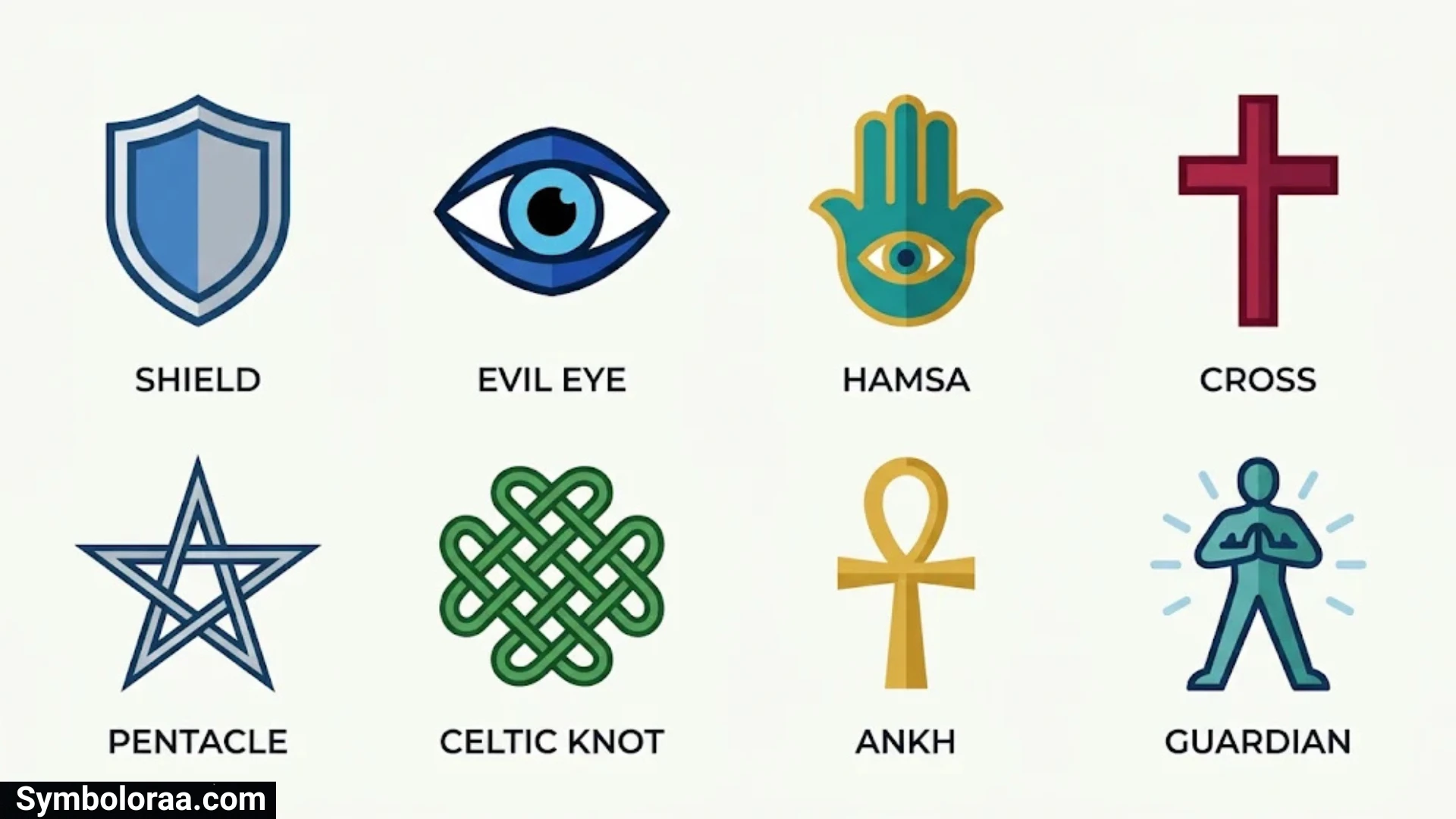
Throughout history, people have turned to symbols to express their hopes for safety, strength, and divine protection. From ancient Egyptian amulets to traditional Middle Eastern charms, these images carry stories that have survived for thousands of years.
Some protection symbols represent the power of gods and spiritual guardians. Others reflect beliefs about harmful spirits, misfortune, illness, and the evil eye. Although their meanings differ across cultures, they share an important purpose: expressing the human desire for safety and reassurance.
Today, these symbols appear in necklaces, rings, bracelets, tattoos, religious objects, and home decorations. The Eye of Horus, Hamsa, Nazar, Ankh, and Pentagram remain especially recognizable examples of ancient protection symbols.
However, their histories deserve more attention than their modern decorative uses. Understanding where these symbols originated, what they represented, and how people used them reveals a fascinating connection between ancient traditions and modern spirituality.
This guide explores traditional protection symbols, their cultural backgrounds, historical meanings, and contemporary interpretations. It also explains the differences between amulets, talismans, and protective symbols.
What Are Protection Symbols?
Protection symbols are visual signs, objects, or designs associated with safety, guardianship, blessings, and protection against perceived harm. Different societies developed these symbols through religious beliefs, mythology, folklore, and everyday customs.
Some represent powerful deities. Others use recognizable shapes such as eyes, hands, animals, crosses, and geometric patterns.
Ancient people often believed that displaying or carrying particular symbols could protect them from harmful spirits, illness, accidents, curses, and misfortune. They incorporated these designs into jewelry, clothing, buildings, weapons, and burial objects.
For example, ancient Egyptians wore Eye of Horus amulets because they associated the symbol with healing and restoration. Meanwhile, Mediterranean communities used eye-shaped charms to guard against the harmful gaze known as the evil eye.
Why Did Ancient Civilizations Use Protection Symbols?
Ancient societies faced dangers they couldn’t always explain or control. Disease, natural disasters, warfare, childbirth complications, and sudden deaths created uncertainty.
Religious and spiritual beliefs offered ways to understand these experiences. Symbols provided visible expressions of those beliefs.
People used protective objects for several reasons:
- Protection against evil: Many communities believed harmful spirits or jealous individuals could cause misfortune.
- Divine guardianship: Religious symbols represented the presence or favor of powerful gods and spiritual beings.
- Health and healing: Certain amulets represented restoration, fertility, and physical well-being.
- Safe journeys: Travelers carried charms for protection during long or dangerous trips.
- Protection after death: Some civilizations placed protective objects inside tombs to safeguard the deceased.
- Personal reassurance: Familiar symbols offered comfort and strengthened religious or cultural identity.
In ancient Egypt, protective amulets served both the living and the dead. Archaeological collections contain examples of symbols placed directly on mummies to support the deceased during their journey into the afterlife.
Common Types of Protective Symbols
Protection symbols often fall into recognizable visual categories.
| Symbol type | Traditional association | Examples |
| Eyes | Watchfulness and protection against harmful gazes | Eye of Horus, Nazar |
| Hands | Blessings and divine guardianship | Hamsa |
| Animals | Strength and spiritual guardianship | Scarab, guardian lions |
| Geometric shapes | Religious and philosophical ideas | Pentagram, Bagua |
| Crosses and knots | Faith, continuity, and spiritual beliefs | Christian Cross, Triquetra |
| Sacred objects | Divine power and spiritual principles | Vajra, Ankh |
25 Ancient Protection Symbols and Their Meanings
Different civilizations developed their own protective symbols, each with a distinct history and cultural meaning. Some have direct archaeological evidence of protective use, while others acquired protective interpretations through later religious or spiritual traditions.
Ancient Egyptian Protection Symbols
Ancient Egypt offers some of the richest archaeological evidence for protective symbolism. Egyptians used amulets made from materials such as faience, stone, metal, and precious stones.
These objects represented divine powers, healing, stability, and rebirth. Many appeared in everyday jewelry and funerary arrangements.
Eye of Horus (Wedjat)
The Eye of Horus, also called the Wedjat, is one of the best-known ancient Egyptian protection symbols.
It combines features of a human eye and the facial markings of a falcon. This design connects the symbol to Horus, a powerful Egyptian deity associated with kingship and divine authority.
According to Egyptian mythology, Horus lost or injured his eye during a conflict with Seth. The god Thoth later restored it, making the healed eye a symbol of recovery and wholeness.
The Egyptian word wedjat refers to something restored or made whole.
Ancient Egyptians believed that amulets shaped like the Wedjat could transfer its protective and regenerative qualities to their owners. They wore these objects during life and placed them in tombs after death.
The Metropolitan Museum of Art documents Wedjat amulets dating back to approximately 2150–1950 BCE. Its collection also includes examples from later Egyptian periods.
Traditional meanings:
- Protection and guardianship.
- Healing and restoration.
- Wholeness and regeneration.
- Health and well-being.
Modern uses: Eye of Horus necklaces, rings, bracelets, tattoos, and decorative artwork.
Eye of Ra
The Eye of Ra represents the power and authority of Ra, the ancient Egyptian sun god.
Egyptian mythology describes the Eye of Ra as a powerful divine force associated with the sun’s protective and destructive qualities. It could defend divine order while punishing threats against it.
Artists often represented the symbol through a solar disk surrounded by a cobra, although its appearance varies across Egyptian religious imagery.
People sometimes confuse the Eye of Ra with the Eye of Horus. However, their mythological associations differ.
| Eye of Horus | Eye of Ra |
| Associated with Horus | Associated with Ra |
| Connected with restoration and healing | Connected with solar power and divine authority |
| Commonly represented as a stylized eye | Often represented through a solar disk and cobra |
| Used extensively in protective amulets | Appears in solar and royal religious imagery |
Both symbols reflect important aspects of ancient Egyptian religious beliefs.
Tyet (Knot of Isis)
The Tyet, commonly called the Knot of Isis, resembles a looped knot with downward-pointing arms.
Ancient Egyptians associated this symbol with Isis, a goddess connected with motherhood, healing, magic, and protection.
The Tyet appeared in funerary objects and protective amulets. Its association with Isis made it particularly important in beliefs about safeguarding the deceased.
Egyptian funerary traditions sometimes connected the symbol with the goddess’s blood and protective powers.
Traditional meanings:
- Protection associated with Isis.
- Divine guardianship.
- Maternal care.
- Protection in the afterlife.
The Tyet remains recognizable in Egyptian-inspired jewelry and historical artwork.
Djed Pillar
The Djed Pillar is an ancient Egyptian symbol of stability and endurance.
Its design resembles a vertical column with several horizontal bars near the top. Egyptians associated it with Osiris, the god of the afterlife, resurrection, and regeneration.
The symbol sometimes represented the backbone of Osiris. This connection reinforced its association with strength, stability, and the restoration of life.
Ancient Egyptians used Djed amulets in funerary settings. Archaeological collections include examples placed alongside other protective objects on mummies.
Traditional meanings:
- Stability and endurance.
- Strength and resilience.
- Continuity and restoration.
- Association with Osiris.
Scarab Beetle
The Scarab Beetle was another important symbol in ancient Egyptian religion.
Its meaning comes from the behavior of dung beetles, which roll balls of dung across the ground. Egyptians connected this action with the movement of the sun across the sky.
They associated the scarab with Khepri, a deity representing the rising sun and renewal.
Scarab amulets appeared in jewelry, seals, and funerary objects. Their flat undersides often carried names, inscriptions, or decorative designs.
The ancient Egyptians connected the scarab with:
- Rebirth and regeneration.
- New beginnings.
- Renewal and transformation.
- Protection in the afterlife.
Today, scarab designs appear in Egyptian-inspired jewelry and decorative art.
Middle Eastern and Mediterranean Protection Symbols
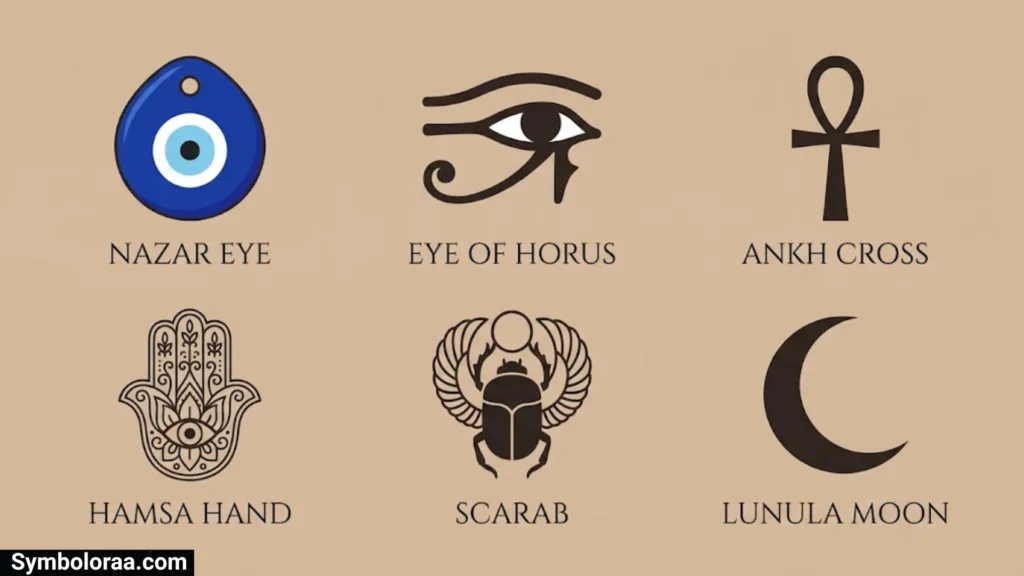
Middle Eastern and Mediterranean cultures developed rich traditions surrounding protective charms. The evil eye, Hamsa, and other symbols remain especially recognizable.
Hamsa (Hand of Protection)
The Hamsa is an open-hand symbol associated with protection, blessings, and resistance to the evil eye.
Its name comes from the Arabic word khamsa, meaning five. The design usually features a palm with five extended fingers. Some versions include an eye in the center.
The Hamsa appears in Jewish and Muslim traditions and has a long history across parts of North Africa and the Middle East.
In Jewish communities, people sometimes call it the Hand of Miriam, referring to Miriam, the sister of Moses and Aaron. In Islamic traditions, it is commonly associated with the Hand of Fatima, referring to Fatima, the daughter of Muhammad.
The symbol also appears in regional folk traditions. Its meanings and religious interpretations vary between communities.
Traditional associations:
- Protection against the evil eye.
- Blessings and good fortune.
- Divine guardianship.
- Family and household protection.
People display Hamsa designs in homes and wear them as necklaces, bracelets, pendants, and rings.
The Jewish Museum London documents a 19th-century Hamsa banner and explains the symbol’s importance in Jewish and Islamic traditions.
Nazar (Evil Eye Bead)
The Nazar, often called the evil eye bead, is a recognizable protective charm found throughout Turkey and neighboring regions.
It typically features concentric circles of dark blue, light blue, white, and black. These circles create the appearance of an eye.
The design relates to the widespread belief in the evil eye: the idea that envy, excessive admiration, or malicious attention can bring misfortune to another person.
Traditional beliefs suggest that a Nazar charm helps guard against this harmful gaze.
People commonly display Nazar beads in:
- Homes and doorways.
- Shops and business entrances.
- Cars and other vehicles.
- Bracelets and necklaces.
- Gifts for newborn children.
Blue glass Nazar beads have become popular decorative objects around the world.
Important distinction: The evil eye refers to the harmful gaze or the belief surrounding it. The Nazar is a charm traditionally used to guard against that perceived threat.
Gorgoneion (Head of Medusa)
The Gorgoneion represents the frightening face of a Gorgon, especially Medusa from Greek mythology.
Medusa is famous for her snake-covered hair and the ability to turn people into stone with her gaze.
Ancient Greeks sometimes used her image as an apotropaic symbol. This term describes an image or object intended to ward off evil or danger.
The frightening face supposedly repelled harmful forces by confronting danger with an equally intimidating image.
Gorgoneion designs appeared on:
- Shields and armor.
- Temple decorations.
- Pottery and vessels.
- Architectural ornaments.
- Coins and other objects.
The Metropolitan Museum of Art explains how Medusa’s image functioned as a protective motif in ancient Greek art. Gorgoneia appeared prominently in temple decorations during the Archaic period, approximately 700–480 BCE.
Mano Fico (Fig Hand)
The Mano Fico is a traditional Mediterranean hand gesture associated with protection and fertility.
Its design shows the thumb positioned between the index and middle fingers. The shape resembles a fig, which explains the name.
The gesture has appeared in Italian and other Mediterranean folk traditions. Depending on the historical and regional context, it has carried associations with fertility, sexuality, protection, and resistance to the evil eye.
People have also made small Mano Fico charms from materials such as silver, coral, and other decorative substances.
Its meaning is not identical across all Mediterranean communities. Regional traditions give the gesture different interpretations.
Eye of Providence
The Eye of Providence consists of an eye surrounded by rays, often enclosed within a triangle.
It represents divine watchfulness and the belief that God observes human actions.
The motif became prominent in Christian European religious art, particularly during the early modern period. Artists used it to express God’s omniscience and presence.
The symbol also appears on the reverse of the Great Seal of the United States, adopted in 1782.
Although people sometimes connect it with ancient Egyptian eye imagery, the Eye of Providence has a distinct historical development.
Its traditional associations include:
- Divine awareness.
- God’s presence.
- Spiritual guidance.
- Providence and protection.
Celtic and European Protection Symbols
Celtic and European traditions contain many recognizable symbols involving knots, spirals, religious imagery, and geometric designs.
However, modern interpretations sometimes go beyond what historians can confirm. Understanding the historical evidence helps separate documented meanings from later spiritual associations.
Triquetra
The Triquetra is a three-pointed knot made from three interconnected loops.
Its name comes from Latin and means three-cornered. The design appears in Insular Christian manuscripts and medieval decorative art.
People often associate the Triquetra with Celtic culture, although its exact origins and earliest meanings remain uncertain.
In modern interpretations, it can represent:
- Threefold unity.
- Interconnectedness.
- Eternity and continuity.
- Mind, body, and spirit.
- The Christian Trinity.
Some contemporary spiritual traditions also use it as a spiritual protection symbol.
The important distinction is that its modern protective meanings should not automatically be treated as proven ancient Celtic beliefs.
Triskele (Triple Spiral)
The Triskele, also called the triple spiral, consists of three connected spiral shapes.
One famous example appears at Newgrange, a prehistoric passage tomb in County Meath, Ireland. The monument dates to approximately 3200 BCE, making it older than Stonehenge and the Great Pyramid of Giza.
The spiral motif is often connected with movement, cycles, and threefold patterns.
Modern interpretations associate it with:
- Life, death, and rebirth.
- Past, present, and future.
- Movement and transformation.
- Natural cycles.
However, archaeologists cannot confidently establish one universal meaning for every prehistoric triple spiral.
Today, the Triskele appears in Celtic-inspired artwork, tattoos, jewelry, and spiritual designs.
Pentagram
The Pentagram is a five-pointed star drawn using five connected lines.
Its history reaches back to ancient mathematical and philosophical traditions. The ancient Greeks studied its geometric properties and associated it with mathematical harmony.
Over time, different religious and spiritual communities adopted the design.
Its meanings vary according to the tradition:
- In some historical contexts, it represented mathematical harmony.
- In Western esoteric traditions, it became associated with protection and spiritual practice.
- In modern Wicca, the pentagram often represents the five elements: earth, air, fire, water, and spirit.
- In some religious contexts, it carries other symbolic meanings.
An upright pentagram is common in contemporary Pagan symbolism. An inverted pentagram has different interpretations in some modern occult traditions.
A pentagram and a pentacle are related but not identical terms. A pentacle often refers to a pentagram enclosed within a circle, although usage varies.
Christian Cross
The Christian Cross is one of the most recognizable religious symbols in the world.
It represents the crucifixion of Jesus Christ and occupies a central place in Christian faith.
Christians use crosses in churches, homes, prayer spaces, religious jewelry, and devotional objects.
Depending on the tradition, the cross may represent:
- Faith and salvation.
- Sacrifice and redemption.
- Hope and resurrection.
- God’s love and spiritual guidance.
Many Christians also regard the cross as a sign of divine protection. Religious medals, crosses, and blessed objects reflect this devotional practice.
However, its primary meaning remains rooted in the central events of Christian belief rather than a general-purpose protective charm.
Thor’s Hammer (Mjölnir)
Mjölnir, the hammer of Thor, comes from Norse mythology.
Thor was associated with thunder, storms, strength, and the defense of gods and humans. His hammer represented extraordinary power and the ability to defeat dangerous enemies.
Archaeologists have discovered Viking Age hammer-shaped pendants. These objects provide evidence that people wore Mjölnir as a religious and cultural symbol.
Its traditional associations include:
- Strength and courage.
- Divine power.
- Protection and guardianship.
- Norse religious identity.
Today, Mjölnir remains popular in Norse-inspired jewelry, historical reenactment, and modern Heathen traditions.
Asian Protection Symbols
Asian religious and philosophical traditions developed distinctive symbols connected with cosmic order, sacred teachings, divine guardianship, and spiritual wisdom.
Bagua
The Bagua is a traditional Chinese diagram consisting of eight trigrams.
Each trigram contains three lines, either solid or broken. Together, the eight combinations form an important part of Chinese cosmology and the I Ching, also known as the Book of Changes.
The Bagua represents relationships between natural forces and different aspects of existence.
Its applications include:
- Traditional Chinese cosmology.
- Feng shui practices.
- Interpretations of spatial arrangement.
- Symbolic representations of natural patterns.
A Bagua mirror sometimes appears above entrances in certain feng shui practices. People traditionally use it to redirect or counter perceived harmful influences.
Fu Talisman (Chinese Protective Talisman)
Fu talismans are inscribed objects associated with Daoist religious practices.
They often feature special characters, symbols, seals, and ritual markings. Their appearance can vary considerably depending on the tradition and intended purpose.
Daoist practitioners have used talismans in rituals involving protection, healing, blessings, and spiritual authority.
Traditional Fu talismans may appear on:
- Paper.
- Fabric.
- Wooden objects.
- Household religious decorations.
- Ritual objects.
These are not simply decorative drawings. Their meanings depend on specific religious teachings, ritual procedures, and the practitioners who create and use them.
Shisa
Shisa are lion-dog guardian figures found throughout Okinawa and the Ryukyu Islands of Japan.
They usually appear as fierce-looking creatures with lion-like faces and dog-like features.
Okinawans traditionally place Shisa on rooftops, gates, and entrances to protect homes and communities against harmful influences.
Their history reflects cultural exchange between Okinawa, China, and neighboring regions.
Many Shisa figures appear in pairs. Local explanations sometimes associate their open and closed mouths with keeping harmful influences away and preserving good fortune.
Their traditional associations include:
- Household protection.
- Guardianship.
- Protection against misfortune.
- Community identity.
Today, Shisa remain an important part of Okinawan architecture, crafts, and cultural heritage.
Vajra (Dorje)
The Vajra, also called Dorje in Tibetan, is an important symbol and ritual object in Vajrayana Buddhism.
Its name carries meanings connected with the thunderbolt and something indestructible.
The object usually features a central sphere with symmetrical prongs extending from both ends.
In Buddhist teachings, the Vajra represents the indestructible nature of enlightened wisdom and the strength of Buddhist teachings.
Practitioners often use it alongside a ritual bell. Together, these objects express complementary principles of wisdom and compassion.
The Smithsonian National Museum of Asian Art describes the Vajra as a symbol and ritual implement expressing the indestructibility of Buddhist teachings.
Its associations include:
- Spiritual wisdom.
- Indestructibility.
- Enlightenment.
- Spiritual strength.
It should not be reduced to a generic protection charm because it holds a specific place within Buddhist religious practice.
Om (Aum)
Om, also written as Aum, is a sacred sound and symbol in Hindu religious and philosophical traditions.
Its written form appears in Sanskrit and other South Asian scripts. It is especially important in Hindu prayer, meditation, and spiritual teachings.
Om represents a profound concept connected with ultimate reality and the nature of existence.
Some Hindu philosophical interpretations associate its sounds with different states of consciousness.
Its traditional significance includes:
- Sacred sound.
- Spiritual awareness.
- Universal reality.
- Meditation and contemplation.
People sometimes display Om in homes, temples, and meditation spaces.
Although modern spiritual communities may describe it as a protection symbol, its established religious meaning goes much deeper than that simplified interpretation.
Other Cultural and Traditional Protection Symbols
Protective traditions also developed across Indigenous communities, Africa, and other regions. These symbols often carry meanings that connect closely with local identity, family, religion, and community life.
Ojo de Dios (God’s Eye)
The Ojo de Dios, or God’s Eye, is a woven object traditionally associated with Wixárika (Huichol) cultural practices in Mexico.
It typically consists of colored yarn woven around crossed wooden sticks to create a diamond-shaped pattern.
Its meaning relates to spiritual observation, prayer, and the relationship between people and the sacred world.
Contemporary versions often appear as decorative wall hangings and craft objects.
However, the traditional object has cultural and ceremonial contexts that deserve respect. It should not be treated simply as a universal symbol of protection.
Dreamcatcher
The Dreamcatcher is a well-known object associated with the Ojibwe people and other Indigenous communities.
Traditional designs usually feature a circular hoop with a woven web inside. Some include feathers, beads, and other decorative elements.
Traditional accounts connect dreamcatchers with beliefs about protecting children during sleep. The web is associated with catching harmful dreams or influences.
The Smithsonian documents the Ojibwe origins and cultural history of dreamcatchers, including their later adoption and commercialization through New Age movements.
Traditional associations include:
- Protection during sleep.
- Childhood safeguarding.
- Family care.
- Cultural identity.
Dreamcatchers have become common decorative objects worldwide. However, their Indigenous history should remain central to any meaningful explanation.
Gye Nyame
Gye Nyame is one of the most recognizable symbols in the Akan Adinkra visual tradition of Ghana.
Its name translates approximately as “except for God.”
The symbol expresses the supremacy, power, and eternal nature of God. It reflects an important aspect of Akan religious and philosophical thought.
Adinkra symbols appear on textiles, clothing, artwork, and decorative objects. Each design communicates a particular concept or cultural message.
Gye Nyame is associated with:
- Divine supremacy.
- Faith and religious devotion.
- The power of God.
- Spiritual reflection.
The National Park Service documents its meaning and connection with Akan culture.
Although people may use it as a symbol of divine protection, its central meaning concerns God’s supremacy.
Eye Motifs in Ancient Greece and Rome
Eye-shaped motifs appeared in several ancient Mediterranean traditions.
People associated the evil eye with harmful attention, jealousy, or envy. Decorative eyes sometimes appeared on vessels and other objects as a form of apotropaic symbolism.
The purpose was to repel perceived harmful influences.
These motifs connect with broader Mediterranean traditions surrounding protective charms and the evil eye.
They also help explain why eye-shaped symbols remain common in modern protective jewelry.
Five Wounds of Christ
The Five Wounds of Christ refer to the wounds associated with Jesus’s crucifixion in Christian devotional tradition.
They generally represent the wounds in his hands, feet, and side.
The subject became especially important in medieval Christian devotion and religious artwork.
The five wounds symbolize:
- Christ’s suffering.
- Sacrifice and redemption.
- Divine love.
- The central events of Christian faith.
Some devotional objects and religious practices incorporate the five wounds. However, they should not be presented as a universal ancient protection emblem.
Protection Symbols Across Different Cultures and Religions
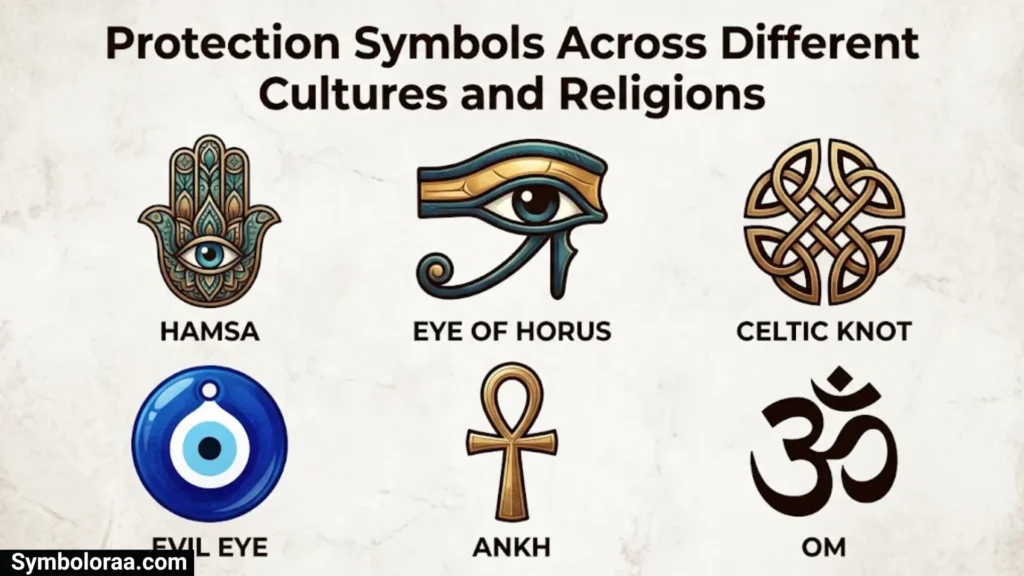
Although protective imagery appears in many societies, each tradition developed its own religious language and symbolic meanings.
Understanding these differences helps explain why similar designs can represent different ideas.
Ancient Egyptian Protection Symbols
Ancient Egyptians viewed the world as a place where divine forces influenced everyday life and the afterlife.
Their religious beliefs shaped their use of amulets, inscriptions, and sacred objects.
Gods and goddesses often appeared on protective objects because Egyptians believed these deities could provide specific forms of assistance.
For example:
- Horus represented kingship and divine authority.
- Isis was associated with motherhood, healing, and magic.
- Osiris represented resurrection and the afterlife.
- Ra represented solar power and divine authority.
- Bes and Taweret were associated with household and childbirth protection.
The British Museum’s educational resources describe how Egyptians used symbols such as the Wedjat, Djed, Ankh, and Scarab to represent health, stability, life, and rebirth.
Middle Eastern and North African Protection Traditions
The evil eye is one of the most widespread beliefs across the Mediterranean, Middle East, and parts of North Africa.
Communities developed different protective customs in response to this belief.
The Hamsa and Nazar became especially recognizable examples.
Jewish, Muslim, and regional folk traditions have all contributed to the cultural history of the Hamsa. Its interpretations vary, but protection and blessings remain common themes.
People have traditionally displayed these objects in homes, carried them during travel, and incorporated them into personal jewelry.
Greek and Roman Protection Symbols
Ancient Greek and Roman communities used religious imagery to express protection and discourage perceived threats.
The Gorgoneion provides a particularly clear example.
Medusa’s frightening face appeared on shields, temples, and other objects. Her image could function as a warning against enemies and harmful forces.
Eye motifs also appeared in Mediterranean art and everyday objects.
These examples show that protective symbolism wasn’t limited to small personal charms. It could also become part of architecture, public spaces, and military equipment.
Celtic and Norse Protection Symbols
Celtic-inspired symbols often feature spirals, interwoven lines, and repeating patterns.
The Triquetra and Triskele remain popular because their designs suggest continuity and interconnectedness.
Norse traditions offer another perspective through Mjölnir.
Archaeological evidence of hammer-shaped pendants reveals how religious identity and protective symbolism could appear in wearable objects.
However, modern interpretations of these symbols sometimes differ from their historical meanings.
Christian Protection Symbols
Christian communities have used crosses, religious medals, sacred images, and devotional objects for centuries.
The cross remains the central symbol of Christianity.
Many believers also use religious objects as reminders of faith, prayer, and divine guidance.
These practices vary across Catholic, Orthodox, and Protestant communities.
Hindu and Buddhist Protection Symbols
Hinduism and Buddhism contain rich traditions of sacred imagery.
Om, Vajra, and other religious symbols appear in temples, rituals, manuscripts, and devotional objects.
Their meanings depend on specific teachings and practices.
For example, the Vajra represents indestructible wisdom in Vajrayana Buddhism. Om holds deep philosophical and religious significance in Hindu traditions.
Treating these symbols as interchangeable charms would overlook their original purpose.
Chinese and East Asian Protection Traditions
Chinese traditions include Bagua diagrams, Daoist Fu talismans, guardian figures, and protective inscriptions.
These objects reflect beliefs about harmony, spiritual authority, cosmic relationships, and household well-being.
Okinawan Shisa figures demonstrate how regional traditions adapt and reinterpret symbols through cultural exchange.
How Were Protection Symbols Used in Ancient Times?
Ancient people didn’t simply admire protective symbols. They incorporated them into everyday activities, religious ceremonies, and important life events.
Protective Amulets and Personal Charms
Wearing amulets was one of the most common ways people interacted with protective symbolism.
They made these objects from materials such as:
- Gold and silver.
- Copper and bronze.
- Faience and glazed ceramics.
- Carnelian and other gemstones.
- Stone, bone, and shell.
- Glass and clay.
The material could influence an object’s appearance, value, and symbolic associations.
Ancient Egyptians, for example, used Wedjat amulets in different materials, including faience, carnelian, agate, and gold.
Protection Symbols in Homes and Buildings
Protective designs also appeared in architectural settings.
People placed guardian figures near entrances, carved images into walls, and displayed religious objects in household spaces.
Examples include:
- Shisa figures on Okinawan rooftops.
- Protective Hamsa decorations.
- Guardian images near temple entrances.
- Sacred inscriptions on household objects.
- Bagua mirrors in traditional feng shui practices.
These objects connected private spaces with wider religious and cultural beliefs.
Protection Symbols in Burial and Funerary Practices
Ancient Egyptian funerary practices provide especially strong evidence of protective symbolism.
People placed amulets among mummy wrappings and inside tombs. Different objects represented healing, stability, rebirth, and divine guardianship.
The Metropolitan Museum of Art documents examples of Wedjat, Djed, and other amulets discovered in funerary contexts.
These objects reflected the Egyptian belief that protection remained important after death.
Protection Symbols in Warfare
Warriors sometimes carried religious symbols into battle.
They displayed protective imagery on shields, armor, weapons, and personal ornaments.
Such objects could express loyalty to a deity, reinforce group identity, and represent hopes for divine favor.
The Gorgoneion and Mjölnir illustrate different ways ancient cultures connected powerful imagery with strength and protection.
Protection Symbols During Birth and Childhood
Childbirth and childhood were important areas of protective religious practice.
Ancient Egyptians used amulets associated with deities such as Bes and Taweret. These figures were connected with childbirth, mothers, and children.
In other cultures, families used charms, prayers, and household rituals to express their hopes for a child’s safety.
Amulets vs. Talismans vs. Protection Symbols: What’s the Difference?
People often use the words amulet, talisman, and protection symbol interchangeably. However, they describe different things.
What Is a Protection Symbol?
A protection symbol is an image or design associated with safety, guardianship, or spiritual beliefs.
Examples include the Eye of Horus, Hamsa, and Pentagram.
A symbol doesn’t need to exist as a physical object. It can appear in artwork, architecture, tattoos, or religious imagery.
What Is an Amulet?
An amulet is a physical object traditionally believed to protect its owner against harm.
People commonly wear or carry amulets.
Examples include:
- Nazar beads.
- Egyptian Wedjat pendants.
- Protective religious medals.
- Small engraved charms.
What Is a Talisman?
A talisman is an object traditionally believed to attract a desired benefit or influence.
Its purpose may include protection, good fortune, prosperity, success, or strength.
Fu talismans provide an example of objects associated with specific religious practices and intentions.
Key Differences Between Amulets and Talismans
| Feature | Amulet | Talisman | Protection symbol |
| Main purpose | Traditionally wards off harm | Traditionally attracts a desired benefit | Represents an idea or belief |
| Form | Physical object | Physical or inscribed object | Image, sign, or motif |
| Common use | Worn or carried | Worn, displayed, or used in rituals | Displayed, worn, or incorporated into objects |
| Example | Nazar bead | Fu talisman | Eye of Horus |
One object can serve multiple symbolic purposes. Its classification depends on its cultural context and intended use.
How to Choose a Protection Symbol
Choosing a protection symbol involves more than finding an attractive design.
Its cultural background, religious meaning, and personal significance all deserve consideration.
Identify What the Symbol Represents
Start by deciding which meaning interests you.
For example:
| Desired association | Symbols to explore |
| Healing and restoration | Eye of Horus |
| Protection against the evil eye | Hamsa, Nazar |
| Divine guardianship | Eye of Providence |
| Strength and courage | Mjölnir |
| Stability and endurance | Djed Pillar |
| Spiritual wisdom | Vajra |
| Life and renewal | Ankh, Scarab |
| Threefold unity | Triquetra |
These associations reflect traditional interpretations rather than guaranteed results.
Consider Its Cultural and Religious Origins
Research the symbol before wearing it or displaying it.
Ask a few basic questions:
- Which culture developed or adopted the design?
- Does it belong to a specific religion?
- What did it originally represent?
- Has its meaning changed over time?
- Are there cultural practices surrounding its use?
This approach helps prevent misunderstandings and encourages respect for cultural heritage.
Choose a Symbol That Reflects Your Beliefs
A meaningful symbol should connect with something you genuinely value.
You might appreciate the Eye of Horus because of its association with restoration. Another person may prefer the Christian Cross because of its religious significance.
Some people choose symbols connected with family heritage, while others appreciate their historical or artistic value.
There is no universal rule that makes one choice better than another.
Understand Traditional Materials and Colors
Materials and colors sometimes carry specific cultural meanings.
For example:
- Blue glass commonly appears in Nazar beads.
- Gold and faience feature prominently in ancient Egyptian amulets.
- Silver appears in many traditional Hamsa objects.
- Red paper is commonly associated with certain Chinese talismanic traditions.
However, these associations differ across cultures. A material doesn’t automatically give every symbol the same meaning.
Modern Uses of Protection Symbols
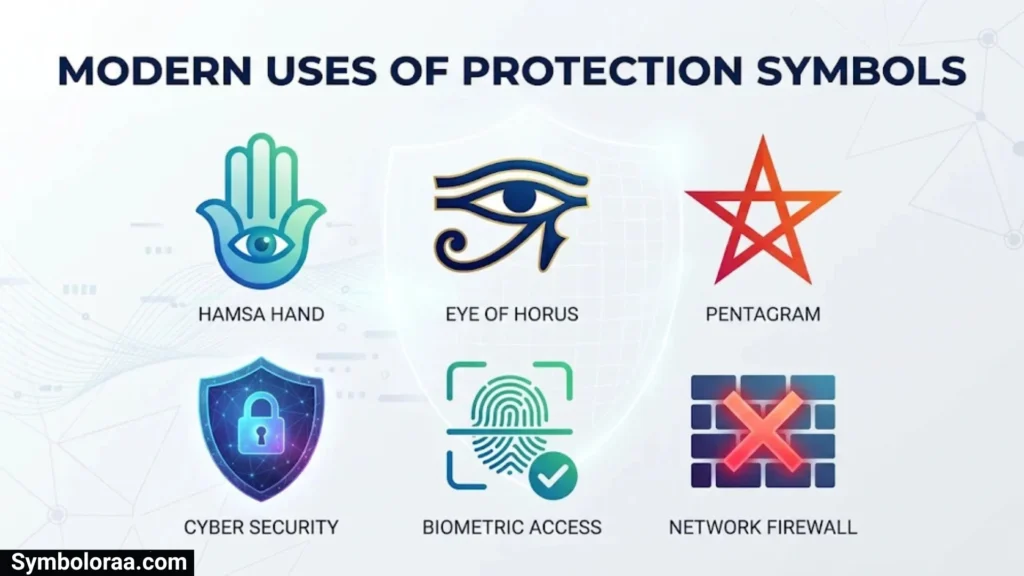
Ancient protective imagery continues to influence modern fashion, art, spirituality, and interior design.
People often choose these symbols because they appreciate their appearance, cultural background, religious significance, or personal meaning.
Protection Symbols in Modern Jewelry
Jewelry remains one of the most popular ways to display protective symbolism.
Common designs include:
- Hamsa necklaces and bracelets.
- Nazar pendants and earrings.
- Eye of Horus rings.
- Ankh necklaces.
- Pentagram pendants.
- Scarab bracelets.
- Mjölnir necklaces.
- Celtic knot rings.
Jewelry designers often combine historical motifs with contemporary materials and craftsmanship.
For example, a Hamsa pendant might feature sterling silver and blue gemstones. An Eye of Horus ring may use gold plating or detailed engraving.
These designs allow people to carry meaningful imagery as part of their everyday style.
However, a modern jewelry design doesn’t necessarily preserve every detail of its historical counterpart.
Protection Symbol Tattoos
Protective symbols also appear in contemporary tattoo art.
People choose them for their religious associations, cultural heritage, personal values, or visual appeal.
Popular examples include:
- Hamsa tattoos.
- Evil eye tattoos.
- Eye of Horus tattoos.
- Triquetra designs.
- Pentagram tattoos.
- Ankh tattoos.
- Norse hammer designs.
Before choosing a culturally specific tattoo, research its history and significance.
A symbol that looks decorative may carry deep religious or cultural meaning for another community.
Protection Symbols in Home Decor
Many people display protective imagery in their homes.
Examples include Hamsa wall hangings, Nazar ornaments, Shisa figures, religious crosses, and traditional Chinese decorative objects.
Some people place these objects near doors or windows because their traditions associate entrances with household guardianship.
Others display them in prayer rooms, meditation spaces, or family gathering areas.
Their value may come from religious devotion, cultural connection, or personal comfort.
Protection Symbols in Modern Spiritual Practices
Contemporary spirituality includes many practices involving symbolic objects.
People may incorporate meaningful designs into:
- Meditation spaces.
- Prayer and devotional practices.
- Personal reflection.
- Yoga environments.
- Mindfulness routines.
- Religious ceremonies.
For example, someone may display Om during meditation because of its significance in Hindu philosophy.
A Buddhist practitioner may use a Vajra in a specific ritual context.
These practices should remain connected to their original traditions rather than being treated as generic spiritual techniques.
Protection Symbols in Fashion and Contemporary Art
Designers continue to draw inspiration from ancient motifs.
Celtic knots appear in rings and clothing. Egyptian imagery influences accessories and graphic design. Adinkra motifs appear on textiles and contemporary artwork.
These adaptations can help preserve interest in historical symbolism.
However, cultural appreciation requires more than copying an attractive pattern. Understanding its origins and respecting the communities connected to it makes its use more meaningful.
Do Protection Symbols Really Work?
This question deserves an honest answer.
Throughout history, people have believed that certain symbols could protect them from supernatural forces, illness, misfortune, or harmful attention.
Those beliefs remain important in many religious and cultural traditions.
However, scientific evidence has not established that protective symbols possess supernatural powers or can physically prevent harm.
What Traditional Beliefs Say
Different traditions explain protection in different ways.
Ancient Egyptians associated the Wedjat with restoration and healing. Many communities use the Hamsa against the evil eye. Buddhist traditions connect the Vajra with indestructible wisdom.
For believers, these symbols may express faith, devotion, and trust in religious teachings.
Their cultural and personal significance doesn’t depend entirely on scientific measurement.
What Science Says About Protective Symbols
Symbols can have psychological and emotional value.
A familiar object may remind someone of family, faith, personal strength, or important cultural traditions.
For example, a person who wears a religious pendant may feel comforted by its connection to their beliefs. Someone who displays a meaningful family symbol may feel a stronger connection to their heritage.
These experiences can be personally valuable.
However, feeling reassured by an object is different from proving that the object prevents supernatural harm.
Symbolic Protection vs. Physical Safety
Protective symbols should never replace practical precautions.
A charm cannot guarantee safety from accidents, illness, crime, or other physical dangers.
People can value religious and cultural objects while also taking sensible steps to protect themselves.
The most balanced approach is to appreciate what symbols represent without expecting them to replace real-world protection.
Frequently Asked Questions About Protection Symbols
What Is the Most Powerful Symbol of Protection?
There is no universally accepted most powerful protection symbol.
Different cultures recognize different symbols according to their religious and historical traditions.
The Eye of Horus, Hamsa, Nazar, and Christian Cross are among the best-known examples.
Their significance depends on the beliefs of the people who use them.
What Are the Oldest Known Protection Symbols?
Protective objects appeared in prehistoric and ancient societies long before many written records existed.
Ancient Egyptian amulets provide particularly strong archaeological evidence. Some Wedjat amulets date to approximately 2150–1950 BCE.
Prehistoric eye motifs and other carved designs also appear in archaeological contexts, although researchers cannot confidently identify every early motif as a protective symbol.
Which Ancient Egyptian Symbol Represents Protection?
Several Egyptian symbols had protective associations.
The most recognizable include:
- Eye of Horus: Healing, restoration, and protection.
- Tyet: Protection associated with Isis.
- Djed Pillar: Stability and endurance.
- Scarab: Renewal and rebirth.
- Ankh: Life and immortality.
The Eye of Horus is particularly well documented as a protective amulet.
What Does the Hamsa Hand Symbolize?
The Hamsa traditionally represents protection, blessings, and divine guardianship.
It appears in Jewish, Islamic, and regional Mediterranean traditions.
Many people associate it with protection against the evil eye.
What Is the Difference Between the Evil Eye and the Hamsa?
The evil eye refers to the belief that a harmful gaze can cause misfortune.
The Hamsa is an open-hand symbol traditionally used to express protection and blessings.
Some Hamsa designs contain an eye in the center, connecting the two symbols.
What Does the Pentagram Mean Spiritually?
The Pentagram has several historical and religious meanings.
Ancient Greek traditions connected it with geometry and mathematical harmony. Modern Pagan and Wiccan traditions often associate it with the five elements: earth, air, fire, water, and spirit.
Some Western esoteric traditions also use it as a protective symbol.
Is the Ankh a Protection Symbol?
The Ankh primarily represents life in ancient Egyptian symbolism.
It appears in the hands of Egyptian gods and goddesses and in religious artwork connected with divine life and immortality.
Its association with life and divine power also contributed to later protective interpretations.
What Symbols Protect Against Negative Energy?
Several traditions use symbols believed to ward off harmful influences.
Examples include:
- Nazar beads.
- Hamsa hands.
- Eye of Horus amulets.
- Gorgoneion imagery.
- Traditional Fu talismans.
Their protective associations come from cultural and religious beliefs rather than scientifically established effects.
Can You Wear Multiple Protection Symbols Together?
Yes. People commonly combine different symbolic designs in jewelry and personal accessories.
For example, someone might wear a Hamsa necklace alongside a Nazar bracelet.
However, understanding each symbol’s cultural and religious background helps avoid treating distinct traditions as interchangeable.
Where Should You Place Protection Symbols in Your Home?
Placement depends on the tradition.
Some people display Hamsa decorations near entrances. Okinawan households traditionally use Shisa figures on rooftops and near gates. Certain feng shui practices involve Bagua mirrors near building entrances.
Others place religious symbols in prayer rooms or personal devotional spaces.
There is no universal placement rule that applies to every culture.
Are Protection Symbols Connected to Specific Religions?
Yes. Many protective symbols have direct connections with religious traditions.
Examples include:
- The Christian Cross in Christianity.
- The Vajra in Vajrayana Buddhism.
- Om in Hindu traditions.
- Fu talismans in Daoist practices.
- The Hamsa in Jewish and Muslim cultural traditions.
- The Wedjat in ancient Egyptian religion.
Some symbols also appear in regional folklore and traditions that cross religious boundaries.
The Lasting Meaning of Protection Symbols
Protection symbols offer a fascinating look into how different societies understood danger, faith, and the desire for security.
From the Eye of Horus in ancient Egypt to the Hamsa across the Middle East, these designs carry stories shaped by religion, mythology, and cultural experience.
Some symbols represent healing and renewal. Others express divine guardianship, spiritual wisdom, or resistance to perceived harmful influences.
Their meanings have also changed over time. Cultural exchange, migration, religious development, and modern fashion have introduced new interpretations and uses.
Today, people continue to wear protective jewelry, display sacred designs in their homes, and incorporate meaningful symbols into tattoos and artwork.
Understanding their origins makes these objects more than attractive decorations. It reveals the beliefs, traditions, and cultural memories behind them.
Ultimately, the lasting value of these ancient protection symbols lies in the stories they preserve and the meanings people continue to find in them.

I’m Madison Reed, a contemporary American author who writes about love, family, friendship, and second chances. I’m fascinated by the choices that shape our lives and the moments that change us forever. My goal is to create honest, emotional stories with characters readers can connect with long after finishing each book.
Three Books:
When We Find Our Way
The Things We Never Said
Summer in September
 Jackson Miller