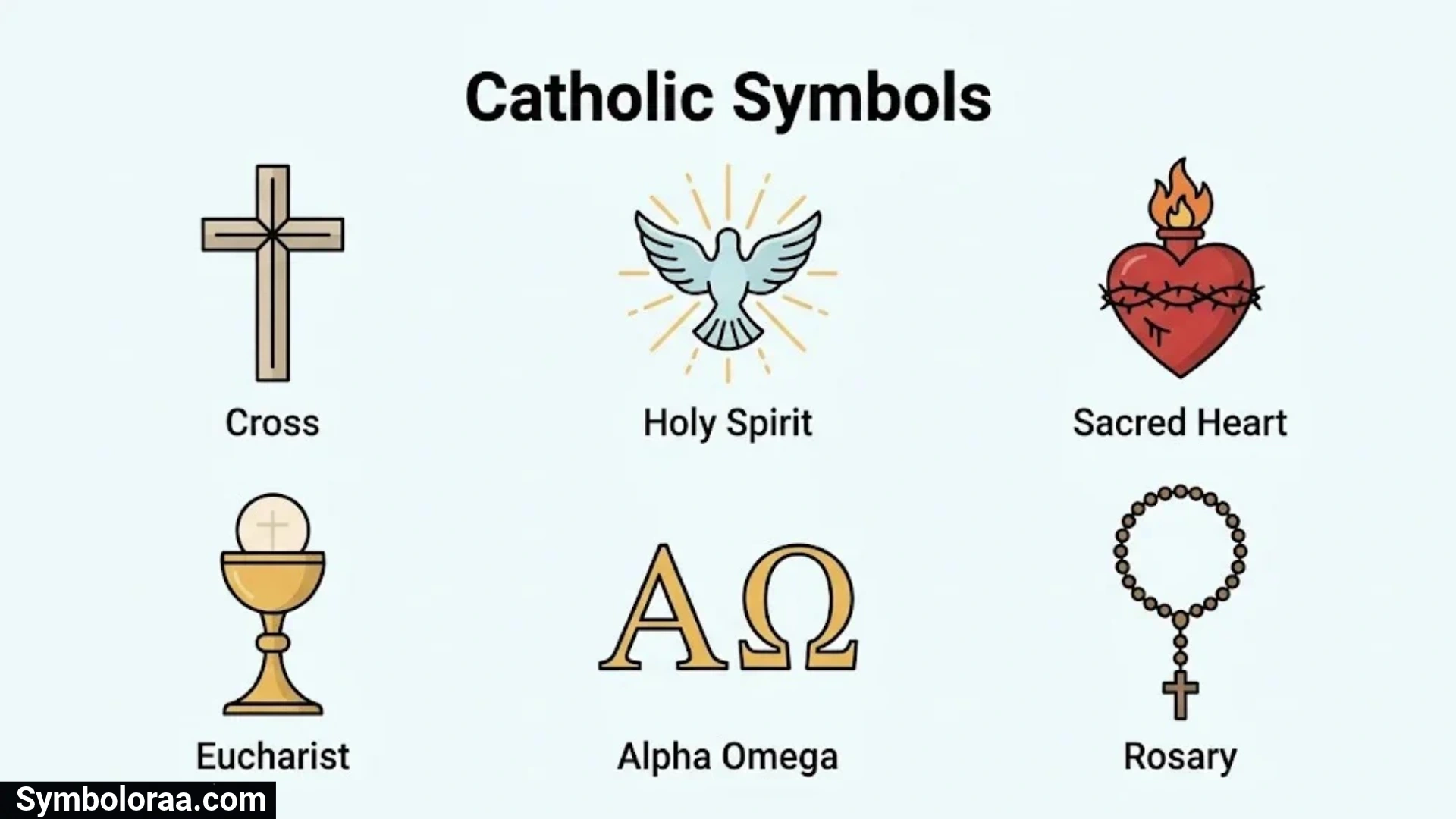
Catholic symbols tell stories that words alone sometimes struggle to express. From the familiar crucifix above a church altar to the dove representing the Holy Spirit, each image carries a deeper religious meaning. These symbols connect Catholic believers with Scripture, sacred traditions, and centuries of Christian history.
Catholic symbols appear throughout churches, religious paintings, statues, stained-glass windows, prayer books, and devotional objects. Some represent God and the Holy Trinity. Others communicate the suffering of Jesus Christ, the purity of the Virgin Mary, or the lives of Christian saints.
You can also find Catholic symbolism in the sacraments, liturgical celebrations, and everyday religious practices. A simple candle, for example, can represent Christ as the Light of the World. An anchor can express hope in God’s promises.
Although many Christian symbols are shared among different denominations, Catholicism has developed distinctive devotional and liturgical traditions around them.
This guide explores the most important Catholic symbols, their meanings, biblical connections, historical origins, and significance in Catholic worship.
What Are Catholic Symbols?
Catholic symbols are visual signs, objects, images, and representations that communicate religious beliefs and spiritual ideas. They help believers understand important teachings about God, Jesus Christ, the Holy Spirit, Mary, the saints, and the Church.
Catholic tradition uses symbols because physical things can communicate spiritual realities. Water represents cleansing and new life. Light suggests holiness and divine presence. Bread and wine communicate the mystery of the Eucharist.
The Catechism of the Catholic Church explains that sacramental celebrations use signs and symbols rooted in creation, human culture, and biblical history.
These religious symbols serve several important purposes:
- Teaching: They communicate biblical stories and Catholic doctrines.
- Remembrance: They help believers remember important events in salvation history.
- Devotion: They encourage prayer, meditation, and spiritual reflection.
- Worship: They contribute to the visual language of Catholic liturgy.
- Identification: They help people recognize Jesus, Mary, angels, and individual saints in religious artwork.
Catholic symbolism also includes gestures and actions. Kneeling expresses reverence, while making the Sign of the Cross recalls the central Christian mystery of salvation.
One important distinction matters here. Catholics do not worship religious objects or statues. They direct worship to God. Sacred images help believers remember and honor the people and mysteries those images represent.
Most Common Catholic Symbols and Their Meanings
Several traditional Catholic symbols appear frequently in churches, homes, religious artwork, and devotional practices. Their meanings connect directly with central Christian beliefs.
The Cross
The cross is the central symbol of Christianity and one of the most recognizable Catholic religious symbols.
It represents the crucifixion of Jesus Christ and His sacrifice for humanity. Through His death and Resurrection, Christians understand the cross as a sign of salvation, redemption, forgiveness, and hope.
The Roman authorities used crucifixion as a form of execution. However, Christians gave the cross a new meaning through their belief in Christ’s victory over death.
The Latin cross has one longer vertical section and a shorter horizontal beam. It appears in Catholic churches, cemeteries, necklaces, rosaries, and religious artwork.
Its main meanings include:
- Sacrifice and suffering.
- God’s love for humanity.
- Forgiveness of sins.
- Salvation through Jesus Christ.
- Victory over death.
- Christian faith and commitment.
Biblical reference: Philippians 2:8 and Galatians 6:14.
The Crucifix
A crucifix shows Jesus Christ on the cross. This distinguishes it from a plain cross, which does not include His body.
Catholic churches commonly display crucifixes above altars because the image emphasizes Christ’s sacrifice. You can also find them in homes, hospitals, chapels, and rosaries.
The crucifix reminds believers of the suffering Jesus accepted for humanity. It also encourages reflection on compassion, forgiveness, and unconditional love.
The image does not represent defeat. Instead, it points toward the Resurrection and Christ’s victory over sin and death.
The Ichthys (Christian Fish)
The Ichthys, also called Ichthus, is an ancient Christian fish symbol.
Its name comes from the Greek word ichthys, meaning fish. Early Christians used the fish as a recognizable sign of their faith.
The Greek letters in the word became associated with the phrase:
Iēsous Christos Theou Huios Sōtēr.
This translates as Jesus Christ, Son of God, Savior.
The fish appears in early Christian art, burial places, and religious inscriptions. Its association with fishing also connects with Jesus calling His disciples to become fishers of people.
Biblical references: Matthew 4:19 and John 21:1–14.
The Chi Rho
The Chi Rho is an ancient Christian monogram formed by combining two Greek letters: Chi (Χ) and Rho (Ρ).
These letters begin the Greek word Christos, meaning Christ.
The symbol became especially recognizable in Roman Christian history through its association with Emperor Constantine. It appeared on Christian objects, manuscripts, coins, and religious decorations.
The Chi Rho represents:
- Jesus Christ.
- Christian identity.
- Christ’s authority.
- Victory through faith.
- The historical development of Christian imagery.
The IHS Christogram
IHS is a traditional Christogram associated with the name of Jesus.
It developed through the use of the first letters of Jesus’ name in Greek. The monogram later became widely used in Western Christian art and Catholic religious decoration.
You can find IHS on church altars, vestments, communion vessels, and devotional objects.
The letters are sometimes surrounded by rays of light or placed over a cross. These additions emphasize Christ’s holiness and divine glory.
The Dove
The dove represents the Holy Spirit in Christian and Catholic symbolism.
Its best-known biblical appearance occurs during Jesus’ baptism. The Gospels describe the Spirit descending upon Jesus like a dove.
The image communicates divine presence, peace, purity, and spiritual renewal.
Catholic artwork frequently depicts a white dove above Christ, near the Virgin Mary, or among the Apostles during Pentecost.
Biblical reference: Matthew 3:16–17.
The Sacred Heart of Jesus
The Sacred Heart of Jesus represents Christ’s divine and human love for humanity.
Traditional images show a heart surrounded by flames, a crown of thorns, and sometimes a cross. A wound often appears on the heart to recall Jesus’ crucifixion.
Each element communicates a different aspect of His love:
- Flames represent burning divine love.
- The crown of thorns recalls His suffering.
- The wound recalls His pierced side.
- The cross represents His sacrifice.
Catholic devotion to the Sacred Heart encourages believers to reflect on Christ’s mercy, compassion, and forgiveness.
The Rosary
The rosary is one of the most recognizable Catholic devotional symbols.
It consists of beads arranged in decades, a crucifix, and a central medal. Catholics use it to meditate on important events in the lives of Jesus and Mary.
The traditional mysteries include:
- Joyful Mysteries.
- Sorrowful Mysteries.
- Glorious Mysteries.
- Luminous Mysteries.
The rosary represents prayer, meditation, and Marian devotion. Although Catholics ask Mary to pray for them, the prayers ultimately direct believers toward Jesus Christ.
The Keys of Saint Peter
The crossed keys of Saint Peter represent the authority Jesus entrusted to Peter.
Catholic tradition connects these keys with Peter’s leadership among the Apostles and the authority of the papacy.
The keys usually appear in gold and silver. They are also prominent in Vatican symbolism.
Biblical reference: Matthew 16:18–19.
The Lamb of God (Agnus Dei)
The Lamb of God, or Agnus Dei, represents Jesus Christ as the sacrificial Savior.
The imagery connects Jesus with the sacrificial lamb in biblical tradition. John the Baptist identifies Jesus as the Lamb of God who takes away the world’s sin.
Christian artwork often depicts the lamb holding a banner with a cross.
The symbol communicates innocence, sacrifice, redemption, resurrection, and victory over sin.
Biblical reference: John 1:29 and Revelation 5:6.
Catholic Symbols of God the Father
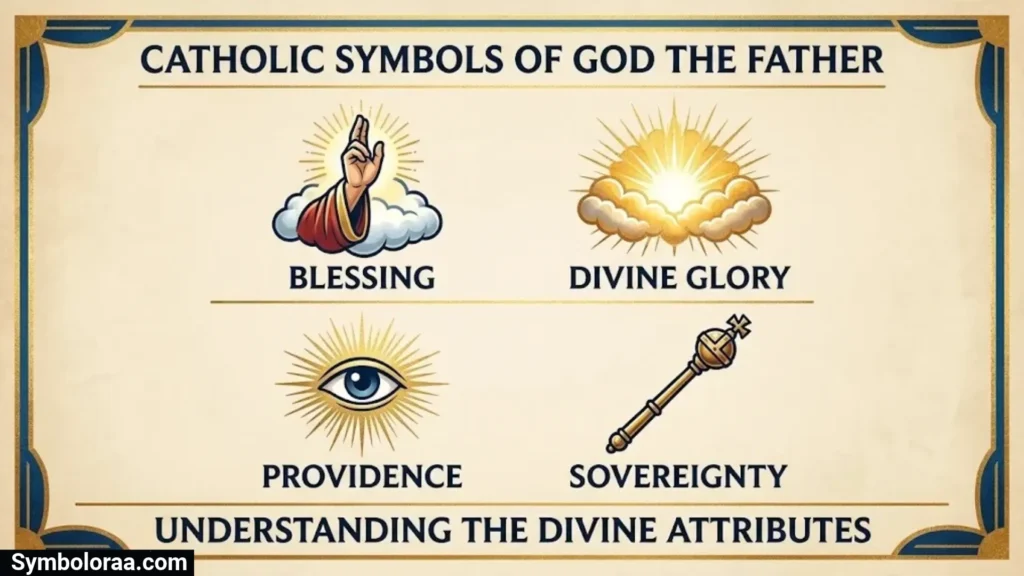
Catholic religious art sometimes represents God the Father through symbolic imagery rather than direct physical representation.
These symbols of God communicate His authority, wisdom, creation, providence, and relationship with humanity.
The Hand of God (Manus Dei)
The Hand of God, known in Latin as Manus Dei, represents divine intervention and providence.
Early Christian and medieval artists sometimes depicted a hand extending from heaven. This image communicated God’s guidance, blessing, or involvement in human affairs.
It can represent:
- Divine protection.
- God’s authority.
- Creation and providence.
- Blessing and judgment.
- God’s presence in human history.
The symbol appears in biblical-inspired religious artwork and historical Christian manuscripts.
The Eye of Providence
The Eye of Providence represents God’s knowledge and watchful care.
It commonly appears as an eye surrounded by rays of light. Some artistic versions place the eye inside a triangle.
The image communicates divine wisdom, omniscience, and providence. However, it is not an exclusively Catholic emblem, and its historical use extends beyond Catholic religious art.
The Burning Bush
The Burning Bush represents God’s revelation to Moses.
In Exodus, Moses encounters a bush that burns without being consumed. God speaks to him and reveals His divine identity.
The event introduces the sacred name traditionally translated as I AM WHO I AM.
The Burning Bush symbolizes:
- Divine revelation.
- God’s eternal nature.
- Holiness.
- God’s relationship with His people.
- The calling of Moses.
Biblical reference: Exodus 3:1–15.
The Tablets of the Ten Commandments
The Tablets of Stone represent God’s covenant and moral law.
According to Exodus, Moses receives the Ten Commandments on Mount Sinai. These commandments establish fundamental principles governing humanity’s relationship with God and other people.
Artists commonly depict two stone tablets with Roman numerals or abbreviated commandments.
The symbol represents obedience, justice, covenant, and divine guidance.
Biblical reference: Exodus 31:18.
The Alpha and Omega
Alpha and Omega are the first and last letters of the Greek alphabet.
Together, they represent God’s eternal nature and Christ’s sovereignty. The expression communicates that God is the beginning and the end of all things.
The letters frequently appear beside crosses, Christograms, and Easter candles.
Biblical reference: Revelation 1:8 and Revelation 22:13.
Catholic Symbols of the Holy Spirit
The Holy Spirit represents the third Person of the Holy Trinity. Catholic imagery uses several symbols to communicate His presence and activity.
The Dove
The dove is the most familiar symbol of the Holy Spirit.
It represents divine presence, peace, and spiritual renewal. The image connects especially with Jesus’ baptism in the Jordan River.
Tongues of Fire
The tongues of fire represent the Holy Spirit’s descent upon the Apostles during Pentecost.
Acts describes how flames appeared over the disciples as they received the Holy Spirit and began speaking in different languages.
This event marks an important moment in the formation and mission of the early Church.
Biblical reference: Acts 2:1–4.
Wind and Breath
Wind represents the invisible yet powerful activity of the Holy Spirit.
Just as people cannot see the wind itself, they can recognize its effects. Catholic symbolism uses this natural image to communicate divine inspiration and spiritual transformation.
Jesus also compares the Spirit’s movement to wind in John 3:8.
Water
Water represents cleansing, renewal, and spiritual life.
Catholic theology connects water particularly with Baptism. Through this sacrament, a person receives new life in Christ and becomes part of the Church.
Jesus also describes the Holy Spirit through the imagery of living water.
Biblical reference: John 7:37–39.
Oil
Sacred oil represents anointing, consecration, and the work of the Holy Spirit.
Catholic liturgy uses holy oils during Baptism, Confirmation, and Holy Orders. The Oil of the Sick also plays an important role in the Anointing of the Sick.
Anointing communicates spiritual strength and dedication to God’s service.
The Seven Gifts of the Holy Spirit
Catholic teaching identifies seven gifts associated with the Holy Spirit.
| Gift | Meaning |
| Wisdom | Seeing life through God’s perspective |
| Understanding | Grasping the deeper meaning of faith |
| Counsel | Recognizing the right course of action |
| Fortitude | Having courage to remain faithful |
| Knowledge | Understanding God’s creation and truth |
| Piety | Developing reverence and love for God |
| Fear of the Lord | Respecting God’s holiness and avoiding sin |
These gifts come from Isaiah 11:2–3. Catholic tradition includes piety and distinguishes it from the repeated expression concerning delight in the Lord.
It is also important not to confuse these seven gifts with the seven attributes of the Lamb in Revelation 5:12: power, wealth, wisdom, might, honor, glory, and blessing.
Catholic Symbols of the Holy Trinity
The Holy Trinity is the Catholic belief in one God existing as three distinct Persons: the Father, the Son, and the Holy Spirit.
Trinity symbols communicate divine unity without suggesting three separate gods.
The Trinity Shield
The Shield of the Trinity, also called the Trinity Shield, is a diagram explaining the relationship among the three Persons.
It connects the Father, Son, and Holy Spirit with the statement that each is God while none is the other.
Traditional diagrams use Latin terms:
- Pater: Father.
- Filius: Son.
- Spiritus Sanctus: Holy Spirit.
- Deus: God.
The diagram represents the central Catholic teaching of one God in three Persons.
The Triquetra
The Triquetra consists of three interconnected loops.
Its continuous design has made it a popular representation of the Holy Trinity in Christian art and religious decoration.
The three sections represent the Father, Son, and Holy Spirit. Their interconnected form communicates unity and eternity.
The symbol also appears in broader Celtic artistic traditions, so its meaning depends on its context.
The Trefoil
A trefoil is a decorative shape with three rounded lobes.
Christian artists and architects have used it to represent the Trinity. It appears in stained glass, church windows, stone carvings, and ornamental designs.
The Shamrock
The shamrock is traditionally associated with Saint Patrick and the teaching of the Trinity.
Its three leaves provide a simple illustration of the Father, Son, and Holy Spirit.
Although popular tradition connects Patrick with this explanation, the precise historical details of the story are not firmly established.
Catholic Symbols of Jesus Christ
Catholic religious imagery includes many symbols of Jesus Christ. These representations communicate His identity, teachings, suffering, kingship, and resurrection.
The Good Shepherd
The Good Shepherd represents Jesus as the protector and guide of His followers.
Traditional artwork shows Christ carrying a sheep or standing among a flock. The shepherd’s staff represents guidance and care.
Jesus describes Himself as the Good Shepherd who lays down His life for the sheep.
Biblical reference: John 10:11.
The Lion of Judah
The Lion of Judah represents Christ’s royal authority and victory.
The image originates in the blessing of Judah in Genesis. Revelation later describes the victorious Lion of the tribe of Judah.
Christian artists use the lion to communicate strength, kingship, and Christ’s triumph.
Biblical reference: Genesis 49:9–10 and Revelation 5:5.
The Crown of Thorns
The Crown of Thorns represents Jesus’ suffering during His Passion.
Roman soldiers placed a crown of thorns on His head while mocking His claim to kingship.
The image communicates humiliation, sacrifice, and the suffering Jesus accepted for humanity.
Biblical reference: John 19:2.
The Five Holy Wounds
The Five Wounds of Christ refer to the wounds associated with His crucifixion.
They traditionally include wounds in both hands, both feet, and His side.
These wounds remind Catholics of Christ’s sacrifice and the physical suffering associated with His Passion.
The Spear of Longinus
The Spear of Longinus represents the piercing of Jesus’ side during the crucifixion.
John’s Gospel describes how a soldier pierced Christ’s side, bringing forth blood and water.
Christian artwork often places the spear near the cross to recall this event.
Biblical reference: John 19:34.
The Resurrection Banner
A banner held by the risen Christ or the Lamb of God represents victory over death.
It often displays a red cross on a white background.
The image communicates the Resurrection, salvation, and the triumph of Jesus Christ.
Catholic Symbols of the Virgin Mary
Marian symbols communicate the Virgin Mary’s purity, motherhood, faithfulness, and special place in Catholic devotion.
These images appear in paintings, statues, medals, rosaries, and churches dedicated to Mary.
The Marian Monogram
The letter M represents Mary and appears in many Catholic devotional designs.
It often appears beneath a cross or surrounded by stars and rays of light.
The monogram identifies Marian devotion and Mary’s relationship with Jesus Christ.
The Fleur-de-lis
The fleur-de-lis is a three-petaled floral design associated with purity and spiritual beauty.
Christian artists have used it to represent the Virgin Mary, especially in medieval and Gothic religious artwork.
Although the fleur-de-lis also appears in royal heraldry, its religious use frequently communicates Marian purity.
The Lily
The white lily represents purity, holiness, and innocence.
Artists often include lilies in paintings of the Annunciation, when the angel Gabriel announces that Mary will become the mother of Jesus.
The flower communicates Mary’s faithfulness and her role in the Incarnation.
The Mystic Rose
The Mystic Rose is a traditional title associated with the Virgin Mary.
The rose represents beauty, purity, and spiritual love. Catholic devotional tradition also uses the title in the Litany of Loreto.
The Immaculate Heart of Mary
The Immaculate Heart of Mary represents her love for God and her compassion for humanity.
Traditional images show a heart surrounded by roses and sometimes pierced by a sword.
The sword recalls Mary’s sorrow during the suffering and death of Jesus.
Biblical reference: Luke 2:35.
The Seven Sorrows of Mary
The Seven Sorrows of Mary represent seven painful events in her life connected with Jesus.
They include:
- The prophecy of Simeon.
- The flight into Egypt.
- The loss of Jesus in Jerusalem.
- Meeting Jesus on the way to Calvary.
- The Crucifixion.
- Receiving Jesus’ body.
- The burial of Jesus.
Artists frequently depict seven swords piercing Mary’s heart.
The Miraculous Medal
The Miraculous Medal is associated with the Marian apparitions reported by Saint Catherine Labouré in Paris in 1830.
Its traditional design includes Mary standing on a globe, rays extending from her hands, and the letter M beneath a cross.
The reverse includes twelve stars and images of the Sacred Hearts of Jesus and Mary.
The medal represents Marian devotion and trust in God’s grace.
The Crown of Mary
The crown represents Mary as Queen of Heaven.
Catholic tradition connects this title with her unique relationship with Jesus Christ.
Some images show Mary wearing a crown surrounded by twelve stars. These details also connect with the symbolic woman in Revelation 12:1.
Catholic Church and Papal Symbols
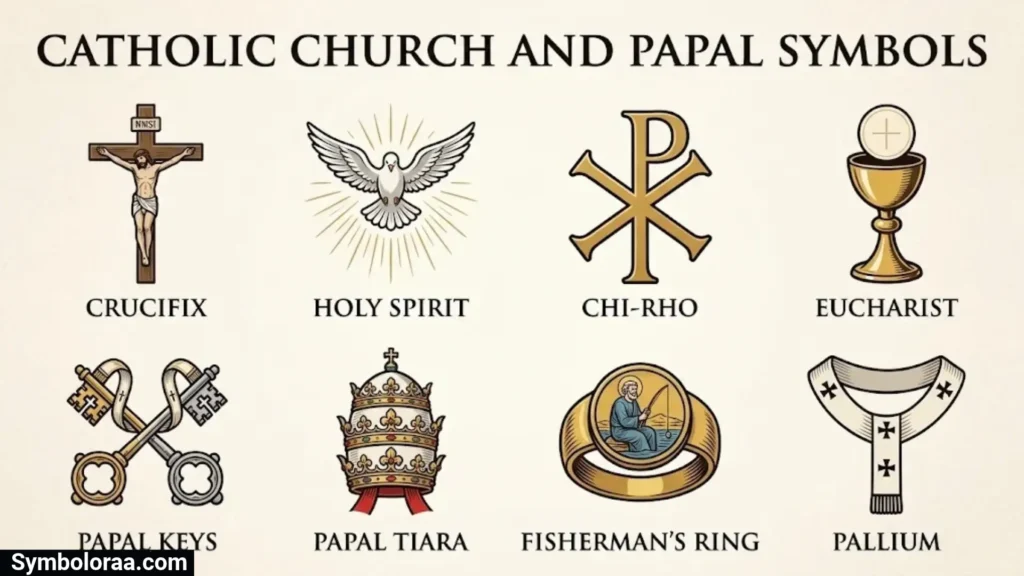
The Catholic Church uses several distinctive symbols to communicate its history, leadership, sacraments, and spiritual mission.
The Crossed Keys of Saint Peter
The crossed keys represent the authority entrusted to Saint Peter.
Catholic tradition understands Peter as the first Pope. The keys therefore appear prominently in papal and Vatican symbolism.
The gold key is traditionally associated with heavenly authority, while the silver key represents authority on earth.
Both keys connect with Matthew 16:18–19.
The Papal Tiara
The papal tiara is a traditional three-crowned headdress associated with the papacy.
Historically, it represented papal authority and developed into an important symbol of the Pope’s office.
Modern popes generally use a mitre instead of the traditional tiara during liturgical celebrations.
The Fisherman’s Ring
The Ring of the Fisherman is a papal ring connected with Saint Peter’s identity as a fisherman and Apostle.
It traditionally bears an image of Peter fishing or another papal design.
The ring represents the Pope’s office as successor of Saint Peter.
The Papal Coat of Arms
A papal coat of arms identifies the Pope through heraldic imagery.
Designs vary according to the individual Pope. They may include crosses, keys, stars, shields, and personal religious symbols.
The Church as a Ship
The ship is an ancient Christian image representing the Church.
Just as a ship carries passengers through dangerous waters, the Church guides believers through life’s challenges toward salvation.
The image also connects with Noah’s Ark and biblical stories involving boats and storms.
The word nave, used for the main body of a church, comes from the Latin navis, meaning ship.
The Rock
The rock represents stability, faith, and the foundation of the Church.
Jesus calls Peter the rock upon which He will build His Church.
Catholic tradition connects this passage with Peter’s leadership and the continuing office of the papacy.
Biblical reference: Matthew 16:18.
The Tabernacle
The tabernacle is a sacred container where consecrated Eucharistic hosts are reserved.
It usually stands in a prominent and dignified location inside a Catholic church or chapel.
A sanctuary lamp traditionally burns near it to indicate the presence of the Blessed Sacrament.
The tabernacle therefore has a special connection with Catholic belief in the Real Presence of Christ in the Eucharist.
Catholic Sacramental Symbols and Their Meanings
Catholic sacraments use physical signs to communicate spiritual realities. These Catholic sacramental symbols play an essential role in the Church’s worship and religious life.
Baptismal Water
Water represents cleansing, spiritual rebirth, and new life.
During Baptism, water serves as the essential visible sign of the sacrament. It recalls Jesus’ command to baptize in the name of the Father, Son, and Holy Spirit.
Biblical reference: Matthew 28:19.
The Baptismal Shell
The shell is a traditional Christian symbol associated with Baptism.
Artists sometimes depict a scallop shell pouring water over a person’s head.
It also has a separate historical association with Saint James and Christian pilgrimage traditions.
Holy Oil (Chrism)
Sacred oil represents anointing and consecration.
The Catholic Church uses three principal holy oils:
- Oil of Catechumens.
- Sacred Chrism.
- Oil of the Sick.
Each serves a distinct purpose in Catholic sacramental life.
Eucharistic Bread and Wine
Bread and wine are central symbols of the Holy Eucharist.
During Mass, Catholic teaching holds that the bread and wine become the Body and Blood of Christ through consecration.
This belief, called transubstantiation, expresses the Real Presence of Jesus in the Eucharist.
The symbols connect directly with the Last Supper and Christ’s command to continue this sacred celebration.
Biblical reference: Matthew 26:26–28.
The Chalice and Paten
The chalice holds the wine used during the Eucharistic celebration.
The paten is a small plate that holds the Eucharistic bread.
Both vessels have important liturgical functions and represent the sacred nature of the Mass.
The Confessional
The confessional is associated with the Sacrament of Penance and Reconciliation.
It provides a place where Catholics confess their sins and receive absolution through the ministry of a priest.
The sacrament represents repentance, forgiveness, reconciliation, and spiritual renewal.
The Laying on of Hands
The laying on of hands represents the invocation of the Holy Spirit and the transmission of ecclesiastical ministry.
Catholic bishops use this gesture during Confirmation and Holy Orders.
It also appears in biblical accounts of prayer and blessing.
Wedding Rings
Wedding rings represent the covenant between husband and wife.
Their circular shape communicates enduring commitment, fidelity, and unity.
In Catholic marriage, the rings serve as visible signs of the promises exchanged by the couple.
The Anointing of the Sick
Holy oil represents spiritual strength, comfort, and healing.
A priest anoints the sick person while offering prayers for God’s grace.
The sacrament provides spiritual support during illness, serious medical conditions, and old age.
Biblical reference: James 5:14–15.
Catholic Liturgical Symbols and Their Meanings
Catholic liturgy uses colors, candles, incense, bells, and sacred objects to communicate the meaning of religious celebrations.
Catholic Liturgical Colors
The colors worn by priests and used in church decorations correspond to different seasons and celebrations.
| Color | Catholic meaning and use |
| White | Christmas, Easter, celebrations of Mary, and non-martyr saints |
| Red | Pentecost, Palm Sunday, Good Friday, Apostles, and martyrs |
| Green | Ordinary Time |
| Violet | Advent, Lent, and certain Masses for the Dead |
| Rose | Gaudete Sunday and Laetare Sunday |
| Black | Permitted traditional color for funerals and Masses for the Dead |
| Gold and Silver | Permitted for more solemn occasions in the United States |
These colors follow the liturgical norms described in the General Instruction of the Roman Missal.
The Paschal Candle
The Paschal Candle represents the risen Jesus Christ and His victory over darkness.
Catholics light it during the Easter Vigil. It also plays an important role in Baptism and funeral liturgies.
Its traditional markings include:
- A cross.
- The Greek letters Alpha and Omega.
- The current year.
- Five grains of incense representing Christ’s wounds.
The Sanctuary Lamp
The sanctuary lamp indicates the presence of the reserved Blessed Sacrament.
Catholic churches traditionally use a continuously burning lamp near the tabernacle.
Its light reminds worshippers of Christ’s Eucharistic presence.
Incense and Censer
Incense represents prayer, reverence, and worship.
Priests use a censer to burn incense during certain Masses and religious ceremonies.
The rising smoke creates a visual connection with prayer ascending toward God.
Biblical reference: Psalm 141:2 and Revelation 8:3–4.
Bells
Church bells call people to worship and announce important religious events.
During some Catholic Masses, altar bells accompany significant moments of the Eucharistic celebration.
They remind worshippers to pay attention to the sacred action taking place.
Holy Water Font
The holy water font stands near the entrance of many Catholic churches.
Catholics dip their fingers into the water and make the Sign of the Cross when entering or leaving.
This gesture recalls Baptism and the believer’s commitment to Christ.
The Altar
The altar is the central place of the Eucharistic celebration.
It represents both the sacrificial offering of Christ and the table of the Lord.
Catholic churches give the altar a prominent position because the Eucharist stands at the heart of Catholic worship.
Symbols of the Twelve Apostles and Their Meanings
Catholic art uses distinctive objects to identify the Twelve Apostles.
These traditional emblems often reflect their biblical stories, missionary work, or accounts of martyrdom.
| Apostle | Traditional symbol | Meaning |
| Saint Peter | Keys and rooster | Church authority and denial of Jesus |
| Saint Paul | Sword and book | Martyrdom and teaching |
| Saint Andrew | X-shaped cross | Traditional account of martyrdom |
| Saint James the Greater | Scallop shell and pilgrim staff | Pilgrimage |
| Saint John | Eagle and chalice | Gospel and traditional legend |
| Saint Philip | Cross and loaves | Apostolic ministry |
| Saint Bartholomew | Knife | Traditional martyrdom account |
| Saint Matthew | Winged man or angel | Gospel writing |
| Saint Thomas | Spear and carpenter’s square | Traditional martyrdom imagery |
| Saint James the Less | Fuller’s club | Traditional martyrdom account |
| Saint Simon | Saw | Traditional martyrdom account |
| Saint Jude Thaddeus | Medallion and club | Devotion and martyrdom traditions |
Saint Peter’s Keys and Rooster
The keys represent the authority entrusted to Peter by Jesus.
The rooster recalls Peter’s denial of Christ before the crucifixion.
These two symbols communicate both his leadership and his human weakness.
Saint Paul’s Sword
The sword represents Paul’s traditional martyrdom by beheading.
It also connects with his description of the Word of God as the sword of the Spirit.
Biblical reference: Ephesians 6:17.
Saint Andrew’s Cross
The X-shaped cross is called the Cross of Saint Andrew.
Christian tradition associates it with the manner of his martyrdom.
Saint James’s Scallop Shell
The scallop shell is strongly associated with Saint James the Greater and pilgrimage.
It became especially recognizable through the pilgrimage route to Santiago de Compostela in Spain.
Saint John’s Eagle
The eagle represents the spiritual depth of John’s Gospel.
Its elevated flight provides an artistic image of the Gospel’s focus on Christ’s divine identity.
Catholic Symbols of the Four Evangelists
The Four Evangelists are Matthew, Mark, Luke, and John, the authors traditionally associated with the four canonical Gospels.
Christian iconography identifies each writer through a distinctive symbolic creature.
| Evangelist | Symbol | Meaning |
| Saint Matthew | Winged man or angel | Christ’s human nature and Incarnation |
| Saint Mark | Winged lion | Strength and resurrection |
| Saint Luke | Winged ox | Sacrifice and service |
| Saint John | Eagle | Spiritual vision and divine nature |
These four creatures connect with the living beings described in Ezekiel’s vision and Revelation.
Saint Matthew – Winged Man
The winged man represents the human dimension of Christ’s story.
Matthew’s Gospel begins with the genealogy of Jesus, emphasizing His human ancestry.
Saint Mark – Winged Lion
The winged lion communicates strength, courage, and royal authority.
It is traditionally associated with the opening of Mark’s Gospel and its wilderness imagery.
Saint Luke – Winged Ox
The winged ox represents sacrifice and service.
The symbol connects with the sacrificial imagery associated with the opening chapters of Luke’s Gospel.
Saint John – Eagle
The eagle represents spiritual insight and the divine nature of Christ.
John’s Gospel begins with a profound description of the Word who existed with God from the beginning.
Catholic Saints and Their Traditional Symbols
Catholic saints often appear with recognizable attributes in religious paintings and statues.
These Christian saint symbols help viewers identify individual saints without needing written labels.
| Saint | Traditional symbol | Significance |
| Saint Michael | Sword, scales, dragon | Victory over evil and divine judgment |
| Saint John the Baptist | Lamb and reed cross | Christ as the Lamb of God |
| Saint Barbara | Tower | Martyrdom |
| Saint Lucy | Eyes and lamp | Light and martyrdom |
| Saint Stephen | Stones | Martyrdom by stoning |
| Saint George | Dragon and lance | Victory over evil |
| Saint Catherine of Alexandria | Spiked wheel | Martyrdom |
| Saint Anthony of Padua | Child Jesus and lily | Devotion and purity |
| Saint Joseph | Lily and carpenter’s tools | Purity and his vocation |
| Saint Francis of Assisi | Stigmata and animals | Poverty and love of creation |
| Saint Ambrose | Beehive | Traditional legend and eloquence |
| Saints Cosmas and Damian | Medical instruments | Healing and medicine |
| Saint Jerome | Lion and book | Scholarship and repentance |
| Saint Augustine | Heart and book | Theology and divine love |
| Saint Benedict | Cross, raven, and cup | Monastic spirituality |
The Halo or Nimbus
A halo, also called a nimbus, is a circle of light surrounding the head of a sacred figure.
Catholic religious art uses halos to indicate holiness and heavenly glory.
Different forms communicate different artistic meanings. A circular halo commonly appears around saints, while a cruciform halo is associated with Christ.
The Palm Branch
The palm branch represents victory and martyrdom.
Christian artwork frequently shows martyrs holding palm branches as signs of their victory through faithfulness to Christ.
The Tower of Saint Barbara
Saint Barbara is traditionally depicted with a tower.
The image recalls the story of her imprisonment and martyrdom.
The Scales of Saint Michael
Saint Michael frequently appears holding scales or defeating a dragon.
The scales represent judgment, while the defeated dragon communicates victory over evil.
Catholic Symbols of Faith, Hope, and Love
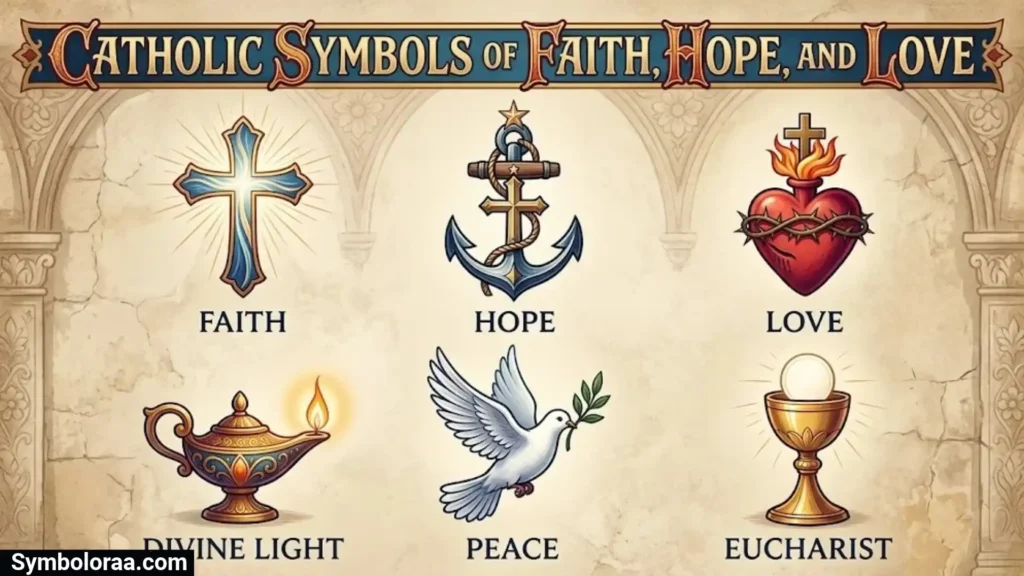
The three theological virtues are faith, hope, and charity.
Catholic teaching identifies them as gifts from God that guide believers toward Him.
The Cross – Symbol of Faith
The cross represents belief in Jesus Christ and His saving sacrifice.
It reminds Catholics that faith requires trust in God and commitment to Christian teachings.
The Anchor – Symbol of Hope
The anchor represents stability, perseverance, and hope.
Early Christians sometimes used anchor imagery in funerary art. Its shape also resembles a cross, creating an additional Christian association.
Hebrews 6:19 describes hope as an anchor for the soul.
The Heart – Symbol of Love
The heart represents love, compassion, and charity.
In Catholic art, it appears in the Sacred Heart of Jesus and the Immaculate Heart of Mary.
It communicates both divine love and the human response to God’s grace.
The Three Theological Virtues
| Virtue | Symbol | Meaning |
| Faith | Cross | Trust in God and belief in Christ |
| Hope | Anchor | Confidence in God’s promises |
| Charity | Heart | Love of God and neighbor |
Biblical reference: 1 Corinthians 13:13.
Catholic theology also identifies four cardinal virtues: prudence, justice, fortitude, and temperance. Together, these seven virtues provide an important framework for Christian moral life.
Catholic Symbols of Heaven, Resurrection, and Eternal Life
Catholic religious art uses several images to communicate heavenly glory, resurrection, and the promise of eternal life.
The Pearly Gates
The Pearly Gates represent entrance into the heavenly kingdom.
Revelation describes the New Jerusalem with twelve gates made from pearls.
The image communicates God’s promise of eternal life and heavenly communion.
Biblical reference: Revelation 21:21.
The Harp
The harp represents heavenly praise and worship.
Biblical tradition connects the instrument with King David and the Psalms.
Christian artists also use harps to depict the joyful worship of heaven.
The Trumpet
The trumpet represents the announcement of significant divine events.
Christian symbolism associates it with the Second Coming, resurrection, and final judgment.
Biblical reference: 1 Corinthians 15:52.
The Seven Seals
The seven seals appear in John’s vision in Revelation.
They represent the unfolding of God’s plan and the events associated with divine judgment.
The Lamb of God opens the seals in the biblical vision.
The Lamb with a Banner
The Lamb holding a banner represents Christ’s victory over death.
The banner often carries a cross, emphasizing the relationship between His sacrifice and Resurrection.
Angels
Angels represent God’s messengers and servants.
Catholic teaching recognizes angels as spiritual creatures who serve God and participate in His plan.
Archangels such as Michael, Gabriel, and Raphael have distinctive roles in biblical tradition.
The Crown
A crown represents heavenly glory, victory, and the reward of faithfulness.
Christian artwork sometimes depicts saints receiving crowns as signs of their participation in God’s kingdom.
Catholic Symbols Found in Church Architecture
Catholic churches contain architectural features that communicate religious ideas and support liturgical worship.
The Latin Cross Floor Plan
Some traditional Catholic churches follow a Latin-cross layout.
The longer central section intersects with shorter side sections, creating the recognizable shape of a cross.
This arrangement visually connects the building with Christ’s sacrifice.
The Dome
Church domes often communicate heavenly glory and sacred space.
Many historical churches decorate their domes with images of Christ, angels, saints, and biblical scenes.
The Rose Window
A rose window is a large circular stained-glass window, especially common in Gothic churches.
Its sections may contain images of Christ, Mary, saints, and biblical stories.
The window combines geometric design with religious imagery.
The Gothic Arch
Gothic arches are pointed architectural structures that support the height and visual design of medieval churches.
Their use allowed builders to create taller buildings and larger stained-glass windows.
The Nave
The nave is the main area where the congregation gathers during Mass.
Its name comes from the Latin word navis, meaning ship.
This linguistic connection also reflects the ancient Christian image of the Church as a ship carrying believers through life’s challenges.
The Baptistery
A baptistery is a designated area or building used for Baptism.
It commonly contains a baptismal font where the sacrament takes place.
Its location and design communicate the importance of Christian initiation.
The Stations of the Cross
The Stations of the Cross represent events surrounding Jesus’ Passion and death.
The traditional devotion includes fourteen stations, beginning with Jesus’ condemnation and ending with His burial.
Catholics frequently pray this devotion during Lent, especially on Fridays.
Catholic Symbols and Their Biblical References
Many biblical symbols have become important parts of Catholic religious art and worship.
The following table connects recognizable symbols with their meanings and relevant Scripture passages.
| Symbol | Meaning | Biblical reference |
| Burning Bush | God’s revelation | Exodus 3:1–15 |
| Ten Commandments | Divine law | Exodus 31:18 |
| Dove | Holy Spirit | Matthew 3:16–17 |
| Tongues of Fire | Pentecost | Acts 2:1–4 |
| Water | Spiritual life | John 7:37–39 |
| Holy Trinity | Father, Son, and Holy Spirit | Matthew 28:19 |
| Cross | Christ’s sacrifice | Philippians 2:8 |
| Good Shepherd | Christ’s protection | John 10:11 |
| Lamb of God | Redemption | John 1:29 |
| Crown of Thorns | Christ’s suffering | John 19:2 |
| Pierced Side | Christ’s Passion | John 19:34 |
| Keys of Peter | Church authority | Matthew 16:18–19 |
| Eucharistic Bread and Wine | Body and Blood of Christ | Matthew 26:26–28 |
| Rock | Foundation of the Church | Matthew 16:18 |
| Four Living Creatures | Evangelist imagery | Ezekiel 1:10 |
| Anchor | Christian hope | Hebrews 6:19 |
| Palm Branch | Heavenly victory | Revelation 7:9 |
| Trumpet | Resurrection | 1 Corinthians 15:52 |
| Alpha and Omega | God’s eternity | Revelation 1:8 |
| Seven Seals | Divine judgment | Revelation 5–8 |
Some Catholic symbols come directly from biblical descriptions. Others developed through centuries of Christian interpretation, devotional practice, and religious artwork.
Understanding this distinction helps readers appreciate the history without confusing later artistic traditions with direct biblical commandments.
Catholic Symbols and Their Latin Names
Latin has played an important role in Catholic worship, theology, and religious art.
Many familiar Catholic religious symbols carry traditional Latin names.
| Latin or Greek term | English meaning |
| Manus Dei | Hand of God |
| Agnus Dei | Lamb of God |
| IHS | Christogram associated with Jesus |
| Chi Rho | Greek monogram for Christ |
| Ichthys | Fish |
| Pater | Father |
| Filius | Son |
| Spiritus Sanctus | Holy Spirit |
| Deus | God |
| Ave Maria | Hail Mary |
| Mater Dei | Mother of God |
| Regina Caeli | Queen of Heaven |
| Crux | Cross |
| Nimbus | Halo |
| Aureole | Radiant sacred light |
| Mandorla | Almond-shaped halo |
| Crosier | Pastoral staff |
| Eucharistia | Eucharist |
| Sanctus | Holy |
| Pax | Peace |
These terms appear in church inscriptions, religious manuscripts, prayers, liturgical objects, and historical artwork.
Ancient Catholic and Early Christian Symbols
Some of the oldest Christian signs and symbols developed during the first centuries of Christianity.
Early believers used recognizable imagery to express their faith and communicate biblical ideas.
Ichthys (Fish)
The fish became an important early Christian sign.
Its Greek name connected it with Jesus Christ, the Son of God and Savior.
Chi Rho
The Chi Rho became a recognizable Christian monogram during the Roman period.
Its association with Constantine helped establish its place in historical Christian imagery.
The Anchor
Early Christian communities used anchors in funerary and devotional contexts.
The image represented hope, stability, and confidence in God’s promises.
The Good Shepherd
Early Christian artists depicted Jesus as a shepherd carrying a sheep.
This image communicated Christ’s protection and His willingness to save the lost.
The Orans Figure
The Orans figure depicts a person praying with raised arms.
Early Christian artwork used this posture to represent prayer, worship, and spiritual devotion.
The Peacock
Christian artists sometimes used the peacock to represent immortality and resurrection.
Ancient beliefs about the bird’s feathers contributed to its symbolic association with renewal.
The Phoenix
The phoenix became an image of resurrection and new life in some early Christian interpretations.
Its legendary rebirth provided a visual comparison with Christ’s victory over death.
The Dove and Olive Branch
The dove carrying an olive branch connects with Noah’s story.
It represents peace, renewal, and hope after destruction.
Biblical reference: Genesis 8:11.
Difference Between Catholic Symbols and Other Christian Symbols
Catholicism shares many symbols with other Christian traditions. However, certain images and devotional objects have particularly strong connections with Catholic practice.
| Symbol category | Examples | Religious context |
| Shared Christian symbols | Cross, fish, dove, Chi Rho | Used across many Christian traditions |
| Marian symbols | Rosary, Immaculate Heart, Miraculous Medal | Strong Catholic devotional traditions |
| Eucharistic symbols | Chalice, host, tabernacle | Central to Catholic sacramental worship |
| Papal symbols | Crossed keys, Fisherman’s Ring, papal coat of arms | Associated with the papacy |
| Saint symbols | Palm branch, keys, lilies, swords | Traditional Christian and Catholic iconography |
| Liturgical symbols | Paschal Candle, sanctuary lamp, sacred oils | Catholic worship and sacramental celebrations |
Catholicism also has a rich tradition of sacred images and icons.
The Catechism explains that Christian iconography communicates the Gospel through visual representation. It also connects sacred images with the Incarnation, because Jesus became visible in human form.
Different Christian communities have developed their own approaches to religious imagery. However, the meaning of shared symbols often remains closely connected with Scripture and the life of Jesus Christ.
Frequently Asked Questions About Catholic Symbols
What Are the Most Common Catholic Symbols?
The most common Catholic symbols include the cross, crucifix, fish, dove, Chi Rho, IHS, Sacred Heart of Jesus, rosary, crossed keys, and Lamb of God.
These symbols represent important Catholic beliefs, including salvation, the Holy Trinity, the Eucharist, and Marian devotion.
What Is the Most Important Symbol in the Catholic Church?
The cross is the central symbol of Christianity and Catholic faith.
It represents Jesus Christ’s crucifixion, sacrifice, and victory over death. Catholic churches commonly display crucifixes to emphasize the importance of Christ’s Passion.
What Is the Difference Between a Cross and a Crucifix?
A cross displays the shape of the instrument of Jesus’ crucifixion without necessarily showing His body.
A crucifix includes an image of Jesus on the cross. Catholic churches traditionally use crucifixes to emphasize Christ’s sacrifice.
What Are the Seven Symbols of the Holy Spirit?
The most recognized visual symbols of the Holy Spirit include the dove, fire, wind, water, and oil.
The seven gifts associated with the Spirit are wisdom, understanding, counsel, fortitude, knowledge, piety, and fear of the Lord.
These gifts are listed in Isaiah 11:2–3 as interpreted in Catholic tradition.
What Symbols Represent the Holy Trinity?
Common Trinity symbols include the Trinity Shield, triquetra, trefoil, shamrock, and triangular nimbus.
Each represents the Father, Son, and Holy Spirit as three distinct Persons in one God.
What Does the Fish Symbol Mean in Catholicism?
The fish, called Ichthys, represents Jesus Christ and early Christian faith.
Its Greek name became associated with the phrase Jesus Christ, Son of God, Savior.
What Does IHS Mean in Catholic Churches?
IHS is a traditional Christogram associated with the name of Jesus.
Catholic churches display it on altars, vestments, religious objects, and devotional decorations.
What Does the Sacred Heart of Jesus Represent?
The Sacred Heart represents Christ’s divine love and compassion for humanity.
Its traditional imagery includes flames, a crown of thorns, a cross, and a wound.
What Are the Main Symbols of the Virgin Mary?
Important Marian symbols include the lily, rose, fleur-de-lis, rosary, Marian monogram, Immaculate Heart, crown, and Miraculous Medal.
They represent purity, motherhood, devotion, compassion, and Mary’s relationship with Jesus.
What Do the Crossed Keys of Saint Peter Represent?
The crossed keys represent the authority Jesus entrusted to Saint Peter.
They connect with Matthew 16:18–19 and remain an important symbol of the papacy.
What Are the Symbols of the Four Evangelists?
The four Evangelists have distinctive symbolic creatures:
- Matthew: Winged man or angel.
- Mark: Winged lion.
- Luke: Winged ox.
- John: Eagle.
These creatures connect with the visions described in Ezekiel and Revelation.
What Does the Anchor Represent in Catholicism?
The anchor represents hope, stability, and perseverance.
It also appears in early Christian imagery and connects with Hebrews 6:19, which describes hope as an anchor for the soul.
What Are the Three Theological Virtues?
The three theological virtues are faith, hope, and charity.
Catholic teaching identifies them as gifts from God that help believers develop a deeper relationship with Him.
What Do Catholic Liturgical Colors Represent?
Catholic liturgical colors communicate the character of different seasons and celebrations.
White represents celebration and glory. Red represents martyrdom and the Holy Spirit. Green marks Ordinary Time, while violet represents Advent and Lent.
What Are the Oldest Christian Symbols?
Some of the oldest recognizable Christian symbols include the fish, anchor, Good Shepherd, and Chi Rho.
Early Christians used these images in religious art, inscriptions, and funerary settings.
Why Do Catholic Churches Use Statues and Religious Images?
Catholic churches use statues and sacred images to communicate biblical teachings and honor Christ, Mary, and the saints.
These images encourage prayer and reflection. Catholics distinguish the veneration of sacred images from the worship owed to God alone.
Are Catholic Symbols Mentioned in the Bible?
Some Catholic symbols come directly from biblical events and descriptions.
Examples include the dove, cross, burning bush, lamb, keys, and anchor.
Other symbols developed later through Christian tradition, religious art, and devotional practices.
What Does the Lamb of God Represent?
The Lamb of God represents Jesus Christ as the Savior who sacrifices Himself for humanity.
It communicates innocence, redemption, forgiveness, and victory over death.
What Is the Difference Between Catholic and Christian Symbols?
Christian symbols are visual representations used throughout Christianity.
Catholic symbols include these shared images as well as distinctive devotional and liturgical traditions, such as the rosary, Sacred Heart devotion, papal keys, and Eucharistic imagery.
Conclusion
Catholic symbols provide a visual language for understanding Christian faith, biblical teachings, and centuries of religious tradition.
The cross represents Christ’s sacrifice. The dove communicates the presence of the Holy Spirit. The Sacred Heart expresses divine love, while the rosary encourages prayer and reflection on Jesus’ life.
Other symbols reveal the history and identity of the Catholic Church. The crossed keys represent the authority entrusted to Saint Peter, while the Lamb of God communicates Christ’s victory over sin and death.
Understanding these Catholic symbols and their meanings helps you recognize the deeper messages behind church decorations, religious paintings, sacred objects, and devotional practices.
If you encounter a symbol in a cathedral, a Bible illustration, or a family prayer space, its meaning can open a window into Catholic belief.
Each image tells part of a larger story: God’s relationship with humanity and the Christian hope of salvation through Jesus Christ.

I’m Jackson Miller, an American author inspired by mystery, adventure, and the unpredictable nature of life. I enjoy writing fast-moving stories filled with memorable characters, unexpected choices, and meaningful moments. Through my books, I want readers to experience new worlds while discovering something about courage, determination, and themselves.
Three Books:
The Edge of Tomorrow
Under a Broken Sky
The Road We Chose
 Madison Reed