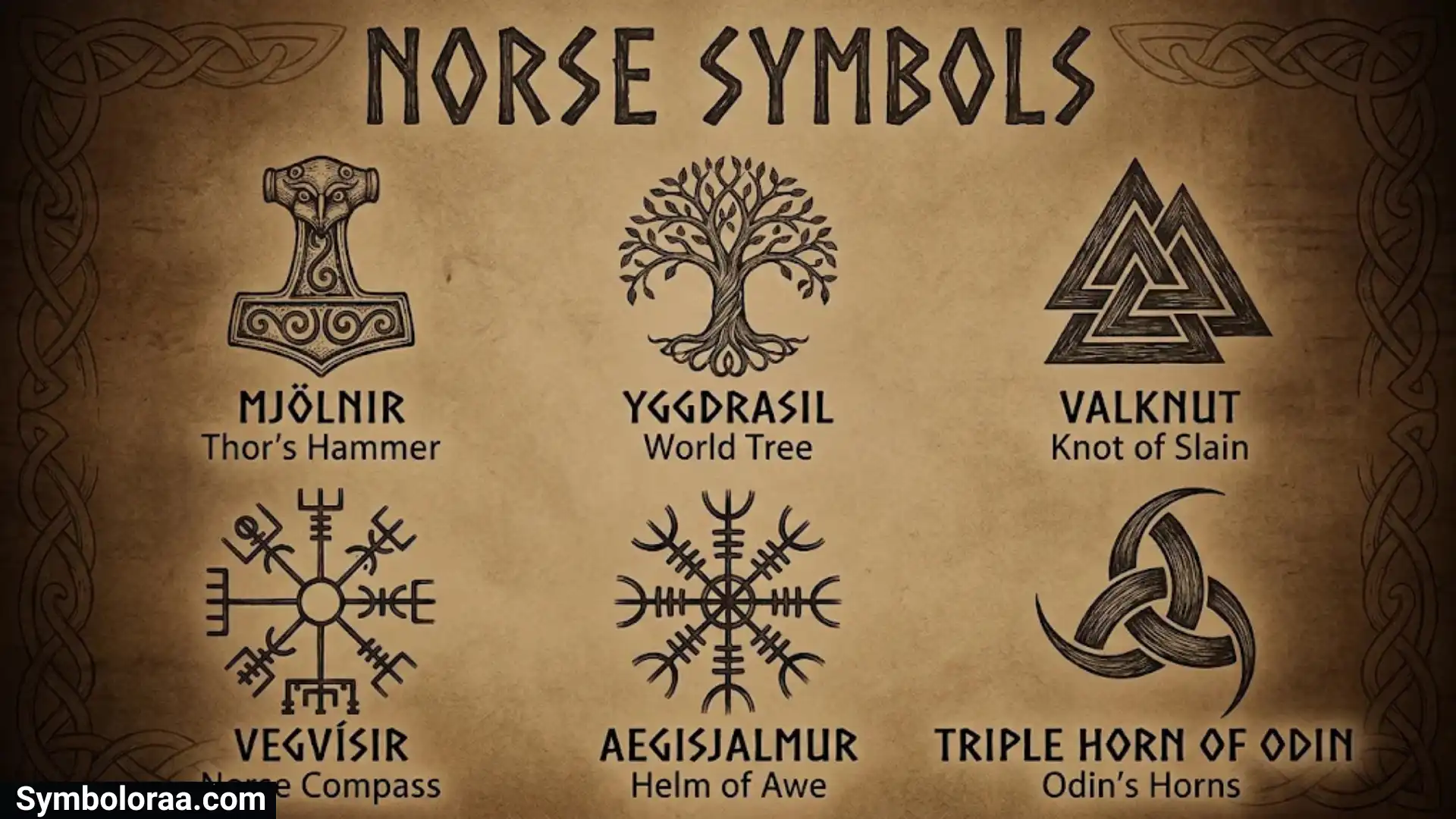
Norse symbols offer a fascinating look into the beliefs, mythology, and everyday lives of ancient Scandinavians. From Thor’s Hammer (Mjölnir) to the mysterious Valknut and the legendary Yggdrasil, these symbols represented powerful ideas about protection, strength, courage, wisdom, fate, and the natural world.
The Vikings used symbols in many ways. They carved them into runestones, engraved them on weapons, wore them as jewelry, and included them in decorative artwork. Some symbols connected people with Norse gods, while others reflected ideas about death, the afterlife, destiny, and the forces of nature.
However, not every design commonly called a Viking symbol comes from the Viking Age. Some popular symbols appeared in medieval literature or much later Icelandic magical manuscripts. Others are modern interpretations inspired by Norse mythology.
Understanding these differences helps you explore Norse symbols and their meanings without confusing historical evidence with modern traditions.
This guide explains the most important Norse symbols, their historical backgrounds, their connections to Viking mythology, and their meanings in modern culture.
What Are Norse Symbols?
Norse symbols are signs, patterns, images, and symbolic designs associated with the ancient Norse people of Scandinavia. These people lived primarily in present-day Norway, Sweden, Denmark, and surrounding regions.
Their culture developed during the Viking Age, traditionally dated from approximately 793 to 1066 CE.
Norse symbols appeared on everyday objects, weapons, jewelry, monuments, ships, and religious items. They also appeared in stories about gods, giants, mythical creatures, and the structure of the universe.
Some symbols had recognizable religious or cultural associations. Others served decorative purposes or communicated ideas through familiar images.
For example:
- Mjölnir: Thor’s hammer, associated with protection, strength, and thunder.
- Valknut: A three-part interlocking design often associated with Odin and death.
- Yggdrasil: The world tree connecting different realms.
- Gungnir: Odin’s legendary spear, associated with authority and divine power.
- Runes: Characters used in ancient Germanic writing systems.
- Ravens: Birds associated with Odin, knowledge, and observation.
Not every symbol had one fixed meaning. Interpretations often depend on the object, location, historical period, and literary source.
Most Important Norse Symbols and Their Meanings
Norse mythology contains many recognizable objects, animals, patterns, and supernatural images. The following symbols are among the most famous in Viking history and modern Norse-inspired culture.
Mjölnir: Thor’s Hammer
Mjölnir is one of the most recognizable Norse symbols. It represents the magical hammer belonging to Thor, the Norse god of thunder.
Thor used Mjölnir to fight giants and protect the gods and human world. The hammer could strike with enormous force and return to Thor after he threw it.
Norse mythology describes Mjölnir as an exceptionally powerful weapon. Its importance extended beyond warfare because it also represented protection, blessing, and the defense of cosmic order.
Common meanings of Mjölnir include:
- Strength and courage
- Protection against harmful forces
- Thunder and lightning
- Divine power
- Fertility and blessing
- Defense against chaos
Archaeologists have discovered numerous Viking Age hammer-shaped pendants. These objects provide strong evidence that people wore Thor’s hammer as a personal emblem.
Some examples appeared in graves and settlements across Scandinavia. Their presence suggests that Mjölnir held religious and cultural importance.
Today, the Thor’s Hammer symbol remains popular in necklaces, rings, tattoos, artwork, and modern Norse-inspired jewelry.
Valknut: The Symbol of Odin and the Slain
The Valknut consists of three interlocking triangles. Its name combines Old Norse elements commonly translated as the knot of the slain.
The design appears on several Viking Age picture stones and other archaeological objects. Researchers often associate it with Odin, death, and warriors who died in battle.
Odin rules Valhalla, the legendary hall where selected fallen warriors gather. This connection has made the Valknut especially popular among people interested in Norse mythology and Viking warrior culture.
However, its exact historical meaning remains uncertain. Archaeologists have identified the design, but surviving evidence does not provide a definitive explanation.
Common modern interpretations include:
- Death and the afterlife
- Odin and divine power
- Sacrifice and transformation
- The connection between life and death
- The destiny of warriors
- Spiritual transition
The Valknut is frequently used in tattoos, pendants, and Norse-inspired artwork. You should remember that its popular meanings are interpretations rather than fully confirmed historical definitions.
Vegvísir: The Icelandic Compass Symbol
Vegvísir is commonly known as the Viking compass or Norse compass. Its name is often translated as wayfinder or signpost.
The design features a central point surrounded by several branching arms. Modern interpretations describe it as a symbol that helps travelers find their way through difficult conditions.
People often connect Vegvísir with Viking navigation and exploration. However, its documented history requires an important distinction.
The earliest known written attestation of Vegvísir appears in the Icelandic Huld manuscript, compiled in 1860. This is centuries after the Viking Age.
There is no established archaeological evidence showing that Viking sailors used this exact design.
Modern meanings associated with Vegvísir include:
- Guidance and direction
- Protection during travel
- Finding your path
- Courage during uncertainty
- Spiritual guidance
- Staying focused on your goals
Today, Vegvísir appears in tattoos, jewelry, clothing, and spiritual artwork. Although it draws inspiration from Icelandic magical traditions, it should not be presented as a confirmed Viking Age symbol.
Ægishjálmur: The Helm of Awe
Ægishjálmur, also called the Helm of Awe, is a powerful symbol from later Icelandic magical traditions.
The name is associated with awe, terror, or overwhelming power. Modern versions usually show a central point surrounded by symmetrical arms and smaller branches.
People often connect this design with protection and the ability to overcome enemies.
The idea of a terrifying or protective helm appears in Norse literary traditions. However, the familiar graphic design belongs to later magical material rather than securely documented Viking Age artifacts.
Common meanings of Ægishjálmur include:
- Protection from enemies
- Courage and confidence
- Fearlessness
- Personal strength
- Spiritual defense
- Overcoming difficult situations
Modern Norse-inspired communities often use the Helm of Awe as a tattoo or protective emblem.
Yggdrasil: The World Tree
Yggdrasil is the enormous world tree in Norse mythology. It connects different parts of the cosmos and provides a central structure for the mythological universe.
The tree is usually described as an immense ash tree. Its branches and roots extend through different realms of existence.
Norse mythology describes several important locations around Yggdrasil. These include the home of gods, giants, humans, and other supernatural beings.
The tree also connects with the Norns, supernatural female figures who influence destiny.
Yggdrasil represents the relationship between different forms of existence. It also reflects the connection between life, death, nature, and cosmic order.
Common meanings of Yggdrasil include:
- Life and growth
- Wisdom and knowledge
- Connection between worlds
- Strength and endurance
- Balance and harmony
- Renewal and transformation
- The cycle of existence
Yggdrasil remains one of the most popular Norse symbols in modern tattoos, pendants, paintings, and decorative designs.
Gungnir: Odin’s Magical Spear
Gungnir is the legendary spear belonging to Odin, the chief god in Norse mythology.
According to the stories, skilled dwarven craftsmen created Gungnir. The spear was known for its exceptional accuracy and magical qualities.
Odin used Gungnir as a symbol of authority and power. It also appears in stories involving sacrifice, warfare, and divine destiny.
Gungnir commonly represents:
- Leadership and authority
- Wisdom and knowledge
- Courage in battle
- Sacrifice
- Divine power
- Victory and determination
The spear is an important part of Odin’s identity. It also reflects the importance of weapons in Norse mythology and Viking warrior culture.
The Triple Horn of Odin
The Triple Horn of Odin features three drinking horns arranged in an interlocking design.
It is commonly associated with Odin and the myth of the Mead of Poetry.
According to Norse mythology, the magical mead could grant poetic ability, wisdom, and exceptional knowledge. Odin went to great lengths to obtain it.
The three-horn design appears in Viking Age contexts, including the Snoldelev runestone in Denmark.
Common meanings include:
- Wisdom and knowledge
- Poetry and creativity
- Inspiration
- Odin’s power
- Learning and intellectual achievement
Modern Norse-inspired communities often use the Triple Horn of Odin as an emblem of wisdom and artistic expression.
The Web of Wyrd
The Web of Wyrd is a popular modern symbol associated with fate and destiny.
Its familiar design resembles a geometric arrangement of intersecting lines. Some interpretations connect its structure with the runic alphabet.
The word wyrd relates to fate or what has become. It is connected to broader Germanic ideas about destiny.
However, the familiar Web of Wyrd graphic does not have firmly established evidence as a Viking Age symbol.
Modern interpretations often describe it as a representation of how past actions, present choices, and future outcomes influence one another.
Common modern meanings include:
- Fate and destiny
- The connection between past and future
- Personal responsibility
- Life’s interconnected events
- The consequences of decisions
Svefnthorn: The Sleep Thorn
Svefnthorn is a name associated with magical sleep in later Norse literary traditions.
The term is often translated as sleep thorn. Stories describe a magical object or power capable of placing someone into deep sleep.
Different medieval sources describe sleep-related magic in different ways. They do not establish one universally accepted graphic design for Svefnthorn.
Modern versions often appear as a group of intersecting lines or pointed shapes.
Modern meanings include:
- Sleep and rest
- Dreams
- Magical protection
- Escape from danger
- The boundary between consciousness and unconsciousness
Troll Cross
The Troll Cross is a popular protective design in modern Scandinavian-inspired culture.
It generally appears as an iron loop with crossed or curved ends. Some modern accounts associate it with protection against trolls and harmful supernatural beings.
However, the familiar Troll Cross design lacks strong evidence as an ancient Viking Age symbol.
Today, people use it in jewelry, decorative objects, and Norse-inspired artwork.
Its modern associations include protection, safety, and resistance against negative influences.
Norse Runes and Their Meanings
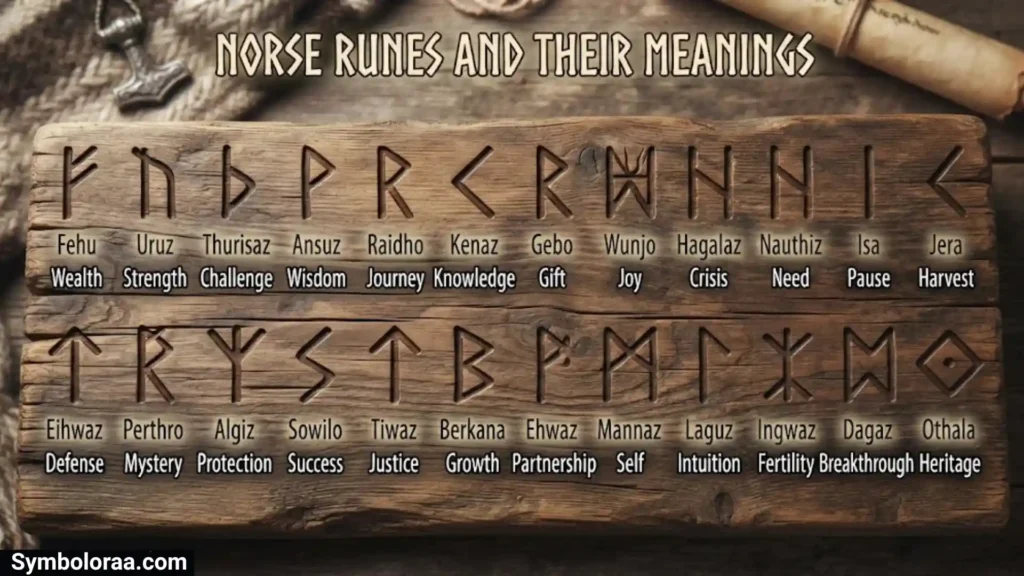
Norse runes are characters from ancient Germanic writing systems. They served as letters and appeared on stones, weapons, tools, jewelry, and other objects.
The word rune is commonly associated with mystery or secret knowledge. However, runes primarily functioned as a writing system.
Different historical periods used different runic alphabets. The two most important systems for understanding Viking history are Elder Futhark and Younger Futhark.
Elder Futhark
The Elder Futhark contains 24 runes. It was used by Germanic peoples before the Viking Age, approximately from the second to eighth centuries CE.
Its name comes from the first six characters of the alphabet.
Although many modern sources associate Elder Futhark with Vikings, it is important to distinguish it from the runic alphabet used most widely during the Viking Age.
Younger Futhark
The Younger Futhark contains 16 runes. It became the main runic writing system in Scandinavia during the Viking Age.
It appeared in inscriptions on runestones, personal objects, and other archaeological materials.
Because it used fewer characters than Elder Futhark, some runes represented multiple sounds.
Elder Futhark Rune Table
The following table lists the 24 Elder Futhark runes and their commonly used transliterations.
| Rune | Name | Common association |
| ᚠ | Fehu | Cattle, wealth, prosperity |
| ᚢ | Uruz | Strength, wild ox |
| ᚦ | Thurisaz | Giants, danger, force |
| ᚨ | Ansuz | God, speech, communication |
| ᚱ | Raidho | Riding, travel, movement |
| ᚲ | Kenaz | Torch, knowledge, light |
| ᚷ | Gebo | Gift, exchange, partnership |
| ᚹ | Wunjo | Joy, happiness, harmony |
| ᚺ | Hagalaz | Hail, disruption |
| ᚾ | Nauthiz | Need, hardship, necessity |
| ᛁ | Isa | Ice, stillness |
| ᛃ | Jera | Year, harvest, cycles |
| ᛇ | Eihwaz | Yew, endurance |
| ᛈ | Perthro | Uncertain interpretation |
| ᛉ | Algiz | Uncertain interpretation; often linked with protection today |
| ᛊ | Sowilo | Sun, light, victory |
| ᛏ | Tiwaz | Tyr, justice, courage |
| ᛒ | Berkano | Birch, growth |
| ᛖ | Ehwaz | Horse, movement |
| ᛗ | Mannaz | Human, community |
| ᛚ | Laguz | Water, flowing |
| ᛜ | Ingwaz | Ing, fertility, potential |
| ᛞ | Dagaz | Day, transformation |
| ᛟ | Othala | Inherited property, heritage |
These associations require caution. Some are based on rune names and linguistic evidence, while others come from later interpretations.
The meanings commonly used in modern rune readings should not automatically be treated as proven Viking Age beliefs.
Norse Gods and Their Associated Symbols
Norse mythology includes many gods and supernatural beings. Their stories explain natural forces, human experiences, conflict, wisdom, and the structure of the universe.
Several gods have recognizable objects and animal companions.
Odin: Wisdom, War, and Magic
Odin is one of the most important gods in Norse mythology.
He is associated with wisdom, poetry, magic, war, death, and knowledge. Odin frequently seeks information, even when gaining it requires great personal sacrifice.
His best-known symbolic associations include:
- Ravens Huginn and Muninn
- The spear Gungnir
- The Valknut
- The Triple Horn of Odin
- His eight-legged horse Sleipnir
Odin’s ravens travel across the world and bring information back to him. Their names are commonly translated as Thought and Memory.
His character reflects the importance of knowledge, strategy, sacrifice, and the search for wisdom.
Thor: Thunder and Protection
Thor is the god of thunder and one of the strongest defenders of the gods and humans.
His hammer Mjölnir is his most recognizable attribute. He also travels in a chariot pulled by two magical goats.
Thor’s main associations include:
- Strength
- Thunder and lightning
- Protection
- Courage
- Physical power
- Defense against giants
His stories often involve battles against giants and other dangerous forces.
Freyja: Love, Fertility, and Magic
Freyja is a major goddess associated with love, fertility, beauty, wealth, and magic.
She belongs to the Vanir group of gods and has strong connections with seiðr, a form of Norse magic.
Freyja is associated with the necklace Brísingamen, cats, falcons, and her role in receiving some of the warriors who die in battle.
Her symbolism includes love, independence, beauty, fertility, and spiritual power.
Freyr: Fertility and Prosperity
Freyr is associated with fertility, agriculture, peace, prosperity, and good harvests.
He is the brother of Freyja and an important member of the Vanir.
His famous magical ship is called Skíðblaðnir. Norse mythology also associates him with a powerful boar named Gullinbursti.
Freyr’s symbolism reflects abundance, natural growth, and the importance of successful harvests.
Tyr: Courage and Justice
Tyr is associated with courage, law, justice, and honorable conduct.
His most famous story involves the binding of Fenrir, the monstrous wolf.
Tyr places his hand inside Fenrir’s mouth as a sign of trust. When the wolf realizes he has been deceived, he bites off Tyr’s hand.
The story highlights sacrifice, bravery, and the difficult responsibilities associated with justice.
Loki: Change and Chaos
Loki is a complicated figure in Norse mythology.
He is known for deception, shapeshifting, cleverness, and unpredictable behavior. His actions sometimes help the gods but also create serious problems.
Loki is connected with several important mythological figures, including Fenrir, Jörmungandr, and Hel.
His modern symbolic associations often include transformation, mischief, chaos, and change.
However, Loki does not have one universally accepted historical emblem.
Heimdall: Watchfulness and Protection
Heimdall guards the entrance to Asgard at Bifröst, the rainbow bridge.
He possesses extraordinary senses and watches for threats against the gods.
His horn, Gjallarhorn, is especially important. According to mythology, Heimdall will sound it when Ragnarök begins.
His symbolic associations include vigilance, protection, awareness, and responsibility.
Norse Mythical Creatures and Their Meanings
Norse mythology includes many powerful animals and supernatural creatures. These beings often represent natural forces, danger, wisdom, destruction, or transformation.
Fenrir: The Giant Wolf
Fenrir is a monstrous wolf and one of Loki’s children.
The gods fear his growing strength and eventually attempt to restrain him using a magical binding called Gleipnir.
Fenrir represents uncontrolled power, destruction, and the inevitability of fate.
His story also plays an important role in Ragnarök, the final conflict in Norse mythology.
Jörmungandr: The World Serpent
Jörmungandr, also known as the Midgard Serpent, is an enormous sea serpent.
According to Norse mythology, it surrounds the human world and bites its own tail.
Its most famous story involves Thor, who attempts to defeat it during a fishing expedition.
Jörmungandr represents danger, cosmic balance, destruction, and the boundaries of the known world.
Níðhöggr: The Dragon Beneath the World Tree
Níðhöggr is a dragon or serpent associated with the roots of Yggdrasil.
Norse mythology describes it as a creature that gnaws at the tree’s roots.
Its symbolic associations include destruction, decay, death, and the forces that threaten cosmic stability.
Sleipnir: Odin’s Eight-Legged Horse
Sleipnir is Odin’s extraordinary eight-legged horse.
He is known for his speed and ability to travel between different worlds.
Sleipnir represents movement, travel, supernatural power, and the connection between realms.
Huginn and Muninn: Odin’s Ravens
Odin’s two ravens are named Huginn and Muninn.
Their names are commonly translated as Thought and Memory.
They fly across the world and return with information for Odin.
Ravens were also familiar birds in the Scandinavian landscape. Their presence in Norse mythology reflects their association with observation, intelligence, battlefields, and death.
Gullinbursti: Freyr’s Golden Boar
Gullinbursti is a magical boar associated with Freyr.
His golden bristles produce light and help him move quickly.
The boar has associations with fertility, prosperity, strength, and protection.
Boar imagery also appears in Germanic warrior culture and archaeological objects.
Dragons and Serpents
Dragons and serpents appear throughout Norse mythology and Scandinavian decorative art.
They can represent danger, supernatural power, destruction, and the unknown.
Animal ornamentation became a major feature of Viking Age art. Interlacing animal bodies, gripping beasts, and serpent-like figures appeared on wood, metal, stones, and other objects.
Norse Animal Symbols and Their Meanings
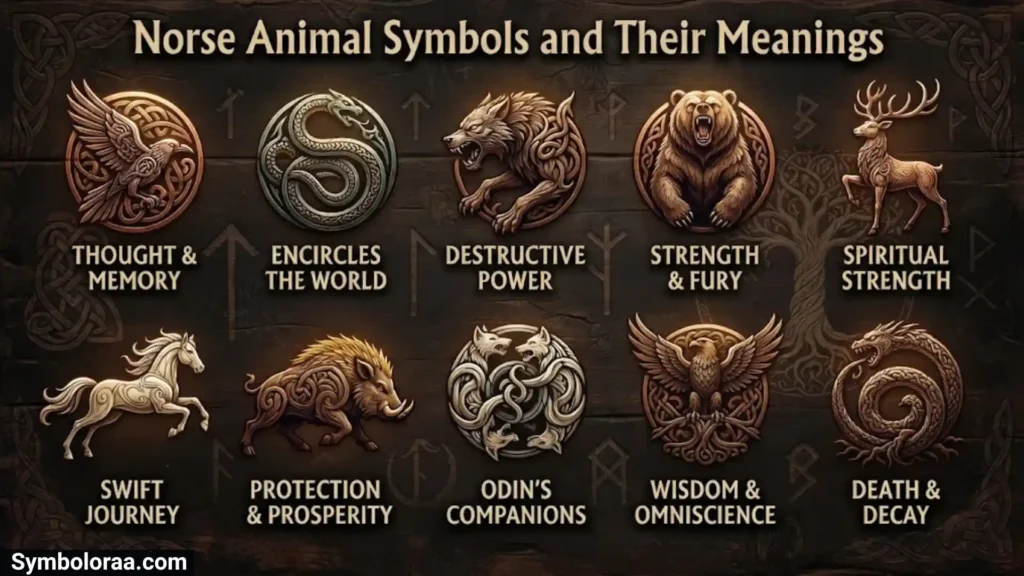
Animals played an important role in Norse mythology and Scandinavian culture.
Their images appeared in stories, decorative designs, and archaeological objects. However, not every animal image carried a specific religious meaning.
Ravens
Ravens are strongly associated with Odin through Huginn and Muninn.
They commonly represent:
- Wisdom and memory
- Observation
- Knowledge
- War and death
- Intelligence
Wolves
Wolves appear in important Norse stories, especially those involving Fenrir and Odin.
They can represent strength, danger, loyalty, aggression, and the unpredictable forces of nature.
Bears
Bears were powerful animals in northern Europe.
Their strength made them important in warrior imagery and later traditions surrounding berserkers.
Modern Norse-inspired designs often use bears to represent courage, endurance, and physical strength.
Boars
Boars appear in Norse mythology through figures such as Gullinbursti.
They are associated with fertility, prosperity, courage, and protection.
Boar imagery also appears on some helmets and other objects from the broader Germanic world.
Horses
Horses were important in transportation, agriculture, warfare, and ritual practices.
In mythology, Sleipnir represents supernatural movement and the connection between worlds.
Horse imagery can therefore suggest travel, freedom, speed, and power.
Norse Symbols of Strength, Protection, and Courage
Many modern readers search for Norse symbols that represent specific qualities. These interpretations often draw on mythology, historical objects, and modern cultural traditions.
| Symbol | Common meaning |
| Mjölnir | Strength, protection, thunder |
| Gungnir | Authority, courage, leadership |
| Valknut | Death, Odin, warriors |
| Ægishjálmur | Protection, fearlessness |
| Yggdrasil | Endurance, growth, connection |
| Fenrir | Raw power, danger, freedom |
| Tyr | Justice, sacrifice, courage |
| Ravens | Wisdom, observation, memory |
| Boar | Strength, prosperity, fertility |
| Sleipnir | Movement, travel, freedom |
Remember that these are common associations, not universal historical definitions.
Norse Symbols of Love and Fertility
Norse mythology includes several figures associated with love, relationships, fertility, and prosperity.
Freyja is especially important in this area. She represents love, beauty, fertility, and magic.
Freyr is associated with fertility, agriculture, peace, and abundance.
Other symbols can also carry related modern interpretations.
- Yggdrasil: Growth, renewal, and the interconnectedness of life.
- Boars: Fertility and prosperity.
- Horses: Vitality and movement.
- Runes such as Gebo: Gift exchange and partnership in modern interpretations.
The rune Gebo is particularly popular in modern discussions of love and relationships. Its name is associated with a gift, making it a natural symbol of exchange and partnership.
However, modern rune interpretations should remain separate from claims about ancient Viking love rituals.
Norse Symbols of Death and the Afterlife
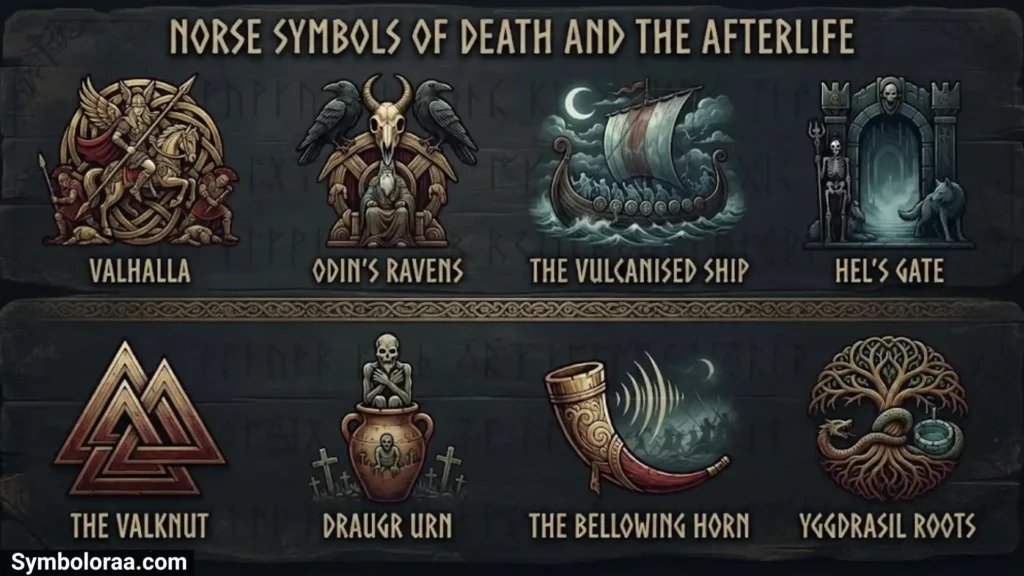
Death was an important theme in Norse mythology.
The stories describe several destinations and experiences associated with death. Valhalla is among the most famous, but it was not the only destination in Norse belief.
The goddess Hel rules a realm associated with many of the dead. Other traditions describe Fólkvangr, a field associated with Freyja.
Important symbols connected with death and the afterlife include:
- Valknut: Often associated with Odin and fallen warriors.
- Ravens: Connected with Odin, battlefields, and death.
- Yggdrasil: Connects different realms of existence.
- Hel: Represents a mythological realm and its ruler.
- Fenrir: Connected with destruction and Ragnarök.
Norse beliefs about death were complex. You should avoid reducing every Viking burial to the idea that the deceased expected to enter Valhalla.
Viking Runes and Their Historical Uses
Runes were an essential part of written communication in ancient Scandinavia.
People carved them into stones, weapons, jewelry, wood, and other materials. Many inscriptions recorded names, family relationships, memorial messages, ownership, or religious expressions.
Runestones
Runestones are large stones containing runic inscriptions.
Many Viking Age runestones commemorate people who died or traveled abroad. Others record family connections, property, and important events.
The inscriptions provide valuable information about language, social relationships, religion, and historical events.
Runes on Weapons and Jewelry
Runic inscriptions also appeared on smaller objects.
Some objects carried names or short messages. Others included inscriptions that may have had protective or magical associations.
However, the presence of runes does not automatically mean an object served as a magical charm.
Were Runes Used for Divination?
Modern popular culture often presents runes as a system for predicting the future.
However, evidence for a standardized Viking Age rune-divination system is limited.
Historical runes primarily functioned as a writing system. Some inscriptions also show that people connected writing with magical or religious ideas.
Modern rune readings are best understood as contemporary spiritual practices rather than proven reconstructions of Viking Age customs.
Viking Art, Patterns, and Decorative Symbols
Viking Age art included intricate animal designs, geometric patterns, and interlacing forms.
These designs appeared on ships, weapons, jewelry, wooden objects, and monuments.
Archaeologists identify several important artistic styles.
Oseberg Style
The Oseberg style is known for elaborate animal ornamentation and gripping creatures.
It is associated with the early Viking Age and appears on objects from the famous Oseberg ship burial.
Borre Style
The Borre style features gripping beasts, interlaced patterns, and symmetrical designs.
It takes its name from archaeological discoveries at Borre in Norway.
Jelling Style
The Jelling style includes ribbon-shaped animals and flowing decorative patterns.
It takes its name from the important archaeological site at Jelling in Denmark.
Mammen Style
The Mammen style features large animals, plant-like patterns, and detailed ornamentation.
One famous example is the decorated Mammen axe from Denmark.
Ringerike Style
The Ringerike style uses elaborate animal and plant motifs with flowing lines.
It represents a later development in Viking Age decorative art.
Urnes Style
The Urnes style is known for elegant, slender animals and complex interlacing.
Its name comes from the decorated wooden church at Urnes in Norway.
These styles show that Viking art changed over time. They also help researchers date and understand objects from different periods.
Historical Norse Symbols vs. Modern Viking Symbols
One of the most important parts of studying Norse symbols is understanding their historical background.
Modern websites and tattoo designs often place all Norse-inspired symbols into one category. However, they come from different periods and traditions.
| Symbol or design | Historical background |
| Mjölnir | Strong Viking Age archaeological evidence |
| Valknut | Appears in Viking Age artwork and monuments; meaning remains uncertain |
| Elder Futhark | Earlier Germanic runic alphabet, mainly before the Viking Age |
| Younger Futhark | Main Scandinavian runic alphabet during the Viking Age |
| Triple Horn of Odin | Appears in Viking Age contexts |
| Yggdrasil | Known from medieval Norse literary sources |
| Vegvísir | Documented in an Icelandic manuscript compiled in 1860 |
| Ægishjálmur | Connected with later Icelandic magical traditions; familiar designs are not securely established as Viking Age artifacts |
| Web of Wyrd | Familiar modern graphic lacks established Viking Age evidence |
| Troll Cross | Popular modern Scandinavian-inspired design |
This distinction matters because a symbol can have genuine cultural significance without dating to the Viking Age.
For example, Vegvísir is a meaningful Icelandic magical symbol in later tradition. Its history simply differs from that of Thor’s hammer.
Norse Symbols in Viking Tattoos
Norse tattoos have become popular among people interested in Scandinavian history, mythology, and warrior culture.
Many people choose these designs because they represent personal values or meaningful ideas.
Common choices include:
- Mjölnir tattoo: Strength, protection, and courage.
- Valknut tattoo: Odin, death, and the warrior tradition.
- Yggdrasil tattoo: Life, growth, and connection.
- Vegvísir tattoo: Guidance and direction.
- Ægishjálmur tattoo: Protection and confidence.
- Runic tattoo: A name, phrase, or chosen symbolic association.
- Raven tattoo: Wisdom, memory, and observation.
- Fenrir tattoo: Power, independence, and resistance.
- Gungnir tattoo: Leadership and determination.
Before choosing a tattoo, research its historical background.
Some designs are modern creations rather than ancient Viking symbols. That does not make them meaningless, but it helps you understand what you are choosing.
You should also check the accuracy of any runic inscription. Transliteration between modern languages and historical runic alphabets can be complicated.
Norse Symbols in Modern Culture
Norse mythology continues to influence books, movies, television, games, music, jewelry, and artwork.
Modern entertainment has introduced many people to Odin, Thor, Loki, Valkyries, and Ragnarök.
These portrayals often combine historical inspiration with creative storytelling.
For example, modern depictions of Thor may differ significantly from medieval descriptions. Similarly, popular Viking tattoos sometimes combine designs from different centuries.
Modern Norse-inspired spirituality also uses symbols in personal and religious contexts.
Some people connect with the historical traditions of ancient Scandinavia. Others use Norse imagery as a source of personal inspiration.
The key is to distinguish historical evidence from modern interpretation.
How to Choose the Right Norse Symbol
Choosing a Norse symbol becomes easier when you understand the meaning you want to express.
Start by identifying the idea that matters most to you.
| Your intended meaning | Symbols to explore |
| Strength | Mjölnir, Fenrir, bear |
| Protection | Mjölnir, Ægishjálmur |
| Wisdom | Odin, ravens, Triple Horn |
| Guidance | Vegvísir, Yggdrasil |
| Courage | Tyr, Gungnir, Mjölnir |
| Life and growth | Yggdrasil, Freyr |
| Love and fertility | Freyja, Freyr, Gebo |
| Fate | Norns, Web of Wyrd |
| Travel | Sleipnir, Vegvísir |
| Death and warriors | Valknut, Odin, ravens |
Think about historical authenticity too.
If you want a design with strong Viking Age archaeological evidence, Thor’s hammer pendants and runestone-inspired designs are useful starting points.
If you prefer a later Icelandic magical symbol, Vegvísir and Ægishjálmur may interest you.
Frequently Asked Questions About Norse Symbols
What Is the Most Powerful Norse Symbol?
There is no single symbol that ancient Norse people universally considered the most powerful.
However, Mjölnir is one of the best-known symbols of divine protection and strength. The Valknut is also strongly associated with Odin and death, although its exact meaning remains uncertain.
What Is the Viking Symbol for Protection?
Mjölnir, Thor’s hammer, is one of the strongest historically supported examples of a protective Viking Age symbol.
Thor was known as a defender of gods and humans. Hammer-shaped pendants found by archaeologists support the symbol’s importance in Viking Age culture.
Ægishjálmur is another popular protective symbol, but its familiar graphic form belongs to later Icelandic magical traditions.
What Is the Viking Symbol for Strength?
Mjölnir is commonly associated with strength because Thor used it as his powerful weapon.
Other symbols and figures associated with strength include Gungnir, Fenrir, bears, and the god Tyr.
What Does the Valknut Mean?
The Valknut is a design made from three interlocking triangles.
Researchers often associate it with Odin, death, and warriors. However, its exact meaning has not been established conclusively.
Is Vegvísir Really a Viking Symbol?
Vegvísir is often called a Viking compass, but its documented history is much later.
The earliest known written attestation appears in the Huld manuscript, compiled in 1860. There is no established evidence that Viking Age sailors used this exact design.
What Is the Norse Symbol for Life?
Yggdrasil is one of the strongest symbols associated with life in Norse mythology.
The world tree connects different realms and represents the structure of existence. Modern interpretations also connect it with growth, renewal, and the cycle of life.
What Does the Web of Wyrd Represent?
The Web of Wyrd is commonly associated with fate and destiny.
Modern interpretations describe it as a pattern connecting past actions, present decisions, and future events. Its familiar graphic form does not have established Viking Age archaeological evidence.
Did Vikings Actually Use Runes?
Yes. Vikings used runes for writing.
They carved inscriptions into stones, wood, metal, weapons, and jewelry. The Younger Futhark was the main runic alphabet used in Scandinavia during the Viking Age.
What Is the Difference Between Elder Futhark and Younger Futhark?
Elder Futhark contains 24 runes and was used by earlier Germanic peoples.
Younger Futhark contains 16 runes and became the main Scandinavian runic alphabet during the Viking Age.
Are All Norse Symbols Religious?
No. Some symbols had religious or mythological associations, while others appeared in decorative art or everyday writing.
An animal design on a Viking object does not automatically represent a god or supernatural belief.
Conclusion
Norse symbols reveal the rich mythology, artistic traditions, and cultural beliefs of ancient Scandinavia.
Symbols such as Mjölnir, the Valknut, Yggdrasil, and Gungnir remain powerful reminders of Norse stories about gods, warriors, nature, and destiny.
Runes provide another important connection to the past. They show how ancient Scandinavian people recorded names, messages, memorials, and other information.
However, historical accuracy matters. Some popular designs, including Vegvísir and the familiar Web of Wyrd graphic, should not be described as confirmed Viking Age symbols.
When you understand their origins, meanings, and historical differences, Norse symbols become much more interesting. They offer more than attractive designs. They provide a window into the stories, values, and imagination of the Norse world.

I’m Jackson Miller, an American author inspired by mystery, adventure, and the unpredictable nature of life. I enjoy writing fast-moving stories filled with memorable characters, unexpected choices, and meaningful moments. Through my books, I want readers to experience new worlds while discovering something about courage, determination, and themselves.
Three Books:
The Edge of Tomorrow
Under a Broken Sky
The Road We Chose
 Madison Reed