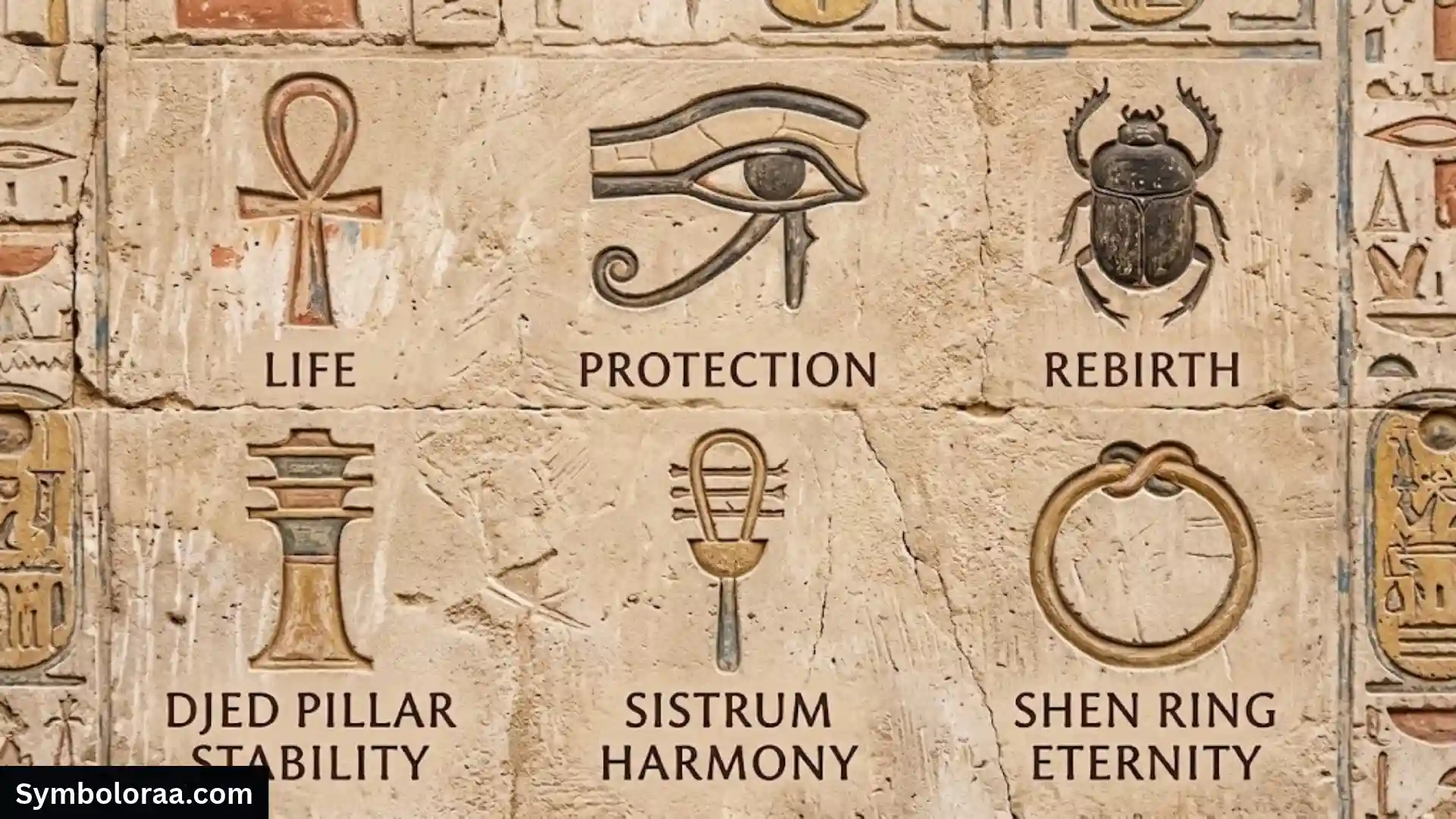
Ancient Egyptian symbols reveal how one of history’s most fascinating civilizations understood life, death, nature, and the divine. For thousands of years, Egyptians used meaningful signs in temples, tombs, jewelry, royal crowns, and religious ceremonies. These symbols helped communicate beliefs that shaped their daily lives and ideas about the afterlife.
Some Egyptian symbols represented life and protection, while others expressed power, stability, truth, and renewal. The Ankh, for example, became a well-known sign of life. The Eye of Horus represented protection and restoration, while the scarab beetle connected with regeneration and the rising sun.
However, Egyptian symbols were more than decorative images. Their meanings depended on historical periods, religious traditions, and the objects on which they appeared. Understanding these details helps you separate authentic ancient meanings from modern interpretations.
This guide explores 16 important Egyptian symbols and their meanings, explains their connections with Egyptian gods, and examines how ancient Egyptians used them. You’ll also learn about their history, religious significance, and continuing influence on modern culture.
What Are Egyptian Symbols?
Egyptian symbols are visual signs, objects, and artistic designs that communicated important ideas in ancient Egyptian society. They represented religious beliefs, royal authority, natural forces, and concepts such as life, death, and cosmic order.
Ancient Egyptians used these symbols across different parts of their civilization. Artists carved them into stone walls, painted them on coffins, and included them in jewelry and protective amulets. Scribes also used many symbolic signs within the Egyptian writing system.
Some symbols had clear religious associations. Others identified rulers, represented gods, or expressed ideas about the universe. Their meanings could overlap, especially when artists combined several signs in one scene.
Egyptian Symbols vs. Hieroglyphs
Egyptian symbols and hieroglyphs are closely connected, but they aren’t exactly the same.
Hieroglyphs formed a writing system that used signs to represent sounds, words, and concepts. Some signs also carried symbolic meanings beyond their role in writing.
For example, the Ankh was both a hieroglyph associated with life and a religious symbol frequently shown in the hands of gods. The Djed sign represented stability and also appeared in religious imagery connected with Osiris.
A cartouche, by contrast, is an enclosure that frames a royal name in hieroglyphic writing. It isn’t simply another hieroglyph representing a single concept.
Understanding this distinction makes Egyptian symbolism easier to interpret. A sign could communicate a written message, express a religious idea, or serve both purposes at once.
Why Did Ancient Egyptians Use Symbols?
Ancient Egyptians used symbols to express beliefs and values that influenced nearly every aspect of their civilization.
Their main purposes included:
- Life and eternal existence: Signs associated with vitality and continued life.
- Protection and healing: Images used in amulets and religious settings.
- Kingship and authority: Emblems that identified rulers and communicated their power.
- Truth and justice: Symbols connected with moral conduct and cosmic order.
- Rebirth and renewal: Images associated with creation and the recurring solar cycle.
- The afterlife: Religious signs used in funerary objects, tombs, and burial rituals.
These meanings weren’t always universal. A symbol could have different associations depending on the deity, object, or historical period involved.
16 Ancient Egyptian Symbols and Their Meanings
Many Egyptian symbols became recognizable because artists used them repeatedly in religious scenes, royal monuments, and funerary objects. Each symbol carried its own history and associations.
The Ankh: The Egyptian Symbol of Life
The Ankh is one of the most famous ancient Egyptian symbols. It resembles a cross with an oval loop at the top and represents life.
Egyptian gods frequently appear holding the Ankh in temple reliefs and tomb paintings. Sometimes a deity extends it toward a pharaoh, expressing the divine gift of life or vitality.
The symbol also appeared in funerary art because ancient Egyptians believed that existence could continue after physical death. Its connection with life therefore extended beyond ordinary earthly existence.
The Ankh’s main associations include:
- Life and vitality.
- Divine life-giving power.
- Continued existence after death.
- Religious devotion and sacred authority.
Ancient Egyptians used the Ankh in jewelry, amulets, statues, inscriptions, and temple decorations. Its widespread presence shows how important life was within Egyptian religious thought.
Today, the Ankh appears in necklaces, tattoos, artwork, and popular culture. Some people use it to represent spirituality or personal identity, although modern interpretations don’t always match its original historical meaning.
The Eye of Horus: Protection and Restoration
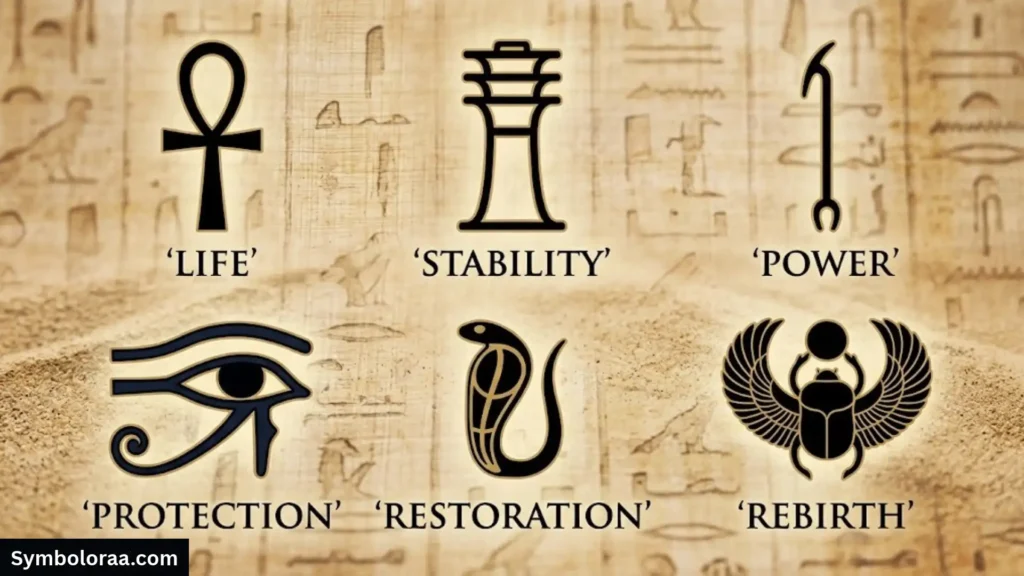
The Eye of Horus, also called the Wedjat eye, is an important Egyptian symbol associated with protection, healing, and restoration.
Its distinctive shape combines an eye with stylized markings beneath it. Egyptian mythology connects the symbol with Horus, a god associated with the sky and kingship.
According to a well-known myth, Horus loses an eye during his conflict with Seth. The eye is later restored, giving the symbol its association with recovery and wholeness.
Ancient Egyptians used Eye of Horus amulets to express protection and well-being. The symbol also appeared in funerary settings, where it could help protect the deceased.
Its main meanings include:
- Protection from harm.
- Healing and restoration.
- Wholeness and well-being.
- Protection in funerary practices.
The Eye of Horus is often confused with the Eye of Ra. Although both have protective associations, they come from different mythological traditions.
The Eye of Ra frequently expresses the sun god’s power and the fierce protective force of associated goddesses. The Eye of Horus is especially connected with the restoration of Horus’s injured eye.
The Scarab Beetle: Rebirth and Renewal
The scarab beetle became a powerful Egyptian symbol of rebirth, renewal, and regeneration.
Its religious significance is closely connected with Khepri, a deity associated with the rising sun. Egyptian art often represents Khepri with a scarab beetle’s head.
The beetle’s behavior helped inspire this association. Scarab beetles roll balls of dung, and their young develop from eggs laid within them. Egyptians connected the emergence of new life with ideas about creation and regeneration.
Scarab-shaped objects served several purposes in ancient Egypt. Some functioned as seals, while others served as amulets or carried inscriptions. Craftspeople made them from materials such as steatite and glazed faience.
Scarab imagery appeared in jewelry, tombs, and religious objects. Heart scarabs had a particular funerary role because their inscriptions could relate to the judgment of the deceased.
The scarab’s principal associations include:
- Rebirth and renewal.
- The rising sun.
- Creation and regeneration.
- Protection in religious contexts.
Modern interpretations often describe the scarab as a symbol of personal transformation. That interpretation draws on its ancient associations with renewal, although its original significance was closely connected with Egyptian mythology and solar religion.
The Djed Pillar: Stability and Endurance
The Djed pillar resembles a column with several horizontal bars near its upper section. It represents stability and endurance and has strong associations with Osiris, the god connected with the afterlife and regeneration.
The Djed appears in religious art, funerary objects, and temple decorations. Its meaning made it particularly relevant to Egyptian beliefs about maintaining stability beyond death.
The symbol also appears in rituals associated with Osiris. One important ceremony involved raising the Djed pillar, expressing the restoration of stability and order.
Ancient Egyptians placed Djed amulets in funerary settings, and the symbol sometimes appeared alongside the Ankh and Tyet.
The Djed’s main associations include:
- Stability and endurance.
- Osiris and regeneration.
- Religious protection.
- Continued existence after death.
Some modern interpretations describe the Djed as a symbol of inner strength. However, its established ancient associations focus on stability, Osiris, and funerary religion.
The Tyet: The Knot of Isis
The Tyet, often called the Knot of Isis, resembles a looped knot with downward-curving arms. Its shape looks somewhat like the Ankh, but the two symbols have different forms and associations.
The Tyet is connected with Isis, a goddess associated with motherhood, magic, healing, and protection. Its use in funerary contexts reflects the importance of divine protection after death.
Some Tyet amulets were made from red materials, including red jasper. The material and placement of an amulet could contribute to its ritual significance.
The Tyet’s principal associations include:
- Protection connected with Isis.
- Funerary safety.
- Maternal and divine care.
- Ritual protection for the deceased.
The Tyet sometimes appeared alongside the Ankh, bringing together related ideas about life and protection. Its historical meaning is more specific than modern descriptions that present it as a universal symbol of feminine energy.
The Shen Ring: Protection and Eternity
The Shen ring consists of a loop or circle with a short line extending from its base. Its shape represents an encircling form associated with protection and completeness.
Because the ring has no obvious beginning or end, modern explanations often connect it with eternity. In ancient Egyptian art, however, its significance also involved the protective enclosure of something valuable.
Shen rings appear in royal and divine imagery. Gods sometimes hold them or extend them toward rulers, expressing protection and the preservation of royal authority.
The cartouche developed from the elongated form of the Shen ring. Although the two are related, they have different visual functions.
A Shen ring usually forms a compact loop, while a cartouche stretches into an oval enclosure that frames a royal name.
The Was Scepter: Divine Power and Authority
The Was scepter is a long staff with a distinctive animal-shaped top and a forked base. It appears in representations of Egyptian gods and, in some contexts, kings.
The scepter represents power and authority. Its presence in religious imagery helps identify figures with divine or royal status.
Egyptian artists often showed gods holding the Was scepter alongside the Ankh. These combinations could express authority and life-giving power within the same scene.
The Was scepter appeared in temple reliefs, statues, and ceremonial imagery. It formed part of the visual language used to communicate the relationships between gods, rulers, and the ordered world.
Its meaning wasn’t limited to physical strength. It expressed authority within the religious and political traditions of ancient Egypt.
The Lotus Flower: Creation and Renewal
The lotus flower appears frequently in Egyptian art and religious imagery. Artists depicted it on temple walls, painted objects, decorative pieces, and columns.
The flower became associated with creation, renewal, and regeneration. Some Egyptian traditions connected its emergence with the beginnings of life and the daily cycle of the sun.
Lotus flowers also appeared in scenes of feasting and social life. Their significance therefore extended beyond strictly religious settings.
The lotus’s common associations include:
- Creation and emergence.
- Renewal and regeneration.
- Solar imagery.
- Beauty and flourishing life.
The exact meaning depends on the image’s context. A lotus in a creation scene may communicate something different from a flower used as a decorative motif.
Modern descriptions sometimes present the lotus as a universal symbol of purity or spiritual awakening. Those interpretations may be meaningful today, but the flower’s ancient Egyptian associations deserve separate consideration.
The Uraeus: The Sacred Cobra of Royal Protection
The Uraeus is an upright cobra depicted on royal crowns and headdresses. It represents royal protection and sovereignty and is associated with the cobra goddess Wadjet.
Its position on a pharaoh’s crown made it a powerful statement about kingship. The ruler appeared under divine protection, connecting political authority with religious power.
The cobra’s threatening posture suited its protective role. In Egyptian imagery, the Uraeus could express the ability to repel threats and defend the ruler.
The symbol appears in statues, temple reliefs, royal regalia, and depictions of pharaohs. It could also appear alongside other emblems, including the vulture associated with Nekhbet.
The cobra and vulture together could communicate royal protection and the traditional unity of Upper and Lower Egypt.
The Uraeus is therefore more than a generic snake image. Its connection with Wadjet and its position on royal regalia give it a specific historical meaning.
The Feather of Ma’at: Truth, Justice, and Balance
The Feather of Ma’at represents truth, justice, and cosmic order. Ma’at was both a goddess and a central concept describing the proper order of the world.
Ancient Egyptians believed that society and the cosmos depended on maintaining Ma’at against Isfet, a principle associated with disorder and disruption.
The feather became especially important in funerary imagery. During the judgment of the dead, the deceased person’s heart was weighed against the Feather of Ma’at.
This scene reflects the belief that a person’s conduct mattered beyond physical death. The heart represented aspects of thought, memory, identity, and moral character.
The feather’s main associations include:
- Truth and justice.
- Proper conduct.
- Cosmic balance.
- Judgment after death.
Ma’at wasn’t simply an ancient version of modern legal justice. The concept also involved social responsibility, religious order, political legitimacy, and the stability of the universe.
The Crook and Flail: Symbols of Kingship
The crook and flail are two recognizable objects associated with Egyptian kingship. The crook resembles a shepherd’s staff, while the flail has a handle with hanging strands.
Pharaohs appear holding these objects in royal representations. Osiris is also frequently depicted with them, connecting the objects with religious imagery and kingship.
The crook is commonly interpreted through its resemblance to a shepherd’s staff, suggesting guidance and care. The flail’s exact meaning is less certain, although it forms part of the established visual language of royal authority.
Together, the objects became recognizable emblems of royal status.
They appear on statues, coffins, and other royal or funerary objects. Their presence helped identify a ruler or deity and communicate their place within Egyptian political and religious life.
The Cartouche: Royal Names and Identity
A cartouche is an elongated oval enclosure used to frame the names of Egyptian kings and queens in hieroglyphic inscriptions. A short horizontal line usually closes one end.
Cartouches made royal names visually distinct within inscriptions. They appeared on temple walls, statues, monuments, and other objects associated with rulers.
The cartouche developed from the Shen ring motif, but the two shouldn’t be confused. A cartouche’s defining purpose is to frame a royal name rather than serve as a generic symbol of eternity.
Royal names mattered because they identified the ruler and connected that person with official representations of kingship. Preserving a name in monuments and funerary settings also mattered within Egyptian beliefs about continued existence and remembrance.
Cartouches remain useful for understanding Egyptian history. Scholars compare royal names across inscriptions to identify rulers, study succession, and interpret monuments.
The Hippopotamus: Fertility and Maternal Protection
The hippopotamus held a distinctive place in Egyptian religious imagery. Although the animal could be dangerous in nature, certain hippopotamus forms represented protective female deities.
One important example is Taweret, a goddess associated with pregnancy, childbirth, and the protection of mothers and infants. Artists often represented her with a pregnant hippopotamus-like body and features drawn from other animals.
Protective figurines of Taweret appeared in domestic and religious settings. Her imagery reflects the importance of safeguarding childbirth and early childhood.
Her principal associations include:
- Pregnancy and childbirth.
- Maternal protection.
- The safety of infants.
- Fertility and family well-being.
This example shows why Egyptian symbolism can’t be understood by looking at an animal’s appearance alone. The deity associated with the image could give it a specific religious meaning.
The Heart (Ib): Conscience and the Afterlife
The heart, called ib in ancient Egyptian, held a central place in beliefs about thought, memory, identity, and moral character.
Unlike many modern ideas that place emotion primarily in the heart and reasoning in the brain, Egyptian beliefs gave the heart a broader role. It could preserve information about a person’s actions and character.
This belief shaped funerary practices. Heart scarabs were placed with the deceased, often bearing spells intended to prevent the heart from speaking against its owner during judgment.
The heart’s principal associations include:
- Thought and memory.
- Personal identity.
- Moral character.
- Judgment in the afterlife.
The heart therefore wasn’t merely an emblem of romantic love. Its religious importance came from its role in the person’s identity and fate after death.
The Sacred Tree: Nourishment and Divine Care
Trees appear in Egyptian religious imagery as sources of nourishment, shade, and protection. The sycamore fig, in particular, held religious significance in some funerary traditions.
Certain scenes show a goddess associated with a tree providing water or food to the deceased. Such images connect the natural world with divine care and the needs of the dead.
Hathor and other goddesses could appear in sacred-tree traditions, although the precise identity and meaning depend on the scene.
Tree imagery could suggest:
- Nourishment and renewal.
- Protection and care.
- Connections between the living and the dead.
- Divine presence within nature.
Modern sources sometimes present the Egyptian Tree of Life as one universal symbol with a single fixed meaning. Ancient Egyptian tree imagery was more varied, so it’s important to consider the particular tree, goddess, and religious context.
The Aten: The Life-Giving Solar Disk
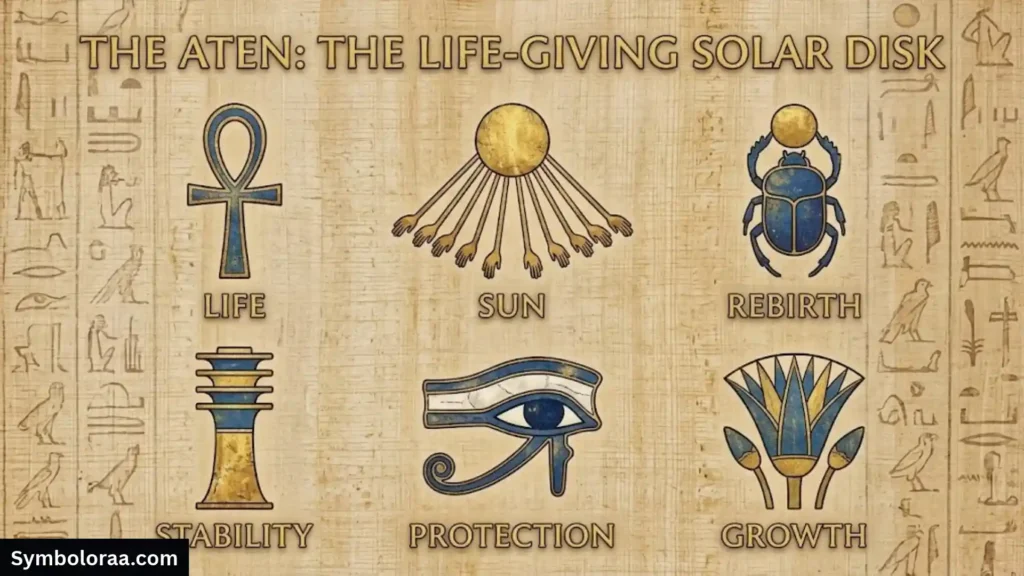
The Aten is represented as a solar disk with rays extending downward, often ending in small hands. These hands sometimes hold Ankhs toward the king and royal family.
Aten imagery became especially prominent during the reign of Akhenaten in the 14th century BCE. His religious reforms placed Aten at the center of royal worship and changed the way Egyptian artists represented divine power.
The rays connected the sun directly with the king and his family. Unlike traditional images showing gods in human or animal forms, Aten often appeared through the disk and its life-giving rays.
Aten’s main associations include:
- Solar power and vitality.
- Life-giving energy.
- Royal religious authority.
- Akhenaten’s religious reforms.
Aten should be understood within this specific historical period. Solar worship existed long before Akhenaten, but his promotion of Aten created an unusual chapter in Egyptian religious history.
Other Important Egyptian Symbols
Several additional symbols help explain the richness of Egyptian mythology and religious art.
The Eye of Ra
The Eye of Ra represents the sun god’s power and can take the form of a fierce protective force. In Egyptian myths, the Eye may be associated with goddesses who defend divine authority and punish threats.
Although it resembles the Eye of Horus, the two have different mythological backgrounds. The Eye of Horus is strongly connected with restoration, while the Eye of Ra often expresses solar power and divine aggression.
The Vulture and Cobra Emblems
The vulture goddess Nekhbet and cobra goddess Wadjet served as protectors of Egyptian kingship. Their imagery appeared on royal crowns and other objects associated with the pharaoh.
The two emblems also reflected the traditional association of Nekhbet with Upper Egypt and Wadjet with Lower Egypt. Together, they could communicate royal protection and the unity of the country.
Combined Symbols of Life, Stability, and Protection
Egyptian artists often combined symbols rather than using each one independently. A single amulet might contain the Ankh, Djed, and Tyet, bringing together ideas of life, stability, and protection.
This practice demonstrates that Egyptian symbolism worked as a visual language. The meaning of an object could emerge from several signs interacting with one another.
Egyptian Symbols and the Gods They Represent
Ancient Egyptian religion included many gods and goddesses, each associated with different aspects of the natural world, royal authority, and human existence.
Symbols helped identify these deities and communicate their attributes. A falcon, scarab, feather, or royal staff could reveal important information about a figure in a temple relief or tomb painting.
| God or Goddess | Main Associations | Related Symbols |
| Isis | Magic, motherhood, protection | Tyet, throne sign |
| Horus | Kingship, sky, restoration | Eye of Horus, falcon imagery |
| Ra | Sun, creation, divine power | Solar disk |
| Khepri | Sunrise and renewal | Scarab beetle |
| Osiris | Afterlife, regeneration, kingship | Djed pillar, crook and flail |
| Ma’at | Truth, justice, cosmic order | Ostrich feather |
| Taweret | Pregnancy and childbirth | Hippopotamus-like form |
| Hathor | Love, music, motherhood | Cow imagery, sacred-tree traditions |
| Wadjet | Royal protection | Uraeus cobra |
| Nekhbet | Royal protection and Upper Egypt | Vulture emblem |
| Aten | Life-giving solar power | Solar disk with rays |
How Egyptian Gods Influenced Symbolic Meanings
The relationship between a deity and a symbol developed through mythology, ritual, and artistic convention.
The scarab, for example, became associated with Khepri and the rising sun. The Djed pillar became closely linked with Osiris and stability. The Feather of Ma’at expressed a concept that was both embodied by a goddess and central to the Egyptian understanding of the universe.
These relationships also changed over time. Gods could acquire additional roles, and artists could combine their attributes in new ways.
Egyptian Symbols by Meaning and Purpose
Grouping Egyptian symbols by their historical associations makes their meanings easier to compare.
Egyptian Symbols of Life and Eternal Life
The Ankh is the clearest example of a symbol associated with life. Gods often hold it in Egyptian art, emphasizing the relationship between divine power and vitality.
The Djed pillar and certain funerary objects also relate to continued existence. Their meanings differ, however. The Ankh emphasizes life, while the Djed expresses stability and has strong connections with Osiris.
These symbols frequently appeared in funerary settings because Egyptians viewed the afterlife as an important continuation of existence.
Egyptian Symbols of Protection and Healing
Several Egyptian symbols served protective roles, although their functions weren’t identical.
- Eye of Horus: Associated with protection, restoration, and healing.
- Tyet: Connected with the protective powers of Isis.
- Shen ring: Associated with protective enclosure and completeness.
- Uraeus: Expressed royal protection and sovereignty.
- Taweret: Protected pregnancy, childbirth, and infants.
Amulets could combine these signs with inscriptions or other imagery. Their intended function depended on the object’s design, placement, and religious context.
Egyptian Symbols of Rebirth and Renewal
The scarab and lotus offer two different ways to understand renewal in Egyptian religion.
The scarab connects regeneration with Khepri and the rising sun. The lotus appears in creation traditions and other imagery associated with emergence and renewal.
The Djed pillar also belongs in this discussion because of its relationship with Osiris. Its emphasis, however, is stability rather than renewal alone.
Solar imagery added another dimension. The sun’s daily movement across the sky offered a powerful model for recurring life, disappearance, and return.
Egyptian Symbols of Power and Kingship
Egyptian royal imagery used recognizable signs to express the pharaoh’s authority and divine status.
- Was scepter: Power and authority.
- Crook and flail: Royal status and kingship.
- Uraeus: Royal protection and sovereignty.
- Cartouche: Identification of royal names.
- Aten disk: Divine solar power in the context of Akhenaten’s reforms.
These symbols weren’t simply personal accessories. They helped establish the ruler’s place within Egyptian political and religious life.
Egyptian Symbols of Truth, Justice, and Balance
The Feather of Ma’at is the strongest example of this category. Ma’at represented the proper order of the world, including truth, justice, and responsible conduct.
The heart also belongs here because of its role in the judgment of the dead. In funerary imagery, the heart’s relationship with the feather expressed the deceased person’s moral standing.
Together, these images connect individual behavior with the larger stability of society and the cosmos.
Egyptian Symbols Associated With Fertility and Motherhood
Taweret and Isis are particularly relevant to maternal protection.
Taweret’s hippopotamus-like form appeared in objects intended to protect mothers and infants. Isis, meanwhile, was associated with motherhood, magic, and the protection of her son Horus.
Sacred-tree imagery also sometimes connected divine nourishment with the needs of the living and dead.
These associations offer a historically grounded way to discuss Egyptian fertility symbols without assigning every symbol a generic meaning of feminine energy.
How Ancient Egyptians Used Symbols
Egyptian symbols appeared in many parts of life. Their meaning depended not only on the image but also on the object carrying it and the setting in which people encountered it.
Temples and Religious Ceremonies
Temple walls and columns carried extensive religious imagery. Artists depicted gods, kings, offerings, and ritual scenes using recognizable signs and attributes.
The Ankh, Was scepter, royal crowns, and solar motifs helped communicate relationships between gods and rulers. Hieroglyphic inscriptions added names, titles, prayers, and descriptions of religious acts.
These images weren’t merely illustrations. Within Egyptian religious practice, temple decoration helped express the relationship between divine beings, the king, and the proper order of the world.
Tombs, Mummies, and Funerary Rituals
Funerary objects provide some of the clearest evidence for the practical use of Egyptian symbols.
Protective amulets could be placed among mummy wrappings, while symbols and spells appeared on coffins, sarcophagi, and tomb walls. Their placement often reflected specific religious intentions.
Heart scarabs are a particularly revealing example. These objects could carry spells intended to protect the deceased during judgment.
Other funerary objects included Djed amulets associated with stability and Tyet amulets connected with Isis. Eye of Horus amulets could also express protection and restoration.
Jewelry, Amulets, and Everyday Objects
Egyptians made symbolic objects from materials such as stone, faience, gold, and other substances. Their forms ranged from small amulets to larger decorative or ceremonial pieces.
Scarab seals could serve practical functions as well as carry protective imagery. Other amulets were intended primarily for religious or funerary use.
Not every symbolic object had the same purpose. Some identified their owners, others served as seals, and still others were intended to provide protection within a religious framework.
Royal Crowns, Statues, and Monuments
Royal regalia communicated the pharaoh’s position through familiar visual signs.
The Uraeus appeared on crowns and headdresses, while the crook and flail identified royal or Osirian imagery. Cartouches made royal names stand out on monuments and inscriptions.
These symbols helped communicate political authority in a society where kingship had a strong religious dimension.
Papyrus and Hieroglyphic Inscriptions
Egyptian scribes used writing to record religious texts, royal decrees, names, titles, and administrative information.
Papyrus manuscripts preserved many kinds of texts, including funerary spells. Monumental inscriptions used hieroglyphs to communicate religious and political messages in temples and tombs.
The Rosetta Stone played an important role in the modern study of Egyptian writing because its inscriptions provided a way to compare hieroglyphic and Demotic Egyptian with Greek. This comparison helped scholars decipher hieroglyphs.
Egyptian Symbols and the Afterlife
The afterlife occupied an important place in ancient Egyptian religion. Funerary texts, amulets, tomb paintings, and burial rituals helped people prepare for existence beyond death.
These practices changed across Egyptian history, but many shared a concern with preserving the deceased and maintaining a relationship with the divine.
Ancient Egyptian Beliefs About Life After Death
Egyptians believed that successful passage into the afterlife required more than burying a body. Funerary preparations could include mummification, offerings, protective objects, and religious texts.
The body, the person’s identity, and the relationship with the gods all mattered. This helps explain why symbols appeared so frequently on coffins, mummy wrappings, and tomb walls.
The Ankh, scarab, Djed pillar, and Tyet could appear in funerary contexts, although each carried its own associations.
The Weighing of the Heart Ceremony
The weighing of the heart is one of the most recognizable scenes in Egyptian funerary art.
In this judgment scene, the deceased person’s heart is weighed against the Feather of Ma’at. Anubis commonly appears overseeing the scales, while Osiris presides over the judgment.
The scene expresses the belief that the deceased’s conduct mattered. The heart represented the person’s character, memory, and moral record.
This is why the heart scarab had a particular role in funerary practice. Its inscription could ask that the heart not testify against its owner during judgment.
The Egyptian Book of the Dead
The Book of the Dead is a modern name for a collection of ancient Egyptian funerary spells. It wasn’t one fixed book with identical contents for every deceased person.
Scribes copied spells onto papyrus, and illustrated manuscripts could include scenes of judgment, protective deities, and other elements connected with the afterlife.
The spells helped the deceased navigate dangers and challenges in the next world. Their words and images worked together, combining written instructions with religious symbolism.
Protective Amulets and Funerary Objects
Funerary amulets demonstrate how Egyptian symbols could serve specific ritual purposes.
- Heart scarabs carried spells connected with the judgment of the dead.
- Djed amulets expressed stability and had associations with Osiris.
- Tyet amulets connected the deceased with the protection of Isis.
- Eye of Horus amulets expressed protection and restoration.
Archaeological objects sometimes combine several symbols, showing that Egyptians could layer related meanings within a single piece.
The History and Evolution of Egyptian Symbols
Egyptian symbolism didn’t remain unchanged throughout the civilization’s long history. Religious practices, artistic styles, political changes, and contact with other cultures all influenced the ways people used symbols.
Predynastic Egypt and Early Symbolic Imagery
Before Egypt’s unification around 3100 BCE, communities along the Nile developed distinctive artistic and ceremonial traditions.
Early pottery, carved objects, and ceremonial palettes included images of animals, people, boats, and other motifs. These objects provide evidence for the development of visual communication before the fully established pharaonic state.
However, scholars must interpret early imagery carefully. A motif that resembles a later religious symbol doesn’t automatically carry the same meaning.
Old Kingdom and Middle Kingdom
During the Old Kingdom, monumental royal architecture and funerary art became prominent features of Egyptian civilization. Royal tombs and religious monuments used imagery to express kingship, divine relationships, and beliefs about death.
The Middle Kingdom saw continued development in funerary practices and the use of symbolic objects. Scarab amulets, for example, could carry signs chosen for their favorable or protective associations.
These objects show how Egyptian symbols could combine religious meaning with practical functions, such as sealing containers or identifying ownership.
New Kingdom and the Expansion of Religious Imagery
The New Kingdom, approximately 1550–1070 BCE, produced many of the best-known surviving examples of Egyptian religious art.
Temples, royal tombs, and funerary objects displayed elaborate imagery. The Valley of the Kings contains royal tombs with scenes and inscriptions related to the deceased ruler’s journey through the afterlife.
During this period, artists used symbols in complex religious compositions. Their meanings often depended on the deities, texts, and rituals surrounding them.
Akhenaten and the Amarna Period
Akhenaten’s reign in the 14th century BCE brought a major change in Egyptian royal religion. His promotion of Aten worship placed the solar disk at the center of religious imagery.
Amarna art frequently shows Aten’s rays reaching toward the royal family, sometimes ending in hands that offer Ankhs. This distinctive imagery contrasts with traditional representations of many Egyptian gods in human or animal forms.
The change was significant, but it didn’t permanently replace all Egyptian religious traditions. After Akhenaten’s reign, older cults and artistic conventions regained prominence.
Greco-Roman Egypt
After Alexander the Great conquered Egypt in 332 BCE, Greek and Egyptian traditions interacted in new political and cultural settings. Egypt later became part of the Roman Empire in 30 BCE.
Egyptian religious symbols continued to appear in temples and religious objects. The worship of Isis also spread across parts of the Mediterranean world, carrying Egyptian religious imagery into new settings.
This period demonstrates that Egyptian symbolism wasn’t isolated from outside influences. Its forms and meanings could travel, adapt, and acquire new associations.
Rediscovery and the Study of Egyptian Symbols
The Rosetta Stone helped transform the modern study of ancient Egypt. Its decree, written in hieroglyphic, Demotic, and Greek scripts, gave scholars a way to compare the texts.
Jean-François Champollion announced a major breakthrough in deciphering hieroglyphs in 1822. His work helped establish the linguistic foundation for modern Egyptology.
Decipherment allowed scholars to connect images with names, inscriptions, and religious texts more accurately. Researchers could move beyond guesswork and interpret symbols using written evidence.
Egyptian Symbols in Modern Culture
Ancient Egyptian symbols remain popular in jewelry, fashion, tattoos, art, and architecture. Their modern meanings sometimes preserve ancient associations, but they can also reflect contemporary interests.
Egyptian Symbols in Jewelry and Fashion
The Ankh, Eye of Horus, and scarab are common motifs in modern jewelry. Designers use them in pendants, rings, bracelets, and decorative accessories.
Some pieces draw directly on ancient Egyptian designs, while others reinterpret the imagery through modern styles and materials. Gold, silver, colored stones, and enamel can give traditional forms a contemporary appearance.
Wearing an Egyptian symbol today doesn’t necessarily mean adopting its original religious meaning. One person might choose an Ankh for its historical importance, while another might use it as a personal emblem of life.
Egyptian Symbols in Tattoos and Personal Art
People often choose Egyptian symbols for tattoos because their shapes are distinctive and their histories are rich.
Common choices include:
- Ankh: Associated with life and continued existence.
- Eye of Horus: Associated with protection and restoration.
- Scarab: Connected with renewal and regeneration.
- Djed pillar: Associated with stability and Osiris.
- Cartouche: Used in ancient Egypt to enclose royal names.
Before choosing a design, research its historical context. This helps you distinguish ancient meanings from modern interpretations and avoid incorrect claims about what a symbol represented.
Egyptian Symbols in Art, Architecture, and Design
Egyptian motifs influenced Western art and design through several periods of renewed interest in ancient Egypt.
The Egyptian Revival movement drew on pyramids, obelisks, lotus forms, and other recognizable motifs. Egyptian-inspired elements also appeared in Art Deco, particularly in decorative objects, jewelry, and architecture.
These modern adaptations often emphasize geometric shapes and dramatic visual forms. Although they borrow from ancient Egyptian art, they don’t always reproduce the original meanings.
Egyptian Symbols in Contemporary Spirituality
Some contemporary spiritual movements use Egyptian symbols as emblems of protection, renewal, or personal growth.
These interpretations can hold personal meaning, but they shouldn’t automatically be presented as established ancient Egyptian beliefs. Modern ideas about energy, meditation, or universal spiritual meanings may differ substantially from the historical evidence.
A useful distinction is to separate three things:
- Historical meaning: What ancient objects, inscriptions, and religious traditions support.
- Modern interpretation: How people understand a symbol today.
- Personal meaning: What the symbol represents to an individual.
Keeping these categories separate makes discussions of Egyptian symbolism more accurate and respectful.
Cultural Respect and Responsible Use
Ancient Egyptian symbols belong to a rich cultural heritage that continues to attract scholarly study and public interest.
Understanding their historical contexts helps you appreciate the artwork without reducing every sign to a generic spiritual meaning. It also encourages more thoughtful use of Egyptian imagery in tattoos, fashion, and design.
You can appreciate the beauty of Egyptian art while recognizing that its symbols once played meaningful roles in religion, government, and daily life.
Frequently Asked Questions About Egyptian Symbols
What do Egyptian symbols mean?
Egyptian symbols express a wide range of ideas, including life, protection, regeneration, kingship, justice, and the afterlife. Their meanings depend on the symbol itself and its historical context. Some signs also functioned as hieroglyphs, while others appeared mainly in religious imagery, royal regalia, or protective objects.
What is the most famous Egyptian symbol?
The Ankh is among the most recognizable Egyptian symbols. Its cross-like shape with an oval loop represents life and appears frequently in depictions of gods and pharaohs. The Eye of Horus and scarab beetle are also widely recognized symbols associated with protection and renewal.
What is the Egyptian symbol for eternal life?
The Ankh is the Egyptian symbol most commonly associated with life and continued existence. It appears in temple reliefs, tomb paintings, and religious scenes in which gods hold it. Its funerary associations connect it with Egyptian beliefs about life beyond death.
What is the difference between the Eye of Horus and the Eye of Ra?
The Eye of Horus is associated with Horus and the restoration of his injured eye. The Eye of Ra is connected with the sun god’s power and the protective force of certain goddesses. Both could have protective associations, but their mythological backgrounds and roles differ.
Which Egyptian symbols represent protection?
The Eye of Horus, Tyet knot, Shen ring, Uraeus cobra, and imagery of Taweret all have protective associations. Their uses varied, however. Some appeared on personal amulets, others on royal crowns, and still others in household or funerary settings.
Which Egyptian symbols represent rebirth?
The scarab, lotus flower, Djed pillar, and solar imagery are associated with renewal or regeneration in different contexts. The scarab connects with Khepri and the rising sun, while the Djed pillar has strong associations with Osiris and stability.
What does the scarab beetle symbolize?
The scarab represents regeneration and renewal and is associated with Khepri, the rising sun. Scarab-shaped objects also served as seals, amulets, and funerary objects. Some carried inscriptions or combinations of hieroglyphic signs with protective meanings.
What does the Djed pillar represent?
The Djed pillar represents stability and endurance and is closely associated with Osiris. It appears in religious imagery and funerary amulets. Its role in Egyptian art connects stability with beliefs about regeneration and continued existence after death.
What does the Egyptian cartouche mean?
A cartouche is an elongated enclosure used to frame a royal name in hieroglyphic inscriptions. It appears on monuments, temple walls, statues, and other objects associated with Egyptian rulers. Although related to the Shen ring, a cartouche primarily serves to identify and enclose a royal name.
Are Egyptian hieroglyphs and Egyptian symbols the same thing?
No. Hieroglyphs form a writing system that represents sounds, words, and grammatical information. Egyptian symbols include a broader range of visual signs and motifs used in religious, political, and artistic contexts. Some hieroglyphs also carried symbolic associations beyond their roles in written language.
How were Egyptian symbols used in ancient times?
Ancient Egyptians used symbols in temples, tombs, royal regalia, amulets, jewelry, and written inscriptions. Some identified gods and rulers, while others communicated religious beliefs or served protective purposes. The intended function depended on the object’s setting, design, and associated text.
Are Egyptian symbols still used today?
Yes. Egyptian symbols appear in jewelry, tattoos, fashion, art, architecture, and popular culture. People may use them to express historical interest, personal identity, or modern spiritual beliefs. These contemporary uses often reinterpret the symbols rather than reproduce their original ancient meanings.
Conclusion
Ancient Egyptian symbols reveal how people understood life, death, authority, and the world around them. The Ankh represented life, the Eye of Horus expressed protection and restoration, and the scarab connected regeneration with the rising sun.
Other symbols communicated equally important ideas. The Djed pillar expressed stability, the Feather of Ma’at represented truth and cosmic order, and royal emblems helped establish the pharaoh’s authority.
Their meanings become clearer when you examine the objects, inscriptions, and religious traditions surrounding them. Rather than treating every sign as a universal spiritual emblem, consider how ancient Egyptians actually used it.
The best way to understand Egyptian symbols is to explore both what they represented and how they functioned in ancient Egyptian life. This approach reveals a rich visual tradition whose influence continues to inspire people today.

I’m Ethan Brooks, an American writer passionate about stories that explore modern life, relationships, ambition, and personal growth. I love creating characters who feel real and face challenges readers can recognize. Through my writing, I hope to entertain, inspire, and encourage readers to see everyday experiences from a different perspective.
Three Books:
The City Between Us
After the Last Goodbye
A Different Tomorrow
 Madison Reed