If you are searching for Louis Vuitton symbols, you are probably trying to identify the famous marks and patterns seen on Louis Vuitton bags, luggage, wallets, shoes, jewelry, and accessories or understand what those symbols actually mean.
The best-known is the Louis Vuitton Monogram, made from the interlocking LV initials and stylized floral motifs. Georges Vuitton created the Monogram in 1896 as a tribute to his father, Louis Vuitton, and as a distinctive signature for the House. Its design drew from artistic influences including Japonism, Art Nouveau, and Gothic decorative art.
But the Monogram is not the only Louis Vuitton symbol worth knowing. The House also has the historic Damier checkerboard, different Monogram variations, embossed leather patterns, and newer reinterpretations of its heritage codes.
This guide explains the history and meaning of the main Louis Vuitton symbols, shows how the patterns differ, separates official history from popular myths, and gives you a simple way to identify the pattern you are looking at.
Quick Answer: What Do Louis Vuitton Symbols Mean?
The main Louis Vuitton symbols are visual signatures of the House rather than a collection of secret codes.
The most important are:
| Symbol or pattern | What it is | Main significance |
| LV Monogram | Interlocking L and V initials with floral motifs | Tribute to Louis Vuitton and a distinctive House signature |
| Four-petal floral motif | Stylized flower/quatrefoil shape | One of the geometric-floral elements of the Monogram |
| Diamond floral motif | Flower-like design inside a diamond | Part of the original Monogram composition |
| Circle floral motif | Stylized floral form enclosed in a circle | Another element of the Monogram pattern |
| Damier | Repeating checkerboard pattern | Historic Louis Vuitton canvas design dating to 1888 |
| Damier variations | Different color and design treatments of the checkerboard | Modern expressions of the Damier heritage |
| Embossed Monogram | Monogram pressed into leather rather than printed | A more subtle interpretation of the House’s signature |
The important distinction is that Louis Vuitton officially documents the history and design of these motifs, but it does not give every individual flower a separate secret meaning. Claims that a particular flower officially means wealth, luck, protection, or a specific spiritual concept should therefore be treated as interpretations unless supported by Louis Vuitton itself.
What Is the Louis Vuitton Monogram?
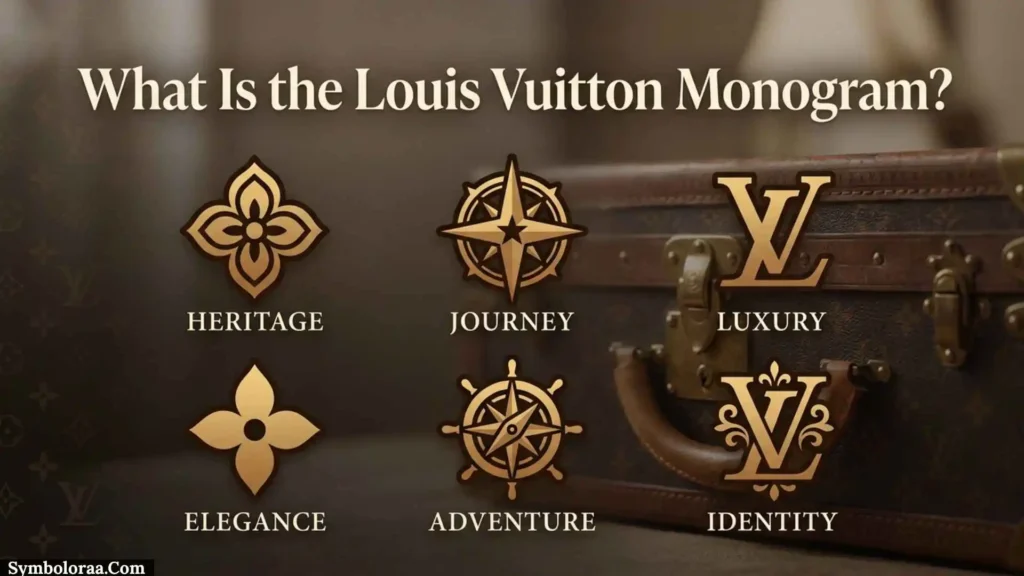
The Louis Vuitton Monogram is the House’s most recognizable pattern.
It combines the interlocking LV initials with stylized floral and geometric forms arranged in a repeating composition. Louis Vuitton’s heritage material identifies the Monogram as a design created by Georges Vuitton in 1896 after the House’s earlier canvas designs had become widely copied.
The Monogram is therefore more than a logo.
A logo can be a single mark used to identify a company. The Monogram is a broader visual system. Its repeated initials and decorative motifs can cover an entire piece of canvas, leather, or another material while still making the product immediately recognizable as Louis Vuitton.
The LV Initials
The LV stands for Louis Vuitton.
Georges Vuitton incorporated his father’s initials into the pattern as part of the design created in 1896. Louis Vuitton describes the Monogram as a tribute to its founder and as a distinctive signature for the House.
The initials are deliberately interlaced rather than simply printed as two separate letters. This gives them a distinctive appearance and allows the letters to work naturally with the surrounding floral motifs.
The Floral Motifs
The flowers are an essential part of the Monogram rather than random decorations.
Louis Vuitton’s heritage information describes the original Monogram as a combination of the LV initials and three floral motifs, with the floral forms being partly botanical and partly geometric.
This is an important point because many online explanations try to give each flower a precise symbolic meaning. The documented history is more cautious: the motifs form part of a decorative design influenced by the artistic culture of the period.
The Quatrefoil-Like Flower
One of the most recognizable shapes resembles a four-petal flower or quatrefoil.
It appears repeatedly between the LV initials on classic Monogram canvas. Its balanced four-part form makes it easy to recognize even when the full pattern is partially hidden.
It is best understood as a stylized floral motif within the Monogram, rather than automatically assigning it a separate official meaning.
The Diamond-Shaped Floral Motif
Another Monogram element combines a floral form with a geometric diamond.
This combination illustrates one of the defining characteristics of the original design: natural-looking flowers were simplified into structured, repeating shapes.
That mixture of botanical and geometric forms is one reason the Monogram can look decorative while still functioning as a strong brand identifier.
The Circular Floral Motif
The original Monogram also includes a floral form associated with a circular outline.
Together, the different motifs create visual variation across the canvas. Instead of repeating only the LV initials, the pattern alternates several recognizable shapes.
This makes the overall design more complex and gives the canvas its distinctive rhythm.
Why Was the Louis Vuitton Monogram Created?
The history of the Monogram explains much of its importance.
By the late 19th century, Louis Vuitton had established a strong reputation for trunks and travel goods. Georges Vuitton, who continued developing the House after his father’s death, faced a practical problem: Vuitton’s canvas designs were being copied.
Louis Vuitton’s official history says that Georges began searching for a new signature motif in 1896. He created the Monogram using the LV initials and geometric floral elements as a tribute to his father, who had died in 1892.
The design therefore had two closely related roles:
- Identification: It gave the House a distinctive visual signature.
- Heritage: It honored Louis Vuitton through the use of his initials.
That history is more meaningful than simply saying the Monogram was designed to look luxurious.
What Inspired the Louis Vuitton Monogram?
The Monogram reflects the artistic world of late 19th-century Paris.
Louis Vuitton’s official historical sources connect the design with Japonism, Art Nouveau, and Gothic heraldic art, while newer Louis Vuitton material also highlights the influence of the family’s Asnières home.
These influences help explain why the Monogram does not resemble a modern minimalist corporate logo.
It has:
- Interlocking initials
- Floral shapes
- Geometric outlines
- Repeating symmetry
- Decorative ornamentation
- A strong connection to the visual culture of its period
The result was a pattern that could serve both as decoration and as a recognizable House signature.
Does Every Louis Vuitton Flower Have a Hidden Meaning?
No—not according to the documented history.
This is one of the most important distinctions when researching Louis Vuitton symbols.
You may find articles claiming that individual Monogram flowers represent:
- Luck
- Protection
- Wealth
- Eternity
- Spirituality
- Specific religious ideas
- Certain personality traits
Those interpretations should not automatically be presented as official Louis Vuitton meanings.
Louis Vuitton’s own historical explanations focus on the artistic influences, geometric-floral composition, LV initials, and tribute to Louis Vuitton.
Official Meaning vs. Popular Interpretation
A useful way to evaluate symbol claims is to ask where the information comes from.
Officially documented:
- LV represents Louis Vuitton.
- The Monogram was created in 1896.
- Georges Vuitton designed it.
- It was created as a tribute to his father.
- It combines LV initials with floral/geometric motifs.
- Its design was influenced by artistic traditions including Japonism and Gothic art.
Popular interpretations:
- A particular flower represents good luck.
- A particular shape represents wealth.
- The symbols contain secret spiritual messages.
- Every individual motif has a fixed symbolic definition.
Unless Louis Vuitton or a reliable historical source confirms the latter claims, they should be described as interpretations rather than facts.
What Is the Louis Vuitton Damier Symbol?
The Damier is another major Louis Vuitton visual code.
Unlike the Monogram, Damier is based on a checkerboard pattern. Louis Vuitton traces the Damier canvas to 1888, making it older than the Monogram. Georges Vuitton registered the design, and the pattern became an important part of the House’s early identity.
Damier matters because it shows that Louis Vuitton’s visual identity did not begin with the famous LV Monogram.
The House was already developing distinctive canvas patterns before the 1896 Monogram.
Why Was Damier Created?
Louis Vuitton’s official history explains that the House’s earlier striped canvas was being imitated. Louis and Georges Vuitton developed the Damier canvas as a new design, with the Vuitton name appearing externally on the trunk for the first time in that design history.
This creates an interesting historical connection:
Copied striped canvas → Damier canvas → copied Damier → Monogram canvas
The development of these patterns shows that recognizable visual identity was closely connected to the House’s efforts to distinguish its creations.
Louis Vuitton Monogram vs. Damier
The simplest way to distinguish the two is by looking at the overall structure.
| Feature | Monogram | Damier |
| Main appearance | LV initials and floral motifs | Checkerboard squares |
| Origin | 1896 | 1888 |
| Designer associated with creation | Georges Vuitton | Georges Vuitton |
| Main visual language | Floral + geometric | Geometric |
| Contains repeating LV initials? | Yes | Not as the defining pattern |
| Heritage role | Major House signature | Major House heritage canvas |
| Common modern versions | Numerous Monogram reinterpretations | Damier Ebène, Damier Azur, Damier Graphite and others |
Louis Vuitton currently describes Damier as a pattern that has developed into multiple variations, including Damier Ebène, Damier Azur, and Damier Graphite.
What Is Damier Ebène?
Damier Ebène is one of the best-known modern versions of the Damier pattern.
It uses the familiar checkerboard structure in a darker brown-toned treatment. The pattern can be seen on various Louis Vuitton bags and small leather goods.
The important point is that Damier Ebène is a variation of the Damier design, not a separate symbol with an unrelated historical origin.
Louis Vuitton’s current product and heritage materials list Damier Ebène among its established Damier patterns.
What Is Damier Azur?
Damier Azur is another recognized Damier variation.
It uses the same fundamental checkerboard idea but presents it in a much lighter color treatment. This gives the pattern a different visual character while keeping the connection to the original Damier structure.
Louis Vuitton currently identifies Damier Azur as one of its principal Damier canvas variations.
What Is Damier Graphite?
Damier Graphite is a darker, more contemporary-looking interpretation of the checkerboard Damier design.
It retains the geometric identity of Damier while moving away from the traditional brown-and-beige appearance.
Louis Vuitton’s official Damier overview lists Damier Graphite alongside Damier Ebène and Damier Azur.
Monogram Canvas vs. Monogram Leather
Not every Louis Vuitton Monogram product uses printed canvas.
The House has repeatedly adapted its Monogram code to different materials and techniques.
For example, Monogram can appear:
- Printed across coated canvas
- Embossed into leather
- Woven into textile
- Reinterpreted through jacquard
- Used in artistic collaborations
- Combined with other materials and design techniques
Louis Vuitton’s 2026 Monogram anniversary collections include Monogram Emblème, a jacquard interpretation that gives the pattern a tactile, dimensional appearance rather than treating it simply as a flat printed design.
This demonstrates an important principle: the symbol can remain recognizable even when the material and production method change.
How Louis Vuitton Symbols Evolved Over Time
The history of Louis Vuitton’s symbols is not a straight line from one logo to another.
Instead, the House has repeatedly reused and reinterpreted its heritage codes.
1888: Damier
Georges Vuitton developed the Damier canvas, creating an identifiable checkerboard pattern and incorporating the Vuitton name into the design.
1896: Monogram
Georges Vuitton introduced the Monogram, combining the LV initials with floral and geometric motifs as a tribute to his father.
20th Century: Expansion
The Monogram moved beyond traditional trunks and became associated with a wider range of leather goods and travel products.
Modern Era: Artistic Reinterpretation
Louis Vuitton has continued to reinterpret the Monogram through different materials, colors, collaborations, and creative directions.
2026: 130th Anniversary
In 2026, Louis Vuitton is celebrating 130 years of the Monogram, emphasizing its continuing role as a House signature. The anniversary includes reinterpretations of heritage icons and new collections that revisit the Monogram through different materials and techniques.
This timeline matters because it shows that the Monogram is not simply an old pattern that remained unchanged. Its identity has survived partly because designers have continued to reinterpret it.
Which Louis Vuitton Symbols Are Most Important?
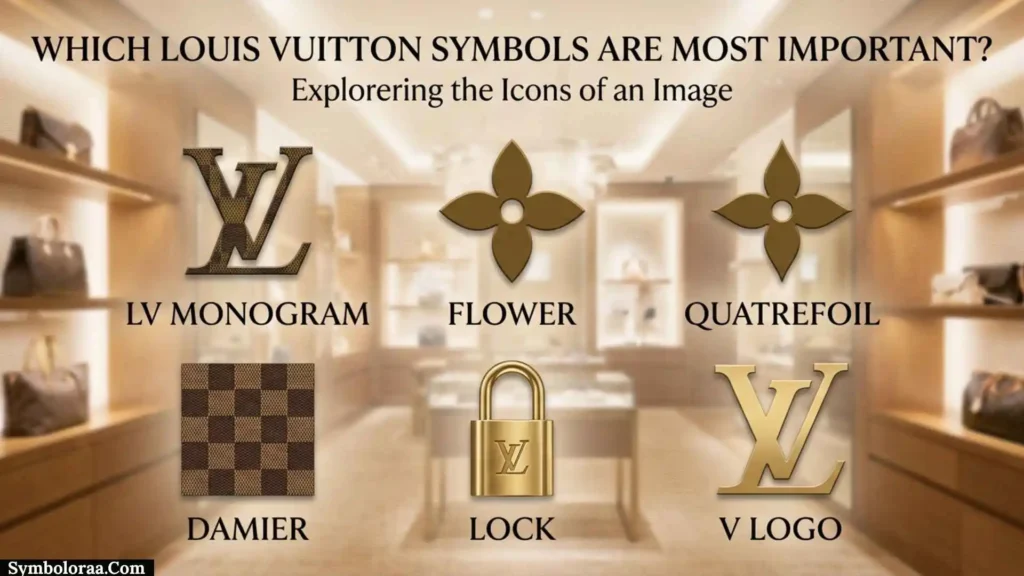
If your goal is to recognize Louis Vuitton patterns quickly, focus on these four categories:
1. The LV Monogram
Look for the interlocking LV initials combined with floral motifs.
Best clue: repeated LV letters plus flowers.
2. Damier
Look for a regular checkerboard.
Best clue: repeated square blocks without the classic floral Monogram arrangement.
3. Monogram Reinterpretations
Look for the familiar LV and floral language presented through different materials, colors, scales, or techniques.
Best clue: the basic Monogram identity remains visible even though the surface treatment has changed.
4. Other House Motifs
Louis Vuitton also uses additional design codes across jewelry, leather goods, fashion, luggage, and special collections.
Best clue: do not assume every Louis Vuitton pattern is the classic Monogram. Product-specific designs may use a different House code.
How to Identify a Louis Vuitton Symbol Quickly
If you have a Louis Vuitton item in front of you, use this simple decision guide.
Louis Vuitton Symbol Decision Tree
Does the design contain interlocking LV initials and floral motifs?
→ Yes: You are likely looking at the Monogram family.
→ No: Continue.
Does the design use repeating checkerboard squares?
→ Yes: It is likely a Damier pattern.
→ No: Continue.
Is the Monogram pressed, embossed, woven, or otherwise reinterpreted rather than printed in the classic canvas format?
→ Yes: It may be a Monogram reinterpretation or material-specific expression.
→ No: Check the product’s exact collection and material name rather than assuming it is one of the classic patterns.
This method is more reliable than trying to memorize dozens of individual Louis Vuitton motifs.
Do Louis Vuitton Symbols Prove a Bag Is Authentic?
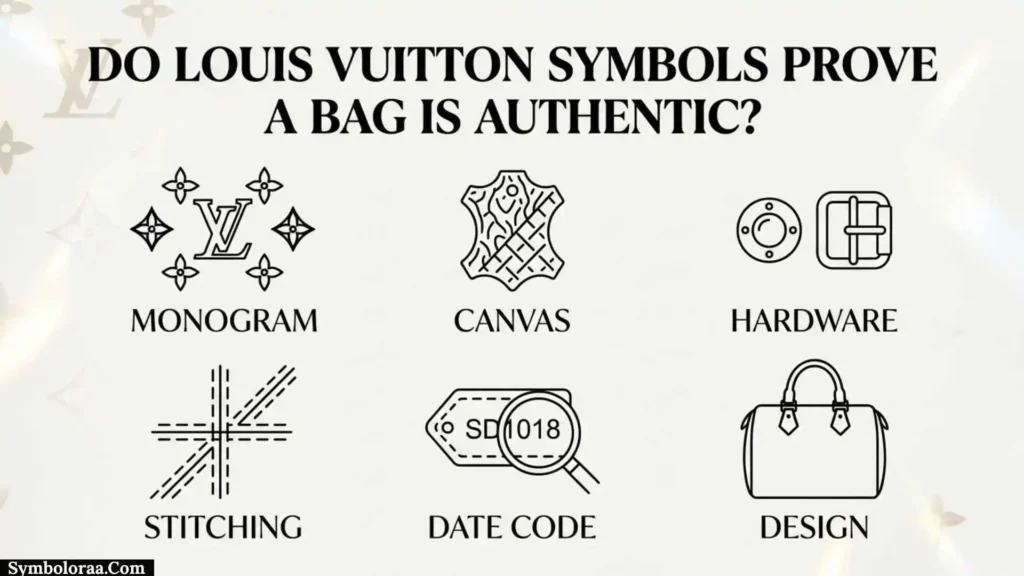
No.
A recognizable Louis Vuitton symbol is not enough to authenticate a product.
This is an important practical distinction for anyone buying a pre-owned Louis Vuitton bag.
A counterfeit product can reproduce:
- The LV initials
- Monogram canvas
- Damier checkerboard
- Common color combinations
- Familiar bag patterns
Therefore, seeing the correct-looking symbol does not establish authenticity.
What Should You Check Instead?
When evaluating a Louis Vuitton product, consider the complete product rather than one logo.
Relevant details can include:
- Overall construction
- Material quality
- Stitching
- Hardware
- Engraving and finishing
- Product-specific details
- Date or production information where applicable
- Provenance
- Seller reputation
- Whether the details match the specific model and production period
A symbol can help you identify a design family, but it should not be treated as an authentication certificate.
Common Mistakes People Make When Reading Louis Vuitton Symbols
Mistake 1: Calling Every Louis Vuitton Pattern “Monogram”
Not every Louis Vuitton pattern is Monogram.
If you see a checkerboard, you are generally looking at Damier, not the classic Monogram.
Mistake 2: Assuming Every Flower Has an Official Meaning
The flowers are documented parts of the Monogram design, but that does not mean each one has an independently assigned spiritual or cultural meaning.
Mistake 3: Confusing a Logo With the Entire Monogram
The LV initials are the logo-like element most people recognize, while the Monogram includes the initials and surrounding floral/geometric motifs.
Mistake 4: Using the Pattern Alone to Authenticate a Bag
A counterfeit can copy the pattern. Authentication requires a broader evaluation.
Mistake 5: Assuming Modern Versions Are Unrelated to the Original
Modern Louis Vuitton collections can change the material, color, texture, or construction while retaining recognizable heritage codes.
The 2026 anniversary collections are a strong example of this approach. Louis Vuitton is revisiting the Monogram through collections including Monogram Origine, VVN, Time Trunk, Monogram Emblème, and the returning LV x Murakami collaboration.
Real-World Examples of Louis Vuitton Symbols
Understanding the symbols becomes easier when you look at how they function on actual products.
Example 1: A Classic Monogram Handbag
Imagine a brown Louis Vuitton handbag covered with repeated tan LV initials and floral shapes.
The primary visual code is Monogram.
The flowers are not separate logos. They are part of the repeating Monogram composition.
Example 2: A Checkerboard Handbag
Imagine a bag with alternating dark and light brown squares and no classic LV-flower arrangement.
The defining pattern is Damier, with the exact variation depending on the product and colorway.
Example 3: An Embossed Leather Wallet
Suppose a wallet has Louis Vuitton’s Monogram pressed into leather rather than printed across coated canvas.
The surface treatment is different, but the underlying visual code is still recognizable as Monogram.
Example 4: A Modern Artistic Reinterpretation
A contemporary Louis Vuitton collection may enlarge the Monogram, change its colors, weave it into fabric, or give it a three-dimensional texture.
The design may look very different from a traditional Monogram canvas bag while still deliberately referencing the same House symbol.
This is one reason it is better to understand the design language rather than memorizing one exact color combination.
Why Are Louis Vuitton Symbols So Recognizable?
Recognition comes from a combination of history, repetition, consistency, and design.
The Monogram has been associated with the House for more than a century. Louis Vuitton continues to use and reinterpret the design across different categories and collections. LVMH describes the Monogram as a highly recognizable material and a continuing source of inspiration for contemporary reinterpretations.
There is also a practical design advantage.
The pattern contains several independent visual cues:
- The letters LV
- Repeating flowers
- Geometric shapes
- Consistent spacing
- Repeated composition
Even if part of a bag is covered or folded, enough of those elements may remain visible for the pattern to be recognizable.
That is a powerful example of how a brand identity can become a complete visual language rather than just a single logo.
What Makes the Monogram Different From an Ordinary Logo?
An ordinary logo often has one primary configuration.
The Louis Vuitton Monogram works differently because it can become a surface pattern.
That means the same identity can appear:
- On a small wallet
- Across a large travel bag
- On luggage
- On footwear
- On clothing
- In jewelry
- In woven materials
- In embossed leather
- In special artistic collections
This flexibility helps explain why the Monogram has remained useful for such a long period.
Louis Vuitton Symbols and Luxury Branding
Louis Vuitton’s symbols also demonstrate an important principle in luxury branding: recognition can become part of the product experience.
The Monogram does not merely tell a customer which company made the product. It can communicate:
- Heritage
- Design continuity
- Brand recognition
- Association with travel
- Craftsmanship
- Cultural history
That does not mean every person interprets the symbol in exactly the same way. Rather, the value comes from the long history and consistent association of the design with the Louis Vuitton House.
What Does the Louis Vuitton Symbol Mean in Modern Fashion?
Today, the Monogram can be understood as a combination of heritage and creative reinvention.
The original design was created in 1896, but Louis Vuitton continues to place it in new creative contexts.
The 2026 130th-anniversary program makes this especially clear. The House is revisiting the Monogram through archival-inspired materials, jacquard techniques, trunkmaking references, and contemporary artistic reinterpretations.
So its modern meaning is not limited to “luxury.”
It represents a continuing House code that connects historical Louis Vuitton craftsmanship with current design.
Editorial Note: How to Read Brand Symbols Accurately
When researching luxury-brand symbols, it is easy to confuse documented history with interpretations repeated across blogs and social media.
For a reliable explanation, prioritize:
- Official Louis Vuitton historical material.
- LVMH corporate information.
- Museum or archival sources when available.
- Reputable fashion-history references.
- Primary sources rather than unsourced “secret meaning” lists.
This approach matters because a symbol can have a rich cultural history without having a fixed dictionary-style meaning for every individual shape.
For Louis Vuitton specifically, the strongest evidence concerns the 1896 creation of the Monogram, the tribute to Louis Vuitton, the LV initials, the floral/geometric composition, and its artistic influences.
Frequently Asked Questions About Louis Vuitton Symbols
What is the main Louis Vuitton symbol?
The Monogram is the best-known Louis Vuitton symbol. It combines interlocking LV initials with stylized floral and geometric motifs and dates to 1896.
What do the LV letters stand for?
The letters LV stand for Louis Vuitton, the founder of the House.
Who created the Louis Vuitton Monogram?
Georges Vuitton created the Monogram in 1896 as a tribute to his father, Louis Vuitton.
Why did Louis Vuitton create the Monogram?
The Monogram was developed as a distinctive signature for the House during a period when Vuitton canvas designs were being copied. It also honored Louis Vuitton through the use of his initials.
What do the flowers on Louis Vuitton bags represent?
The flowers are stylized floral motifs that form part of the Monogram. Louis Vuitton’s historical material connects the overall design with artistic influences such as Japonism and Gothic art.
There is not reliable evidence that every individual flower has a separate official symbolic meaning.
Is the Louis Vuitton flower a quatrefoil?
One of the Monogram’s recurring floral forms has a four-part, quatrefoil-like appearance. It is best understood as one of the stylized floral/geometric motifs within the Monogram.
What is the difference between LV and Monogram?
LV refers to the interlocking initials. Monogram refers to the broader repeating design that combines those initials with floral and geometric motifs.
Is Damier a Louis Vuitton symbol?
Yes. Damier is one of Louis Vuitton’s major heritage patterns. It was introduced in 1888 and uses a checkerboard design.
Which came first, Damier or Monogram?
Damier came first. Louis Vuitton’s Damier canvas dates to 1888, while the Monogram was introduced in 1896.
What are Damier Ebène and Damier Azur?
They are modern variations of the Damier checkerboard design. Louis Vuitton also identifies Damier Graphite as another major variation.
Does a Louis Vuitton Monogram prove a bag is authentic?
No. A counterfeit can reproduce the Monogram. Authenticity requires examining the complete product, including construction, materials, hardware, provenance, and model-specific details.
Are Louis Vuitton symbols religious symbols?
The official history describes the Monogram in terms of its floral/geometric design and artistic influences. It does not establish the common internet claims that individual Monogram motifs are secret religious symbols.
Why is the Louis Vuitton Monogram still used today?
Its long history, strong recognition, and ability to be adapted to new materials and creative ideas make it a flexible House design code. Louis Vuitton continues to reinterpret it, including through its 2026 130th-anniversary collections.
How old is the Louis Vuitton Monogram in 2026?
The Monogram was created in 1896, so 2026 marks its 130th anniversary. Louis Vuitton and LVMH are highlighting the milestone with anniversary collections and heritage-focused projects.
Key Takeaways
If you only remember a few points about Louis Vuitton symbols, remember these:
- The LV initials stand for Louis Vuitton.
- The Monogram was created in 1896 by Georges Vuitton.
- It was created as a tribute to Louis Vuitton and as a distinctive House signature.
- The Monogram combines LV initials with stylized floral and geometric motifs.
- Its design was influenced by artistic traditions including Japonism and Gothic decorative art.
- Damier dates to 1888, making it older than the Monogram.
- Damier uses a checkerboard structure, while Monogram uses LV initials and floral motifs.
- Not every Louis Vuitton flower has a documented secret meaning.
- A Monogram pattern alone cannot prove a product is authentic.
- Louis Vuitton continues to reinterpret these heritage codes rather than simply reproducing the original designs.
- In 2026, the House is celebrating 130 years of the Monogram.
Conclusion
Louis Vuitton symbols are more than decorative patterns they are part of the brand’s visual heritage. The Monogram, created in 1896, combines the LV initials with floral and geometric motifs, while the Damier checkerboard pattern dates back to 1888.
For quick identification, LV initials and floral motifs usually indicate the Monogram, while the checkerboard design indicates Damier. These symbols have evolved over time, but both remain closely connected to Louis Vuitton’s identity and history.
That combination of heritage, recognition, and continual reinvention is what makes Louis Vuitton’s symbols so enduring. In 2026, as the House celebrates the Monogram’s 130th anniversary, the original design continues to function not merely as a pattern, but as one of fashion’s most recognizable visual signatures.

I’m Jackson Miller, an American author inspired by mystery, adventure, and the unpredictable nature of life. I enjoy writing fast-moving stories filled with memorable characters, unexpected choices, and meaningful moments. Through my books, I want readers to experience new worlds while discovering something about courage, determination, and themselves.
Three Books:
The Edge of Tomorrow
Under a Broken Sky
The Road We Chose
 Madison Reed