If you are searching for Michigan symbols, you may be looking for the official state symbols, their meanings, adoption dates, or the images and ideas that represent Michigan. Michigan has official symbols connected to its wildlife, forests, freshwater, geology, agriculture, history, government, and cultural identity.
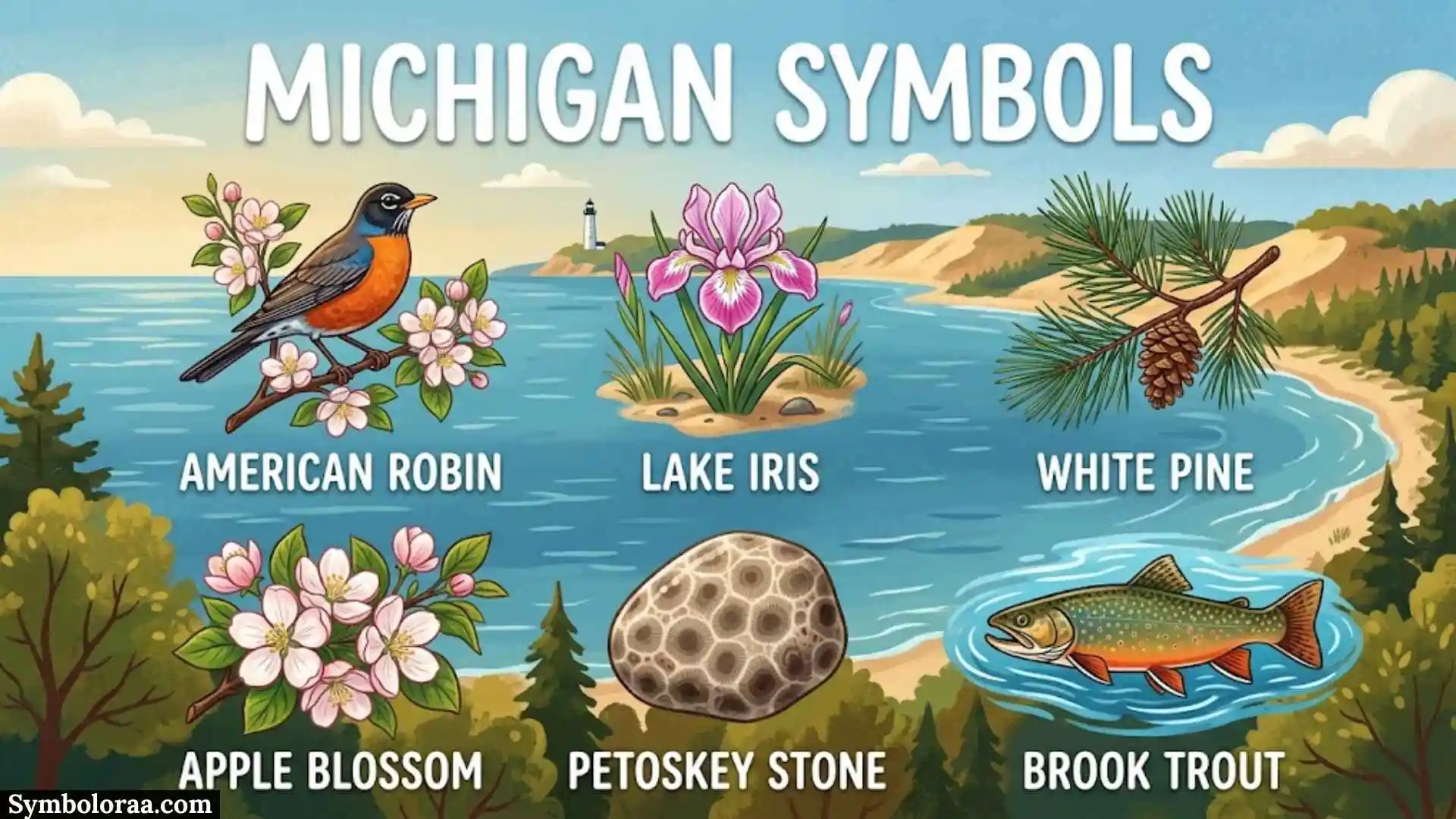
The state’s official symbols include the American robin, apple blossom, eastern white pine, brook trout, Petoskey stone, chlorastrolite, Kalkaska soil, painted turtle, white-tailed deer, dwarf lake iris, mastodon, and Manoomin (Michigan wild rice). Michigan also has an official flag, Great Seal, coat of arms, motto, and state song.
These symbols are useful for more than memorizing state facts. Together, they explain why Michigan is closely associated with the Great Lakes, forests, wildlife, natural resources, geological history, and the state’s two peninsulas.
This guide explains what each Michigan symbol means, when it was adopted, how the symbols relate to the state’s history, which popular Michigan icons are not official symbols, and how to choose the right symbol for a school project, article, presentation, or educational activity.
Quick Answer: What Are Michigan’s Official Symbols?
Michigan’s official symbols represent different parts of the state’s natural and historical identity.
| Category | Michigan Symbol | Adopted |
| State Motto | “Si Quaeris Peninsulam Amoenam Circumspice” | Historical state motto |
| State Bird | American robin | 1931 |
| State Flower | Apple blossom | 1897 |
| State Tree | Eastern white pine | 1955 |
| State Fish | Brook trout | 1988 |
| State Stone | Petoskey stone | 1965 |
| State Gem | Chlorastrolite | 1972 |
| State Soil | Kalkaska Soil Series | 1990 |
| State Reptile | Painted turtle | 1995 |
| State Game Mammal | White-tailed deer | 1997 |
| State Wildflower | Dwarf lake iris | 1998 |
| State Fossil | Mastodon | 2002 |
| State Native Grain | Manoomin, or Michigan wild rice | 2023 |
| State Song | “My Michigan” | 1937 |
| State Flag | Blue field with Michigan coat of arms | 1865; current legal design 1911 |
| Great Seal | Michigan Great Seal | 1835 |
Michigan’s official state facts page identifies these symbols and their historical designations. The Michigan Legislature’s publications provide additional confirmation of the state’s major symbols and adoption years.
What Do Michigan Symbols Represent?
Michigan’s symbols represent more than individual plants, animals, rocks, or objects. They collectively reflect several major themes.
Michigan’s Natural Environment
Many official symbols come directly from nature. The white pine represents Michigan’s forests, the brook trout reflects its freshwater ecosystems, and the dwarf lake iris represents a distinctive native plant.
The American robin, painted turtle, and white-tailed deer similarly represent familiar wildlife.
Michigan’s Geological History
The Petoskey stone, chlorastrolite, mastodon, and Kalkaska soil represent different aspects of Michigan’s physical environment.
These symbols show that Michigan’s identity is connected not only with living wildlife but also with rocks, minerals, soil, fossils, and ancient landscapes.
Michigan’s History And Development
The white pine is especially important because of Michigan’s lumbering history. The state government describes the tree as a symbol of the state’s rich logging history. Michigan’s forests supported a major lumber industry during the state’s development.
The Great Seal and coat of arms add another historical layer by connecting Michigan’s government, frontier history, peace, defense, and relationship with the United States.
Michigan’s Cultural Identity
Some symbols also represent cultural traditions. Manoomin, or Michigan wild rice, is particularly important because the state recognizes its cultural significance to Indigenous peoples as well as its role as a native wetland grain.
This makes Michigan’s collection of symbols broader than a simple list of popular state images.
Michigan State Flag And Its Meaning
The Michigan state flag is one of the state’s most recognizable official symbols.
The flag features a blue field with the Michigan coat of arms. Michigan had flags carrying the state’s coat of arms before the current legal framework, but an official state flag was adopted in 1865. In 1911, Michigan law formally described the state flag as blue and charged with the arms of the state.
What Is Shown On The Michigan Flag?
The central coat of arms contains a number of important elements:
- A man standing on a peninsula
- A raised hand
- A firearm
- A blue shield
- An elk
- A moose
- An American eagle
- An olive branch
- Arrows
- Latin mottoes
Each element contributes to the historical meaning of the design.
What Does The Man On The Michigan Flag Represent?
The man on the shield is shown with one hand raised in a gesture of peace while holding a firearm in the other hand.
According to Michigan’s official explanation, the raised hand represents peace, while the weapon expresses readiness to defend the state and nation.
This combination creates one of the central themes of Michigan’s coat of arms: a preference for peace together with the ability and willingness to defend it.
What Do The Elk And Moose Represent?
The elk and moose appear on either side of the shield.
Michigan’s official explanation identifies these animals as representing Michigan. Their presence reinforces the state’s connection with wildlife and its natural environment.
What Does The Eagle Represent?
The American eagle represents the authority and jurisdiction of the United States.
The eagle also connects Michigan’s state identity with its position within the United States.
What Do The Olive Branch And Arrows Mean?
The eagle holds an olive branch and arrows.
The olive branch represents peace, while the arrows indicate readiness to defend principles. Michigan’s official Great Seal explanation also notes that the thirteen olives refer to the original thirteen states.
Michigan Great Seal And Coat Of Arms
The Great Seal of Michigan is one of the most historically important Michigan symbols.
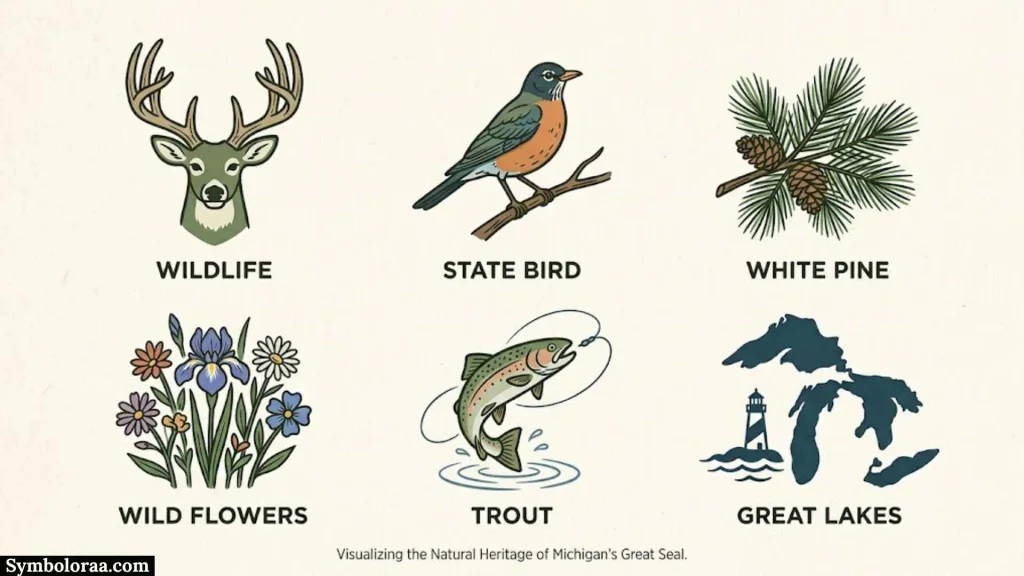
The seal was designed by Lewis Cass, Michigan’s second non-acting territorial governor. It was presented to the Constitutional Convention of 1835 and adopted as Michigan’s official Great Seal on June 2, 1835.
How Is The Great Seal Different From The Coat Of Arms?
The two are closely related but are not exactly the same.
Michigan’s coat of arms uses the central imagery of the Great Seal. The Great Seal includes the surrounding wording identifying it as the Great Seal of the State of Michigan.
Michigan’s current coat of arms was adopted by the Legislature in 1911.
This distinction matters because articles and educational materials sometimes use “Great Seal” and “coat of arms” as if they were interchangeable.
What Does “Tuebor” Mean?
The word “Tuebor” appears on the Michigan shield.
It means “I will defend.”
Michigan’s official explanation connects the phrase with the state’s historical frontier position.
What Does Michigan’s Latin Motto Mean?
Michigan’s official motto is:
“Si Quaeris Peninsulam Amoenam Circumspice.”
It means:
“If you seek a pleasant peninsula, look about you.”
The motto appears at the bottom of the coat of arms and Great Seal. Michigan’s government explains that the phrase is associated with the state’s pleasant peninsula.
Is The Michigan Great Seal Free To Use?
No. This is an important practical distinction.
Michigan law restricts the use of reproductions of the Great Seal outside official state functions. The Michigan Department of State explains that unauthorized use can violate the Great Seal Act.
Therefore, someone creating a commercial website, product, logo, advertisement, or publication should not assume that the Great Seal can be used simply because it is publicly visible.
The coat of arms has different rules, so the two should not be treated as legally identical.
Michigan State Flower: Apple Blossom
Michigan’s official state flower is the apple blossom.
The designation dates to 1897. Michigan’s official state-symbol information identifies the sweet crabapple, Malus coronaria, in connection with the designation.
Why Was The Apple Blossom Chosen?
The apple blossom connects Michigan with native plant life and the state’s agricultural and orchard traditions.
It is also a visually distinctive flower, making it practical as a recognizable state emblem.
For a school assignment asking for Michigan’s state flower, the correct answer is the apple blossom, not the dwarf lake iris.
Michigan State Bird: American Robin
The American robin is Michigan’s official state bird.
It was chosen in 1931 after an election conducted by the Michigan Audubon Society. The robin was strongly favored during that process and was described as one of the best-known and best-loved birds in Michigan.
Why Is The Robin Important To Michigan?
The American robin is familiar throughout Michigan and is easy to recognize.
Its selection demonstrates that state symbols do not always need to be rare or unusual. A common species can represent a state’s identity precisely because people encounter it regularly.
Michigan State Tree: Eastern White Pine
The eastern white pine is Michigan’s official state tree.
Michigan adopted the white pine in 1955. The tree is closely associated with the state’s historic lumber industry.
What Does The White Pine Represent?
The white pine represents Michigan’s forests and an important chapter in its economic history.
Michigan’s historical lumber industry depended heavily on its forests. The Michigan Historical Center notes that the state led the nation in lumber production during the period from the 1860s through the late 1890s.
This makes the white pine an excellent example of a state symbol connecting nature with human history.
Michigan State Fish: Brook Trout
Michigan’s official state fish is the brook trout, Salvelinus fontinalis.
Trout was first designated as the state fish in 1965. In 1988, the Michigan Legislature specifically identified brook trout as the state’s fish. The species is native to Michigan and found throughout the state.
Why Does The Brook Trout Represent Michigan?
Michigan’s identity is closely connected with freshwater.
The state is surrounded by the Great Lakes and contains numerous inland waters. The brook trout therefore represents both Michigan’s natural aquatic environment and its long tradition of fishing and outdoor recreation.
Michigan State Stone: Petoskey Stone
The Petoskey stone is Michigan’s official state stone.
It is a fossilized coral associated with Hexagonaria percarinata. The stone is particularly associated with northern Michigan and is widely recognized by its distinctive patterned surface.
Why Is The Petoskey Stone Important?
The Petoskey stone connects Michigan with its ancient geological history.
The stone is also a familiar Michigan souvenir, making it both a geological symbol and a popular cultural representation of the state.
This is why “Michigan stone” searches often lead to the Petoskey stone.
Michigan State Gem: Chlorastrolite
Michigan’s official state gem is chlorastrolite, commonly known as Isle Royale greenstone.
Michigan adopted it as the state gem in 1972. It is strongly associated with the Upper Peninsula, particularly Isle Royale.
Petoskey Stone vs. Michigan Greenstone
These two symbols are often confused.
| Feature | Petoskey Stone | Chlorastrolite |
| Official designation | State stone | State gem |
| General type | Fossilized coral | Mineral/gem material |
| Major association | Northern Lower Peninsula | Isle Royale and Upper Peninsula |
| Key feature | Distinctive coral pattern | Green, patterned appearance |
So, if a question asks for Michigan’s state stone, the answer is Petoskey stone. If it asks for Michigan’s state gem, the answer is chlorastrolite.
Michigan State Soil: Kalkaska Soil Series

Michigan’s official state soil is the Kalkaska Soil Series.
It was adopted as the state soil in 1990.
Why Is Soil A State Symbol?
Soil may seem less obvious than a flower or animal, but it plays a major role in agriculture, forests, wetlands, and ecosystems.
Including soil among Michigan’s official symbols highlights the physical foundation on which the state’s natural and agricultural environments depend.
It also demonstrates that Michigan’s official symbols cover scientific and environmental categories, not only objects that are visually attractive.
Michigan State Reptile: Painted Turtle
The painted turtle is Michigan’s official state reptile.
It became the state reptile in 1995. The Michigan government notes that the designation followed an effort by fifth-grade students from Niles.
Why Is The Painted Turtle A Michigan Symbol?
Painted turtles are associated with freshwater environments, which makes them a natural fit for Michigan’s landscape.
The story behind the designation is also valuable for students because it demonstrates that young people can participate in civic life and help bring attention to state symbols.
Michigan State Game Mammal: White-Tailed Deer
Michigan’s official state game mammal is the white-tailed deer.
It was designated in 1997 after efforts that included fourth-grade students from Zeeland.
What Does The Deer Represent?
White-tailed deer are widespread across Michigan and are an important part of the state’s wildlife and outdoor traditions.
The symbol therefore connects Michigan with forests, wildlife management, hunting traditions, and outdoor recreation.
Michigan State Wildflower: Dwarf Lake Iris
The dwarf lake iris, Iris lacustris, became Michigan’s official state wildflower in 1998.
It is native to Michigan and grows along northern shorelines associated with Lakes Michigan and Huron. Michigan identifies the plant as endangered.
Why Is The Dwarf Lake Iris Significant?
The dwarf lake iris represents Michigan’s distinctive native plant life.
Its limited habitat also gives the symbol a conservation dimension. It can remind students and visitors that some of Michigan’s natural heritage depends on protecting specific habitats.
This makes the dwarf lake iris different from a symbol chosen only because it is attractive.
Michigan State Fossil: Mastodon
Michigan’s official state fossil is the mastodon.
The designation was made in 2002. Michigan’s official state information notes that American mastodon fossils have been found at numerous locations across the state.
What Does The Mastodon Represent?
The mastodon represents Michigan’s prehistoric past.
Long before modern cities, roads, farms, and state boundaries existed, large mammals lived in the region. Fossils provide evidence of those ancient environments.
For students, the mastodon is therefore a useful example of how a state symbol can represent a period of history far older than the state itself.
Michigan State Native Grain: Manoomin
Manoomin, also known as Michigan wild rice, is Michigan’s official native grain.
Michigan designated it in 2023. The state identifies Michigan wild rice with the scientific names Zizania palustris and Zizania aquatica and recognizes its cultural importance to Indigenous people in Michigan.
Why Is Manoomin An Important Michigan Symbol?
Manoomin connects several aspects of Michigan identity:
- Native plant life
- Wetland ecosystems
- Food traditions
- Indigenous cultural history
- Michigan’s freshwater environment
Its inclusion also makes the state’s official symbol list more representative of Michigan’s long human and environmental history.
Because Manoomin has specific cultural significance, it should be discussed with care rather than reduced to a generic “wild rice symbol.”
Michigan State Song: “My Michigan”
“My Michigan” is Michigan’s official state song.
The lyrics were written by Giles Kavanagh and the music by H. Clint O’Reilly. The song was written and published in 1933 and formally adopted as the official state song by concurrent resolution of the Michigan Legislature on May 21, 1937.
Why Is The State Song A Michigan Symbol?
A state song represents Michigan through music and words rather than through an animal, plant, or physical object.
It provides a cultural expression of attachment to the state and complements the natural symbols that make up much of Michigan’s official list.
Complete Michigan Symbols List By Category
For quick reference, Michigan’s official symbols can be grouped into several categories.
Plants And Natural Resources
- Apple blossom — state flower
- Eastern white pine — state tree
- Dwarf lake iris — state wildflower
- Manoomin — state native grain
- Kalkaska Soil Series — state soil
Animals
- American robin — state bird
- Brook trout — state fish
- Painted turtle — state reptile
- White-tailed deer — state game mammal
Geological And Prehistoric Symbols
- Petoskey stone — state stone
- Chlorastrolite — state gem
- Mastodon — state fossil
Government And Cultural Symbols
- Michigan state flag
- Great Seal of Michigan
- Michigan coat of arms
- State motto
- “My Michigan” — state song
This organization makes it easier to find the appropriate symbol for a particular research question.
Michigan Symbols And Their Meanings
The official symbols become more meaningful when considered as a group.
Symbols Connected With Water
Michigan’s freshwater environment appears in several symbols.
The brook trout represents freshwater fish and aquatic ecosystems. The painted turtle is associated with freshwater habitats, while Manoomin grows in wetland environments.
The dwarf lake iris also has a direct connection with northern Great Lakes shorelines.
Symbols Connected With Forests
The white pine is the clearest example.
It represents Michigan’s forests while also recalling the state’s lumbering history. This gives it both an environmental and economic meaning.
The white-tailed deer also has a strong connection with Michigan’s forested landscapes.
Symbols Connected With Geology
Petoskey stone, chlorastrolite, Kalkaska soil, and the mastodon each tell a different geological story.
Together they show that Michigan’s identity is shaped by rocks, minerals, soils, fossils, ancient animals, glaciers, lakes, and changing landscapes.
Symbols Connected With Government And History
The flag, Great Seal, coat of arms, and motto communicate Michigan’s political and historical identity.
The Great Seal’s imagery reflects peace, defense, Michigan’s position within the United States, and the state’s frontier history.
Michigan’s Great Lakes Identity And State Symbols
Michigan’s geography helps explain many of its official symbols.
The state is divided into the Upper and Lower Peninsulas and is surrounded by the Great Lakes. Michigan’s official materials emphasize the state’s natural resources, beauty, and historical significance.
The connection with water appears repeatedly:
- Brook trout
- Painted turtle
- Dwarf lake iris
- Manoomin
- Great Lakes shoreline habitats
This does not mean every Michigan symbol is directly about water. Instead, the pattern shows how Michigan’s geography influences its broader identity.
Official Michigan Symbols vs. Popular Michigan Icons
One of the most important distinctions in Michigan symbolism is the difference between official symbols and popular icons.
The Wolverine
Michigan is widely known as the Wolverine State, but the wolverine should not automatically be listed as Michigan’s official state animal or game mammal.
The official state game mammal is the white-tailed deer.
The wolverine is an important part of Michigan’s nickname and cultural identity, but that is different from having a current official state-symbol designation.
The Mitten Shape
Michigan’s Lower Peninsula is often described as mitten-shaped.
This is an extremely popular visual representation of Michigan, especially in clothing, souvenirs, maps, sports culture, and local art.
However, the mitten shape is a popular geographic icon, not one of the state’s formal biological or natural-resource symbols listed by Michigan government.
The Great Lakes
The Great Lakes are central to Michigan’s geography and identity.
They are also closely connected with several official symbols, particularly aquatic plants and animals. But “the Great Lakes” is better described as a defining geographical feature than as one single official state symbol.
Mackinac Bridge
The Mackinac Bridge is another powerful Michigan icon.
It represents engineering, transportation, and the connection between Michigan’s two peninsulas. It is an important landmark, but it is separate from the official state-symbol designations.
Automotive Heritage
Michigan is strongly associated with the automobile industry, especially Detroit and the history of American automobile manufacturing.
This is an important part of Michigan’s economic and cultural identity, but it should not be confused with the state’s legally designated symbols.
Michigan Symbols For Kids And School Projects
Michigan’s state symbols are especially useful for classroom assignments because each symbol can become the starting point for a different lesson.
For A Michigan State Symbols Poster
A simple poster can divide symbols into:
- Plants
- Animals
- Rocks and minerals
- Fossils
- Government symbols
- Cultural symbols
For example, a student could place the robin under birds, white pine under trees, Petoskey stone under rocks, and mastodon under fossils.
For A Michigan History Project
The white pine and Great Seal are especially useful.
The white pine provides an opportunity to discuss Michigan’s lumbering history, while the Great Seal can introduce students to Michigan’s territorial period, statehood, government, and historical imagery.
For A Science Project
The Petoskey stone, chlorastrolite, mastodon, state soil, brook trout, and dwarf lake iris can connect a Michigan project with geology, paleontology, ecology, or environmental science.
For A Geography Project
The Michigan flag, state motto, Great Lakes, two peninsulas, and symbols connected with shoreline habitats provide useful starting points.
The Michigan Department of Natural Resources also provides educational materials and state-symbol coloring pages covering symbols such as the brook trout, painted turtle, white-tailed deer, American robin, and wild rice.
How To Choose The Right Michigan Symbol
If you need one Michigan symbol for a particular project, use the following decision guide.
Do you need a plant?
→ Apple blossom for the state flower
→ White pine for the state tree
→ Dwarf lake iris for the state wildflower
→ Manoomin for the state native grain
Do you need an animal?
→ American robin for the state bird
→ Brook trout for the state fish
→ Painted turtle for the state reptile
→ White-tailed deer for the state game mammal
Do you need a geological symbol?
→ Petoskey stone for the state stone
→ Chlorastrolite for the state gem
→ Mastodon for the state fossil
→ Kalkaska Soil Series for the state soil
Do you need a government symbol?
→ Michigan flag for the state flag
→ Great Seal for official state-seal questions
→ Coat of arms for Michigan’s heraldic imagery
→ State motto for Michigan’s official phrase
This approach helps prevent category mistakes, especially when a question asks for a specific official designation.
Common Mistakes About Michigan Symbols
Mistaking The Dwarf Lake Iris For The State Flower
The apple blossom is the official state flower.
The dwarf lake iris is the official state wildflower.
These are separate designations.
Calling The Petoskey Stone The State Gem
Michigan’s state stone is the Petoskey stone.
Michigan’s state gem is chlorastrolite, also called Isle Royale greenstone.
Calling The Wolverine The Official State Mammal
Michigan’s nickname is the Wolverine State, but the official state game mammal is the white-tailed deer.
This distinction is important when answering a question specifically about official symbols.
Confusing The Great Seal With The Coat Of Arms
The Great Seal contains the coat of arms plus identifying text around it.
The coat of arms uses the central imagery without the surrounding Great Seal legend. Michigan’s current coat of arms was adopted by the Legislature in 1911.
Assuming Every Michigan Icon Is Official
The mitten shape, Mackinac Bridge, Great Lakes, automobiles, and wolverine are all strongly associated with Michigan.
That does not automatically make each one an official state symbol.
Practical Tips For Using Michigan Symbols Correctly
Whether you are writing an article, preparing a classroom project, creating educational material, or designing a presentation, a few practices improve accuracy.
Name The Official Category
Instead of writing “Michigan’s flower” when discussing the dwarf lake iris, specify Michigan’s state wildflower.
Precise labels make your content easier to understand and reduce factual errors.
Include The Adoption Year When Relevant
Adoption dates add historical value.
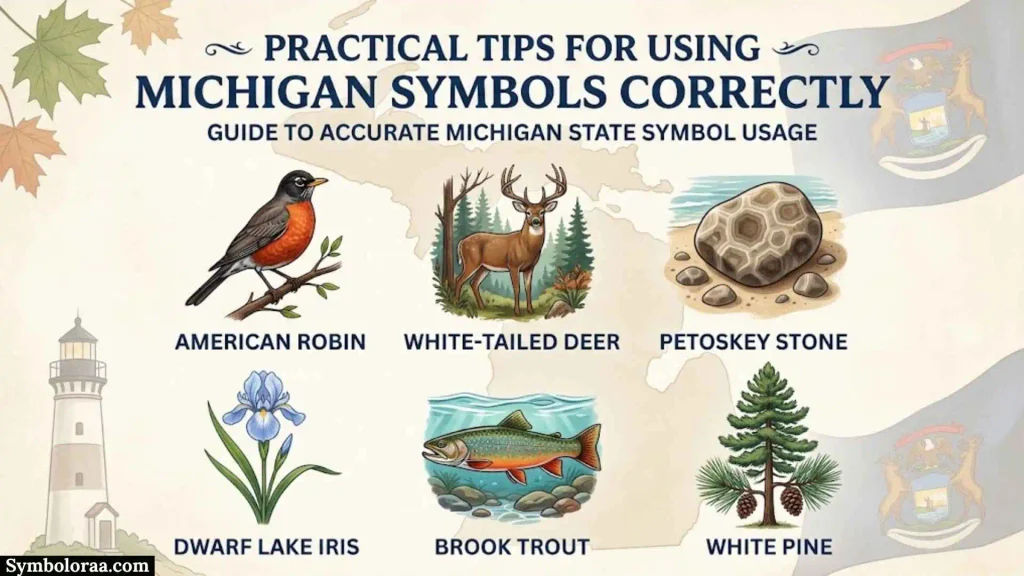
For example, the apple blossom was adopted in 1897, the robin in 1931, the white pine in 1955, and the mastodon in 2002.
Distinguish Official Facts From Popular Associations
If you mention the wolverine or mitten shape, explain that these are popular Michigan associations rather than presenting them as equivalent to the official state symbols.
Use Government Sources For Legal Questions
Questions about the Great Seal or coat of arms should be checked against Michigan government sources because their use is subject to state law.
Editorial Note On Michigan Symbols
Michigan’s official symbol system has developed over many decades, so the symbols do not all have the same history or purpose.
Some were selected because they represent Michigan’s natural environment. Others reflect economic history, geology, wildlife, cultural traditions, or state government.
For accuracy, this article distinguishes official designations from popular Michigan imagery. Adoption dates and official meanings are based primarily on Michigan government and Michigan Legislature sources rather than unsourced symbolism lists.
Frequently Asked Questions About Michigan Symbols
What Is Michigan’s State Flower?
Michigan’s state flower is the apple blossom. It was adopted as the state flower in 1897.
What Is Michigan’s State Bird?
Michigan’s state bird is the American robin. It was selected in 1931.
What Is Michigan’s State Tree?
Michigan’s state tree is the eastern white pine. It was adopted in 1955 and is strongly associated with Michigan’s lumbering history.
What Is Michigan’s State Fish?
Michigan’s state fish is the brook trout. Trout was first designated in 1965, and the Legislature specified brook trout as the state fish in 1988.
What Is Michigan’s State Stone?
Michigan’s state stone is the Petoskey stone, a fossilized coral associated with Hexagonaria percarinata.
What Is Michigan’s State Gem?
Michigan’s state gem is chlorastrolite, commonly known as Isle Royale greenstone. It was adopted in 1972.
What Is Michigan’s State Fossil?
Michigan’s state fossil is the mastodon. It became the official state fossil in 2002.
What Is Michigan’s State Reptile?
Michigan’s state reptile is the painted turtle, designated in 1995.
What Is Michigan’s State Game Mammal?
Michigan’s state game mammal is the white-tailed deer, designated in 1997.
What Is Michigan’s State Wildflower?
Michigan’s state wildflower is the dwarf lake iris, Iris lacustris. It was designated in 1998.
What Is Michigan’s State Native Grain?
Michigan’s state native grain is Manoomin, also known as Michigan wild rice. It was designated in 2023.
What Is Michigan’s State Motto?
Michigan’s official motto is “Si Quaeris Peninsulam Amoenam Circumspice,” which means “If you seek a pleasant peninsula, look about you.”
What Does The Michigan Flag Mean?
The Michigan flag features the state’s coat of arms on a blue field. Its imagery includes a man representing peace and readiness to defend, an elk and moose representing Michigan, and an American eagle representing U.S. authority. The flag’s design is based on Michigan’s coat of arms.
What Does “Tuebor” Mean On The Michigan Seal?
“Tuebor” is Latin for “I will defend.” Michigan’s official explanation connects the phrase with the state’s historical frontier position.
Is The Wolverine An Official Michigan State Symbol?
The wolverine is strongly associated with Michigan through the state’s nickname, the Wolverine State. However, it should not be confused with Michigan’s official state game mammal, which is the white-tailed deer.
Is The Mitten An Official Michigan Symbol?
The mitten-shaped Lower Peninsula is a popular visual representation of Michigan, but it is different from the state’s formally designated official symbols.
What Is Michigan’s Most Important Symbol?
Michigan does not officially rank its symbols by importance. The flag, Great Seal, coat of arms, motto, and natural symbols each represent different aspects of Michigan’s identity.
How Many Official Michigan Symbols Are There?
There is no single useful number unless the categories being counted are clearly defined. Michigan has official designations for numerous plants, animals, geological features, government emblems, and cultural symbols, and the list has expanded over time. For an accurate answer, it is better to identify the specific categories rather than use an unexplained total.
Key Takeaways About Michigan Symbols
Michigan’s official symbols tell a story about the state’s nature, water, forests, geology, wildlife, history, and culture.
The most important distinctions to remember are:
- Apple blossom — state flower
- American robin — state bird
- Eastern white pine — state tree
- Brook trout — state fish
- Petoskey stone — state stone
- Chlorastrolite — state gem
- Kalkaska Soil Series — state soil
- Painted turtle — state reptile
- White-tailed deer — state game mammal
- Dwarf lake iris — state wildflower
- Mastodon — state fossil
- Manoomin — state native grain
- “My Michigan” — state song
- Michigan flag — official state flag
- Great Seal — official state seal
- “Si Quaeris Peninsulam Amoenam Circumspice” — state motto
Just as importantly, popular icons such as the wolverine, mitten-shaped Lower Peninsula, Mackinac Bridge, Great Lakes, and automotive heritage can represent Michigan culturally without necessarily being official state symbols.
The strongest way to understand Michigan symbols is therefore not simply to memorize a list. Look at what each symbol represents: the forests that shaped the state’s economy, the lakes and wetlands that define its environment, the wildlife that inhabits its landscape, the fossils and minerals that reveal its geological past, and the historical imagery that appears on its flag and Great Seal.

I’m Madison Reed, a contemporary American author who writes about love, family, friendship, and second chances. I’m fascinated by the choices that shape our lives and the moments that change us forever. My goal is to create honest, emotional stories with characters readers can connect with long after finishing each book.
Three Books:
When We Find Our Way
The Things We Never Said
Summer in September
 Ethan Brooks
 Jackson Miller