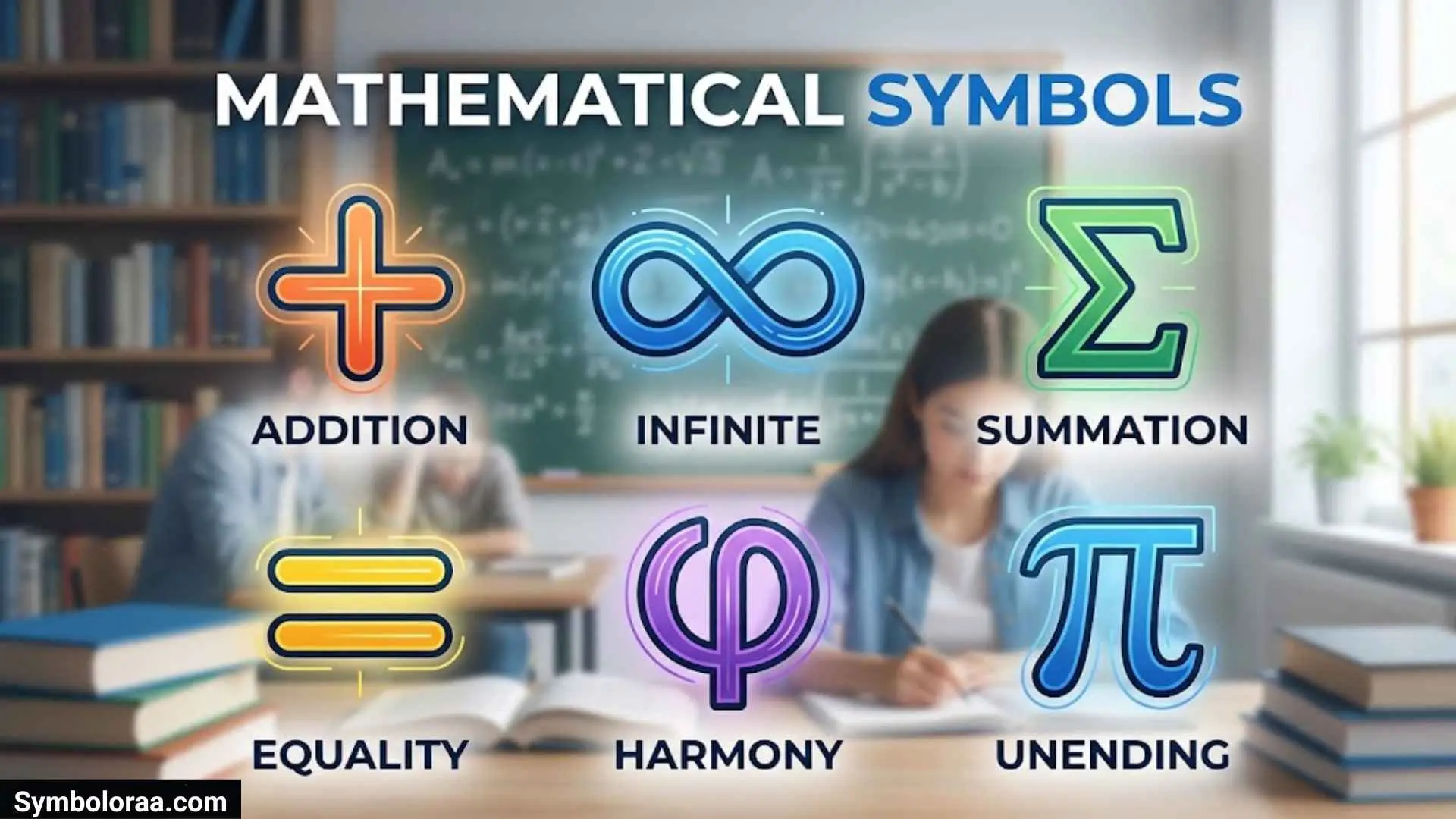
Mathematics becomes easier to understand when you know what each symbol means. From the plus sign used in elementary arithmetic to the integral symbol found in calculus, math symbols help you express calculations, compare quantities, solve equations, and describe complex ideas with fewer words.
Whether you’re a student learning basic arithmetic, a teacher preparing lessons, or someone looking for a quick reference, understanding mathematical symbols with names and meanings can make a real difference. You don’t need to memorize hundreds of symbols at once. Start with the common ones, learn how they work in simple examples, and gradually explore more advanced notation.
This guide covers math symbols and meanings, including arithmetic signs, algebra symbols, geometry notation, calculus operators, mathematical logic, statistics, set theory, Greek letters, and important constants. You’ll also find practical examples and a copy-and-paste reference to help you recognize and use mathematical symbols correctly.
What Are Math Symbols?
Math symbols are characters, marks, or combinations of characters that represent numbers, mathematical operations, relationships, quantities, or abstract ideas. They help people communicate mathematical information accurately without writing lengthy explanations.
For example, the expression 5+3=8 uses three important symbols. The plus sign tells you to add, while the equal sign shows that both sides have the same value.
Mathematical symbols appear throughout everyday life. You see the percent sign on store discounts, the degree symbol in temperature readings, and inequality signs when comparing measurements. Scientists and engineers also rely on mathematical notation to describe patterns, model physical systems, and solve technical problems.
A mathematical symbol can have different meanings depending on its context. The letter x, for example, often represents an unknown value in algebra, a coordinate in geometry, or an independent variable in a function.
Here are three important terms to understand:
- Mathematical symbol: An individual character or mark, such as +, , or .
- Mathematical expression: A combination of numbers, variables, and operations, such as 2x+5.
- Mathematical equation: A statement that says two expressions are equal, such as 2x+5=11.
These terms are related, but they aren’t interchangeable. Recognizing the difference makes mathematical problems easier to read and solve.
Math Symbols With Names, Meanings, and Examples
The following mathematical symbols chart provides a quick reference to commonly used mathematical signs. Each entry includes the symbol’s name, its general meaning, and an example of how mathematicians use it.
| Symbol | Mathematical symbol name | Meaning | Example |
| + | Plus sign | Addition | 4+3=7 |
| − | Minus sign | Subtraction or negation | 9-5=4 |
| × | Multiplication sign | Multiplication | 34=12 |
| ÷ | Division sign | Division | 123=4 |
| = | Equal sign | Both sides have the same value | 5+2=7 |
| ≠ | Not equal to | Values are different | 46 |
| < | Less than | Left value is smaller | 2<5 |
| > | Greater than | Left value is larger | 8>3 |
| ≤ | Less than or equal to | Smaller than or equal to | x5 |
| ≥ | Greater than or equal to | Greater than or equal to | x2 |
| ≈ | Approximately equal to | Values are close but not necessarily exact | 3.14159 |
| ± | Plus-minus sign | Indicates positive and negative alternatives | x=3 |
| % | Percent sign | Parts per hundred | \(25\%=0.25\) |
| √ | Square root sign | Principal square root | 25=5 |
| ∛ | Cube root sign | Number whose cube gives the original value | 38=2 |
| ! | Factorial sign | Product of positive integers up to a number | 4!=24 |
| ∞ | Infinity symbol | Infinite extent or unboundedness | x |
| ∝ | Proportional to | Indicates proportional quantities | yx |
| ∈ | Element of | Membership in a set | 3{1,2,3} |
| ∅ | Empty set | A set containing no elements | \(A=\varnothing\) |
| ∑ | Summation symbol | Adds a sequence of terms | i=13i=6 |
| ∫ | Integral symbol | Represents integration | 2xdx=x2+C |
| ∂ | Partial derivative symbol | Differentiation with respect to one variable | f/x |
| ∠ | Angle symbol | Identifies a geometric angle | ABC |
| ∥ | Parallel symbol | Lines that do not intersect in a plane | ABCD |
| ⊥ | Perpendicular symbol | Lines meeting at a right angle | ABCD |
| ∪ | Union symbol | Elements belonging to either of two sets | AB |
| ∩ | Intersection symbol | Elements shared by two sets | AB |
| ∀ | Universal quantifier | For all | \(\forall x\in\mathbb R\) |
| ∃ | Existential quantifier | There exists | \(\exists x\in\mathbb R\) |
This chart covers many of the most useful common mathematical symbols. The sections below explain how to interpret them and when to use each group.
Basic Math Symbols and Their Meanings
Basic arithmetic symbols form the foundation of mathematics. They tell you how to combine numbers, compare values, and represent calculations.
Addition, Subtraction, Multiplication, and Division Symbols
The four basic arithmetic operations appear in nearly every branch of mathematics.
| Symbol | Name | Operation | Example |
| + | Addition sign | Combines quantities | 6+4=10 |
| − | Subtraction sign | Finds a difference | 10-4=6 |
| × | Multiplication sign | Combines equal groups | 43=12 |
| ÷ | Division sign | Splits a quantity into equal parts | 124=3 |
| · | Multiplication dot | Another multiplication notation | 35=15 |
| / | Division slash | Represents division or a fraction | 15/3=5 |
Addition (+) combines quantities. If you have six books and buy four more, you now have ten books.
Subtraction (−) measures the difference between quantities or represents a negative number. For example, 7-10=-3.
Multiplication (×) represents repeated groups or scaling. Four bags containing three apples each hold twelve apples altogether.
Division (÷) separates a quantity into equal parts. Dividing twelve apples among four people gives each person three apples.
Mathematicians also use a dot for multiplication, particularly in algebra. The expression 3x means the same as 3x. In some contexts, a dot can represent a different operation, so the surrounding notation matters.
Equal, Not Equal, and Comparison Symbols
Comparison symbols show how two values relate to each other. They’re essential when solving inequalities, checking answers, and describing numerical limits.
| Symbol | Name | Example | Reading |
| = | Equal to | 5=5 | Five equals five |
| ≠ | Not equal to | 53 | Five is not equal to three |
| < | Less than | 2<7 | Two is less than seven |
| > | Greater than | 9>4 | Nine is greater than four |
| ≤ | Less than or equal to | x10 | x is at most ten |
| ≥ | Greater than or equal to | x5 | x is at least five |
| ≈ | Approximately equal to | 21.414 | Approximately equal |
| ≡ | Identically equal or congruent | Depends on context | An identity or equivalence relation |
A useful way to remember inequality signs is to imagine the open end facing the larger number.
For example:
- 3<8 means three is smaller than eight.
- 8>3 means eight is larger than three.
- x8 allows eight and every smaller value.
- x<8 excludes eight itself.
That last distinction matters when working with ranges. If a rule allows a maximum age of eighteen, you would generally express it as a18, not a<18.
The symbol has several established meanings. In algebra, it may express an identity; in number theory, it often appears in modular congruence; in geometry, related congruence notation describes matching shapes.
Plus-Minus, Minus-Plus, and Other Arithmetic Symbols
Several additional mathematical signs and symbols make calculations more precise.
| Symbol | Name | Meaning | Example |
| ± | Plus-minus | Positive or negative alternatives | x=4 |
| ∓ | Minus-plus | Paired opposite signs | (ab)(cd) |
| mod | Modulo | Remainder-based arithmetic | \(17\bmod5=2\) |
| ! | Factorial | Product of descending positive integers | 5!=120 |
| % | Percent | Parts per hundred | \(40\%=0.4\) |
| ‰ | Per mille | Parts per thousand | 5‰=0.005 |
| * | Asterisk | Multiplication in many programming languages | 4 * 5 |
The plus-minus symbol (±) often appears when an equation has two solutions. For example, x2=16 has solutions x=4, meaning x=4 or x=-4.
The factorial symbol (!) appears frequently in counting problems. To calculate 5!, multiply 54321, which gives 120. By definition, 0!=1.
Percentages describe quantities per hundred. A 20% discount on a $50 item equals $10 because 0.2050=10.
Per mille works similarly but uses a denominator of 1,000. You’ll encounter it in some scientific measurements, demographic statistics, and concentration calculations.
Powers, Exponents, Roots, and Fractions

Exponents, roots, and fractions let you represent repeated multiplication, reverse powers, and parts of a whole. These symbols appear in arithmetic, algebra, geometry, and scientific calculations.
Exponents and Power Symbols
An exponent tells you how many times to use a number as a factor. In 34, the number 3 is the base and 4 is the exponent.
34=3333=81
Common examples include:
- x2: x squared.
- x3: x cubed.
- xn: x raised to the nth power.
- 10-2=0.01: a negative exponent represents a reciprocal for a nonzero base.
- a0=1: any nonzero number raised to zero equals one.
Scientific notation uses powers of ten to write very large or very small numbers compactly. For example, 3.0108 represents 300,000,000.
Square Roots, Cube Roots, and Higher Roots
A radical symbol indicates a root. A square root asks which nonnegative number produces the original value when squared.
| Symbol | Name | Example |
| √ | Square root | 36=6 |
| ∛ | Cube root | 327=3 |
| 4 | Fourth root | 481=3 |
| n | Nth root | 364=4 |
The small number beside a radical is its index. When a square root has no index, mathematicians assume the index is 2.
Remember that 25=5 denotes the principal square root. However, the equation x2=25 has two real solutions: x=5 and x=-5.
Fractions, Decimals, and Absolute Value
Fractions express division or parts of a whole. The numerator appears above the fraction bar, while the denominator appears below it.
For example:
\[ \frac{3}{4}=0.75=75\% \]
These three forms express the same quantity as a fraction, decimal, and percentage.
The absolute value symbol uses vertical bars around a number or expression. It represents distance from zero on the real number line.
|7|=7,|-7|=7
Both values have an absolute value of seven because they sit seven units from zero. Absolute value also appears in algebra, distance formulas, and error calculations.
Algebra Symbols and Their Meanings

Algebra symbols allow you to describe relationships without knowing every numerical value in advance. Instead of solving a new problem from scratch each time, you can use variables and equations to represent a general rule.
Variables, Constants, and Coefficients
Consider the expression:
4x+7
Each part has a specific role.
- Variable: x represents a value that may change or remain unknown.
- Coefficient: 4 multiplies the variable.
- Constant: 7 stands alone and does not depend on x in this expression.
- Term: 4x and 7 are the expression’s two terms.
Variables commonly include x, y, and z, although mathematicians use many other letters. A variable’s meaning comes from the problem rather than its letter alone.
Algebraic Expressions, Equations, and Inequalities
These three forms serve different purposes.
| Type | Example | Purpose |
| Algebraic expression | 2x+3 | Represents a quantity |
| Equation | 2x+3=11 | States that two expressions are equal |
| Inequality | 2x+3>11 | States that one expression exceeds another |
To solve the equation 2x+3=11, subtract 3 from both sides and divide by 2. The answer is x=4.
For the inequality 2x+3>11, the same operations produce x>4. Instead of one solution, the inequality describes every real number greater than four.
Function, Logarithm, and Polynomial Notation
A function describes how an input corresponds to an output. The notation f(x) means the value of function f at input x.
For example, if f(x)=2x+1, then f(3)=7.
Logarithms reverse exponentiation. The expression 10(100)=2 means that 10 raised to the second power equals 100. The notation (x) represents the natural logarithm, which uses Euler’s number e as its base.
Polynomials combine constants and variables raised to nonnegative integer powers. For example:
3×2+2x-5
This polynomial contains three terms. Its highest exponent is 2, so its degree is two.
Geometry Symbols and Their Meanings
Geometry symbols describe shapes, angles, lengths, and relationships between lines. Students use them to interpret diagrams and write proofs without repeating long descriptions.
Angles, Degrees, and Geometric Shapes
| Symbol or letter | Name | Meaning |
| ∠ | Angle symbol | Identifies an angle |
| ° | Degree symbol | Measures angles in degrees |
| △ | Triangle symbol | Represents a triangle |
| r | Radius | Distance from a circle’s center to its edge |
| d | Diameter | Distance across a circle through its center |
| Pi | Ratio of a circle’s circumference to its diameter |
An angle of 90 is a right angle, while 180 represents a straight angle. A full turn measures 360.
The diameter of a circle is twice its radius:
d=2r
For a circle with radius 5 units, the diameter is 10 units. Its circumference is C=2r=10, or approximately 31.42 units.
Parallel, Perpendicular, Congruent, and Similar Symbols
These symbols describe how geometric objects relate to one another.
| Symbol | Name | Meaning |
| ∥ | Parallel | Lines that do not meet in a plane |
| ⊥ | Perpendicular | Lines that intersect at a right angle |
| ≅ | Congruent | Shapes with the same size and shape |
| ∼ | Similar | Shapes with the same angles and proportional corresponding sides |
For example, ABCD means line AB is parallel to line CD. Meanwhile, ABCD indicates that the lines meet at 90.
Congruent triangles have matching corresponding sides and angles. Similar triangles share corresponding angles and have proportional sides, even if one triangle is larger than the other.
Area, Perimeter, Circumference, and Volume Notation
Letters often represent measurements in geometry, but their meanings depend on the formula.
| Quantity | Common notation | Formula |
| Area of a rectangle | A | A=lw |
| Perimeter of a rectangle | P | P=2l+2w |
| Circumference of a circle | C | C=2r |
| Area of a circle | A | A=r2 |
| Volume of a rectangular prism | V | V=lwh |
Here, l represents length, w represents width, h represents height, and r represents radius.
These letters aren’t universal mathematical operators. They’re conventional labels that make formulas easier to understand.
Set Theory Symbols and Their Meanings
Set theory symbols describe collections of objects and relationships between them. A set might contain numbers, letters, geometric objects, or any other clearly defined elements.
Suppose A={1,2,3} and B={3,4,5}. These two sets provide simple examples of how set notation works.
| Symbol | Name | Meaning | Example |
| ∈ | Element of | Belongs to a set | 2A |
| ∉ | Not an element of | Does not belong to a set | 4A |
| ∪ | Union | Combines elements from both sets | AB={1,2,3,4,5} |
| ∩ | Intersection | Contains shared elements | AB={3} |
| ⊆ | Subset | Every element belongs to the larger set | {1,2}A |
| ⊂ | Proper subset | A subset that is not equal to the larger set under the stated convention | {1,2}A |
| ⊇ | Superset | Contains every element of another set | ABA |
| ∅ | Empty set | Contains no elements | \(A\cap\{8,9\}=\varnothing\) |
| \ | Set difference | Keeps elements in the first set but not the second | \(A\setminus B=\{1,2\}\) |
| × | Cartesian product | Forms ordered pairs | AB |
One important detail: Some textbooks use to mean subset without requiring it to be proper. Check the convention used in your course. The symbol explicitly allows a set to equal its subset.
Number Sets in Mathematics
Mathematicians use special letters to identify different number systems.
| Symbol | Number set | Description |
| \(\mathbb N\) | Natural numbers | Counting numbers; inclusion of zero depends on convention |
| \(\mathbb Z\) | Integers | Negative and positive whole numbers, including zero |
| \(\mathbb Q\) | Rational numbers | Numbers expressible as a ratio of integers with nonzero denominator |
| \(\mathbb R\) | Real numbers | All numbers on the real number line |
| \(\mathbb C\) | Complex numbers | Numbers of the form a+bi, with real a,b |
For example, -3 belongs to the integers and real numbers. The fraction 1/2 belongs to the rational numbers, while 2 is real but irrational.
The number i, defined by i2=-1, allows mathematicians to represent square roots of negative numbers within the complex number system.
Mathematical Logic Symbols and Their Meanings
Mathematical logic symbols help express statements, conditions, and formal reasoning. They appear in proofs, computer science, discrete mathematics, and Boolean algebra.
| Symbol | Name | Meaning |
| ∧ | Logical AND | Both statements must be true |
| ∨ | Logical OR | At least one statement must be true in inclusive OR |
| ¬ | Logical NOT | Reverses a statement’s truth value |
| ⊕ | Exclusive OR | Exactly one statement is true in standard Boolean usage |
| ⇒ | Implies | Indicates logical implication |
| ⇔ | If and only if | Indicates equivalence in both directions |
| ∀ | Universal quantifier | For all |
| ∃ | Existential quantifier | There exists |
| ∄ | Does not exist | No such object exists |
| ∴ | Therefore | Introduces a conclusion |
| ∵ | Because | Introduces a reason |
Consider the statement PQ. It is true only when both P and Q are true.
By contrast, PQ is true when at least one statement is true. In standard inclusive logic, it remains true even when both statements are true.
The implication PQ means that if P holds, then Q holds. The equivalence PQ requires both directions: P implies Q, and Q implies P.
Quantifiers describe how broadly a statement applies:
- \(\forall x\in\mathbb R,\ x^2\ge0\) means every real number has a square greater than or equal to zero.
- \(\exists x\in\mathbb R,\ x^2=9\) means at least one real number has a square equal to nine.
These symbols make mathematical proofs shorter and more precise. Their exact interpretation follows the rules of the logical system in use.
Calculus Symbols and Their Meanings
Calculus symbols describe change, accumulation, and the behavior of functions. Students encounter them when studying limits, derivatives, integrals, and multivariable functions.
Limits and Derivative Symbols
A limit describes the value a function approaches as its input gets closer to a particular point.
| Symbol | Name | Meaning | Example |
| Limit | Describes an approaching value | x2x=2 | |
| f'(x) | First derivative | Rate of change of a function | If f(x)=x2, then f'(x)=2x |
| f”(x) | Second derivative | Derivative of the first derivative | If f(x)=x2, then f”(x)=2 |
| dydx | Leibniz derivative notation | Derivative of y with respect to x | ddx(x3)=3×2 |
| Partial derivative | Differentiation with respect to one variable | fx | |
| y(n) | Nth derivative | Derivative of order n | y(3) |
The derivative measures how quickly a function changes. For example, if f(x)=x2, its derivative is f'(x)=2x. At x=3, the derivative equals 6.
In physics, derivatives can describe velocity as the rate of change of position and acceleration as the rate of change of velocity.
Partial derivatives extend this idea to functions with multiple variables. For example, if f(x,y)=x2+y2, the partial derivative with respect to x is 2x, treating y as constant.
Integral and Summation Symbols
Integration often measures accumulated quantities, such as area under a curve or total distance from a changing velocity.
| Symbol | Name | Main use |
| Integral | Integration | |
| ab | Definite integral | Accumulation over an interval |
| \(\iint\) | Double integral | Integration over a two-dimensional region |
| \(\iiint\) | Triple integral | Integration over a three-dimensional region |
| Closed contour integral | Integration along a closed path | |
| Summation | Adds a sequence of terms | |
| Product notation | Multiplies a sequence of terms |
For example:
022xdx=4
This definite integral calculates the accumulated value of 2x from zero to two.
Summation notation provides another useful shortcut:
i=14i=1+2+3+4=10
The uppercase Greek letter sigma () represents summation, while uppercase pi () represents a product. Although these characters resemble ordinary Greek letters, their mathematical roles differ from the lowercase letters.
Gradient, Infinity, and Advanced Analysis Notation
The nabla symbol (∇) appears in vector calculus. Depending on how mathematicians use it, it can represent the gradient, divergence, or curl of a vector field.
Other useful symbols include:
- Infinity (∞): Represents infinite extent or unbounded behavior.
- Epsilon (ε): Often represents a small positive quantity or tolerance.
- Delta (δ): Often represents a change, small quantity, or a specialized mathematical object.
- Open interval (a,b): Contains numbers between a and b, excluding both endpoints.
- Closed interval [a,b]: Includes both endpoints and every real number between them.
For example, the interval [2,5] includes 2 and 5, whereas (2,5) excludes both.
Infinity isn’t an ordinary real number. The expression x describes a variable increasing without bound rather than approaching a finite endpoint.
Mathematical Symbols Used in Probability and Statistics
Probability and statistics symbols help describe uncertainty, summarize data, and analyze random events. Their notation can distinguish a sample measurement from a population quantity.
| Symbol | Name | Meaning |
| P(A) | Probability | Probability that event A occurs |
| \(P(A\mid B)\) | Conditional probability | Probability of A given B |
| x | Sample mean | Average of sample observations |
| Population mean | Average of a population | |
| n | Sample size | Number of observations in a sample |
| s2 | Sample variance | Measures sample data spread |
| 2 | Population variance | Measures population data spread |
| s | Sample standard deviation | Measures sample variability |
| Population standard deviation | Measures population variability | |
| E[X] | Expected value | Long-run average represented by a random variable |
Suppose five students earn scores of 60, 70, 80, 90, and 100. Their sample mean is:
x=60+70+80+90+1005=80
The mean summarizes the center of the observations, while variance and standard deviation describe how widely the values spread around that center.
Conditional probability answers a different question. The notation \(P(A\mid B)\) means the probability of event A occurring when event B is known to have occurred.
Remember: The letters s, , and don’t have identical roles. Their meanings depend on whether you’re describing a sample, a population, or another statistical model.
Mathematical Symbols Used in Trigonometry
Trigonometry studies relationships between angles and sides, especially in triangles and periodic functions. Its notation appears in geometry, engineering, physics, and signal processing.
| Symbol | Name | Common meaning |
| sin | Sine | Ratio involving the opposite side and hypotenuse in a right triangle |
| cos | Cosine | Ratio involving the adjacent side and hypotenuse |
| tan | Tangent | Ratio of the opposite side to the adjacent side |
| cot | Cotangent | Reciprocal of tangent where defined |
| sec | Secant | Reciprocal of cosine where defined |
| csc | Cosecant | Reciprocal of sine where defined |
| Theta | Frequently represents an angle | |
| ° | Degree | Angular measurement unit |
| rad | Radian | Angular measurement unit based on circle radius |
For a right triangle, the three basic trigonometric ratios are:
=oppositehypotenuse
=adjacenthypotenuse
=oppositeadjacent
A full circle measures 360, equivalent to 2 radians. Therefore, 180= radians.
For example, 30=1/2. That familiar result appears in geometry problems, physics calculations, and trigonometric equations.
Mathematical Constants and Their Values
Mathematical constants represent fixed values that appear in formulas, equations, and mathematical relationships. Unlike variables, they don’t change within the mathematical context in which they’re defined.
| Symbol | Name | Approximate value or definition |
| Pi | 3.14159265… | |
| e | Euler’s number | 2.71828183… |
| i | Imaginary unit | i2=-1 |
| 2 | Square root of two | 1.41421356… |
| Infinity | Represents unboundedness, not a finite numerical value | |
| Euler–Mascheroni constant | 0.57721566… |
Pi Symbol (π)
The pi symbol (π) represents the ratio of a circle’s circumference to its diameter. Its decimal expansion continues forever without repeating, so calculations usually use an approximation.
=circumferencediameter
For a circle with radius r, its circumference is 2r, and its area is r2.
The fraction 22/7 provides a convenient approximation of pi, but it isn’t its exact value.
Euler’s Number (e)
Euler’s number is the base of natural logarithms and appears in exponential growth, decay, calculus, and probability.
Its approximate value is 2.71828. For example, the function f(x)=ex has the useful property that its derivative is itself:
ddxex=ex
Don’t confuse Euler’s number e with the Euler–Mascheroni constant . They are different mathematical constants.
Imaginary Unit (i)
The imaginary unit satisfies i2=-1. It allows mathematicians to represent complex numbers such as 3+2i.
Complex numbers combine a real part and an imaginary part. They play important roles in electrical engineering, signal processing, and advanced algebra.
Greek Letters Used in Mathematics
Greek letters in mathematics often represent angles, constants, variables, parameters, and functions. Their meanings vary by subject, so the same letter may represent different quantities in different formulas.
| Name | Uppercase | Lowercase | Common mathematical use |
| Alpha | Α | α | Angles, coefficients |
| Beta | Β | β | Parameters, coefficients |
| Gamma | Γ | γ | Functions, constants |
| Delta | Δ | δ | Change, differences, small quantities |
| Epsilon | Ε | ε | Small quantities, error bounds |
| Theta | Θ | θ | Angles and parameters |
| Lambda | Λ | λ | Eigenvalues, parameters |
| Mu | Μ | μ | Population mean, coefficients |
| Pi | Π | π | Products and circle constant |
| Sigma | Σ | σ | Summation, standard deviation |
| Phi | Φ | φ | Angles and functions |
| Omega | Ω | ω | Angular frequency and other quantities |
| Tau | Τ | τ | Time constants and parameters |
| Psi | Ψ | ψ | Functions and specialized mathematical quantities |
Some uppercase and lowercase Greek letters look similar to Latin letters. Others have distinctive shapes. Mathematical typography helps preserve these differences, especially in advanced equations. Unicode’s mathematical character guidance also explains why character variants and formatting can matter when representing mathematical notation.
You don’t need to memorize the entire Greek alphabet immediately. Start with , , , , and , then learn additional letters as they appear in your coursework.
Combinatorics Symbols: Permutations, Combinations, and Factorials
Combinatorics studies counting, arrangements, and selections. Permutation and combination symbols help calculate how many possible outcomes exist without listing every possibility individually.
Permutation Symbols
A permutation counts arrangements where order matters. For example, choosing a first-place and second-place winner differs from simply selecting two winners.
One common notation is:
P(n,r)=n!(n-r)!
Here, n represents the total number of objects, and r represents the number selected in order.
If you choose two different winners from five contestants, the number of ordered outcomes is:
P(5,2)=5!3!=20
Combination Symbols
A combination counts selections where order doesn’t matter.
nr=n!r!(n-r)!
Choosing two people from five for a committee gives:
52=5!2!3!=10
The same pair counts once regardless of which person’s name you write first.
Factorials and Binomial Coefficients
The factorial symbol (!) appears in both formulas. For example:
4!=4321=24
A binomial coefficient, written nr, counts ways to choose r objects from n distinct objects when order doesn’t matter.
The practical difference is straightforward: use permutations when arrangement matters and combinations when selection alone matters.
Roman Numerals and Number Systems in Mathematics
Numeral systems represent numbers using different characters and rules. They’re related to mathematical notation, although numerals themselves don’t perform operations like plus and minus signs.
Common Number Systems
- Hindu-Arabic numerals: The familiar digits 0 through 9 used in modern decimal notation.
- Roman numerals: A system using letters such as I, V, X, L, C, D, and M.
- Binary notation: A base-two system using only 0 and 1.
- Decimal notation: A base-ten place-value system used for everyday arithmetic.
Roman Numerals Reference Table
| Roman numeral | Value |
| I | 1 |
| V | 5 |
| X | 10 |
| L | 50 |
| C | 100 |
| D | 500 |
| M | 1,000 |
| IV | 4 |
| IX | 9 |
| XL | 40 |
| XC | 90 |
Roman numerals use combinations of symbols to represent values. For example, XIV represents 14: X means 10 and IV means 4.
Although Roman numerals remain useful for clock faces, chapter headings, and formal names, decimal notation is more convenient for most modern calculations.
Math Symbols Copy and Paste
If you need mathematical symbols copy and paste for homework, notes, websites, or documents, use this quick reference. Select the characters you need and copy them into your preferred application.
| Category | Copyable mathematical symbols |
| Arithmetic | + − × ÷ · ± ∓ % ‰ |
| Comparison | = ≠
≤ ≥ ≈ ≡ ∝ |
| Powers and roots | √ ∛ ∜ ^ ! |
| Geometry | ∠ ° ∥ ⊥ △ ≅ ∼ |
| Sets | ∈ ∉ ∪ ∩ ⊂ ⊆ ⊃ ⊇ ∅ |
| Logic | ∧ ∨ ¬ ⊕ ⇒ ⇔ ∀ ∃ ∄ ∴ ∵ |
| Calculus | ∞ ∑ ∏ ∫ ∬ ∭ ∮ ∂ ∇ |
| Constants and Greek letters | π α β γ Δ δ ε θ λ μ σ φ ω |
How to Type Mathematical Symbols
You can enter symbols in several ways:
- Copy and paste: Copy a symbol from the table above.
- Equation editors: Use Microsoft Word’s equation tools or another mathematical editor to insert structured formulas.
- Character maps: Windows Character Map lets you browse and copy available characters.
- Unicode input: Some applications support Unicode-based input methods, although the exact method varies.
- LaTeX: Mathematical documents often use commands such as \alpha, \sqrt{} and \int to produce formatted notation.
Keep in mind that copying a character doesn’t always preserve its mathematical formatting. A plain-text symbol may not display the same way as a properly formatted equation with superscripts, subscripts, or fraction bars.
Unicode’s standard also distinguishes certain mathematical characters and styled letterforms, so use an equation editor when the exact presentation affects meaning.
How to Read Mathematical Symbols Correctly
Learning the symbol’s name is only the first step. You also need to understand how symbols work together in an expression.
Consider this example:
32+4=13
Read it as “three squared plus four equals thirteen.” The exponent tells you to calculate 32=9 before adding four.
Here are a few practical guidelines:
- Check parentheses first: In 2(3+4), calculate the expression inside the parentheses before multiplying.
- Read superscripts and subscripts carefully: In x2, the 2 is an exponent; in x2, it identifies a particular indexed value.
- Distinguish negative signs from subtraction: In -5, the minus sign indicates a negative number. In 8-5, it indicates subtraction.
- Check the mathematical field: The symbol can describe similarity, asymptotic behavior, or another relation depending on context.
- Pay attention to notation conventions: The meaning of , e, and Greek letters can depend on the textbook or discipline.
For example, abf(x)dx represents the definite integral of f(x) from a to b. The letters a and b identify the integration limits, while dx indicates the variable of integration.
Why Are Mathematical Symbols Important?
Mathematical symbols make complex ideas easier to express, compare, and calculate. Instead of writing a full sentence every time, you can use a concise notation that other readers can interpret.
They help in several practical ways:
- Faster calculations: The multiplication sign quickly communicates an operation.
- Clear comparisons: Inequality signs show whether a value is above or below a limit.
- Precise communication: Equations describe relationships between quantities without lengthy explanations.
- Scientific modeling: Derivatives, integrals, and constants help describe motion, growth, energy, and other phenomena.
- Data analysis: Statistical notation summarizes averages, variability, probability, and patterns.
- Logical reasoning: Set and logic symbols make proofs and formal arguments easier to follow.
Think of mathematical notation as a compact language. Each symbol carries meaning, and combining symbols creates statements that can describe anything from a simple shopping discount to a complex scientific model.
Frequently Asked Questions About Math Symbols
What Are the Basic Math Symbols?
The four basic arithmetic symbols are plus (+), minus (−), multiplication (×), and division (÷). The equal sign (=) is also essential because it states that two expressions have the same value. Comparison symbols such as less than () help describe numerical relationships.
What Are Mathematical Symbols With Names and Meanings?
Mathematical symbols with names and meanings are characters paired with their standard names, definitions, and examples. For instance, √ is called the square root sign, while ∞ is the infinity symbol. A reference chart helps you identify each character and understand how mathematicians use it.
What Are the Most Common Mathematical Symbols?
Some of the most common symbols are +, −, ×, ÷, =, ≠, , ≤, ≥, %, and √. Students also frequently encounter variables such as x and y, exponents, parentheses, and fraction bars.
How Many Mathematical Symbols Are There?
There is no single fixed total of mathematical symbols. Mathematics uses standard arithmetic signs, Greek letters, logical operators, specialized notation, and field-specific symbols. New notation and variations also appear across different disciplines. A practical reference guide focuses on widely used symbols rather than claiming to include every possible mathematical character.
What Is the Difference Between Less Than and Greater Than?
The less-than sign () indicates that the left value is larger. For example, 3<8 and 8>3 express the same numerical relationship from opposite directions.
What Does the Pi Symbol Mean in Mathematics?
The pi symbol (π) represents the ratio of a circle’s circumference to its diameter. Its approximate value is 3.14159. Pi appears in circle formulas, trigonometry, geometry, and many advanced mathematical applications.
What Does the E Symbol Mean in Mathematics?
The lowercase letter e often represents Euler’s number, approximately 2.71828. This constant is the base of natural logarithms and appears in exponential functions. However, e can also represent an ordinary variable, so its meaning depends on the equation.
What Do Greek Letters Represent in Mathematics?
Greek letters represent many types of mathematical quantities, including angles, parameters, constants, and functions. For example, θ often represents an angle, π represents the circle constant, and Σ represents summation when used as an operator. The uppercase and lowercase forms may have different meanings.
What Is the Difference Between a Mathematical Symbol and Mathematical Notation?
A mathematical symbol is an individual character, such as + or √. Mathematical notation is the broader system used to write mathematical expressions and relationships. For example, x2+3=12 combines variables, an exponent, an arithmetic sign, and an equal sign into one mathematical statement.
How Do You Type Math Symbols on a Keyboard?
You can copy symbols from a reference chart, insert them through your computer’s character tools, or use an equation editor. Applications such as Microsoft Word also support mathematical input. For complex equations, an equation editor or LaTeX usually produces clearer formatting than plain text.
Conclusion
Understanding math symbols with names, meanings, and examples gives you a stronger foundation for learning mathematics. Basic arithmetic signs help you calculate, algebra symbols represent unknown quantities, geometry notation describes shapes, and calculus operators explain change and accumulation.
Start with the common mathematical symbols, then explore specialized notation as you need it. Use the reference tables to check unfamiliar characters, practice reading complete expressions, and pay attention to context when a symbol has more than one meaning.
With regular practice, mathematical notation becomes less like a collection of strange marks and more like a clear language for solving problems, explaining relationships, and understanding the world around you.

I’m Madison Reed, a contemporary American author who writes about love, family, friendship, and second chances. I’m fascinated by the choices that shape our lives and the moments that change us forever. My goal is to create honest, emotional stories with characters readers can connect with long after finishing each book.
Three Books:
When We Find Our Way
The Things We Never Said
Summer in September