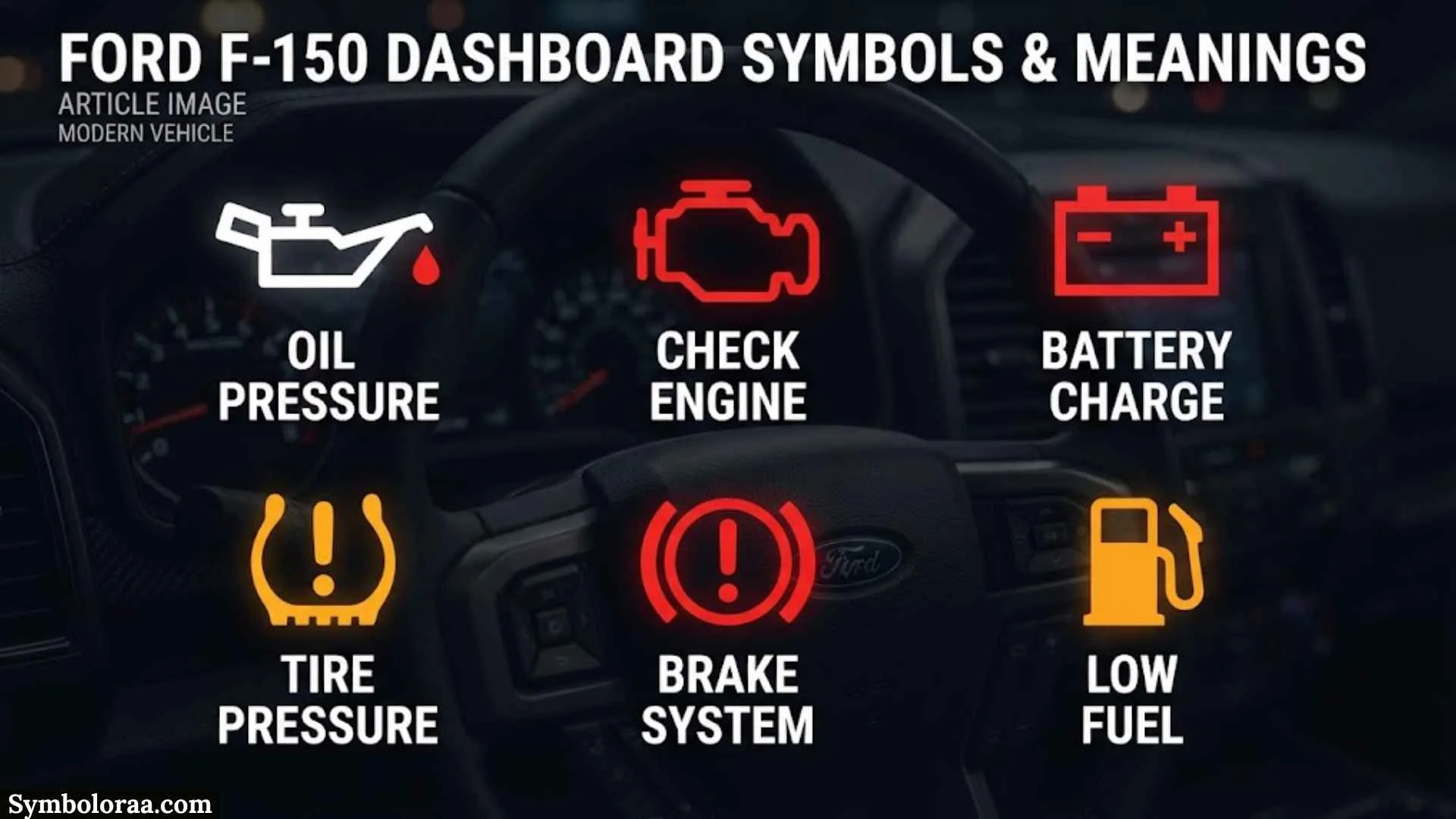
Seeing a warning light on your Ford F-150 dashboard can be confusing, especially when you do not know whether the symbol is simply telling you that a feature is active or warning you about a problem. Understanding Ford F-150 dashboard symbols and meanings helps you decide what needs immediate attention, what can wait for service, and what is completely normal.
Modern F-150 trucks can display warning lamps, information indicators, drivetrain symbols, driver-assistance alerts, tire-pressure warnings, engine messages, and system-specific notifications. The exact symbols can vary according to model year, engine, trim, drivetrain, and optional equipment. Ford’s owner manuals specifically note that warning lamps alert the driver to conditions that could become serious and that some lamps illuminate during startup as a system check.
This guide explains the most common F-150 dashboard symbols in simple language. It also explains warning-light colors, which lights require you to stop, what different symbols mean, why several lights may appear together, what to do when a warning comes on while towing, and how to identify a symbol on different F-150 model years.
Important: Dashboard symbols can differ between F-150 generations and equipment levels. Use this article as a general reference, but use the owner’s manual for your exact truck as the final authority. Ford itself advises owners to consider the manual supplied with their vehicle as the primary source.
Quick Answer: What Do Ford F-150 Dashboard Symbols Mean?
Ford F-150 dashboard symbols communicate information about the truck’s engine, brakes, electrical system, tires, drivetrain, lighting, safety systems, emissions equipment, and driver-assistance features.
As a general guide:
- Red warning lights usually require immediate attention.
- Amber or yellow lights generally indicate a fault, warning, or condition that needs attention.
- Green indicators commonly show that a feature is operating.
- Blue indicators commonly identify a lighting function, such as high beams.
- Some symbols are information indicators, not faults.
- A warning that appears briefly during startup may simply be part of the normal system check.
- A warning that remains illuminated after starting should be identified and investigated.
Ford’s manuals show that individual warnings have different required actions. For example, Ford instructs drivers to stop safely for an engine coolant temperature warning and not continue driving when the oil-pressure warning remains illuminated while driving.
Ford F-150 Dashboard Warning Light Colors Explained
Color is one of the fastest ways to determine how seriously you should treat a dashboard symbol. However, color alone is not enough. Always consider the exact symbol, accompanying message, and how the truck is behaving.
Red Warning Lights
Red generally means the vehicle has detected a condition that may require immediate attention.
Examples include:
- Oil pressure warning
- Engine coolant temperature warning
- Brake system warning
- Certain electrical or charging warnings
- Serious system messages
For example, Ford states that if the oil-pressure warning illuminates while driving, the driver should not continue the journey even if the oil level is correct.
Practical rule: If a red warning appears and the truck is overheating, losing braking performance, showing abnormal engine behavior, or displaying a stop-related message, safely pull over and follow the vehicle’s instructions.
Amber Or Yellow Warning Lights
Amber or yellow generally indicates that a system needs attention, diagnosis, or service.
Examples include:
- Check engine light
- ABS warning
- Low tire pressure
- Airbag warning
- Powertrain fault
- Four-wheel-drive fault
- Certain driver-assistance warnings
An amber light does not automatically mean you must stop immediately. The correct response depends on the symbol, message, and vehicle behavior.
Green Indicators
Green commonly means that a feature is active or operating.
Examples include:
- Turn signals
- Cruise-control status
- Certain exterior lighting indicators
- Some driver-assistance status indicators
A green light is usually informational rather than a sign of a mechanical fault.
Blue Indicators
Blue is commonly used for lighting information.
The high-beam indicator is a familiar example. It tells you that the high beams are switched on.
Ford F-150 Dashboard Symbols And Meanings Chart
The following table provides a quick reference. Exact symbols and messages can vary by model year and equipment.
| Dashboard Symbol or System | Typical Color | Meaning | Recommended Action |
| Oil Pressure | Red | Engine oil pressure is low | Stop safely and switch off the engine |
| Engine Temperature | Red | Engine coolant temperature is too high | Stop safely and allow the vehicle to cool |
| Brake System | Red | Parking brake, low brake fluid, or brake-system concern | Check and have the system inspected |
| Battery/Charging | Red/Amber | Charging-system problem | Have the system checked promptly |
| Check Engine | Amber | Engine/emissions fault detected | Diagnose the vehicle |
| ABS | Amber | Anti-lock braking system concern | Have it checked as soon as practical |
| Tire Pressure | Amber | One or more tires may have low pressure | Check tire pressures |
| Airbag | Amber | Restraint-system concern | Arrange inspection |
| Traction Control | Amber/Green | Traction-control status or fault | Check the indicator/message |
| Powertrain Fault | Amber | Powertrain or related system requires service | Have the system diagnosed |
| 4WD | Varies | Four-wheel-drive mode or fault | Check the selected mode/message |
| Low Fuel | Amber | Fuel level is low | Refuel |
| Washer Fluid | Amber | Washer fluid is low | Refill |
| Door Ajar | Red/Amber | Door is not completely closed | Close the door securely |
| Tailgate Ajar | Varies | Tailgate is not completely closed | Secure the tailgate |
| High Beam | Blue | High beams are active | Switch off when appropriate |
| Turn Signal | Green | Turn signal is active | Normal operation |
| Cruise Control | Green | Cruise-control system status | Monitor system operation |
Ford’s F-150 manuals specifically list systems such as ABS, battery, brake system, coolant temperature, low oil pressure, low tire pressure, powertrain malfunction, malfunction indicator, tailgate ajar, and other warning lamps.
Most Important Ford F-150 Warning Symbols
Some dashboard warnings deserve more attention than others because ignoring them can lead to vehicle damage or a safety problem.
Oil Pressure Warning Light
The oil-pressure warning symbol commonly resembles an oil can.
It indicates that the engine oil pressure is too low.
This is different from simply receiving a reminder that an oil change is due. Oil pressure is essential for circulating engine oil through components that require lubrication.
Ford’s F-150 manual warns that if the oil-pressure warning illuminates while driving, you should not continue the journey, even if the oil level is correct.
What to do:
- Safely pull off the road.
- Switch the engine off.
- Allow the vehicle to sit safely.
- Check the oil level if appropriate.
- If the warning remains or the oil level is normal, arrange professional diagnosis.
Real-world example: If the oil light appears while towing a heavy trailer, do not assume the warning is caused only by the extra load. Stop safely and investigate the warning.
Engine Coolant Temperature Warning
This symbol commonly resembles a thermometer over liquid.
It indicates that the engine or coolant temperature is too high.
Possible causes can include:
- Low coolant
- Cooling-system malfunction
- Thermostat problem
- Radiator problem
- Cooling fan problem
- Heavy operating conditions
Ford instructs drivers to safely stop the vehicle and switch it off when this warning illuminates.
Never remove a hot pressurized cooling-system cap simply because the warning has appeared. Hot coolant can cause severe burns.
Brake System Warning Light
The brake warning symbol commonly contains an exclamation mark within a circle.
It can illuminate when the parking brake is applied. If it remains on while driving after the parking brake has been released, Ford indicates that low brake fluid or a brake-system problem may be involved.
What to check:
- Is the parking brake fully released?
- Does the brake pedal feel normal?
- Is there any change in braking performance?
- Is another brake-related warning illuminated?
If braking performance changes, treat the situation as urgent.
Battery Or Charging System Warning
The battery-shaped warning indicates a potential charging-system issue.
It does not necessarily mean that the battery itself is defective.
Possible causes include:
- Battery problem
- Alternator or charging-system problem
- Electrical connection issue
- Wiring fault
- Other electrical-system problems
Ford’s F-150 documentation states that a battery warning that remains illuminated while the engine is running indicates the vehicle requires service.
If several electronic warnings appear together, the charging system should be considered as one possible cause, but it should be tested rather than assumed to be the problem.
Engine And Powertrain Dashboard Symbols
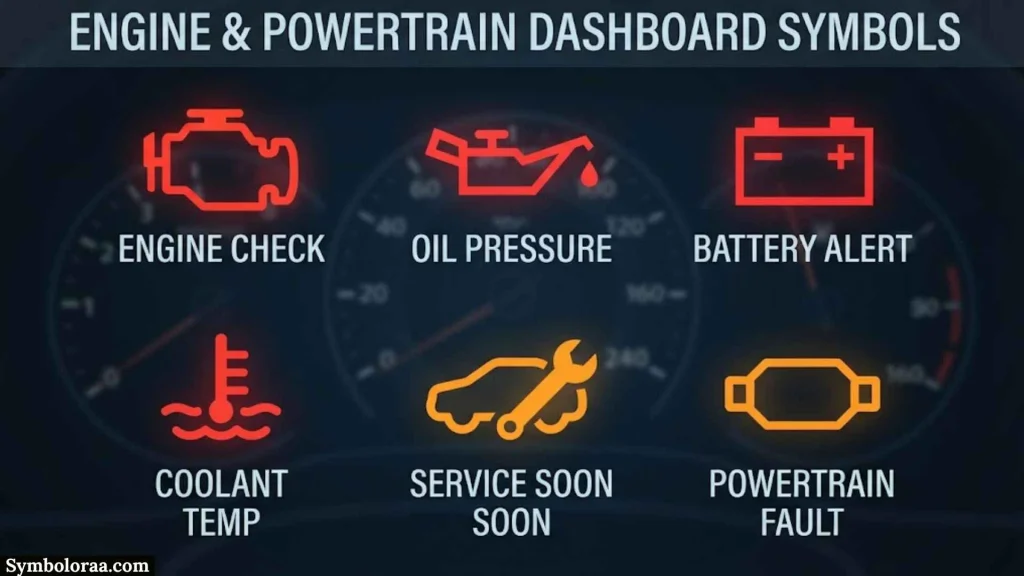
The F-150’s engine and powertrain systems can produce several different warning indicators.
Check Engine Light
The check engine symbol is normally shaped like an engine.
It is also called the Malfunction Indicator Lamp (MIL).
Ford explains that the light can indicate an emissions-control system concern. A flashing light requires more urgent attention than a light that simply remains on.
Potential causes can include:
- Engine misfire
- Emissions-system fault
- Sensor problem
- Fuel-system issue
- Ignition problem
- Other engine-control faults
Steady light: Arrange diagnosis and avoid ignoring it.
Flashing light: Reduce unnecessary driving and seek immediate service, particularly if the engine is running roughly.
Powertrain Malfunction Warning
A powertrain warning can indicate that the engine, transmission, drivetrain, or related electronic systems have detected a problem.
Ford’s F-150 manual groups certain warnings under powertrain malfunction, reduced power, electronic throttle control, and 4X4-related concerns.
If the truck enters a reduced-power mode, acceleration may become limited.
Do not treat reduced power as a normal driving mode. Read the instrument-cluster message and arrange diagnosis.
Wrench Symbol
The wrench symbol is commonly associated with a powertrain-related or service condition on Ford vehicles, but its exact meaning can vary according to model year and configuration.
That is why searching only for “Ford F-150 wrench light” may not provide enough information.
Check:
- Model year
- Exact dashboard message
- Engine
- Drivetrain
- Other warning lights
- Whether the truck has reduced power
The message accompanying the wrench symbol can provide important context.
Brake, Tire And Safety Symbols
These warnings relate directly to systems that affect vehicle control and occupant protection.
ABS Warning Light
ABS stands for Anti-lock Braking System.
The ABS warning symbol normally contains the letters ABS inside a circle.
Ford explains that if the ABS warning illuminates while driving, the normal braking system can remain available but the anti-lock function may not operate. Ford recommends having the vehicle checked as soon as possible.
Do not confuse an ABS warning with a brake-system warning. If both appear together, the situation deserves greater attention.
Low Tire Pressure Warning
The tire-pressure symbol looks like a tire or horseshoe with an exclamation mark.
It indicates that tire pressure is low.
Possible causes include:
- Normal air loss
- Cold temperatures
- A puncture
- A leaking valve
- Tire damage
Ford’s F-150 manual states that the tire-pressure warning should be checked as soon as possible and that a flashing warning indicates the system itself should be checked.
Best practice: Check all tires with a reliable pressure gauge instead of judging pressure by looking at the tires.
Airbag Warning Light
The airbag symbol usually shows a seated person with an airbag in front.
It can indicate a concern with the supplemental restraint system.
Because airbags are safety equipment, do not ignore a persistent airbag warning.
Avoid attempting electrical repairs to airbag components without the appropriate training and procedures.
Seat Belt Warning
The seat-belt symbol reminds occupants to fasten their seat belts.
A warning light and audible reminder may continue until the relevant seat belt is fastened.
If the warning appears when nobody is sitting in the passenger seat, an object on the seat may sometimes be detected by the occupant-sensing system.
F-150 4WD And Drivetrain Symbols
Four-wheel-drive-equipped F-150 models can display symbols indicating the selected drivetrain mode or a problem with the system.
2H, 4H, 4L And 4A Indicators
Depending on the truck’s equipment, you may encounter drivetrain selections such as:
- 2H — two-wheel-drive high
- 4H — four-wheel-drive high
- 4L — four-wheel-drive low
- 4A — automatic four-wheel-drive operation on applicable configurations
These are not all warning lights. Some simply tell you which drive mode has been selected.
The appropriate mode depends on the road surface, traction conditions, speed, and the instructions for your particular F-150.
4WD Fault Warning
A four-wheel-drive fault can indicate a problem with the transfer case, drivetrain controls, sensors, or another related component.
If the truck displays a specific 4WD message, do not guess based only on the icon.
Record the exact message and check the owner’s manual.
Differential Lock Indicator
Some F-150 configurations provide a differential-lock function.
The indicator tells you when that feature is engaged or operating.
A locking differential can help in certain low-traction situations, but it should not be treated as a universal substitute for selecting the correct drive mode or driving technique.
Lighting And Visibility Indicators
Not every dashboard symbol indicates a fault.
High Beam Indicator
The high-beam indicator is normally blue.
It simply tells you that the high beams are active.
Switch to low beams when approaching other road users or whenever conditions require it.
Turn Signal Indicator
Green arrows generally indicate that the left or right turn signal is operating.
Ford notes that an increase in the flashing rate can warn of a failed turn-signal lamp.
If the indicator suddenly begins flashing much faster than usual, inspect the exterior turn-signal lights.
Fog Lamp Indicator
If equipped, the fog-lamp indicator shows that the relevant lamps are switched on.
The exact availability and operation can vary by configuration.
Parking Lamp Indicator
This indicator tells you that the parking lamps are switched on.
It is an operating-status indicator rather than an indication of a mechanical fault.
F-150 Body And Convenience Warning Symbols
Some dashboard symbols relate to doors, the hood, tailgate, fuel, or washer fluid.
Door Ajar Warning
A door-ajar warning means that one or more doors are not completely closed.
Do not ignore this warning before driving.
Check every door and make sure each one is securely latched.
Hood Ajar Warning
The hood-ajar indicator can illuminate when the hood is not completely closed.
Ford lists the hood-ajar warning among the F-150 instrument-cluster warnings.
A hood that is not properly latched can create a serious visibility and safety problem while driving.
Tailgate Ajar Warning
The tailgate warning illuminates when the tailgate is not completely closed on applicable F-150 configurations.
Before driving, make sure:
- The tailgate is fully closed.
- The latch is engaged.
- Cargo is properly secured.
- No warning remains.
This is particularly important when carrying loose cargo.
Low Fuel Warning
The low-fuel symbol indicates that the fuel level is low.
The remaining driving range depends on factors such as:
- Speed
- Load
- Towing
- Traffic
- Temperature
- Driving style
- Terrain
Treat the estimated range as an estimate rather than a guarantee.
Low Washer Fluid Warning
This warning indicates that windshield washer fluid is low.
It is usually a maintenance issue rather than an indication of an engine fault.
Keeping the reservoir filled is particularly useful during dusty, muddy, or rainy driving.
Diesel F-150 Dashboard Symbols
Diesel-powered F-150 models can display additional emissions and engine-related information.
Diesel Exhaust Fluid Warning
Applicable diesel trucks use Diesel Exhaust Fluid (DEF) as part of their emissions-control system.
A DEF warning can indicate that the fluid level needs attention.
Do not ignore a DEF warning until the vehicle reaches a severe warning stage. Follow the instrument-cluster instructions and use the correct fluid specified for the vehicle.
Diesel Particulate Filter Information
A diesel particulate filter, or DPF, captures particulate matter from diesel exhaust.
The truck can perform a regeneration process to reduce accumulated soot.
If a DPF-related message appears, read the exact instruction displayed by the truck. Do not assume that every DPF message means the filter needs to be replaced.
Glow Plug Indicator
Some diesel systems use glow plugs to assist cold starting.
The glow-plug indicator can illuminate before startup.
If the light behaves abnormally or remains illuminated after starting, consult the appropriate owner’s manual and arrange diagnosis.
Driver-Assistance Dashboard Symbols
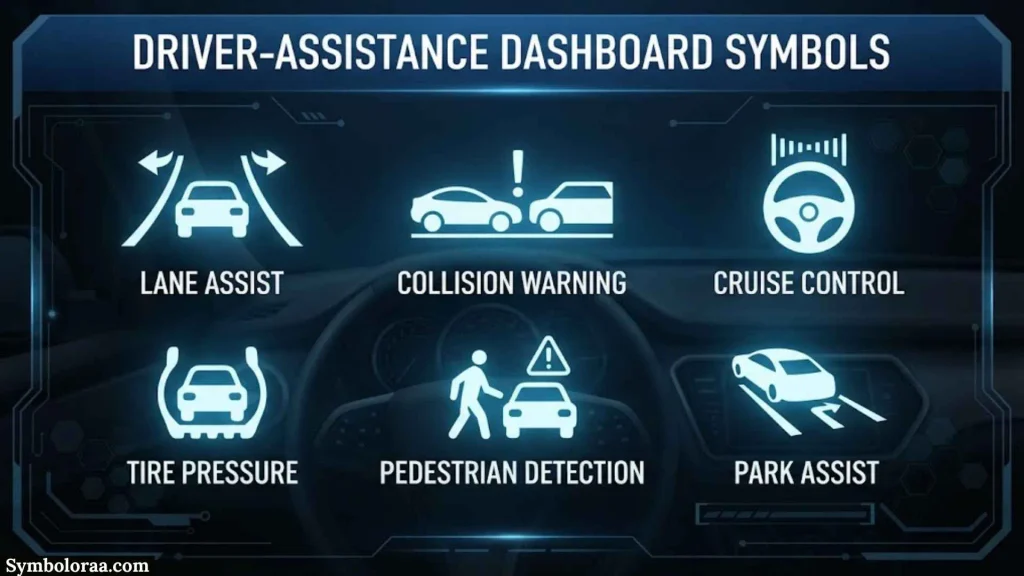
Newer F-150 models can display information related to driver-assistance systems.
These systems can include:
- Lane-keeping assistance
- Pre-Collision Assist
- Adaptive cruise control
- Blind Spot Information System
- Driver alert
- Parking assistance
- Trailer-related assistance
The symbols may indicate that a system is active, unavailable, temporarily limited, or requesting driver attention.
Lane-Keeping Indicators
Lane-keeping-related indicators can show information about lane markings and system availability.
The system may be affected by:
- Poor lane markings
- Weather
- Camera obstruction
- Road construction
- Dirt or damage around the sensor area
A driver-assistance warning does not mean that the driver can stop monitoring the road.
Pre-Collision Assist Warning
Pre-Collision Assist can provide warnings when the system detects a potential collision risk.
Depending on the vehicle and circumstances, the system may provide visual and audible alerts and braking assistance.
It remains a driver-assistance technology. The driver must continue to monitor traffic and be prepared to brake or steer.
Blind Spot Information System
BLIS can provide warnings when another vehicle is detected in a blind-spot area.
A BLIS warning should be treated as additional information rather than permission to change lanes.
Always check mirrors and the surrounding area before changing lanes.
Ford F-150 Dashboard Symbols When Towing
Towing changes how the truck operates and can introduce additional trailer-related information.
Depending on the equipment installed, you may encounter messages involving:
- Trailer connection
- Trailer lighting
- Trailer brakes
- Trailer sway control
- Tow/Haul mode
- Trailer tire pressure
- Trailer-related driver assistance
Example: Warning Light Appears While Towing
Imagine an F-150 is pulling a trailer and a warning appears on the instrument cluster.
Do not immediately assume the trailer is the cause.
Use this sequence:
- Check the exact dashboard message.
- Safely reduce speed if necessary.
- Find a safe place to stop.
- Check the trailer connection and visible wiring.
- Check whether the truck itself is showing another warning.
- Consult the owner’s manual.
- Have the problem diagnosed if the warning remains.
A warning involving braking, overheating, oil pressure, or significant vehicle control should receive priority over a convenience-related message.
Why Are Multiple Ford F-150 Warning Lights On At Once?
Multiple dashboard lights do not always mean that several unrelated parts have failed.
One underlying problem can sometimes cause multiple systems to report a fault.
Possible causes can include:
- Low system voltage
- Charging-system problem
- Communication fault
- Sensor problem
- Powertrain issue
- ABS or stability-system fault
- Electrical connection problem
However, you should not automatically blame the battery just because several lights appear.
Real-World Example: Several Lights After Startup
Suppose your F-150 starts normally but suddenly displays ABS, traction-control, and other warnings.
Instead of clearing the warnings immediately, note:
- Which warnings appeared first
- Any written message
- Whether the engine runs normally
- Whether braking feels normal
- Whether the warnings disappear after restarting
A diagnostic scan and electrical-system test can help identify the underlying cause.
Ford F-150 Dashboard Warning Light Decision Tree
Use this simple decision process when a dashboard warning appears.
Step 1: Is The Light Red?
Yes → Identify the symbol.
Oil pressure, overheating, serious brake warning, or stop-related message → Safely stop and follow the owner’s manual instructions.
No → Continue to Step 2.
Step 2: Is The Light Amber Or Yellow?
Yes → Read the accompanying message.
Vehicle behaves normally → Arrange diagnosis or service as appropriate.
Vehicle has reduced power, abnormal braking, overheating, severe vibration, or another major change → Stop safely and seek assistance.
No → Continue to Step 3.
Step 3: Is It Green Or Blue?
Yes → It is likely an operating-status indicator.
Check whether the related feature is intentionally active.
Step 4: Did The Warning Flash?
Yes → Treat a flashing warning more seriously than a simple steady indicator, especially for the check engine or tire-pressure system.
No → Check the symbol and accompanying message.
Step 5: Does The Warning Return?
Yes → Do not keep resetting it without finding the cause.
No → Check the owner’s manual to determine whether it was a normal temporary condition.
What To Do When A Ford F-150 Warning Light Comes On
A systematic approach is safer than guessing.
1. Identify The Symbol
Look at the exact shape of the icon.
Do not rely only on a description such as “red light” or “yellow engine symbol.”
2. Read The Dashboard Message
Modern F-150s can provide a written message along with a warning icon.
The message may narrow down the problem considerably.
3. Check The Color
Determine whether it is:
- Red
- Amber/yellow
- Green
- Blue
Then consider whether the light is steady or flashing.
4. Check Vehicle Behavior
Ask yourself:
- Is the engine running normally?
- Is the truck overheating?
- Do the brakes feel normal?
- Has steering changed?
- Is power reduced?
- Are there unusual noises?
- Is smoke or an unusual smell present?
5. Check Simple Maintenance Items
Depending on the warning, you may be able to check:
- Tire pressure
- Engine oil level
- Coolant level after the system is safely cool
- Washer fluid
- Fuel level
- Door or tailgate closure
Do not perform checks that expose you to hot, moving, pressurized, or high-voltage components.
6. Consult The Correct Manual
Use the owner’s manual for your exact F-150.
Ford’s online manual system provides model-specific information, and Ford maintains owner-manual resources by vehicle and model year.
7. Diagnose Rather Than Guess
If the warning remains, returns, or is accompanied by abnormal vehicle behavior, professional diagnosis is usually more useful than replacing random parts.
Ford F-150 Dashboard Symbols By Model Year
One of the biggest mistakes when researching dashboard symbols is assuming every F-150 has the same warning system.
It does not.
Ford has produced the F-150 across multiple generations with different:
- Instrument clusters
- Engines
- Transmissions
- Drivetrains
- Safety systems
- Driver-assistance features
- Hybrid technology
- Diesel equipment
- Display systems
Ford’s owner-manual resources show F-150 documentation across multiple model years, and the manuals themselves warn that information can vary by vehicle.
Older F-150 Models
Older F-150s may have simpler gauges and fewer digital messages.
Some warnings may be represented primarily by traditional indicator lamps.
Newer F-150 Models
Newer F-150s can provide more detailed instrument-cluster information and additional driver-assistance or drivetrain messages.
This means a symbol found on a newer F-150 may not appear on an older truck.
2023–2025 F-150 Models
Ford’s official manuals for recent F-150 models include extensive instrument-cluster warning information, including warnings for ABS, battery, brakes, coolant temperature, oil pressure, low tire pressure, powertrain faults, malfunction indicators, and body-related warnings.
For the most accurate interpretation, always match the warning with the exact model year.
Common Misconceptions About F-150 Dashboard Lights
“Every Red Light Means The Engine Is About To Fail”
Not necessarily.
Red indicates that the condition may require serious attention, but the underlying cause depends on the particular warning.
“A Yellow Light Means I Can Ignore It”
No.
Amber warnings often allow you to drive cautiously, but they can indicate a fault that becomes more expensive or unsafe if ignored.
“The Check Engine Light Always Means A Major Engine Failure”
No.
The malfunction indicator can be triggered by different engine and emissions-related conditions.
The exact cause requires diagnosis.
“If The Warning Disappears, The Problem Is Fixed”
Not necessarily.
A temporary condition may disappear, or the system may no longer detect the fault at that moment.
If a warning repeatedly returns, it deserves investigation.
“All F-150 Dashboard Symbols Are The Same”
They are not.
Model year, engine, trim, drivetrain, and optional equipment can affect which symbols appear.
Common Mistakes When Troubleshooting Dashboard Warnings
Clearing The Warning Without Diagnosis
Resetting a warning may remove the visible symptom without correcting the problem.
Replacing The Battery Without Testing It
Multiple warnings can have an electrical cause, but that does not mean the battery is automatically defective.
Ignoring Tire Pressure
A tire-pressure warning can result from a slow leak or puncture, not just normal air loss.
Continuing To Drive With An Oil Warning
This is one of the more serious mistakes because Ford specifically warns against continuing the journey when the oil-pressure warning remains illuminated while driving.
Assuming The Same Symbol Means The Same Thing On Every Model
Always verify the model year and exact message.
Expert Tips For Reading F-150 Dashboard Warnings
Focus On The Message, Not Just The Icon
The icon tells you which system may be involved.
The written message can provide additional context.
Record The Warning Before Restarting
If a warning disappears after restarting, write down what you saw.
This information can help a technician diagnose an intermittent problem.
Pay Attention To Flashing Indicators
A flashing warning can represent a different level of urgency from a steady light.
Ford specifically identifies a flashing malfunction indicator as a condition requiring immediate attention.
Consider What Happened Before The Warning
Think about whether the warning appeared:
- After refueling
- During towing
- After driving through deep water
- During cold weather
- After a tire change
- After battery work
- During heavy acceleration
- After a recent repair
This context can help narrow the possibilities.
Do Not Guess From A Symbol Alone
Two symbols can look similar while representing different systems.
Use the model-specific manual whenever there is uncertainty.
When Should You Stop Driving Your F-150?
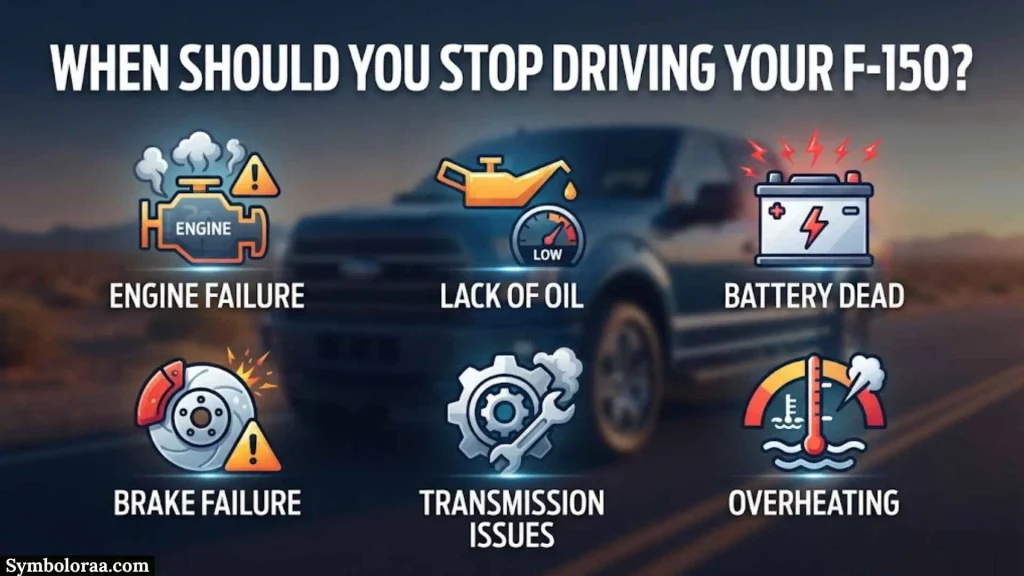
There is no single rule for every warning.
However, stopping safely deserves priority when you see a serious warning involving:
- Oil pressure
- Engine overheating
- Significant brake-system problems
- A stop-safely message
- Severe loss of vehicle control
- Major smoke or unusual mechanical noise
Ford’s F-150 documentation specifically instructs drivers to stop for an engine coolant temperature warning and not continue the journey for a low oil-pressure warning while driving.
For less urgent amber warnings, the correct response may be to drive cautiously and arrange service.
When Is A Dashboard Light Normal?
Some dashboard symbols are expected during startup.
Ford explains that certain warning lamps illuminate when you start the vehicle to verify that they are working. If a lamp remains on after startup, the relevant warning information should be checked.
For example:
- Switch the ignition on.
- Several warning lights illuminate.
- The engine starts.
- Normal system-check indicators turn off.
- Any remaining warning should be identified.
This startup behavior is why a light appearing for a few seconds does not automatically indicate a fault.
Frequently Asked Questions About Ford F-150 Dashboard Symbols
What Does The Wrench Symbol Mean On A Ford F-150?
The wrench symbol can indicate a powertrain or related service condition, depending on the model year and configuration. Check the accompanying instrument-cluster message and the owner’s manual for the exact truck.
What Does The Red Oil Can Mean On An F-150?
It indicates a low engine oil-pressure warning. Ford advises not continuing the journey if this warning illuminates while driving, even when the oil level is correct.
What Does The Yellow Engine Symbol Mean?
The yellow engine-shaped symbol is generally the malfunction indicator or check engine light. It can indicate an engine or emissions-system problem. A flashing light requires more immediate attention than a steady one.
What Does The Tire With An Exclamation Mark Mean?
It normally indicates a low tire-pressure condition. Check the pressure of all tires and correct it according to your F-150’s specified tire-pressure requirements.
What Does The ABS Light Mean On A Ford F-150?
The ABS warning indicates a concern with the anti-lock braking system. Ford states that normal braking can remain available without ABS, but the vehicle should be checked as soon as possible.
Why Are My ABS And Traction-Control Lights On Together?
Multiple warnings can sometimes be related because vehicle systems share sensors and electronic information. The combination does not identify one guaranteed cause. Read the exact messages and have the truck diagnosed if the warnings remain.
Why Is My F-150 Showing A Battery Light?
A battery-shaped warning can indicate a charging-system concern. It does not automatically prove that the battery needs replacement. The battery and charging system should be tested.
Can Low Battery Voltage Cause Multiple Warning Lights?
It can contribute to multiple electronic warnings, but it is only one possible cause. A proper electrical-system test is needed before replacing parts.
Why Is My F-150 Check Engine Light Flashing?
A flashing malfunction indicator can indicate a serious engine problem. Ford’s documentation specifically states that a flashing malfunction indicator requires immediate attention.
What Does The 4WD Warning Mean?
A 4WD warning can indicate a problem with the four-wheel-drive system or can relate to the selected drivetrain mode, depending on the symbol and message. Check the exact wording on the instrument cluster.
What Does “Stop Safely” Mean On An F-150?
A Stop Safely message indicates a condition that may require the vehicle to stop. Ford documentation associates this message with certain electrical or operating conditions that can cause the vehicle to shut down or enter a limited operating mode.
Why Does My F-150 Show A Door Ajar Warning When The Door Looks Closed?
The door may not be fully latched, or the vehicle may be detecting a problem with the door-latch sensing system. Open and securely close the door. If the warning remains, have the system inspected.
Why Does My F-150 Say The Tailgate Is Open?
The tailgate warning indicates that the tailgate is not completely closed on applicable models. Ford specifically lists a tailgate warning lamp for this condition.
Why Does My F-150 Show A Low Tire Pressure Light After A Tire Change?
The system may need time to recognize the new tire-pressure condition, or one or more tires may not be inflated to the specified pressure. If the warning flashes or does not clear after correcting pressure, the tire-pressure monitoring system may require inspection.
Do F-150 Dashboard Symbols Change By Model Year?
Yes. F-150 dashboard systems vary across model years, generations, engines, trims, and optional equipment. Always use the manual for your exact vehicle.
Where Can I Find The Official Meaning Of My F-150 Dashboard Symbol?
The owner’s manual supplied with your F-150 is the primary reference. Ford also provides online owner-manual information for different F-150 model years.
F-150 Dashboard Warning Light Checklist
When a warning appears, use this checklist:
- Identify the exact symbol.
- Check the color.
- Determine whether it is flashing.
- Read the instrument-cluster message.
- Check whether the engine is running normally.
- Check braking and steering behavior.
- Check tire pressure if relevant.
- Check fluid levels only when safe and appropriate.
- Note what happened immediately before the warning appeared.
- Check the owner’s manual for your exact model year.
- Do not clear recurring warnings without finding the cause.
- Seek professional diagnosis when the warning persists or vehicle behavior changes.
Editorial Note About Ford F-150 Dashboard Symbols
Dashboard symbols are not completely universal across the F-150 lineup. A symbol, message, or recommended action can vary by model year, engine, drivetrain, trim, market, and optional equipment.
For that reason, this guide is intended to help you understand the general meaning and urgency of common dashboard warnings. It should not replace the owner’s manual or professional diagnosis for a specific fault.
Ford’s official documentation is particularly important because its online manuals can contain information that differs between vehicles, and Ford identifies the manual provided with the vehicle as the primary source.
Key Takeaways
- Red dashboard warnings generally deserve immediate attention.
- Amber or yellow warnings usually indicate a condition requiring attention or service.
- Green and blue indicators commonly show that a feature is operating.
- An oil-pressure warning while driving should not be ignored.
- An engine-temperature warning requires safe stopping and cooling.
- A flashing check-engine light requires more urgent attention than a steady light.
- A tire-pressure warning should be investigated rather than dismissed.
- ABS and brake warnings are not the same system.
- Multiple warning lights can sometimes result from one underlying problem.
- The wrench symbol requires interpretation based on the exact F-150 model and message.
- F-150 dashboard symbols vary across model years and configurations.
- The instrument-cluster message can provide important information beyond the symbol itself.
- The exact owner’s manual should take priority when the meaning or required action is uncertain.
Conclusion
Understanding Ford F-150 dashboard symbols and meanings is an important part of safe truck ownership. The key is not simply memorizing every icon. You need to understand the difference between a normal operating indicator, a maintenance warning, and a condition that requires immediate action.
Start by checking the color, symbol, flashing behavior, and written dashboard message. Then consider how the truck is behaving. A red oil-pressure or overheating warning deserves a very different response from a blue high-beam indicator or green turn signal.
Remember that the F-150 has been produced with many different engines, generations, trims, drivetrain systems, and technologies. Therefore, the same-looking warning may not have exactly the same context on every truck.
When a warning remains illuminated, returns repeatedly, or is accompanied by reduced power, unusual noise, overheating, braking changes, or another major change in vehicle behavior, do not rely on guesswork. Check the owner’s manual and arrange appropriate diagnosis.

I’m Madison Reed, a contemporary American author who writes about love, family, friendship, and second chances. I’m fascinated by the choices that shape our lives and the moments that change us forever. My goal is to create honest, emotional stories with characters readers can connect with long after finishing each book.
Three Books:
When We Find Our Way
The Things We Never Said
Summer in September
 Ethan Brooks
 Jackson Miller