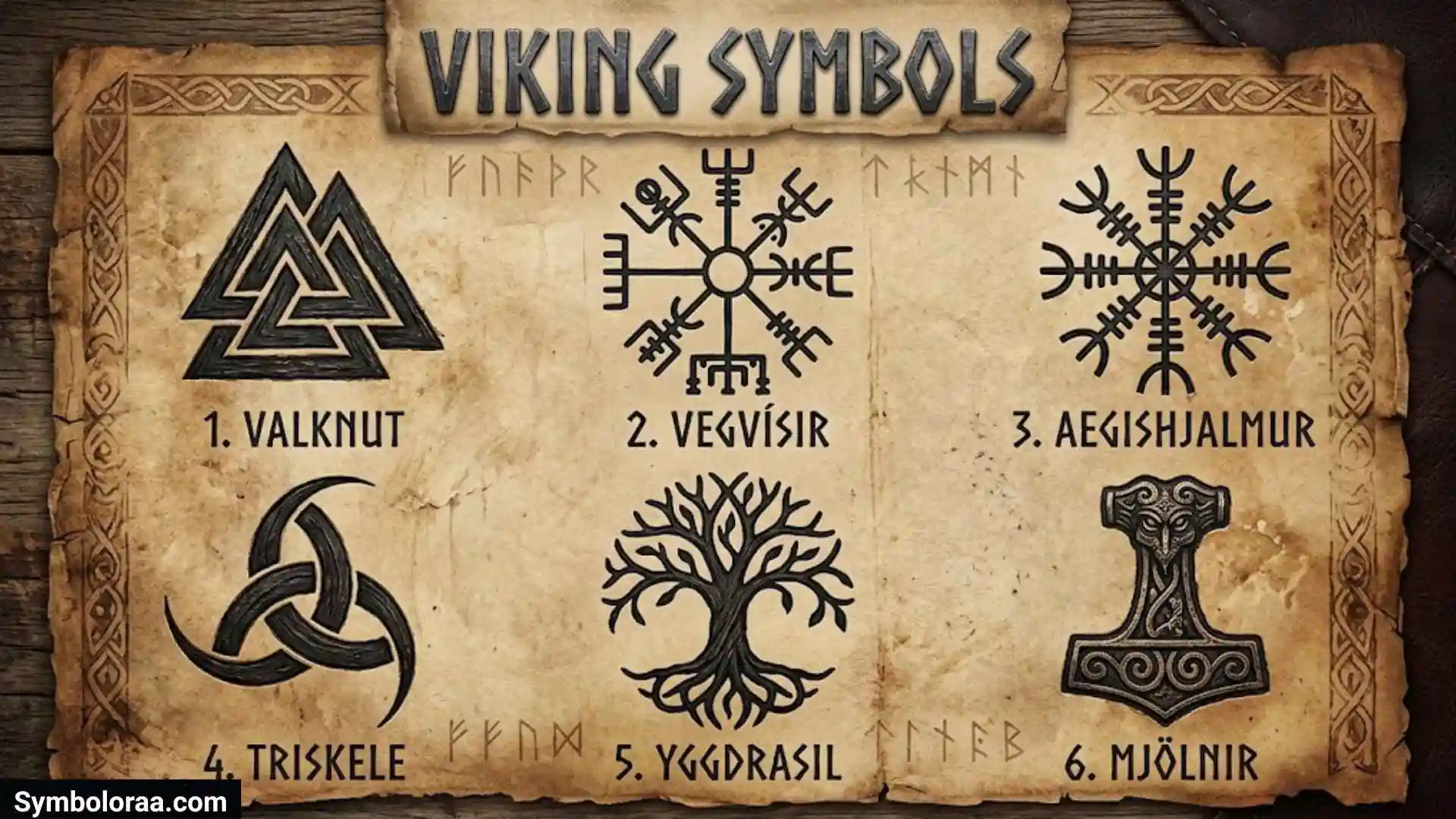
Viking symbols offer a fascinating glimpse into the beliefs, stories, and traditions of ancient Scandinavia. From Thor’s mighty hammer to Odin’s mysterious Valknut and the towering world tree Yggdrasil, these designs connect modern readers with the world of Norse gods, legendary warriors, and ancient Scandinavian culture.
But what do these symbols actually mean? Some have strong archaeological connections to the Viking Age, while others come from medieval literature or later Icelandic magical traditions. Understanding these differences helps you appreciate their history without confusing modern interpretations with ancient beliefs.
This guide explores the most important Viking symbols and meanings, including Norse mythology symbols, runes, protective emblems, mythological animals, and symbols of fate. You’ll also learn which designs have historical evidence, which are popular today, and what to consider before choosing a Norse-inspired tattoo or piece of jewelry.
What Are Viking Symbols?
Viking symbols are visual designs, motifs, and written characters associated with the Viking Age, Norse mythology, and the broader cultures of medieval Scandinavia. They appeared on objects such as weapons, jewelry, runestones, tools, and decorative woodwork.
The Viking Age is generally dated from approximately AD 800 to 1100. During this period, Scandinavian people traveled extensively for trade, settlement, exploration, and warfare. Their material culture reflected practical needs, religious traditions, artistic styles, and connections with other societies.
However, there was no single catalog of official Viking emblems. Different designs served different purposes, and archaeologists cannot always determine exactly what an image meant to the people who created it.
Why Did Vikings Use Symbols?
Viking Age imagery could communicate several kinds of information:
- Religious beliefs: Hammer pendants and mythological scenes reflected connections to Norse gods and religious traditions.
- Identity and status: Jewelry, ornaments, and decorated possessions could communicate wealth, social position, or cultural affiliation.
- Memorials: Runestones recorded the names, relationships, achievements, and deaths of individuals.
- Decoration: Animal patterns, interlaced designs, and geometric motifs appeared on everyday objects and elaborate works of art.
- Writing and communication: Runes recorded names, messages, memorial inscriptions, and other information.
- Possible magical practices: Some inscriptions and objects suggest that people sometimes associated runes or particular objects with protective or supernatural powers.
Not every design had a religious meaning. An animal carving might represent a mythological creature, express an artistic tradition, or simply decorate an object.
Viking Symbols vs. Norse Symbols
The terms Viking symbols and Norse symbols overlap, but they are not identical.
The word Viking commonly refers to Scandinavian people who participated in maritime expeditions during the Viking Age. Norse describes the broader language, mythology, and cultural traditions of medieval Scandinavia.
Consequently, a symbol drawn from a later Icelandic magical manuscript might belong to the wider history of Norse-inspired traditions without being a verified Viking Age emblem.
This distinction matters when researching ancient Norse symbols, especially designs frequently advertised as ancient Viking protection symbols.
Viking Symbols and Their Meanings
The following table introduces important symbols and explains their commonly accepted associations. Some meanings come from historical objects or medieval texts, while others remain interpretations rather than established facts.
| Viking or Norse Symbol | Common Meaning or Association | Historical Context |
| Mjölnir | Thor, protection, divine power | Supported by Viking Age pendants and imagery |
| Valknut | Odin, death, fallen warriors | Ancient motif with uncertain meaning |
| Yggdrasil | Cosmic order and interconnected worlds | Known primarily through Old Norse literature |
| Gungnir | Odin, warfare, authority | Mythological spear |
| Huginn and Muninn | Thought and memory | Described in Norse mythology |
| Sleipnir | Odin, supernatural travel | Mythological eight-legged horse |
| Fenrir | Destruction, prophecy, Ragnarok | Mythological wolf |
| Jörmungandr | Midgard, cosmic conflict, Ragnarok | Mythological serpent |
| Horns of Odin | Odin and the mead of poetry | Associated with historical horn imagery and later interpretation |
| Vegvísir | Guidance and finding one’s way | Documented in a nineteenth-century Icelandic manuscript |
| Helm of Awe | Fear, power, magical protection | Literary tradition and later magical imagery |
| Runes | Writing, names, messages, inscriptions | Extensively documented in Scandinavian archaeology |
These associations provide a starting point. The following sections explain each symbol in greater detail.
Mjölnir: Thor’s Hammer
Mjölnir, commonly known as Thor’s Hammer, is one of the best-supported examples of a recognizable Viking Age religious symbol.
In Norse mythology, Thor is the god associated with thunder, lightning, strength, and the defense of gods and humans. His hammer serves as a formidable weapon against giants and other dangerous beings.
Mjölnir also appears in archaeological evidence. Hammer-shaped pendants have been discovered at Viking Age sites, demonstrating that people wore objects associated with Thor.
Its main associations include:
- Protection against danger.
- Strength and divine power.
- Thor and his role as a defender.
- Religious identity and devotion.
Mjölnir remains popular in necklaces, pendants, artwork, and Viking symbols for protection. Unlike several symbols whose histories are difficult to establish, Thor’s hammer has substantial material evidence connecting it with Viking Age Scandinavia.
The Valknut: Odin and Fallen Warriors
The Valknut consists of three interlocking triangles. It appears in early Scandinavian imagery, including some picture stones associated with mythological or death-related scenes.
Modern interpretations often connect it with Odin, warriors who died in battle, and the afterlife. These associations draw partly on the contexts in which related imagery appears.
However, the exact meaning remains uncertain. The name Valknut is a modern label rather than a securely documented Viking Age name for the design.
The Valknut is commonly associated with:
- Odin and Norse mythology.
- Death and the afterlife.
- Fallen warriors.
- Interconnected triangles and modern spiritual interpretations.
Although it is widely recognized today, claims that it definitively represents Valhalla, the Nine Realms, or a specific ancient ritual go beyond what the surviving evidence proves.
Yggdrasil: The Norse World Tree
Yggdrasil, often called the Norse World Tree or Tree of Life, occupies a central place in Norse cosmology.
Old Norse literary sources describe a great tree connecting different parts of the cosmos. Gods, humans, giants, and other mythological beings inhabit worlds associated with this larger cosmic structure.
Yggdrasil is connected with important mythological locations, including the Well of Urðr. Various creatures also appear in stories associated with the tree.
Its common symbolic associations include:
- Life and interconnectedness.
- Cosmic order.
- Wisdom and knowledge.
- Continuity and transformation.
- The relationship between different realms.
Modern artwork frequently depicts Yggdrasil as a tree with extensive roots and branches. Although the image captures the mythological concept, today’s familiar Tree of Life designs should not automatically be treated as exact reproductions of Viking Age artwork.
Gungnir: Odin’s Magical Spear
Gungnir is the spear associated with Odin, the Norse god connected with wisdom, warfare, poetry, magic, and prophecy.
In Norse mythology, Gungnir is a remarkable weapon associated with supernatural power. Its stories emphasize Odin’s authority and his connection to battle and the divine world.
Gungnir is commonly associated with:
- Odin’s power and authority.
- Warfare and leadership.
- Magical weapons.
- Determination and precision in modern interpretations.
Although spears were real and important weapons in Viking Age Scandinavia, Gungnir itself belongs to mythology. Modern designs representing Odin’s spear are inspired by those stories rather than by one universally established historical emblem.
Huginn and Muninn: Odin’s Ravens
Odin’s two ravens, Huginn and Muninn, appear in Norse mythology as companions who travel throughout the world and bring information back to him.
Their names are commonly translated as Thought and Memory. They represent the gathering and retention of knowledge within the mythological narrative.
Ravens also appear in Scandinavian art and are strongly associated with Odin in modern Norse-inspired imagery.
Common interpretations include:
- Thought and memory.
- Knowledge and observation.
- Wisdom and awareness.
- Odin’s connection with the world beyond his immediate surroundings.
Raven designs are popular in tattoos, jewelry, and artwork. Still, a modern raven emblem does not necessarily reproduce one specific Viking Age symbol.
Sleipnir: Odin’s Eight-Legged Horse
Sleipnir is Odin’s extraordinary eight-legged horse. Norse mythology describes the animal as capable of traveling with exceptional speed and crossing boundaries between worlds.
Sleipnir is associated with Odin and appears in stories that explore supernatural travel and the relationships between different parts of the mythological cosmos.
Modern interpretations connect Sleipnir with:
- Speed and endurance.
- Odin and divine power.
- Journeys between worlds.
- Spiritual travel and transformation.
Horses held practical and cultural importance in Scandinavia, but Sleipnir’s eight-legged form is specifically mythological.
Fenrir: The Giant Wolf
Fenrir is a powerful wolf in Norse mythology and one of Loki’s children. The gods fear the danger Fenrir may pose, so they attempt to restrain him.
The wolf’s story becomes particularly important in accounts of Ragnarok, the catastrophic conflict associated with the end of the existing cosmic order.
Fenrir is commonly associated with:
- Destructive power.
- Prophecy and fate.
- Uncontrollable forces.
- Conflict between order and chaos.
Modern Norse-inspired designs often use Fenrir to represent independence, rebellion, or personal strength. These are contemporary interpretations of the myth rather than a single established Viking meaning.
Jörmungandr: The Midgard Serpent
Jörmungandr, also called the Midgard Serpent, is a giant sea serpent in Norse mythology. It is associated with the ocean surrounding Midgard, the world of humans.
The serpent’s relationship with Thor is especially important. Their eventual confrontation forms part of the mythology surrounding Ragnarok.
Jörmungandr commonly represents:
- The boundaries surrounding the human world.
- Powerful natural forces.
- Cycles of conflict and destruction.
- The relationship between Thor and the forces threatening cosmic order.
Serpents and dragon-like creatures also appear in Viking Age decorative art. However, not every serpent carving depicts Jörmungandr specifically.
The Horns of Odin
The Horns of Odin, also called the Triple Horns of Odin, depict three interlocking drinking horns. The design is associated in modern interpretations with Odin and the mead of poetry.
In Norse mythology, Odin acquires the magical mead connected with poetic ability and inspiration. The story helps explain the design’s modern associations with poetry, wisdom, and knowledge.
A famous Scandinavian example of three interlocking horns appears on the Snoldelev stone in Denmark, generally dated to the ninth century. The historical motif is real, although the precise interpretation of every horn design requires care.
The Horns of Odin should not be confused with the Valknut. Their shapes and historical contexts differ.
The Triquetra
The Triquetra is a three-part interlaced design found in various European artistic and religious contexts.
Although modern Norse-inspired artwork sometimes includes it among Viking symbols, the triquetra is not exclusively Norse. Similar forms appear in broader European traditions, including Christian art.
Common modern interpretations include:
- Three interconnected parts.
- Unity and continuity.
- Life, death, and rebirth.
- Spiritual or religious connections.
These meanings vary by context. There is no sound basis for treating every triquetra as an ancient Viking emblem with one fixed meaning.
Viking Symbols of Protection, Strength, and Courage

Many people search for Viking symbols for strength, protection, courage, and good luck. Historical Norse beliefs included supernatural beings and magical practices, but modern interpretations sometimes assign meanings that the evidence cannot confirm.
The Helm of Awe (Ægishjálmur)
The Helm of Awe, or Ægishjálmur, is commonly associated today with protection, fear, and supernatural power.
The name has roots in Old Norse literary tradition. However, the familiar radial graphic design belongs to later Icelandic magical traditions rather than securely documented Viking Age artifacts.
In modern interpretations, it can represent:
- Courage in difficult circumstances.
- Protection against danger.
- Strength in the face of opposition.
- Fearlessness and determination.
The historical distinction is important: an idea may appear in medieval literature long before a particular graphic representation becomes documented.
Mjölnir as a Protective Symbol
Thor’s hammer is a particularly strong example of Norse religious symbolism because archaeological finds support its use as a pendant during the Viking Age.
Its protective associations connect with Thor’s mythological role as a defender. People today may choose Mjölnir jewelry to express an interest in Norse heritage, personal resilience, or modern Norse religious practice.
However, a pendant’s meaning depends on the wearer. Historical evidence does not establish that every Viking used Mjölnir for precisely the same purpose.
The Bear and Berserker Warriors
Bears held a place in Scandinavian animal imagery and folklore. The term berserker appears in Old Norse sources describing warriors associated with fierce or extraordinary fighting behavior.
The exact historical nature of berserker practices remains a subject of discussion. It is therefore better to distinguish the literary warrior tradition from modern bear logos marketed as ancient Viking symbols.
Today, bear imagery often represents:
- Physical strength.
- Courage and resilience.
- Ferocity and determination.
- A connection with wild nature.
These are reasonable modern associations, but a universal historical Viking bear emblem has not been established.
The Viking Axe
The axe was both a practical tool and a weapon in Viking Age Scandinavia. Axes varied in size and design, and many served everyday needs rather than warfare alone.
In modern art, the Viking axe symbol often represents bravery, independence, strength, and combat.
Historical interpretation requires context. A decorated axe might communicate craftsmanship, status, or personal ownership, but not every axe carried a specific religious meaning.
Viking Symbols for Good Luck
People often look for Norse symbols that promise good fortune. Historical Scandinavian societies did use objects and inscriptions that may have served protective or magical purposes.
Nevertheless, there was no single universally accepted Viking symbol guaranteed to bring luck.
When exploring this topic, distinguish between documented history and modern spiritual beliefs:
- Mjölnir: A historically supported hammer pendant associated with Thor.
- Runic inscriptions: Written signs that sometimes appear to have had special significance.
- Vegvísir: A later Icelandic magical stave associated with finding one’s way.
- Helm of Awe: A symbol associated with later Icelandic magical traditions.
These objects have different histories. Their modern use does not prove that they all belonged to one ancient system of Viking magic.
Viking Runes and Their Meanings

Viking runes were characters in a writing system used throughout Scandinavia and other parts of the Germanic world. They are among the most important sources of direct evidence about early Scandinavian societies.
Runes appeared on stone, wood, bone, metal, combs, weapons, and personal objects. Many surviving runestones commemorate deceased people or record family relationships and journeys.
According to the Swedish History Museum’s overview of runes, the runic writing system existed hundreds of years before the Viking Age. The museum also explains that the common Viking Age runic alphabet contained 16 characters.
Elder Futhark vs. Younger Futhark
The two most important runic systems for understanding Viking-related symbolism are Elder Futhark and Younger Futhark.
| Feature | Elder Futhark | Younger Futhark |
| Number of runes | 24 | 16 |
| Main period | Approximately second to eighth centuries | Approximately eighth to twelfth centuries |
| Historical context | Early Germanic inscriptions | Widely used during the Viking Age |
| Common uses | Names, short inscriptions, personal objects | Runestones, names, messages, memorials |
The Younger Futhark became the principal runic system in Scandinavia during the Viking Age. Its 16 characters represented the sounds of a language that had more distinctions than the alphabet could directly express.
This means that reading runes is not simply a matter of replacing each modern English letter with a runic character. Language, pronunciation, spelling, and historical period all matter.
Important Runes and Their Traditional Associations
The following examples come from Elder Futhark. Their historical names and later symbolic interpretations should not be confused with a single standardized Viking spiritual dictionary.
- Fehu (ᚠ): Associated with cattle and movable wealth in traditional rune-name interpretations.
- Uruz (ᚢ): Associated with the aurochs, an extinct wild bovine.
- Ansuz (ᚨ): Traditionally associated with a god in the Elder Futhark rune-name tradition.
- Raidō (ᚱ): Associated with riding or a journey.
- Tiwaz (ᛏ): Named for or associated with the god Týr in later Germanic runic traditions.
- Sowilo (ᛊ): Associated with the sun.
Modern rune guides may assign additional meanings involving prosperity, courage, protection, or personal growth. These interpretations can be meaningful to modern practitioners, but they should be identified as modern or tradition-specific rather than presented as proven Viking Age beliefs.
Did Vikings Use Runes for Magic?
Runes were primarily a writing system, but their use may sometimes have extended beyond ordinary communication.
The Swedish History Museum’s research-based guide to the first runes discusses the possibility that runic inscriptions carried special significance for their owners or users.
Some inscriptions appear on personal objects, and literary sources describe runes in magical contexts. Yet the evidence does not establish that all runes were magical or that every character possessed a fixed supernatural meaning.
Modern runic divination and rune-based spiritual practices should therefore be distinguished from historical runic writing.
Norse Mythology Symbols and the Nine Realms
Norse mythology describes a universe containing gods, humans, giants, and other supernatural beings. The World Tree Yggdrasil connects different parts of this cosmos.
Modern summaries commonly describe the Nine Realms as follows:
| Realm | General Description |
| Asgard | Realm associated with the Æsir gods |
| Midgard | World of humans |
| Jotunheim | Land associated with giants |
| Vanaheim | Realm associated with the Vanir gods |
| Alfheim | Realm associated with elves |
| Svartalfheim | Commonly associated with dwarves or dark elves in later interpretations |
| Nidavellir | Often identified as the home of dwarves in modern presentations |
| Niflheim | Realm associated with cold, mist, and primordial conditions |
| Hel | Realm associated with the dead and the goddess Hel |
The exact relationships between these realms vary across interpretations of Old Norse sources. The familiar modern diagram of nine separate worlds is a convenient way to explain the mythology, but surviving texts do not provide one complete, consistent map.
Odin’s Symbols and Their Meanings
Odin is associated with several well-known mythological objects and creatures:
- Valknut: A motif commonly linked with Odin and death, though its precise meaning is uncertain.
- Gungnir: His spear.
- Huginn and Muninn: His ravens, associated with thought and memory.
- Sleipnir: His eight-legged horse.
- Horns of Odin: A design associated in modern interpretations with the mead of poetry.
These elements come from different kinds of evidence, including archaeological imagery and literary accounts. They should not be treated as a single standardized set of official Odin symbols.
Thor’s Symbols and Their Meanings
Thor is most closely associated with Mjölnir, his hammer. Thunder and lightning also feature prominently in his mythological identity.
Stories about Thor often involve protecting the gods and confronting dangerous beings. His conflict with Jörmungandr is especially important in accounts of Ragnarok.
For this reason, modern Norse-inspired designs often connect Thor with courage, defense, physical strength, and resilience.
Loki and His Mythological Family
Loki is a complex figure in Norse mythology. He appears in stories involving trickery, conflict, transformation, and relationships with both gods and other supernatural beings.
His children include Fenrir, Jörmungandr, and Hel in the familiar mythological accounts.
These figures play important roles in stories about the fate of the gods and the end of the existing cosmic order. However, not every creature associated with Loki has a historically documented individual emblem.
Norse Symbols of Fate and Destiny
The Norns are female figures associated with fate in Norse mythology. Their names are commonly given as Urðr, Verðandi, and Skuld.
They are associated with Yggdrasil and the Well of Urðr, and their stories contribute to the wider Norse understanding of destiny.
Modern discussions of Norse fate also frequently mention the Web of Wyrd. Its familiar geometric design, however, should not automatically be presented as an authenticated Viking Age symbol.
Viking Symbols of Animals and Mythological Creatures

Animals appear throughout Norse mythology and Scandinavian art. Some are closely connected to particular gods or stories, while others appear as decorative motifs.
Viking Wolf Symbols
Wolves have several roles in Norse mythology:
- Fenrir: The giant wolf associated with Ragnarok.
- Sköll and Hati: Wolves associated in Norse sources with the Sun and Moon.
- Geri and Freki: Odin’s wolves.
Modern wolf designs often represent independence, loyalty, strength, or danger. These interpretations may draw inspiration from mythology, but they do not all reflect fixed meanings from the Viking Age.
Viking Raven Symbols
Ravens are especially prominent in imagery associated with Odin. Huginn and Muninn are the best-known mythological examples.
Modern raven designs may represent intelligence, observation, memory, and a connection to Norse mythology. Their popularity reflects both the stories themselves and the striking appearance of ravens in Scandinavian-inspired artwork.
Dragons and Serpents in Norse Art
Serpent and dragon-like designs appear in Viking Age decorative styles, including elaborate animal ornament and interlaced patterns.
Jörmungandr and Níðhöggr are important mythological examples, although they play different roles in Norse stories. Jörmungandr is the Midgard Serpent, while Níðhöggr is associated with Yggdrasil.
A serpent carved into an artifact does not necessarily depict either creature. Archaeologists consider the object’s date, location, style, and surrounding imagery before suggesting an interpretation.
Gullinbursti: Freyr’s Golden-Boar
Gullinbursti is the golden-bristled boar associated with Freyr, a god connected with fertility, prosperity, and abundance.
In Norse mythology, dwarven craftsmanship plays a role in the creation of remarkable divine objects, including Gullinbursti.
The boar’s modern associations include vitality, prosperity, and strength. These interpretations arise from its mythological context, rather than from evidence of a universal Viking boar emblem.
Viking Symbols of Fate, Magic, and Spirituality
Some popular Norse-inspired symbols come from later magical traditions. They deserve attention, but their historical origins should remain clear.
The Web of Wyrd and Skuld’s Net
The Web of Wyrd is a modern name for a geometric design often associated with fate and the Norns.
Its familiar form is sometimes explained as a pattern connecting runes or representing the interconnected events of life. However, a securely documented Viking Age emblem with this name and design has not been established.
The idea of fate itself is well grounded in Norse literature. The problem is not the historical existence of that concept, but the claim that this particular modern graphic was its recognized Viking symbol.
The Svefnthorn Symbol
The Svefnthorn, often translated as sleep thorn, appears in Norse saga traditions as an object associated with sleep or magical incapacitation.
Its literary appearances have inspired modern designs, tattoos, and discussions of Norse magic. However, the familiar graphic forms are not securely established as standardized Viking Age symbols.
It is best to distinguish the saga motif from later artistic representations.
Icelandic Magical Staves
Icelandic magical staves, known as galdrastafir, appear in later manuscript traditions. These designs belong to the history of Icelandic folk magic and related esoteric practices.
They include symbols intended, according to their accompanying instructions, to provide protection or help a person navigate difficult circumstances.
The Vegvísir is a well-known example. It is documented in the Icelandic Huld manuscript compiled in 1860, long after the Viking Age ended.
The National and University Library of Iceland’s manuscript record identifies the source as a nineteenth-century Icelandic manuscript. This provides an important historical distinction for anyone researching ancient Viking symbols.
The Mead of Poetry and Odin’s Horns
The mead of poetry is a magical substance in Norse mythology associated with poetic ability and inspiration.
Odin’s acquisition of the mead forms part of the stories about his wisdom and supernatural knowledge. The triple-horn motif has become closely associated with these stories in modern Norse-inspired culture.
However, a historical depiction of three horns does not automatically prove every modern interpretation attached to the design.
Viking Ships, Weapons, and Other Historical Emblems
Viking Age objects provide some of the strongest evidence for understanding Scandinavian craftsmanship, travel, and warfare.
Viking Longships and Drakkar
Viking ships supported trade, exploration, migration, and warfare. Their construction allowed Scandinavian sailors to travel along coastlines and navigate many rivers.
The word drakkar is frequently used in modern writing to describe dragon-headed Viking ships, although popular usage does not always reflect the terminology used by historians.
Ships and dragon-headed decorations are powerful symbols of exploration today. Historically, however, ship designs served practical purposes and varied across vessels and regions.
Viking Axes and Swords
Axes and swords were important weapons, but their ownership and decoration differed according to period, region, and social status.
Axes also served everyday purposes, while swords could require considerable resources to manufacture. The presence of an ornamented weapon does not automatically prove that its owner belonged to a specific religious group or followed a particular warrior code.
Modern Norse-inspired art often uses weapons to represent courage, honor, determination, and independence. These are contemporary symbolic associations rooted in the broader image of Viking warriors.
Viking Shields and Animal Motifs
Shields were practical defensive equipment, and archaeological evidence helps researchers understand their construction and use.
Modern Viking artwork frequently places ravens, wolves, serpents, and geometric designs on shields. Some motifs draw inspiration from historical Scandinavian art, while others combine elements from different periods.
A shield bearing a modern Norse-inspired design can still be meaningful. It simply should not be mistaken for proof that the same emblem was an official historical insignia.
Viking Symbols in Modern Culture
Viking and Norse-inspired imagery remains popular in tattoos, jewelry, fashion, games, and contemporary spiritual communities.
These modern uses often combine historical objects with literary characters and later magical designs. Knowing the origin of each symbol helps people make informed choices.
Viking Symbols for Tattoos
Popular Viking symbols for tattoos include:
- Mjölnir and other Thor-inspired imagery.
- The Valknut.
- Yggdrasil and World Tree designs.
- Huginn and Muninn.
- Fenrir and other mythological animals.
- Runic inscriptions.
- Vegvísir and other Icelandic magical staves.
Before choosing a design, research its original context. If you want a historically grounded tattoo, consider a documented artifact, runestone motif, or correctly researched runic inscription.
A modern symbol can still have personal meaning. Historical accuracy simply helps you understand what you are choosing.
Viking Jewelry and Pendants
Hammer pendants are among the clearest examples of jewelry connected with Viking Age religious symbolism. Other modern designs use ravens, runes, serpents, and interlocking geometric motifs.
When shopping for Norse-inspired jewelry, distinguish between a modern reproduction and an authentic archaeological artifact.
Useful questions include:
- Is the design based on a documented historical object?
- Does the seller identify its period and origin?
- Is the claimed meaning supported by archaeological or literary evidence?
- Is the piece a modern interpretation rather than an exact historical reproduction?
These questions are particularly important when a product description claims that a design is thousands of years old.
Viking Symbols for Strength, Protection, and Good Luck
People choose Norse-inspired symbols for many reasons, including personal resilience, cultural interest, spirituality, and appreciation of Scandinavian art.
Mjölnir has strong archaeological connections to Viking Age pendants. The Valknut has ancient visual parallels but an uncertain meaning. Vegvísir comes from a later Icelandic manuscript tradition.
Choosing among them depends on what you want the design to express. None has a universally established ability to guarantee protection, courage, or good fortune.
Viking Symbols in Movies, Games, and Popular Media
Films, television, and video games have introduced Norse mythology to large audiences. They also sometimes combine historical Viking Age imagery with medieval literature and modern fantasy designs.
This mixture can make the imagery visually compelling, but it may blur historical distinctions.
When researching a symbol featured in entertainment, look for the oldest documented examples and examine whether its claimed meaning comes from an artifact, a medieval text, or a modern creative interpretation.
Are All Popular Viking Symbols Historically Authentic?
No. Some popular designs have strong connections to the Viking Age, while others are documented only in later sources.
This distinction does not make later symbols unimportant. It helps explain their actual place in Scandinavian and Icelandic cultural history.
Is the Vegvísir Actually a Viking Symbol?
The Vegvísir is commonly called the Viking compass or Viking wayfinder. Its name is associated with guidance, and its manuscript instructions describe carrying the sign to avoid losing one’s way in storms or bad weather.
However, its earliest known documentation is in the Huld manuscript, compiled in Iceland in 1860. That is several centuries after the Viking Age.
There is no reliable evidence establishing the familiar Vegvísir design as a Viking Age symbol. It is more accurately described as a later Icelandic magical stave that has become popular in modern Norse-inspired culture.
Is the Helm of Awe a Viking Age Symbol?
The name Ægishjálmur appears in Old Norse literary tradition, but the familiar radial graphic is documented in later Icelandic magical sources.
This distinction between a concept and its graphic representation is important. A medieval text may preserve an old idea without proving that a particular modern design existed during the Viking Age.
Is the Web of Wyrd an Ancient Norse Symbol?
The Web of Wyrd is associated today with Norse fate and the Norns. However, the familiar geometric emblem has not been securely established as a named Viking Age symbol.
The Norse concept of fate is historically grounded, but that does not establish the antiquity of every modern design used to represent it.
Did Vikings Really Wear Symbolic Tattoos?
Written accounts have been used to argue that some Scandinavian travelers had body markings. However, the surviving evidence does not provide a clear archaeological record of the specific tattoos commonly shown in modern Viking artwork.
Therefore, it is reasonable to discuss historical accounts of body markings, but claims that Vikings routinely wore particular runes or standardized symbolic tattoos require stronger evidence.
Viking Symbols vs. Celtic Symbols
Norse and Celtic symbolism developed within different cultural and historical traditions, although contact between Scandinavian and Celtic-speaking communities influenced art and material culture in parts of Europe.
Key Differences Between Norse and Celtic Symbols
Norse-inspired symbolism often draws on:
- Old Norse mythology and its gods.
- Runic inscriptions.
- Scandinavian animal art.
- Thor’s hammer and other mythological objects.
- Viking Age archaeological finds.
Celtic symbolism covers a wide range of traditions and periods. Celtic knotwork, spirals, crosses, and interlaced patterns appear in different historical settings, and not all Celtic designs share the same origin or meaning.
Valknut vs. Triquetra
The Valknut consists of three interlocking triangles. The triquetra uses a three-part interlaced design.
Although both can feature three connected elements, they are not interchangeable symbols. Their visual structures, cultural contexts, and historical evidence differ.
Neither symbol has one universally accepted meaning across all periods and communities.
Shared Motifs and Cultural Contact
Scandinavian travelers encountered communities across the British Isles and other parts of Europe. Trade, migration, settlement, and artistic exchange created opportunities for styles and motifs to influence one another.
Still, visual similarity alone does not prove that two designs share a common origin. Historical interpretation depends on dated artifacts, archaeological context, and documentary evidence.
Frequently Asked Questions About Viking Symbols
What do Viking symbols mean?
Viking symbols can represent religious beliefs, mythological stories, personal identity, craftsmanship, and communication. Mjölnir is associated with Thor, while runes serve as a writing system. Other motifs have uncertain meanings, so their interpretations should reflect the available historical evidence.
What are the most important Viking symbols?
Important examples include Mjölnir, the Valknut, Yggdrasil, runic inscriptions, and imagery associated with Odin’s ravens. These symbols differ in their historical evidence and original purposes. Some appear on archaeological objects, while others are known mainly through Old Norse literary sources.
What is the Viking symbol for protection?
Mjölnir is strongly associated with Thor and appears in Viking Age pendants. Later Icelandic magical staves, including the Vegvísir, also have protective associations. However, the Vegvísir is documented centuries after the Viking Age, so it should not be presented as a verified Viking Age symbol.
What is the Viking symbol for strength?
Thor’s hammer is one of the clearest Norse-inspired choices for strength because Thor is associated with power and protection. Bear imagery, warrior designs, and axes also symbolize strength in modern interpretations, although these do not all represent standardized historical Viking emblems.
What does the Vegvísir symbol mean?
Vegvísir is an Icelandic magical stave associated with finding one’s way in difficult weather. Its earliest known documentation appears in the Huld manuscript from 1860. Although widely marketed as a Viking compass, it has not been established as a Viking Age symbol.
What does the Valknut symbolize?
The Valknut is a design of three interlocking triangles often associated with Odin, death, and fallen warriors. Its ancient visual forms are documented, but its original meaning remains uncertain. Claims about its exact connection to Valhalla or the Nine Realms should therefore be treated as interpretations.
What does the Helm of Awe symbolize?
The Helm of Awe, or Ægishjálmur, is associated with fear, power, and protection. Its name has roots in Old Norse literature, while the familiar graphic form belongs to later Icelandic magical traditions. The distinction between the literary concept and the later design is important.
What do Viking runes mean?
Runes are characters in a historical writing system used to record names, messages, memorials, and other information. Individual rune names have traditional associations, but modern spiritual meanings do not always match historical usage. The period and language of an inscription matter when interpreting runes.
What is the Elder Futhark?
The Elder Futhark is an early Germanic runic alphabet containing 24 characters. It predates the Viking Age’s common Younger Futhark, which contained 16 characters. Understanding the difference between these systems is essential when researching runic inscriptions or choosing a historically informed rune design.
What is the Web of Wyrd?
The Web of Wyrd is a modern symbol commonly associated with fate and the Norns. Although fate is an important concept in Norse mythology, the familiar geometric design has not been securely established as a named Viking Age emblem.
What is the difference between the Valknut and the Triquetra?
The Valknut uses three interlocking triangles, whereas the triquetra consists of three interconnected loops. Both have been given spiritual meanings in modern culture, but they come from different visual traditions. Neither should automatically be assigned one universal meaning.
What are the Nine Realms in Norse mythology?
Modern summaries commonly list Asgard, Midgard, Jotunheim, Vanaheim, Alfheim, Svartalfheim, Nidavellir, Niflheim, and Hel. These realms belong to the broader Norse mythological worldview, although surviving texts do not provide one complete, consistent map of all nine.
Did Vikings really wear symbolic tattoos?
Some historical accounts have been interpreted as evidence of body markings among Scandinavian travelers. However, archaeological evidence for the specific runic and mythological tattoos popular today remains limited. Modern Viking tattoos should not automatically be treated as reproductions of verified Viking Age body art.
Which Viking symbols are associated with Odin?
Odin is associated with Gungnir, his spear; Huginn and Muninn, his ravens; and Sleipnir, his eight-legged horse. The Valknut is also commonly connected with Odin, although the meaning of the ancient motif remains debated.
Are Viking symbols still used today?
Yes. Norse-inspired symbols appear in jewelry, tattoos, artwork, historical reenactment, entertainment, and contemporary religious communities. Modern users may give these designs personal or spiritual meanings, but their current popularity does not establish that every symbol originated during the Viking Age.
Conclusion: Understanding Viking Symbols and Their Meanings
Viking symbols connect us with the mythology, craftsmanship, writing, and cultural traditions of ancient Scandinavia. Mjölnir offers strong archaeological evidence of Viking Age religious symbolism, while runic inscriptions provide direct information about people, places, and events.
Other designs require more careful interpretation. The Valknut has ancient visual parallels but an uncertain meaning, while the Vegvísir belongs to a documented nineteenth-century Icelandic magical tradition. Yggdrasil, Odin’s ravens, Fenrir, and Jörmungandr help explain the stories that shaped Norse mythology.
When exploring Viking symbols and their meanings, the most useful approach is to consider both the story behind a design and the historical evidence supporting it. Whether you’re researching Norse heritage, choosing a tattoo, or learning about ancient Scandinavian religion, understanding a symbol’s origin makes its meaning far more interesting.

I’m Madison Reed, a contemporary American author who writes about love, family, friendship, and second chances. I’m fascinated by the choices that shape our lives and the moments that change us forever. My goal is to create honest, emotional stories with characters readers can connect with long after finishing each book.
Three Books:
When We Find Our Way
The Things We Never Said
Summer in September