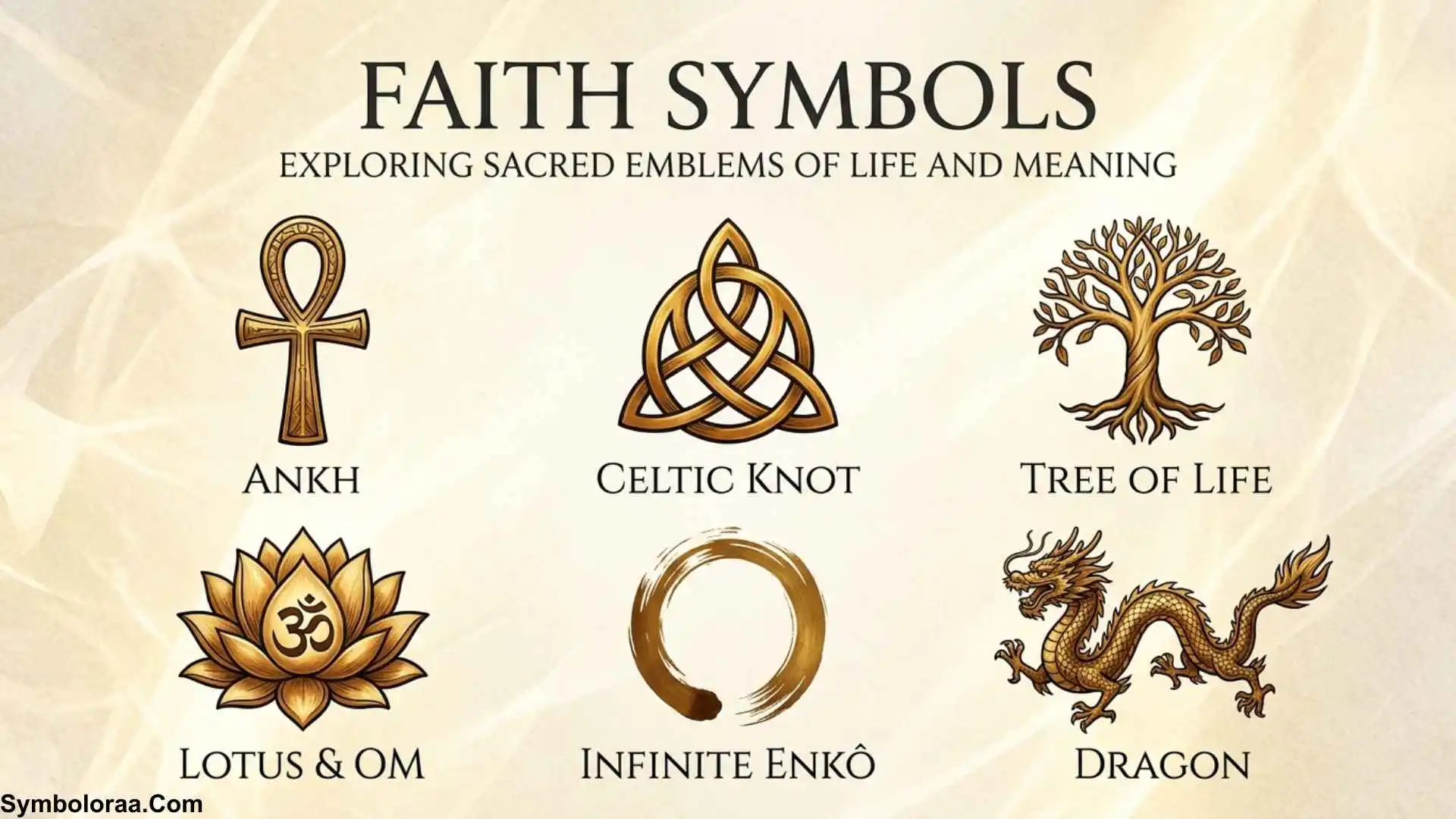
Faith symbols are visual expressions of religious belief, spiritual ideas, identity, tradition, and sacred history. They can be simple shapes, letters, objects, plants, animals, gestures, or artistic designs, yet a single symbol may communicate ideas that would otherwise require pages of explanation.
If you are looking for faith symbols and their meanings, the most useful approach is not simply to memorize a list. The meaning of a symbol depends on the religion, culture, historical period, and context in which it appears. The cross, Star of David, Om, Dharma Wheel, Khanda, lotus, crescent and star, and other symbols are widely recognized, but each has a distinct story.
This guide explains what faith symbols are, why religions use them, the meanings of major religious symbols, how symbols developed historically, how to identify unfamiliar symbols, common misconceptions, and how to use them respectfully.
What Are Faith Symbols?
Faith symbols are visual representations associated with religious beliefs, spiritual practices, sacred traditions, communities, or religious identity. They may appear in places of worship, religious artwork, books, jewelry, clothing, architecture, ceremonies, flags, and everyday objects.
A symbol does not always represent an entire religion. It may instead represent one teaching, story, deity, practice, community, or philosophical idea.
For example, the Christian cross is closely connected with the crucifixion of Jesus Christ and has become a central Christian emblem. The Buddhist Dharma Wheel is connected with the Buddha’s teachings and the Buddhist path. In Hindu and Buddhist art, the lotus can represent spiritual perfection and transformation. The Metropolitan Museum of Art notes that religious imagery and symbolism can contain multiple layers of meaning rather than one simple definition.
Symbol, sign, emblem, and icon: what is the difference?
These words are related but are not always interchangeable.
A symbol represents an idea or concept beyond its literal appearance. A religious symbol might represent faith, salvation, wisdom, purity, protection, or spiritual awakening.
A sign generally communicates information directly. A road sign, for example, tells someone what to do or where to go.
An emblem is a recognizable representation of a group, community, organization, or identity. A religious emblem may therefore become a visual marker of belonging.
An icon can mean a sacred image, especially in Christian traditions, although the word is also used more broadly in modern English. Religious art has long used recognizable visual features to communicate the identity and attributes of sacred figures.
The distinction matters because not every religious image functions in exactly the same way.
Also Check This Post: Emotional Strength Woman Symbols of Strength and Courage That Inspire
Why Do Religions Use Symbols?
Religious symbols can make abstract ideas easier to recognize and remember. They also connect individuals with communities and traditions that may have existed for centuries.
A symbol can serve several purposes at once.
Symbols communicate complex beliefs
A visual design can represent an idea without requiring a long explanation. For example, the cross can immediately evoke central Christian ideas about Jesus, sacrifice, death, resurrection, and salvation.
Similarly, the Dharma Wheel can point readers toward Buddhist teachings and the path of practice rather than merely identifying a Buddhist building.
Symbols preserve history and tradition
Religious symbols often survive through art, architecture, manuscripts, ceremonial objects, and family traditions.
Historical objects demonstrate how symbols were used in real communities. The Metropolitan Museum of Art, for example, documents crosses used in Byzantine religious processions and Christian objects dating back many centuries.
Symbols express religious identity
People may wear, display, draw, or keep a religious symbol because it represents their connection to a faith or community.
However, the presence of a symbol does not always tell you everything about an individual’s beliefs. A person might use a symbol for religious devotion, cultural identity, family heritage, education, art, or personal meaning.
Symbols support religious teaching
Symbols can help communicate teachings to people who encounter them in temples, churches, gurdwaras, synagogues, mosques, homes, books, and works of art.
Religious art often uses a visual vocabulary in which objects, gestures, clothing, colors, animals, and other attributes help identify figures or communicate ideas.
Major Faith Symbols and Their Meanings
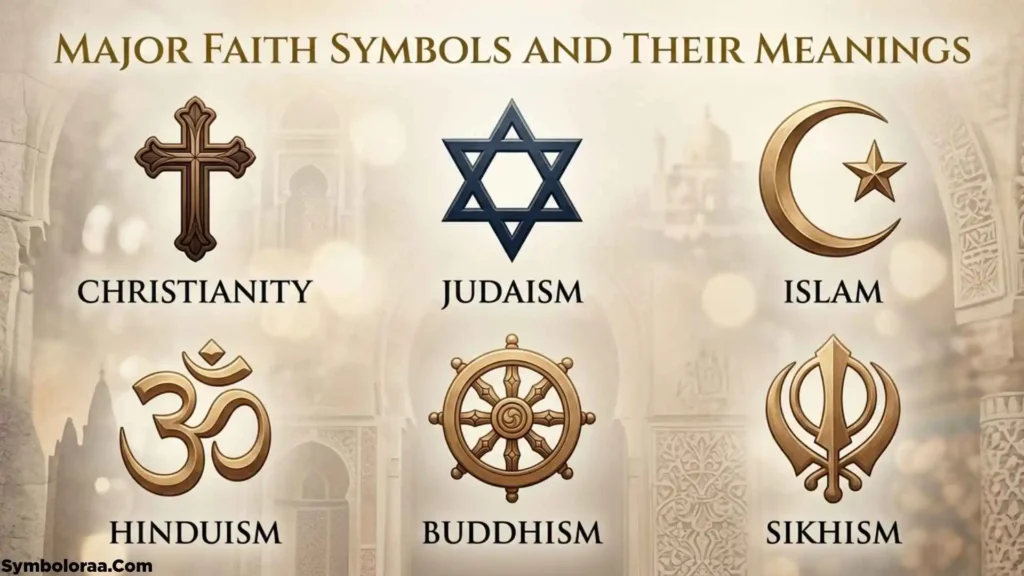
There is no single universal list of faith symbols. Religious traditions contain many symbols, and the importance of a particular symbol can vary between denominations, regions, historical periods, and communities.
The following examples are among the most recognizable.
The Cross: Christianity
Symbol: ✝
The cross is one of the most widely recognized symbols associated with Christianity. Its importance comes primarily from the crucifixion of Jesus Christ.
For Christians, the cross can represent sacrifice, redemption, salvation, death, resurrection, hope, and faith. Different Christian communities use different forms, including the Latin cross, Greek cross, Celtic cross, and crucifix.
The cross also has a long history in Christian visual culture. Museum collections show crosses being used in buildings, clothing, jewelry, domestic objects, processions, and devotional settings. The Metropolitan Museum describes the cross in early Byzantine contexts as a sign associated with Christ’s triumph over death and hope for eternal life.
The Ethiopian Orthodox Tewahedo tradition provides another example of how a cross can develop distinctive regional artistic forms while remaining central to Christian devotion.
Key meaning: Christianity, Christ, sacrifice, resurrection, salvation, and hope.
The Star of David: Judaism
Symbol: ✡
The Star of David, or Magen David, is strongly associated with Jewish identity and Judaism.
It consists of two overlapping triangles that form a six-pointed star. Today it appears in Jewish religious and cultural contexts, including synagogues, artwork, jewelry, community organizations, and the flag of Israel.
One important point is that the symbol’s modern prominence should not be confused with claims that its geometric shape has one universally agreed ancient meaning. Its historical development and adoption as a widespread Jewish identity symbol are more complicated than a simple definition suggests.
Key meaning: Jewish identity, community, tradition, and cultural heritage.
Om: Hinduism
Symbol: ॐ
Om, also written Aum, is a sacred syllable and an important symbol in Hindu traditions.
It is associated with sacred sound, spiritual practice, meditation, and ideas concerning ultimate reality. It can appear in religious texts, temples, artwork, prayer settings, and personal devotional objects.
Hinduism contains diverse philosophical and devotional traditions, so Om should not be reduced to one simplistic definition. The broader Hindu visual tradition includes many symbols, deities, gestures, objects, and forms of sacred imagery.
Key meaning: Sacred sound, spiritual reality, meditation, and Hindu religious tradition.
Dharma Wheel: Buddhism
Symbol: ☸
The Dharma Wheel, or Dharmachakra, is a major Buddhist symbol.
The wheel is associated with the Buddha’s Dharma, meaning his teachings. Its eight-spoked form is commonly connected with the Noble Eightfold Path.
The image of the wheel has particular importance in Buddhist art and teaching. The Metropolitan Museum explains that the wheel can represent the Buddha’s doctrine and the idea of “turning the wheel of the law.”
The symbol is therefore more than a simple identifier for Buddhism. It can represent the teachings themselves and the practitioner’s movement along the Buddhist path.
Key meaning: Buddha’s teachings, Dharma, practice, and the path toward awakening.
The Khanda: Sikhism
Symbol: ☬
The Khanda is strongly associated with Sikhism and Sikh identity.
Its design includes a central double-edged sword, a circular chakkar, and two kirpans. Together, these elements form a recognizable Sikh emblem.
The Khanda can be seen in gurdwaras, Sikh publications, flags, educational materials, and community settings. Its interpretation involves important Sikh ideas concerning spiritual commitment, courage, justice, and responsibility.
Key meaning: Sikh identity, spiritual commitment, courage, justice, and religious tradition.
Crescent and Star: Islamic-Associated Symbolism
Symbol: ☪
The crescent and star is widely recognized around the world as an Islamic-associated symbol. However, describing it as the universal official symbol of Islam is inaccurate.
Its association with Islam developed through historical and political use, especially through the Ottoman Empire and later Muslim-majority states and institutions. Islam itself is not dependent on one universal visual emblem.
This distinction is important because readers often search for “the symbol of Islam” expecting one universally prescribed sign. A more accurate description is that the crescent and star became a powerful cultural and historical symbol associated with Islam in many parts of the world.
Key meaning: A widely recognized Islamic-associated cultural symbol, rather than a universally mandated emblem of Islam.
The Lotus: Hinduism and Buddhism
Symbol: 🪷
The lotus has important meanings in several South Asian religious traditions, particularly Hinduism and Buddhism.
Its growth from muddy water into a clean, beautiful flower makes it a powerful image of purity, transformation, spiritual development, and awakening.
The lotus is especially important in South Asian religious art. The Metropolitan Museum describes it as a major Indian symbol of spiritual perfection and explains how it appears in both Hindu and Buddhist imagery.
The meaning is not identical in every tradition, however. The lotus should be interpreted according to the specific religious and artistic context.
Key meaning: Purity, spiritual development, transformation, and enlightenment.
Yin-Yang: Taoist and Chinese Philosophical Symbolism
Symbol: ☯
The yin-yang symbol is commonly associated with Taoism and Chinese philosophy.
It represents complementary forces and the relationship between apparently opposite aspects of existence. The familiar black-and-white design emphasizes that these forces are interconnected rather than completely separate.
It is often described simply as a “balance symbol,” but that explanation is incomplete. Its philosophical meaning involves complementary relationships, change, interdependence, and the dynamic nature of opposites.
Key meaning: Complementarity, interdependence, change, and balance.
Hamsa: Jewish and Muslim Cultural Traditions
Symbol: 🪬
The Hamsa is a hand-shaped symbol found in Jewish and Muslim cultural traditions, particularly in parts of the Middle East and North Africa.
It is often associated with protection and the idea of guarding against the evil eye. Hamsa designs appear in jewelry, decorative objects, artwork, and architectural contexts.
Its cross-cultural history is particularly useful for understanding why religious symbols cannot always be placed into rigid categories. A symbol can move between communities and acquire different interpretations.
Key meaning: Protection, cultural heritage, and traditions surrounding the evil eye.
Faith Symbols by Religion
The following comparison gives a quick starting point for readers researching symbols associated with major religious traditions.
| Religious tradition | Commonly associated symbol | Main association |
| Christianity | Cross ✝ | Christ, sacrifice, salvation, resurrection |
| Judaism | Star of David ✡ | Jewish identity and tradition |
| Hinduism | Om ॐ | Sacred sound and spiritual reality |
| Buddhism | Dharma Wheel ☸ | Dharma and Buddhist teachings |
| Sikhism | Khanda ☬ | Sikh identity and religious principles |
| Islam | Crescent and star ☪ | Historical and cultural association |
| Taoism | Yin-yang ☯ | Complementary forces and interdependence |
| Hinduism and Buddhism | Lotus 🪷 | Purity and spiritual transformation |
| Jewish and Muslim cultural traditions | Hamsa 🪬 | Protection and cultural tradition |
This table should be treated as a starting point, not a complete catalog. Many faiths have numerous symbols, and some traditions deliberately avoid reducing their beliefs to a single emblem.
Religious Symbols Can Have More Than One Meaning
One of the biggest mistakes when researching faith symbols is assuming that every symbol has one fixed definition.
A symbol’s meaning can change according to:
- Religious tradition
- Denomination or school
- Historical period
- Geographic region
- Artistic context
- Religious ceremony
- Cultural use
- Personal interpretation
The lotus is a good example
The lotus appears in Hindu and Buddhist traditions, but its exact symbolism depends on the context. It can communicate purity, spiritual growth, divine beauty, enlightenment, or other related ideas.
The wheel is another example
The wheel appears in different South Asian traditions and does not always mean exactly the same thing. The Metropolitan Museum notes that the chakra has multiple layers of meaning: in Buddhist contexts it relates to the Buddha’s teachings, while in Hindu thought the wheel can relate to time, cosmic cycles, and the attributes of particular deities.
This is why a good explanation should always answer two questions:
What does the symbol look like?
and
What does it mean in this particular religious context?
How Faith Symbols Developed Through History
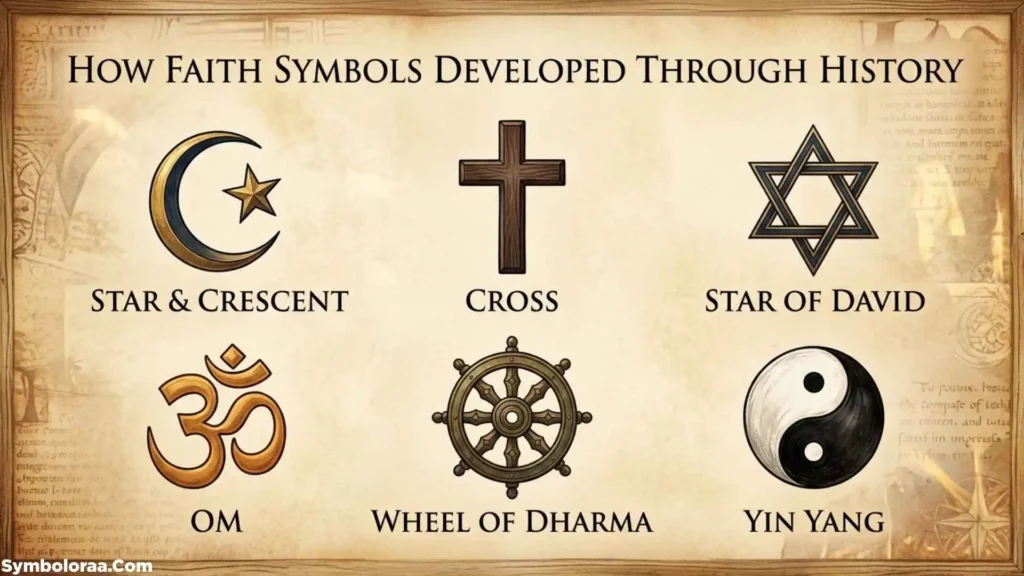
Religious symbols developed through long processes rather than appearing as complete modern designs overnight.
Religious art, architecture, manuscripts, sculpture, textiles, jewelry, ceremonial objects, and public monuments all helped preserve and transform symbolic traditions.
Ancient traditions influenced later religious art
South Asian religious art provides a strong example. Hindu, Buddhist, and Jain traditions developed rich visual systems in which posture, gesture, objects, clothing, animals, plants, and other attributes could identify sacred figures or express concepts.
The Metropolitan Museum notes that Buddhist and Hindu iconography contains a complex visual language in which symbols and attributes help communicate religious ideas.
Christianity developed diverse symbolic traditions
Christian symbolism also developed differently across regions and historical periods.
Byzantine crosses, Ethiopian crosses, Western crucifixes, Celtic crosses, and other forms show that a common religious symbol can acquire distinctive local artistic styles.
For example, Ethiopian crosses developed highly recognizable forms and became important cultural and devotional objects within the Ethiopian Orthodox Tewahedo Church.
Religious art has not always been universally accepted
It is also incorrect to assume that every religious tradition has always agreed about sacred imagery.
Christian history includes debates over icons and religious images. Smarthistory’s discussion of Christian icons explains that disagreements over sacred images became especially intense during the Byzantine Iconoclastic Controversy.
This demonstrates an important principle: a religious symbol can be important while the use of religious images remains debated within the same tradition.
Faith Symbols vs. Religious Icons
Faith symbols and religious icons overlap, but they are not identical.
A cross can function as a symbol without being an icon in the technical sense. A painted image of Christ used within an Orthodox Christian devotional context can function as an icon.
The distinction becomes important when discussing religious art because an icon may have a specific theological and devotional role rather than merely serving as a visual logo.
In some traditions, sacred images are understood as more than representations. Smarthistory notes that Christian debates about icons involved questions about whether sacred images could appropriately represent divine realities.
Also Check This Post: 63+ Antique Symbols Stamped on Jewelry: The Best Guide for Collectors
Faith Symbols in Religious Art and Architecture
Religious symbols are especially visible in architecture and art because sacred spaces provide a natural setting for visual storytelling.
They can appear on:
- Church walls and crosses
- Synagogue artwork and ceremonial objects
- Hindu temple sculptures
- Buddhist temples and manuscripts
- Gurdwara decorations
- Islamic architectural and decorative traditions
- Religious jewelry
- Prayer objects
- Flags and banners
- Tombs and memorials
- Religious books
In many cases, the surrounding imagery is just as important as the central symbol.
For example, a Hindu deity may be identified not only by the figure itself but also by particular objects, gestures, vehicles, clothing, and attributes. The Metropolitan Museum’s educational material explains how these elements form part of the visual language of South Asian religious art.
How to Identify an Unfamiliar Faith Symbol
If you see an unfamiliar religious symbol, do not immediately rely on a generic symbol chart. Context can make identification much more accurate.
Start with the visual features
Look closely at the shape.
Ask whether it contains:
- A cross
- A circle
- A wheel
- A star
- A hand
- A letter or sacred character
- A flower
- A weapon
- An animal
- A geometric pattern
These features can narrow down possibilities.
Examine where the symbol appears
Location provides important evidence.
A symbol found in a Buddhist temple may have a different interpretation from a similar-looking design found in a Hindu temple. A symbol on a historical manuscript may also have a different meaning from a modern decorative version.
Identify the religious and cultural context
Ask:
- Which country or region is associated with the object?
- Which religion or community uses the building?
- Is the object ceremonial, decorative, or educational?
- Does the symbol appear alongside other recognizable symbols?
- Does a reliable museum, university, religious institution, or historical source identify it?
Verify the meaning before sharing it
This is especially important for websites, educational assignments, tattoos, artwork, jewelry designs, and social media posts.
A quick image search may identify the appearance of a symbol, but it does not necessarily establish its historical meaning. Museum collections and university resources can provide stronger context.
A Simple Decision Guide for Identifying Faith Symbols
Use this quick decision process when you are unsure what a symbol means.
Do you know the religious tradition?
→ Yes: Research the symbol within that specific tradition rather than using a general symbol list.
→ No: Identify the location, surrounding imagery, language, and artistic style first.
Does the symbol appear in more than one tradition?
→ Yes: Compare its meanings in each tradition.
→ No: Examine its historical development and modern use.
Are sources giving conflicting meanings?
→ Yes: Prefer museum, university, scholarly, or official religious sources and explain the disagreement.
→ No: Present the commonly supported meaning while noting important context.
This approach is more reliable than assuming that every symbol has one universal definition.
Common Mistakes People Make When Researching Faith Symbols
Mistake 1: Treating every symbol as an official religious emblem
Not every symbol commonly associated with a religion is formally required by that religion.
The crescent and star is a particularly useful example. It is widely recognized as an Islamic-associated symbol, but it should not automatically be presented as Islam’s universally official emblem.
Mistake 2: Giving one meaning to a symbol used by several traditions
A lotus, wheel, hand, or other symbol may appear across different cultures.
Its meaning should be explained according to the specific tradition and context.
Mistake 3: Confusing modern popularity with ancient origin
A symbol can become popular in modern culture without having exactly the same meaning in its earliest historical context.
Historical claims therefore need evidence rather than assumptions.
Mistake 4: Treating decorative use as proof of religious belief
A person wearing a symbol does not necessarily indicate a particular theological position.
Jewelry, tattoos, fashion, artwork, and cultural decoration can have different purposes.
Mistake 5: Ignoring differences within religions
Large religious traditions are internally diverse. Practices and interpretations can vary among denominations, schools, communities, and regions.
A responsible article should avoid claiming that every believer understands a symbol in precisely the same way.
How to Use Faith Symbols Respectfully
Religious symbols can carry deep emotional, historical, and spiritual significance. If you are using one in design, education, jewelry, artwork, clothing, or digital content, research its context first.
For educational projects
Identify the religion, explain the symbol’s meaning, and distinguish established historical facts from modern interpretations.
For graphic design
Check whether the symbol has sacred or ceremonial significance before using it purely as decoration. Avoid altering an important religious symbol in a way that could misrepresent its meaning.
For jewelry or clothing
Consider whether the symbol is commonly worn, displayed, or reserved for particular religious contexts. A design that looks decorative to one person may have serious spiritual meaning to another.
For tattoos
Research the symbol’s original meaning, language, orientation, spelling, and cultural context carefully. A small design error can change the appearance or meaning of a sacred symbol.
For websites and social media
Do not present uncertain claims as facts. If a symbol has multiple interpretations, explain the variation instead of choosing the most sensational definition.
Are Faith Symbols the Same as Spiritual Symbols?
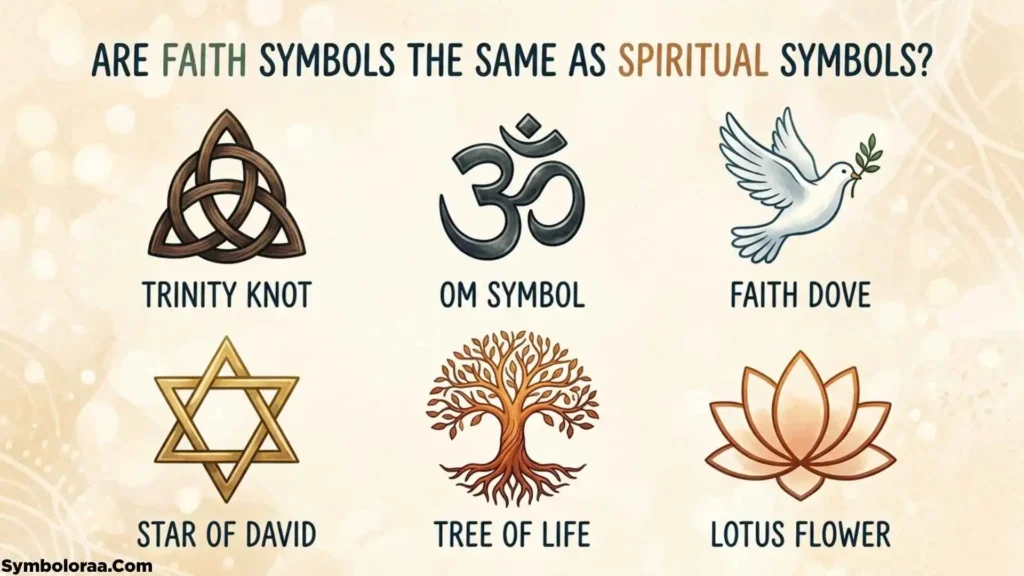
Not necessarily.
A religious symbol is generally connected with a particular faith tradition, religious community, teaching, or practice.
A spiritual symbol can have a broader meaning and may be used by people who do not identify with a specific organized religion.
There can be overlap. The lotus, for example, may be used in explicitly religious Buddhist or Hindu contexts and also in modern spiritual settings.
The safest approach is to describe the symbol according to its actual context rather than assuming that “religious” and “spiritual” mean exactly the same thing.
Do All Religions Have a Single Main Symbol?
No.
Some religious traditions are strongly identified with one widely recognized symbol, while others have many important symbols or place less emphasis on visual emblems.
Even when one symbol is highly recognizable, it may represent only one aspect of the religion.
This is why lists titled “the symbol of every religion” can be misleading if they imply that each religion has one official image.
Why Context Matters More Than Appearance
Two symbols can look similar but carry completely different meanings. Conversely, the same symbol can be used by different communities for related but distinct purposes.
Consider the wheel. In Buddhist contexts it can represent Dharma and the Buddha’s teachings, while the chakra has other meanings in Hindu traditions.
The lesson is simple:
Never identify a religious symbol by appearance alone when historical accuracy matters.
Look at the symbol, the surrounding imagery, the culture, the location, and the religious tradition together.
Frequently Asked Questions About Faith Symbols
What are the most common faith symbols?
Some of the most widely recognized include the Christian cross, Star of David, Hindu Om, Buddhist Dharma Wheel, Sikh Khanda, lotus, yin-yang, and crescent and star. Their levels of religious importance vary, so “common” does not necessarily mean “official.”
What is the symbol of faith?
There is no single universal symbol representing all faith. Different religions and spiritual traditions have their own symbols, while some people use broader images such as a heart, light, dove, lotus, or other spiritual imagery to express faith.
What symbol represents belief in God?
There is no universal symbol for belief in God. The appropriate symbol depends on the religious tradition. Christianity, Judaism, Islam, Hindu traditions, and other faiths express belief through different symbols, texts, practices, and forms of art.
What is a symbol of spirituality?
There is no universally accepted symbol of spirituality. The lotus, Om, mandala, light, tree, and other images are sometimes used in spiritual contexts, but their meanings depend on the tradition and the person using them.
What is the oldest religious symbol?
There is no single answer because “religious symbol” covers many types of objects and traditions, and prehistoric evidence can be difficult to interpret. A mark or object may be symbolic without researchers being able to prove exactly what religious meaning its creators intended.
Is the cross only a Christian symbol?
The cross has been used in many cultures and contexts, but its most prominent modern religious association is with Christianity. Within Christianity, different cross forms developed across regions and historical periods.
Is the crescent and star the official symbol of Islam?
No, it is better described as a widely recognized Islamic-associated cultural and historical symbol. It is not a universal religious emblem required by Islam.
Why is the lotus important in religion?
The lotus is important in several South Asian traditions because its growth from muddy water into a beautiful flower provides a powerful metaphor for purity, transformation, spiritual development, and awakening.
What does the Dharma Wheel represent?
The Dharma Wheel represents the Buddha’s teachings, or Dharma. Its eight spokes are commonly associated with the Noble Eightfold Path.
What does the Khanda represent?
The Khanda is a major symbol of Sikh identity. Its components are traditionally interpreted in relation to Sikh principles such as spiritual commitment, courage, justice, and responsibility.
Can one symbol belong to multiple religions?
Yes. Some symbols have been used by multiple religious or cultural traditions. Their meaning may change according to context, history, and community.
Why do some religions use images while others limit religious imagery?
Religious traditions have different theological views about images, representations, and sacred art. Even within one religion, views can change across time and communities. Christian history, for example, includes major debates over the use of icons and sacred images.
Key Takeaways
- Faith symbols visually communicate religious, spiritual, cultural, and historical ideas.
- A symbol’s meaning depends heavily on context.
- The cross is strongly associated with Christianity and the life, death, and resurrection of Jesus.
- The Star of David is strongly associated with Jewish identity.
- Om is an important sacred symbol and syllable in Hindu traditions.
- The Dharma Wheel represents Buddhist teachings and the path of practice.
- The Khanda is strongly associated with Sikh identity.
- The crescent and star is widely associated with Islam but is not a universal official emblem of Islam.
- The lotus has important symbolic meanings in Hindu and Buddhist traditions.
- Yin-yang is associated with Taoist and Chinese philosophical ideas of complementary forces.
- Some symbols cross religious and cultural boundaries.
- Historical and cultural context is essential when identifying a religious symbol.
- A symbol commonly used today may not have had exactly the same meaning in its earliest historical use.
- Reliable museum, university, scholarly, and religious sources are preferable when verifying disputed claims.
Conclusion
Faith symbols are much more than decorative images. They are part of the visual language through which religious communities preserve history, communicate teachings, express identity, and represent ideas about spirituality and human existence.
The most important lesson is that there is rarely a single meaning that applies to every use of a religious symbol. The cross, Om, Star of David, Dharma Wheel, Khanda, lotus, crescent and star, and other symbols become much easier to understand when their historical and cultural context is considered.
If you are researching a symbol for an article, school project, artwork, jewelry, tattoo, religious study, or design project, start with the symbol’s appearance but do not stop there. Identify the tradition, investigate its history, compare reliable sources, and determine whether the modern meaning differs from its historical use.
That approach produces a more accurate understanding of faith symbols and helps prevent the common mistake of turning complex religious traditions into oversimplified definitions.
Also Check This Post: 75+ Bravery Symbols: Powerful Designs and Their Meanings

I’m Jackson Miller, an American author inspired by mystery, adventure, and the unpredictable nature of life. I enjoy writing fast-moving stories filled with memorable characters, unexpected choices, and meaningful moments. Through my books, I want readers to experience new worlds while discovering something about courage, determination, and themselves.
Three Books:
The Edge of Tomorrow
Under a Broken Sky
The Road We Chose
 Madison Reed