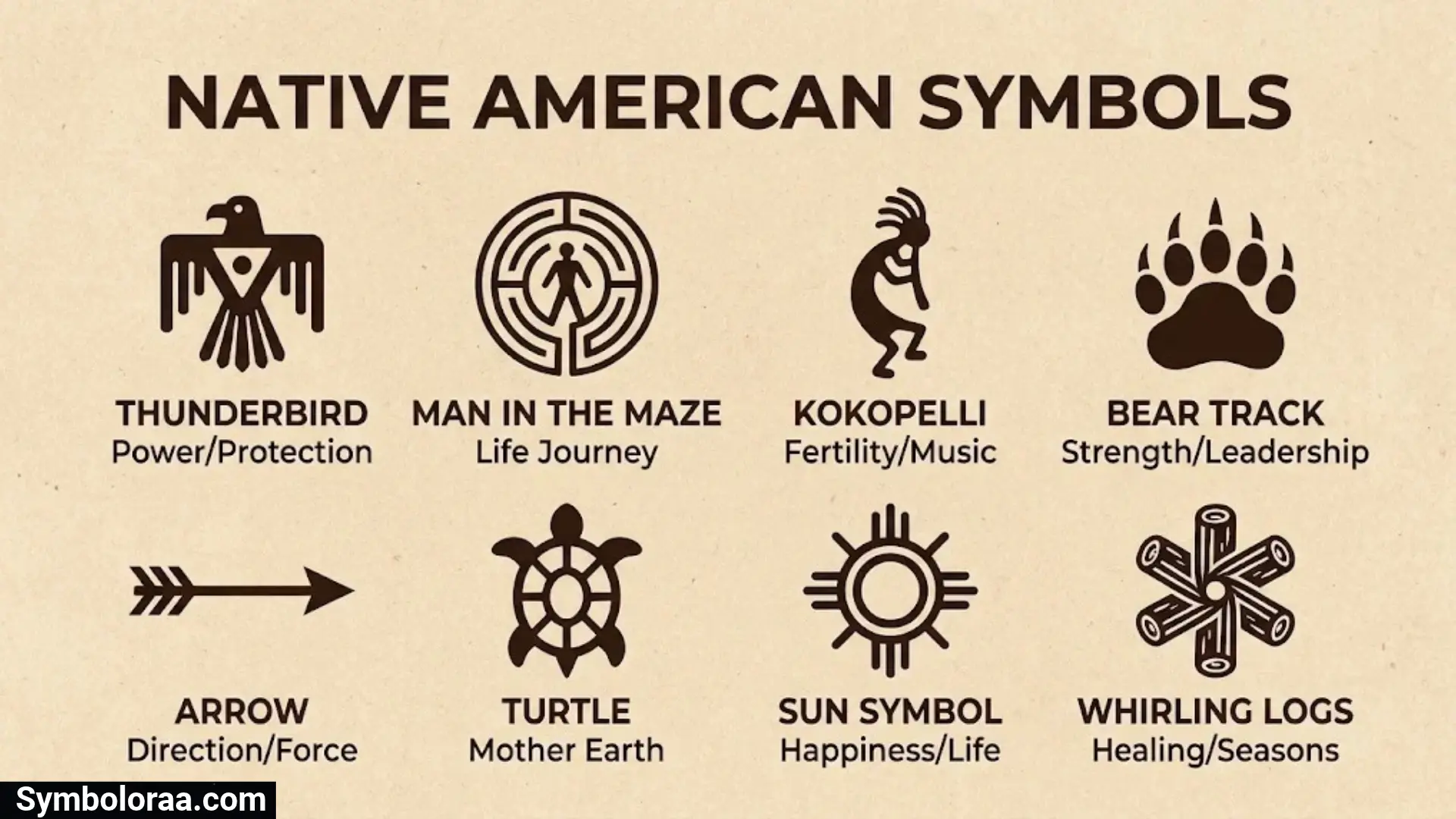
Native American symbols carry stories about nature, spirituality, animals, community, and the relationship between people and the world around them. For generations, Indigenous nations have used symbols in pottery, clothing, beadwork, ceremonial objects, rock markings, architecture, and storytelling.
Many designs represent important ideas such as protection, strength, wisdom, courage, balance, healing, and unity. Others connect people with animals, ancestors, natural elements, sacred places, and spiritual traditions.
However, Native American cultures don’t share one universal symbol system. Each Indigenous nation has its own languages, histories, beliefs, artistic traditions, and interpretations. A design that carries one meaning within a particular community may represent something different elsewhere.
This guide explores more than Native American symbols and their commonly discussed associations. It also explains their cultural backgrounds, regional differences, historical uses, and significance today.
What Are Native American Symbols?
Native American symbols are visual designs, markings, objects, and patterns that communicate cultural, spiritual, historical, or practical ideas within Indigenous communities.
These symbols appear in many forms, including:
- Petroglyphs: Images carved, pecked, or scratched into rock surfaces.
- Pictographs: Images painted onto rock using natural pigments.
- Geometric patterns: Lines, circles, diamonds, spirals, and repeated shapes.
- Animal figures: Representations of creatures connected with local environments, stories, and cultural traditions.
- Ceremonial designs: Images used on objects, clothing, masks, and other materials associated with particular ceremonies.
- Clan symbols: Images that identify family groups, communities, or inherited relationships.
- Writing systems: Written characters and syllabic systems developed by particular Indigenous nations.
Native American symbols can communicate much more than a simple definition. Their meanings may depend on the artist, community, location, materials, historical period, and intended purpose.
For example, an eagle image might represent an important relationship with the natural world in one context. In another, it may appear as part of a specific ceremonial or artistic tradition.
You should always consider the cultural background before assigning a meaning to an Indigenous design.
Native American Symbols and Their Meanings Chart
The following chart introduces common symbols and the ideas people often associate with them. These descriptions provide general context rather than universal definitions.
| Symbol | Commonly Associated Meaning |
| Medicine Wheel | Balance, directions, relationships, and the cycles of life |
| Thunderbird | Powerful spiritual presence and natural forces in certain traditions |
| Kokopelli | Southwestern flute-player figure associated with several interpretations |
| Katsina | Spiritual beings and relationships between people and the sacred world |
| Man in the Maze | Life’s journey and choices in a particular O’odham tradition |
| Yei figures | Sacred beings and ceremonial traditions among the Diné |
| Whirling Log | A traditional design with meanings that depend on its cultural context |
| Bear | Strength, power, and relationships with the natural world |
| Eagle | Spiritual importance, vision, and respect |
| Wolf | Social relationships, loyalty, and animal knowledge |
| Buffalo | Sustenance, community, and the importance of bison |
| Turtle | Earth, creation stories, and longevity in some traditions |
| Raven | Transformation, intelligence, and culture-hero stories in some Northwest Coast traditions |
| Coyote | Trickster stories, lessons, and transformation |
| Salmon | Food, seasonal cycles, and cultural relationships |
| Orca | Family, community, and marine life in some Northwest Coast traditions |
| Owl | Knowledge, night, and meanings that vary by community |
| Hummingbird | Beauty, movement, and relationships with flowering plants |
| Butterfly | Transformation and natural cycles |
| Spider | Creativity, weaving, and storytelling in some traditions |
| Snake | Renewal, power, and different spiritual associations |
| Frog | Water, seasonal change, and local ecological relationships |
| Sun | Light, warmth, time, and life |
| Moon | Night, cycles, and the passage of time |
| Morning Star | Dawn, celestial observation, and particular cultural traditions |
| Rainbow | Weather, color, and spiritual associations in some communities |
| Corn | Agriculture, nourishment, and community |
| Water | Life, purification, and the natural environment |
| Rain Cloud | Rainfall, agriculture, and seasonal change |
| Cactus | Desert environments and survival |
| Mountains | Homeland, geography, and sacred landscapes |
| Tree | Growth, continuity, and relationships with the environment |
| Fire | Warmth, transformation, and ceremonial uses |
| Spiral | Movement, journeys, and other interpretations depending on context |
| Circle | Wholeness, cycles, and relationships |
| Arrow | Hunting, direction, and practical or artistic meanings |
| Crossed Arrows | Meanings that depend on the community and design |
| Broken Arrow | Interpretations that vary; not a universal peace symbol |
| Arrowhead | Hunting tools, technology, and historical material culture |
| Drum | Music, community, and ceremonial traditions |
| Eagle Feather | Respect and important cultural or ceremonial relationships |
| Totem Pole | Family histories, crests, ancestors, and community narratives |
| Mask | Ceremonial roles, identities, and spiritual relationships |
| Beadwork | Identity, artistic skill, history, and cultural expression |
| Pipe | Sacred relationships and specific ceremonial traditions |
| Prayer Stick | Ceremonial practices in certain Southwestern communities |
The chart is a starting point, not a dictionary of fixed meanings. Some designs are sacred, and their full interpretations may belong within the communities that maintain them.
Spiritual and Sacred Native American Symbols
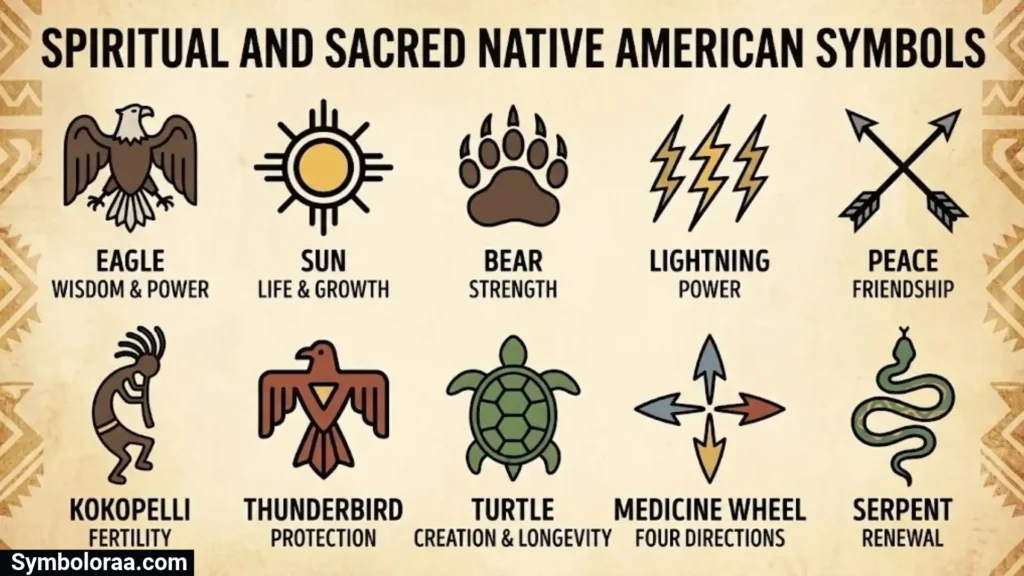
Spiritual symbols hold an important place in many Indigenous traditions. They can express relationships with the land, ancestors, natural forces, sacred beings, and community responsibilities.
Their forms and meanings differ across North America. The following examples highlight several well-known traditions.
Medicine Wheel
The Medicine Wheel, also called the Sacred Hoop in some contexts, is one of the most recognized Indigenous symbols.
It often appears as a circle divided into four sections. Some versions use four colors, while others include additional elements or arrangements.
People commonly connect the Medicine Wheel with:
- The Four Directions
- The cycles of life
- Seasonal changes
- Balance and harmony
- Relationships between people and nature
- Physical, emotional, mental, and spiritual well-being
Some interpretations connect the directions with particular colors, animals, seasons, or stages of life. However, these associations vary among Indigenous nations.
The Medicine Wheel is especially important in several Plains traditions. You shouldn’t assume every Native American community uses the same design or interpretation.
Thunderbird
The Thunderbird is a powerful supernatural bird found in the traditional stories of several Indigenous peoples, particularly in parts of the Great Lakes and Northwest Coast regions.
Artists may depict it with large wings, a strong beak, and dramatic features. Some stories connect the Thunderbird with thunder, lightning, storms, and powerful spiritual forces.
Its appearance and meaning differ between communities. In some traditions, the Thunderbird has relationships with other supernatural beings and the natural world.
The image also appears in contemporary Indigenous artwork, carving, and storytelling.
Kokopelli
Kokopelli is a recognizable flute-player figure associated with ancient and contemporary artistic traditions of the American Southwest.
Artists often portray this figure with a curved back, a flute, and an expressive posture. Some modern interpretations connect Kokopelli with fertility, music, agriculture, renewal, and seasonal change.
However, these meanings aren’t identical across Southwestern cultures. The figure’s history, interpretation, and use require attention to its particular cultural setting.
Kokopelli imagery appears in pottery, jewelry, decorative artwork, and tourism-related designs. Not every modern representation reflects a traditional ceremonial meaning.
Katsina Symbols
Katsina, also written as Kachina in older English-language usage, refers to spiritual beings and related traditions among Hopi and other Pueblo communities.
Katsinas can be represented through ceremonial dances, songs, masks, and carved figures. These traditions connect communities with spiritual beings and relationships involving rain, crops, health, and community well-being.
Carved Katsina figures are often called Katsina dolls in English. They have traditionally served as teaching objects and gifts that help children learn about Katsina beings.
A Katsina figure isn’t simply a decorative toy. It belongs to a much wider cultural and spiritual tradition.
Man in the Maze
The Man in the Maze is a well-known design associated with the Tohono O’odham and other O’odham cultural contexts.
It generally features a human-like figure near the entrance of a maze. The paths move through a series of turns toward a central point.
Some interpretations connect the design with life’s journey, personal choices, challenges, and the lessons people gain through experience.
The maze can also carry cultural meanings that go beyond popular explanations found in commercial artwork.
You may see this design on jewelry, pottery, prints, and decorative objects. Its specific significance should be understood through O’odham cultural knowledge.
Yei and Yei Bi Chei
Yei figures are associated with Diné (Navajo) spiritual traditions. The term refers to sacred beings connected with particular ceremonial practices.
Diné sandpainting designs may include Yei figures, mountains, plants, animals, and other important elements. These designs form part of healing ceremonies and are created according to established cultural practices.
Yei Bi Chei imagery also appears in Diné artistic traditions. The figures may be represented in ceremonial scenes and other forms of artwork.
Diné sandpaintings are not simply decorative patterns. Their creation, use, and interpretation belong to specific ceremonial contexts.
Whirling Log
The Whirling Log is a traditional design found in some Southwestern Indigenous artistic contexts.
It may resemble a cross with bent arms or a turning geometric figure. Its interpretations depend on the specific community, object, and historical setting.
The design has appeared in pottery and other traditional artwork. However, it requires an important historical distinction: similar-looking shapes can carry very different meanings in different cultures.
The Whirling Log has an Indigenous history that predates its later appropriation by extremist movements. It should not automatically be confused with the Nazi swastika or assigned one universal meaning.
Sisiutl
Sisiutl is a powerful supernatural being in the traditions of some Northwest Coast peoples, including Kwakwaka’wakw communities.
Artists often depict Sisiutl as a double-headed serpent with a central face. Its appearance may include elaborate curves, symmetrical heads, and distinctive forms associated with Northwest Coast visual traditions.
Sisiutl can appear in ceremonial objects, masks, carvings, and other cultural works. Its meaning depends on the specific tradition and context.
Komokwa
Komokwa is a supernatural figure associated with wealth and the underwater world in Kwakwaka’wakw traditions.
Artistic representations may include marine creatures and other imagery connected with the sea. Stories about Komokwa form part of a broader body of Northwest Coast oral traditions.
The figure’s cultural significance is more complex than a simple symbol of money or prosperity.
Dzunukwa
Dzunukwa, also known as Tsonoqua in some spellings, is a supernatural figure in Kwakwaka’wakw traditions.
Artists commonly portray her with distinctive facial features and a strong visual presence. Stories about Dzunukwa can involve children, forests, and relationships between human and supernatural worlds.
Her appearance in masks, carvings, and ceremonial art connects the figure with specific cultural narratives.
Bukwus
Bukwus, sometimes called the Wild Man of the Woods, appears in certain Northwest Coast traditions.
Stories describe a mysterious being associated with the forest and the boundary between ordinary and supernatural worlds.
Bukwus imagery may appear in masks and ceremonial performances. Its role should be understood through the cultural traditions in which it appears.
Native American Animal Symbols and Their Meanings
Animals have important roles in Indigenous storytelling, art, food systems, ceremonies, and relationships with the natural world.
However, no animal has one meaning shared by every Native American nation. Local environments and cultural teachings influence how communities understand particular animals.
Bear Symbol
The bear appears in the stories, art, and traditions of many Indigenous communities.
People often associate bears with strength, protection, courage, and physical power. Some traditions also connect bears with healing, leadership, or relationships between humans and animals.
Bear imagery appears in carvings, pottery, clothing, and other artistic forms.
Eagle Symbol
The eagle holds deep cultural and spiritual importance in many Indigenous communities.
Its ability to fly high has inspired associations with vision, strength, and relationships between the earthly and spiritual worlds.
Eagle feathers also carry significant cultural and ceremonial importance in various nations. Their use follows community-specific traditions and responsibilities.
An eagle design should not be treated as a generic decoration without considering its cultural background.
Wolf Symbol
The wolf appears in many Indigenous stories and artistic traditions.
Common interpretations connect wolves with family relationships, cooperation, intelligence, and survival. Their social behavior can also provide lessons about responsibility and community.
Some traditions feature wolves in creation stories, origin narratives, and teachings about the natural world.
Buffalo and Bison Symbol
The buffalo, more accurately called the American bison, has enormous historical and cultural importance for many Plains nations.
Bison provided food, clothing materials, shelter resources, tools, and other necessities. Their importance extended beyond practical survival.
Buffalo imagery can represent abundance, community, sustenance, and relationships with the land.
For many Plains communities, the bison also remains an important part of cultural identity and historical memory.
Turtle Symbol
The turtle appears in important creation stories among several Indigenous peoples.
In some Eastern Woodlands traditions, the turtle connects with the creation of land and the concept of Turtle Island. This name is used by some Indigenous people when referring to North America.
Turtle imagery can also connect with longevity, protection, patience, and relationships with water.
However, specific stories and meanings vary between nations.
Raven Symbol
The raven plays a major role in many Northwest Coast traditions.
Some stories portray Raven as a trickster, transformer, or culture hero. In certain narratives, Raven helps bring important things into the world or changes the way people experience it.
Raven artwork often features a curved beak and distinctive forms associated with Northwest Coast design.
Coyote Symbol
The coyote appears in storytelling traditions across several Indigenous regions.
Coyote stories may explore intelligence, foolishness, transformation, mistakes, and the consequences of human behavior.
As a trickster figure, Coyote can challenge expectations and teach lessons through humor or surprising events.
The character’s role changes significantly between communities.
Snake Symbol
The snake carries different meanings in Indigenous traditions.
Some communities associate snakes with renewal, transformation, water, or spiritual power. Other stories connect particular snake beings with dangerous forces or sacred responsibilities.
Snake designs appear in pottery, textiles, rock markings, and ceremonial artwork.
You should avoid treating every snake symbol as a universal sign of healing or rebirth.
Salmon Symbol
The salmon is especially important among many Indigenous communities of the Pacific Northwest.
Salmon provide food and connect with seasonal fishing practices, trade, community gatherings, and cultural traditions.
Some communities maintain ceremonies and teachings that express respect for salmon and the relationship between people, rivers, and the natural environment.
Salmon imagery can therefore represent more than food. It may express cultural continuity and responsibility toward natural resources.
Orca Symbol
The orca, also called the killer whale, holds significance in some Northwest Coast traditions.
Orca imagery can connect with family, community, the sea, and particular clan histories. In some cultural settings, orcas appear in crests and ceremonial artwork.
Their artistic representation varies among Northwest Coast nations.
Owl Symbol
The owl appears in Indigenous stories and artwork across different regions.
Its associations vary widely. Some traditions connect owls with nighttime, knowledge, warnings, or spiritual messages. Others give the bird different roles in stories and teachings.
An owl tattoo or design doesn’t automatically carry one traditional Native American meaning.
Hummingbird Symbol
The hummingbird is a small but visually striking bird that appears in various Indigenous artistic traditions.
People may associate hummingbirds with movement, beauty, flowers, and the natural environment. In some regional traditions, hummingbirds also appear in stories with deeper cultural meanings.
The significance depends on the community and the particular representation.
Butterfly Symbol
The butterfly appears in Indigenous artwork and storytelling in several regions.
Its life cycle can inspire associations with change and transformation. Its colors and movement also make it a common subject in decorative art.
However, modern descriptions of butterfly symbols shouldn’t automatically be presented as ancient teachings shared by every nation.
Spider Symbol
The spider appears in important stories and traditions among several Indigenous peoples.
Some traditions connect spiders with weaving, creativity, storytelling, and protection. Spider Woman, for example, has an important place in certain Southwestern cultural narratives.
Spider imagery may also appear in pottery, textiles, and other forms of artistic expression.
Frog Symbol
The frog connects with water, wetlands, seasonal change, and local environments.
Some Indigenous traditions include frogs in stories about rain, transformation, or relationships with water. Their presence in artwork may also reflect the importance of nearby ecosystems.
The meaning of a frog design depends on its cultural and artistic context.
Native American Nature Symbols
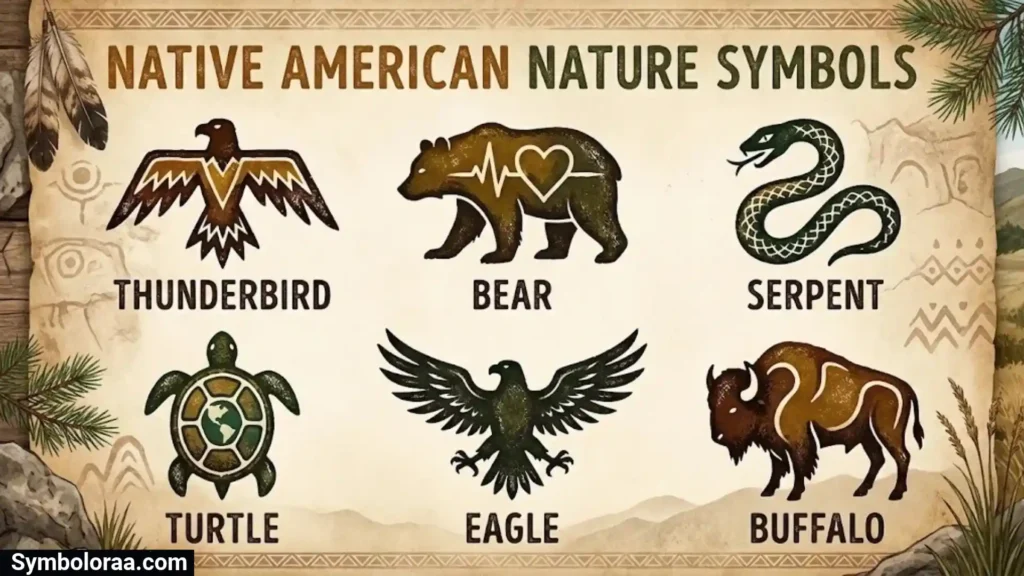
Nature plays a central role in many Indigenous cultural traditions. Symbols inspired by the sun, moon, water, plants, mountains, and weather can communicate relationships with the environment.
These images may appear in pottery, beadwork, rock markings, clothing, and ceremonial objects.
Sun Symbol
The sun represents an important natural force in many Indigenous traditions.
It provides warmth, light, and energy. Some communities also connect the sun with time, seasonal changes, agriculture, and spiritual relationships.
Sun designs may feature circles, rays, faces, or other geometric details.
Their meanings depend on the specific nation and artwork.
Moon Symbol
The moon is associated with nighttime, natural cycles, and the measurement of time in many cultures.
Indigenous communities have developed their own lunar knowledge and seasonal calendars. These systems can connect with hunting, fishing, agriculture, and ceremonial activities.
Moon imagery may also appear in stories and artistic designs.
Morning Star Symbol
The Morning Star refers to the bright appearance of Venus in the sky before sunrise.
Celestial observations have influenced the traditions of several Indigenous nations. In some Plains traditions, the Morning Star carries important spiritual and ceremonial significance.
The symbol may connect with the sky, dawn, and particular stories or ceremonies.
Its meaning should be linked to the specific nation rather than generalized across all Indigenous cultures.
Rainbow Symbol
The rainbow appears in many Indigenous stories and artistic traditions.
Its connection with rain, sunlight, and changing weather makes it an important natural image. Some traditions also connect rainbows with spiritual beings, protection, or relationships between different worlds.
The design can feature curved bands, repeated colors, or geometric patterns.
Corn Symbol
Corn is one of the most important agricultural plants in many Indigenous communities, especially in parts of the Southwest and Eastern Woodlands.
Corn has provided food and supported community life for generations. It also appears in creation stories, ceremonies, artwork, and seasonal traditions.
Corn imagery may represent nourishment, agriculture, fertility, and cultural continuity.
In some communities, corn belongs to a wider agricultural tradition involving beans and squash.
Water Symbol
Water is essential to life and has important cultural significance throughout Indigenous North America.
Rivers, lakes, springs, oceans, and rain support communities, wildlife, farming, and travel. Water can also hold spiritual and ceremonial importance.
Artists may represent water through wavy lines, flowing patterns, blue colors, or images of aquatic animals.
Its meaning depends on the local environment and cultural teachings.
Rain Cloud Symbol
Rain clouds are important in agricultural traditions, particularly in regions where rainfall supports crops and community life.
Southwestern Indigenous artwork may include cloud terraces and rain-related imagery. Such designs can connect with agriculture, seasonal weather, and ceremonial traditions.
Some cloud designs are associated with particular Pueblo communities and should not be treated as universal symbols.
Cactus Symbol
The cactus reflects the environments of the American Southwest.
Cacti survive in dry conditions and provide resources for certain desert communities. Their appearance in artwork can connect with local plants, landscapes, and regional identity.
Some modern interpretations associate cactus designs with endurance and survival. These descriptions shouldn’t replace specific cultural explanations.
Mountain Symbol
Mountains can hold deep cultural significance for Indigenous communities.
They may serve as landmarks, sources of water, ceremonial places, or important features in creation stories. Certain mountains also form part of the sacred geography of specific nations.
Diné traditions, for example, recognize sacred mountains as important elements of their understanding of homeland and the world.
Tree Symbol
Trees provide food, shelter, medicine, materials, and habitats for wildlife.
Some Indigenous traditions connect trees with life, continuity, ancestors, or relationships between different parts of the natural world.
The exact meaning depends on the species, region, and cultural context.
Fire Symbol
Fire has practical, social, and ceremonial roles in many Indigenous communities.
It provides warmth, helps prepare food, and supports community gatherings. Certain ceremonies also involve specific relationships with fire.
Fire imagery may represent transformation, energy, warmth, or renewal in modern artistic interpretations.
Geometric Native American Symbols and Patterns
Geometric designs are common in many Indigenous artistic traditions. They appear in pottery, weaving, beadwork, basketry, clothing, carving, and architecture.
However, a geometric shape doesn’t automatically have one traditional meaning. Its colors, arrangement, location, and cultural background matter.
Circle Symbol
The circle appears in many Indigenous designs.
It can represent cycles, relationships, continuity, or wholeness in particular contexts. Circular forms also appear in objects and structures connected with community gatherings and ceremonies.
Some interpretations connect circles with the natural cycles of life. Others reflect specific teachings within a particular nation.
Spiral Symbol
The spiral appears in prehistoric and historic designs throughout parts of North America.
It can be found in petroglyphs, pottery, and other artistic forms. Some interpretations connect spirals with movement, migration, journeys, or natural cycles.
At particular sites, descendants of the people who created the markings may preserve specific interpretations. Archaeologists may also offer explanations based on location and related evidence.
A spiral doesn’t have one fixed meaning across every Indigenous culture.
Cross and Directional Designs
Cross-shaped designs and patterns with four sections appear in different Indigenous artistic traditions.
Some connect with the cardinal directions, while others have distinct cultural or ceremonial meanings.
A four-part design may include colors, animals, plants, seasons, or other elements. The arrangement can differ between communities.
Diamond Patterns
Diamond shapes appear in weaving, beadwork, pottery, and other Indigenous designs.
They may form part of larger geometric compositions. Their significance depends on the artistic tradition and the way the pattern is used.
Modern decorative interpretations often associate diamonds with balance or protection. These meanings should not be presented as universal historical facts.
Zigzag and Stepped Patterns
Zigzag and stepped patterns appear in various Southwestern and other Indigenous artistic traditions.
They may resemble lightning, mountains, water, or other features of the natural environment. Their meanings depend on the specific design and cultural setting.
Some patterns also serve as important decorative elements without having a single symbolic definition.
Native American Arrow Symbols and Their Meanings
Arrow designs appear in Indigenous artwork because arrows and arrowheads played important practical roles in hunting, defense, and everyday life.
They also appear in modern jewelry, tattoos, decorative objects, and cultural designs.
Single Arrow
A single arrow can represent direction, movement, hunting, or a practical tool.
Modern interpretations often connect it with focus, determination, and forward progress. However, these meanings don’t automatically represent traditional beliefs shared by Indigenous nations.
Crossed Arrows
Crossed arrows appear in different artistic and historical contexts.
Modern decorative descriptions sometimes connect them with friendship, alliance, or unity. The meaning depends on the particular design and the people who created it.
Broken Arrow
A broken arrow may appear in modern artwork and decorative designs.
Some contemporary explanations describe it as a sign of peace or the end of conflict. However, you shouldn’t assume that every broken-arrow image carries this meaning in Native American traditions.
Its interpretation requires cultural and historical context.
Arrowhead Symbol
An arrowhead is the pointed stone or other material attached to an arrow.
Arrowheads provide evidence of Indigenous technology, craftsmanship, hunting practices, and trade. Different shapes and materials developed across regions and historical periods.
Today, arrowhead designs also appear in jewelry and tattoos. Their original significance is best understood through archaeology and the history of the communities that made them.
Petroglyphs and Pictographs: Ancient Native American Symbols
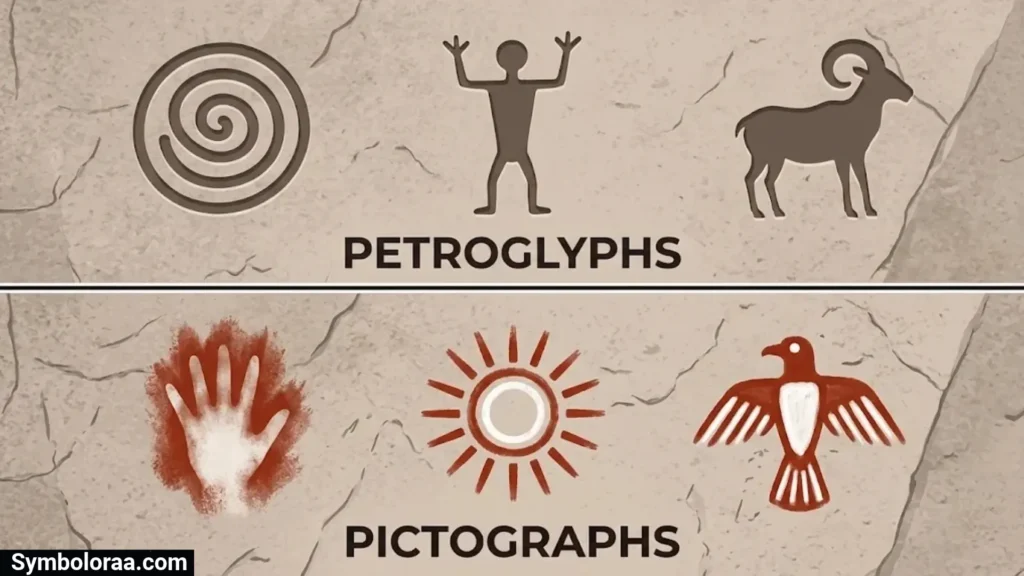
Petroglyphs and pictographs are important forms of Indigenous visual communication.
They appear on cliffs, boulders, canyon walls, caves, and other landscapes throughout North America.
These markings can preserve information about cultural traditions, travel, animals, ceremonies, and historical experiences.
What Are Petroglyphs?
Petroglyphs are images made by carving, pecking, scratching, or otherwise removing material from a rock surface.
Their designs may include:
- Human figures
- Animal shapes
- Handprints and footprints
- Spirals and circles
- Geometric patterns
- Celestial imagery
- Hunting scenes
- Abstract markings
Petroglyphs can have different purposes. Some may communicate stories, mark places, record events, or connect with ceremonial landscapes.
Their meanings aren’t always known today. Descendant communities may preserve knowledge that isn’t available through visual examination alone.
What Are Pictographs?
Pictographs are images painted onto rock surfaces.
Artists used natural materials to create pigments. These could include minerals, charcoal, and other locally available substances.
Pictographs may feature people, animals, plants, geometric patterns, and ceremonial figures.
Some images have survived for centuries because sheltered locations protected them from weather and erosion.
Petroglyphs vs. Pictographs
| Feature | Petroglyphs | Pictographs |
| Meaning | Carved or pecked rock image | Painted rock image |
| Technique | Scratching, pecking, or carving | Applying pigment to rock |
| Materials | Stone tools and rock surfaces | Natural pigments and binders |
| Appearance | Often cut or textured into the surface | Often colored or painted |
| Location | Cliffs, boulders, and rock faces | Sheltered walls, cliffs, and caves |
Both forms can carry cultural, historical, and spiritual significance.
Some Indigenous people also prefer not to describe these markings simply as art. The term may overlook their roles in communication, ceremony, and cultural knowledge.
Important Places With Native American Rock Markings
Several places in North America preserve significant Indigenous rock markings.
Petroglyph National Monument: Located in New Mexico, this site contains thousands of images carved into volcanic rock. The markings connect with the histories and traditions of surrounding Indigenous communities.
Newspaper Rock: Located in Utah, this site features a large collection of carved images from different periods. Its markings include human figures, animals, and geometric designs.
Chaco Canyon: This important ancestral Puebloan landscape contains petroglyphs, pictographs, and other archaeological features.
Mesa Verde: Known for its ancestral Puebloan history, this region preserves important cultural landscapes and archaeological remains.
Bandelier National Monument: This New Mexico site contains evidence of ancestral Puebloan communities, including rock markings and historic structures.
These locations help researchers and visitors understand the depth of Indigenous history. They also require respectful protection because some markings remain culturally important to descendant communities.
Totem Poles and Native American Clan Symbols
Totem poles are among the most recognizable forms of Northwest Coast Indigenous art.
They are traditionally associated with particular Indigenous peoples of the Pacific Northwest, including Haida, Tlingit, and Tsimshian communities.
Totem poles may display animals, supernatural beings, family crests, and figures connected with community histories.
Commonly represented figures include:
- Eagle
- Raven
- Bear
- Wolf
- Orca
- Frog
- Thunderbird
- Human and supernatural figures
These figures aren’t simply decorative animals. They can communicate family relationships, inherited rights, historical events, stories, and cultural identities.
What Do Totem Pole Symbols Mean?
The meaning of a figure depends on the family, community, and pole.
An eagle may appear as part of a family crest. A raven may connect with a particular ancestral story. An orca may represent an important relationship with the sea.
The order and placement of figures can also matter.
Not every totem pole tells the same type of story. Some commemorate events, while others identify family histories or display important cultural relationships.
Totem Poles and Clan Crests
A clan crest is a design connected with a particular family or social group.
Crests may represent inherited rights, ancestral histories, and relationships with particular beings or stories.
Northwest Coast formline art uses distinctive curves, shapes, and design principles. Artists combine these elements to create powerful images of animals and supernatural figures.
You should avoid treating every Northwest Coast design as interchangeable. Haida, Tlingit, Tsimshian, and Kwakwaka’wakw artists have distinct traditions.
Native American Symbols by Tribe and Cultural Region
Native American symbols make more sense when you study the communities that created and used them.
Different nations developed artistic traditions based on their languages, environments, histories, and spiritual teachings.
Navajo (Diné) Symbols
The Diné people have a rich artistic and ceremonial heritage.
Important elements of Diné cultural expression include:
- Sandpainting designs
- Sacred mountains
- Yei figures
- Geometric weaving patterns
- Natural pigments
- Ceremonial objects
- Images connected with healing traditions
Diné sandpaintings form part of specific ceremonies. Artists create detailed designs using colored sand and other natural materials.
These designs may represent sacred beings, landscapes, stories, and ceremonial relationships.
Diné weaving also features distinctive geometric patterns. These designs can reflect artistic traditions, family knowledge, regional styles, and individual creativity.
Not every pattern has a publicly documented spiritual meaning.
Hopi Symbols
The Hopi people have longstanding artistic, agricultural, and ceremonial traditions.
Hopi artwork includes pottery, baskets, textiles, Katsina figures, and other cultural objects.
Commonly recognized subjects include:
- Katsina beings
- Corn and agricultural imagery
- Rain and cloud designs
- Birds and animals
- Geometric patterns
- Migration-related imagery
Hopi Katsina traditions connect spiritual beings with ceremonies, community life, and relationships with the natural world.
Hopi pottery and other artwork also include symbols passed through generations. Their interpretations depend on the design and cultural setting.
Zuni Symbols
The Zuni people have distinctive traditions involving pottery, carving, jewelry, and ceremonial objects.
Zuni artistic expression includes animal figures, geometric designs, and images connected with the natural and spiritual worlds.
The Zuni also have important traditions involving carved figures and ceremonial practices.
Some designs are connected with specific cultural knowledge. They shouldn’t be assigned generic meanings simply because they resemble symbols from another Indigenous nation.
Lakota and Dakota Symbols
The Lakota and Dakota peoples belong to the larger Oceti Sakowin, or Seven Council Fires, cultural and historical grouping.
Their artistic traditions include beadwork, quillwork, clothing, ceremonial objects, and designs connected with community identity.
The Sacred Hoop and Medicine Wheel are important concepts in some Plains traditions. Their interpretations may connect with relationships among people, the land, directions, and the cycles of life.
Lakota and Dakota symbols should be understood through their own languages, histories, and teachings.
Haida Symbols
The Haida people are known for distinctive Northwest Coast art, including carving, weaving, jewelry, and formline designs.
Common figures in Haida artwork include:
- Raven
- Eagle
- Bear
- Wolf
- Frog
- Orca
- Other animals and supernatural beings
Haida designs often feature carefully balanced shapes and flowing lines.
These figures may connect with clan identity, family histories, inherited rights, and traditional stories.
Kwakwaka’wakw Symbols
The Kwakwaka’wakw people have rich ceremonial and artistic traditions along the Northwest Coast.
Their artwork includes masks, carvings, regalia, and images of supernatural beings.
Important figures in certain traditions include Sisiutl, Dzunukwa, Bukwus, and other beings from cultural narratives.
Masks and ceremonial objects can represent specific roles and stories. Their significance extends beyond their appearance.
Ojibwe and Anishinaabe Symbols
The Ojibwe, also known as Anishinaabe in broader cultural contexts, have important traditions involving birchbark work, beadwork, storytelling, and visual design.
Some recognizable examples include:
- Floral beadwork
- Animal imagery
- Woodland-style designs
- Birchbark scroll traditions
- Dreamcatchers in certain contemporary contexts
The dreamcatcher is widely associated with Ojibwe cultural traditions and has also been adopted by other Indigenous communities.
Modern dreamcatchers vary in design and use. Their commercial popularity has sometimes separated them from their original cultural context.
Cherokee Symbols
The Cherokee people have a distinctive history, language, and cultural heritage.
One of their most important achievements is the Cherokee syllabary, created by Sequoyah.
The syllabary uses written characters to represent syllables in the Cherokee language. It is not an ordinary alphabet, even though people sometimes describe it that way.
Cherokee visual culture also includes pottery, basketry, beadwork, and other artistic traditions.
Other Indigenous Nations and Their Symbolic Traditions
Many other Indigenous nations maintain distinctive artistic and symbolic traditions.
These include the Blackfoot, Cree, Haudenosaunee, Caddo, Inuit, O’odham, and many Pueblo communities.
Their designs may feature animals, plants, geometric patterns, ceremonial objects, and images connected with local landscapes.
There is no single collection that represents every Indigenous nation. Each community has its own cultural knowledge and artistic history.
Native American Writing Systems and Picture Symbols
Native American writing systems are often misunderstood because people group all Indigenous visual communication together.
However, petroglyphs, pictographs, and written language systems serve different purposes.
Cherokee Syllabary
The Cherokee syllabary is a writing system developed by Sequoyah in the early nineteenth century.
Instead of representing individual letters in the same way as the English alphabet, its characters represent syllables in the Cherokee language.
The syllabary helped expand literacy, printing, and written communication among Cherokee people.
It remains an important part of Cherokee language and cultural identity.
Cree Syllabics
Cree syllabics are writing characters used for several Cree language varieties.
The system represents syllables through written shapes and orientation. It became an important method of recording and sharing Indigenous languages.
Different communities use different writing conventions and forms.
Inuktitut Syllabics
Inuktitut syllabics are used to write Inuktitut in several communities.
The writing system helps preserve and communicate the language. It also appears in educational materials, public signs, and other forms of everyday communication.
Not all Inuit communities use the same writing system. Latin-based orthographies are also used in some regions.
Pictographs and Picture-Based Communication
Pictographs communicate through images rather than ordinary alphabetic characters.
They may record stories, events, places, or other information. Their meanings depend on the traditions and knowledge of the people who created them.
Not every pictograph represents a word or sound. Some images communicate ideas through cultural conventions and visual relationships.
Native American Symbols for Tattoos
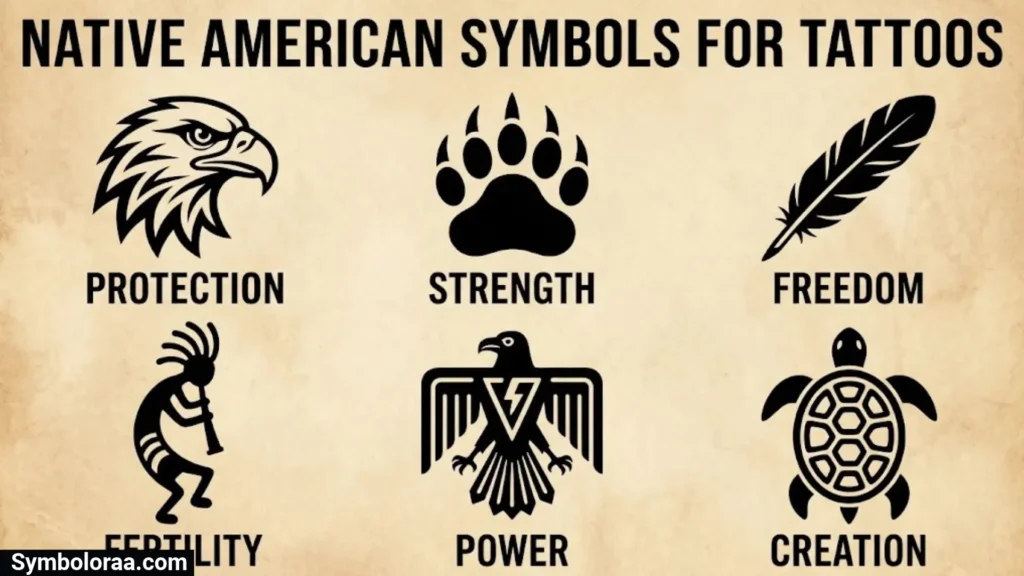
Native American symbols have become popular in modern tattoo designs.
People often choose animal figures, arrows, geometric patterns, and nature-inspired artwork because they connect with personal ideas such as strength, courage, freedom, protection, and identity.
However, using an Indigenous symbol as a tattoo requires care.
Some designs belong to particular families, communities, or ceremonies. Others may carry meanings that aren’t appropriate to reproduce outside their cultural setting.
Before choosing a design, consider these points:
- Learn which Indigenous nation the design comes from.
- Research its actual history rather than relying on generic tattoo descriptions.
- Avoid copying sacred or restricted ceremonial imagery.
- Don’t assume every animal or geometric pattern has a universal Indigenous meaning.
- Consider supporting Indigenous artists when commissioning culturally specific artwork.
- Respect community guidance about designs that should not be reproduced.
Popular Native American-Inspired Tattoo Designs
Eagle tattoo: Often chosen for ideas such as strength, vision, and freedom. Its cultural meaning depends on the specific Indigenous tradition.
Bear tattoo: Commonly associated in modern tattoo culture with strength and courage. Particular Indigenous bear imagery may carry more specific meanings.
Wolf tattoo: Often represents loyalty, family, and cooperation in contemporary interpretations.
Arrow tattoo: May represent direction, movement, focus, or determination in modern designs.
Turtle tattoo: Sometimes chosen to express patience, longevity, and connection with the natural world.
Medicine Wheel tattoo: This design can carry deep cultural and spiritual significance. Learn about the specific tradition before using it.
Thunderbird tattoo: A powerful image in certain Indigenous traditions. Its use should reflect knowledge of its cultural background.
A tattoo can express personal meaning without claiming to represent an entire Indigenous culture.
Native American Symbols in Modern Culture
Native American symbols continue to appear in contemporary art, fashion, education, jewelry, architecture, and public spaces.
Indigenous artists often combine traditional visual elements with modern materials and techniques. They create new work while maintaining relationships with their cultural heritage.
You may encounter Native American-inspired designs in:
- Contemporary paintings
- Pottery and ceramics
- Beadwork and jewelry
- Clothing and textiles
- Wood and stone carving
- Sculptures and public art
- Educational materials
- Cultural exhibitions
However, commercial use can create problems when businesses copy Indigenous designs without permission or cultural understanding.
Some symbols have specific community connections. Others may involve sacred knowledge or inherited rights.
Respectful appreciation starts with learning who created a design and what it means within its original context.
How to Identify Authentic Native American Symbols
You may see many products described as traditional Native American symbols. However, not every design marketed this way has a documented Indigenous origin.
Use these guidelines when researching a symbol or purchasing Indigenous artwork.
Identify the Indigenous Nation
Start by finding out which nation or community created the design.
A Hopi Katsina figure, a Haida crest, and a Diné sandpainting belong to different cultural traditions. Their meanings and uses aren’t interchangeable.
Research the Historical Context
Look at the material, location, artistic style, and historical period.
A design carved into a canyon wall may have a different purpose from a pattern woven into clothing. Context helps you avoid inaccurate interpretations.
Understand the Difference Between Traditional and Modern Designs
Contemporary Indigenous artists continue to create new work. A modern design can be culturally meaningful without being an ancient symbol.
Don’t assume every recently created design represents an old tradition.
Respect Sacred and Restricted Imagery
Some designs belong to particular ceremonies, families, or community responsibilities.
Their use may be limited. A symbol’s visual appearance doesn’t mean everyone can reproduce it.
Support Indigenous Artists and Communities
When buying Indigenous artwork, look for reliable information about the artist and their community.
Authentic Indigenous art reflects living cultural traditions, individual creativity, and knowledge passed through generations.
Frequently Asked Questions About Native American Symbols
What Is the Most Famous Native American Symbol?
The Medicine Wheel is among the most widely recognized Indigenous symbols. The Thunderbird, eagle, turtle, and Kokopelli figure are also well known.
However, no single symbol represents every Native American nation.
What Do Native American Symbols Represent?
Native American symbols can represent animals, nature, spiritual relationships, community histories, ceremonies, family identity, and important events.
Their meanings depend on the Indigenous nation and the context in which people use them.
What Is the Meaning of the Medicine Wheel?
The Medicine Wheel, or Sacred Hoop in some traditions, can represent balance, the Four Directions, cycles of life, and relationships with the natural world.
Its colors and interpretations vary between Indigenous communities.
What Does the Thunderbird Symbol Mean?
The Thunderbird is a powerful supernatural being in several Indigenous traditions.
Some stories connect it with thunder, lightning, storms, and spiritual power. Its meaning depends on the community.
What Does the Bear Symbol Mean in Native American Culture?
Bears can represent strength, power, protection, and relationships with the natural world.
However, individual communities have their own bear stories and interpretations.
What Does the Eagle Symbolize?
Eagles have important spiritual and cultural significance in many Indigenous communities.
They may connect with vision, strength, and ceremonial traditions. Eagle feathers also carry important cultural responsibilities.
What Does the Turtle Symbol Mean?
Turtles appear in several Indigenous creation stories and cultural traditions.
In some Eastern Woodlands traditions, the turtle connects with Turtle Island and the creation of land. Other communities have different turtle stories and interpretations.
What Does the Wolf Symbol Mean?
Modern descriptions often associate wolves with loyalty, family, cooperation, and intelligence.
Indigenous stories may give wolves additional meanings based on local traditions and relationships with the animal.
What Is Kokopelli?
Kokopelli is a flute-player figure associated with Southwestern Indigenous artistic traditions.
Modern interpretations connect the figure with music, fertility, agriculture, and renewal. Specific cultural meanings vary.
What Are Kachina or Katsina Symbols?
Katsina refers to spiritual beings in Hopi and other Pueblo traditions.
Katsina figures may appear in ceremonial dances, masks, and carved teaching objects. Their significance belongs to specific cultural traditions.
What Is the Difference Between Petroglyphs and Pictographs?
Petroglyphs are carved or pecked into rock surfaces. Pictographs are painted onto rock using pigments.
Both can communicate cultural, historical, or spiritual information.
Are Native American Symbols the Same Across All Tribes?
No. Indigenous nations have different languages, histories, environments, and cultural traditions.
Some visual themes may appear in multiple regions, but their meanings can differ considerably.
What Does a Native American Arrow Symbol Mean?
Arrow designs may represent hunting, direction, movement, or other practical and artistic ideas.
Modern tattoo culture often connects arrows with focus and determination. These interpretations shouldn’t be confused with universal traditional meanings.
What Is the Meaning of a Native American Spiral?
Spirals appear in Indigenous artwork and rock markings across different regions.
Some interpretations connect them with journeys, movement, or migration. Their meaning depends on the site and cultural tradition.
What Is the Cherokee Syllabary?
The Cherokee syllabary is a writing system created by Sequoyah.
Its characters represent syllables in the Cherokee language. The system remains important to Cherokee language preservation and cultural identity.
Are Native American Symbols Suitable for Tattoos?
Some Indigenous-inspired designs appear in modern tattoos. However, sacred, ceremonial, or restricted imagery deserves special care.
Research the design’s origin and consider whether its use respects the community that maintains the tradition.
What Is the Difference Between a Native American Symbol and a Tribal Pattern?
A symbol may communicate a particular idea, story, identity, or cultural relationship.
A pattern may combine repeated shapes for decorative, practical, or symbolic purposes. Some patterns have specific cultural meanings, while others primarily reflect artistic choices.
Why Are Animal Symbols Important in Native American Cultures?
Animals are connected with food, survival, local environments, stories, ceremonies, and spiritual traditions.
Their importance varies between nations. The same animal may have different roles in different communities.
Conclusion
Native American symbols offer a meaningful way to explore Indigenous history, art, storytelling, spirituality, and relationships with the natural world.
From the Medicine Wheel and Thunderbird to animal figures, geometric designs, petroglyphs, pictographs, and clan crests, these traditions reflect the diversity of Indigenous North America.
Each symbol has a cultural background. Some communicate stories or identify family relationships, while others belong to ceremonies and spiritual practices.
The most important thing to remember is that Native American cultures aren’t one single tradition. The Hopi, Diné, Lakota, Haida, Cherokee, Ojibwe, Kwakwaka’wakw, and many other nations maintain distinct histories and forms of cultural expression.
When you explore Native American symbols, look beyond simple definitions. Learn who created each design, understand its original context, and respect the communities that continue to preserve its meaning.

I’m Madison Reed, a contemporary American author who writes about love, family, friendship, and second chances. I’m fascinated by the choices that shape our lives and the moments that change us forever. My goal is to create honest, emotional stories with characters readers can connect with long after finishing each book.
Three Books:
When We Find Our Way
The Things We Never Said
Summer in September
 Jackson Miller