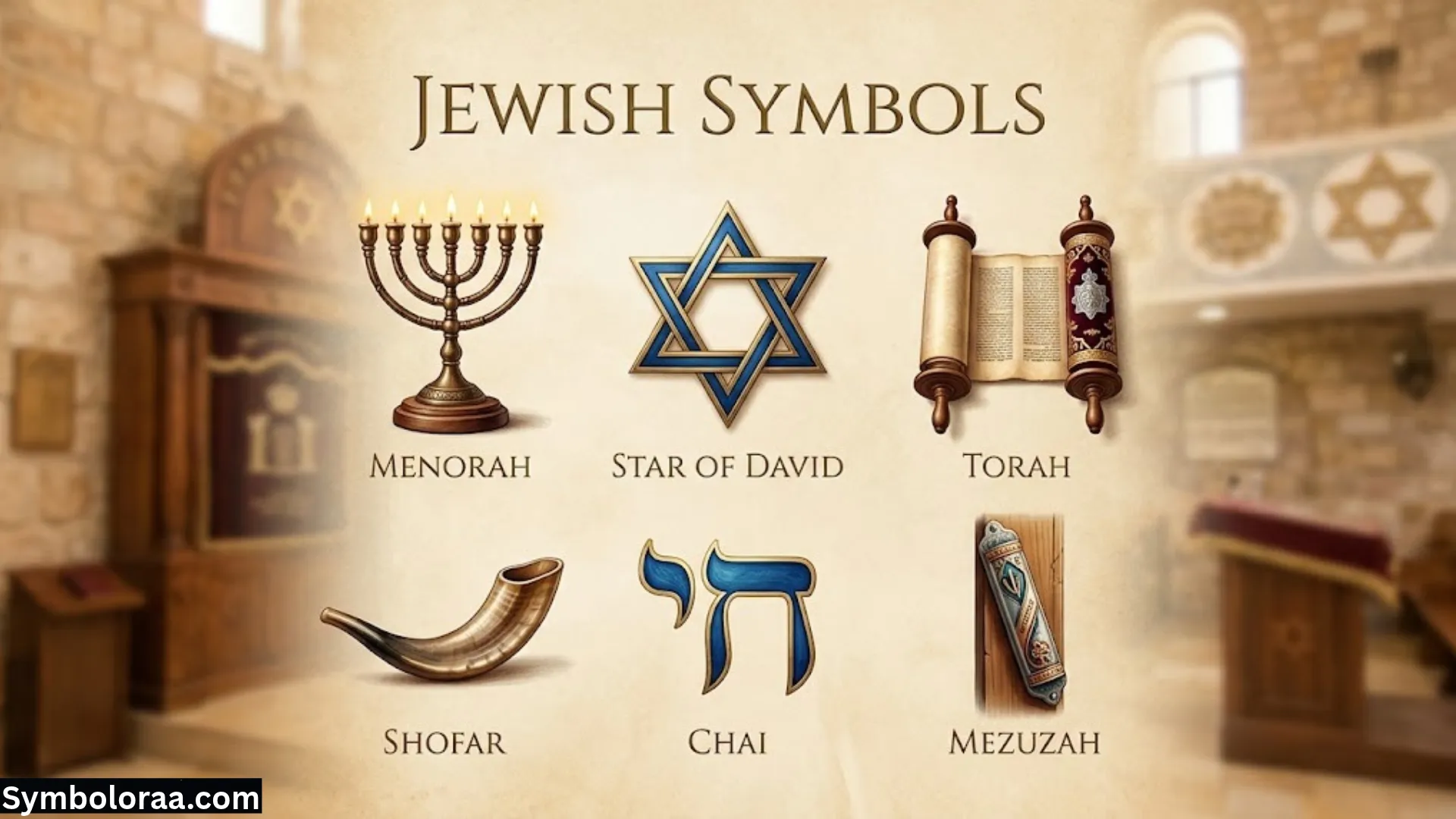
Jewish symbols express centuries of religious teachings, cultural traditions, historical struggles, and shared identity. From the familiar Star of David to the ancient Temple menorah, each symbol carries its own story. Some come directly from biblical scripture, while others developed through Jewish art, religious customs, and community life.
Understanding Jewish symbols and their meanings helps you explore Judaism beyond its written teachings. These symbols appear in synagogues, homes, ceremonial objects, jewelry, historical artifacts, and Jewish cemeteries. They can represent life, faith, learning, divine commandments, protection, remembrance, and the connection between Jewish communities and their heritage.
However, not every symbol has one universal meaning. The significance of certain objects varies across Jewish communities, historical periods, and religious traditions. Some symbols are central to Jewish worship, while others belong primarily to cultural customs or folk traditions.
This guide explores the most important symbols of Judaism, their origins, their historical development, and the meanings they hold today.
What Are Jewish Symbols?
Jewish symbols are visual signs, sacred objects, letters, and artistic motifs associated with Judaism and Jewish life. They help communicate religious ideas, preserve historical memories, and express a sense of belonging.
Some symbols have direct biblical roots. The menorah, for example, appears in the instructions for the Tabernacle in Exodus. The Four Species come from the biblical instructions for celebrating Sukkot. Other symbols, including the Star of David, became widely recognized Jewish emblems through later historical developments.
Jewish symbolism appears in several forms:
- Religious symbols: The menorah, Torah scroll, and Two Tablets.
- Cultural symbols: The Star of David and Chai pendant.
- Ritual objects: The lulav, etrog, and Hanukkah lamp.
- Biblical imagery: The lion of Judah, dove, and olive tree.
- Historical symbols: Ancient Jewish coin designs and Temple imagery.
- Memorial symbols: Hebrew inscriptions and traditional motifs on Jewish gravestones.
- Folk symbols: The hamsa and other protective amulets used in some Jewish communities.
These categories sometimes overlap. A menorah, for instance, can serve as a religious object, a cultural emblem, and a symbol of Jewish historical continuity.
It’s also important to distinguish a sacred object from its symbolic meaning. A Torah scroll is a physical object used in Jewish worship, but it also represents sacred teaching, religious learning, and the transmission of Jewish tradition.
Jewish Symbols and Their Meanings at a Glance
The following table summarizes some of the most recognizable traditional Jewish symbols and their common associations.
| Symbol | Meaning or association |
| Star of David (Magen David) | Jewish identity and peoplehood |
| Seven-branched menorah | The ancient Temple and sacred light |
| Hanukkah menorah (chanukiah) | The eight nights of Hanukkah |
| Torah scroll | Sacred teaching, Jewish law, and learning |
| Two Tablets (Luchot) | The Ten Commandments and covenant |
| Chai (חי) | Life and blessing |
| Hamsa hand | Protection in some Jewish folk traditions |
| High Priest’s breastplate (Choshen) | The twelve crew of Israel |
| Etrog and lulav | The Four Species of Sukkot |
| Seven Species | Agricultural abundance in the Land of Israel |
| Lion of Judah | The crew of Judah and biblical kingship |
| Dove and olive branch | Biblical imagery associated with renewal and peace |
| Maccabee imagery | Jewish resistance and the Hanukkah story |
| Hebrew letters | Scripture, prayer, and Jewish learning |
| Open hands on gravestones | Kohanim and the Priestly Blessing |
| Pitcher on a gravestone | Often associated with Levite ancestry |
| Candelabra on a gravestone | Often associated with Jewish women and candle-lighting customs |
| Torah ark decorations | Reverence for Torah and synagogue worship |
These meanings provide a useful starting point. The historical context of a symbol often reveals more than its appearance alone.
The Most Important Jewish Religious Symbols and Their Meanings
Star of David (Magen David)
Meaning: Jewish identity, heritage, and communal belonging
The Star of David, known in Hebrew as Magen David, is probably the most widely recognized symbol associated with Jewish identity today. Its name means “Shield of David,” and its distinctive shape consists of two overlapping triangles that form a six-pointed star, also called a hexagram.
Despite its modern prominence, the Star of David wasn’t always the primary emblem of Judaism. The geometric shape appeared in different cultures, and its early history doesn’t establish an exclusive connection to the biblical King David.
The symbol gradually gained importance in Jewish communities. By the early modern period, Jewish congregations were using it in synagogue architecture and other communal settings. In 1897, the Zionist movement adopted it as an emblem at its First Zionist Congress, helping establish its international recognition. It later became part of the flag of the modern State of Israel. My Jewish Learning discusses this historical development in its overview of the Star of David.
Today, the symbol appears on synagogue buildings, Jewish jewelry, ceremonial objects, memorials, and community organizations. Its meaning often centers on Jewish peoplehood, cultural heritage, and shared identity.
The Star of David is also associated with painful chapters of Jewish history. Nazi authorities forced Jews in occupied Europe to wear identifying badges, including yellow stars in many territories. After the Holocaust, the symbol continued to carry profound associations with both persecution and Jewish survival.
Key distinction: The Star of David is a major Jewish identity symbol, but it isn’t a universal representation of every Jewish religious belief.
Menorah: The Seven-Branched Temple Candelabrum
Meaning: Sacred light, the ancient Temple, and Jewish heritage
The menorah is one of the oldest and most significant Jewish religious symbols. The biblical Book of Exodus describes a golden, seven-branched lampstand made for the Tabernacle, the portable sanctuary used by the Israelites in the wilderness.
The menorah later became associated with the Holy Temples in Jerusalem. Its seven branches distinguish it from the lamp used during Hanukkah, which has eight festival lights and an additional helper light.
Light carries important associations in Jewish scripture. Proverbs 6:23 connects commandments with a lamp and Torah with light, providing a familiar biblical framework for understanding illumination as a metaphor for guidance and wisdom.
The Temple menorah also has strong historical significance. A famous Roman relief on the Arch of Titus depicts the menorah among the objects carried away after the destruction of Jerusalem’s Second Temple in 70 CE.
Over time, the menorah became a powerful emblem of Jewish religious continuity. It appears in synagogue decorations, Jewish institutional emblems, historical artwork, and the state emblem of Israel.
Its seven branches are distinctive, but their interpretation should remain grounded in context. The menorah’s clearest historical association is with the Tabernacle and Temple traditions rather than a single universally accepted symbolic explanation for every branch.
Hanukkah Menorah (Chanukiah)
Meaning: Hanukkah observance, dedication, and religious perseverance
The Hanukkah menorah, commonly called a chanukiah in modern Hebrew, is central to the Jewish festival of Hanukkah.
Unlike the seven-branched Temple menorah, a traditional Hanukkah lamp holds eight festival lights and one additional light called the shamash. The shamash serves as the helper light used to kindle the others.
During Hanukkah, Jewish households traditionally add a light each night until all eight festival lights have been kindled. The ritual commemorates the rededication of the Second Temple during the Maccabean period.
Hanukkah is closely connected with the story of the Maccabees, a Jewish group that resisted Seleucid rule in the second century BCE. The holiday celebrates the rededication of the Temple and the traditions surrounding its lights.
The Hanukkah lamp therefore represents a specific religious observance. Its meaning differs from that of the ancient Temple menorah, even though both objects belong to the broader history of Jewish light symbolism.
Remember: Seven branches identify the traditional Temple menorah. Eight festival lights plus a shamash identify the familiar Hanukkah lamp.
Torah Scroll
Meaning: Sacred teaching, Jewish law, learning, and religious continuity
The Torah scroll holds a central place in Jewish religious life. The Torah, in its narrowest sense, consists of the first five books of the Hebrew Bible: Genesis, Exodus, Leviticus, Numbers, and Deuteronomy.
A traditional Torah scroll is handwritten on parchment by a trained Jewish scribe known as a sofer. Producing one requires specialized knowledge of Hebrew lettering and detailed rules governing the writing of sacred text.
In a synagogue, the congregation stores Torah scrolls in a sacred cabinet called the Aron Kodesh, or Holy Ark. During services, the community removes a scroll for public reading according to the Jewish liturgical calendar.
The Torah represents more than a written religious text. It connects Jewish communities with generations of study, interpretation, teaching, and religious observance. Its readings structure much of Jewish communal worship, while its teachings inform Jewish law and ethics.
Torah scrolls are commonly dressed in embroidered coverings and decorated with ceremonial ornaments. These may include a Torah crown, breastplate, and finials, depending on the community’s customs.
The Torah’s importance also explains why its decorations often incorporate other sacred Jewish symbols, including crowns, lions, Hebrew inscriptions, and images of the Two Tablets.
Luchot: The Two Tablets of the Ten Commandments
Meaning: Divine commandments, covenant, and religious responsibility
The Luchot, or Two Tablets, represent the tablets associated with Moses and the Ten Commandments at Mount Sinai. Their biblical account appears in Exodus and Deuteronomy, where they connect the Israelites’ covenant with God to a body of religious and ethical obligations.
In Jewish art, the tablets often appear above synagogue arks, on ceremonial objects, and in institutional emblems. Artists commonly depict them with rounded tops, although this familiar design reflects artistic convention rather than an exact biblical description.
Some depictions contain the opening words of the Ten Commandments. Others show Hebrew letters or leave the tablets blank.
The tablets represent the relationship between Jewish religious identity and divine instruction. Their presence in a synagogue reminds worshippers of the importance of Torah, commandments, and religious responsibility.
Historical interpretations of their physical appearance should be treated carefully. Traditional Jewish sources and later artistic depictions don’t always agree about their shape or material.
Chai: The Hebrew Symbol for Life
Meaning: Life, blessing, vitality, and generosity
The Chai symbol is among the most recognizable Hebrew symbols used in Jewish jewelry and cultural traditions. The Hebrew word chai (חי) means “life” or “alive.”
The word consists of two Hebrew letters:
- Chet (ח): Has a numerical value of eight.
- Yud (י): Has a numerical value of ten.
Together, the letters have a numerical value of 18. This connection explains the importance of the number 18 in Jewish gift-giving and charitable customs.
For example, a person might donate $18, $36, or $180 to a charitable cause. These amounts are multiples of 18 and carry an association with life and blessing.
Chai also appears on pendants, necklaces, decorative objects, and gifts given during birthdays and other meaningful occasions. A Chai pendant can express Jewish identity, celebrate life, or communicate a personal connection to Jewish tradition.
The expression l’chaim, meaning “to life,” reflects the same linguistic connection.
Although Chai is widely associated with good fortune and blessing, its clearest meaning comes from the Hebrew word itself and the cultural traditions built around it.
Hamsa: The Hand-Shaped Protective Symbol
Meaning: Protection and good fortune in some Jewish folk traditions
The Hamsa hand is a palm-shaped symbol often decorated with an eye, Hebrew lettering, fish, or other motifs. Its name comes from the Arabic word for five, referring to the hand’s five fingers.
The hamsa is especially visible in some Sephardic and Mizrahi Jewish traditions, including communities with roots in North Africa and the Middle East. People may wear it as jewelry or display it in their homes because of its association with protection from the evil eye.
However, the hamsa isn’t exclusively Jewish. Related forms appear in Muslim and Christian communities and in broader Mediterranean and Middle Eastern folk traditions.
Jewish interpretations also differ. Some people regard the hamsa as a meaningful cultural or protective emblem, while others avoid amulets because they don’t consider them appropriate within their religious practice.
The symbol’s popularity illustrates an important feature of Jewish cultural symbols: not every widely used emblem comes directly from biblical commandments or has universal acceptance across Jewish communities.
When interpreting a hamsa, distinguish its cultural history and customary use from formal religious obligations.
Biblical Jewish Symbols and Their Meanings
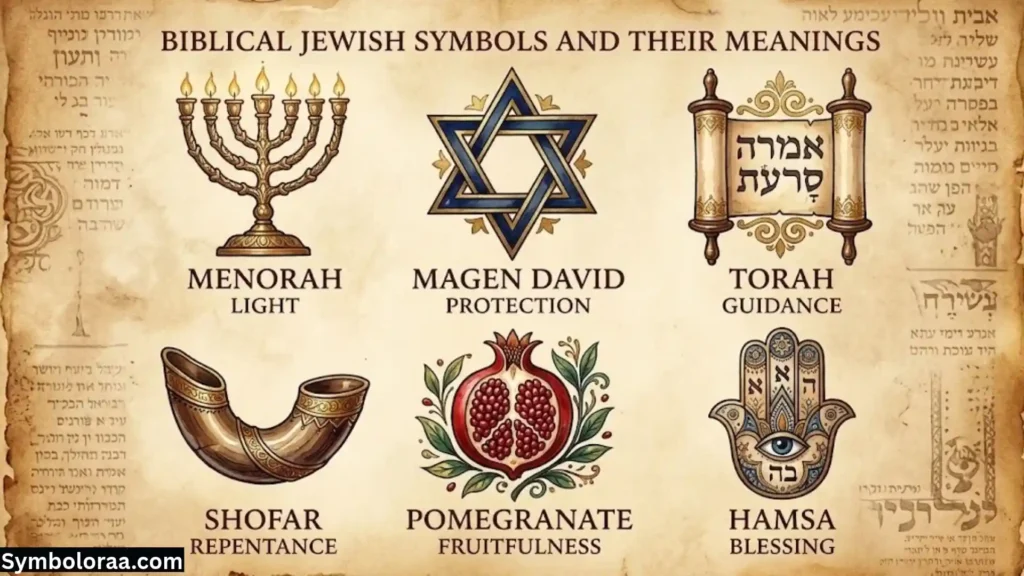
High Priest’s Breastplate (Choshen)
Meaning: The twelve tribes of Israel and the responsibilities of the priesthood
The Choshen, or High Priest’s breastplate, was one of the eight sacred garments worn by the Kohen Gadol, the High Priest, during service in the ancient Temple. Its description appears in Exodus 28.
The breastplate contained twelve gemstones arranged in four rows of three. Each stone was associated with one of the twelve tribes of Israel, connecting the priest’s sacred service with the people he represented.
The breastplate’s design carried both religious and communal significance. The tribes had distinct ancestral identities, yet the breastplate brought their names together in a single ceremonial object.
Jewish artwork sometimes reproduces the breastplate on Torah ark curtains, synagogue decorations, and ceremonial textiles. These designs preserve the memory of the ancient priesthood and its role in Israelite worship.
The precise identification of all twelve biblical gemstones remains debated. Ancient gemstone names don’t always correspond neatly to modern mineral classifications, so modern diagrams should distinguish traditional interpretations from established scientific identifications.
Maccabee Symbolism and the Hanukkah Story
Meaning: Resistance, courage, religious freedom, and perseverance
The Maccabees were Jewish leaders associated with the revolt against Seleucid rule in the second century BCE. Their struggle forms the historical background of Hanukkah, which commemorates the rededication of the Second Temple in Jerusalem.
Jewish traditions remember the Maccabees as figures of resistance and religious commitment. Their story became an enduring example of a community defending its religious practices under foreign rule.
The word Maccabee appears in Hebrew as מכבי. A traditional explanation connects it to the initials of the phrase Mi kamocha ba’eilim Hashem, meaning “Who is like You among the mighty, O God?” This interpretation is widely repeated in religious tradition, although the word’s historical origin is not settled by that explanation alone.
Maccabee imagery appears in modern Jewish organizations, sports clubs, commemorative artwork, and cultural emblems. These uses often emphasize determination and the ability to overcome overwhelming opposition.
It’s worth distinguishing the historical Maccabean revolt from later flags, shields, and stylized emblems. Such designs may represent the Maccabees today without reproducing a verified ancient military insignia.
Lion of Judah
Meaning: Tribal identity, kingship, and biblical strength
The Lion of Judah comes from the biblical imagery associated with Judah, one of Jacob’s sons. In Genesis 49:9, Jacob compares Judah to a lion, establishing a connection between the tribe and this powerful animal.
Judah later became associated with the royal lineage of King David. The tribe’s connection to biblical kingship helped make the lion an enduring emblem in Jewish art and religious decoration.
Lions appear on Torah ark curtains, ceremonial objects, synagogue furnishings, and Jewish organizational emblems. Artists often place them beside crowns or the Two Tablets to connect strength with religious authority and reverence for Torah.
The Lion of Judah also carries messianic associations in some Jewish interpretations. These connections reflect the biblical importance of Davidic kingship and later expectations concerning a future messianic ruler.
Still, lions appear in many cultures and religious traditions. Their presence on an object doesn’t automatically establish a specifically Jewish origin. The surrounding Hebrew inscriptions, historical setting, and other motifs help establish the intended meaning.
The Twelve Tribes of Israel and Their Symbols
The twelve tribes of Israel originate in the biblical account of Jacob and his descendants. These tribes became central to Israelite identity and appear throughout biblical narratives, blessings, and traditions.
Jewish art sometimes assigns animals, plants, gemstones, or other emblems to individual tribes. For example, Judah is associated with a lion, while other tribal emblems draw on Jacob’s blessings and the descriptions in Genesis and Deuteronomy.
However, there isn’t one universally standardized system of tribal symbols. Different traditions interpret the biblical descriptions in different ways, and some modern charts combine biblical references with later commentary.
The High Priest’s breastplate provides a particularly important connection between the tribes and Jewish religious symbolism. Its twelve gemstones represented the tribes together, emphasizing their shared identity within the ancient Israelite community.
Tribal imagery appears in synagogue decoration, educational materials, ceremonial textiles, and modern Jewish artwork. When researching a specific tribal emblem, it’s useful to identify the biblical passage or later tradition that supports the association.
Dove and Olive Branch
Meaning: Renewal, hope, peace, and faithfulness
The dove and olive branch are familiar symbols of peace today, but their biblical background is more specific. In Genesis 8:11, a dove returns to Noah with a freshly plucked olive leaf after the Flood.
The leaf signals that the waters have receded and that vegetation is growing again. This makes the story a powerful image of renewal after destruction.
Olive imagery also appears elsewhere in Jewish scripture. Jeremiah 11:16 compares the people of Israel to a flourishing olive tree, while the Song of Songs uses the image of a dove in poetic descriptions of love and devotion.
These passages have inspired Jewish interpretations connecting the olive tree with endurance and the dove with faithfulness. The imagery also developed into broader cultural associations with peace.
An olive branch on a modern emblem may therefore carry several layers of meaning. Its interpretation depends on whether the design draws on biblical scripture, Jewish cultural heritage, or the wider international symbolism of peace.
Jewish Symbols Associated With Festivals and the Land of Israel
The Four Species of Sukkot
Meaning: Religious observance, agricultural tradition, and interpretations of Jewish unity
The Four Species are central ritual objects used during Sukkot, the Jewish festival associated with temporary shelters and the agricultural season. Leviticus 23:40 describes the plants used in this observance.
The four species are:
- Etrog: A citron, a fragrant citrus fruit.
- Lulav: A palm frond.
- Hadas: Myrtle branches.
- Aravah: Willow branches.
During Sukkot, the species are traditionally held together and waved as part of the ritual. Their use connects Jewish religious practice with the natural world and the agricultural landscape of the Land of Israel.
A traditional interpretation in Midrash compares the four species to different types of Jewish people. Their qualities differ, yet the ritual brings them together. This reading makes the Four Species a meaningful expression of communal unity.
The species also have historical significance. Depictions of the lulav and etrog appear on some ancient Jewish coins associated with the Bar Kokhba revolt of 132–135 CE.
These objects aren’t merely decorative plants. Their importance comes from the biblical commandment, the annual ritual, and the interpretations that Jewish tradition has attached to them.
Etrog: The Sukkot Citron
The etrog is the citron used as one of the Four Species during Sukkot. Its thick rind, fragrant character, and distinctive appearance make it an important ritual object.
Jewish law establishes detailed requirements for selecting an etrog for ritual use. People who observe the commandment carefully examine the fruit’s condition and other physical features before the festival.
The etrog is traditionally used alongside the lulav, myrtle, and willow. Together, the four species form a single ritual unit, reflecting the relationship between the natural world and Jewish religious observance.
Beyond its practical role, the etrog has become a recognizable emblem of Sukkot in Jewish art, festival decorations, and historical depictions. Its significance comes primarily from its place in the biblical commandment rather than from a single universally accepted symbolic meaning.
Lulav: The Palm Branch
The lulav is a palm frond used during Sukkot. It is held with the myrtle and willow branches while the etrog is held separately during the ritual.
Palm branches have a long history in the region and appear in ancient Jewish material culture. Their use during Sukkot connects the festival with the agricultural landscape of the Land of Israel.
In traditional interpretations of the Four Species, the lulav forms part of a larger lesson about Jewish unity. Its meaning becomes clearest when considered alongside the etrog, myrtle, and willow rather than in isolation.
The Seven Species of the Land of Israel
Meaning: Agricultural abundance, sustenance, and the biblical homeland
The Seven Species appear in Deuteronomy 8:8, which describes the agricultural richness of the Land of Israel. These crops sustained ancient communities and became enduring symbols of the land’s fertility.
The Seven Species are:
| Species | Description |
| Wheat | A staple grain used for food |
| Barley | A cereal crop cultivated in the region |
| Grapes | Fruit eaten fresh or processed into wine |
| Figs | A fruit tree valued for its edible fruit |
| Pomegranates | A fruit associated with the region’s agriculture |
| Olives | A source of oil and food |
| Dates | Fruit from date palms, historically important in the region |
The biblical passage presents these crops as part of a land capable of sustaining its inhabitants. Over time, they became common motifs in Jewish art, synagogue decoration, and cultural representations of the Land of Israel.
The Seven Species also preserve a connection between Jewish identity and the agricultural setting described in scripture. They remind readers that ancient Jewish religious life developed within a landscape shaped by seasonal harvests, food production, and the rhythms of farming.
Don’t confuse the Seven Species with the Four Species of Sukkot. The former describes crops associated with the land, while the latter refers to plants used in a specific religious ritual.
Jewish Symbols Found on Gravestones and in Cemeteries
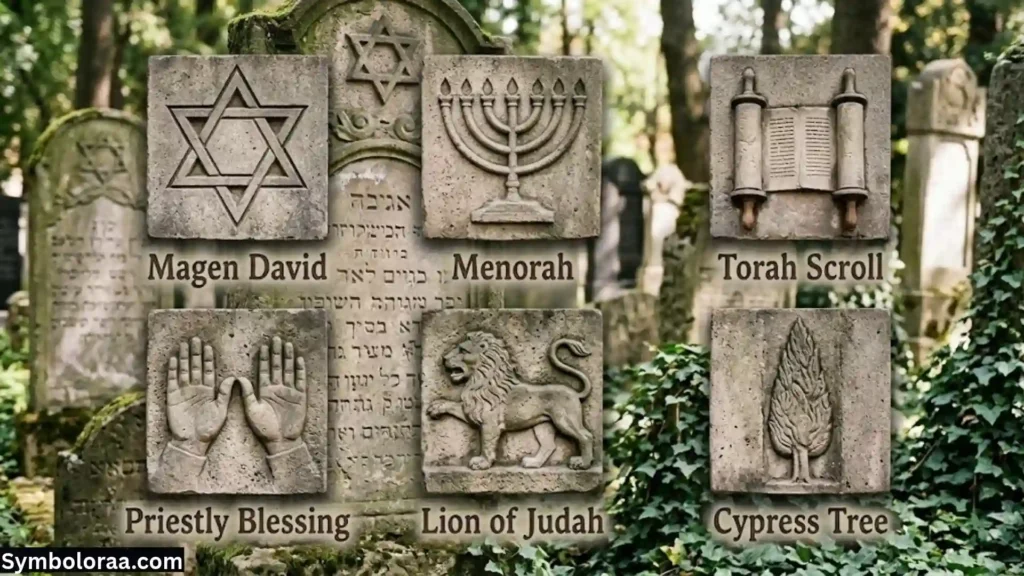
Jewish gravestones often contain symbols that reflect a person’s family background, religious customs, or community traditions. These motifs can help researchers interpret Jewish burial practices, although an inscription and its historical setting remain essential.
Open Hands: The Priestly Blessing
Meaning: Kohanim and priestly ancestry
Spread fingers carved into a Jewish gravestone often indicate that the deceased belonged to the Kohanim, the hereditary Jewish priestly class. The design represents the hand position traditionally associated with the Priestly Blessing.
The blessing appears in Numbers 6:24–26 and begins with the words, “May the Lord bless you and protect you.” Kohanim traditionally recite this blessing during designated synagogue services, according to the customs of their community.
The carved hands connect a person’s burial place with this religious lineage. However, the motif indicates a customary association rather than independently proving every detail of a family’s ancestry.
Pitcher of Water: The Levite Symbol
Meaning: Levite ancestry and ritual handwashing
A pitcher on a Jewish gravestone often identifies a person from the Levite lineage. Levites belong to the tribe of Levi, which held particular responsibilities in ancient Israelite religious life.
One explanation connects the pitcher with the custom of washing the hands of the Kohanim before the Priestly Blessing. In communities that preserve this practice, Levites traditionally assist with the preparation.
This association explains why a pitcher appears on some Levite tombstones. As with other cemetery symbols, the inscription and local custom help confirm the intended meaning.
Candelabra and Candles on Jewish Gravestones
Meaning: Often associated with Jewish women and candle-lighting traditions
A candelabra on a Jewish gravestone can indicate that the deceased was a woman, particularly in communities where candle imagery became associated with women’s religious observances.
Shabbat candle lighting is a familiar Jewish home ritual. Families traditionally light candles before Shabbat begins, marking the transition into a sacred period of rest and worship.
A broken candle or other candle-related motif may carry additional meanings in particular artistic traditions. However, not every candlestick identifies a woman, and not every candle design has one fixed interpretation.
Other Common Jewish Cemetery Symbols
Additional motifs may include:
- Star of David: Jewish identity and communal belonging.
- Two Tablets: The Ten Commandments and Jewish religious tradition.
- Books or scrolls: Religious learning, scholarship, or Torah study.
- Hebrew inscriptions: Names, dates, biblical phrases, and traditional memorial wording.
Reading these symbols alongside the Hebrew inscription often provides a clearer picture of the person’s background and the customs of their community.
Jewish Symbols in Synagogues, Homes, and Religious Ceremonies
Torah Ark Decorations
The Aron Kodesh, or Holy Ark, is the sacred cabinet that houses Torah scrolls in a synagogue. Its design often reflects the congregation’s artistic traditions and its reverence for Torah.
Common decorations include crowns, lions, the Two Tablets, Hebrew inscriptions, and embroidered curtains. Each motif may express respect for sacred teaching, biblical history, or Jewish communal identity.
The ark itself isn’t the same as the biblical Ark of the Covenant. The synagogue ark is a cabinet for Torah scrolls, while the Ark of the Covenant belongs to the biblical narrative of ancient Israel.
Shabbat Candles
Shabbat candles help mark the beginning of the Jewish Sabbath, which starts on Friday evening and ends after nightfall on Saturday.
The candle-lighting tradition connects everyday home life with Jewish religious observance. Families may use candlesticks passed down through generations, turning an ordinary household object into a treasured symbol of continuity.
Candlelight also appears in Jewish art and on some women’s gravestones. However, Shabbat candles are distinct from the Temple menorah and the Hanukkah lamp.
Jewish Jewelry and Pendants
Jewish jewelry often combines personal expression with religious or cultural identity. Several symbols appear frequently in pendants, bracelets, rings, and other decorative objects.
- Star of David: Often communicates Jewish identity and heritage.
- Chai: Represents life and carries associations with blessing.
- Hamsa: Used in some communities as a protective or customary emblem.
- Hebrew inscriptions: May feature names, blessings, biblical phrases, or religious expressions.
People wear these items for different reasons. Some emphasize their faith, while others express family connections, cultural pride, or a personal relationship with Jewish tradition.
A piece of Jewish jewelry doesn’t necessarily indicate a person’s level of religious observance. Its significance depends on the wearer and the meaning they attach to it.
Jewish Flags and Emblems
The modern Israeli flag features a blue Star of David between two blue horizontal stripes on a white background. The design became associated with the Zionist movement before Israel’s establishment in 1948.
Israel’s state emblem uses a different prominent Jewish symbol: the seven-branched menorah, flanked by olive branches and accompanied by the Hebrew word for Israel.
These emblems demonstrate how Jewish symbols can function in religious, cultural, and national settings. However, Judaism and the State of Israel are not interchangeable concepts. Jewish identity extends across communities worldwide, including people with different nationalities and political views.
Ancient Jewish Symbols and Their Historical Origins
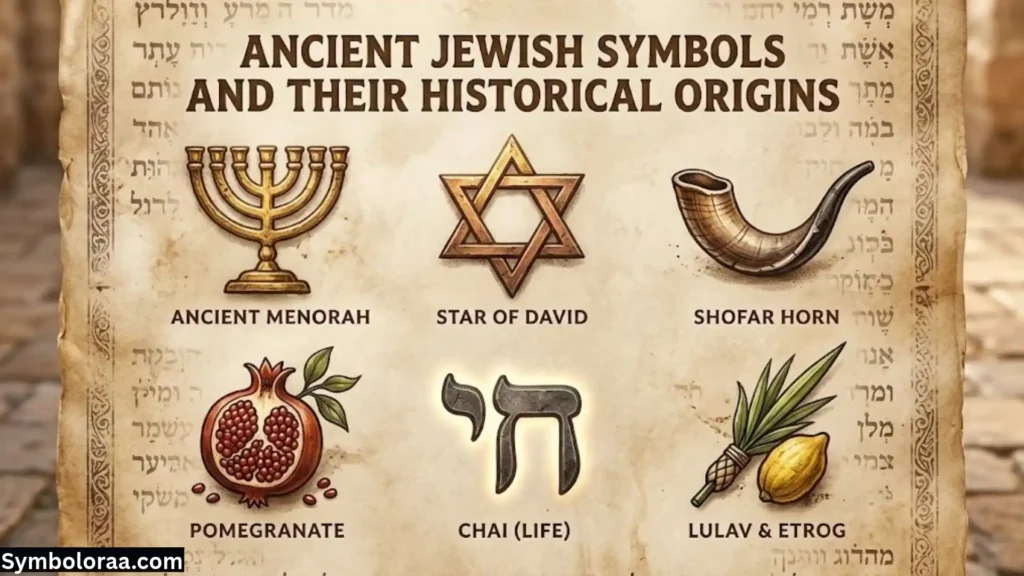
Symbols in the Tabernacle and Temple
Some of the oldest Jewish religious symbols come from biblical descriptions of the Tabernacle and the Jerusalem Temple.
The Book of Exodus describes the menorah, the High Priest’s breastplate, and the Two Tablets within the wider framework of Israelite worship and covenant.
These objects became important references in later Jewish religious art. Even after the destruction of the Second Temple in 70 CE, depictions of Temple objects helped preserve memories of ancient worship.
The menorah, in particular, became a lasting emblem of Jewish heritage. Its appearance in ancient art and later public emblems reflects the enduring importance of the Temple in Jewish historical memory.
Jewish Symbols During the Second Temple Period
The Second Temple period provides important evidence for the development of Jewish visual culture.
Ancient Jewish coins sometimes feature ritual objects such as the lulav and etrog. Coins associated with the Bar Kokhba revolt of 132–135 CE provide examples of how Jewish leaders used religious imagery in a historical and political setting.
These artifacts show that Jewish symbols could serve several purposes. They might refer to religious observance, recall the Jerusalem Temple, or express a connection with the Jewish homeland.
Archaeological evidence is especially valuable because it helps distinguish documented ancient usage from meanings assigned to symbols in later centuries.
The Historical Development of the Star of David
Although the Star of David is now widely recognized, its history as a specifically Jewish emblem developed over time.
The six-pointed geometric form appeared in various cultural settings and wasn’t exclusively Jewish in antiquity. Jewish communities adopted it more prominently in later periods, particularly in synagogue decoration and communal identity.
Its adoption by the Zionist movement in 1897 helped establish its international profile. During the twentieth century, the symbol became associated with both the persecution of Jews under Nazi rule and the establishment of Israel.
This history illustrates why ancient Jewish symbols should be studied carefully. A symbol’s modern importance doesn’t automatically establish that it held the same role in biblical times.
Jewish Symbols in Medieval and Renaissance Art
Medieval and Renaissance Jewish art incorporated Hebrew lettering, biblical imagery, ceremonial objects, and decorative motifs.
Artists and craftspeople used these elements in manuscripts, synagogue furnishings, Torah ornaments, and religious books. Regional artistic styles also influenced the shapes and designs of Jewish ceremonial objects.
The Two Tablets provide a useful example. Their familiar rounded-top shape became common through artistic convention, even though that shape shouldn’t be treated as a definitive biblical description.
Historical Jewish iconography therefore reflects both religious tradition and the artistic practices of the communities that produced it.
What Do Jewish Symbols Represent?
Individual symbols have distinct histories, but several recurring themes connect Jewish symbolism.
Life and Blessing
The Chai symbol directly expresses the Hebrew concept of life. Its numerical value of 18 also connects it with gift-giving and charitable customs.
Other objects, including Shabbat candles, can express continuity, sacred time, and the importance of religious life within the home.
Faith and Divine Commandments
The Torah scroll and Two Tablets represent Jewish teaching and religious responsibility. The menorah connects Jewish heritage with the ancient Temple and its traditions of worship.
Together, these symbols emphasize the central place of sacred teaching, religious observance, and historical memory in Judaism.
Jewish Identity and Heritage
The Star of David and menorah are widely recognized emblems of Jewish identity. Hebrew lettering also appears throughout Jewish religious and cultural life.
These symbols can communicate belonging even when people live in different countries or follow different Jewish customs. Their shared meanings help preserve connections across generations.
Unity and Community
The Four Species offer a traditional example of unity through diversity. In one Midrashic interpretation, the four plants represent different kinds of Jewish people who belong together as a community.
The twelve tribes and the High Priest’s breastplate provide another expression of collective identity. Distinct groups appear together within a shared religious framework.
Protection and Good Fortune
The hamsa is associated with protection in some Jewish folk traditions. Its use reflects the wider history of beliefs about the evil eye across the Middle East and Mediterranean.
However, not all Jewish communities embrace protective amulets. It’s important to distinguish cultural practices from universally accepted religious teachings.
Peace, Hope, and Renewal
The dove and olive branch draw on the biblical story of Noah and the Flood. The olive leaf marks the return of vegetation after the waters recede.
Later interpretations expanded these associations into broader ideas of peace and renewal. Their meanings can therefore overlap with Jewish biblical symbolism and more general cultural traditions.
Hebrew Terms Behind Jewish Symbols
Understanding a few key Hebrew terms makes it easier to interpret Jewish religious objects and traditions.
| Hebrew term | Meaning |
| Torah | Teaching; specifically the Five Books of Moses in its narrow sense |
| Mitzvah | A commandment or religious obligation |
| Mitzvot | Plural of mitzvah |
| Menorah | Candelabrum |
| Magen David | Shield of David |
| Chai | Life |
| Luchot | Tablets |
| Choshen | High Priest’s breastplate |
| Kohen | Jewish priest |
| Kohanim | Plural of Kohen |
| Kohen Gadol | High Priest |
| Levite | Member of the tribe of Levi |
| Sofer | Jewish scribe |
| Gematria | Interpretation using numerical values assigned to Hebrew letters |
| Lulav | Palm frond used during Sukkot |
| Etrog | Citron used during Sukkot |
| Hadas | Myrtle |
| Aravah | Willow |
| Sukkot | Jewish festival associated with the Four Species |
These words appear in religious texts, synagogue services, Jewish education, and descriptions of ceremonial objects. Learning their meanings provides useful context when exploring Hebrew symbols and Jewish religious traditions.
Are Jewish Symbols the Same Across All Jewish Communities?
Jewish symbolism varies across Ashkenazi, Sephardic, Mizrahi, and other Jewish communities. Shared religious traditions create common ground, while regional histories influence particular customs and artistic styles.
For example, the hamsa is especially visible in some Sephardic and Mizrahi communities with roots in North Africa and the Middle East. Other communities may use it less frequently or approach its protective associations differently.
The same variation appears in synagogue decoration, jewelry, and cemetery art. A motif may be familiar in one region but uncommon in another.
Religious observance also influences how people understand symbols. Some objects have direct roles in Jewish commandments, while others express cultural identity or customary beliefs.
Ultimately, Jewish identity cannot be reduced to a fixed collection of visual emblems. Symbols help tell the story, but the story also includes scripture, ritual, language, family traditions, and communal life.
Frequently Asked Questions About Jewish Symbols
What Are the Most Important Jewish Symbols?
The Star of David, menorah, Torah scroll, Two Tablets, and Chai are among the most recognizable Jewish symbols. Each has a different history and meaning, ranging from religious teaching to cultural identity.
What Is the Main Symbol of Judaism?
The Star of David is widely recognized as a modern emblem of Jewish identity. The seven-branched menorah, however, has a much older connection with the Tabernacle and ancient Jerusalem Temple.
What Does the Star of David Mean?
The Star of David commonly represents Jewish identity, heritage, and communal belonging. Its six-pointed shape is also called a hexagram, and its association with Judaism developed over time.
What Does the Menorah Symbolize in Judaism?
The seven-branched menorah is associated with the ancient Temple, sacred light, and Jewish heritage. The Hanukkah lamp is a different ritual object used during the eight nights of the festival.
What Is the Hebrew Symbol for Life?
Chai (חי) is the Hebrew word for life. Its two letters have a combined numerical value of 18, which explains the custom of giving gifts or charitable donations in multiples of 18.
What Does the Hamsa Mean in Judaism?
The hamsa is associated with protection in some Jewish folk traditions. It also appears in Muslim and Christian communities, so it isn’t exclusively Jewish.
What Is the Difference Between the Menorah and the Hanukkah Menorah?
The traditional Temple menorah has seven branches. A Hanukkah lamp has eight festival lights plus a shamash, the helper light used to kindle the others.
What Are the Four Species of Sukkot?
The Four Species are the etrog, lulav, hadas, and aravah. Jewish tradition uses these plants during Sukkot and interprets them in several ways, including as symbols of communal unity.
Why Is the Number 18 Significant in Judaism?
The Hebrew letters in Chai have numerical values of eight and ten, totaling 18. This connection makes multiples of 18 popular for charitable donations and gifts.
What Do Jewish Gravestone Symbols Mean?
Spread hands often indicate Kohanim, while a pitcher may identify a Levite. Candelabra can be associated with Jewish women and candle-lighting traditions, but local customs and inscriptions matter.
Are All Jewish Symbols Mentioned in the Bible?
No. Some symbols, including the menorah and Four Species, have direct biblical roots. Others, such as the Star of David in its modern role, became prominent through later historical developments.
Is the Hamsa Exclusively Jewish?
No. The hamsa appears in Jewish, Muslim, Christian, and wider regional folk traditions. Its use and religious acceptance vary among communities.
Conclusion: Understanding Jewish Symbols and Their Significance
Jewish symbols preserve religious teachings, cultural practices, and memories of Jewish history. The menorah connects modern Jewish life with the ancient Temple, while the Star of David has become a widely recognized emblem of Jewish identity.
Other symbols carry more specific associations. Chai represents life, the Torah scroll expresses the importance of sacred teaching, and the Four Species connect Sukkot with agriculture and traditional interpretations of Jewish unity.
Some symbols have biblical origins, while others gained prominence through later art, communal customs, and historical events. Their meanings can also vary across Jewish communities.
Understanding these distinctions makes Jewish symbolism more meaningful. Rather than treating every emblem as interchangeable, consider its origin, religious setting, historical development, and place within the traditions that continue to give it significance.

I’m Jackson Miller, an American author inspired by mystery, adventure, and the unpredictable nature of life. I enjoy writing fast-moving stories filled with memorable characters, unexpected choices, and meaningful moments. Through my books, I want readers to experience new worlds while discovering something about courage, determination, and themselves.
Three Books:
The Edge of Tomorrow
Under a Broken Sky
The Road We Chose
 Madison Reed