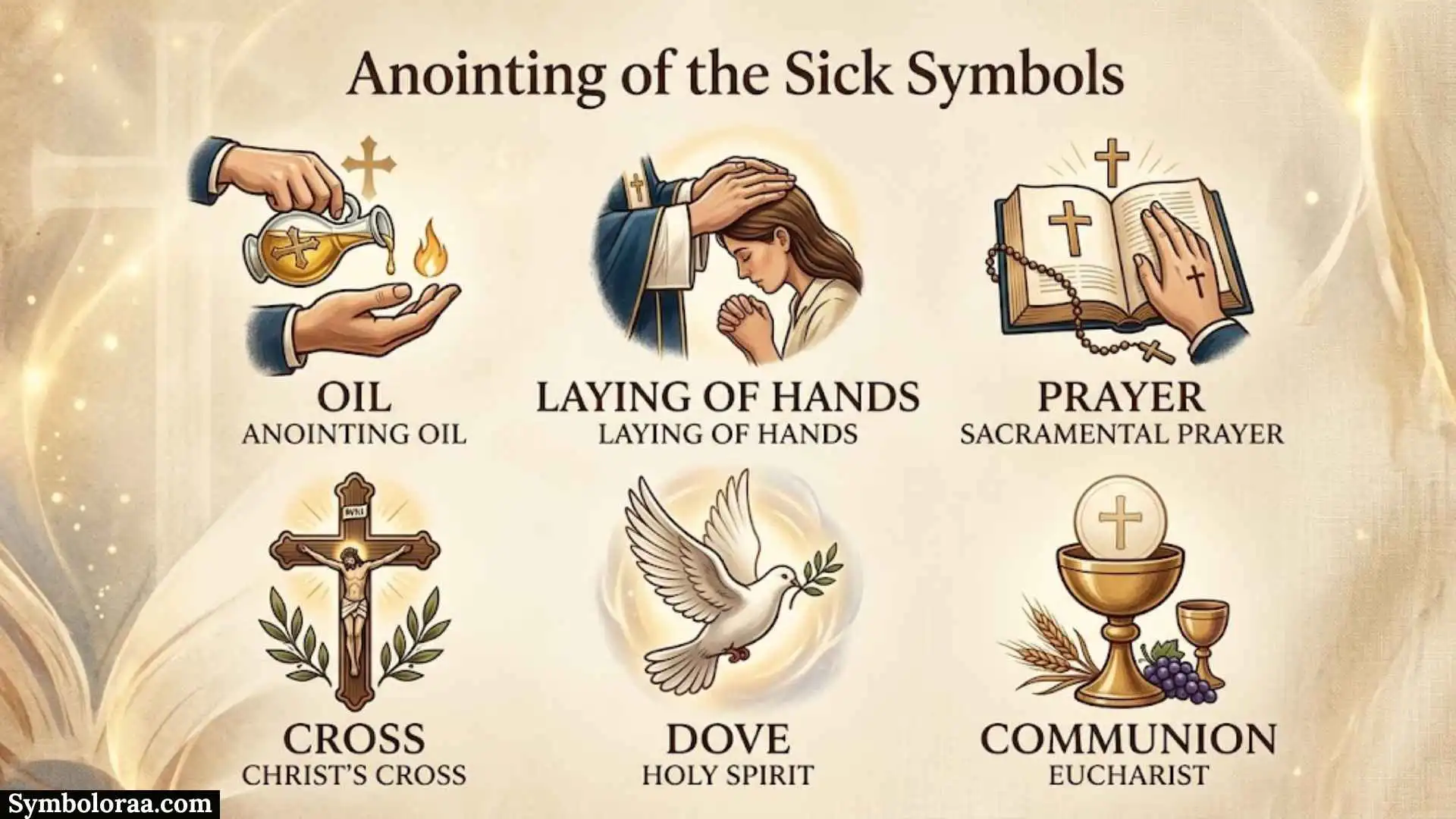
If you are looking for the Anointing of the Sick symbols, the most important ones are oil, the laying on of hands, prayer, Scripture, and the Sign of the Cross. In the Roman Catholic rite, the priest anoints the sick person’s forehead and hands with blessed oil while praying for God’s grace. These visible signs point to deeper spiritual realities, including healing, strength, peace, forgiveness, courage, and hope.
The Anointing of the Sick is not simply a ceremony performed when someone is dying. Catholic teaching describes it as a sacrament for Christians experiencing serious illness or the difficulties associated with old age. The Church teaches that it can unite a sick person more closely with Christ, give strength and peace, and, when it contributes to the person’s salvation, even accompany a restoration of physical health.
This guide explains what each symbol means, why oil is used, what the laying on of hands represents, how the sacrament is celebrated, where the practice comes from in Scripture and Christian history, and how the Anointing of the Sick differs from Last Rites.
Quick Answer:
The central symbols of the Anointing of the Sick are blessed oil, the laying on of hands, prayer, Scripture, and the Sign of the Cross. In the Roman Rite, the forehead and hands are anointed. Together, these signs express God’s mercy, healing, strength, consolation, and the Christian hope of salvation.
What Is the Anointing of the Sick?
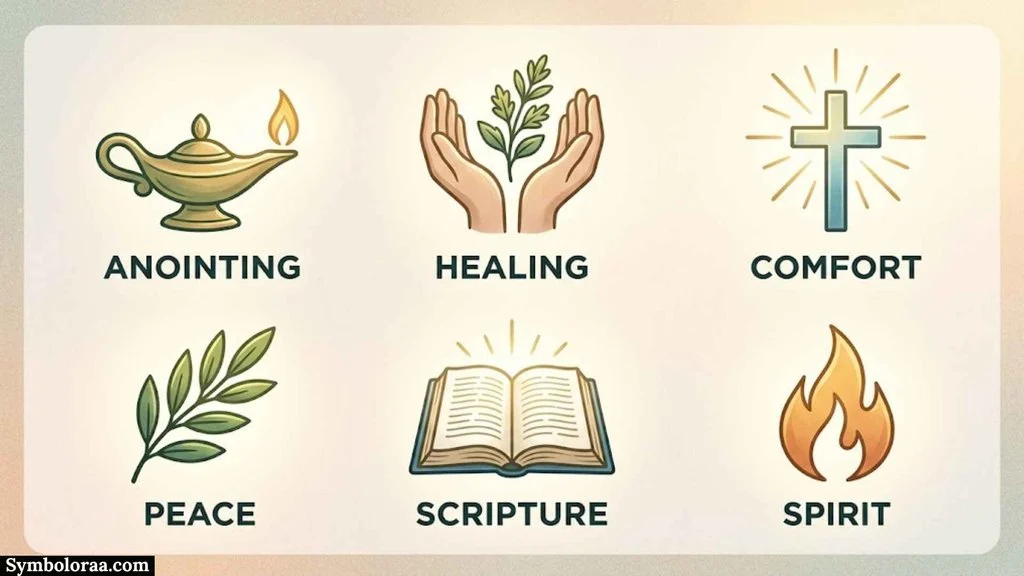
The Anointing of the Sick is one of the seven sacraments of the Catholic Church. It is intended especially to strengthen Christians who are seriously ill or experiencing the difficulties associated with serious illness or old age.
The sacrament has a strong biblical foundation. The Letter of James instructs the sick to call for the elders of the Church so that they may pray over them and anoint them with oil in the name of the Lord.
The sacrament therefore brings together several important elements:
- A person experiencing serious illness or frailty
- Prayer by the Church
- The laying on of hands
- Blessed oil
- Anointing
- A sacramental prayer
- Faith in Christ’s healing and saving work
The purpose is not limited to physical recovery. Catholic teaching describes effects that include union with Christ’s Passion, strength and courage, peace, forgiveness of sins when confession is not possible, possible restoration of health, and preparation for eternal life.
Is It Only for Someone Who Is Dying?
No. This is one of the most important points to understand.
The Catechism specifically says that the Anointing of the Sick is not a sacrament reserved only for people at the point of death. It is appropriate when a person begins to be in danger because of serious sickness or old age. It may also be repeated if a person recovers and later develops another serious illness, or if the same illness becomes more serious.
For example, a Catholic facing a serious operation may appropriately receive the sacrament before surgery. Likewise, an people older than 70 person whose frailty has become significantly worse may receive it.
What Are the Main Symbols of the Anointing of the Sick?
The sacrament uses visible actions and objects to communicate invisible spiritual realities. The most important symbols are oil, hands, prayer, Scripture, and the cross.
| Symbol or sign | What it communicates |
| Blessed oil | Healing, strength, mercy, consolation, and God’s care |
| Laying on of hands | Prayer, blessing, solidarity, and the Church’s care |
| Anointing of the forehead | God’s grace and care for the whole person |
| Anointing of the hands | God’s care for the person’s life and actions |
| Prayer | Faith, intercession, dependence on God, and hope |
| Scripture | The biblical foundation of Christian care for the sick |
| Sign of the Cross | Christ’s Passion, death, resurrection, and salvation |
| Priest | Christ’s sacramental ministry through the Church |
These signs should not be treated as unrelated decorations. They form part of one sacramental action. The Catechism describes the principal elements as the priests laying hands on the sick, praying in the faith of the Church, and then anointing the person with blessed oil.
The Oil of the Sick
Oil is the central physical symbol of the sacrament.
In the Roman Rite, the priest uses properly blessed oil to anoint the sick person. Catholic teaching specifically identifies blessed oil as an essential part of the sacramental celebration.
Oil has a long biblical and religious history. In Scripture, anointing with oil can be associated with healing, blessing, consecration, hospitality, and being set apart for a particular purpose.
Within the Anointing of the Sick, oil points toward God’s gracious care for someone who is experiencing suffering or weakness.
It can help communicate several ideas at once:
- Healing: The Church prays for the person’s healing.
- Strength: The sacrament asks God to strengthen the sick person.
- Comfort: The person is reminded that suffering does not mean abandonment by God.
- Mercy: The sacrament is connected with God’s saving and forgiving action.
- Hope: The anointing points beyond present suffering toward Christian hope.
It is important not to interpret the oil as a magical substance. Its sacramental meaning comes from its use within the Church’s rite, prayer, and faith in Christ.
The Laying on of Hands
The laying on of hands is another major symbol.
During the celebration, the priest lays hands on the sick person in silence before praying and anointing. The Catechism identifies this as one of the principal liturgical actions of the sacrament.
This physical gesture can communicate:
- Blessing
- Prayer
- Care
- Solidarity
- The Church’s presence
- Dependence on God’s grace
The gesture also has biblical roots. The Catholic Catechism notes that Jesus used the laying on of hands in His ministry of healing and blessing, and the Church continues to recognize the hand as an important biblical symbol.
For someone lying in a hospital bed, for example, the laying on of hands makes the Church’s prayer physically visible. It communicates that the person is being accompanied rather than forgotten.
The Sign of the Cross
The cross is a central Christian symbol and provides an important context for understanding the Anointing of the Sick.
The cross represents Christ’s Passion, death, and resurrection. It also helps Christians understand suffering through the story of Christ, who entered into human suffering and overcame death.
The Catechism teaches that Christ’s Passion gives suffering a new meaning and can unite the Christian’s suffering with Christ.
This does not mean that Christianity treats suffering as something desirable. Rather, the cross expresses the belief that suffering can be encountered with Christ rather than faced alone.
Prayer
Prayer is essential to the sacrament.
The priest prays over the sick person as part of the sacramental celebration. The Church’s prayer asks God to give the special grace associated with the sacrament.
Prayer represents:
- Trust in God
- Intercession
- Hope
- Spiritual dependence
- The Church’s concern for the sick
It also reminds everyone present that the sacrament is not a medical procedure. Its purpose is sacramental and spiritual, even though the Church also prays for physical healing.
Scripture
Scripture gives the sacrament its biblical foundation.
The most directly relevant passage is James 5:14–15, where the sick person is instructed to call the elders of the Church, who pray over the person and anoint the person with oil.
The Gospel accounts of Jesus healing the sick provide additional context. The Catholic Catechism explains that Jesus’ healing ministry is connected with His compassion for suffering people and with the coming of God’s Kingdom.
The use of Scripture therefore does more than add a reading to the ceremony. It connects the sacrament with the larger Christian story of Christ’s ministry, suffering, death, resurrection, and saving work.
What Does Each Symbol Mean Spiritually?
The physical signs of the sacrament point toward several spiritual realities.
Healing
Healing is an important theme, but it should be understood carefully.
The Church prays for healing, and Catholic teaching allows for physical restoration when it is beneficial for the person’s salvation. However, receiving the sacrament is not a promise that a particular physical disease will disappear.
Healing can also involve spiritual and emotional dimensions.
A person may receive:
- Peace during fear
- Courage during suffering
- Strength during weakness
- Reconciliation with God
- Greater trust
- Comfort while facing uncertainty
This broader understanding prevents a common mistake: assuming that the sacrament has failed if a person’s physical condition does not immediately improve.
Strength and Courage
Serious illness can affect more than the body. It can create fear, uncertainty, loneliness, and anxiety.
Catholic teaching specifically identifies strength, peace, and courage among the effects associated with the sacrament.
This is why the sacrament can be meaningful even when medical treatment continues and the person’s physical condition remains unchanged.
Forgiveness
The Anointing of the Sick is also connected with forgiveness of sins.
According to the Catechism, if a sick person was unable to obtain forgiveness through the Sacrament of Penance, the Anointing of the Sick can provide forgiveness of sins under the sacramental conditions.
This does not mean that the sacrament should simply be treated as a replacement for Confession whenever Confession is possible. Rather, it provides important spiritual assistance when serious illness makes ordinary confession difficult or impossible.
Hope
Hope is especially important when illness creates uncertainty about the future.
The sacrament directs the person toward Christ rather than allowing illness to become the entire focus of life. Catholic teaching also describes the sacrament as preparing the sick person for the final journey toward eternal life.
For a person with a serious diagnosis, this can give the sacrament a meaning that goes beyond the question, “Will I get better physically?”
Why Are the Forehead and Hands Anointed?
In the Roman Rite, the priest anoints the sick person’s forehead and hands with blessed oil. The Catechism identifies these two areas as part of the essential celebration in the Roman Rite.
The locations are meaningful because the sacrament concerns the whole person.
Meaning of the Forehead
The forehead is a visible part of the person and can be understood within the rite as representing the person as a whole.
The anointing is not a treatment directed at a particular medical condition on the forehead. Instead, it is a sacramental sign that the person’s entire life is being placed under God’s merciful care.
Meaning of the Hands
Hands are closely connected with human activity.
People use their hands to work, serve, create, care for others, receive gifts, and interact with the world.
Their anointing can therefore be understood as part of the sacrament’s concern for the whole person and the person’s life, actions, and vocation.
A useful way to remember the two locations is:
Forehead → the person as a whole
Hands → the person’s life and actions
The exact sacramental meaning comes from the Church’s rite rather than from a claim that each body part has an independent magical or mechanical effect.
What Happens During the Anointing of the Sick?
The celebration is more than the brief moment when oil touches the forehead and hands.
The Catechism explains that the sacrament is a liturgical and communal celebration. It can take place in a home, hospital, or church, either for one sick person or for a group of sick people.
A typical celebration may include the following elements:
- Gathering and preparation – The priest, sick person, and others present prepare for prayer.
- Liturgy of the Word – Scripture may be proclaimed to awaken faith and place the sacrament within the biblical story.
- Prayer – The Church prays for the sick person.
- Laying on of hands – The priest lays hands on the person in silence.
- Anointing – The priest anoints the forehead and hands with blessed oil in the Roman Rite.
- Sacramental prayer – The priest asks God for the grace associated with the sacrament.
- Concluding prayer – The celebration ends with further prayer and, when appropriate, other sacramental or pastoral care.
The exact form can vary depending on the circumstances and liturgical setting.
Who Can Receive the Anointing of the Sick?
The sacrament is intended for faithful Catholics who are experiencing serious illness or danger associated with illness or old age, according to Catholic norms.
The Catechism explains that it is appropriate when a person begins to be in danger of death because of sickness or old age, while also emphasizing that it is not only for people at the point of death.
It may also be received again when:
- A person recovers and later develops another serious illness
- The same illness becomes more serious
- An people older than 70 person’s frailty becomes significantly worse
- A serious operation is approaching
The Church encourages the faithful not to wait unnecessarily until the final moments of life.
Who Administers the Sacrament?
Only a priest, meaning a bishop or presbyter, validly administers the Anointing of the Sick in the Catholic Church.
This is an important distinction because family members, nurses, deacons, or lay ministers may pray with a sick person and offer other forms of pastoral support, but they do not administer the sacrament itself.
Anointing of the Sick vs. Last Rites
These expressions are related, but they should not be treated as exact synonyms.
Anointing of the Sick is a specific sacrament intended for people experiencing serious illness or significant frailty.
Last Rites is a broader pastoral expression commonly associated with the Church’s care for someone approaching death. It may involve several forms of sacramental and pastoral ministry.
One particularly important term is Viaticum, Holy Communion given to someone who is approaching death. The Catechism describes the Eucharist as the final sacrament of the earthly journey in this context.
This distinction matters because asking for the Anointing of the Sick does not automatically mean that death is imminent.
Anointing of the Sick and Physical Healing: What Should You Expect?
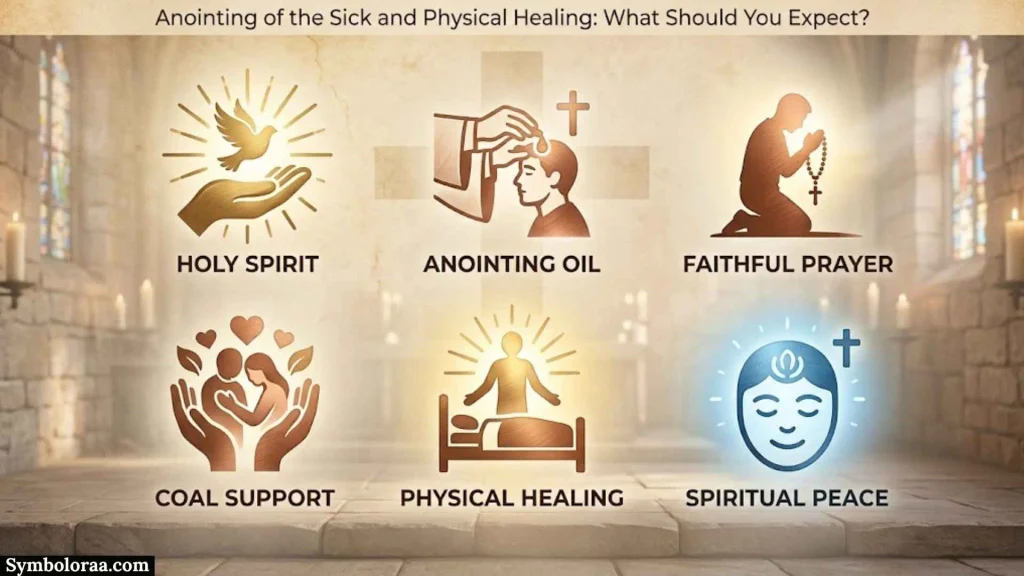
A common misconception is that the sacrament guarantees a physical cure.
It does not.
Catholic teaching says that the sacrament can bring restoration of health if it is conducive to the person’s salvation. The Church also recognizes that even intense prayers do not always result in physical healing.
This means a person can receive the sacrament faithfully while continuing to receive medical treatment.
A Practical Example
Imagine a Catholic patient who is scheduled for major surgery.
The patient asks a priest for the Anointing of the Sick before the procedure. The priest prays, lays hands on the patient, and anoints the patient with blessed oil.
The patient may still need surgery, medication, rehabilitation, or other medical care.
The sacrament’s purpose is not to replace those treatments. Instead, it provides sacramental grace and spiritual support as the person faces a serious health challenge.
Common Misconceptions About the Symbols
Understanding what the symbols do not mean can prevent confusion.
The Oil Is Not a Magical Substance
The physical oil does not have magical healing power.
Its significance comes from the sacramental rite, the prayer of the Church, and God’s grace.
The Sacrament Is Not Only for the Dying
A person can receive the Anointing of the Sick because of serious illness without being expected to die immediately.
The Sacrament Does Not Replace Medicine
Receiving the sacrament does not mean abandoning appropriate medical care.
The religious and medical dimensions of caring for a sick person can work alongside each other.
The Forehead and Hands Are Not Being Medically Treated
The priest’s anointing is sacramental rather than medical.
The oil is not being applied because the forehead or hands are the location of a particular disease.
Physical Healing Is Not Guaranteed
The sacrament asks God for healing but does not promise that a particular illness will disappear.
The Church also understands healing in terms of spiritual strength, peace, courage, forgiveness, and union with Christ.
Historical Background of the Anointing of the Sick
The practice has ancient Christian roots.
The Letter of James provides an early biblical witness to praying over the sick and anointing them with oil. The Catholic Catechism also identifies ancient evidence of anointing the sick with blessed oil in both Eastern and Western Christian liturgical traditions.
Over time, the way the sacrament was commonly understood changed.
During part of Western Christian history, the practice became increasingly associated with people who were close to death. This led to the term Extreme Unction, or final anointing. The Catechism notes this historical development while also observing that the liturgy continued to pray for the sick person’s recovery when beneficial.
The modern Roman Rite reflects a broader understanding of the sacrament.
In 1972, Pope Paul VI issued Sacram Unctionem Infirmorum, establishing the revised form of the sacrament for the Roman Rite. It specifies anointing with properly blessed oil and identifies the forehead and hands as the places of anointing.
This history helps explain why older Catholic sources may use terminology such as Extreme Unction, while contemporary Catholic sources generally speak of the Anointing of the Sick.
A Simple Decision Guide: When Should You Consider the Sacrament?
If you are unsure whether the Anointing of the Sick is appropriate, this simple guide can help.
Is the person experiencing serious illness or significant frailty?
↓
Yes → Contact a Catholic priest or parish and ask about the sacrament.
No, but a serious operation is approaching → The sacrament may be appropriate before the operation.
The person already received it but the same illness has become significantly worse → The sacrament may be repeated according to Catholic teaching.
The person has recovered but later develops another serious illness → The sacrament may be received again.
The person is approaching death → Contact a priest promptly to discuss the Anointing of the Sick and other appropriate end-of-life pastoral care.
The best practical advice is not to wait until communication becomes impossible if there is a reasonable opportunity to contact a priest earlier.
Practical Checklist for Families
If a family member is seriously ill, the following checklist can make the process easier:
- Contact the person’s parish or a Catholic priest.
- Explain the person’s medical situation clearly.
- Ask whether the priest can visit the home or hospital.
- Let the medical facility know a priest is coming if required.
- Create a quiet space for prayer when possible.
- Allow the sick person to participate as much as their condition permits.
- Do not treat the sacrament as a substitute for medical care.
- Ask about Confession if the person is able to receive it.
- If death may be approaching, ask the priest about Viaticum and other pastoral care.
- Continue practical and emotional support after the sacrament.
The goal is not to create a complicated ceremony. The purpose is to help the sick person receive the Church’s prayer and sacramental care with dignity and faith.
Expert Context: Why These Symbols Work Together
One of the easiest ways to misunderstand the Anointing of the Sick is to study each symbol separately.
The deeper meaning appears when the symbols are viewed together.
Oil provides the visible sign of anointing.
Hands express prayer and the Church’s care.
Words and prayer explain what the Church is asking God to do.
Scripture connects the celebration to the biblical ministry of Christ and the early Church.
The cross places suffering within the Christian story of Christ’s Passion and Resurrection.
The result is a sacramental language that speaks to the whole person.
This is especially important because serious illness is rarely only a physical experience. It can affect relationships, emotions, faith, identity, independence, and a person’s understanding of the future.
The sacrament responds to that whole experience rather than reducing the sick person to a medical condition.
Frequently Asked Questions About Anointing of the Sick Symbols
What is the main symbol of the Anointing of the Sick?
The principal physical symbol is blessed oil. In the Roman Rite, the priest uses it to anoint the sick person’s forehead and hands while praying the sacramental prayer.
What does the oil symbolize in the Anointing of the Sick?
The oil represents God’s gracious care and is associated with healing, strength, comfort, and spiritual assistance. Its meaning comes from the sacramental rite rather than from any magical property of the oil.
What does the laying on of hands symbolize?
It expresses prayer, blessing, solidarity, and the Church’s care for the sick person. The laying on of hands is one of the principal actions in the celebration of the sacrament.
Why are the forehead and hands anointed?
In the Roman Rite, these are the designated places of anointing. The signs express sacramental care for the person as a whole rather than medical treatment of those particular body parts.
What Bible verse is connected with the Anointing of the Sick?
James 5:14–15 is the key biblical passage. It describes the sick person calling the elders of the Church, who pray over the person and anoint the person with oil in the name of the Lord.
Is the Anointing of the Sick the same as Last Rites?
No. The Anointing of the Sick is a specific sacrament. “Last Rites” is a broader expression for pastoral and sacramental care associated with someone approaching death. Viaticum, for example, is Holy Communion given to a person nearing death.
Can someone receive the Anointing of the Sick before surgery?
Yes. Catholic teaching specifically says that it is fitting to receive the sacrament before a serious operation.
Can the sacrament be received more than once?
Yes. It can be repeated when a person recovers and later develops another serious illness, or when the same illness becomes more serious.
Does the sacrament guarantee physical healing?
No. The Church prays for healing, but Catholic teaching does not promise a physical cure. Restoration of health may occur if it is beneficial for the person’s salvation.
Who can administer the Anointing of the Sick?
A Catholic priest—either a bishop or presbyter—administers the sacrament.
Can the Anointing of the Sick take place in a hospital?
Yes. The sacrament can be celebrated in a hospital, home, church, or another appropriate setting.
What if the sick person cannot speak?
A priest should be contacted as soon as possible. The person’s medical condition may affect how the celebration is carried out, so the priest can determine the appropriate pastoral and sacramental approach.
Is the oil used in the sacrament ordinary cooking oil?
The sacrament uses properly blessed oil, not simply ordinary oil taken from a kitchen. Catholic law and liturgical practice specify the oil used for the sacrament.
Key Takeaways
The most important points to remember are:
- Oil is the central physical symbol of the sacrament.
- Laying on of hands expresses prayer, blessing, and the Church’s care.
- The forehead and hands are anointed in the Roman Rite.
- Prayer and Scripture connect the sacrament to Christian faith and the biblical ministry of healing.
- The cross places suffering within the story of Christ’s Passion, death, and Resurrection.
- The sacrament offers strength, peace, courage, and spiritual grace.
- It is not only for people who are dying.
- It does not guarantee a physical cure.
- It does not replace appropriate medical treatment.
- Only a priest administers the sacrament in the Catholic Church.
- The practice has biblical roots, especially in James 5:14–15.
- Modern Catholic practice is broader than the older association of the sacrament with the final moments of life.
Conclusion
The Anointing of the Sick symbols give visible form to some of the central beliefs of Catholic care for people who are seriously ill. The oil represents sacramental anointing and God’s healing care. The laying on of hands communicates prayer and solidarity. Scripture connects the rite to the ministry of Christ and the early Church, while the cross places human suffering within the Christian story of Christ’s death and Resurrection.
The sacrament is therefore much more than the physical application of oil. It is a prayerful encounter in which the Church asks God to strengthen, comfort, forgive, and assist the sick person. Physical healing may occur, but Catholic teaching also emphasizes spiritual strength, peace, courage, union with Christ, and hope.
For families dealing with serious illness, one of the most practical lessons is simple: the Anointing of the Sick is not something that must be postponed until the final moments of life. When serious illness or significant frailty arises, contacting a priest can allow the sick person to receive the sacrament at an appropriate time.

I’m Madison Reed, a contemporary American author who writes about love, family, friendship, and second chances. I’m fascinated by the choices that shape our lives and the moments that change us forever. My goal is to create honest, emotional stories with characters readers can connect with long after finishing each book.
Three Books:
When We Find Our Way
The Things We Never Said
Summer in September
 Jackson Miller