
Chinese symbols appear on restaurant menus, street signs, traditional artwork, business logos, and everyday products. Some represent ordinary words, while others carry cultural meanings associated with love, happiness, prosperity, or longevity. Once you understand how these characters work, the Chinese writing system becomes much less intimidating.
If you’re learning Mandarin for the first time or exploring Chinese culture, this guide will help you get started. You’ll discover basic Chinese characters, their English meanings, Mandarin pinyin, common words, and practical examples. You’ll also learn how Chinese radicals work, why stroke order matters, and how simplified and traditional characters differ.
Most importantly, you’ll see how individual characters combine to create meaningful words and expressions. That knowledge will help you recognize Chinese writing in real-life situations instead of simply memorizing unfamiliar shapes.
What Are Chinese Symbols Called?
Chinese characters are called Hanzi (汉字) in Mandarin. They form the foundation of written Chinese and represent a writing tradition that developed over thousands of years.
People often use the phrase Chinese symbols when searching for character meanings, cultural emblems, or decorative designs. However, Chinese characters and cultural symbols aren’t exactly the same thing.
A Chinese character belongs to a writing system. It can represent a word, a meaningful element within a word, or a syllable associated with a word. A cultural symbol, by contrast, may communicate an idea through a character, an image, or a traditional design.
For example:
| Chinese character | Pinyin | Meaning |
| 人 | rén | Person |
| 山 | shān | Mountain |
| 水 | shuǐ | Water |
| 火 | huǒ | Fire |
| 木 | mù | Tree; wood |
| 爱 | ài | Love |
| 福 | fú | Good fortune; blessings |
Each character has a recognizable written form. However, its precise meaning and grammatical role depend on context.
Consider 人 (rén), which means “person.” Combine it with 口 (kǒu), meaning “mouth,” and you get 人口 (rénkǒu), meaning “population.” The characters contribute to a larger word rather than functioning as separate English words.
Chinese Characters vs. Pinyin
Hanyu Pinyin is the standard Roman-letter system used to represent Mandarin pronunciation. It helps beginners learn how to say Chinese words without already knowing their written forms.
Compare these three elements:
- Character: 水
- Pinyin: shuǐ
- English meaning: Water
Pinyin uses tone marks because Mandarin is a tonal language. For example, mā, má, mǎ, and mà represent different tones and can distinguish different words.
Learning Chinese characters alongside pinyin and English meanings gives you a more complete understanding of the language. You’ll recognize written words, pronounce them more accurately, and begin connecting vocabulary with real conversations.
How the Chinese Writing System Works
Chinese writing differs from an alphabetic system such as English. Instead of spelling most words by arranging letters, Chinese uses characters that combine to represent meaningful linguistic units.
Many characters originated from visual representations of objects. Others developed through combinations of meaningful components and pronunciation clues.
Are Chinese Characters Pictures?
Some Chinese characters preserve traces of their pictographic origins.
For example, 山 (shān) means “mountain” and resembles a simplified outline of mountain peaks. 日 (rì), meaning “sun” or “day,” developed from an older symbol representing the sun.
However, Chinese characters aren’t simply pictures of objects. Many modern characters contain components that provide information about meaning or pronunciation.
Consider 河 (hé), meaning “river.” Its left-side component, 氵, is associated with water. The right-side component, 可, contributes a historical pronunciation clue.
This structure appears throughout Chinese writing. Recognizing recurring components can help you understand how unfamiliar characters are built.
How Chinese Characters Form Meaning
Chinese characters developed through several structural principles.
- Pictographs: Characters originally associated with visual representations, such as 山 (mountain).
- Simple ideographs: Characters representing concepts such as 上 (up) and 下 (down).
- Compound ideographs: Characters combining meaningful elements to express an idea.
- Phono-semantic compounds: Characters combining a semantic component with a phonetic component. This is a major category of Chinese characters.
These categories explain why some characters look like what they represent while others don’t.
How Many Chinese Characters Exist?
There isn’t one universally useful number because the answer depends on what you count. Historical dictionaries, specialist terminology, regional writing, and modern everyday Chinese contain different sets of characters.
The Unicode Standard encodes more than 100,000 CJK unified ideographs as of Unicode 17.0, released in September 2025. That technical inventory includes many rare characters, including forms used in historical texts and personal or place names. It doesn’t mean ordinary readers need to learn all of them. Unicode’s release announcement explains the additions.
For beginners, a much smaller set of frequently used characters offers a practical starting point. You’ll make faster progress by learning common characters in useful words than by trying to memorize a dictionary.
100+ Basic Chinese Characters With Pinyin and Meanings
The following Chinese characters list groups beginner vocabulary into everyday categories. Each entry includes its Mandarin pinyin and a common English meaning.
Keep in mind that a character can have several meanings or readings. The English definitions below provide useful starting points rather than covering every possible use.
Chinese Numbers and Counting Characters
Chinese number characters are among the easiest to learn because they follow clear patterns.
| Character | Pinyin | Meaning |
| 一 | yī | One |
| 二 | èr | Two |
| 三 | sān | Three |
| 四 | sì | Four |
| 五 | wǔ | Five |
| 六 | liù | Six |
| 七 | qī | Seven |
| 八 | bā | Eight |
| 九 | jiǔ | Nine |
| 十 | shí | Ten |
| 百 | bǎi | Hundred |
| 千 | qiān | Thousand |
| 万 | wàn | Ten thousand |
Chinese numbers combine these characters to express larger values. For example, 二十 (èrshí) means twenty, while 三百 (sānbǎi) means three hundred.
The character 万 represents ten thousand, which differs from the grouping used in English. Understanding this pattern helps when reading prices, addresses, and large numbers.
Chinese Characters for People and Family
People-related characters appear constantly in everyday Mandarin. Start with pronouns and common family terms.
| Character | Pinyin | Meaning |
| 人 | rén | Person |
| 我 | wǒ | I; me |
| 你 | nǐ | You |
| 他 | tā | He; him |
| 她 | tā | She; her |
| 们 | men | Plural marker |
| 父 | fù | Father; paternal |
| 母 | mǔ | Mother |
| 子 | zǐ | Child; son in some contexts |
| 女 | nǚ | Woman; female |
| 男 | nán | Man; male |
| 家 | jiā | Home; family |
| 朋 | péng | Friend-related component |
| 友 | yǒu | Friend |
Several of these characters combine to form everyday vocabulary.
For example, 我们 (wǒmen) means “we” or “us.” The character 们 marks plurality in certain pronouns and people-related nouns.
Similarly, 朋友 (péngyou) means “friend.” Learning both characters together is more useful than memorizing 朋 and 友 as isolated entries.
Common Chinese Verbs and Action Characters
Verbs help you describe what people do, where they go, and what they need.
| Character | Pinyin | Meaning |
| 是 | shì | To be; is/am/are in common patterns |
| 有 | yǒu | To have; there is/are |
| 在 | zài | To be at; in |
| 去 | qù | To go |
| 来 | lái | To come |
| 看 | kàn | To look; watch; read |
| 吃 | chī | To eat |
| 喝 | hē | To drink |
| 学 | xué | To study; learn |
| 说 | shuō | To speak; say |
| 听 | tīng | To listen |
| 写 | xiě | To write |
These common Chinese characters become especially useful when you place them in short sentences.
- 我是学生。(Wǒ shì xuésheng.) — I am a student.
- 我有水。(Wǒ yǒu shuǐ.) — I have water.
- 我去学校。(Wǒ qù xuéxiào.) — I go to school.
- 我看书。(Wǒ kàn shū.) — I read a book.
Notice how characters work together to convey a complete thought. You don’t need to translate every character into a separate English word to understand the sentence.
Chinese Adjectives and Descriptive Words
Descriptive characters help you talk about size, quality, speed, temperature, and price.
| Character | Pinyin | Meaning |
| 大 | dà | Big |
| 小 | xiǎo | Small |
| 多 | duō | Many; much |
| 少 | shǎo | Few; little |
| 好 | hǎo | Good |
| 坏 | huài | Bad |
| 新 | xīn | New |
| 旧 | jiù | Old; used |
| 高 | gāo | Tall; high |
| 长 | cháng | Long |
| 热 | rè | Hot |
| 冷 | lěng | Cold |
| 快 | kuài | Fast |
| 慢 | màn | Slow |
| 贵 | guì | Expensive |
| 便 | biàn | Convenient in certain uses |
Some characters change meaning depending on their pronunciation or the word containing them. For example, 便宜 (piányi) means “cheap,” while 方便 (fāngbiàn) means “convenient.”
Learn these expressions as complete vocabulary items. Doing so prevents confusion when a familiar character appears in a different context.
Chinese Characters for Places and Directions
Location-related characters are especially helpful for travelers and anyone learning practical Mandarin.
| Character | Pinyin | Meaning |
| 中 | zhōng | Middle; center |
| 国 | guó | Country |
| 城 | chéng | City; town in compounds |
| 店 | diàn | Shop; store |
| 校 | xiào | School-related component |
| 上 | shàng | Up; above; on |
| 下 | xià | Down; below; under |
| 左 | zuǒ | Left |
| 右 | yòu | Right |
| 里 | lǐ | Inside; within |
| 外 | wài | Outside |
| 东 | dōng | East |
| 西 | xī | West |
| 南 | nán | South |
| 北 | běi | North |
The word 中国 (Zhōngguó) means China. It combines 中, meaning “middle” or “center,” with 国, meaning “country.”
Likewise, 学校 (xuéxiào) means “school.” You may recognize 校 from this word, but it isn’t normally used alone to mean “school” in everyday Mandarin.
These distinctions show why vocabulary matters as much as individual character meanings.
Chinese Characters for Food and Drinks
Food vocabulary is practical for ordering meals, reading menus, and shopping.
| Character | Pinyin | Meaning |
| 米 | mǐ | Uncooked rice |
| 面 | miàn | Flour; noodles in compounds |
| 水 | shuǐ | Water |
| 茶 | chá | Tea |
| 肉 | ròu | Meat |
| 鱼 | yú | Fish |
| 菜 | cài | Vegetable; dish |
| 饭 | fàn | Cooked rice; meal |
| 果 | guǒ | Fruit; result in other contexts |
| 蛋 | dàn | Egg |
These characters appear in common food words:
- 水果 (shuǐguǒ) — fruit
- 米饭 (mǐfàn) — cooked rice
- 鸡蛋 (jīdàn) — egg
- 鱼肉 (yúròu) — fish meat
- 茶水 (cháshuǐ) — tea or drinking water, depending on context
One important distinction is the difference between 米 and 饭. 米 usually refers to uncooked rice, while 饭 often refers to cooked rice or a meal.
Chinese Characters for Time and Dates
Time-related characters help you discuss schedules, dates, and daily routines.
| Character | Pinyin | Meaning |
| 日 | rì | Day; sun |
| 月 | yuè | Month; moon |
| 年 | nián | Year |
| 天 | tiān | Day; sky |
| 时 | shí | Time; hour in compounds |
| 分 | fēn | Minute; part |
| 今 | jīn | Present; today-related |
| 明 | míng | Bright; tomorrow-related |
| 早 | zǎo | Early; morning-related |
| 晚 | wǎn | Late; evening |
Common expressions include 今天 (jīntiān), meaning “today,” 明天 (míngtiān), meaning “tomorrow,” and 时间 (shíjiān), meaning “time.”
The character 明 also appears in 明白 (míngbai), meaning “to understand.” This is another reminder that character meanings can extend beyond their most familiar definitions.
Chinese Question Words and Grammar Characters
Function words help connect ideas, form questions, and express relationships between words.
| Chinese | Pinyin | Meaning or use |
| 谁 | shéi | Who |
| 什 | shén | Component in 什么, meaning what |
| 哪 | nǎ | Which |
| 么 | me | Component in 什么 |
| 吗 | ma | Yes/no question particle |
| 的 | de | Possession or description marker |
| 不 | bù | Not |
| 也 | yě | Also |
| 和 | hé | And; with |
| 这 | zhè | This |
| 那 | nà | That |
| 有 | yǒu | To have; there is/are |
Here are several useful expressions:
- 什么 (shénme) — what
- 哪里 (nǎlǐ) — where
- 谁 (shéi) — who
- 这个 (zhège) — this; this one
- 那个 (nàge) — that; that one
- 多少钱 (duōshao qián) — how much money?
Pay particular attention to 的 and 吗. These characters are common in Mandarin sentences, but their roles differ from those of nouns and verbs.
For example, 你好吗?(Nǐ hǎo ma?) means “How are you?” The particle 吗 turns a statement-like structure into a yes-or-no question.
More Useful Chinese Characters for Everyday Life
Expand your beginner vocabulary with characters associated with colors, transportation, and common signs.
| Character | Pinyin | Meaning |
| 白 | bái | White |
| 黑 | hēi | Black |
| 红 | hóng | Red |
| 绿 | lǜ | Green |
| 电 | diàn | Electricity |
| 车 | chē | Vehicle |
| 门 | mén | Door |
| 开 | kāi | Open; start |
| 关 | guān | Close; shut |
| 请 | qǐng | Please; invite |
| 谢 | xiè | Thanks-related character |
| 爱 | ài | Love |
These characters appear in words such as 电话 (diànhuà, telephone), 电车 (diànchē, electric vehicle or tram depending on context), and 开门 (kāimén, open the door).
Learning practical combinations makes character recognition more useful. You might recognize 电 on an appliance label or 开 on a sign indicating that something is open.
Common Chinese Words and Phrases for Beginners
Individual characters provide a foundation, but complete words make that knowledge useful in everyday situations.
Essential Chinese Greetings
| Chinese phrase | Pinyin | English meaning |
| 你好 | nǐ hǎo | Hello |
| 您好 | nín hǎo | Hello; polite form |
| 谢谢 | xièxie | Thank you |
| 再见 | zàijiàn | Goodbye |
| 对不起 | duìbuqǐ | Sorry |
| 不客气 | bú kèqi | You’re welcome |
| 请 | qǐng | Please |
Chinese greetings often depend on the social situation. 您好 is a more polite form of hello, while 你好 is common in everyday interactions.
Everyday Chinese Vocabulary
| Chinese | Pinyin | Meaning |
| 中国 | Zhōngguó | China |
| 中文 | Zhōngwén | Chinese language or writing |
| 汉字 | Hànzì | Chinese characters |
| 朋友 | péngyou | Friend |
| 学生 | xuésheng | Student |
| 老师 | lǎoshī | Teacher |
| 学校 | xuéxiào | School |
| 水果 | shuǐguǒ | Fruit |
| 手机 | shǒujī | Mobile phone |
| 工作 | gōngzuò | Work; job |
Notice that some Chinese words contain characters you may already know. 学 appears in 学生 and 学校, both associated with learning and education.
This pattern makes vocabulary expansion easier. Once you recognize a character, you can begin noticing it in several related words.
Basic Chinese Sentences With English Translations
Practice these beginner-friendly sentences:
我爱你。
Wǒ ài nǐ. — I love you.
我有水。
Wǒ yǒu shuǐ. — I have water.
我是学生。
Wǒ shì xuésheng. — I am a student.
你好吗?
Nǐ hǎo ma? — How are you?
这个多少钱?
Zhège duōshao qián? — How much does this cost?
Read each sentence aloud and identify the characters you recognize. Then try to understand the whole expression without translating every character separately.
Chinese Symbols With Cultural and Traditional Meanings

Some Chinese characters have cultural associations that extend beyond their ordinary dictionary definitions. These characters appear in celebrations, artwork, gifts, architecture, and traditional decorations.
Their cultural meanings can vary by context. A character used in a greeting may function differently from the same character displayed as decorative art.
福 (Fú): Good Fortune and Blessings
福 (fú) is one of the most recognizable Chinese symbols associated with good fortune, blessings, and happiness.
People commonly display 福 decorations during Lunar New Year. You’ll find the character on red paper decorations, household ornaments, and festive gifts.
One well-known tradition involves hanging 福 upside down. The custom relies on a Chinese wordplay association between the upside-down 福 and the idea that fortune has arrived. It isn’t simply a different written form of the character.
For cultural decoration, 福 communicates a wish for good luck and prosperity. In ordinary writing, however, it remains a Chinese character with the meaning “blessing” or “good fortune.”
寿 / 壽 (Shòu): Longevity
寿 is the simplified form of traditional 壽. Both are associated with longevity and long life.
The character appears in traditional birthday celebrations, decorative artwork, and gifts intended to express wishes for a long and healthy life.
Its appearance can vary considerably across calligraphic styles. Even when the design becomes elaborate, the underlying character remains recognizable.
喜 and 囍: Happiness and Double Happiness
喜 (xǐ) means happiness or joy. The character appears in words and expressions related to celebration.
囍 is known as the double-happiness character. It combines two 喜 forms and is strongly associated with traditional Chinese weddings.
You’ll often see 囍 on wedding decorations, gifts, and red paper designs. It expresses wishes for happiness in married life rather than serving as an ordinary everyday word.
爱 / 愛 (Ài): Love
爱 is the simplified form of traditional 愛. Both mean “love” or “affection.”
The character appears in romantic expressions, family-related language, and phrases about caring for others.
For example, 我爱你 (Wǒ ài nǐ) means “I love you.” The phrase is a familiar example of how a character’s meaning contributes to a complete expression.
If you’re choosing Chinese characters for a tattoo, pendant, or other permanent design, verify the spelling and intended meaning with a knowledgeable speaker. A dictionary definition alone may not capture the expression you want.
和 (Hé): Harmony
和 has several everyday meanings, including “and” and “with.” It can also express harmony or peaceful relations in suitable contexts.
In cultural discussions, 和 is often associated with balance, cooperation, and harmonious relationships. These associations reflect particular uses of the character rather than every sentence in which it appears.
龙 / 龍 (Lóng): The Chinese Dragon
龙 is the simplified form of 龍. Both mean “dragon.”
The Chinese dragon has a long history in mythology, art, folklore, and imperial symbolism. Unlike many Western dragon traditions, Chinese dragon imagery often associates the creature with auspicious power, authority, rain, and prosperity.
Dragon motifs appear in festivals, architecture, traditional paintings, clothing, and decorative objects. The character 龙 itself is a written character, while a dragon illustration is a visual cultural motif.
Other Recognizable Chinese Cultural Symbols
Several other concepts are frequently discussed alongside Chinese symbols and meanings.
- 阴阳 (Yīnyáng): Yin and yang, representing complementary aspects of a whole.
- 太极图 (Tàijítú): The familiar circular diagram associated with yin and yang.
- 八卦 (Bāguà): The eight trigrams used in traditional Chinese cosmology.
- 莲花 (Liánhuā): Lotus imagery, often associated with purity and spiritual traditions.
- 十二生肖 (Shí’èr shēngxiào): The twelve-animal Chinese zodiac cycle.
These examples aren’t all individual characters. Some are multi-character terms, diagrams, or cultural systems.
Understanding the distinction helps you interpret Chinese artwork more accurately. A decorative design may communicate an idea through a combination of written characters, shapes, colors, and traditional imagery.
Simplified vs. Traditional Chinese Characters
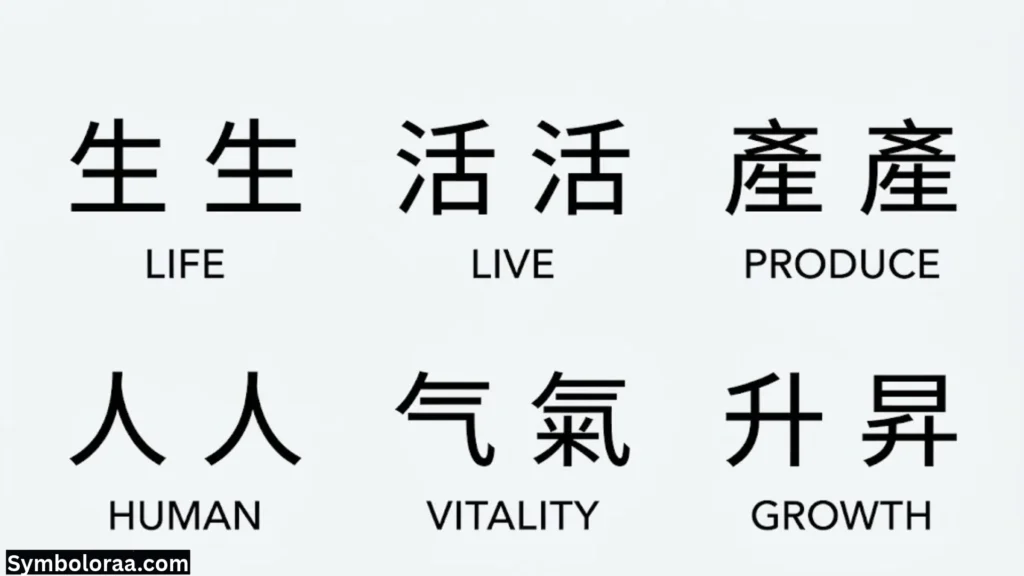
Chinese writing uses different character forms in different regions. The two main systems beginners encounter are simplified Chinese and traditional Chinese.
What Is Simplified Chinese?
Simplified Chinese uses modern standardized forms for many characters. The People’s Republic of China introduced nationwide character simplification reforms during the twentieth century.
Simplified characters are used in mainland China and are also standard in Singapore.
Examples include:
- 爱 — love
- 国 — country
- 学 — learn
- 书 — book
- 龙 — dragon
- 马 — horse
- 门 — door
- 见 — see
Some simplified characters have fewer strokes than their traditional counterparts. However, simplification doesn’t affect every character, and not every simplified character has a direct one-to-one relationship with a traditional form.
What Is Traditional Chinese?
Traditional Chinese retains character forms that preserve more of the older written structures. Traditional characters are standard in Taiwan, Hong Kong, and Macau.
Examples include:
- 愛 — love
- 國 — country
- 學 — learn
- 書 — book
- 龍 — dragon
- 馬 — horse
- 門 — door
- 見 — see
Traditional characters remain important in modern publications, education, literature, and cultural settings.
Simplified and Traditional Chinese Comparison
| English meaning | Simplified | Traditional | Pinyin |
| Love | 爱 | 愛 | ài |
| Country | 国 | 國 | guó |
| Learn | 学 | 學 | xué |
| Book | 书 | 書 | shū |
| Dragon | 龙 | 龍 | lóng |
| Horse | 马 | 馬 | mǎ |
| Door | 门 | 門 | mén |
| See | 见 | 見 | jiàn |
Many characters look identical in both systems. Others differ significantly in shape or stroke count.
Some simplified characters also correspond to multiple traditional characters. This means that automatic conversion sometimes requires context to select the correct traditional form.
Which system should beginners learn? Choose based on where you plan to study, travel, communicate, or read. If you mainly use materials from mainland China, simplified Chinese is a practical starting point. If your goals center on Taiwan, traditional Chinese is usually the better choice.
Chinese Radicals, Strokes, and Character Structure
Chinese characters can look complicated until you learn to recognize their recurring components. Radicals and stroke patterns give you a useful framework for understanding written forms.
What Are Chinese Radicals?
Chinese radicals are components used to classify characters in dictionaries. Some also provide clues about a character’s meaning.
The traditional Kangxi system contains 214 radicals, a classification associated with the eighteenth-century Kangxi Dictionary. Modern dictionaries and learning tools may organize characters differently.
A radical isn’t necessarily the only meaningful component in a character. Nor does every radical reliably predict the full meaning of the character containing it.
Common Chinese Radicals With Examples
| Component | Common association | Example |
| 氵 | Water-related meanings | 河 (hé, river) |
| 亻 | People-related meanings | 你 (nǐ, you) |
| 口 | Mouth or speech | 吃 (chī, eat) |
| 木 | Trees or wood | 林 (lín, grove) |
| 火 / 灬 | Fire-related meanings | 热 (rè, hot) |
| 女 | Woman or female | 妈 (mā, mother) |
| 扌 | Hand-related actions | 打 (dǎ, hit) |
| 艹 | Plants or vegetation | 花 (huā, flower) |
These components can help you recognize patterns in unfamiliar characters. For example, the water-related component 氵 appears in 河, meaning “river,” and 海, meaning “sea.”
Treat radicals as helpful clues rather than infallible definitions. Character history and modern usage can be more complicated than a component’s appearance suggests.
Chinese Stroke Order Rules
Stroke order refers to the conventional sequence used to write a character’s individual strokes. Following standard stroke order helps you form characters consistently and improves handwriting practice.
Common conventions include:
- Horizontal strokes generally come before vertical strokes.
- Top strokes generally come before bottom strokes.
- Left-side components generally come before right-side components.
- Outside components are often written before inside components.
- Enclosing strokes are often completed after the enclosed components.
These are general guidelines, not rules without exceptions. Check a reliable stroke-order reference when learning an unfamiliar character.
Understanding Chinese Character Structure
Characters commonly use several arrangements:
- Left-right structure: 妈, with 女 on the left and 马 on the right.
- Top-bottom structure: 花, with 艹 above 化.
- Enclosing structure: 国, with an outer frame surrounding the inner component.
Practicing on Chinese grid paper can help you maintain balanced proportions. Aim to reproduce the character’s structure instead of simply drawing something that looks similar.
Chinese Character Pronunciation: A Beginner’s Pinyin Guide
Pinyin helps learners pronounce Mandarin words and recognize the tones that distinguish them.
The Four Mandarin Tones and Neutral Tone
Mandarin uses four main lexical tones and a neutral tone. The same syllable can represent different words depending on its tone.
| Tone | Pinyin example | Basic description |
| First | mā | High and level |
| Second | má | Rising |
| Third | mǎ | Low or dipping, depending on context |
| Fourth | mà | Falling |
| Neutral | ma | Light and unstressed |
These examples use the syllable ma to demonstrate tone marks. They shouldn’t be interpreted as five versions of the same word.
Tone is important because Mandarin uses it to distinguish words. Ignoring tone marks can lead to confusion even when the consonants and vowels are correct.
Why Chinese Characters May Have Different Pronunciations
Some characters have multiple readings depending on their meaning or context.
For example, 行 can be pronounced xíng in 行走 (xíngzǒu, “to walk”) and háng in 银行 (yínháng, “bank”).
This is one reason learning characters within words is so effective. A complete word provides context for selecting the correct pronunciation and meaning.
Common Pinyin Mistakes
Beginners often make a few predictable mistakes:
- Reading pinyin letters exactly as they would in English.
- Ignoring tone marks.
- Confusing similar initials and finals.
- Assuming every character has only one pronunciation.
- Memorizing written forms without listening to spoken examples.
Use audio recordings and repeat short words aloud. Listening and speaking practice should complement reading and writing rather than becoming an afterthought.
How to Learn and Memorize Chinese Characters Effectively

Memorizing Chinese characters takes time, but the right methods make the process more manageable. Focus on recognition, pronunciation, meaning, and practical use.
Start With High-Frequency Chinese Characters
Begin with characters you encounter in common words and everyday communication. Numbers, pronouns, basic verbs, question particles, and familiar nouns provide a useful foundation.
Frequency matters because not every character appears equally often. Jun Da’s Chinese text-computing resources provide character-frequency lists based on modern and classical Chinese text collections.
Prioritizing frequent characters gives you more opportunities to recognize what you’ve learned in new material.
Learn Pinyin, Meaning, and Example Words Together
For each new character, record three things:
- The character itself.
- Its pinyin and tone.
- One common word or phrase containing it.
For example:
- Character: 水
- Pinyin: shuǐ
- Meaning: water
- Example: 水果 (shuǐguǒ), fruit
This approach connects written form, pronunciation, and vocabulary. It also reduces the risk of memorizing an English meaning without knowing how the character works in a real word.
Use Spaced Repetition and Active Recall
Spaced repetition schedules reviews at intervals so you revisit information over time. Active recall means trying to remember an answer before looking at it.
Flashcards can combine both methods. Apps such as Anki support spaced-repetition workflows, while Pleco offers Chinese dictionary and language-learning features.
A useful flashcard might show 水 on one side and ask you to recall its pronunciation and meaning. Another card can show “water” and ask you to identify the corresponding character.
Practice Writing by Hand
Handwriting practice reinforces character structure and stroke order. Write carefully enough to notice how each component fits within the character’s overall shape.
Don’t focus on producing dozens of identical copies without checking your work. Instead, compare your writing with a reliable reference and correct mistakes as you go.
Learn Chinese Characters in Context
Reading characters inside words and sentences helps you understand how Mandarin actually works.
Practice with short dialogues, graded reading material, restaurant menus, product labels, and everyday signs. When you encounter a familiar character in a new word, look up the complete word instead of assuming its meaning from the character alone.
Build a Realistic Daily Study Routine
A simple 15-minute routine can keep your learning consistent:
- Five minutes: Review previously learned characters.
- Five minutes: Learn a few new characters with pinyin and example words.
- Five minutes: Read, write, or use those characters in short sentences.
Adjust the pace to suit your schedule and learning goals. Regular review generally provides more value than trying to memorize an enormous list in one sitting.
How Many Chinese Characters Should Beginners Learn?
There’s no single number that guarantees reading fluency. Your progress depends on character recognition, vocabulary, grammar, reading experience, and the kinds of texts you want to understand.
Still, staged goals can help you organize your learning.
| Learning stage | Suggested focus |
| First 100 characters | Numbers, pronouns, common verbs, basic descriptions |
| Next 300–500 characters | Everyday vocabulary, simple reading, shopping, travel |
| Around 1,000 characters | Broader recognition in beginner texts and common written material |
| Beyond 1,000 characters | More varied reading, specialized vocabulary, and stronger literacy |
Treat these as flexible milestones rather than official proficiency levels. The characters you need for a restaurant menu aren’t necessarily the ones you’ll encounter in a newspaper or historical text.
Remember that character recognition and vocabulary knowledge aren’t identical. You might recognize every character in a two-character word yet still need to learn what the complete word means.
Common Mistakes to Avoid When Learning Chinese Symbols
A few habits can make learning unnecessarily difficult. Avoiding them helps you build more reliable knowledge.
- Memorizing meanings without pronunciation: Learn pinyin and tones alongside the written form.
- Treating every character as a complete word: Study common combinations and sentence examples.
- Ignoring stroke order: Follow standard writing sequences when practicing by hand.
- Confusing simplified and traditional forms: Choose a primary system and learn common differences.
- Assuming radicals explain everything: Use components as clues rather than definitive translations.
- Learning too many characters at once: Leave enough time to review older material.
- Relying on literal translation: Learn complete words and phrases to understand natural Mandarin.
- Confusing cultural symbolism with ordinary meaning: Check whether a character is being used linguistically or symbolically.
The goal isn’t simply to recognize a large number of characters. You want to understand how they function in words and how those words communicate meaning.
Useful Chinese Character Learning Resources
Reliable references can help you check character meanings, pronunciation, writing structure, and vocabulary.
Chinese Dictionaries and Character References
- MDBG Chinese-English Dictionary: Look up Chinese characters, pinyin, English meanings, and vocabulary.
- Pleco: Explore Chinese dictionary and language-learning tools.
- Unicode’s Unihan Database: Consult technical character information, including readings and radical-stroke data.
Use learner-friendly dictionaries for daily study and technical references when you need detailed character information.
Writing and Pronunciation Practice
Choose resources that show stroke order and provide reliable Mandarin audio. Compare unfamiliar characters with dictionary entries instead of relying entirely on visual guesswork.
When practicing pronunciation, listen to complete words as well as individual syllables. This helps you hear tones in context and recognize how Mandarin sounds in connected speech.
Structured Mandarin Learning
If you prefer a formal learning plan, explore beginner Mandarin courses and proficiency resources. The HSK assesses Mandarin proficiency, while TOCFL is associated with Chinese-language assessment in Taiwan.
These assessments can provide learning goals, but you don’t need to prepare for an exam to benefit from learning common Chinese characters.
Frequently Asked Questions About Chinese Symbols
What are Chinese symbols called?
Chinese characters are called Hanzi (汉字). They form the writing system used for Chinese. The phrase “Chinese symbols” can also refer to traditional cultural motifs, decorative designs, or auspicious characters such as 福, which represents good fortune.
What are the most common Chinese characters?
Frequently encountered characters include 的, 了, 是, 不, 我, 你, 人, 一, and 有. Exact rankings depend on the text collection and whether the source measures written Chinese, spoken dialogue, or a particular type of publication.
How many Chinese characters are there?
The total depends on the dictionary or character inventory being counted. Unicode 17.0 encodes more than 100,000 CJK unified ideographs, including many rare forms. Everyday readers need far fewer characters to handle common vocabulary and ordinary communication.
What are 100 basic Chinese characters for beginners?
A practical list includes numbers, pronouns, verbs, adjectives, location words, food vocabulary, time expressions, and common grammar characters. Learning each character with pinyin and example words makes the list more useful than memorizing English definitions alone.
What is the difference between Chinese characters and pinyin?
Chinese characters are the written forms used to represent Chinese language. Pinyin uses Roman letters and tone marks to represent Mandarin pronunciation. For example, 水 is the character, shuǐ is its pinyin, and “water” is its English meaning.
Are Chinese characters and Japanese kanji the same?
Chinese characters and Japanese kanji share historical roots, but they belong to different language systems. Japanese uses kanji alongside hiragana and katakana. Some characters look alike across the languages, yet their pronunciations and meanings may differ.
What are Chinese radicals?
Radicals are components used to classify Chinese characters in dictionaries. Some provide clues about meaning or structure. The traditional Kangxi system contains 214 radicals, although modern references may use different organizational methods.
What do Chinese symbols for love, luck, and happiness mean?
爱 / 愛 means love, 福 represents good fortune or blessings, 喜 means happiness, and 囍 is associated with double happiness and traditional weddings. Their cultural associations depend on how and where people use them.
Should beginners learn simplified or traditional Chinese?
Choose the system that fits your learning goals. Simplified Chinese is standard in mainland China and Singapore, while traditional Chinese is standard in Taiwan, Hong Kong, and Macau. Your preferred reading materials and travel plans can guide the decision.
How can I memorize Chinese characters faster?
Use spaced repetition, active recall, handwriting practice, and example words. Review characters regularly and learn them in context. Focus on retaining a manageable number of characters rather than rushing through a large list without revision.
How do you write Chinese characters correctly?
Follow standard stroke order, maintain balanced proportions, and pay attention to each character’s components. Use a reliable stroke-order reference and grid paper while practicing. Regular feedback helps you correct mistakes and improve recognition.
How long does it take to learn basic Chinese characters?
The time required depends on your study routine, prior language experience, and learning goals. A short daily session can help you build a foundation over time. Your progress will depend on consistent review and how often you use the characters in real words and sentences.
Conclusion: Start Learning Chinese Characters One Step at a Time
Chinese symbols become easier to understand when you distinguish written characters from cultural motifs and learn how each character works in context.
Start with common characters such as 人, 我, 水, 火, 山, and 爱. Add pinyin, English meanings, and useful example words. Then expand your vocabulary into numbers, family, food, directions, and everyday expressions.
As your skills improve, explore Chinese radicals, stroke order, simplified and traditional forms, and the cultural meanings of characters such as 福 and 囍.
You don’t need to memorize thousands of characters immediately. Learn a few useful characters well, review them regularly, and use them in real words. Over time, those small steps will help you recognize more Chinese writing and understand the language with greater confidence.

I’m Madison Reed, a contemporary American author who writes about love, family, friendship, and second chances. I’m fascinated by the choices that shape our lives and the moments that change us forever. My goal is to create honest, emotional stories with characters readers can connect with long after finishing each book.
Three Books:
When We Find Our Way
The Things We Never Said
Summer in September