
Christianity has a rich history of symbols that communicate faith, hope, love, sacrifice, and eternal life. From the familiar cross to the ancient Ichthys fish, these symbols help Christians express important beliefs through simple yet meaningful images.
You can find Christian symbols in churches, stained-glass windows, religious paintings, jewelry, books, and places of worship. Each symbol has its own history and significance. Some come directly from biblical stories, while others developed through centuries of Christian art, worship, and tradition.
Understanding Christian symbols and their meanings helps you appreciate the beliefs behind these images. For example, the cross represents Jesus Christ’s crucifixion and the Christian belief in salvation. The dove symbolizes the Holy Spirit, while bread and wine hold special meaning in Holy Communion.
This guide explores more than 25 Christian symbols, their biblical connections, historical origins, and traditional interpretations. You’ll also learn how different Christian denominations use these symbols and why their meanings sometimes vary.
What Are Christian Symbols?
Christian symbols are images, objects, shapes, letters, and signs that represent important beliefs and teachings of Christianity. They help communicate spiritual ideas and connect believers with biblical stories, religious traditions, and the life of Jesus Christ.
Some symbols represent God or the Holy Trinity. Others recall events from the Bible, such as the crucifixion, resurrection, or birth of Jesus. Certain objects, including candles and Communion vessels, also carry religious significance during Christian worship.
Christian symbolism includes several categories:
- Biblical symbols: Images associated with Scripture, such as the rainbow, burning bush, and Lamb of God.
- Symbols of Jesus Christ: The cross, crucifix, Chi-Rho, and IHS monogram.
- Symbols of the Holy Spirit: The dove, fire, and other images associated with divine presence.
- Symbols of the Holy Trinity: The Triquetra, Shield of the Trinity, and Borromean rings.
- Christian worship symbols: Bread, wine, candles, chalices, and the Bible.
- Ancient Christian symbols: The Ichthys fish, anchor, and Good Shepherd.
- Christian devotional symbols: Religious jewelry, crosses, and other objects used to express personal faith.
Not every Christian symbol comes directly from the Bible. Some represent biblical teachings, while others developed through Christian history and artistic traditions. Understanding this difference helps you interpret each symbol more accurately.
Christian Symbols and Their Meanings at a Glance
The following table summarizes some of the most recognizable symbols of Christianity.
| Christian Symbol | Meaning | Biblical or Historical Connection |
| Latin Cross | Sacrifice, salvation, and redemption | Jesus’ crucifixion |
| Crucifix | Christ’s suffering and sacrifice | Matthew 27:27–50 |
| Empty Cross | Resurrection and victory over death | Matthew 28:5–6 |
| Ichthys Fish | Christian identity and faith in Jesus | Early Christian tradition |
| Dove | Holy Spirit, peace, and renewal | Matthew 3:16; Genesis 8 |
| Crown of Thorns | Suffering and Christ’s kingship | Matthew 27:29 |
| Triquetra | Unity of the Holy Trinity in some Christian traditions | Later Christian symbolism |
| Light and Flame | Truth, guidance, and divine presence | John 8:12 |
| Star of Bethlehem | Jesus’ birth and divine guidance | Matthew 2:1–10 |
| Bread and Wine | Holy Communion and remembrance | Luke 22:19–20 |
| Rainbow | God’s covenant with Noah | Genesis 9:12–17 |
| Wedding Ring | Marriage, commitment, and fidelity | Christian marriage traditions |
| Lamb of God | Sacrifice, redemption, and salvation | John 1:29 |
| Holy Bible | Scripture and Christian teaching | 2 Timothy 3:16–17 |
| Ten Commandments Tablets | Divine law and moral responsibility | Exodus 20 |
| Cross and Crown | Perseverance and heavenly reward | James 1:12 |
| Alpha and Omega | Eternity and divine sovereignty | Revelation 22:13 |
| Chi-Rho | Christ’s name and Christian identity | Early Christian history |
| IHS Monogram | The name of Jesus | Christian devotional tradition |
| Anchor | Hope and steadfastness | Hebrews 6:19 |
| Palm Branch | Triumph and celebration | John 12:12–13 |
| Good Shepherd | Christ’s care and protection | John 10:11–14 |
| Peacock | Resurrection and immortality in historical Christian art | Later Christian tradition |
| Pelican | Self-sacrificing love in medieval Christian art | Medieval symbolism |
| INRI | Jesus of Nazareth, King of the Jews | John 19:19–22 |
| Jerusalem Cross | Christian history associated with Jerusalem | Medieval Christian tradition |
These meanings offer a helpful starting point. However, the interpretation of a symbol may depend on its historical period, artistic setting, and Christian denomination.
The Most Important Christian Symbols Explained
The Christian Cross
The Christian cross is the most widely recognized symbol of Christianity. It represents the crucifixion of Jesus Christ and the Christian belief that his death and resurrection provide the way to salvation.
The cross initially recalls suffering and execution. Within Christianity, however, it also represents forgiveness, redemption, reconciliation with God, and hope beyond death.
In 1 Corinthians 1:18, the apostle Paul connects the message of the cross with God’s power. Jesus also teaches his followers to take up their crosses, emphasizing commitment, sacrifice, and discipleship.
Latin Cross
The Latin cross has a long vertical beam and a shorter horizontal beam positioned above its midpoint. It appears on church buildings, gravestones, necklaces, paintings, and other Christian objects.
This familiar design represents Jesus’ crucifixion and the salvation associated with his sacrifice. Its widespread use makes it one of the most recognizable Christian religious symbols.
Crucifix
A crucifix is a cross that includes a representation of Jesus’ body. It emphasizes Christ’s suffering and death.
Crucifixes are especially common in Roman Catholic worship. They also appear in some Anglican, Lutheran, and other Christian traditions.
The crucifix doesn’t deny the resurrection. Instead, it places particular emphasis on the sacrifice Jesus made through his crucifixion.
Empty Cross
An empty cross has no figure of Jesus attached to it. Many Christians use it to emphasize the resurrection and Christ’s victory over death.
The empty cross appears in numerous Protestant churches and personal devotional items. However, Christians who use crucifixes also believe in the resurrection.
The difference generally reflects artistic and devotional preferences rather than a disagreement about whether Jesus rose from the dead.
Other Christian Cross Designs
Christian history includes several other cross shapes.
- Greek Cross: Features four arms of approximately equal length.
- St. Andrew’s Cross: Has an X-shaped design traditionally associated with Saint Andrew.
- Eastern Orthodox Cross: Often includes additional horizontal bars.
- Jerusalem Cross: Combines one large cross with four smaller crosses.
- Cross and Crown: Connects the cross with imagery of victory and heavenly reward.
Each design has its own historical background and religious associations.
The Christian Fish Symbol (Ichthys)
The Christian fish symbol, also called the Ichthys or Ichthus, consists of two curved lines that form the outline of a fish. It is one of the best-known symbols associated with early Christianity.
Ichthys is the ancient Greek word for fish. Christian tradition also connects the Greek letters with the phrase commonly translated as Jesus Christ, Son of God, Savior.
The fish has several connections with the New Testament. Jesus called fishermen to follow him and become fishers of people. The Gospels also describe miraculous meals in which Jesus fed crowds with bread and fish.
Early Christians used fish imagery in religious art and other settings. Over time, the fish became a recognizable expression of Christian identity.
Popular accounts sometimes describe the Ichthys as a secret code used by all early Christians during persecution. The historical evidence doesn’t establish that every Christian community used it in this way.
Today, the Jesus fish appears on vehicle decals, necklaces, clothing, and personal accessories. People commonly use it to express their Christian faith or identify themselves as followers of Jesus.
The Dove: A Symbol of the Holy Spirit
The Christian dove is one of the most recognizable symbols of the Holy Spirit. In the Gospel accounts of Jesus’ baptism, the Holy Spirit descends like a dove.
This event connects the dove with divine presence and the beginning of Jesus’ public ministry.
The dove also appears in the story of Noah. In Genesis 8:8–12, Noah sends out a dove that eventually returns with a fresh olive leaf. The bird signals that the floodwaters have receded and that the earth is becoming habitable again.
These two biblical accounts contribute different meanings to Christian symbolism. The baptism story connects the dove with the Holy Spirit, while Noah’s story associates it with renewal and the return of dry land.
Common uses of the dove include:
- Representing the Holy Spirit in Christian artwork.
- Appearing in paintings of Jesus’ baptism.
- Symbolizing peace and renewal.
- Decorating church windows and religious objects.
- Representing spiritual presence in some depictions of Pentecost.
The dove is one of the clearest symbols of the Holy Spirit, although the Bible also uses images of wind and fire when describing the Spirit’s activity.
The Crown of Thorns
The crown of thorns represents Jesus’ suffering before his crucifixion. According to the Gospels, Roman soldiers placed a crown made of thorns on Jesus’ head and mocked him as the King of the Jews.
This act appears in Matthew 27:29 and John 19:2. The soldiers intended to humiliate Jesus, but Christians interpret the scene as a powerful contrast between mockery and Christ’s true kingship.
The crown of thorns communicates several important ideas:
- Suffering: Jesus endured physical pain and humiliation.
- Sacrifice: The scene leads toward the crucifixion.
- Kingship: Jesus’ identity as King contrasts with the soldiers’ ridicule.
- Redemption: Christian teaching connects Christ’s suffering with salvation.
Artists often include the crown of thorns in Passion paintings, crucifixion scenes, and Holy Week decorations.
Symbols of the Holy Trinity
The Holy Trinity is the Christian belief that there is one God in three Persons: the Father, the Son, and the Holy Spirit.
Christians have developed different symbols to help explain this theological concept. These designs aim to express both the unity of God and the distinction between the three Persons.
Triquetra
The Triquetra is a three-part design made from interlocking loops or arcs. Some Christian traditions use it to represent the Father, Son, and Holy Spirit.
However, the design has a broader artistic history, including Celtic traditions. Its appearance alone doesn’t prove that an object originally carried Christian meaning.
Borromean Rings
The Borromean rings consist of three interlinked circles arranged so that removing one ring breaks the overall link.
Some Christian explanations use this structure as an analogy for the unity of the three Persons of the Trinity. The design serves as a visual teaching aid rather than a symbol specifically prescribed by Scripture.
Shield of the Trinity
The Shield of the Trinity is a traditional diagram that connects the Father, Son, and Holy Spirit with statements about their relationship to God.
It helps explain how Christians understand the three Persons while affirming one God. The diagram is primarily a theological illustration.
Relevant biblical passages include Matthew 28:19, Matthew 3:16–17, and 2 Corinthians 13:14.
Light and Flame: Symbols of God’s Presence
Light is a recurring image throughout the Bible. It represents truth, guidance, life, holiness, and divine presence.
In John 8:12, Jesus describes himself as the Light of the World. Psalm 119:105 compares God’s word to a lamp that guides a person’s path.
Candles and Lamps
Candles and lamps provide physical light, but they can also carry spiritual meaning during Christian worship.
Churches use candles during prayer, memorials, worship services, Advent, and Easter celebrations. In many Western Christian traditions, the Paschal candle plays an important role during Easter and represents the risen Christ.
The Burning Bush
The burning bush appears in Exodus 3:1–6. Moses encounters a bush that burns without being consumed, and God speaks to him through this event.
The burning bush represents divine presence, revelation, and a calling to serve. It also holds special significance in certain Christian traditions, including Eastern Orthodoxy.
Christian Stars and Their Meanings
Stars appear in several biblical passages and Christian artistic traditions. However, the Star of Bethlehem, Morning Star, and Star of David have different meanings and histories.
Star of Bethlehem
The Star of Bethlehem appears in Matthew 2:1–10. According to the Gospel, the star guides the Magi toward Jesus after his birth.
Christian art frequently places the star above the Nativity scene. It represents divine guidance, the announcement of Jesus’ birth, and the journey of the Magi.
The biblical account doesn’t provide enough information to identify the star conclusively with a particular astronomical event.
Morning Star
The Morning Star is an image associated with brightness, hope, and the beginning of a new day.
In Revelation 22:16, Jesus identifies himself as the bright Morning Star. Christian interpretations connect this title with Christ’s glory, his reign, and the hope of salvation.
Star of David
The Star of David is a six-pointed star formed by two overlapping triangles. It is primarily associated with Judaism and Jewish identity rather than serving as a universal Christian symbol.
Some Christian artworks incorporate the star in particular historical or biblical contexts. However, it shouldn’t be confused with the Star of Bethlehem.
Bread and Wine: Symbols of Holy Communion
Bread and wine hold central significance in Christian worship. Their meaning comes from the Last Supper, when Jesus shared a meal with his disciples before his crucifixion.
In Luke 22:19–20, Jesus connects the bread with his body and the cup with the new covenant in his blood. Christians remember this event through Holy Communion, also called the Eucharist or the Lord’s Supper.
Christian denominations differ in how they explain Christ’s presence in Communion. Roman Catholic and Eastern Orthodox teaching emphasizes the sacramental presence of Christ, while Protestant traditions have several interpretations.
Bread and wine commonly represent:
- Remembrance: Christians recall Jesus’ death and the Last Supper.
- Sacrifice: The elements point toward Christ’s body and blood.
- Covenant: The cup connects with the new covenant described in the New Testament.
- Unity: Communion expresses fellowship among believers.
- Spiritual nourishment: Bread and wine point toward the sustaining role of Christ.
Bread of Life
In John 6:35, Jesus describes himself as the Bread of Life. This metaphor connects physical nourishment with spiritual life.
The image also recalls the manna God provided to the Israelites in the wilderness. In Christian interpretation, it emphasizes God’s provision and the importance of Christ in sustaining spiritual life.
Grapes and the Vine
Grapes and vines appear in Christian art as symbols of Christ, discipleship, and spiritual fruitfulness.
In John 15:1–5, Jesus describes himself as the true vine and his followers as branches. The metaphor emphasizes the importance of remaining connected to Christ and producing spiritual fruit.
The Rainbow: A Symbol of God’s Covenant
The rainbow in the Bible represents God’s covenant with Noah after the Flood. Genesis 9:12–17 identifies the rainbow as a sign of the covenant between God, Noah, his descendants, and every living creature.
The passage emphasizes God’s promise never again to destroy all life through a flood of that kind. For Christians, the rainbow therefore represents divine faithfulness, mercy, and the reliability of God’s promises.
Other biblical passages use rainbow imagery in different contexts. Ezekiel 1:28 compares the appearance of divine glory to a rainbow, while Revelation 4:2–3 describes a rainbow-like appearance around God’s throne.
These passages contribute to the rainbow’s broader associations with divine glory and majesty.
The Circle and Wedding Ring
The circle can represent eternity because it has no obvious beginning or end. Christian art and devotional traditions sometimes use the shape to communicate God’s eternal nature and enduring love.
A wedding ring has a more specific role in many Christian marriage ceremonies. Couples exchange rings as visible signs of commitment, fidelity, and their marriage vows.
The Bible doesn’t establish a universal doctrine that every circle represents eternity. Instead, these interpretations developed through religious customs and artistic traditions.
Wedding rings commonly symbolize:
- Commitment to marriage.
- Faithfulness between spouses.
- Enduring love.
- A visible reminder of marriage vows.
Ephesians 5:25–33 discusses marriage through the relationship between Christ and the Church. Christian traditions often draw on this passage when explaining the spiritual significance of marriage.
The Lamb of God (Agnus Dei)

The Lamb of God, known in Latin as Agnus Dei, is an important symbol of Jesus Christ. It draws on biblical images of sacrifice and the lamb’s association with innocence.
In John 1:29, John the Baptist identifies Jesus as the Lamb of God who takes away the sin of the world. Christians interpret this statement as connecting Jesus’ mission with sacrifice and redemption.
The lamb also appears in Revelation, where it represents Christ in imagery associated with victory, worship, and heavenly glory.
Christian artists commonly depict the Lamb of God in several ways:
- A lamb standing beside a cross.
- A lamb carrying a banner associated with victory.
- A lamb associated with imagery from Revelation.
- A lamb positioned among other symbols of worship and redemption.
The symbol communicates innocence, sacrifice, atonement, and salvation. When depicted triumphantly, it also emphasizes the Christian belief that Christ’s death leads to resurrection and victory.
The Holy Bible: A Symbol of Scripture and Faith
The Holy Bible is the sacred collection of Scriptures central to Christianity. Although it is a text rather than simply an emblem, artists often depict an open or closed Bible to represent God’s word and Christian teaching.
An open Bible may suggest study, preaching, or public Scripture readings. A closed Bible may appear in religious portraits or church decoration as an emblem of biblical authority.
The Bible contains two main divisions:
- Old Testament: Includes texts shared with Judaism, although Christian and Jewish traditions differ in canon and arrangement.
- New Testament: Contains the Gospels, Acts, letters, and Revelation, including accounts of Jesus’ life and teachings.
Second Timothy 3:16–17 describes Scripture as useful for teaching, correction, and training in righteousness. Psalm 119:105 also uses a lamp as an image of God’s word guiding a person’s path.
The Ten Commandments and Stone Tablets
The Ten Commandments are associated with Moses and the biblical account of God’s covenant with Israel. Exodus 20:1–17 and Deuteronomy 5:6–21 present the commandments within the story of Israel’s relationship with God.
Christian art often depicts Moses holding two stone tablets. The image represents divine law, moral responsibility, and the covenant established at Sinai.
The tablets commonly communicate:
- Divine law: Instructions given to Israel in the biblical narrative.
- Worship: Commands concerning loyalty to God and the rejection of idols.
- Moral conduct: Teachings about honoring parents and respecting others.
- Covenant: The relationship between God and the people of Israel.
Christians interpret the commandments alongside New Testament teachings, including Jesus’ emphasis on love for God and neighbor.
The Cross and Crown
The Cross and Crown combines two familiar Christian images. The cross represents Christ’s suffering, while the crown can symbolize victory, kingship, or heavenly reward.
In traditions that use this emblem, the combination often expresses perseverance through earthly trials and hope for eternal life.
James 1:12 connects perseverance under trial with receiving the crown of life. Revelation 2:10 similarly uses the crown of life in a message about faithfulness amid suffering.
The Cross and Crown shouldn’t be confused with the crown of thorns. The crown of thorns recalls Jesus’ humiliation before his crucifixion, while the crown in this emblem commonly represents victory or reward.
Alpha and Omega: The Beginning and the End
Alpha and Omega are the first and last letters of the Greek alphabet. In the Book of Revelation, the phrase communicates divine eternity and sovereignty.
The image suggests that God encompasses the beginning and end of all things. Revelation 22:13 uses the titles “the First and the Last” and “the Beginning and the End” alongside Alpha and Omega.
Christian art frequently places these letters beside a cross or incorporates them into church decoration. They also appear in Easter imagery, where their association with Christ reinforces themes of resurrection and eternal life.
The symbol communicates eternity, sovereignty, completion, and divine authority.
Chi-Rho: An Ancient Christian Monogram
The Chi-Rho is one of the best-known ancient Christian symbols. It combines two Greek letters: Chi (Χ) and Rho (Ρ), the first two letters of Christos, the Greek word for Christ.
The letters overlap to form a monogram called a Christogram. Early Christians used the design in inscriptions, religious art, and objects associated with their faith.
The Chi-Rho became especially prominent during the reign of Constantine the Great in the fourth century. Constantine’s association with the symbol helped increase its visibility as Christianity gained imperial support.
The Chi-Rho represents Christ’s name and became a visible marker of Christian identity. Artists sometimes combine it with Alpha and Omega to connect Christ with the biblical language of eternity.
IHS: The Monogram of Jesus
The IHS monogram is a traditional Christian emblem associated with the name of Jesus. It appears on church altars, vestments, religious paintings, and devotional objects.
Its development involves the transmission of Jesus’ name from Greek into Latin Christian writing. The letters IHS became associated with the name of Jesus through historical Christian usage.
During the medieval period and afterward, the monogram became a prominent devotional sign. Some versions include rays of light, a cross, or other decorative elements.
IHS is often associated with devotion to the Holy Name of Jesus. It serves as a reminder of Christ’s identity and central place in Christian worship.
Other Christian Symbols Worth Knowing
Beyond the major emblems, many other Christian symbols communicate hope, victory, love, discipleship, and eternal life.
The Anchor
The anchor represents hope and steadfastness in some Christian traditions. Hebrews 6:19 compares hope to an anchor for the soul, providing a clear biblical foundation for this interpretation.
Early Christian art also used anchor imagery. Its familiar shape made it a useful expression of stability amid uncertainty.
The Palm Branch
Palm branches appear in the account of Jesus’ entry into Jerusalem. John 12:12–13 describes people welcoming Jesus with palm branches as he approaches the city.
Many Christian churches commemorate this event on Palm Sunday, which begins Holy Week in numerous traditions. Palm branches represent celebration, triumph, and recognition of Jesus as king.
In some Christian traditions, palm branches also appear in depictions of martyrs and represent victory through faithfulness.
The Good Shepherd
The Good Shepherd is a biblical image of Jesus as the one who cares for and protects his followers.
In John 10:11, Jesus describes himself as the Good Shepherd who lays down his life for the sheep. Artists may depict him carrying a lamb, guiding a flock, or standing among sheep.
The image communicates compassion, protection, guidance, and self-giving love. It also appears in early Christian art.
The Peacock
The peacock appears in some historical Christian artworks as a symbol associated with immortality and resurrection.
These associations developed through ancient cultural beliefs and later Christian artistic interpretation. The Bible doesn’t directly identify the peacock as a Christian emblem.
Its meaning therefore depends on the artwork’s historical period and setting.
The Pelican
The pelican became a symbol of self-giving love in medieval Christian art. A traditional story claimed that a pelican would wound itself to feed its young, creating an image that artists connected with Christ’s sacrifice.
This belief reflects historical natural lore rather than an established fact about pelican behavior. Within Christian symbolism, however, the image became a powerful illustration of sacrificial love.
Pelicans appear in some Eucharistic artwork and church decoration because of this association.
The INRI Inscription
INRI is an abbreviation of the Latin inscription associated with Jesus’ crucifixion. It represents Iesus Nazarenus, Rex Iudaeorum, commonly translated as “Jesus of Nazareth, King of the Jews.”
John 19:19–22 describes the inscription placed above Jesus on the cross. Artists often reproduce INRI on crucifixes and Passion scenes.
Unlike the Chi-Rho and IHS, INRI comes from the wording associated with the crucifixion narrative rather than a monogram formed from Christ’s name.
The Three Nails
The three nails appear in some Christian depictions of the crucifixion. They represent the physical suffering associated with Jesus’ death.
Their number and placement depend on artistic tradition. The Gospels don’t specify a universally established count of the nails used during the crucifixion.
The Chalice
A chalice is a cup used in many Christian traditions during Holy Communion. It represents the cup shared by Jesus and his disciples at the Last Supper.
In Communion, the chalice connects with remembrance, the new covenant, and Christian understandings of Christ’s blood.
The Jerusalem Cross
The Jerusalem Cross combines a large central cross with four smaller crosses. It is historically associated with Jerusalem and Christian traditions connected to the Holy Land.
Its components have received different interpretations over time. The design is best understood by considering its historical background and the community using it.
Ancient Christian Symbols and Their Origins

The history of Christian symbolism stretches back to the early centuries of Christianity. Early believers used images to express their faith in funerary art, inscriptions, worship settings, and other forms of visual culture.
The fish, anchor, Good Shepherd, dove, and Chi-Rho became important parts of this visual tradition. Each developed within a particular historical setting, and not every symbol appeared at the same time.
Symbols Used by Early Christians
Early Christian imagery often drew on familiar forms from the surrounding Mediterranean world. Artists adapted existing visual language to communicate biblical stories and Christian beliefs.
Examples include:
- Fish: Associated with Christian identity and Gospel narratives.
- Anchor: Connected with hope and steadfastness.
- Good Shepherd: Represented Christ’s care for believers.
- Dove: Used in imagery associated with peace and the Holy Spirit.
- Chi-Rho: Expressed Christ’s name through Greek letters.
Some modern explanations describe all early Christian symbols as secret codes used to avoid persecution. That interpretation is too broad. Symbols could communicate identity or belief, but their purposes varied across communities and historical circumstances.
The Catacombs and Early Christian Art
Early Christian burial sites preserve examples of religious imagery from the first centuries of the faith. Paintings, carved decorations, and inscriptions help historians understand how Christian communities expressed their beliefs.
The images often include biblical scenes, shepherds, and motifs associated with hope and salvation. Archaeologists and art historians study these objects to understand their original contexts.
A symbol’s date, location, and surrounding imagery can reveal more than its shape alone. A fish carved into an early Christian burial site, for example, may carry different historical significance from the same design printed on a modern car.
Constantine and the Chi-Rho
Constantine’s reign marked an important period in Christian history. During the fourth century, Christian symbols became increasingly visible in imperial and public contexts.
The Chi-Rho’s association with Constantine helped establish it as a prominent Christian emblem. It appeared in settings linked to imperial authority and Christian identity.
Historical accounts of Constantine’s vision vary in detail. It’s important to distinguish the symbol’s documented use from later narratives about the circumstances surrounding his conversion.
Christian Symbols in the Middle Ages
During the Middle Ages, Christian symbols became prominent in manuscripts, mosaics, stained-glass windows, sculpture, and church architecture.
Visual art helped communicate biblical stories to people with different levels of literacy. A lamb, dove, or cross could communicate a recognizable religious theme even when viewers couldn’t read the accompanying text.
Artists also developed more elaborate ways to depict the Trinity, saints, Christ’s Passion, and other theological subjects. These traditions shaped much of the Christian iconography visible in historical churches today.
Christian Symbols in the Bible
Many biblical symbols emerge from stories, teachings, and prophetic visions. Others became Christian emblems through later interpretation.
Distinguishing these categories helps readers understand where a symbol’s meaning comes from.
Symbols and Images in the Old Testament
The Old Testament contains many objects and images that later Christian traditions interpret symbolically.
| Symbol or Image | Biblical Context | Common Christian Interpretation |
| Rainbow | God’s covenant with Noah | Promise and faithfulness |
| Burning bush | God’s call to Moses | Divine presence and revelation |
| Lamp | Images of guidance and God’s word | Spiritual direction |
| Lamb | Sacrificial imagery | Later connections with Christ’s sacrifice |
| Stone tablets | Covenant at Sinai | Divine law and moral responsibility |
| Olive leaf | Noah’s dove returns with a leaf | Renewal and the end of the Flood |
These meanings don’t all function in the same way. Genesis 9 explicitly identifies the rainbow as a sign of God’s covenant. By contrast, the later Christian interpretation of the lamb as a symbol of Jesus develops through connections between Old Testament imagery and New Testament teaching.
Symbols and Images in the New Testament
The New Testament provides the foundations for many of Christianity’s most recognizable symbols.
- The cross: Connected with Jesus’ crucifixion and Christian teaching about salvation.
- The dove: Appears in the account of Jesus’ baptism.
- Bread and wine: Associated with the Last Supper and Christian Communion.
- The Lamb of God: Identifies Jesus through sacrificial imagery in John 1:29.
- The Good Shepherd: Communicates Christ’s care and willingness to lay down his life.
- Alpha and Omega: Expresses divine eternity and sovereignty in Revelation.
- The Morning Star: Appears as a title associated with Jesus in Revelation 22:16.
These images became central to Christian art, worship, and teaching.
Biblical Symbols Versus Later Christian Symbols
Not every familiar Christian emblem appears in Scripture as a formal religious sign.
The Chi-Rho developed as a monogram based on the Greek word for Christ. The IHS monogram grew through Christian writing and devotional practice. The Triquetra has a broader artistic history, although some Christians use it to represent the Trinity.
These symbols can express Christian beliefs without originating in a specific biblical command. Their significance comes from their relationship to Scripture, theology, historical use, or devotional tradition.
This distinction is essential when exploring the history of Christian symbols. It prevents later artistic interpretations from being mistaken for direct biblical statements.
Christian Symbols Across Denominations
Christian communities share many symbols, but they don’t always use them in the same ways. Differences in worship, theology, history, and artistic tradition influence which images receive the most attention.
Roman Catholic Symbols
Roman Catholic churches commonly use the crucifix, cross, IHS monogram, Chi-Rho, and Agnus Dei. Eucharistic symbols, candles, and the Paschal candle also play important roles in Catholic worship.
The crucifix emphasizes Christ’s Passion, while the Agnus Dei connects Jesus with the biblical image of the Lamb of God. The IHS monogram appears on altars, vestments, and devotional objects.
Catholic art also includes images of Mary and the saints, often with distinctive visual attributes. These images serve particular devotional and historical purposes within Catholic tradition.
Eastern Orthodox Symbols
Eastern Orthodox Christianity places strong emphasis on icons, which depict Christ, Mary, saints, and important biblical events.
Icons aren’t simply decorative pictures in Orthodox theology. They function within a tradition of prayer, worship, and religious teaching.
Orthodox churches also use distinctive cross designs, candles, incense, and other liturgical objects. The exact forms and customs vary by church and cultural tradition.
Protestant Symbols
Protestant communities vary considerably in their use of religious imagery. Many use crosses, Bibles, fish symbols, and other historical Christian emblems.
Some Protestant churches favor simpler interiors, while others retain elaborate stained glass, crucifixes, and liturgical decorations. Lutheran and Anglican traditions, for example, may use visual symbols differently from some Baptist or Reformed communities.
The empty cross appears in many Protestant settings, but it isn’t universal. A church’s symbols reflect its own history and worship practices rather than a single rule that applies to all Protestants.
Why Christian Symbols Differ Between Churches
Different Christian traditions may emphasize different aspects of the same belief.
A crucifix places visual emphasis on Christ’s suffering. An empty cross can highlight the resurrection. Both can communicate central Christian teachings.
Likewise, a Trinity diagram may serve a teaching purpose in one context, while an icon of Jesus’ baptism communicates the relationship between the Father, Son, and Holy Spirit in another.
Understanding these differences makes Christian symbols easier to compare fairly.
Christian Symbols in Churches, Worship, and Everyday Life
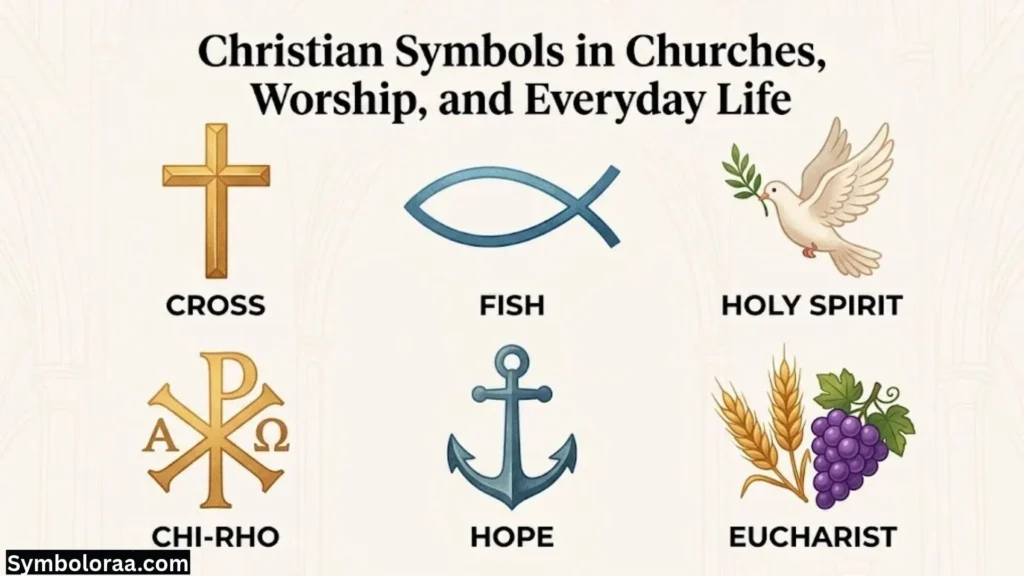
Christian symbolism extends far beyond paintings and historical artifacts. It remains part of worship, architecture, personal devotion, and contemporary design.
Symbols in Church Architecture
Church buildings often use symbols to communicate their religious purpose. A cross may stand above the entrance or steeple, while stained-glass windows depict biblical scenes.
Other churches incorporate Alpha and Omega, the Chi-Rho, lamb imagery, or the dove. Mosaics and carvings may also include symbols associated with the Trinity or the lives of saints.
The meaning of an image often depends on where it appears. A lamb near an altar, for instance, may have a strong Eucharistic association, while a shepherd in a funerary setting may emphasize care and hope.
Symbols in Christian Worship
Christian worship uses both physical objects and visual imagery to express religious beliefs.
Common examples include:
- Bread and wine during Holy Communion.
- Candles during prayer and liturgical services.
- Palm branches during Palm Sunday observances.
- Crosses and crucifixes in processions.
- The Paschal candle during Easter celebrations.
- Bibles used for public Scripture readings and preaching.
The role of these objects varies across Christian traditions. Some churches use elaborate liturgical ceremonies, while others emphasize simplicity.
Christian Symbols in Jewelry and Personal Items
Cross necklaces, Ichthys pendants, rings, bracelets, and other personal items allow people to express their faith outside church settings.
A cross necklace may represent devotion to Jesus, while a fish pendant can signal Christian identity. Some people wear a particular symbol because it reminds them of a family member, religious experience, or personal commitment.
However, a symbol’s meaning isn’t always obvious from its appearance. A design may have different associations in different cultures or contexts. Understanding its history helps prevent confusion.
Christian Symbols in Tattoos and Modern Design
Contemporary artists adapt traditional Christian imagery for tattoos, clothing, logos, and digital designs.
Common choices include crosses, doves, fish, scripture references, and Greek-letter monograms. Some designs combine several symbols to communicate a personal understanding of faith.
Before choosing a religious symbol, consider its established meaning and cultural background. A design that looks attractive may carry historical or theological associations you haven’t considered.
How to Identify and Interpret Christian Symbols
Recognizing a symbol is only the first step. To understand its meaning accurately, look at its visual details, historical setting, and religious context.
Examine the Shape and Components
Start with the symbol’s most noticeable features. Look for intersecting lines, letters, animals, crowns, circles, or other recognizable elements.
For example, the Chi-Rho combines two Greek letters, while the Jerusalem Cross includes a large cross surrounded by four smaller crosses. A crucifix depicts Jesus’ body, whereas an empty cross doesn’t.
Small details can help distinguish similar symbols.
Consider the Historical Context
Ask where the symbol appears and when the object was created. A symbol carved into an early Christian artifact may have a different historical significance from a similar design on a modern necklace.
The surrounding imagery also matters. A dove appearing in a baptism scene likely carries a different emphasis from a dove holding an olive branch in a depiction of Noah.
Check Biblical and Historical Sources
When a symbol comes from a biblical story, read the relevant passage rather than relying only on a popular explanation.
For symbols developed later, consult museum collections, scholarly books, church history resources, and reputable religious institutions.
The date, location, materials, and surrounding artwork can provide clues about how a symbol was originally understood.
Recognize Denominational Differences
The same image may receive different emphasis in Roman Catholic, Eastern Orthodox, and Protestant settings.
Check whether an interpretation belongs to a particular denomination or reflects a widely shared Christian understanding. This is especially important for symbols connected with the sacraments, saints, icons, and liturgical practices.
Common Misconceptions About Christian Symbols
Is Every Religious Symbol in a Church Christian?
No. Churches may contain decorative patterns, historical motifs, architectural designs, and symbols borrowed from broader artistic traditions.
A shape’s presence in a church doesn’t automatically prove that it originated in Christianity. Its meaning depends on the object’s date, location, and intended use.
Did Early Christians Always Use the Fish as a Secret Code?
The fish is an important symbol in early Christian history. However, popular stories about Christians universally using it as a secret recognition test can oversimplify the evidence.
Early Christians used fish imagery in various settings. Its exact purpose depended on the community and context.
Is the Star of David a Christian Symbol?
The Star of David is primarily associated with Judaism and Jewish identity. Some Christian artworks include the star in particular historical or biblical contexts, but it isn’t a universal Christian emblem.
The Star of Bethlehem is a different image associated with the Gospel account of Jesus’ birth.
Is the Triquetra Exclusively Christian?
No. The Triquetra has a broader artistic history, including Celtic contexts. Some Christian traditions later adopted the design to represent the Trinity.
Its appearance alone doesn’t establish a Christian origin or meaning.
Do All Christian Denominations Use the Same Symbols?
No. Churches differ in their use of crosses, icons, crucifixes, candles, monograms, and other religious imagery.
These differences reflect historical, theological, and liturgical traditions. A symbol’s absence from one church doesn’t mean that the community rejects every belief associated with it.
Does Every Christian Symbol Have a Direct Bible Verse?
No. Some symbols directly depict biblical stories or objects, while others developed through later Christian art and devotional practice.
The Chi-Rho and IHS are good examples of later monograms associated with Christ. Their religious significance comes from their use in Christian history rather than from a biblical instruction to display those exact designs.
Frequently Asked Questions About Christian Symbols
What Is the Most Recognized Symbol of Christianity?
The cross is generally considered the most widely recognized symbol of Christianity. It represents Jesus’ crucifixion and, in Christian belief, the salvation associated with his death and resurrection.
What Are the Main Symbols of Christianity?
Major Christian symbols include the cross, Ichthys fish, dove, crown of thorns, Lamb of God, bread and wine, Chi-Rho, and Alpha and Omega.
Each communicates a different aspect of Christian belief, history, or worship.
What Symbol Represents Jesus Christ?
Several symbols represent Jesus Christ, including the cross, crucifix, Lamb of God, Chi-Rho, IHS, and Alpha and Omega.
The cross emphasizes his crucifixion, the lamb represents sacrifice and redemption, and the monograms identify his name.
What Is the Symbol of the Holy Spirit?
The dove is one of the best-known symbols of the Holy Spirit because of the baptism accounts in the Gospels.
Fire and wind also appear in biblical descriptions associated with the Spirit, especially in the account of Pentecost in Acts 2.
What Symbols Represent the Holy Trinity?
The Shield of the Trinity, Triquetra, and Borromean rings are used in some Christian contexts to represent the Trinity.
These designs illustrate the relationship between the Father, Son, and Holy Spirit, although no single geometric symbol is used universally.
What Does the Christian Fish Symbol Mean?
The Ichthys is an ancient Greek word meaning fish. Christian tradition connects its letters with the phrase “Jesus Christ, Son of God, Savior.”
The fish also recalls Gospel stories involving Jesus’ disciples, fishing, and miraculous meals.
What Is the Difference Between a Cross and a Crucifix?
A cross is a cross-shaped emblem without necessarily depicting Jesus. A crucifix includes a representation of Jesus’ body on the cross.
Both appear in Christian worship and art. Their use often reflects the devotional and artistic traditions of a particular church.
What Are Some Ancient Christian Symbols?
Important historical examples include the fish, anchor, Good Shepherd, dove, and Chi-Rho.
Their origins and uses differ, so each should be studied within its historical context.
Which Christian Symbols Represent Hope and Eternal Life?
The anchor is associated with hope through Hebrews 6:19. Alpha and Omega expresses divine eternity, while the Lamb of God appears in Revelation imagery connected with Christ’s victory.
The cross and resurrection imagery also communicate Christian hope in eternal life.
Are Christian Symbols Mentioned in the Bible?
Some symbols, including the rainbow covenant, the dove at Jesus’ baptism, and the Lamb of God, have direct biblical foundations.
Others, such as the Chi-Rho and IHS, developed through later Christian history. Both categories contribute to Christian visual culture, but their origins should be explained accurately.
Conclusion: Understanding the Meaning of Christian Symbols
Christian symbols communicate biblical stories, central beliefs, and centuries of religious history through familiar images. The cross recalls Jesus’ crucifixion and resurrection, the dove represents the Holy Spirit, and the Lamb of God points toward sacrifice and redemption.
Other symbols, such as the Ichthys, Chi-Rho, IHS, and Alpha and Omega, reveal how Christian communities developed a visual language for expressing their faith. Candles, bread and wine, wedding rings, and church decorations also carry meanings shaped by Scripture and tradition.
The best way to understand Christian symbols and their meanings is to examine their biblical connections, historical origins, and use across Christian traditions. Some interpretations come directly from Scripture, while others developed through centuries of art and worship.
Once you understand those distinctions, a cross on a church wall, a dove in a stained-glass window, or a monogram on an altar becomes more than decoration. Each can offer a window into the beliefs, history, and practices of Christianity.

I’m Madison Reed, a contemporary American author who writes about love, family, friendship, and second chances. I’m fascinated by the choices that shape our lives and the moments that change us forever. My goal is to create honest, emotional stories with characters readers can connect with long after finishing each book.
Three Books:
When We Find Our Way
The Things We Never Said
Summer in September