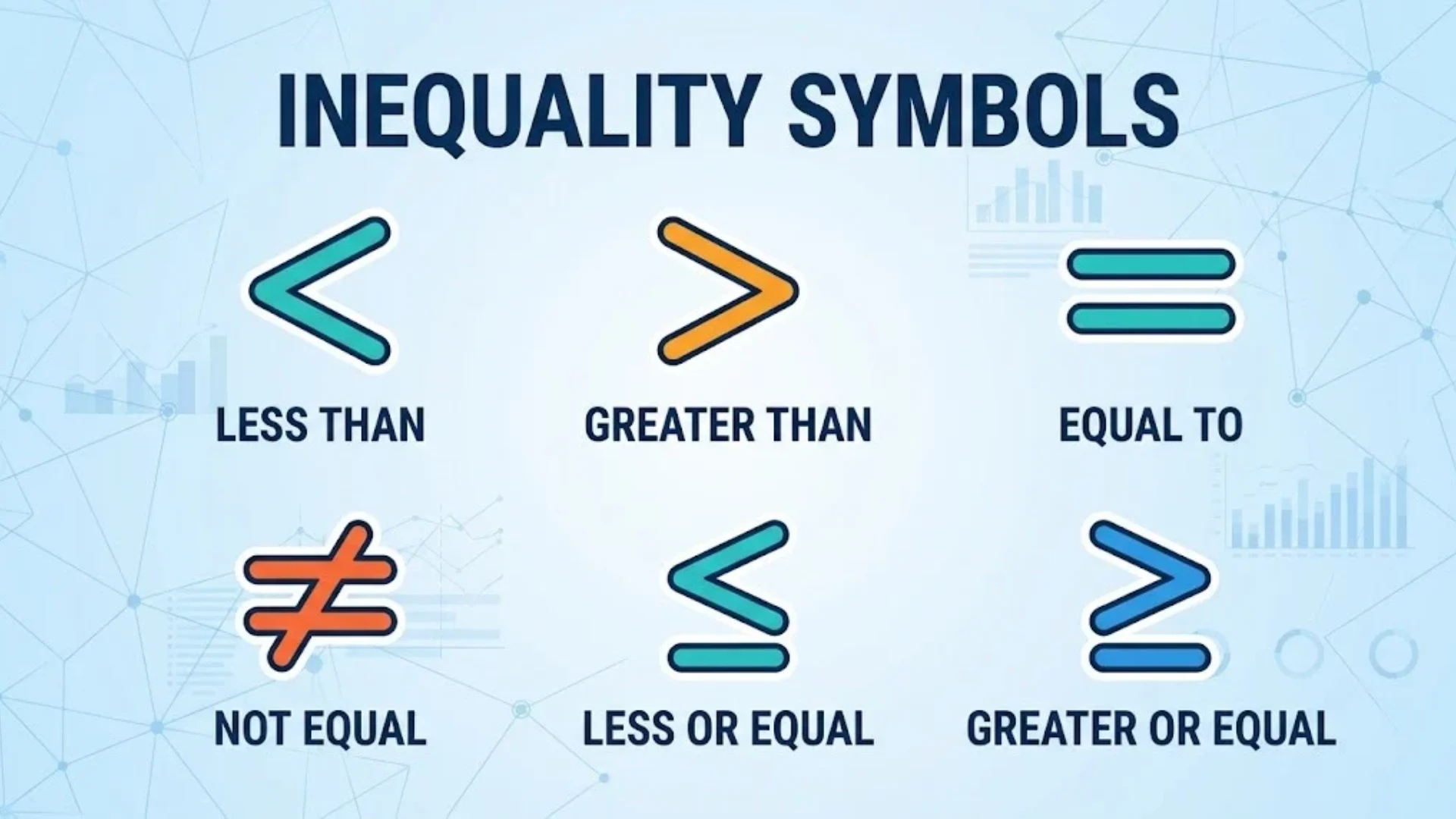
Inequality symbols help you compare numbers, describe relationships between values, and solve algebra problems. Whether you’re comparing prices, calculating a minimum grade, or finding a variable’s possible values, these mathematical signs make the relationships clear.
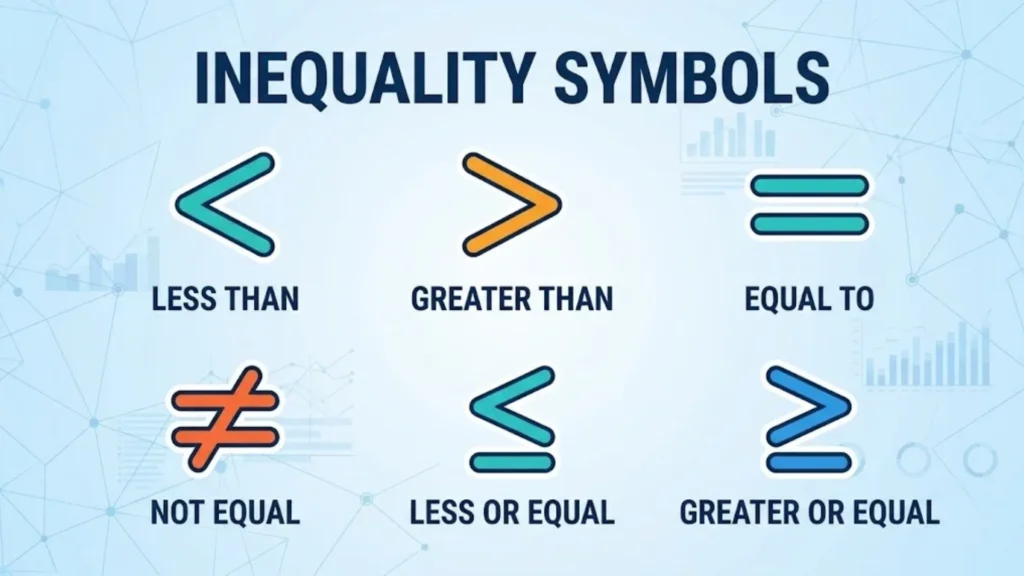
The four main inequality symbols are greater than (>), less than (<), greater than or equal to (), and less than or equal to (). Another important comparison symbol is not equal to ().
Although these signs look simple, understanding their differences is essential for working with mathematical inequalities, algebraic expressions, and number line graphs. A small change in a symbol can completely change the answer.
This guide explains each inequality sign, shows how to remember its meaning, and walks you through the rules for solving inequalities. You’ll also learn how to graph solutions, use interval notation, translate everyday statements into mathematical expressions, and avoid common mistakes.
What Are Inequality Symbols?
Inequality symbols are mathematical signs that show how two numbers, variables, or expressions compare. They indicate whether one value is greater than, less than, greater than or equal to, or less than or equal to another value.
An inequality is a mathematical statement that expresses a relationship between quantities. Unlike an equation, which states that two expressions have equal values, an inequality can describe a range of possible values.
For example:
- 7>4 means seven is greater than four.
- 3<5 means three is less than five.
- x7 means x can equal seven or any number greater than seven.
- x10 means x can equal ten or any number smaller than ten.
- x5 means x cannot equal five.
These inequality statements can describe simple numerical comparisons or more advanced relationships involving variables and algebraic expressions.
Inequalities vs. Equations
The main difference between an inequality and an equation is the relationship each one represents.
| Mathematical statement | Meaning | Possible values of x |
| x=5 | x equals five | Only 5 |
| x>5 | x is greater than five | Values above 5 |
| x<5 | x is less than five | Values below 5 |
| x5 | x is at least five | Five and greater values |
| x5 | x is at most five | Five and smaller values |
| x5 | x does not equal five | Every real number except 5 |
Notice how the solution changes with each symbol. The statement x=5 identifies one value, while x>5 describes infinitely many real numbers.
An inequality can have one solution, several solutions, or infinitely many solutions. For example, x2<0 has no real solutions, while x>5 has infinitely many.
Inequality Symbols and Their Meanings
The quickest way to learn inequality symbols and meanings is to compare them in one chart.
| Symbol | Name | Meaning in words | Example |
| > | Greater than | More than | 9>4 |
| < | Less than | Fewer than or smaller than | 2<6 |
| Greater than or equal to | At least | x7 | |
| Less than or equal to | At most | x10 | |
| Not equal to | Different from | 58 | |
| = | Equal to | The same value as | 4=4 |
The four main inequality symbols are >, <, , and . The symbols and = are useful comparison signs, but they aren’t part of that group of four.
Greater Than Symbol (>)
The greater than symbol (>) indicates that the value on its left is larger than the value on its right.
For example:
9>4
Read this statement as “nine is greater than four.” The same symbol works with decimals, fractions, and algebraic expressions.
- 12>8: Twelve is greater than eight.
- 4.5>3.7: Four and a half is greater than 3.7.
- x>6: The variable x must be greater than six.
The symbol x>6 doesn’t include six itself. Values such as 6.1, 7, and 100 satisfy the inequality, but 6 does not.
In everyday situations, you might use this sign to show that a purchase costs more than $50 or that a runner finished in less than a certain time. The symbol expresses the comparison without requiring a lengthy sentence.
Less Than Symbol (<)
The less than symbol (<) indicates that the value on its left is smaller than the value on its right.
For example:
2<6
This statement means two is less than six.
Other examples include:
- 5<10: Five is less than ten.
- 0.25<0.5: One-quarter is less than one-half.
- x<12: The variable x must be smaller than twelve.
The inequality x<12 excludes 12. Values such as 11, 0, and -3 satisfy it, while 12 and 15 do not.
Remember that negative numbers follow the same comparison rule. For instance, -8<-3 because negative eight lies farther left on the number line.
Greater Than or Equal To Symbol ()
The greater than or equal to symbol () means a value can be larger than another value or exactly equal to it.
For example:
x7
This statement means x is seven or greater. The possible values include 7, 8, 10, and 7.25.
Common phrases associated with this symbol include:
- At least
- No less than
- Equal to or greater than
- Minimum of
- Not below
Suppose a course requires a score of at least 80%. You can express the requirement as:
s80
Here, s represents the student’s score. A score of 80% qualifies, as does a score of 95%.
The line beneath the greater than sign is important because it includes the boundary value. Without that line, s>80 would exclude a score of exactly 80%.
Less Than or Equal To Symbol ()
The less than or equal to symbol () means a value can be smaller than another value or equal to it.
For example:
x10
The variable x can equal 10 or any smaller real number. Values such as 10, 7, 0, and -4 satisfy the statement.
Common phrases associated with this symbol include:
- At most
- No more than
- Maximum of
- Not exceeding
- Up to and including
Imagine a bag that can hold no more than 15 pounds. If w represents the bag’s weight, the condition becomes:
w15
A weight of exactly 15 pounds meets the limit. A weight of 15.1 pounds exceeds it.
This distinction matters whenever a rule includes a maximum capacity, spending limit, age range, or other upper boundary.
Not Equal To Symbol ()
The not equal to symbol () indicates that two values are different.
For example:
58
This statement is true because five and eight have different values.
In algebra, you might see:
x0
This means x can be any real number except zero. The restriction often appears in fractions because a denominator cannot equal zero.
For instance:
1x,x0
The expression is defined for every real value of x except zero.
Equal To Symbol (=)
The equal to symbol (=) states that two expressions have the same value.
For example:
6=6
Equality provides a useful reference point when learning inequality signs. The statement x6 includes equality, whereas x>6 does not.
These differences become especially important when solving algebra problems and interpreting mathematical statements.
How to Read and Remember Inequality Signs
Greater than and less than signs look similar, so it’s easy to mix them up. A simple visual trick can help you remember which one to use.
The Open-Side Rule
Look at the symbol’s shape. Its wide, open side faces the larger number, while its pointed end faces the smaller number.
For example:
8>3
The open side faces eight because eight is larger than three.
Similarly:
2<6
The open side faces six because six is the larger value.
Memory tip: Think of the symbol as a hungry alligator opening its mouth toward the bigger number.
8 > 3
Greater than
The left value is larger than the right value.
2 < 6
Less than
The left value is smaller than the right value.
What Does the Line Under an Inequality Sign Mean?
The extra line in and means equal to is included.
Compare these statements:
- x>5: x must be greater than five, but it cannot equal five.
- x5: x can equal five or be greater than five.
- x<5: x must be less than five.
- x5: x can equal five or be less than five.
That small line changes the solution set. When a problem says “at least five,” for instance, five itself must qualify.
Greater Than vs. Greater Than or Equal To
Both symbols describe values above a boundary, but only one includes the boundary.
| Greater than (>) | Greater than or equal to () |
| Excludes the boundary | Includes the boundary |
| x>4 | x4 |
| Four isn’t a solution | Four is a solution |
| Used for “more than four” | Used for “at least four” |
Less Than vs. Less Than or Equal To
The same distinction applies when a value must stay below a limit.
| Less than (<) | Less than or equal to () |
| Excludes the boundary | Includes the boundary |
| x<10 | x10 |
| Ten isn’t a solution | Ten is a solution |
| Used for “under ten” | Used for “ten or less” |
How to Compare Numbers Using Inequality Symbols
Before writing an inequality, identify which value is larger. The comparison becomes straightforward once you understand how numbers behave.
Comparing Positive Numbers
For positive numbers, the larger number represents the greater value.
For example:
13>9
Likewise, 0.8>0.65, because 0.8 equals 0.80 and 0.80 exceeds 0.65.
When comparing decimals, line up the decimal points and add trailing zeros if needed. This method helps prevent mistakes involving numbers with different decimal lengths.
Comparing Negative Numbers
Negative numbers often confuse beginners because their digits can suggest the wrong comparison.
Consider:
-2>-5
Although five is greater than two as a positive number, negative two is greater than negative five. On a number line, negative two lies to the right of negative five.
The general rule is simple: a number farther to the right on the number line is greater.
Examples:
- -1>-4
- -7<-3
- -10<-2
This rule applies to positive and negative values alike.
Comparing Fractions and Decimals
You can compare fractions by finding a common denominator or converting them into decimals.
For example:
34>23
Using a common denominator gives:
912>812
Therefore, three-quarters is greater than two-thirds.
Decimal comparisons work similarly. Since 0.75>0.67, the original comparison is confirmed.
Comparing Variables and Algebraic Expressions
Variables represent values that may be unknown. You can compare expressions when the available information tells you enough about those values.
Suppose x=4. To compare 3x and 9, substitute four for x:
3x=3(4)=12
Therefore:
3x>9
However, if the value of x is unknown, you cannot automatically conclude that 3x>9. You need additional information or an inequality to establish that relationship.
Properties and Rules of Inequalities
The properties of inequality help you transform mathematical statements without changing their meaning. These rules are essential when solving linear inequalities and simplifying algebraic expressions.
Addition Property of Inequality
Adding the same number to both sides preserves the inequality direction.
If a<b, then:
a+c<b+c
For example:
3<7
Add four to both sides:
3+4<7+4
7<11
The statement remains true because adding the same amount doesn’t change the order of the values.
Subtraction Property of Inequality
Subtracting the same number from both sides also preserves the direction.
If a>b, then:
a-c>b-c
For example:
12>8
Subtract three from each side:
12-3>8-3
9>5
This property lets you move constant terms when solving algebraic inequalities.
Multiplication by a Positive Number
Multiplying both sides by a positive number preserves the inequality direction.
For example:
2<5
Multiply both sides by three:
2(3)<5(3)
6<15
The left side remains smaller than the right side.
Multiplication by a Negative Number
Multiplying both sides by a negative number reverses the inequality direction. This is one of the most important inequality rules to remember.
Consider:
2<5
Multiply both sides by negative one:
-2>-5
The symbol changes from less than to greater than. If it remained unchanged, the statement -2<-5 would be false.
The same rule applies when dividing both sides by a negative number.
Division by a Positive or Negative Number
Division follows the same sign rules as multiplication.
| Operation | Effect on inequality direction |
| Add the same number to both sides | Preserves direction |
| Subtract the same number from both sides | Preserves direction |
| Multiply both sides by a positive number | Preserves direction |
| Divide both sides by a positive number | Preserves direction |
| Multiply both sides by a negative number | Reverses direction |
| Divide both sides by a negative number | Reverses direction |
For example:
12>6
Divide both sides by two:
6>3
The direction stays the same because two is positive.
Now divide both sides of -12>-6 by negative two:
6<3
The direction reverses. The result is true because six is greater than three? No—the correct result must be checked against the original relationship.
Starting with -12>-6 is false. A valid demonstration begins with -6>-12. Dividing by negative two gives:
3<6
This statement is true and illustrates why the sign must reverse.
Transitive Property of Inequality
The transitive property connects three values.
If:
a<bandb<c
then:
a<c
For example, if 2<5 and 5<9, then 2<9.
This property helps establish relationships between values even when you haven’t compared the first and last values directly.
Converse Property of Inequality
The converse relationship reverses the order of two values and reverses the inequality sign.
For example:
\[ a<b\iff b>a \]
If five is less than eight, then eight is greater than five. Both statements express the same numerical relationship from opposite directions.
Law of Trichotomy
The law of trichotomy states that for any two real numbers a and b, exactly one of these relationships holds:
a<b,a=b,a>b
For ordinary real-number comparisons, two different values cannot be both greater than and less than each other. They must have one definite ordering.
How to Solve Linear Inequalities
Solving linear inequalities resembles solving linear equations. You isolate the variable by performing valid operations on both sides, while keeping track of the inequality sign.
Solving One-Step Inequalities
Consider:
x+4<9
Subtract four from both sides:
x+4-4<9-4
Therefore:
x<5
Every real number below five satisfies the inequality.
You can check the result by substituting a value such as x=3. The original statement becomes 3+4<9, or 7<9, which is true.
Solving Two-Step Inequalities
Now consider an inequality that requires two operations:
2x+311
First, subtract three from both sides:
2×8
Next, divide both sides by two:
x4
The solution includes four and every real number below it.
When to Reverse the Inequality Sign
You must reverse the sign whenever you multiply or divide both sides by a negative number.
For example:
-3x>12
Divide both sides by negative three and reverse the sign:
x<-4
Check the result using x=-5. The original inequality becomes 15>12, which is true.
By contrast, x=-3 produces 9>12, which is false. This confirms that the solution must remain below negative four.
Checking an Inequality Solution
After solving, substitute a test value into the original statement.
For x4:
- x=4 works because the boundary is included.
- x=2 works because two is less than four.
- x=5 fails because five exceeds four.
Testing values helps you catch sign errors before moving to graphs or more advanced algebra.
For a more detailed algebra reference, see OpenStax’s guide to solving inequalities. It explains the operation rules with worked examples.
Graphing Inequalities on a Number Line
A number line turns an inequality into a visual representation of its solution set. You can see the boundary value, whether that value counts, and which direction contains the solutions.
Open Circle vs. Closed Circle
The endpoint tells you whether the boundary belongs to the solution set.
- Open circle: The endpoint isn’t included. Use it with < and >.
- Closed circle: The endpoint is included. Use it with and .
For example, x>3 uses an open circle at three because the variable must exceed three. Meanwhile, x3 uses a closed circle because three itself qualifies.
Graphing Greater Than Inequalities
Consider x>3.
<────────────○════════════>
3
The open circle marks the excluded endpoint. The line extends right because the solutions are greater than three.
For x3, replace the open circle with a closed circle:
<────────────●════════════>
3
The closed circle includes three in the solution set.
Graphing Less Than Inequalities
For x<3, place an open circle at three and shade to the left.
<════════════○────────────>
3
For x3, use a closed circle instead:
<════════════●────────────>
3
The shading extends left because every number smaller than three satisfies the inequality.
These diagrams are simplified illustrations. In a finished mathematical graph, use a properly scaled number line with labeled tick marks.
Understanding Endpoints and Shading
Follow these steps when graphing an inequality:
- Identify the boundary value.
- Draw an open or closed circle according to the symbol.
- Shade left for values less than the boundary.
- Shade right for values greater than the boundary.
- Extend the line or arrow to show that the solution continues.
For more examples, Khan Academy’s graphing inequalities guide explains how to plot solutions on a number line.
Compound Inequalities and Chained Inequalities
A compound inequality combines two or more inequality statements. It can describe a bounded range or separate groups of acceptable values.
What Is a Compound Inequality?
Consider:
x>2andx<8
Both conditions must hold. Together, they can be written as:
2<x<8
The solution includes every real number between two and eight, excluding both endpoints.
Compound inequalities often use the words AND or OR. These words determine how the individual conditions combine.
AND Inequalities
An AND inequality requires a value to satisfy both conditions.
For example:
x2andx<7
This becomes:
2x<7
The solution includes two but excludes seven. Values such as 2, 3.5, and 6.99 qualify.
OR Inequalities
An OR inequality accepts a value that satisfies either condition.
For example:
x<0orx>5
The solution includes numbers below zero and numbers above five. Values between zero and five don’t qualify, and neither boundary is included.
On a number line, this solution appears as two separate shaded regions.
Chained Inequality Notation
A chained inequality combines multiple comparisons in one expression.
Examples include:
-1<x<10
-4<x5
-1×3
Each expression establishes lower and upper bounds for the variable.
| Chained inequality | Lower endpoint | Upper endpoint |
| -1<x<10 | Excluded | Excluded |
| -4<x5 | Excluded | Included |
| -1×3 | Included | Included |
| 2x<9 | Included | Excluded |
Solving and Graphing Compound Inequalities
Consider:
-3<2x+1<9
Subtract one from all three parts:
-4<2x<8
Divide all three parts by two:
-2<x<4
The solution contains every real number strictly between negative two and four.
On a number line, place open circles at both endpoints and shade the region between them.
Inequalities and Interval Notation
Interval notation expresses a range of real numbers using endpoints, parentheses, and brackets. It provides a compact alternative to writing inequalities or drawing number line graphs.
Open Intervals
An open interval excludes both endpoints.
For example:
(2,6)
This represents every real number greater than two and less than six:
2<x<6
Neither two nor six belong to the interval.
Closed Intervals
A closed interval includes both endpoints.
For example:
[2,6]
This represents:
2×6
Both two and six qualify.
Half-Open and Half-Closed Intervals
A half-open interval includes one endpoint but excludes the other.
For example:
(2,6]
This means:
2<x6
Two is excluded, while six is included. The interval [2,6) works the other way around.
Intervals Extending to Infinity
Some inequalities have no upper or lower bound. Interval notation uses infinity to represent these unbounded ranges.
| Inequality | Interval notation |
| x>3 | (3,) |
| x3 | [3,) |
| x<5 | (-,5) |
| x5 | (-,5] |
| -2<x<7 | (-2,7) |
| -2×7 | [-2,7] |
| -2<x7 | (-2,7] |
Important: Infinity isn’t a real number, so it always takes a parenthesis in standard interval notation. A finite endpoint gets a bracket only when the interval includes that value.
Converting Inequalities Into Interval Notation
Use this simple process:
- Identify the lower and upper endpoints.
- Use parentheses for excluded endpoints.
- Use brackets for included endpoints.
- Use negative or positive infinity when the interval extends indefinitely.
- Always use parentheses beside infinity.
For instance, x4 becomes (-,4]. The interval includes four and every real number below it.
For additional examples, OpenStax’s elementary algebra chapter covers inequalities, number lines, and interval notation together.
How to Translate Words Into Inequalities
Everyday language often describes mathematical limits without using numbers or symbols. Learning to translate these phrases helps you write accurate algebraic inequalities.
Common Words and Their Inequality Symbols
| Words or phrases | Symbol | Example |
| Greater than, more than | > | x>7 |
| Less than, fewer than | < | x<5 |
| At least, no less than | x10 | |
| At most, no more than | x20 | |
| Not equal to, different from | x4 | |
| Equal to, exactly | = | x=12 |
Pay close attention to words that include the boundary. “More than 10” excludes ten, while “at least 10” includes it.
Translating Minimum Requirements
Minimum requirements describe the smallest acceptable value. Phrases such as “at least,” “minimum,” and “no fewer than” usually translate to .
Example: A passing grade
A student must earn at least 75 points to pass. Let g represent the student’s grade.
g75
A score of 75 qualifies. A score of 74 doesn’t.
Example: Minimum age
A competition requires participants to be at least 16 years old. Let a represent age in years.
a16
The wording includes participants who are exactly 16.
Translating Maximum Limits
Maximum limits describe the largest permitted value. Phrases such as “at most,” “maximum,” and “no more than” usually translate to .
Example: A spending budget
You have $100 to spend on supplies. Let c represent the total cost.
c100
Spending exactly $100 meets the budget. Spending $101 exceeds it.
Example: Passenger capacity
An elevator can carry no more than eight people. If p represents the number of passengers:
p8
The number of passengers must be eight or fewer. Since passengers are counted in whole numbers, possible values are nonnegative integers from zero through eight.
Writing Inequalities From Word Problems
Use a consistent process to turn a sentence into mathematics:
- Identify the unknown quantity.
- Choose a variable to represent it.
- Find the phrase that describes the relationship.
- Select the appropriate inequality symbol.
- Write the statement and check whether it matches the original meaning.
Example: Saving for a purchase
You have $40 and want to buy a product that costs $120. How much more money do you need?
Let s represent the additional amount you save. You need enough money to reach at least $120.
40+s120
Subtract 40 from both sides:
s80
You need to save at least $80.
Example: A time limit
A project must take no more than six hours. If t represents the time required:
t6
The project can take six hours or less.
Example: A minimum score
A student already has 68 points and needs a total of at least 80 points. Let p represent the additional points required.
68+p80
Subtract 68:
p12
The student needs at least 12 additional points.
Common Mistakes When Using Inequality Symbols
Even a simple inequality can produce a wrong answer when you overlook one detail. These are the most common errors and how to avoid them.
Confusing Greater Than and Less Than
The symbols > and < have opposite meanings.
- 8>3 means eight is greater than three.
- 3<8 means three is less than eight.
Both statements are true. The values appear in a different order, so the sign changes direction.
Misreading “At Least” and “At Most”
These phrases include the boundary value.
- “At least 10” means x10.
- “At most 10” means x10.
Using > or < would incorrectly exclude ten.
Forgetting to Reverse the Sign
Multiplying or dividing both sides by a negative number reverses the inequality sign.
For example:
-2x<10
Divide both sides by negative two and reverse the sign:
x>-5
A quick substitution confirms the answer. If x=0, the original statement becomes 0<10, which is true.
Comparing Negative Numbers Incorrectly
Negative numbers become greater as they move toward zero.
For example:
-3>-8
Negative three is greater because it lies farther right on the number line. Don’t compare negative values by looking only at their digits.
Using the Wrong Circle on a Graph
An open circle excludes its endpoint. A closed circle includes it.
- x<4: open circle at four.
- x4: closed circle at four.
- x>4: open circle at four, shading right.
- x4: closed circle at four, shading right.
Using Incorrect Interval Notation
Parentheses and brackets communicate whether an endpoint belongs to the solution.
- (1,5) excludes both endpoints.
- [1,5] includes both endpoints.
- (1,5] excludes one and includes the other.
Remember that infinity always uses parentheses because it doesn’t represent a reachable endpoint.
Treating Every Inequality as a Single Answer
An equation such as x=4 identifies one value. An inequality such as x>4 describes infinitely many real-number solutions.
The solution set can include whole numbers, fractions, decimals, and irrational numbers unless the problem restricts the allowed values.
Inequality Symbols Practice Problems With Answers
Practice helps you recognize symbols quickly and apply the rules correctly. Try the questions first, then check your answers and reasoning.
Basic Inequality Symbol Exercises
Fill in each blank with >, <, , or .
| Problem | Answer | Explanation |
| 8 _ 3 | > | Eight is greater than three. |
| 4 _ 9 | < | Four is less than nine. |
| x _ 5, meaning at least five | Five is included. | |
| x _ 12, meaning at most twelve | Twelve is included. | |
| -2 _ -7 | > | Negative two is farther right. |
| 6 _ 6 | or | Both statements are true. |
For the final question, both 66 and 66 are correct. However, neither 6>6 nor 6<6 is true.
Solving Inequality Practice Problems
Solve each inequality and compare your work with the answers.
Problem A
x+5>12
Subtract five from both sides:
x>7
Answer: x>7.
Problem B
3×18
Divide both sides by positive three:
x6
Answer: x6.
Problem C
-4×20
Divide both sides by negative four and reverse the sign:
x-5
Answer: x-5.
Problem D
2x+4<14
Subtract four:
2x<10
Divide by two:
x<5
Answer: x<5.
Graphing and Interval Notation Exercises
Convert each inequality into interval notation.
| Inequality | Interval notation |
| x>6 | (6,) |
| x2 | (-,2] |
| -3<x<4 | (-3,4) |
| -2×5 | [-2,5] |
| 1<x8 | (1,8] |
For graphing questions, remember the same rules: strict inequalities use open circles, inclusive inequalities use closed circles, and the shading follows the valid solution range.
Real-World Inequality Practice
Question: A theater has 200 seats and already sold 135 tickets. How many additional tickets can it sell without exceeding capacity?
Let t represent additional tickets.
135+t200
Subtract 135:
t65
Answer: The theater can sell at most 65 more tickets.
Question: A student needs at least 90 points to qualify for an award. The student currently has 72 points. How many additional points are needed?
Let p represent additional points.
72+p90
Subtract 72:
p18
Answer: The student needs at least 18 additional points.
Question: A package must weigh less than 20 pounds. Which inequality describes its weight w?
w<20
Answer: The weight must be strictly below 20 pounds. A package weighing exactly 20 pounds doesn’t meet the requirement.
Frequently Asked Questions About Inequality Symbols
What are the four main inequality symbols?
The four main inequality symbols are greater than (>), less than (<), greater than or equal to (), and less than or equal to (). They compare values and show whether a boundary value is included.
What do inequality symbols mean?
Inequality symbols show how two values compare. They can indicate that one value is greater than, less than, greater than or equal to, or less than or equal to another value.
What is the difference between > and ?
The greater than symbol (>) excludes equality. The greater than or equal to symbol () includes equality. For example, x>5 excludes five, while x5 includes it.
What is the difference between < and ?
The less than symbol (<) excludes the boundary value. The less than or equal to symbol () includes it. Therefore, x<10 excludes ten, while x10 includes ten.
What is the symbol for “at least”?
The symbol for “at least” is . For example, x15 means x must be 15 or greater.
What is the symbol for “at most”?
The symbol for “at most” is . For example, x20 means x cannot exceed 20, but it can equal 20.
What does the line under an inequality sign mean?
The line underneath > or < indicates that equality is allowed. That’s why means greater than or equal to and means less than or equal to.
How do you remember greater than and less than signs?
Remember that the open side faces the larger number and the pointed end faces the smaller number. The alligator-mouth trick offers an easy visual reminder.
When do you reverse the inequality sign?
Reverse the inequality sign when multiplying or dividing both sides by a negative number. Adding or subtracting the same number on both sides doesn’t require reversal.
Why does multiplying by a negative number reverse an inequality?
Multiplication by a negative number reverses the order of real numbers. For example, 2<5 becomes -2>-5 after multiplying both sides by negative one.
When do you use an open circle or closed circle?
Use an open circle when the endpoint isn’t included, as with x<3. Use a closed circle when the endpoint is included, as with x3.
How do you write inequalities in interval notation?
Use parentheses for excluded endpoints and brackets for included endpoints. For example, x>3 becomes (3,), while x3 becomes (-,3].
What is the difference between an equation and an inequality?
An equation states that two expressions have equal values. An inequality compares them using symbols such as >, <, , or .
Can an inequality have more than one solution?
Yes. Many inequalities have infinitely many real-number solutions. For example, x>2 includes every real number greater than two, not just one specific value.
Final Takeaway: Understanding Inequality Symbols
Inequality symbols are easier to understand when you connect each sign to its meaning, boundary rules, and practical use. Once you recognize these patterns, you can compare numbers, solve algebraic problems, and represent solution sets accurately.
Keep these essential rules in mind:
- > means greater than.
- < means less than.
- means greater than or equal to.
- means less than or equal to.
- means not equal to.
- Adding or subtracting the same value on both sides preserves the inequality direction.
- Multiplying or dividing both sides by a negative number reverses the inequality direction.
- Open circles exclude endpoints, while closed circles include them.
- Parentheses and brackets in interval notation show whether endpoints belong to the solution set.
With regular practice, these rules become second nature. Start with simple comparisons, then work toward algebraic inequalities, compound statements, and real-world problems.

I’m Madison Reed, a contemporary American author who writes about love, family, friendship, and second chances. I’m fascinated by the choices that shape our lives and the moments that change us forever. My goal is to create honest, emotional stories with characters readers can connect with long after finishing each book.
Three Books:
When We Find Our Way
The Things We Never Said
Summer in September