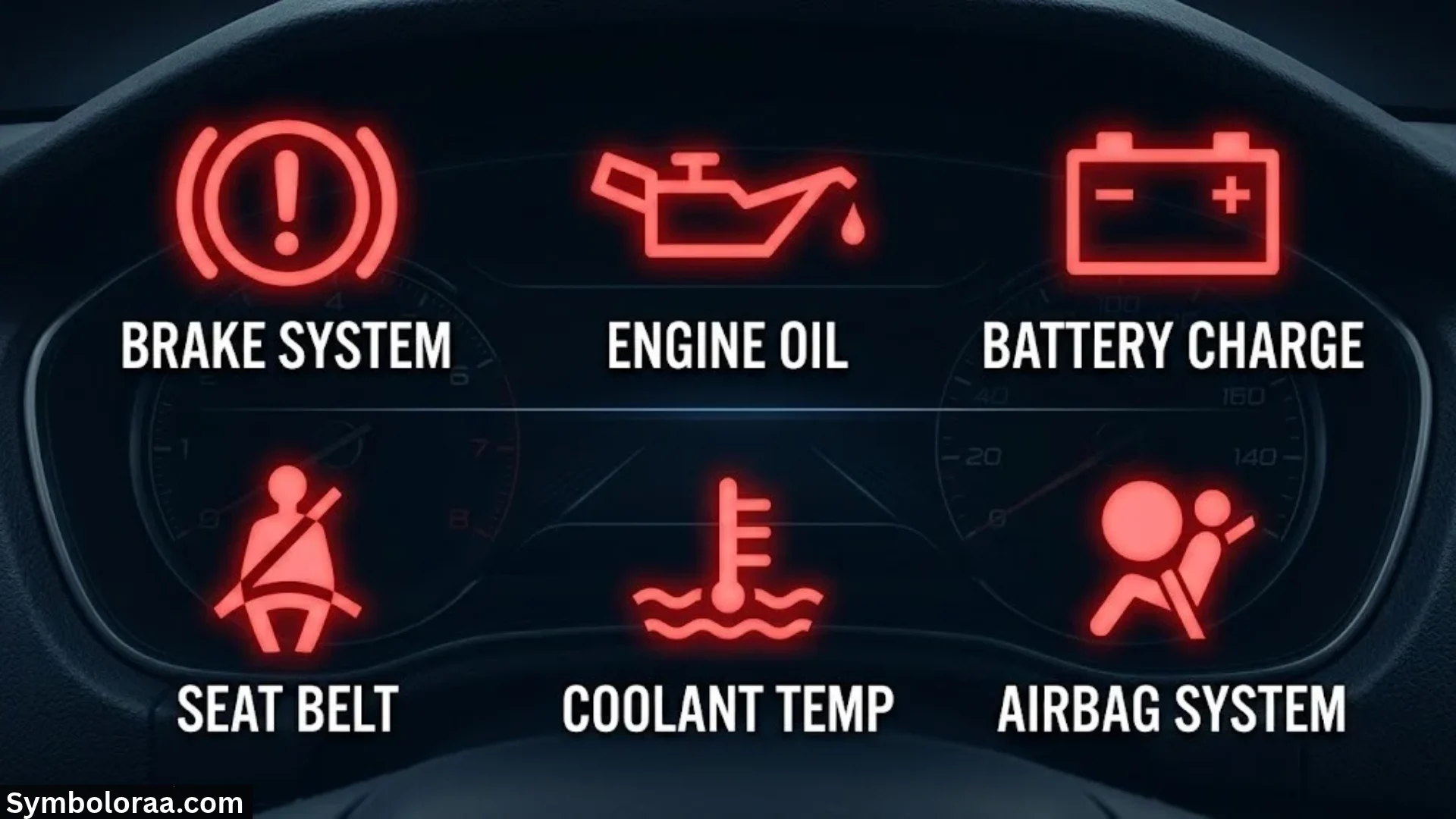
Your car’s dashboard does more than display your speed and fuel level. It also warns you about mechanical problems, safety issues, and systems that need your attention. Understanding car dashboard symbols and meanings helps you recognize potential problems before they become expensive repairs.
A red oil can, for example, may signal dangerously low engine oil pressure. A yellow engine symbol can indicate an emissions problem or an engine fault. Meanwhile, a green arrow usually tells you that a turn signal is operating.
Although many dashboard symbols look similar across vehicles, their meanings can vary by manufacturer, model, and year. Your owner’s manual remains the best reference for symbols specific to your vehicle.
This guide explains common car warning lights, their meanings, possible causes, and the steps you should take when they appear.
How to Read Car Dashboard Symbols and Warning Lights
Dashboard symbols communicate information quickly. Some indicate normal operation, while others warn you about faults that require attention.
Before reacting to a warning light, consider its color, whether it flashes, and any message displayed alongside it.
What Do Dashboard Light Colors Mean?
Most vehicles use colors to indicate the urgency of a warning. However, the exact meaning depends on the vehicle’s design.
| Dashboard light color | General meaning | What you should do |
| Red | Serious warning or immediate safety concern | Stop safely when the warning indicates a critical problem |
| Yellow or amber | Fault, maintenance need, or system limitation | Investigate the warning and arrange service when necessary |
| Green | System is active or operating | Usually continue driving normally |
| Blue | A specific function is active, often high-beam headlights | Check that the function is appropriate for current conditions |
| White | Information, system status, or driver-assistance message | Read the display and follow the instructions |
Important: Color alone does not tell the whole story. A red seat belt symbol generally means someone needs to buckle up, while a red oil pressure warning can indicate a problem that may quickly damage your engine.
Always consider the symbol and its accompanying message together.
What Does a Flashing Dashboard Light Mean?
A flashing warning light often indicates a more urgent condition than a steady light. However, this depends on the symbol and vehicle.
For example, a flashing check engine light commonly indicates an engine misfire severe enough to damage the catalytic converter. You should reduce engine load and stop driving when it is safe to do so.
A flashing tire pressure light may indicate a problem with the tire pressure monitoring system rather than low tire pressure itself.
If a warning light flashes unexpectedly, check your owner’s manual and avoid assuming that the problem is minor.
Why Do Dashboard Lights Turn On When You Start Your Car?
Many dashboard lights illuminate briefly when you turn on the ignition. This process is called a warning light self-check.
During the check, your vehicle verifies that important indicator lights and monitoring systems can operate. Many lights should disappear after the engine starts, although some may remain on until you fasten your seat belt or activate a particular feature.
If a warning remains illuminated, consult your owner’s manual to determine whether it indicates normal operation or a fault.
Red Dashboard Warning Lights and Their Meanings
Red dashboard warning lights generally deserve immediate attention. Some indicate a safety issue, while others warn that continuing to drive could damage your vehicle.
When a critical red warning appears, pull over somewhere safe as soon as possible. Turn off the engine if the warning calls for it.
Engine Oil Pressure Warning Light
The engine oil pressure warning light usually resembles a small oil can with a drop coming from its spout.
This warning indicates that the engine may not be receiving sufficient oil pressure. It does not necessarily mean the engine simply needs more oil.
Possible causes include:
- Low engine oil level
- An oil leak
- A failing oil pump
- A blocked oil pickup or oil passage
- Incorrect oil viscosity
- A faulty oil pressure sensor
Low oil pressure can prevent moving engine parts from receiving adequate lubrication. Severe damage may occur within a short time.
What should you do?
- Pull over safely and switch off the engine.
- Wait for the engine to cool sufficiently before checking the oil.
- Check the oil level using the dipstick or the vehicle’s electronic oil-level system.
- Add the correct oil if the level is low and your manual permits it.
- If the warning remains on, do not restart or continue driving. Arrange professional assistance.
Remember, a normal oil level does not rule out low oil pressure.
Brake Warning Light
The brake warning light often appears as an exclamation point inside a circle, sometimes surrounded by parentheses. Some vehicles display the word “BRAKE.”
This warning may indicate that the parking brake is engaged. If the parking brake is fully released and the light remains on, the braking system may need attention.
Possible causes include:
- Low brake fluid
- A hydraulic brake system problem
- A parking brake that has not fully disengaged
- A faulty brake warning switch
- A problem with an electronic parking brake
What should you do?
Check that the parking brake is completely released. If the warning remains illuminated, pay attention to any changes in pedal feel or braking performance.
If the pedal feels soft, sinks toward the floor, or the vehicle does not stop normally, pull over safely and arrange towing. Do not continue driving with suspected brake failure.
Engine Coolant Temperature Warning Light
The engine temperature warning light often resembles a thermometer floating in liquid. It may turn red when the engine overheats.
Possible causes include:
- Low coolant level
- A coolant leak
- A failed cooling fan
- A faulty thermostat
- A damaged water pump
- A blocked radiator
- A failing radiator cap
An overheating engine can suffer serious damage, including a warped cylinder head or damaged engine components.
When this warning appears, pull over safely and turn off the engine. Allow it to cool before inspecting the cooling system.
Never open a hot radiator cap or coolant reservoir that is pressurized. Hot coolant can escape violently and cause severe burns.
If the temperature warning returns after cooling, arrange professional assistance instead of continuing your journey.
Battery and Charging System Warning Light
The battery warning light usually looks like a rectangular battery with plus and minus signs.
Although people often associate this symbol with a weak battery, it can indicate a charging system problem. The alternator, wiring, battery connections, or drive belt may be responsible.
Common causes include:
- A failing alternator
- A worn or broken drive belt
- Loose or corroded battery terminals
- A damaged battery
- Faulty charging system wiring
If the charging system stops working, the vehicle may eventually lose electrical power. Depending on the vehicle, steering assistance and other systems may also be affected.
Turn off unnecessary electrical accessories and find a safe place to stop. Arrange assistance if the warning remains on.
Seat Belt Warning Light
The seat belt warning symbol usually shows a seated person wearing a belt.
It illuminates when the driver or a passenger has not fastened a required seat belt. Many vehicles also sound an audible alert.
Possible causes include:
- An unfastened seat belt
- An object weighing down a passenger seat
- A faulty buckle sensor
- A problem with the seat occupancy sensor
Fasten your seat belt before driving. If the warning remains on despite everyone being properly buckled, consult your owner’s manual or arrange an inspection.
Master Warning Light or STOP Symbol
Some vehicles display a red triangle with an exclamation point or a prominent STOP message.
This master warning symbol can indicate a serious problem requiring immediate attention. The accompanying message usually provides more specific information.
Do not treat every master warning as the same fault. Read the instrument display, follow the instructions, and stop when the message directs you to do so.
Other Red Dashboard Warning Symbols
Some vehicles use additional red symbols for specific systems.
| Symbol or warning | Possible meaning | Recommended action |
| Red steering wheel | Power steering fault | Stop if steering becomes difficult or unsafe |
| Red airbag warning | Airbag or restraint system fault | Arrange prompt inspection |
| Red transmission warning | Transmission overheating or system fault | Follow the vehicle’s warning message and stop if instructed |
| Red high-voltage system warning | Possible hybrid or electric vehicle system fault | Follow the vehicle’s instructions and avoid touching high-voltage components |
| Red door or hood warning | Door, hood, or trunk is not securely closed | Stop safely and secure it before driving |
A red symbol does not always mean the engine must be switched off immediately. Nevertheless, warnings involving braking, oil pressure, overheating, or high-voltage safety require particular caution.
Yellow and Amber Dashboard Warning Lights and Their Meanings
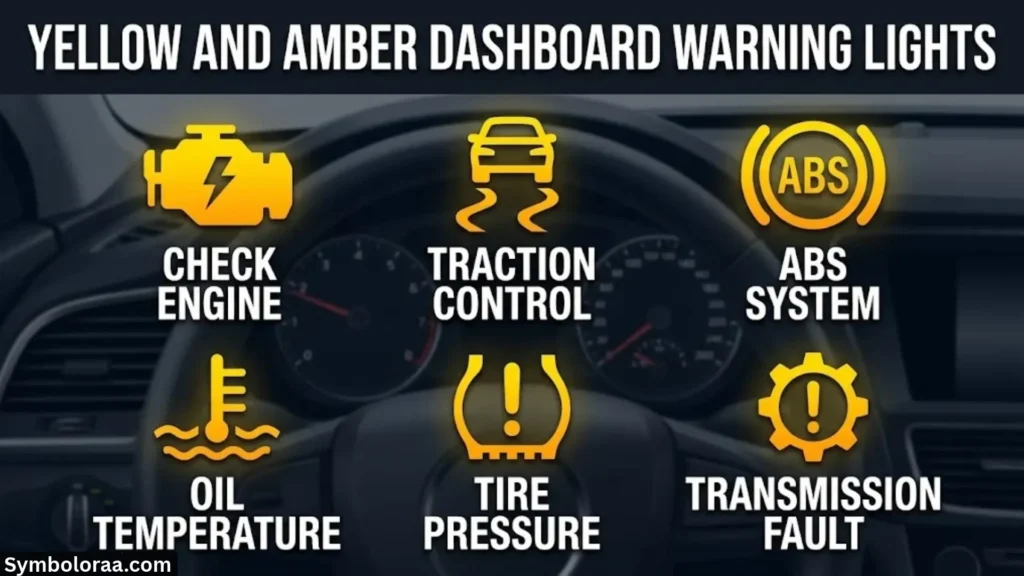
Yellow and amber dashboard lights usually indicate a problem that needs attention. Some allow limited driving, while others require you to stop or avoid using particular systems.
The safest response depends on the symbol, the vehicle’s behavior, and any accompanying message.
Check Engine Light
The check engine light usually resembles an engine outline. It may also be called the malfunction indicator lamp.
It monitors the engine management and emissions systems. The light can appear for a relatively minor issue or a problem that affects performance.
Common causes include:
- A loose or damaged fuel cap on vehicles that use one
- A faulty oxygen sensor
- An ignition misfire
- A failing mass airflow sensor
- An emissions control problem
- A catalytic converter fault
- Fuel delivery issues
A steady check engine light with normal vehicle behavior often allows you to drive cautiously to a repair facility. However, you should arrange a diagnostic check promptly.
A flashing check engine light is more urgent. It may indicate a severe misfire that can damage the catalytic converter.
Reduce speed and engine load. If the engine shakes, loses power, smells unusual, or makes abnormal noises, stop safely and arrange assistance.
Tire Pressure Monitoring System (TPMS) Warning Light
The tire pressure warning light often resembles a flat tire with an exclamation point inside.
It usually indicates that one or more tires have pressure below the recommended level. Incorrect tire pressure can affect braking, handling, fuel economy, and tire life.
Possible causes include:
- A slow puncture
- A sudden loss of air
- Temperature changes
- A damaged tire valve
- A faulty pressure sensor
Check tire pressures when the tires are cold, using the recommended pressures listed on the vehicle’s tire information label or in the owner’s manual.
Do not use the maximum pressure printed on the tire sidewall as the normal recommended pressure.
If a tire looks visibly flat or the vehicle handles abnormally, stop in a safe location. Do not continue driving on a damaged tire.
On many vehicles, a TPMS light that flashes briefly before staying on indicates a system fault. Check your manual to confirm the behavior for your model.
Anti-Lock Braking System (ABS) Warning Light
The ABS warning light commonly displays the letters “ABS” inside a circle.
The anti-lock braking system helps prevent the wheels from locking during hard braking. This can help you maintain steering control during emergency stops.
Possible causes of an ABS warning include:
- A faulty wheel speed sensor
- Damaged sensor wiring
- A malfunctioning ABS control module
- Low system voltage
- A fault in the ABS hydraulic system
If the ABS light remains on, conventional braking may still work, but the anti-lock function may be unavailable.
Drive cautiously and arrange an inspection. If the red brake warning light appears alongside the ABS light, or braking performance changes, stop safely and seek assistance.
Electronic Stability Control and Traction Control Lights
The electronic stability control (ESC) and traction control system (TCS) help manage wheel slip and vehicle stability.
A car with wavy lines beneath it is a common symbol for these systems.
If the symbol flashes while driving, the system may be actively correcting wheel slip. This can happen on wet roads, gravel, snow, or slippery surfaces.
If the light stays on continuously, the system may be switched off or experiencing a fault.
Possible causes include:
- Slippery road conditions
- A disabled traction control system
- A faulty wheel speed sensor
- Incorrect tire sizes
- An ABS-related fault
Reduce speed when the symbol flashes. If it remains illuminated without an obvious reason, check the owner’s manual and arrange an inspection.
Electronic Power Control (EPC) Warning Light
Some vehicles, including many Volkswagen Group models, display an EPC warning light.
EPC stands for Electronic Power Control. It generally relates to electronic engine and throttle management.
Possible causes include:
- A throttle body problem
- An accelerator pedal sensor fault
- An engine management issue
- Brake light switch problems
- Wiring or electrical faults
You may notice reduced engine power, uneven acceleration, or an engine that does not respond normally.
If the car loses power or becomes difficult to control, stop safely. Otherwise, drive cautiously only if the vehicle behaves normally, and arrange a diagnostic check.
Engine Oil Level Warning Light
An oil level warning is different from an oil pressure warning.
The oil level symbol indicates that the engine oil may be below the recommended level. The exact symbol and color vary by vehicle.
Check the oil level according to the owner’s manual and add the correct oil if needed.
If the warning is red, or you see an oil pressure symbol, treat the situation as more urgent. Do not assume adding oil will resolve a pressure problem.
Diesel Particulate Filter (DPF) Warning Light
Diesel vehicles may display a DPF warning light that looks like a filter or exhaust component.
The diesel particulate filter captures soot from exhaust gases. Over time, the system needs to burn off accumulated soot through a process called regeneration.
Repeated short journeys and low-speed driving can prevent regeneration from completing under the right conditions.
Follow your vehicle’s specific regeneration instructions. Some models require a particular driving pattern, while others may need workshop service.
Do not attempt regeneration if the vehicle displays a serious engine warning, overheating warning, or another instruction telling you to stop.
Glow Plug Warning Light
Diesel vehicles commonly use a coiled-wire symbol to indicate the glow plug system.
The light usually illuminates before starting a cold diesel engine. You may need to wait until it goes out before starting.
If it flashes while driving or remains on unexpectedly, the engine management system may have detected a fault.
Consult the owner’s manual, particularly if the vehicle loses power or enters reduced-performance mode.
AdBlue or Diesel Exhaust Fluid Warning Light
Many modern diesel vehicles use AdBlue, also known as diesel exhaust fluid, to reduce harmful nitrogen oxide emissions.
An AdBlue warning may indicate a low fluid level, a system fault, or a starting restriction that will apply if you ignore the message.
Refill the correct fluid according to the manufacturer’s instructions. If the warning remains after refilling, the system may need diagnosis.
Never put AdBlue into the diesel fuel tank. The fluid belongs in its designated reservoir.
Low Fuel Warning Light
The low fuel symbol usually resembles a fuel pump.
It indicates that the remaining fuel has reached a low threshold. The exact remaining range depends on the vehicle, driving conditions, fuel consumption, and tank design.
Refuel as soon as practical rather than relying on a displayed range estimate. Running out of fuel can leave you stranded and may cause additional issues in some fuel systems.
Low Outside Temperature and Ice Warning
Some vehicles display a snowflake symbol when outside temperatures approach freezing.
This ice warning light does not necessarily mean your car has a mechanical fault. It alerts you to conditions that may create slippery roads.
Bridges, shaded roads, and exposed surfaces can freeze even when other areas remain clear.
Reduce speed, leave extra stopping distance, and avoid sudden braking or steering movements.
Airbag and Supplemental Restraint System (SRS) Warning Light
The airbag warning light often shows a seated person with a circle in front of them.
It may indicate a problem with airbags, seat belt pretensioners, occupancy sensors, or related wiring.
If the warning remains on, some restraint features may not operate as designed during a collision.
Arrange a professional inspection promptly. Avoid probing airbag wiring or connectors yourself because these systems contain safety-related components.
Green, Blue, and White Dashboard Indicator Symbols
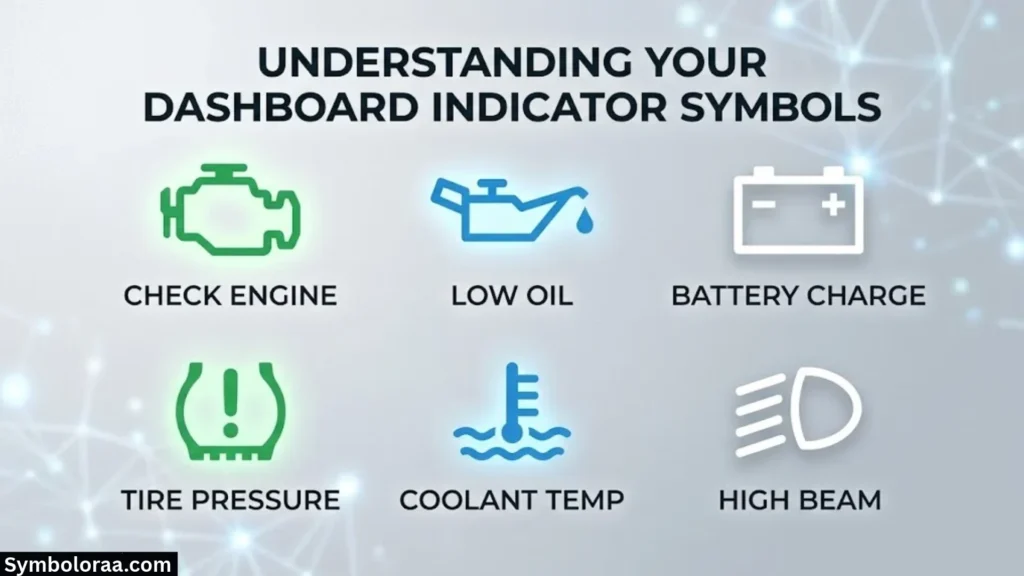
Not every dashboard symbol indicates a fault. Green, blue, and white lights often show that a vehicle feature is operating or ready for use.
Even so, understanding these indicators helps you use your vehicle correctly.
Turn Signal and Hazard Light Symbols
Green arrows usually indicate that the left or right turn signal is operating.
If an arrow flashes faster than usual, a turn signal bulb may have failed, although some vehicles behave differently because of their lighting design.
The hazard warning symbol typically shows two arrows or a red triangle. It indicates that the hazard lights are active.
Use turn signals before changing lanes or turning. Activate hazard lights when appropriate to warn other road users about a stopped vehicle or an immediate hazard, following local traffic rules.
Headlight and Fog Light Symbols
Dashboard lighting indicators tell you which exterior lights are active.
| Symbol or indicator | Meaning |
| Green headlight symbol | Often indicates low-beam headlights |
| Blue headlight symbol | Usually indicates high-beam headlights |
| Green front fog light symbol | Front fog lights are active |
| Amber rear fog light symbol | Rear fog lights are active |
| Automatic headlight indicator | Automatic lighting function is enabled on some vehicles |
Exact symbols vary by manufacturer.
High beams can dazzle approaching drivers and people ahead of you. Switch to low beams when necessary, and use fog lights only in conditions that justify them.
Cruise Control and Speed Limiter Symbols
Cruise control maintains a selected speed without requiring constant accelerator input.
A cruise control symbol may appear as a speedometer, a small vehicle, or a steering-related icon.
An adaptive cruise control indicator may show a vehicle with distance bars. This system can adjust speed to maintain a gap from traffic ahead, depending on its design.
A speed limiter symbol indicates that the vehicle is configured to restrict acceleration beyond a selected speed under specified conditions.
These features support the driver rather than replace attention. You remain responsible for steering, observing traffic, and braking when needed.
Auto Hold and Electronic Parking Brake Symbols
An Auto Hold symbol often indicates that the vehicle can remain stationary after you stop without keeping your foot on the brake pedal.
An electronic parking brake may display a circled P or another manufacturer-specific symbol.
These systems are useful in traffic and on hills, but they are not interchangeable. Auto Hold helps keep the vehicle stopped temporarily, while the parking brake secures it when parked.
Always confirm that the parking brake is engaged before leaving the vehicle.
Start-Stop System Indicator
The Start-Stop symbol commonly includes the letter A inside a circular arrow.
This system can shut off the engine temporarily when the vehicle stops, then restart it when driving resumes.
The system may not activate if the battery charge is low, the engine is cold, climate control needs additional power, or other operating conditions are not met.
A message explaining why Start-Stop is unavailable does not necessarily mean the car has a fault.
High Beam Assist and Automatic Lighting
High beam assist automatically switches between high and low beams under certain conditions.
A related dashboard indicator may show that the feature is active. The system typically relies on sensors or a camera to detect surrounding traffic and lighting.
Weather, road layout, dirt on the windshield, and sensor limitations can affect performance. You should always override the system when necessary to avoid dazzling other drivers.
Hybrid and Electric Vehicle Charging Symbols
Hybrid and electric vehicles display additional symbols related to battery charge, electric drive, regenerative braking, and high-voltage systems.
Common indicators include:
- Battery charge level
- Charging status
- Regenerative braking activity
- Electric motor operation
- Power limitation
- High-voltage system warnings
A green or blue indicator may simply show that electric driving or energy recovery is active. A warning about battery temperature, charging faults, or high-voltage safety needs more careful attention.
Follow the vehicle’s instructions, and never attempt to repair high-voltage components without appropriate training.
Common Car Dashboard Symbols by Vehicle System
Grouping dashboard symbols by system can make them easier to understand. Instead of memorizing every icon individually, identify the part of the vehicle it relates to.
Engine and Powertrain Symbols
Engine-related warnings can involve combustion, fuel delivery, emissions, sensors, or transmission operation.
Common examples include:
- Check engine light
- EPC warning
- Engine oil level warning
- Engine oil pressure warning
- Coolant temperature warning
- Transmission fault warning
- Diesel particulate filter warning
Pay attention to changes in acceleration, engine noise, exhaust smoke, fuel economy, and starting behavior. These symptoms can help a technician identify the cause.
Braking and Stability Symbols
Braking and stability indicators include the ABS light, brake warning light, traction control symbol, and ESC warning.
These systems influence stopping distance, wheel control, and vehicle stability.
If several braking-related warnings appear together, the problem may affect more than one system. Avoid aggressive driving and seek professional help if braking or handling feels different.
Tire and Suspension Symbols
The tire pressure monitoring light is the most familiar tire-related warning.
Some vehicles also monitor suspension height, adaptive damping, or other chassis functions. These systems may display a vehicle with arrows, suspension components, or a chassis-related message.
If the vehicle sits unusually low, leans to one side, or handles poorly, do not rely on the dashboard symbol alone. A physical inspection may be necessary.
Electrical System Symbols
Electrical warnings can involve the battery, alternator, charging system, exterior lighting, or electronic control modules.
A weak battery or charging fault can sometimes trigger multiple warning lights because modern vehicles depend on stable electrical voltage.
If several unrelated warnings appear at once, note whether the engine starts normally and whether headlights or other electrical equipment behave unusually.
Do not assume every warning is a separate mechanical failure. A technician can test the battery, charging system, and stored fault codes.
Driver Assistance Symbols
Modern vehicles may display indicators for lane departure warning, blind-spot monitoring, collision alerts, parking sensors, and automatic emergency braking.
These systems may use cameras, radar, ultrasonic sensors, or other equipment.
A warning can mean that a feature is active, disabled, temporarily unavailable, or faulty. Heavy rain, snow, dirt, glare, and blocked sensors can limit operation.
Clean accessible sensor areas as directed in your manual. Never assume a driver-assistance system will detect every hazard.
Hybrid and Electric Vehicle Symbols
Hybrid and electric vehicles combine conventional dashboard warnings with indicators for battery management, electric drive, charging, and energy recovery.
A reduced power message may appear when the system limits output to protect components or respond to operating conditions.
High-voltage warnings require particular care. Do not touch orange high-voltage cables, open battery enclosures, or attempt repairs yourself.
Follow the displayed instructions and contact a qualified service provider when a high-voltage fault appears.
Maintenance Reminder Symbols
Some dashboard symbols remind you about routine service rather than an immediate mechanical problem.
Examples include:
- Oil change reminder
- Scheduled maintenance alert
- Tire rotation reminder
- Inspection reminder
- Brake pad wear warning
Maintenance reminders may be based on mileage, time, sensor data, or a combination of factors.
Resetting a reminder does not fix an underlying problem. Complete the required service first, then follow the manufacturer’s reset procedure.
What to Do When a Dashboard Warning Light Appears
A warning light can be stressful, especially when you do not recognize the symbol. A clear response helps you protect yourself and avoid unnecessary damage.
Identify the Symbol and Read the Message
Start by checking the symbol, its color, and any text displayed on the instrument panel.
If you cannot identify it, consult the owner’s manual for your exact model and year. Do not rely solely on a symbol chart for a different vehicle.
Some warnings appear only briefly, so note the message before it disappears if you can do so safely.
Assess Whether You Need to Stop
Look for signs of a serious problem, such as:
- Smoke or steam
- A strong burning smell
- A sudden loss of power
- Unusual engine knocking
- Reduced braking performance
- Heavy steering
- A rapidly rising engine temperature
If you experience any of these symptoms, pull over safely and stop the engine when appropriate.
Never keep driving simply because the vehicle still moves. Some serious faults do not immediately affect how the car feels.
Check Only What You Can Safely Inspect
Once parked in a safe location, you may be able to check basic items.
For example, you can inspect tire pressure, confirm that the fuel cap is secure if your vehicle uses one, or check the engine oil level after following the correct procedure.
Avoid opening hot cooling systems, working near moving engine parts, or touching high-voltage components.
If a basic check does not explain the warning, arrange a professional inspection.
Use Diagnostic Testing When Necessary
A repair technician may use an OBD-II diagnostic scanner to retrieve stored fault codes from compatible vehicles.
These codes help narrow down the cause of a warning. However, a code does not always identify the exact failed component.
For example, an oxygen sensor-related code may result from a sensor fault, wiring damage, an exhaust leak, or another underlying issue.
Proper diagnosis involves interpreting the code, checking related components, and confirming the cause before replacing parts.
Can You Keep Driving With a Dashboard Warning Light On?
Whether you can continue driving depends on the warning, its severity, and the vehicle’s behavior.
Use this table as a general guide, not a substitute for your owner’s manual.
| Warning light | General urgency | Recommended response |
| Red oil pressure | Critical | Stop safely and switch off the engine |
| Engine overheating | Critical | Stop safely and allow the engine to cool |
| Brake warning with poor braking | Critical | Stop and arrange assistance |
| Flashing check engine light | High | Reduce load and stop if safe; arrange diagnosis |
| Steady check engine light | Varies | Drive cautiously if the car behaves normally and seek diagnosis promptly |
| Low tire pressure | Moderate to high | Check pressure promptly; stop if the tire appears damaged |
| ABS warning alone | Requires attention | Drive cautiously if braking remains normal and arrange service |
| Airbag warning | Requires prompt inspection | Arrange service because restraint systems may be affected |
| Low fuel | Routine but time-sensitive | Refuel as soon as practical |
| Green turn signal | Informational | Continue normally if the lights work correctly |
| Blue high-beam indicator | Informational | Switch to low beams when conditions require it |
When in doubt, prioritize safety over convenience. If a warning indicates a critical fault or the vehicle behaves abnormally, stop safely and seek professional help.
Why Dashboard Warning Lights Stay On or Appear Unexpectedly
A warning light may remain illuminated for several reasons. Understanding the possible causes can help you decide what to do next.
The Problem Has Not Been Fixed
A warning light usually remains on when the monitored system still detects a fault.
Adding oil, inflating a tire, or tightening a fuel cap may resolve some warnings. Other problems require component repairs, a system reset, or a diagnostic procedure.
Do not assume the issue has disappeared just because the car seems to run normally.
The Battery or Charging System Is Weak
Low voltage can interfere with electronic systems and trigger multiple dashboard warnings.
This can happen when a battery is aging, charging performance is poor, or electrical connections are damaged.
If several unrelated warning lights appear together, have the battery and charging system tested rather than replacing parts without diagnosis.
A Sensor or Electrical Connection Has Failed
Modern vehicles use many sensors to monitor temperature, pressure, wheel speed, emissions, and other functions.
A damaged wire, corroded connector, or failed sensor can produce a warning even when the underlying mechanical system appears normal.
A technician can test the relevant circuit and determine whether the sensor or another component is responsible.
The Warning Appears Only Under Certain Conditions
Some faults occur intermittently. A warning might appear during acceleration, after the engine warms up, or when driving over rough roads.
These patterns can provide useful diagnostic clues.
Record when the light appears, whether it flashes, and any changes in performance. This information can help a technician reproduce the problem.
The Warning Light Was Reset Without Repairing the Cause
Clearing a fault code can switch off a warning temporarily. However, the light may return when the vehicle detects the problem again.
A proper repair addresses the cause rather than simply hiding the warning.
How to Prevent Avoidable Dashboard Warning Lights
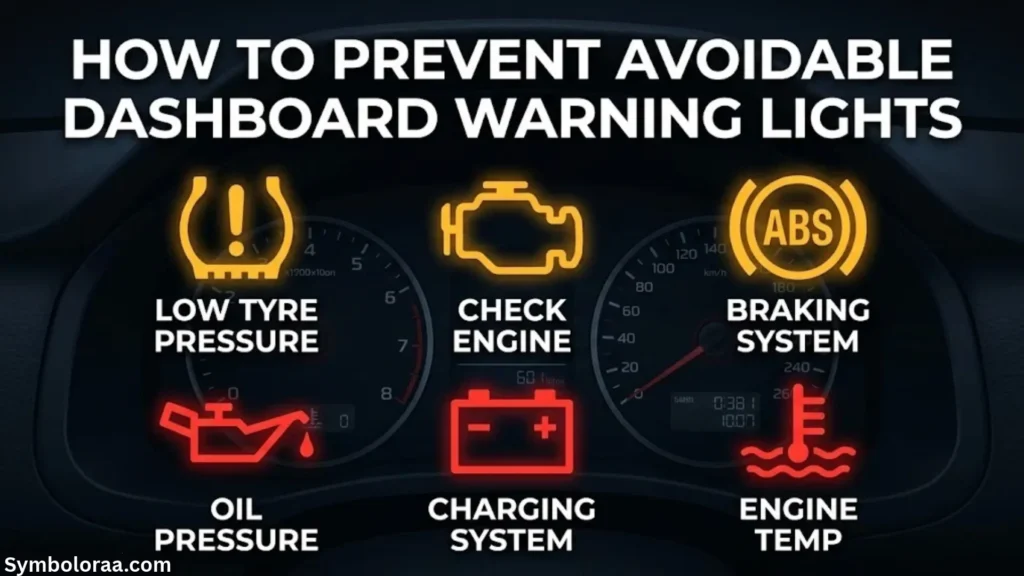
You cannot prevent every warning light, but regular maintenance can reduce the risk of common problems.
Follow the Recommended Maintenance Schedule
Use the service schedule specified for your vehicle. Routine inspections can identify worn components, fluid leaks, and developing faults before they become serious.
Do not rely on dashboard reminders alone. Some maintenance items require attention even when no warning light appears.
Check Tire Pressure Regularly
Correct tire pressure supports handling, braking, tire life, and fuel economy.
Check pressures when the tires are cold and use the recommended figures for your vehicle. Inspect the tires for cuts, bulges, punctures, and uneven wear.
A warning light can help identify a problem, but regular checks remain important.
Monitor Engine Oil and Coolant
Check fluid levels according to your owner’s manual.
Use the correct oil specification and coolant type. Mixing incompatible fluids or adding the wrong product can create additional problems.
Investigate repeated low-level warnings instead of simply topping up fluids each time.
Pay Attention to Battery Health
A weak battery can cause starting problems and electronic warnings.
Have it tested when starting becomes sluggish, electrical accessories behave strangely, or several warning lights appear together.
Keep battery terminals and connections in good condition, following the manufacturer’s safety guidance.
Respond to Unusual Symptoms Early
Warning lights are not the only signs of trouble.
Watch for new noises, vibration, smoke, fluid spots, unusual smells, reduced power, or changes in braking and steering.
Early inspection can help prevent a minor fault from becoming a major repair.
Frequently Asked Questions About Car Dashboard Symbols
What Are the Most Important Car Dashboard Symbols?
Some of the most urgent symbols include the engine oil pressure warning, engine overheating warning, serious brake warning, and certain high-voltage system warnings.
A flashing check engine light can also indicate a serious problem.
Learn the meaning of these symbols before you need them. Knowing what to do can help you respond quickly in an emergency.
Which Dashboard Warning Lights Mean Stop Immediately?
Stop safely when a warning indicates dangerously low oil pressure, engine overheating, brake failure, or another critical safety problem.
A STOP message should also be taken seriously. Read the accompanying instructions and follow the manufacturer’s guidance.
If the car smokes, loses braking ability, or develops severe mechanical symptoms, do not continue driving.
Is It Safe to Drive With a Yellow Dashboard Warning Light?
Sometimes. A steady check engine light may allow cautious driving if the vehicle operates normally, but it still requires diagnosis.
Other yellow warnings may require you to stop, reduce speed, or avoid using a particular feature.
Always identify the symbol before deciding whether to continue.
What Does a Flashing Check Engine Light Mean?
A flashing check engine light commonly indicates a severe engine misfire.
Continued driving can damage the catalytic converter and increase repair costs. Reduce engine load and stop safely if the warning continues or the vehicle runs roughly.
Arrange professional diagnosis as soon as possible.
Why Do All My Dashboard Lights Turn On When I Start the Car?
Many vehicles illuminate their warning lights briefly during the ignition self-check.
The lights should behave as described in your owner’s manual. If a warning stays on after starting, investigate its meaning rather than assuming it is part of the normal check.
Can I Reset a Dashboard Warning Light Myself?
Some reminders can be reset through the vehicle’s controls after you complete the required maintenance.
However, fault warnings should not be reset simply to make them disappear. The underlying problem may remain, even if the light temporarily turns off.
Follow the correct procedure for your model and repair any confirmed fault.
Why Does My Car Show Multiple Warning Lights at Once?
Multiple warnings may result from a shared electrical problem, a weak battery, a charging fault, or a failure that affects several related systems.
They can also indicate separate faults.
Record the warnings and any accompanying messages. A diagnostic scan and appropriate testing can help identify the root cause.
Do Car Dashboard Symbols Mean the Same Thing in Every Vehicle?
No. Many symbols follow common conventions, but manufacturers can use different icons, colors, and warning procedures.
Hybrid and electric vehicles also have symbols that conventional gasoline cars may not display.
Always confirm unfamiliar symbols using the owner’s manual for your exact vehicle.
What Should I Do If I Don’t Recognize a Dashboard Symbol?
Park safely before investigating the symbol. Check the instrument display and owner’s manual to identify its meaning.
If the symbol indicates a critical fault, the car behaves abnormally, or the instructions are unclear, contact roadside assistance or a qualified technician.
Do not ignore an unfamiliar warning simply because the vehicle continues to run.
Final Thoughts on Car Dashboard Symbols and Meanings
Understanding car dashboard symbols and meanings helps you recognize warnings, make safer decisions, and respond to vehicle problems before they become more serious.
Remember these essential points:
- Red warning lights often indicate serious faults or safety concerns that require immediate attention.
- Yellow and amber lights usually indicate a problem that needs investigation or a system that requires attention.
- Green, blue, and white indicators generally communicate that a feature is active or provide useful information.
- Flashing warning lights can indicate a more urgent issue, depending on the symbol.
- Multiple warning lights may point to an electrical problem or a fault affecting several systems.
- Your owner’s manual provides the most reliable guidance for your specific vehicle.
Never ignore a warning simply because the car still drives. Identify the symbol, assess the risk, and take the appropriate action.
A little dashboard knowledge can save you time, reduce repair costs, and help keep you and your passengers safer on the road.

I’m Madison Reed, a contemporary American author who writes about love, family, friendship, and second chances. I’m fascinated by the choices that shape our lives and the moments that change us forever. My goal is to create honest, emotional stories with characters readers can connect with long after finishing each book.
Three Books:
When We Find Our Way
The Things We Never Said
Summer in September