Antique symbols stamped on jewelry are much more than tiny marks hidden inside rings, bracelets, necklaces, brooches, and lockets. These small symbols often reveal a piece’s age, metal purity, place of origin, manufacturer, cultural significance, and historical value.
Many people discover an unusual stamp inside a ring and immediately ask questions such as:
- What does this symbol mean?
- Is my jewelry made of real gold or silver?
- Is this piece antique or simply old?
- Does the stamp identify the country of origin?
- Can a hallmark increase the value of jewelry?
The answers are usually found in the symbols themselves.
A single antique ring may contain several different markings. One stamp might identify the metal. Another might identify the maker. A third could indicate the year of production, while a fourth could reveal the assay office that tested the piece.
Learning to interpret these symbols can help collectors avoid expensive mistakes, identify valuable pieces, preserve family heirlooms, and distinguish authentic antiques from reproductions.
This comprehensive guide explains the history of antique jewelry symbols, the meaning of the most common hallmarks, methods for identifying stamps, country-specific marking systems, decorative symbols, authentication techniques, collector strategies, and practical steps for evaluating antique jewelry.
Quick Answer: What Do Antique Symbols Stamped on Jewelry Mean?
Antique symbols stamped on jewelry are identifying marks placed on precious metals by manufacturers, government authorities, assay offices, or artisans.
These symbols usually indicate:
| Symbol type | What it tells you |
| Purity mark | Gold, silver, or platinum content |
| Hallmark | Metal certification |
| Maker’s mark | Manufacturer or jeweler |
| Assay mark | Testing office |
| Date letter | Year of certification |
| Import mark | Country of entry |
| Export mark | Country of manufacture |
| Decorative symbol | Cultural or religious meaning |
| Monogram | Personal ownership |
If you discover a symbol inside your jewelry, examine it carefully before assuming it represents a brand or decoration.
Key takeaway: Most antique jewelry contains multiple symbols that should be interpreted together rather than individually.
Understanding the Difference Between Jewelry Symbols, Hallmarks, and Stamps
People often use the words symbol, stamp, hallmark, and mark as if they mean the same thing. They do not.
What Is a Hallmark?
A hallmark is an official certification mark that verifies the purity of precious metals.
Hallmarks are often regulated by government agencies or authorized assay offices.
Examples include:
- Leopard’s head (London)
- Anchor (Birmingham)
- Eagle’s head (France)
What Is a Maker’s Mark?
A maker’s mark identifies the company, workshop, or individual who created the jewelry.
Examples include:
- Initials
- Company logos
- Monograms
- Registered trademarks
What Is a Purity Mark?
A purity mark indicates the percentage of precious metal.
Examples include:
- 925
- 750
- 585
- 950
What Is a Decorative Symbol?
Decorative symbols communicate cultural, spiritual, artistic, or personal meanings.
Examples include:
- Crosses
- Crescent moons
- Hearts
- Serpents
- Family crests
Common mistake: Many beginners assume that every symbol is a hallmark. Decorative engravings often have no connection to metal purity or authenticity.
The History of Jewelry Hallmarks
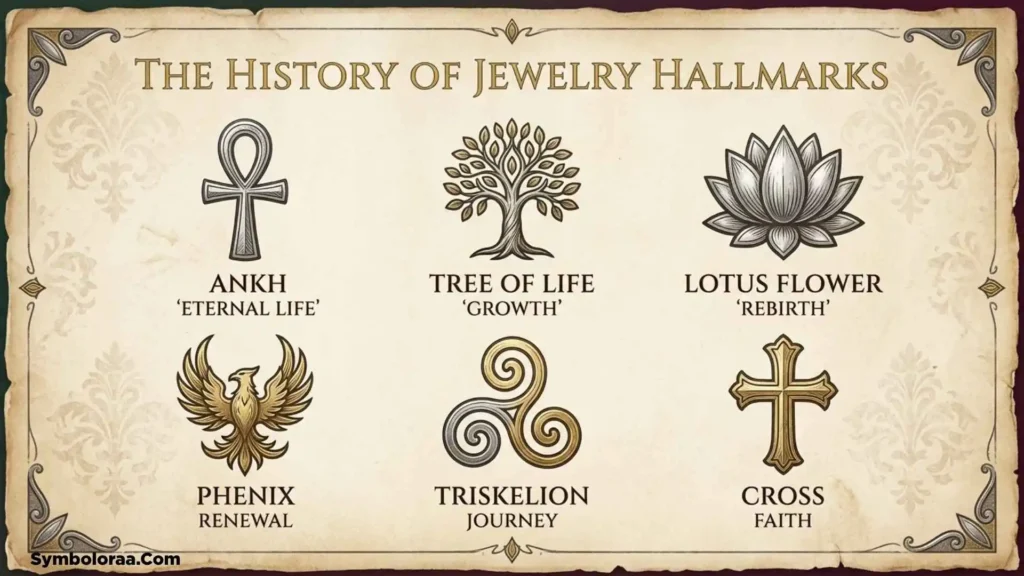
Jewelry hallmarking has existed for centuries.
Before official hallmarking systems, dishonest sellers could mix precious metals with cheaper materials and sell them as pure gold or silver.
Governments eventually created testing systems to protect consumers.
The Origins of Hallmarking
Europe introduced formal hallmarking systems during the Middle Ages.
Goldsmith guilds inspected jewelry and verified metal purity before allowing pieces to enter the marketplace.
This process protected both consumers and legitimate craftsmen.
The Development of British Hallmarking
England established one of the world’s oldest hallmarking systems in the 1300s.
Jewelry was examined by authorized assay offices.
After passing inspection, official symbols were stamped into the metal.
Over time, additional marks were added, including:
- Date letters
- Tax marks
- Maker’s marks
- Duty stamps
British hallmarking eventually became one of the most detailed jewelry identification systems in history.
Why Historical Hallmarks Still Matter
Modern collectors rely on antique hallmarks to:
- Estimate age
- Verify authenticity
- Identify geographical origins
- Confirm precious metal content
- Determine historical significance
A tiny stamp can reveal hundreds of years of history.
Also Check This Post: 51+ Emo Symbols Explained: The Complete Guide to Meanings and Uses
Gold Jewelry Symbols and Their Meanings
Gold purity is usually measured in karats.
Many antique gold pieces include numerical stamps.
Common Gold Purity Marks
| Stamp | Gold purity | Karat |
| 333 | 33.3% | 8K |
| 375 | 37.5% | 9K |
| 417 | 41.7% | 10K |
| 585 | 58.5% | 14K |
| 750 | 75% | 18K |
| 916 | 91.6% | 22K |
| 999 | 99.9% | 24K |
Understanding Karat Marks
Antique jewelry may also use traditional karat stamps.
Examples include:
- 10K
- 14K
- 18K
- 22K
A ring stamped 18K contains 18 parts pure gold and 6 parts additional metals.
Real-Life Example
Suppose you inherit a gold bracelet stamped “750.”
Many people might assume that 750 is a model number.
In reality, the stamp indicates 18-karat gold.
Expert tip: Wear can make stamps difficult to read. Use a jeweler’s loupe rather than relying on the naked eye.
Silver Jewelry Symbols and Their Meanings
Silver markings are among the most recognizable antique jewelry stamps.
Common Silver Hallmarks
| Stamp | Meaning |
| 800 | 80% silver |
| 830 | 83% silver |
| 900 | 90% silver |
| 925 | Sterling silver |
| 958 | Britannia silver |
| 999 | Fine silver |
Why the 925 Stamp Is So Important
A 925 mark means the jewelry contains 92.5% silver.
The remaining 7.5% usually consists of strengthening metals.
Sterling silver became the international standard because pure silver is too soft for everyday jewelry.
Common Misconception
A 925 stamp does not automatically mean that a piece is antique.
Many modern jewelry manufacturers also use the same hallmark.
Always examine:
- Design
- Construction
- Gemstones
- Clasps
- Decorative techniques
Platinum Jewelry Symbols and Their Meanings
Platinum became especially popular during the late nineteenth and early twentieth centuries.
Common Platinum Marks
| Stamp | Meaning |
| PT | Platinum |
| PLAT | Platinum |
| PT900 | 90% platinum |
| PT950 | 95% platinum |
Why Platinum Became Popular During the Art Deco Era
Platinum allowed jewelers to create delicate settings without sacrificing strength.
Its durability made it ideal for intricate designs.
Many Art Deco engagement rings contain platinum hallmarks.
British Hallmarks: Understanding One of the World’s Most Detailed Systems
British jewelry often contains several symbols.
Common Assay Office Symbols
| Symbol | Assay office |
| Leopard’s head | London |
| Anchor | Birmingham |
| Rose | Sheffield |
| Castle | Edinburgh |
Understanding Date Letters
British date letters identify the year of certification.
Characteristics include:
- Alphabetical cycles
- Different fonts
- Different shield shapes
A single letter may reveal a precise production year.
Understanding Duty Marks
Historically, Britain taxed precious metals.
Duty marks demonstrated that the required taxes had been paid.
Many antique pieces still contain these symbols.
French Jewelry Symbols and Hallmarks
French jewelry uses a distinctive hallmarking system.
Common French Symbols
| Symbol | Meaning |
| Eagle’s head | Gold |
| Boar’s head | Silver |
| Crab | Regional assay office |
Why French Hallmarks Are Different
French authorities introduced symbols based on animal imagery.
Unlike numerical systems, these pictorial marks required specialized identification guides.
Collectors frequently misidentify French hallmarks because the symbols are extremely small.
Other International Jewelry Symbols You May Encounter
Antique jewelry often crosses borders through inheritance, auctions, and estate sales.
Russian Jewelry Symbols
Russian jewelry commonly includes:
- Kokoshnik marks
- Cyrillic initials
- Imperial assay marks
Austrian Jewelry Symbols
Austrian jewelry may contain:
- Diana heads
- Animal symbols
- Regional hallmarks
American Jewelry Marks
The United States historically relied more heavily on manufacturer marks than on government-regulated hallmark systems.
Common American identifiers include:
- Company names
- Initials
- Patents
- Trademarks
Decorative Symbols Found on Antique Jewelry
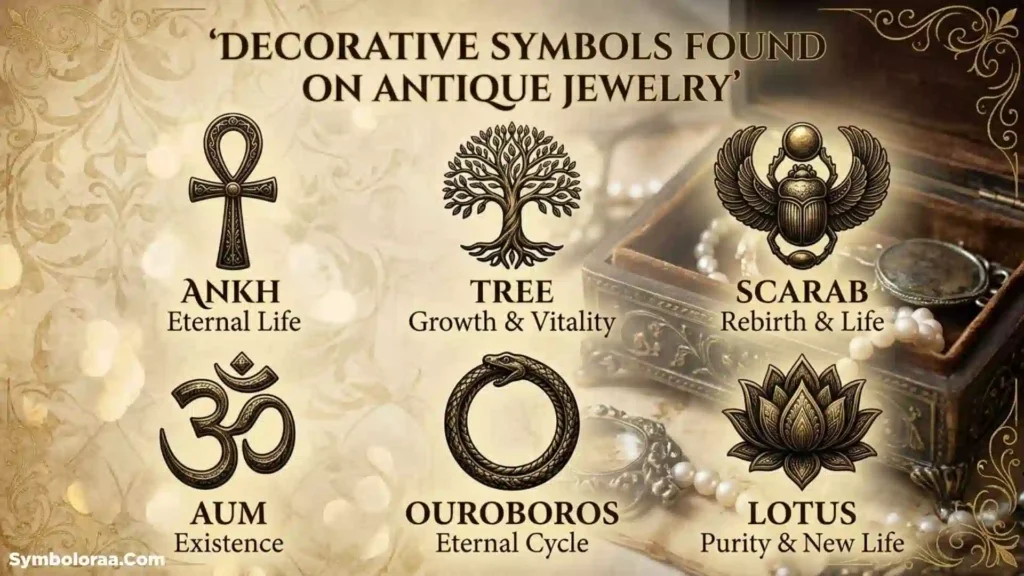
Not every antique symbol was intended for identification.
Many represented beliefs, emotions, and traditions.
Religious Symbols
Common examples include:
| Symbol | Meaning |
| Cross | Christianity |
| Star of David | Judaism |
| Crescent moon | Spiritual renewal |
| Angel | Protection |
Nature Symbols
Nature-inspired jewelry frequently included:
- Flowers
- Leaves
- Birds
- Butterflies
- Trees
Victorian jewelers often used flowers to communicate hidden messages.
Animal Symbols
Animals carried symbolic meanings.
Examples include:
| Animal | Traditional meaning |
| Snake | Eternity |
| Dove | Peace |
| Lion | Strength |
| Bee | Hard work |
| Owl | Wisdom |
Victorian, Art Nouveau, and Art Deco Symbolism
Jewelry designs changed dramatically across historical periods.
Understanding artistic movements can help identify antique pieces.
Victorian Jewelry Symbols
Victorian jewelry often reflected:
- Mourning traditions
- Romance
- Family relationships
- Sentimental messages
Common symbols included:
- Hearts
- Locks
- Hair jewelry
- Black enamel
Art Nouveau Symbols
Art Nouveau favored:
- Flowing lines
- Natural themes
- Feminine figures
- Organic forms
Art Deco Symbols
Art Deco emphasized:
- Geometry
- Symmetry
- Modernism
- Architectural patterns
Collector insight: Artistic styles often provide more dating evidence than hallmarks alone.
How to Identify Antique Symbols Stamped on Jewelry
Professional appraisers rarely depend on a single clue.
Instead, they follow a systematic process.
Step 1: Locate Every Mark
Inspect:
- Clasps
- Ring interiors
- Pin backs
- Bracelet hinges
- Pendant bails
Step 2: Photograph the Symbols
Use your smartphone’s zoom function.
Photographs often reveal details that are invisible to the naked eye.
Step 3: Identify the Metal
Determine whether the piece contains:
- Gold
- Silver
- Platinum
Step 4: Separate Hallmarks From Decorative Symbols
Ask:
- Does this mark indicate purity?
- Does it identify a manufacturer?
- Is it simply decorative?
Step 5: Compare Symbols With Hallmark Databases
Compare the markings with official hallmark references.
Step 6: Seek Professional Verification
If the jewelry appears valuable, consult a professional appraiser.
Also Check This Post: 53+ Symbols for Fire: The Ultimate Guide to Spiritual Symbolism
Decision Tree: How to Interpret an Unknown Jewelry Stamp
Do you see a number?
↓
Yes
↓
Is it 925, 585, 750, or 950?
↓
Yes
↓
You are probably looking at a purity mark.
No
↓
Do you see an animal or pictorial symbol?
↓
Yes
↓
Compare it with official assay office symbols.
No
↓
Do you see initials?
↓
Yes
↓
You may be looking at a maker’s mark.
Still uncertain?
↓
Consult a certified jewelry appraiser.
How Experts Authenticate Antique Jewelry
Authentication extends far beyond hallmarks.
Metal Testing
Experts may use:
- X-ray fluorescence
- Acid testing
- Spectrometry
Gemstone Analysis
Gemologists examine:
- Inclusions
- Cutting styles
- Settings
- Stone replacements
Construction Analysis
Experts also study:
- Soldering methods
- Clasps
- Hand-finishing
- Manufacturing techniques
Professional authentication combines science, history, and craftsmanship.
Common Mistakes When Identifying Jewelry Symbols
Assuming Every Stamp Means the Jewelry Is Antique
Many modern pieces contain traditional hallmarks.
Ignoring Construction Techniques
Construction often reveals more information than the stamp itself.
Overlooking Foreign Hallmarks
International jewelry frequently contains unfamiliar symbols.
Believing Online Images Without Verification
Hallmark charts can contain errors.
Always verify information using multiple sources.
Preserving and Cleaning Antique Jewelry
Improper cleaning can permanently damage antique jewelry.
Cleaning Best Practices
Do:
- Store jewelry separately.
- Keep pieces dry.
- Use soft clothes.
- Protect gemstones.
Do not:
- Use abrasive cleaners.
- Soak delicate jewelry.
- Polish aggressively.
- Use ultrasonic cleaners without professional advice.
Storage Recommendations
Store jewelry in:
- Fabric-lined boxes
- Anti-tarnish bags
- Protective cases
Preservation protects both monetary and historical value.
How Antique Jewelry Symbols Affect Value
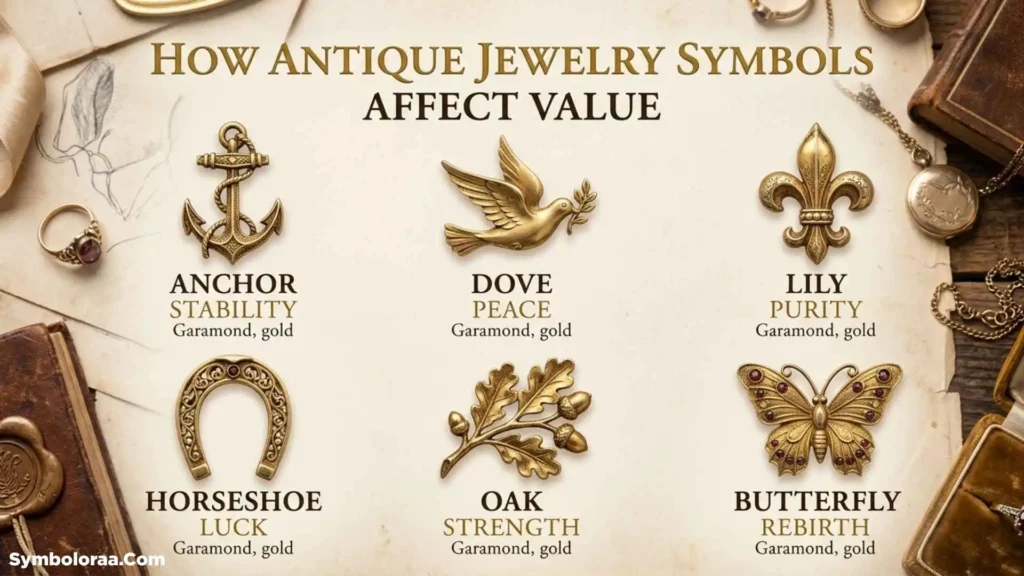
Symbols can significantly influence market value.
Factors that increase value include:
- Rare hallmarks
- Famous makers
- Precious metals
- Historical significance
- Exceptional craftsmanship
However, hallmarks alone do not determine value.
Professional appraisers evaluate the entire piece.
Best Practices for Collectors
Experienced collectors follow several important principles.
Keep Detailed Records
Document:
- Hallmarks
- Measurements
- Photographs
- Purchase history
Learn Historical Styles
Hallmarks become more meaningful when combined with design knowledge.
Buy From Reputable Sources
Choose:
- Estate jewelers
- Established auction houses
- Professional appraisers
Invest in Reference Books
Hallmark guides remain essential tools for serious collectors.
Frequently Asked Questions
What is the most common antique jewelry stamp?
The 925 sterling silver hallmark is one of the most common jewelry stamps worldwide.
Does a hallmark guarantee authenticity?
No.
Hallmarks provide valuable evidence, but they should never be the only factor used to verify authenticity.
Can antique jewelry have no markings?
Yes.
Wear, resizing, repairs, and manufacturing practices may remove or eliminate original markings.
Are all gold stamps numerical?
No.
Some antique jewelry uses traditional karat marks, while other pieces rely on pictorial symbols.
How can I identify an unknown jewelry symbol?
Start by determining whether the mark is:
- A purity stamp
- A hallmark
- A maker’s mark
- A decorative symbol
If necessary, consult a professional appraiser.
Do antique symbols increase jewelry value?
Sometimes.
Rare hallmarks and famous makers can increase value, but overall condition and historical importance also play important roles.
Conclusion
Antique symbols stamped on jewelry serve as historical fingerprints that preserve information about precious metals, craftsmanship, artistic movements, trade practices, and cultural traditions.
Whether you discover a 925 hallmark inside a silver ring, an eagle’s head on a French pendant, or a mysterious maker’s mark on a family heirloom, every symbol contributes to a larger historical story.
The most successful collectors do not rely on a single stamp. They combine hallmark research with design analysis, historical knowledge, gemstone evaluation, and professional authentication.
The next time you examine an antique piece, look beyond its beauty. The smallest symbol may reveal the most fascinating part of its history.
Also Check This Post: 61+ Alaska Symbols: Important Facts About Alaska’s Official Icons

I’m Madison Reed, a contemporary American author who writes about love, family, friendship, and second chances. I’m fascinated by the choices that shape our lives and the moments that change us forever. My goal is to create honest, emotional stories with characters readers can connect with long after finishing each book.
Three Books:
When We Find Our Way
The Things We Never Said
Summer in September
 Jackson Miller