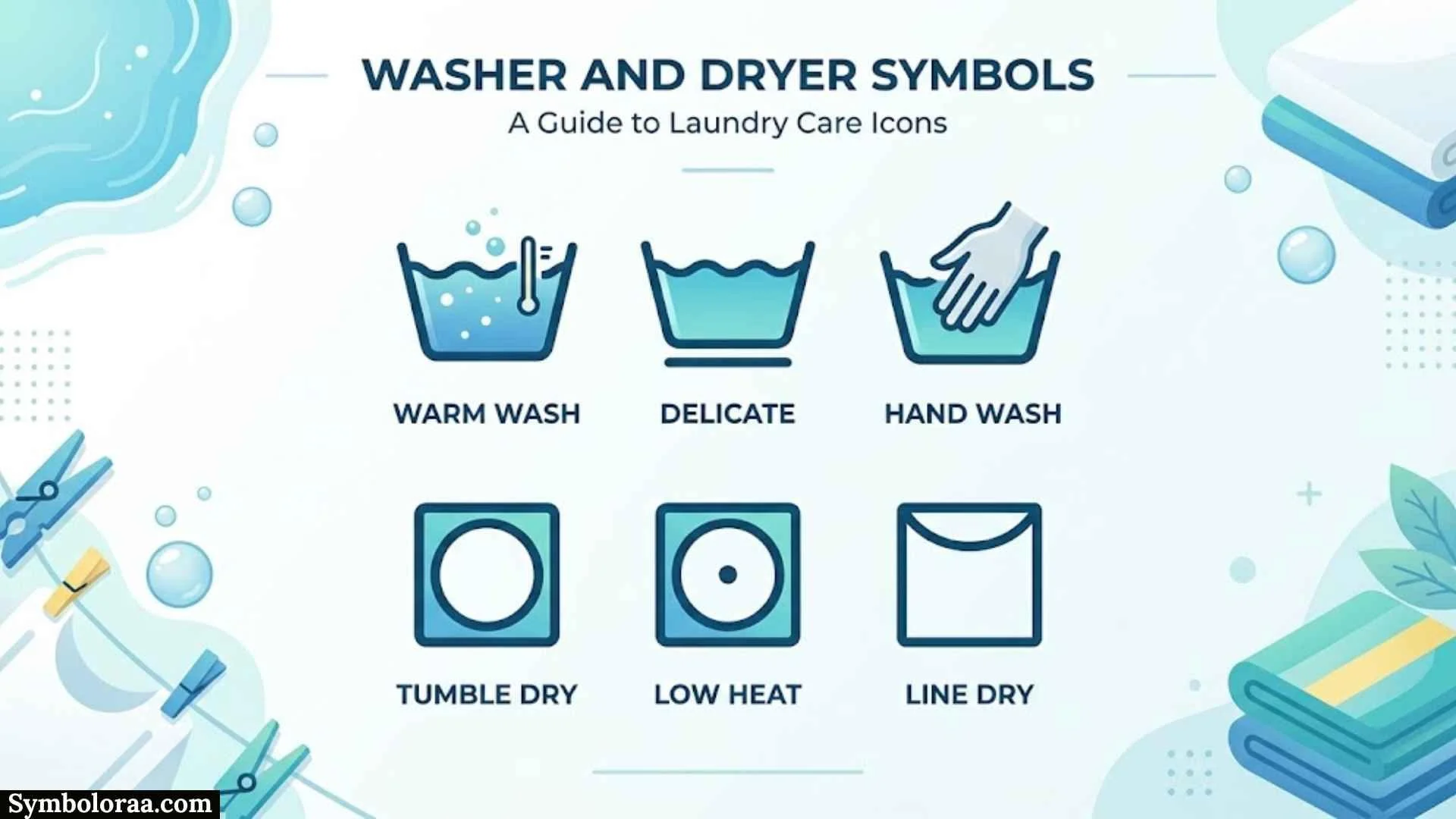
If you are trying to understand a washer and dryer symbol on a clothing label, the shape of the icon tells you what type of care the garment needs, while numbers, dots, lines, and crosses provide additional instructions. A wash tub usually relates to washing, while a square containing a circle indicates tumble drying.
The challenge is that one small symbol can contain several pieces of information. A line beneath a wash tub can change the required washing action, while dots inside a dryer symbol can control heat. A cross can mean that a particular treatment should not be used at all.
This guide explains washer and dryer symbols from the ground up, including what each symbol means, how to translate a care label into an actual washing-machine or dryer setting, how symbols differ between care-label systems, what the symbols mean for common fabrics, and which mistakes can damage clothing.
Quick Answer: What Do Washer and Dryer Symbols Mean?
The easiest way to identify a laundry symbol is to start with its main shape.
| Main Symbol | What It Usually Means |
| Tub filled with water | Washing |
| Tub with a hand | Hand washing |
| Crossed-out tub | Do not wash |
| Square | Natural or general drying instructions |
| Square with a circle | Tumble drying |
| Square with a crossed-out circle | Do not tumble dry |
| Circle inside square + one dot | Tumble dry on low heat |
| Circle inside square + two dots | Tumble dry on medium heat |
| Circle inside square + three dots | Tumble dry on high heat |
| Square with horizontal line | Dry flat |
| Square with vertical lines | Drip or line drying |
| Triangle | Bleaching |
| Iron | Ironing |
| Circle | Professional textile cleaning |
| Crossed-out symbol | Do not use the treatment represented |
The exact markings can vary between standards and regions. ISO 3758:2023 defines an international textile-care symbol system covering washing, bleaching, drying, ironing, and professional textile care.
The most important principle is to read the complete care label rather than interpreting one icon by itself.
What Is a Washer and Dryer Symbol?
A washer or dryer symbol is a graphical instruction on a textile care label that tells you how an item can be cleaned or dried without exceeding the treatment intended for that garment.
The symbols are designed to communicate information about:
- Washing method
- Washing temperature
- Mechanical treatment
- Bleaching
- Tumble drying
- Dryer temperature
- Natural drying
- Ironing
- Professional cleaning
- Treatments that should not be used
ISO describes its care-symbol system as information about the most severe treatments that should not cause irreversible damage to the textile when the specified care process is followed.
That wording leads to an important practical point:
A care symbol is generally a limit or permitted treatment, not an instruction to use the harshest possible setting.
For example, if a label permits washing at 40°C, you should not assume that 40°C is always necessary. A cooler suitable wash may be preferable when the garment is lightly soiled and the label permits it.
How to Identify a Laundry Symbol at a Glance
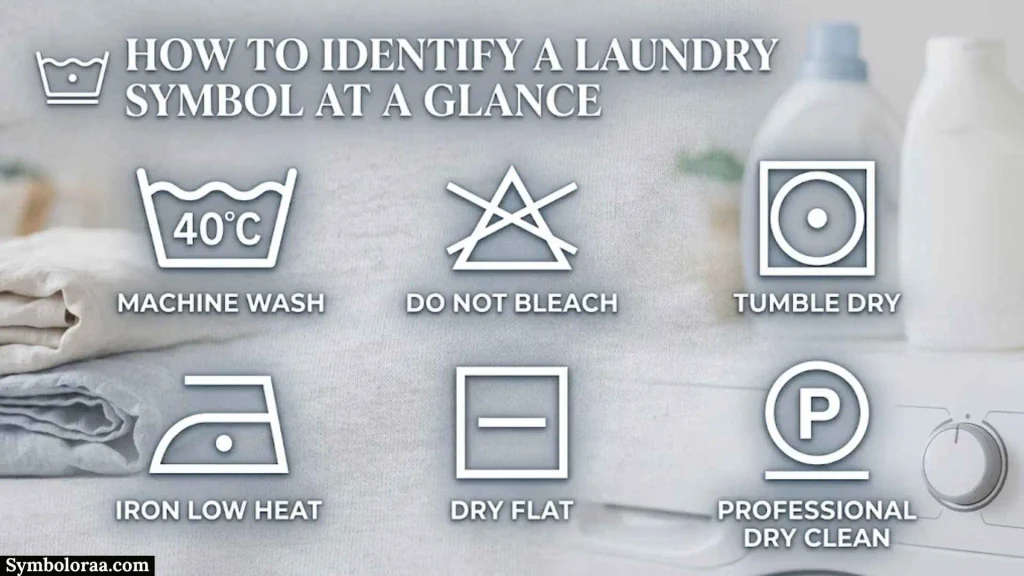
Before memorizing individual icons, learn the five basic families.
The Tub Means Washing
A tub or wash-basin shape represents washing.
Look inside or underneath the tub for additional information such as:
- Temperature
- Hand-wash indication
- Gentle-treatment markings
- A cross indicating that washing is prohibited
This symbol answers the question:
“How can I wash this garment?”
The Square Means Drying
A square represents drying instructions.
The markings inside or around the square tell you whether the item should be:
- Tumble dried
- Dried naturally
- Dried flat
- Line dried
- Drip dried
- Dried in the shade
This symbol answers:
“How should I dry this garment?”
The Triangle Means Bleaching
A triangle is associated with bleaching.
Depending on its markings, it can indicate that bleach is permitted, restricted, or prohibited.
The Iron Means Ironing
An iron-shaped symbol tells you whether ironing is permitted and, when dots are present, the applicable heat level.
The Circle Means Professional Cleaning
A circle is associated with professional textile cleaning.
Do not confuse it with the circle inside a square used for tumble drying.
That distinction is easy to remember:
Circle alone = professional cleaning.
Circle inside square = tumble drying.
Washing Symbols and Their Meanings
The washing symbol is one of the most important icons because it determines whether a garment can go into a washing machine and what treatment it can tolerate.
Machine Wash Symbol
A basic wash tub indicates that the garment can be washed under the conditions represented by the symbol.
If a temperature appears inside the tub, that temperature is important.
For example:
Tub + 30°C → maximum washing temperature of 30°C.
Tub + 40°C → maximum washing temperature of 40°C.
The symbol does not automatically tell you which detergent to use, how much detergent to use, or whether the garment should be washed with dark or light colors. Those details may appear separately in written instructions.
30°C Wash Symbol
A 30°C wash instruction indicates a maximum washing temperature of 30°C.
This type of instruction is commonly encountered on garments that need relatively gentle treatment or on items where higher temperatures could affect color, shape, or fabric performance.
A useful real-world example is a colored synthetic shirt labeled for 30°C washing.
If the shirt is only lightly worn, there is usually little reason to deliberately choose a hotter wash than the label permits.
40°C Wash Symbol
A 40°C instruction permits washing at temperatures up to 40°C.
You may see this on many everyday garments, but the fiber content alone does not determine the correct temperature.
Two shirts made partly from cotton can have different care instructions because of differences in dye, finishing, construction, decoration, or blended fibers.
60°C Wash Symbol
A 60°C symbol permits washing at up to 60°C.
This is a higher-temperature treatment than 30°C or 40°C and should be used only when the garment’s care instructions allow it.
Do not assume that a white garment automatically needs a 60°C wash.
Hand-Wash Symbol
A hand inside the wash tub indicates hand washing.
This is not simply a recommendation to “wash carefully.” It identifies a different washing method involving manual handling rather than a standard machine cycle.
The FTC defines hand washing as manually removing soil using water and detergent or soap with gentle squeezing action.
If a garment specifically requires hand washing, selecting a normal machine cycle because it is labeled “gentle” is not automatically equivalent.
Do Not Wash Symbol
A crossed-out wash tub means do not wash using the represented washing process.
Do not assume that:
- Cold water makes it safe
- A short cycle makes it safe
- A delicate cycle makes it safe
- Hand washing automatically makes it safe
If washing is prohibited, look for professional-care instructions or other directions on the label.
Gentle or Delicate Wash Markings
Lines beneath a wash tub can indicate a reduced or gentler treatment.
This matters because washing involves more than water temperature.
Mechanical action can affect:
- Stretch
- Shape
- Surface texture
- Decorative details
- Knitted structures
- Delicate fibers
The FTC describes a delicate or gentle cycle as involving slower agitation and reduced time.
Therefore, if a label indicates a gentle treatment, choosing a regular cycle at the same temperature may still be inappropriate.
Dryer Symbols and Their Meanings
Dryer symbols use a different basic shape from washer symbols.
The most recognizable tumble-dryer symbol is a square containing a circle.
Tumble Dry Symbol
A square with a circle inside generally indicates that the garment can be tumble dried.
However, look for additional markings before selecting a dryer temperature.
The dryer symbol may tell you:
- Whether heat is permitted
- How much heat can be used
- Whether air-only drying is required
- Whether tumble drying is prohibited
Low-Heat Dryer Symbol
A single dot inside the tumble-dryer symbol generally indicates low heat in the commonly used care-symbol system.
If a garment says low heat, selecting the highest dryer setting simply because the clothing is “dryer safe” defeats the purpose of the care instruction.
Low heat can be especially important for heat-sensitive materials and garments containing elastic components.
Medium-Heat Dryer Symbol
Two dots generally indicate medium heat.
This does not mean “any normal dryer setting.”
The actual dryer setting should correspond as closely as possible to the care instruction.
If your appliance uses words rather than dots, look for an equivalent setting such as Medium Heat, provided it matches the garment manufacturer’s instructions.
High-Heat Dryer Symbol
Three dots generally indicate high heat where the applicable care-symbol system uses three dryer temperature levels.
High heat should not be treated as a default setting.
A garment that permits high heat is different from a garment that merely permits tumble drying at a lower temperature.
No-Heat or Air-Dry Setting
Some care systems provide an instruction for tumble drying without heat.
If your dryer has an Air Dry, No Heat, or similar setting, that may be the appropriate appliance option when it matches the garment’s care instruction.
Always distinguish air-only tumbling from ordinary heated drying.
Do Not Tumble Dry Symbol
A square with a crossed-out circle means:
Do not tumble dry.
This does not necessarily mean that the garment cannot be washed.
It means the tumble-drying process is not permitted.
The correct alternative may be:
- Line drying
- Drip drying
- Flat drying
- Shade drying
Check the rest of the label for the intended method.
Natural Drying Symbols
A garment that cannot be tumble dried may still have a specific natural-drying instruction.
Line Dry
A line-drying symbol indicates that the item should be dried using a line or hanging method as specified by the care symbol.
This can reduce exposure to dryer heat.
However, hanging a wet garment is not always appropriate. A heavy knitted item, for example, can stretch under its own weight.
That is why you should check whether the label instead says to dry flat.
Drip Dry
Drip drying means the garment should be hung or positioned so that water can drain naturally without the more intensive drying treatment associated with wringing or machine drying.
This can be useful for items that should be handled gently while wet.
Dry Flat
A horizontal line within the drying symbol indicates a flat-drying method in the relevant care-symbol system.
This is particularly important for garments that could stretch or become misshapen if hung while wet.
A practical example is a knitted sweater.
If the label says dry flat, placing the sweater on a suitable flat drying surface is safer than hanging it from a clothes hanger.
Dry in the Shade
A shade instruction indicates that the garment should be protected from direct sunlight during drying.
This can matter for certain dyes, colors, and fabrics that may be affected by prolonged direct sunlight.
What Do Dots Mean on Washer and Dryer Symbols?
Dots generally communicate temperature or heat level, but their meaning depends on the particular symbol.
For common tumble-dryer markings:
| Marking | Typical Dryer Meaning |
| One dot | Low heat |
| Two dots | Medium heat |
| Three dots | High heat |
The key is to identify the symbol first.
For example:
Circle inside square + one dot = low-heat tumble drying.
A dot inside an iron symbol has a different context: it relates to ironing temperature rather than dryer temperature.
This is why reading the shape + markings together is more reliable than memorizing dots in isolation.
What Do Lines Under a Washer Symbol Mean?
Lines beneath a care symbol generally indicate a gentler treatment.
They can affect the amount of mechanical action rather than simply changing the water temperature.
This creates an important distinction:
30°C normal wash and 30°C gentle wash are not necessarily the same treatment.
If your washing machine offers settings such as:
- Delicate
- Gentle
- Synthetics
- Permanent Press
- Wool
choose the setting that most closely matches the garment’s care instruction and the manufacturer’s recommendations.
The FTC defines permanent-press treatment separately from delicate/gentle treatment, illustrating why cycle selection is not simply a matter of temperature.
What Does a Crossed-Out Symbol Mean?
A cross through a symbol generally means do not perform the treatment represented by that symbol.
Examples include:
- Crossed wash tub → Do not wash
- Crossed triangle → Do not bleach
- Crossed dryer → Do not tumble dry
- Crossed iron → Do not iron
- Crossed circle → Do not use the corresponding professional cleaning process
The important point is that a prohibition is not the same as a lower setting.
For example:
Do not tumble dry ≠ tumble dry on low.
If tumble drying is prohibited, selecting a low-heat cycle does not automatically make the treatment acceptable.
Washer and Dryer Symbols: How to Translate Them Into Appliance Settings
One of the biggest gaps between understanding a symbol and actually doing laundry is knowing how to turn a clothing-label instruction into a washing-machine or dryer setting.
From Wash Symbol to Washing-Machine Setting
Suppose the label indicates:
40°C + gentle treatment
Your appliance may not show a symbol that looks exactly like the clothing label.
Instead, you may need to select something such as:
40°C + Delicate/Gentle/Synthetics
The exact choice depends on the garment and the available cycles.
The goal is to reproduce the required temperature and mechanical treatment, not merely match the number on the display.
From Dryer Symbol to Dryer Setting
Suppose the garment shows:
Tumble dry + one dot
Look for a dryer setting equivalent to:
Low Heat
If the garment shows:
Tumble dry + two dots
look for:
Medium Heat
If the garment shows:
Do not tumble dry
do not substitute low heat simply because your dryer has a “gentle” setting.
What If Your Appliance Does Not Have the Exact Setting?
Modern washers and dryers use different names for similar treatments.
For example, a machine might use:
- Delicates
- Gentle
- Easy Care
- Synthetics
- Permanent Press
- Wool
- Low Heat
- Air Dry
The clothing label describes the treatment requirement; your appliance manual explains how its specific settings operate.
When the two do not match perfectly, choose the less aggressive treatment that still meets the garment’s needs.
The Difference Between a Laundry Symbol and a Washing-Machine Button
This distinction causes a lot of confusion.
A care-label symbol describes how the textile should be treated.
A washing-machine icon describes a function or program on the appliance.
They are related but are not necessarily identical.
For example, the clothing label might show a wash tub with a temperature and gentle-treatment marking. Your washing machine may represent its delicate cycle using a feather, flower, or another brand-specific icon.
Do not assume that an appliance symbol and a clothing-care symbol have the same standardized meaning.
The garment’s care label tells you the treatment requirement. The appliance manual tells you what each machine program actually does.
The Five Main Categories on a Complete Care Label
A complete textile care label can contain several types of instructions.
Washing
The wash symbol tells you how the item should be washed.
It can communicate:
- Machine wash
- Hand wash
- Maximum temperature
- Reduced or gentle treatment
- No washing
Bleaching
The triangle communicates bleaching instructions.
Depending on the markings, it can indicate whether bleaching is allowed or prohibited and whether restrictions apply.
Drying
The square-based symbol communicates drying instructions.
This includes:
- Tumble drying
- Dryer heat
- Natural drying
- Line drying
- Drip drying
- Flat drying
- Shade drying
Ironing
The iron symbol tells you whether ironing is allowed and, where applicable, the permitted temperature.
Professional Textile Care
The circle represents professional textile care.
ISO 3758:2023 covers washing, bleaching, drying, ironing, and professional textile-care treatments as part of its care-labelling system.
How to Read a Complete Clothing Label Step by Step
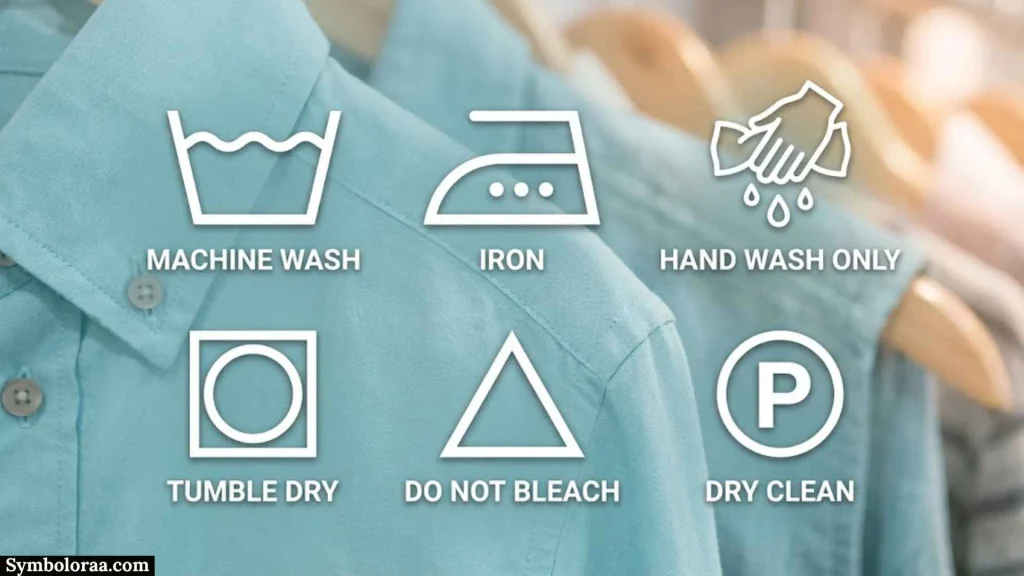
Do not stop after finding the washer symbol.
Use the complete sequence.
Step 1: Identify the Washing Method
Ask:
- Machine wash?
- Hand wash?
- Do not wash?
- What temperature?
- Is reduced mechanical action required?
Step 2: Check Bleaching Instructions
Look for the triangle.
Determine whether:
- Bleaching is allowed
- Only a specific type of bleach is permitted
- Bleaching is prohibited
Step 3: Identify the Drying Method
Look for the square.
Ask:
- Can it be tumble dried?
- What heat level is allowed?
- Is air-only drying required?
- Does it need natural drying?
Step 4: Check for Special Natural-Drying Instructions
If tumble drying is not appropriate, look for:
- Line dry
- Drip dry
- Dry flat
- Dry in shade
Step 5: Check the Iron
Determine whether ironing is permitted and whether a low, medium, or high temperature is specified.
Step 6: Check Professional Cleaning
If a circle appears, determine what professional-cleaning instruction applies.
Step 7: Look for Written Warnings
Written instructions can provide information that symbols alone do not fully communicate, such as:
- Wash separately
- Wash with like colors
- Do not wring
- Wash inside out
- Remove promptly
- Use a pressing cloth
The FTC requires covered care labels to provide appropriate regular-care instructions and warnings where a reasonably expected treatment could damage the product.
Real-Life Examples: How to Interpret Washer and Dryer Symbols
The fastest way to understand care symbols is to see how they affect actual laundry decisions.
Example 1: A Polyester Sports Shirt
Imagine a sports shirt labeled:
30°C wash → Do not bleach → Low-heat tumble dry
The practical instructions are:
- Select a wash temperature no higher than 30°C.
- Use an appropriate cycle for the garment.
- Do not use bleach.
- Select low heat if tumble drying.
- Avoid assuming that a hotter dryer will make it dry better simply because the fabric is synthetic.
Example 2: A Knitted Wool Sweater
Suppose the label says:
Hand wash → Do not bleach → Dry flat → Low-temperature iron
The correct approach is very different from the sports shirt:
- Wash by hand.
- Avoid bleach.
- Do not hang the wet sweater on a hanger.
- Dry it flat.
- Use only the permitted ironing temperature if ironing is needed.
The drying method is particularly important because wet knitted garments can lose their shape.
Example 3: A Shirt That Is Machine Washable but Not Dryer Safe
Imagine the label says:
40°C wash → Do not tumble dry → Iron low
The shirt can go into the washing machine, but the dryer is not part of the approved care process.
After washing, use the specified natural-drying method or the method recommended by the garment manufacturer.
This is one of the most important distinctions in laundry care:
Washable does not automatically mean dryer-safe.
Example 4: A Delicate Blouse
Suppose a blouse has:
30°C + gentle treatment → Do not tumble dry → Dry in shade
Simply selecting “30°C Normal” may not be enough.
The temperature is correct, but the mechanical treatment may be too aggressive.
A gentler cycle followed by the specified natural drying method is more appropriate.
Example 5: A Garment With a Missing Label
If the care label has been removed and you cannot confirm the manufacturer’s instructions, avoid automatically choosing:
- Hot water
- High spin
- High dryer heat
- Strong bleach
Instead, consider the garment’s construction and fiber content and use a conservative treatment until reliable care instructions can be found.
Washer and Dryer Symbols by Fabric Type
Fabric names can provide clues, but the actual care label should take priority.
Cotton
Cotton garments can have very different care requirements.
A lightweight printed cotton shirt may need different treatment from a heavy cotton towel or a structured cotton garment.
Do not choose a temperature based only on the word “cotton.”
Wool
Wool is often sensitive to heat, agitation, and incorrect drying.
If the label specifies hand washing, a wool or delicate program, or flat drying, those instructions are important.
Polyester
Polyester can usually tolerate machine washing, but some garments have restricted dryer temperatures.
Performance clothing may also have special instructions intended to protect its construction or finishes.
Rayon and Viscose
Rayon and viscose garments can be more vulnerable to distortion or changes in shape.
Do not rely on a generic “synthetic” setting unless it is consistent with the garment’s label.
Denim
Denim can be durable, but the presence of stretch fibers, special dyes, coatings, prints, or finishes can change its care requirements.
Follow the specific label rather than assuming every pair of jeans should be treated identically.
Knits
Knitted garments deserve particular attention during drying.
If the label says dry flat, do not substitute hanging simply because hanging is faster.
Garments With Elastic
Items containing elastic components can be particularly sensitive to excessive heat.
If the label restricts dryer temperature, follow that instruction rather than treating the garment as heat-resistant because its main fabric appears durable.
What Happens When You Ignore a Washer or Dryer Symbol?
Incorrect laundry treatment can produce different types of damage.
Shrinkage
Excessive heat or unsuitable washing conditions can cause some garments to shrink.
The risk depends on the fiber, construction, finishing, and treatment.
Stretching and Loss of Shape
Wet garments can stretch if they are hung when they should be dried flat.
Knits are especially important to handle carefully.
Color Fading or Bleeding
Temperature, detergent, bleach, and washing conditions can affect dyes.
Some garments may also carry instructions such as washing with like colors or separately.
Heat Damage
Excessive dryer heat can affect heat-sensitive fibers, elastic, prints, coatings, and other components.
Wrinkling
Some garments become heavily wrinkled if they remain inside a dryer after the cycle ends.
Where the care instructions call for prompt removal, follow that instruction.
Damage to Decorations
Sequins, beads, printed graphics, coatings, trims, and attached components can have different care requirements from the main fabric.
This is one reason professional care instructions consider the garment as a complete product rather than looking only at its main fiber.
The FTC notes that care instructions should account for components such as linings, trim, buttons, zippers, and other parts of the garment.
Common Washer and Dryer Symbol Mistakes
Mistake 1: Treating a Maximum Temperature as a Required Temperature
If a label allows 40°C, that does not mean every wash needs to use exactly 40°C.
A lower permitted treatment can sometimes be preferable.
Mistake 2: Assuming “Machine Wash” Means “Any Cycle”
Machine washing does not automatically mean that every cycle is appropriate.
A garment can require reduced mechanical action.
Mistake 3: Thinking “Low Heat” Is Safe When Tumble Drying Is Prohibited
It is not.
Do not tumble dry and tumble dry low are different instructions.
Mistake 4: Looking Only at the Wash Symbol
A garment can survive the washing process but be damaged during drying.
Always check both.
Mistake 5: Treating Dots as Universal Instructions
Dots have meaning within the symbol they appear in.
One dot in a dryer symbol and one dot in an iron symbol do not describe the same appliance treatment.
Mistake 6: Hanging Everything to Dry
Some garments need to be dried flat.
Hanging a heavy wet knit can distort its shape.
Mistake 7: Choosing the Appliance Program by Icon Alone
A washing machine may use proprietary icons that are not identical to standardized textile-care symbols.
Read the appliance manual when you are unsure what a program actually does.
Mistake 8: Ignoring Written Instructions
A label may contain both symbols and text.
Instructions such as wash separately, do not wring, or remove promptly can be just as important as the main symbols.
Washer and Dryer Symbols: International Standards and Regional Differences
Not every care-label system is identical worldwide.
ISO 3758:2023 is an international standard for textile care symbols. It covers domestic washing, bleaching, drying, ironing, and professional textile care.
In the United States, the Federal Trade Commission’s Care Labeling Rule governs care instructions for covered textile apparel and recognizes specific care terminology and symbol requirements. The FTC also explains that ASTM care symbols are similar to, but not identical with, ISO symbols.
Canada has its own textile-labeling framework and notes that its care-labeling program is harmonized with North American and ISO symbol systems.
This means that an unfamiliar symbol should not be interpreted purely from memory if the garment was manufactured for a different market.
When purchasing clothing internationally, check the manufacturer’s written instructions if a symbol is unclear.
Why Care Labels Matter More Than Guessing From Fabric
It is tempting to look at a garment and think:
“This feels like cotton, so I can wash it normally.”
That reasoning can fail because the final care requirement depends on more than the main fiber.
Manufacturers may need to consider:
- Dye
- Fabric construction
- Finishes
- Linings
- Elastic
- Buttons
- Zippers
- Prints
- Decorative components
- Multiple materials in the same garment
The FTC requires covered manufacturers and importers to have a reasonable basis for care information and notes that evidence may need to account for the garment as a whole and its component parts.
Expert tip: When the fabric name and care label appear to conflict, follow the garment’s specific care label unless the manufacturer provides a documented correction or updated instruction.
What If the Washer and Dryer Symbol Is Unclear?
If you cannot identify a symbol, use this process.
Identify the Base Shape
Ask whether it is:
- Tub
- Square
- Triangle
- Iron
- Circle
Look for Extra Markings
Check for:
- Numbers
- Dots
- Lines
- Crosses
- Hands
- Other internal markings
Read the Label From Left to Right
Many care labels present the main care stages in a logical sequence:
Washing → Bleaching → Drying → Ironing → Professional care
Check for Written Instructions
Look for words such as:
- Gentle
- Delicate
- Separately
- Like colors
- Do not wring
- Dry flat
- Wash inside out
Check the Manufacturer
If the symbol remains unclear, look up the garment’s care instructions from the manufacturer.
This is especially useful for expensive, technical, decorated, or delicate clothing.
A Simple Washer and Dryer Symbol Decision Tree
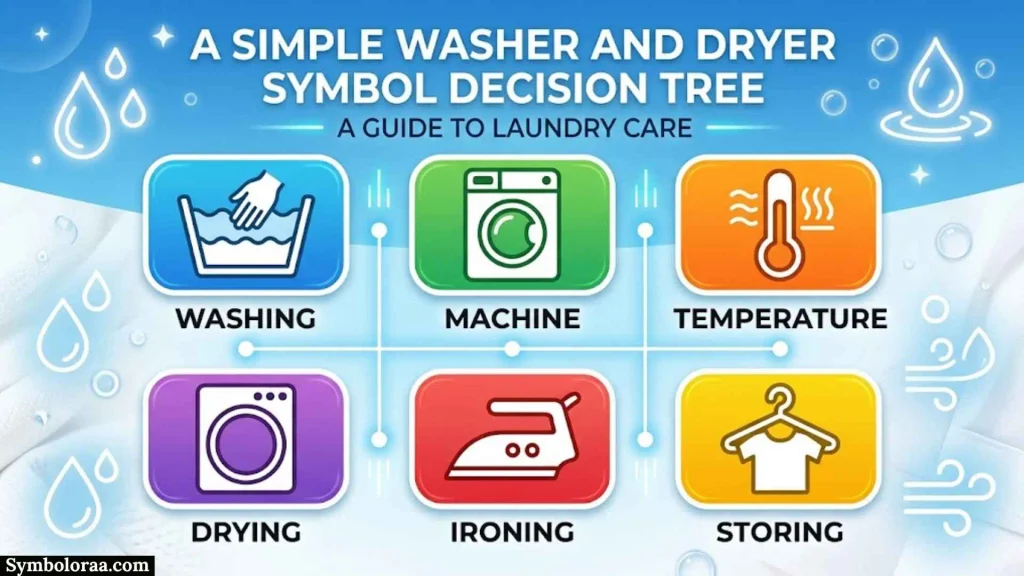
Use this quick decision guide before starting laundry.
Question 1: What is the main symbol?
Tub → Check washing instructions.
Square → Check drying instructions.
Triangle → Check bleaching instructions.
Iron → Check ironing instructions.
Circle → Check professional-cleaning instructions.
Question 2: Is there a cross?
Yes → Do not perform the treatment represented by that symbol.
No → Continue reading the remaining markings.
Question 3: Is there a number or temperature?
Yes → Do not exceed the stated maximum temperature.
No → Check whether dots or other markings define the treatment.
Question 4: Are there dots?
One → Usually lower temperature.
Two → Usually medium temperature.
Three → Usually higher temperature.
Always interpret dots in the context of the symbol they belong to.
Question 5: Are there lines?
Yes → Look for a gentler or reduced treatment.
Question 6: Does the dryer symbol permit tumble drying?
Yes → Match the permitted heat level.
No → Use the natural-drying method specified on the label.
Washer and Dryer Symbol Cheat Sheet
| Symbol Pattern | Meaning | Practical Action |
| Tub | Washing | Use the permitted washing method |
| Tub + temperature | Maximum wash temperature | Do not exceed the temperature |
| Hand in tub | Hand wash | Wash manually and gently |
| Crossed tub | Do not wash | Use the specified alternative |
| Tub + gentle markings | Reduced/gentle treatment | Choose an appropriate gentle cycle |
| Square + circle | Tumble dry | Use dryer if heat level permits |
| Dryer + 1 dot | Low heat | Select low heat |
| Dryer + 2 dots | Medium heat | Select medium heat |
| Dryer + 3 dots | High heat | Select high heat |
| Crossed dryer | Do not tumble dry | Air dry using the specified method |
| Square + horizontal line | Dry flat | Dry on a flat surface |
| Square + vertical lines | Drip/line drying | Follow the indicated natural-drying method |
| Shade marking | Dry in shade | Keep out of direct sunlight |
| Triangle | Bleaching | Check permitted bleach type |
| Crossed triangle | Do not bleach | Do not use bleach |
| Iron + dots | Ironing temperature | Match the iron temperature |
| Crossed iron | Do not iron | Avoid ironing |
| Circle | Professional care | Follow professional-cleaning instructions |
| Crossed circle | Do not use that professional treatment | Choose an approved alternative |
The 10 Laundry Symbols Worth Memorizing First
If you do not want to memorize every possible care symbol, start with these:
- Wash tub — washing
- Hand in tub — hand wash
- Crossed tub — do not wash
- Square with circle — tumble dry
- One dryer dot — low heat
- Two dryer dots — medium heat
- Three dryer dots — high heat
- Crossed dryer — do not tumble dry
- Iron — ironing
- Triangle — bleaching
Once these are familiar, the remaining markings become easier because you are mainly learning how dots, lines, and crosses modify the basic symbol.
Frequently Asked Questions About Washer and Dryer Symbols
What is the symbol for a washing machine?
The standard textile-care washing symbol is a wash tub. It can contain a temperature or other markings that modify the washing instruction.
What is the symbol for a dryer?
A square containing a circle represents tumble drying in common textile-care symbol systems.
What does a circle inside a square mean?
It generally means tumble dry. Dots inside the circle can specify the permitted heat level.
What does one dot mean in a dryer symbol?
One dot generally means low heat in the common tumble-drying symbol system.
What do two dots mean on a dryer?
Two dots generally indicate medium heat.
What do three dots mean on a dryer?
Three dots generally indicate high heat where the applicable symbol system uses three temperature levels.
What does a crossed-out dryer symbol mean?
It means do not tumble dry. Use the natural-drying method specified by the garment’s care instructions.
Can I put something in the dryer if it says machine wash?
Not necessarily. The washing and drying instructions are separate. A garment can be machine washable but unsuitable for tumble drying.
What does 30°C mean on a washer symbol?
It indicates a maximum washing temperature of 30°C under that care instruction.
Is 40°C hotter than 30°C?
Yes. A 40°C wash uses a higher maximum water temperature than a 30°C wash.
Does a gentle cycle mean cold water?
No. Gentle treatment and temperature are separate aspects of the care instruction. A garment can require gentle mechanical treatment at a specified temperature.
Can I use low heat if the label says do not tumble dry?
No. “Do not tumble dry” prohibits the tumble-drying treatment; switching to low heat does not automatically make it acceptable.
What does the hand-wash symbol mean?
It indicates that the garment should be hand washed rather than treated using the machine-washing process represented by a standard wash cycle.
What does a line under the wash tub mean?
It generally indicates a gentler or reduced treatment. The exact interpretation depends on the applicable care-symbol standard.
What does a crossed-out washing tub mean?
It means do not wash using the represented washing process.
What does a square with a horizontal line mean?
It indicates dry flat in the relevant textile-care symbol system.
What does a triangle mean on a clothing label?
A triangle relates to bleaching. Additional markings indicate whether bleaching is permitted or restricted.
What does a crossed-out triangle mean?
It means do not bleach.
What does the iron symbol mean?
It indicates ironing instructions. Dots inside the iron can specify the permitted temperature.
What does a circle mean on a clothing label?
A circle generally represents professional textile cleaning.
Are laundry symbols the same in every country?
No. International and regional systems are similar but can differ. ISO 3758:2023 provides an international system, while the United States has FTC requirements involving recognized care terminology and symbols.
Should I follow the fabric type or the care label?
When there is a conflict, the garment-specific care label is the better starting point because care instructions can account for construction, dyes, finishes, trims, and other components rather than only the main fiber.
What should I do if the care label is missing?
Avoid high heat and aggressive washing until you can establish reliable care instructions. Check the garment manufacturer’s website or product documentation when available.
Why does my washing machine symbol look different from my clothing label?
Because appliance manufacturers can use their own program icons. A washing-machine button is not necessarily the same standardized symbol used on a textile care label.
Use the clothing label to determine the required treatment and your appliance manual to understand which program provides that treatment.
Best Practices for Using Washer and Dryer Symbols
The easiest way to avoid laundry mistakes is to turn symbol reading into a routine.
Before Washing
Check:
- Washing temperature
- Machine or hand wash
- Gentle treatment
- Bleach restrictions
- Separate-wash instructions
- Color-related warnings
Before Drying
Check:
- Tumble dry permitted?
- Heat level?
- Air-only?
- Dry flat?
- Line dry?
- Shade dry?
Before Ironing
Check:
- Ironing permitted?
- Temperature?
- Special instructions?
Before Professional Cleaning
Check:
- Circle symbol
- Any letters or restrictions
- Any “do not” markings
When in Doubt
Choose the less aggressive treatment that is consistent with the label and seek manufacturer guidance for valuable or unusually delicate garments.
Why Care Symbols Are an Industry Standard, Not Just Decoration
Care symbols exist because consumers need consistent information about how textile products should be maintained.
ISO 3758:2023 establishes a formal graphical system for textile care information, while the FTC’s U.S. Care Labeling Rule requires covered manufacturers and importers to provide appropriate regular-care instructions and warnings.
The history of modern care labeling is therefore closely connected to consumer information and textile manufacturing rather than simply being a collection of laundry icons.
An important industry principle is that care instructions should have a reasonable basis. The FTC explains that manufacturers and importers must have reliable evidence supporting the care instructions they provide.
That is why a garment’s care label is more reliable than a generic rule such as “all cotton can be washed hot.”
Key Takeaways
The most useful way to understand washer and dryer symbols is to learn the basic shapes first and then understand how dots, lines, numbers, and crosses modify them.
- Tub = washing
- Hand in tub = hand washing
- Crossed tub = do not wash
- Square = drying
- Square with circle = tumble drying
- One dryer dot = low heat
- Two dryer dots = medium heat
- Three dryer dots = high heat
- Crossed dryer = do not tumble dry
- Horizontal line = dry flat
- Triangle = bleaching
- Iron = ironing
- Circle = professional textile care
Most importantly, do not treat washing and drying as one instruction. A garment can be perfectly safe to wash in a machine but unsuitable for a tumble dryer.
Likewise, the temperature is only part of the instruction. Mechanical action, drying method, bleaching, ironing, and professional care can all affect the final result.
Final Laundry Care Checklist
Before starting a load, ask:
- What does the wash symbol say?
- What is the maximum wash temperature?
- Does the garment require hand washing?
- Is a gentle or delicate treatment required?
- Can bleach be used?
- Can the item be tumble dried?
- What dryer heat is allowed?
- Does it need air or natural drying?
- Should it be dried flat?
- Should it dry in the shade?
- Can it be ironed?
- What ironing temperature is allowed?
- Is professional cleaning required?
- Are there written warnings such as “wash separately”?
- Is any symbol crossed out?
If you can answer these questions, you can interpret most everyday clothing care labels without guessing.
Conclusion
Understanding washer and dryer symbols makes it much easier to care for your clothes correctly. These symbols tell you how to wash, dry, bleach, iron, and care for different fabrics, helping you avoid common problems such as shrinking, fading, stretching, and fabric damage. Before putting any garment in the washer or dryer, always check its care label and follow the recommended symbols. With a basic understanding of these laundry symbols, you can protect your clothes, improve their lifespan, and make your laundry routine easier and more effective.

I’m Jackson Miller, an American author inspired by mystery, adventure, and the unpredictable nature of life. I enjoy writing fast-moving stories filled with memorable characters, unexpected choices, and meaningful moments. Through my books, I want readers to experience new worlds while discovering something about courage, determination, and themselves.
Three Books:
The Edge of Tomorrow
Under a Broken Sky
The Road We Chose
 Madison Reed