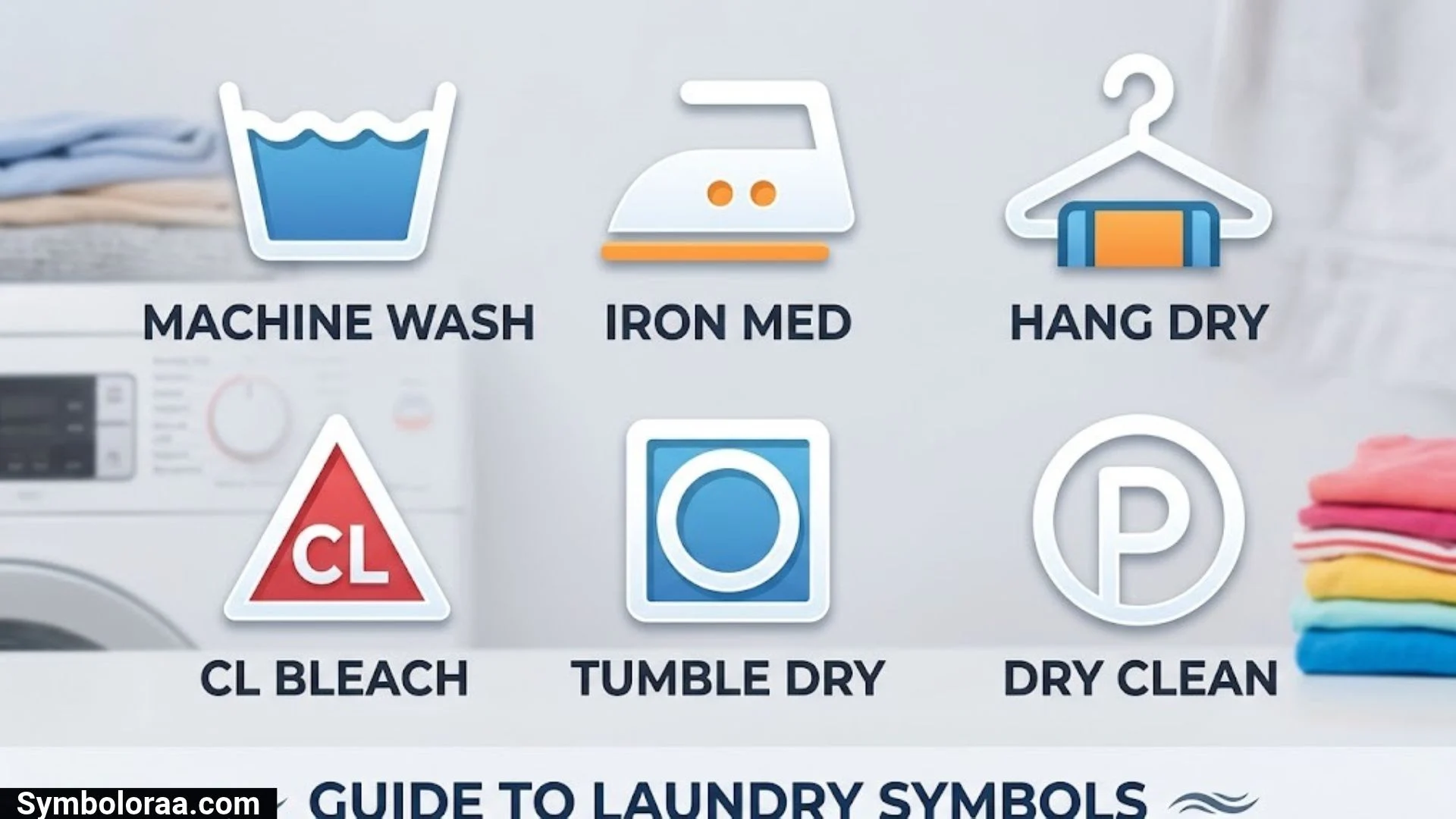
Laundry symbols meanings can help you wash, dry, iron, and care for your clothes correctly. Those small icons on clothing labels provide essential instructions that prevent shrinking, fading, stretching, and fabric damage. Once you understand what each symbol means, doing laundry becomes easier and safer.
However, not every garment can handle the same washing temperature, detergent, or drying method. Cotton shirts, wool sweaters, silk blouses, and synthetic sportswear all have different care requirements. Following the right laundry symbols helps you protect your clothes and extend their lifespan.
This guide explains the most common washing symbols, drying symbols, bleaching symbols, ironing symbols, and dry-cleaning symbols. You’ll also learn how to read clothing care labels, understand temperature settings, and avoid common laundry mistakes.
Quick Guide to Laundry Symbols Meanings
The easiest way to understand laundry symbols is to recognize the basic shapes. Each shape represents a different type of clothing-care instruction.
| Symbol Shape | Meaning | What You Should Do |
| Washtub | Washing instructions | Check the temperature and washing method |
| Triangle | Bleaching instructions | Determine whether bleach is safe |
| Square | Drying instructions | Check tumble-drying or natural-drying guidance |
| Iron | Ironing instructions | Follow the recommended heat setting |
| Circle | Professional cleaning | Check dry-cleaning or wet-cleaning instructions |
| Crossed-Out Symbol | Prohibited treatment | Avoid the indicated cleaning method |
| Dots | Temperature or heat level | Follow the recommended heat setting |
| Lines Beneath a Symbol | Gentler treatment | Use reduced mechanical action or a delicate cycle |
Remember: A symbol’s shape tells you the type of instruction, while its dots, lines, numbers, and markings provide additional details.
What Are Laundry Symbols?
Laundry symbols are standardized pictograms printed on clothing care labels. They communicate how to clean and maintain garments without relying entirely on written instructions.
Manufacturers use these symbols to help consumers choose suitable washing, bleaching, drying, ironing, and professional-cleaning methods. The symbols are especially useful when clothing is sold internationally or when the wearer speaks a different language.
The international care-labeling system is associated with ISO 3758, which defines symbols for textile care. Different countries and labeling systems may use slightly different designs, so a symbol’s appearance can vary by market.
For example, some care labels show a number inside a washing tub to indicate the maximum recommended water temperature. Other systems may use dots or different graphical conventions.
Why Laundry Symbols Matter
Care labels help you make better decisions before you wash a garment. Ignoring them can lead to damage that is difficult or impossible to reverse.
Following the correct instructions can help you:
- Prevent shrinkage: High temperatures can shrink certain fabrics, especially wool and some cotton garments.
- Protect colors: Suitable washing temperatures and detergents help reduce fading and color transfer.
- Maintain fabric shape: Gentle washing and drying reduce stretching and distortion.
- Avoid heat damage: Appropriate dryer and iron settings protect delicate fibers.
- Preserve special finishes: Certain garments contain coatings, prints, adhesives, or decorative details that require extra care.
- Extend clothing life: Proper cleaning helps garments retain their appearance and fit.
A care label isn’t merely a suggestion. It provides practical guidance based on the garment’s materials and construction.
How to Read Laundry Symbols on Clothing Labels
Before interpreting individual symbols, learn how their basic features work. A small detail can change the recommended treatment considerably.
Understand the Five Main Symbol Categories
Most standard care labels use five primary categories.
- Washing: A washtub indicates how to wash the garment.
- Bleaching: A triangle explains whether bleach is permitted.
- Drying: A square provides drying instructions.
- Ironing: An iron symbol indicates whether ironing is allowed and which temperature to use.
- Professional Care: A circle communicates instructions for professional dry cleaning or wet cleaning.
Read all the symbols before starting your laundry. A garment might be safe to wash in cold water but unsuitable for tumble drying.
What Do Dots Mean on Laundry Symbols?
Dots generally indicate a temperature or heat level. Their exact meaning depends on the symbol and labeling system.
For example, dots inside an iron represent ironing temperature. Dots inside a tumble-drying symbol indicate the permitted dryer heat level.
In many common care-label systems, fewer dots indicate lower heat, while more dots indicate higher heat.
| Dot Count | General Meaning |
| One Dot | Low heat |
| Two Dots | Medium heat |
| Three Dots | High heat |
Always interpret dots within the specific symbol. Don’t assume that a dot means the same temperature across every category.
What Do Lines Beneath Laundry Symbols Mean?
Horizontal lines beneath a washing tub indicate a gentler washing process in the ISO-style system.
- No Line: Normal washing action is generally permitted within the stated limits.
- One Line: Use a mild process with reduced mechanical action.
- Two Lines: Use a very mild process with extra-gentle handling.
These instructions matter for delicate fabrics, wool garments, and items that can lose their shape during aggressive washing.
What Does a Crossed-Out Laundry Symbol Mean?
A cross over a symbol means you should not use the treatment shown.
For example:
- A crossed-out washing tub means do not wash using the indicated washing method.
- A crossed-out triangle means do not bleach.
- A crossed-out square with a circle means do not tumble dry.
- A crossed-out iron means do not iron.
- A crossed-out circle can indicate that professional dry cleaning is prohibited.
Never ignore a prohibition symbol simply because a garment looks sturdy.
Where Can You Find Clothing Care Labels?
Care labels are commonly sewn into the following locations:
- Inside the side seam of shirts, dresses, and trousers.
- Along the waistband of pants and skirts.
- Inside the neckline of tops.
- Along an interior seam of sweaters and jackets.
- On a label attached to bedding, towels, or other household textiles.
Some garments contain several labels. One may list fiber content, while another provides washing and drying instructions.
If a label becomes unreadable, check the manufacturer’s website or product documentation when available. Avoid guessing when the garment is expensive, delicate, or difficult to replace.
Washing Symbols and Their Meanings
The washing symbol usually looks like a washtub filled with water. It tells you whether the garment can be washed and provides information about the appropriate temperature and washing intensity.
Washing Tub With a Number
A number inside the tub indicates the maximum washing temperature in the ISO-style system. It does not mean you must wash the garment at that temperature.
| Washing Temperature | Fahrenheit Equivalent | Typical Use |
| 30°C | 86°F | Delicate garments and color-sensitive fabrics |
| 40°C | 104°F | Many everyday garments, depending on fabric and detergent |
| 50°C | 122°F | Selected items that permit warmer washing |
| 60°C | 140°F | Certain durable textiles that allow hot washing |
| 95°C | 203°F | Limited items designed to withstand very high temperatures |
These temperatures are examples of common care-label values, not universal recommendations for every garment.
Always follow the maximum temperature shown on the label. A lower temperature may be suitable when it cleans the garment effectively and meets the care requirements.
Hand-Washing Symbol
A washing tub with a hand indicates that the garment requires hand washing.
This instruction commonly appears on delicate clothing, including certain wool sweaters, silk garments, and embellished items.
To hand wash safely:
- Fill a clean basin with water at the recommended temperature.
- Add a suitable detergent in the correct amount.
- Submerge the garment and gently move it through the water.
- Avoid twisting, stretching, or aggressively rubbing the fabric.
- Rinse carefully until the detergent is removed.
- Press out excess water without wringing.
- Dry the garment according to its drying symbol.
Some garments marked for hand washing may also require a specific wool or delicate detergent. Check the product label before use.
Do Not Wash Symbol
A crossed-out washing tub means the garment should not be washed using the indicated method.
This instruction may appear on items with sensitive construction, special coatings, or materials that could deteriorate in water.
However, do not wash doesn’t automatically mean every garment requires dry cleaning. Check the complete label for professional-care instructions. If the label is unclear, consult the manufacturer or a qualified cleaner.
Washing Symbols With One or Two Lines
Lines beneath the tub indicate a reduced level of mechanical action.
A single line generally means a mild washing process. Two lines indicate a very mild process designed for particularly delicate items.
Use the appropriate machine setting when available. A gentle cycle, low spin speed, and a suitable detergent can help reduce unnecessary stress on the fabric.
How to Choose the Right Washing Machine Cycle
Choose a cycle based on the care label rather than appearance alone.
- Normal Cycle: Suitable for garments that permit regular washing action.
- Permanent Press: Often uses a gentler process and reduced creasing, depending on the machine.
- Delicate Cycle: Suitable for many fragile fabrics that permit machine washing.
- Wool Cycle: Designed for compatible wool garments, although not every wool item is machine washable.
- Hand-Wash Cycle: May provide gentle agitation, but you should use it only when the label permits machine washing.
Your machine’s cycle names and performance can vary. Read the garment label and your appliance manual before selecting a setting.
Bleaching Symbols and Their Meanings

The triangle represents bleaching instructions. It tells you whether bleach is allowed and, in some systems, which type is suitable.
Bleach can help remove certain stains and brighten compatible fabrics. However, the wrong product can weaken fibers, discolor garments, or damage decorative finishes.
Empty Triangle
An empty triangle generally indicates that bleaching is permitted under the applicable care-label system.
It doesn’t mean every bleach product is suitable. Always check the bleach manufacturer’s instructions and the garment’s other care requirements.
Triangle With Two Diagonal Lines
A triangle with two diagonal lines generally permits oxygen-based or non-chlorine bleach only.
Oxygen bleach is used in many laundry products for stain removal and color-safe cleaning. Suitability still depends on the fabric, dye, and product formulation.
Crossed-Out Triangle
A crossed-out triangle means do not bleach.
Avoid chlorine bleach and other bleaching products unless the garment manufacturer explicitly provides different guidance. Even products marketed as color-safe can cause problems with sensitive dyes or finishes.
How to Use Bleach Safely
Follow these precautions whenever bleaching is permitted:
- Read both the clothing label and the bleach product instructions.
- Use only the type of bleach permitted by the care label.
- Measure the product according to its directions.
- Never pour concentrated bleach directly onto clothing.
- Never mix chlorine bleach with ammonia, acids, or other cleaning products.
- Test a hidden area when the product instructions recommend testing.
Bleaching is not necessary for every stain. For many everyday marks, a suitable detergent and prompt treatment provide a better starting point.
Drying Symbols and Their Meanings
The square represents drying instructions. A square containing a circle indicates tumble drying in common international care-label systems.
Drying symbols help you avoid excessive heat, unwanted shrinkage, fabric distortion, and damage to delicate trims.
Square With a Circle
A square with a circle generally indicates that tumble drying is permitted. Dots inside the circle specify the allowed heat level.
| Drying Symbol | Meaning | Recommended Action |
| Square With Circle | Tumble drying permitted | Follow the indicated heat level |
| Square With Circle and One Dot | Low heat | Use a low-temperature setting |
| Square With Circle and Two Dots | Medium heat | Use medium heat when permitted |
| Square With Circle and Three Dots | High heat | Use high heat only when explicitly permitted |
| Crossed-Out Square With Circle | Do not tumble dry | Choose an allowed alternative |
Symbol details can vary across labeling systems. Check the actual care label rather than relying on a generic chart alone.
Do Not Tumble Dry Symbol
A crossed-out square containing a circle means you should not tumble dry the garment.
High heat and repeated tumbling can shrink certain fabrics, damage elastic, distort prints, and harm delicate decorations.
Instead, follow any permitted natural-drying instructions on the label.
Natural Drying Symbols
Natural-drying instructions appear as markings within a square. Their exact interpretation depends on the symbol design.
Common forms include:
- Line Hanging: Hang the garment to dry when the label indicates this method.
- Drip Drying: Allow water to drip from the garment rather than using a forceful spin or wringing.
- Flat Drying: Place the garment flat on a suitable surface to help preserve its shape.
- Shade Drying: Keep the garment away from direct sunlight when the symbol specifies shade.
Flat drying is especially useful for some knitwear because wet fibers can stretch under their own weight.
How to Dry Clothes Without Damaging Them
A few practical habits can help protect your clothing.
- Check the drying symbol before placing anything in the dryer.
- Separate garments that require different heat settings.
- Avoid overloading the dryer.
- Remove compatible items promptly to reduce creasing.
- Reshape delicate garments before air drying.
- Keep garments away from direct sunlight when their care instructions call for shade.
When you’re uncertain, choose a permitted lower-heat or natural-drying method rather than exposing the garment to excessive heat.
Ironing Symbols and Their Meanings

The iron symbol indicates whether ironing is permitted and helps you choose an appropriate temperature.
Heat affects different fibers in different ways. Excessive temperature can flatten texture, melt synthetic fibers, create shiny marks, or leave permanent scorch damage.
One-Dot Iron Symbol
One dot indicates a low ironing temperature.
This setting is commonly associated with heat-sensitive materials and some synthetic fabrics. The exact permitted temperature depends on the applicable labeling system.
Two-Dot Iron Symbol
Two dots indicate a medium ironing temperature.
This setting may suit certain fabrics that tolerate moderate heat. Always check the label and test a hidden area if the manufacturer recommends doing so.
Three-Dot Iron Symbol
Three dots indicate a high ironing temperature.
This level is intended for garments that can withstand higher heat. Never assume a cotton-looking fabric automatically permits the highest setting, especially when it contains synthetic fibers or decorative finishes.
Crossed-Out Iron Symbol
A crossed-out iron means do not iron.
Some garments can be damaged by direct heat, including certain coated fabrics, heat-sensitive prints, and materials with special finishes.
Use an approved alternative, such as careful steaming, only when the garment’s care instructions permit it.
Ironing Tips for Better Results
- Start with the lowest suitable temperature.
- Check the garment label before using steam.
- Turn suitable garments inside out to help protect the outer surface.
- Place a pressing cloth over sensitive materials when appropriate.
- Avoid leaving a hot iron in one place.
- Let the garment cool before folding or hanging it.
Always follow the iron manufacturer’s instructions as well as the garment label.
Dry-Cleaning Symbols and Professional Care Instructions

A circle commonly represents professional cleaning. Letters inside the circle provide information about the permitted cleaning process.
These instructions matter because professional cleaners use different solvents and methods. A garment suitable for one process may not tolerate another.
Circle With the Letter P
A circle containing P generally indicates that professional dry cleaning is permitted under specified process conditions.
The letter helps the cleaner identify the applicable solvent and process requirements. It isn’t an instruction for home washing.
Circle With the Letter F
A circle containing F generally indicates a specified professional dry-cleaning process using permitted hydrocarbon solvents.
The exact conditions depend on the relevant care-labeling standard and professional equipment.
Circle With the Letter W
A circle containing W indicates professional wet cleaning in applicable care-label systems.
Professional wet cleaning differs from ordinary household washing. It uses controlled water-based cleaning methods, specialized equipment, and trained handling.
Crossed-Out Circle
A crossed-out circle generally means that the indicated professional dry-cleaning treatment is not permitted.
Check the rest of the label before choosing another method. A garment that cannot be dry cleaned may still have specific washing or other care instructions.
Should You Dry-Clean Every Delicate Garment?
No. The correct treatment depends on the garment’s complete care label.
Some delicate items can be hand washed, while others require professional care. The fabric alone doesn’t always determine the safest method because linings, dyes, adhesives, and decorative details also affect cleaning.
When a garment is valuable or the instructions are unclear, ask a professional cleaner before proceeding.
Laundry Symbols for Common Fabrics
Different fibers respond differently to water, detergent, agitation, and heat. Use the fabric name as helpful context, but let the care label guide the final decision.
| Fabric | Common Care Considerations | What to Check |
| Cotton | May shrink or fade under unsuitable conditions | Washing temperature and dryer permission |
| Wool | Can shrink, felt, or lose shape | Wool-cycle, hand-wash, and flat-drying instructions |
| Silk | Can be sensitive to water, friction, and heat | Washing method and ironing temperature |
| Polyester | May be heat-sensitive despite its durability | Dryer and iron settings |
| Linen | Can wrinkle and may shrink | Washing temperature and drying method |
| Lace | Can snag or distort | Gentle washing and drying instructions |
| Knitwear | Can stretch when wet | Flat-drying instructions |
| Embellished Clothing | Decorations may loosen or become damaged | Washing, ironing, and professional-care instructions |
Cotton Clothing
Cotton is widely used in T-shirts, shirts, towels, and bedding. However, cotton garments don’t all share the same care requirements.
Some cotton items tolerate warmer water, while others may shrink, fade, or lose their finish. Blended cotton fabrics can behave differently from pure cotton.
Check the washing temperature, bleaching instructions, and drying symbol before laundering.
Wool Garments
Wool fibers can shrink or felt when exposed to unsuitable combinations of moisture, heat, and agitation.
Some wool garments permit machine washing on a specific wool cycle. Others require hand washing or professional care.
If the label allows flat drying, reshape the garment and lay it on a clean, dry surface. Avoid hanging heavy, wet knitwear because its weight may stretch the fibers.
Silk Clothing
Silk can be sensitive to rough handling, unsuitable detergents, and excessive heat.
Some silk garments permit hand washing, while others require professional cleaning. Don’t assume that every silk item needs the same treatment.
Follow the label carefully, and avoid twisting wet silk to remove water.
Polyester and Synthetic Fabrics
Polyester is often durable and easy to maintain, but heat can still damage it.
High dryer temperatures may affect the fabric’s finish, while a hot iron can melt or leave marks on some synthetic materials.
Use the temperature and drying settings permitted by the care label.
Linen Clothing
Linen is known for its breathable texture and tendency to wrinkle.
Some linen garments tolerate regular washing, while structured pieces may need special handling. Linings, dyes, and blends can change their care requirements.
Check the label before choosing a washing temperature or ironing setting.
Common Laundry Symbol Mistakes to Avoid
Even experienced laundry users can misread care labels. These common mistakes can damage garments unnecessarily.
Assuming Every Washing Tub Means Machine Washing
A washing tub can provide temperature and washing-method information, but a hand symbol or other marking can change the instruction.
Read the complete symbol before choosing a machine cycle.
Treating the Maximum Temperature as the Best Temperature
A number in a washing tub indicates the maximum permitted temperature in the relevant ISO-style system. It doesn’t mean that temperature is required.
A lower temperature may be appropriate if it cleans the garment effectively.
Ignoring the Lines Beneath a Symbol
Lines indicate a gentler washing process. Ignoring them can expose delicate garments to excessive mechanical action.
Choose a suitable mild or very mild cycle when available.
Using Bleach on Every White Garment
White clothing isn’t automatically bleach-safe. Some white fabrics contain finishes, fibers, or decorations that bleach can damage.
Check the triangle symbol before using any bleaching product.
Putting Every Garment in the Dryer
Tumble drying can shrink or distort certain garments. Others require flat drying, line drying, or another method.
Check the square symbol before starting the dryer.
Ironing Without Checking the Heat Setting
A hot iron can damage synthetic fibers, prints, and delicate fabrics.
Start with the recommended temperature and never exceed the garment’s permitted setting.
Assuming All Countries Use Identical Symbols
Care-label designs can vary between markets and standards. A chart based on one system may not explain every label correctly.
Use the manufacturer’s guidance when a symbol doesn’t match a familiar chart.
What Happens When You Ignore Laundry Symbols?
Ignoring care instructions can cause several types of damage.
- Shrinkage: A garment may become too small after unsuitable washing or drying.
- Color Fading: Incorrect temperatures, bleach, or harsh cleaning products can affect dyes.
- Stretching: Heavy wet garments may lose their shape if handled incorrectly.
- Fabric Damage: Excessive heat and agitation can weaken fibers.
- Surface Damage: Prints, coatings, and embellishments may crack, peel, or detach.
- Permanent Iron Marks: Excessive heat can leave shiny or scorched areas.
- Unnecessary Cleaning Costs: Improper home treatment can make professional restoration more difficult.
Not every mistake causes immediate damage. Repeated exposure to unsuitable conditions can gradually shorten a garment’s useful life.
A Simple Routine for Reading Laundry Care Labels
You don’t need to memorize every laundry symbol. Follow a consistent routine before washing a load.
Step One: Check the Washing Symbol
Determine whether the garment can be washed and identify the permitted temperature or washing method.
Step Two: Check the Bleaching Symbol
Confirm whether bleach is allowed. If the label prohibits it, choose another stain-removal method.
Step Three: Check the Drying Symbol
Decide whether the garment can go into the dryer or needs natural drying.
Step Four: Check the Ironing Symbol
Identify the permitted heat level or confirm that ironing isn’t allowed.
Step Five: Check Professional-Care Instructions
Look for any dry-cleaning or professional wet-cleaning requirements.
Step Six: Sort Your Laundry
Separate garments according to color, fabric, soil level, and care requirements. Don’t rely on color alone.
Step Seven: Choose Suitable Products and Settings
Use an appropriate detergent and follow the washing machine or dryer’s instructions.
This routine takes only a few moments, yet it can prevent many common laundry problems.
Example: How to Read a Clothing Care Label
Imagine a shirt has the following instructions:
- Washing tub marked 30°C.
- Triangle crossed out.
- Square with a circle crossed out.
- Iron with one dot.
- Circle with a professional-cleaning instruction.
Here’s how you would interpret those markings:
| Label Instruction | Meaning | Practical Action |
| 30°C Washing Tub | Maximum washing temperature is 30°C in this system | Use a suitable cycle at or below the stated temperature |
| Crossed-Out Triangle | Do not bleach | Avoid bleaching products |
| Crossed-Out Tumble-Drying Symbol | Do not tumble dry | Use an allowed natural-drying method |
| One-Dot Iron | Low ironing temperature | Use a low setting if ironing is permitted |
| Professional-Care Symbol | Follow the specified professional-cleaning process | Check the letter and any additional markings |
This example illustrates why you must read the entire label. A garment can permit washing while prohibiting bleach and tumble drying.
Frequently Asked Questions About Laundry Symbols
What do laundry symbols mean?
Laundry symbols explain how to wash, bleach, dry, iron, and professionally clean clothing. Their shapes identify the care category, while numbers, dots, lines, and crosses provide additional instructions.
Are laundry symbols the same worldwide?
No. Many countries use systems based on international standards, but symbol designs and conventions can differ. Always check the garment’s own label and consult the manufacturer when a symbol is unclear.
What does one dot mean on a laundry symbol?
One dot usually indicates a low temperature or heat level, depending on the symbol. For example, one dot inside an iron indicates low ironing heat in common care-label systems.
Can I ignore care labels?
It’s best not to ignore care labels. Incorrect washing, drying, bleaching, or ironing can cause shrinkage, fading, stretching, and permanent damage.
What symbol means do not wash?
A crossed-out washing tub generally means the garment must not undergo the indicated washing treatment. Check the complete label to determine whether professional cleaning or another method is required.
What does a square with a circle mean?
A square containing a circle generally represents tumble drying. Dots inside the circle indicate the permitted dryer heat level, while a cross means tumble drying isn’t allowed.
Why are laundry symbols used instead of words?
Laundry symbols communicate care instructions across languages. They provide a compact, recognizable way to explain garment-care requirements on small labels.
What happens if I use the wrong water temperature?
An unsuitable temperature can cause shrinkage, fading, color transfer, or damage to delicate fibers. Follow the temperature shown on the label, and don’t assume hotter water is always better.
Are dry-clean-only clothes always required to be dry cleaned?
Follow the complete care label rather than relying on the fabric name alone. If the label specifies professional cleaning, ask a qualified cleaner whether another safe method is available before attempting home washing.
What does a triangle mean on a clothing label?
A triangle represents bleaching instructions. An empty triangle generally permits bleaching, diagonal lines commonly restrict the instruction to non-chlorine bleach, and a crossed-out triangle means do not bleach.
What does a line under a washing symbol mean?
One line generally indicates a mild washing process with reduced mechanical action. Two lines indicate a very mild process. These markings are particularly important for delicate garments.
How can I remember laundry symbols easily?
Remember the five main shapes: tub for washing, triangle for bleaching, square for drying, iron for ironing, and circle for professional care. Then check the dots, lines, numbers, and crosses for specific instructions.
Final Thoughts on Laundry Symbols Meanings
Understanding laundry symbols meanings makes clothing care easier and helps you avoid preventable damage. The five main categories washing, bleaching, drying, ironing, and professional care provide a reliable starting point for reading almost any care label.
Pay attention to temperatures, dots, lines, and crossed-out symbols. These small details often determine whether a garment needs a normal wash, a gentle cycle, natural drying, or professional treatment.
Most importantly, don’t guess when a label is unclear. Check the manufacturer’s instructions, especially for expensive or delicate garments.
Once you become familiar with the most common laundry symbols and their meanings, you’ll spend less time worrying about washing mistakes and more time keeping your clothes clean, comfortable, and in good condition.

I’m Madison Reed, a contemporary American author who writes about love, family, friendship, and second chances. I’m fascinated by the choices that shape our lives and the moments that change us forever. My goal is to create honest, emotional stories with characters readers can connect with long after finishing each book.
Three Books:
When We Find Our Way
The Things We Never Said
Summer in September