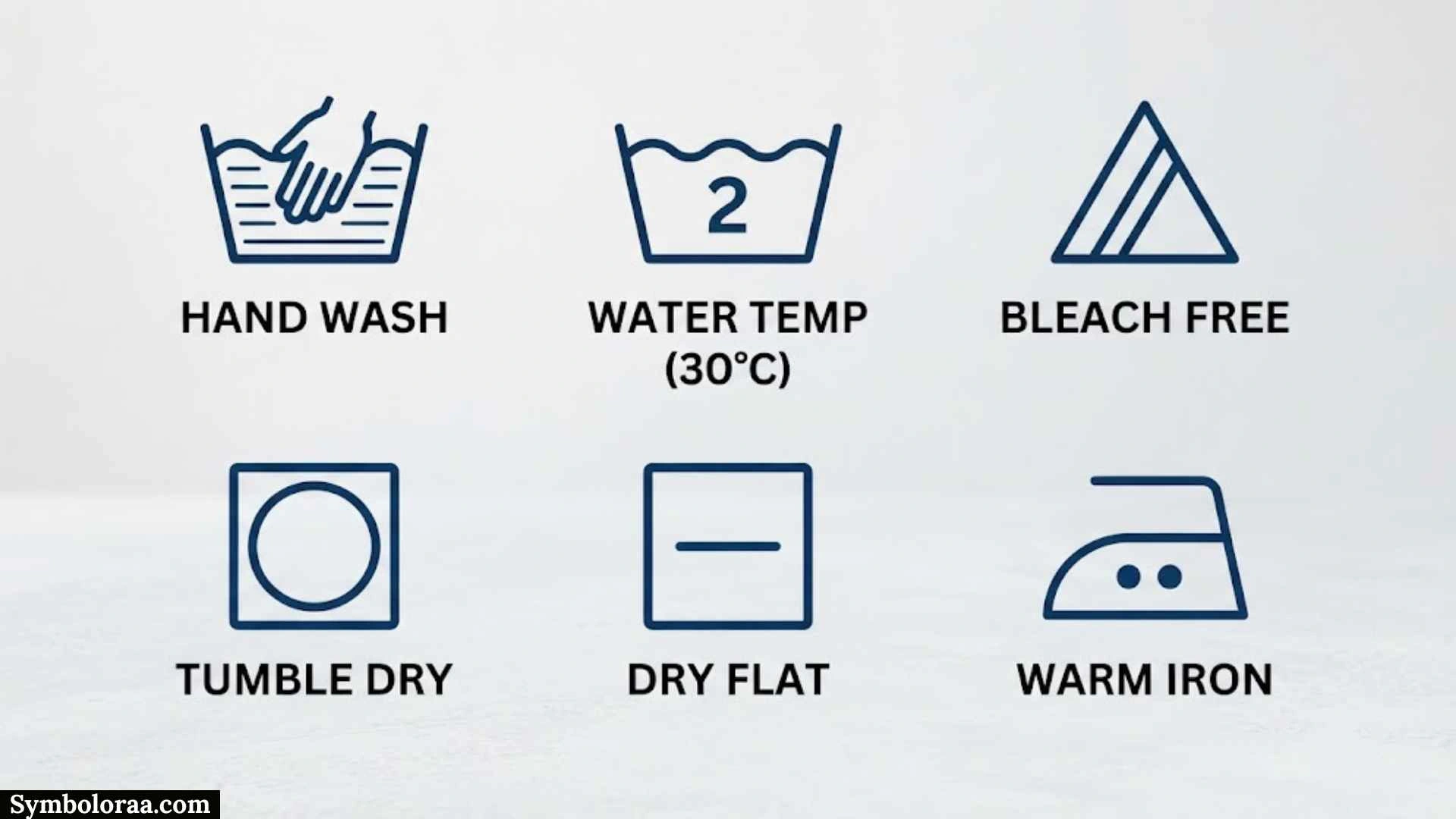
Laundry washing symbols are small but useful instructions found on clothing and textile care labels. The familiar tub, number, hand, lines, and crossed-out marks tell you how a garment should be washed and what treatment it can safely handle.
This guide explains laundry washing symbols and meanings, common washing temperatures, gentle-cycle markings, drying symbols, and the machine wash 30 symbols. It also includes practical laundry symbols charts so you can quickly identify what a care label is telling you.
You will also learn how to read laundry washing symbols in the UK, understand the difference between washing and drying instructions, and avoid common mistakes. The key is to read the complete symbol rather than focusing only on its main shape.
Laundry Washing Symbols Guide
Laundry care labels use a small group of standard pictograms to communicate textile-care instructions without relying on long written directions. Under the ISO 3758 care-labelling system, the main categories are washing, bleaching, drying, ironing, and professional textile care.
The washing symbol is a tub filled with water. A number inside the tub gives the maximum washing temperature in degrees Celsius. Lines underneath the tub can require a milder or very mild washing process.
Main Washing Symbols
| Symbol Description | Meaning |
| Tub with 30 | Wash at a maximum of 30°C |
| Tub with 40 | Wash at a maximum of 40°C |
| Tub with 60 | Wash at a maximum of 60°C |
| Tub with 95 | Wash at a maximum of 95°C |
| Hand inside tub | Hand wash |
| Tub with one line underneath | Use a mild washing process |
| Tub with two lines underneath | Use a very mild washing process |
| Crossed-out tub | Do not wash |
The symbols above are described in words so they remain easy to understand even when a particular device or font does not display a care pictogram correctly.
What Do The Numbers Mean?
The number inside the washing tub is a maximum temperature, not a command to wash at exactly that temperature. For example, a tub marked 30 means the washing temperature should not exceed 30°C.
This distinction is useful because people sometimes assume that a 40 symbol means the machine must reach exactly 40°C. The label is instead telling you the upper temperature limit for the recommended treatment.
What Do The Lines Under The Tub Mean?
The lines are easy to overlook, but they can change how the garment should be washed.
- No line: The standard washing treatment represented by the symbol is permitted.
- One line: Use a milder cycle with reduced mechanical action.
- Two lines: Use a very mild cycle with substantially reduced mechanical action.
- Cross through the tub: Do not wash.
GINETEX explains that the single bar indicates a milder process, while the double bar indicates a very mild process, such as one suitable for woollen articles.
Laundry Washing Symbols And Meanings
Knowing the basic shapes makes clothing labels much easier to understand. The washing tub is the starting point, but numbers, hands, bars, and crosses provide additional information.
Wash Symbols With Numbers
A numbered tub indicates the maximum permitted washing temperature.
- 30°C: Maximum washing temperature of 30°C.
- 40°C: Maximum washing temperature of 40°C.
- 60°C: Maximum washing temperature of 60°C.
- 70°C: Maximum washing temperature of 70°C where this symbol is specified.
- 95°C: Maximum washing temperature of 95°C.
Higher temperatures should never be chosen simply because you think they will clean clothes better. The care label identifies the maximum treatment the garment is designed to tolerate.
Hand Wash Symbol
A hand inside the washing tub means hand washing is required. This instruction is different from a normal machine-wash symbol.
When hand washing a delicate garment, avoid aggressive rubbing, pulling, and wringing. GINETEX’s care guidance specifically describes careful agitation and gentle handling for hand-wash items.
Do Not Wash Symbol
A crossed-out washing tub means do not wash. The garment should not receive domestic washing with water.
Do not interpret this symbol as simply meaning “use a colder wash.” It means washing itself is not an approved treatment. Check the rest of the label for professional-care instructions.
Mild And Very Mild Wash Symbols
A line or two lines beneath the tub indicate reduced mechanical action.
This matters for garments that may be sensitive to agitation. Even when the temperature is relatively low, a strong washing cycle can place more mechanical stress on a fabric than the care label permits.
A Useful Rule For Reading Symbols
Always read the washing symbol as a complete unit:
Shape + temperature + lines + cross = complete washing instruction
For example, a 30°C tub with two lines means something different from a plain 30°C tub. The temperature may be the same, but the required mechanical treatment is gentler.
Laundry Symbols Chart
The following laundry symbols chart provides a quick reference for common washing, bleaching, drying, ironing, and professional-care symbols.
| Care Symbol | Basic Meaning |
| Washing tub | Domestic washing information |
| Tub + 30 | Wash at maximum 30°C |
| Tub + 40 | Wash at maximum 40°C |
| Tub + 60 | Wash at maximum 60°C |
| Tub + 95 | Wash at maximum 95°C |
| Hand in tub | Hand wash |
| Tub + one line | Mild washing process |
| Tub + two lines | Very mild washing process |
| Crossed-out tub | Do not wash |
| Triangle | Bleaching information |
| Crossed-out triangle | Do not bleach |
| Square | Drying information |
| Square + circle | Tumble drying information |
| Crossed-out square + circle | Do not tumble dry |
| Iron | Ironing information |
| Crossed-out iron | Do not iron |
| Circle | Professional textile-care information |
The five basic care categories follow the familiar sequence of washing, bleaching, drying, ironing, and professional textile care.
How To Read A Complete Care Label
A clothing label can contain several symbols in a row. Do not stop after identifying the washing tub.
Use this simple sequence:
- Check the washing symbol for temperature and washing method.
- Check the bleach symbol before using bleach or whitening products.
- Check the drying symbol before placing the item in a dryer.
- Check the ironing symbol before applying heat.
- Check the professional-care symbol if the garment requires specialist cleaning.
This approach reduces the chance of treating a garment correctly during washing but damaging it during drying or ironing.
Machine Wash 30 Symbol
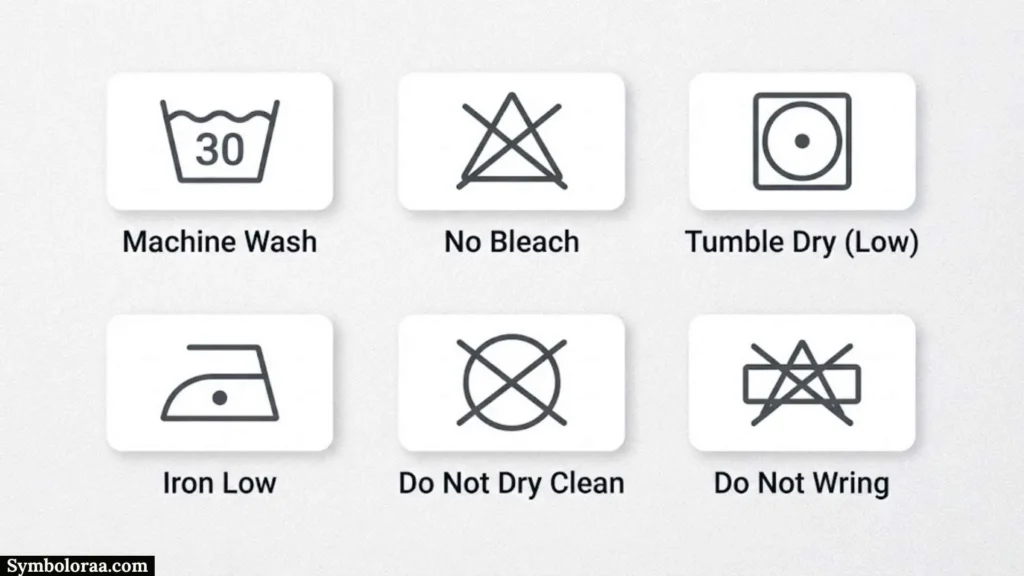
The machine wash 30 symbol is a washing tub containing the number 30. It means the maximum washing temperature is 30°C. The symbol does not, by itself, specify the exact washing-machine program or detergent to use.
What Does The 30°C Symbol Mean?
The 30°C mark tells you not to exceed 30°C during the indicated washing treatment. A lower temperature can be used where appropriate, because care-label systems describe maximum permitted treatment. GINETEX states that milder treatments and lower temperatures than those shown on a label are permitted.
For example:
Tub + 30 = Maximum wash temperature: 30°C
If you see a line underneath the tub, pay attention to that line as well. It indicates that the washing process should be milder.
Machine Wash 30 With One Line
A 30°C tub with one line underneath combines two instructions:
- Do not exceed 30°C.
- Use a mild washing process with reduced mechanical action.
A suitable gentle or easy-care program may be appropriate, depending on your washing machine and the garment’s fabric.
Machine Wash 30 With Two Lines
Two lines indicate a very mild treatment. This can be used for particularly sensitive textiles when the complete care label specifies it.
The important point is that 30°C describes temperature, while the lines describe the intensity of treatment. These are separate parts of the same care instruction.
Can You Wash At 20°C?
If the label allows washing at a maximum of 30°C, a lower-temperature program can generally be used because a lower temperature is a milder treatment. However, the machine program should still provide the appropriate mechanical action for the garment.
Drying Symbols For Laundry
Washing and drying are separate parts of clothing care. A garment may be safe to wash at 30°C but unsuitable for tumble drying, so checking the drying symbol is essential.
The basic drying symbol is a square. A circle inside the square indicates tumble drying, while different lines inside or around the square can describe natural drying methods.
Tumble Drying Symbols
A square containing a circle represents tumble drying.
Common variations include:
| Symbol Description | Meaning |
| Square with circle | Tumble drying is permitted |
| Square with circle and one dot | Lower-temperature tumble drying |
| Square with circle and two dots | Higher-temperature tumble drying |
| Crossed-out square with circle | Do not tumble dry |
The dots in the dryer symbol indicate the permitted temperature severity of the tumble-drying process.
Natural Drying Symbols
A square without a circle can provide information about natural drying.
Common forms include:
- Square with a vertical line: Line drying.
- Square with two vertical lines: Drip drying.
- Square with a horizontal line: Flat drying.
- Square with diagonal lines in the corner: Dry in the shade.
The exact combination of lines communicates the natural drying method. GINETEX describes vertical and horizontal lines as indicators of line, drip-line, flat, and drip-flat drying, while diagonal lines indicate drying in the shade.
Why Drying Instructions Matter
Heat and mechanical movement can affect some textiles differently from washing. A garment can therefore have a normal washing instruction but a restriction on tumble drying.
For example, if a label shows:
30°C wash + crossed-out tumble dryer
You can wash the item according to the washing instructions, but you should not put it in a tumble dryer.
Laundry Washing Symbols Chart
This second chart focuses on the symbols people are most likely to check while doing everyday laundry.
| Symbol | What To Look For | What It Means |
| Tub + 30 | Number 30 | Maximum wash temperature 30°C |
| Tub + 40 | Number 40 | Maximum wash temperature 40°C |
| Tub + 60 | Number 60 | Maximum wash temperature 60°C |
| Tub + hand | Hand | Hand wash |
| Tub + one bar | One line | Mild process |
| Tub + two bars | Two lines | Very mild process |
| Crossed tub | X | Do not wash |
| Square + circle | Circle inside square | Tumble dry |
| Square + circle + dots | Dots | Tumble-dry temperature level |
| Crossed square + circle | X | Do not tumble dry |
| Square + vertical line | Vertical line | Line dry |
| Square + horizontal line | Horizontal line | Dry flat |
| Triangle | Triangle | Bleaching information |
| Iron + dots | Dots | Ironing temperature level |
| Crossed iron | X | Do not iron |
Washing Versus Drying Symbols
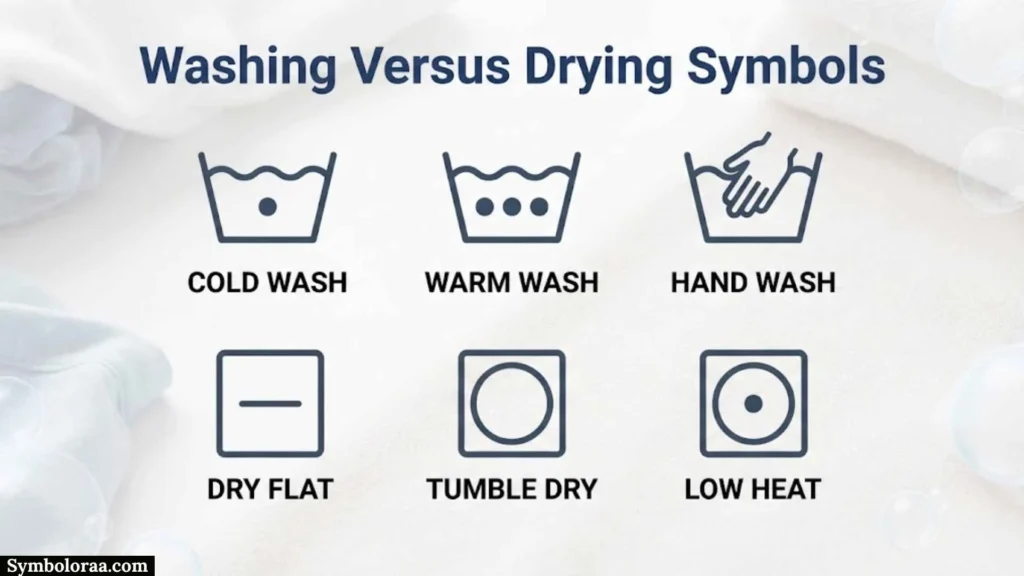
One of the easiest mistakes is confusing the tub with the square.
Tub = washing
Square = drying
Triangle = bleaching
Iron = ironing
Circle = professional textile care
Learning these five basic shapes gives you a useful foundation for reading almost any complete care label.
Laundry Washing Symbols UK
Laundry washing symbols in the UK use the same familiar care-label language of tubs, squares, triangles, irons, and circles. These symbols are designed to communicate textile-care instructions clearly without depending entirely on written language.
The current international care-labelling framework is ISO 3758:2023. GINETEX notes that the 2023 edition replaced ISO 3758:2012 and introduced several graphical and technical changes.
Common UK Laundry Symbols
| UK Label Symbol | Meaning |
| Washing tub + number | Maximum washing temperature |
| Washing tub + hand | Hand wash |
| Washing tub + one line | Mild washing treatment |
| Washing tub + two lines | Very mild washing treatment |
| Crossed washing tub | Do not wash |
| Triangle | Bleaching instructions |
| Crossed triangle | Do not bleach |
| Square + circle | Tumble dry |
| Crossed square + circle | Do not tumble dry |
| Iron | Ironing instructions |
| Crossed iron | Do not iron |
| Circle | Professional cleaning information |
The same symbol can therefore be understood by its shape and markings rather than by a long sentence.
How To Read UK Clothing Labels
When you find a care label on a shirt, trousers, jumper, jacket, towel, or other textile item, read the symbols from left to right.
A typical care sequence gives information about:
- Washing
- Bleaching
- Drying
- Ironing
- Professional textile care
This order is part of the standardized care-symbol system.
Are UK And European Laundry Symbols The Same?
The familiar care symbols are part of an international standardized system, so many symbols used in the UK are recognizable in other countries as well. However, individual labels can contain different combinations of symbols depending on the garment.
The safest approach is to interpret the complete label rather than assuming that a symbol always has the same practical instruction in every context.
Common Laundry Label Mistakes To Avoid
Avoid these common errors when reading care labels:
- Do not treat the temperature number as a required temperature.
- Do not ignore lines underneath the washing tub.
- Do not assume a machine-washable garment can automatically be tumble dried.
- Do not use bleach without checking the triangle.
- Do not iron an item before checking its iron symbol.
- Do not wash a crossed-out tub.
- Do not rely on fabric type alone when the manufacturer’s care label gives a specific instruction.
A lower temperature or milder treatment than the maximum shown can be permitted, but the complete label should always guide your choice.
FAQ
What Is The Most Common Laundry Washing Symbol?
The washing tub is the main symbol used for domestic washing instructions. Numbers inside it show the maximum permitted washing temperature, while lines underneath can indicate a gentler process.
What Does A Washing Tub With 40 Mean?
A washing tub containing 40 means the garment can be washed at a maximum temperature of 40°C. If the tub also has one or two lines underneath, a milder washing process is required.
What Does The Square Symbol Mean On Clothes?
The square represents drying instructions. A circle inside the square relates to tumble drying, while lines within the square can describe natural drying methods such as line or flat drying.
What Does A Triangle Mean On A Laundry Label?
A triangle provides information about bleaching. A crossed-out triangle means bleaching is not permitted, while other triangle markings can specify which types of bleach are allowed.
Can I Use A Lower Temperature Than The Label Shows?
Yes. The temperature shown in a washing tub is the maximum temperature that should not be exceeded. GINETEX states that milder treatments and lower temperatures than those indicated are permitted.
Conclusion
Laundry washing symbols provide a simple visual way to understand how clothing should be cared for. The washing tub tells you about washing, numbers indicate maximum temperatures, hands indicate hand washing, and lines show when a gentler process is required.
The drying symbols are equally important because washing and drying are separate treatments. A 30°C washing instruction does not automatically mean that tumble drying is safe. Always check the square and any dots, lines, or crosses that appear with it.
Once you understand the main shapes and markings, most clothing care labels become much easier to read. Use the charts in this guide as a quick reference whenever you need to check a washing temperature, drying method, or other laundry-care instruction.

I’m Madison Reed, a contemporary American author who writes about love, family, friendship, and second chances. I’m fascinated by the choices that shape our lives and the moments that change us forever. My goal is to create honest, emotional stories with characters readers can connect with long after finishing each book.
Three Books:
When We Find Our Way
The Things We Never Said
Summer in September
 Jackson Miller