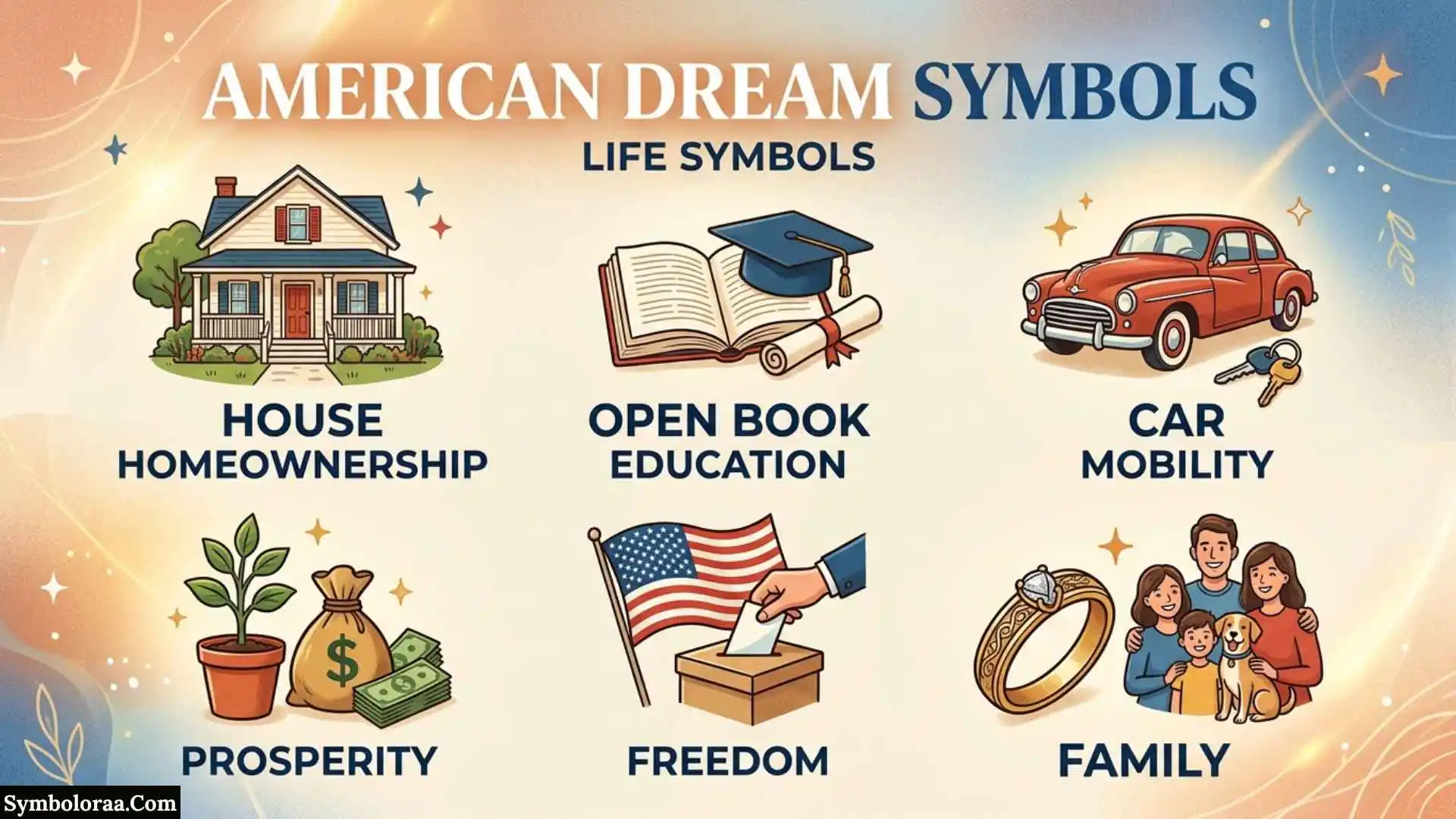
If you are looking for American Dream symbols, the most recognizable examples include the white picket fence, American house, Statue of Liberty, American flag, open road, bald eagle, diploma, ladder, family, car, dollar sign, farm, and rising sun. Each symbol represents a different part of the American Dream, from freedom and immigration to homeownership, education, hard work, financial success, and the hope of creating a better future.
There is no official list of American Dream symbols. The American Dream is a broad cultural idea that has changed across American history. James Truslow Adams popularized the phrase in his 1931 book The Epic of America, describing a vision of a better and fuller life with opportunity based on ability and achievement rather than circumstances of birth. The Library of Congress also emphasizes that people have understood the dream differently across generations.
That is why a house, diploma, open road, or Statue of Liberty can all represent the American Dream without having identical meanings.
This guide explains the most important symbols, their historical background, what they represent, how their meanings have changed, and how to choose the right symbol for an essay, school project, poster, artwork, tattoo, or cultural analysis.
Quick Answer: What Are the Main American Dream Symbols?
The strongest American Dream symbols depend on the specific idea you want to communicate.
| Symbol | What It Commonly Represents |
| White picket fence | Homeownership, family, security, suburban prosperity |
| House | Stability, independence, ownership, family security |
| Statue of Liberty | Freedom, immigration, opportunity, hope |
| American flag | National identity, freedom, belonging |
| Open road | Independence, mobility, choice, new beginnings |
| Bald eagle | Freedom, strength, independence, national identity |
| Diploma | Education, achievement, opportunity, upward mobility |
| Ladder | Ambition, progress, social mobility |
| Family | Love, stability, responsibility, generational progress |
| Car | Mobility, independence, prosperity |
| Dollar sign | Wealth, financial success, material prosperity |
| Farm or land | Ownership, self-sufficiency, independence |
| Rising sun | Hope, renewal, future opportunity |
| Open door | Opportunity, access, new beginnings |
| City skyline | Career opportunity, ambition, economic growth |
| Workplace or business | Hard work, entrepreneurship, achievement |
| Books | Education, knowledge, self-improvement |
Best traditional symbol: white picket fence
Best freedom symbol: Statue of Liberty
Best immigration symbol: Statue of Liberty or golden door
Best education symbol: diploma or graduation cap
Best social mobility symbol: ladder
Best independence symbol: open road
Best family symbol: house and family
Best financial success symbol: dollar sign
The key is to match the symbol with the specific version of the American Dream you are discussing.
What Is the American Dream?
The American Dream is the belief that people can pursue a better life through opportunity, freedom, effort, achievement, and personal initiative.
It is not limited to becoming rich.
The Library of Congress presents the American Dream as an idea that has been interpreted in many ways. It can involve economic success, personal fulfillment, education, family, freedom, social opportunity, and the ability to create a better life.
James Truslow Adams’s 1931 definition is especially important because it challenges the idea that the American Dream simply means expensive possessions. His formulation focused on a fuller life and opportunity for people according to ability or achievement.
This distinction helps explain why American Dream symbolism includes both material objects, such as houses and cars, and abstract ideals, such as freedom, education, hope, and opportunity.
The Core Ideas Behind the American Dream
Most American Dream symbols connect to one or more of these ideas:
- Opportunity
- Freedom
- Equality of opportunity
- Hard work
- Achievement
- Independence
- Homeownership
- Education
- Family security
- Economic mobility
- Entrepreneurship
- Immigration
- Personal fulfillment
- A better future
A symbol becomes especially meaningful when it connects several of these ideas at once.
Why There Is No Single Official American Dream Symbol
The American Dream is not a government emblem, flag, or officially designated symbol.
It is a cultural ideal.
That means different people, historical periods, communities, writers, artists, and political movements can represent it differently.
For one person, the American Dream may mean owning a house.
For another, it may mean graduating from college.
For an immigrant, it may mean arriving in a country where new opportunities are possible.
For an entrepreneur, it may mean starting a successful business.
For a civil rights activist, it may mean achieving equal rights and equal opportunity.
The Smithsonian’s historical material on American dreams similarly describes multiple versions of the dream, including freedom, economic independence, education, satisfying work, family, and opportunity.
A Better Way to Understand the Symbols
Instead of asking:
“What is the one American Dream symbol?”
ask:
“Which symbol best represents the specific American Dream I am discussing?”
That small change produces a much more accurate interpretation.
The White Picket Fence: The Classic American Dream
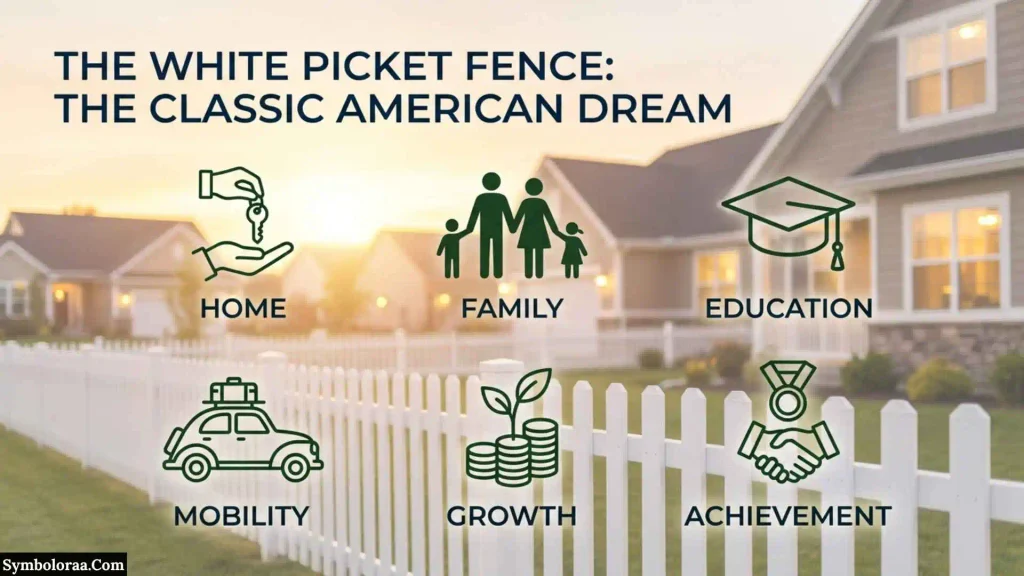
The white picket fence is perhaps the most recognizable visual representation of the traditional American Dream.
It commonly suggests:
- Homeownership
- Family life
- Security
- Middle-class prosperity
- Suburban comfort
- Stability
- Respectability
- A peaceful neighborhood
The symbolism became especially strong during the 20th century. Smithsonian Magazine notes that beginning in the late 1940s, the white picket fence became closely associated with the American Dream and the suburban ideal.
Why the White Picket Fence Became So Powerful
The fence is rarely meaningful by itself.
Its power comes from the complete visual scene:
House + lawn + fence + family + car = traditional suburban American Dream
The house represents ownership and security.
The family represents stability.
The lawn and neighborhood represent comfort.
The fence ties the image together.
It became a kind of visual shorthand for the idea that a person had “made it.”
The White Picket Fence Has a Critical Meaning Too
The symbol is not always positive.
Artists, filmmakers, and writers have also used the white picket fence to question:
- Conformity
- Social pressure
- The idea of a “perfect” family
- Suburban isolation
- Economic inequality
- The difference between appearance and reality
Smithsonian Magazine points out that the fence has appeared in both idealized and unsettling portrayals of American life, showing how the same object can communicate very different ideas depending on context.
Best use: traditional American Dream, homeownership, family, suburban prosperity, or a critique of the idealized American lifestyle.
The House: Ownership, Security, and Independence
The American house is one of the strongest symbols of economic stability.
It can represent:
- Homeownership
- Financial security
- Independence
- Family
- Privacy
- Stability
- Achievement
- A permanent place to build a life
A house is slightly different from a white picket fence.
The house focuses more directly on ownership and security.
The white picket fence adds the cultural image of suburban family life.
Why Homeownership Became Part of the American Dream
American ideas about land ownership have deep historical roots.
The Homestead Act of 1862 encouraged settlement by allowing eligible people to claim surveyed public land under specific conditions. The National Archives notes that the law required residence and improvement of the land before a claimant could receive title.
The policy had major limitations and did not provide equal or easy access to prosperity. The National Archives also explains that many settlers lacked the resources needed to develop a farm and that much of the land distributed under the broader system did not ultimately go to ordinary homesteaders.
This history is important because it shows that the symbol of “owning your own land” has always involved both opportunity and barriers to opportunity.
The Statue of Liberty: Freedom, Immigration, and Opportunity
The Statue of Liberty is one of the most powerful symbols associated with the opportunity side of the American Dream.
It can represent:
- Liberty
- Freedom
- Immigration
- Hope
- Opportunity
- A new beginning
- Escape from oppression
- National ideals
The National Park Service explains that the statue’s broken shackles and chains symbolize the abolition of slavery, while the torch represents enlightenment and freedom. Its tablet bears the date July 4, 1776.
Why the Statue of Liberty Represents the American Dream
The statue became deeply connected with immigration and the idea of America as a place where people could seek a new life.
The National Park Service describes the monument as a powerful symbol of liberty, peace, human rights, abolition, democracy, and opportunity, while also noting its relationship to migration into the United States.
This makes the statue especially useful when the American Dream is being discussed from an immigrant perspective.
An Important Historical Complication
The symbolism of the Statue of Liberty should not be treated as proof that freedom and equality were equally available to everyone.
The National Park Service documents how African Americans could experience the statue’s symbolism differently because racial discrimination and unequal citizenship continued after the statue was dedicated.
This gives the symbol a deeper meaning:
Ideal → freedom for all
versus
Historical reality → freedom and equality were incomplete
That tension is essential to understanding American Dream symbolism.
The American Flag: National Identity and the Idea of America
The American flag is primarily a national symbol rather than an American Dream symbol.
However, it can represent the American Dream when it appears with imagery related to:
- Freedom
- Opportunity
- Immigration
- Citizenship
- Equal rights
- National ideals
- Belonging
The flag therefore needs context.
A flag on a military memorial may symbolize national service and sacrifice.
A flag beside an immigrant family may emphasize belonging and opportunity.
A flag above a graduation scene may suggest achievement within the broader American ideal.
Best use: national identity, patriotism, citizenship, freedom, and the national framework in which the American Dream is discussed.
The Open Road: Freedom, Mobility, and Reinvention
The open road represents a more individual and adventurous version of the American Dream.
It can symbolize:
- Freedom
- Independence
- Mobility
- Personal choice
- Exploration
- Reinvention
- Escape from limitations
- A new beginning
Unlike the house, the road does not symbolize putting down roots.
It symbolizes the freedom to move forward.
A person standing beside an empty highway can therefore represent someone who believes the future is open and that they can choose their own direction.
Why the Road Is More Than a Travel Symbol
In American culture, roads often connect ideas of movement and self-determination.
The road can mean:
Leave → travel → discover → change → build a new life
That makes it especially useful for stories about migration, career changes, entrepreneurship, or personal reinvention.
The Bald Eagle: Freedom, Strength, and Independence
The bald eagle is primarily a national symbol of the United States.
In an American Dream context, however, it can represent:
- Independence
- Strength
- Freedom
- Self-determination
- National identity
- Aspiration
It is best used when the American Dream is being connected with broader American ideals rather than with homeownership or financial success.
National Symbol vs. American Dream Symbol
This distinction matters.
Bald eagle: national symbol first.
White picket fence: cultural American Dream symbol first.
Statue of Liberty: national symbol with strong connections to liberty, immigration, and opportunity.
Understanding these differences makes an interpretation more precise.
The Diploma and Graduation Cap: Education as Opportunity
A diploma, graduation cap, school, or university can represent education as a pathway to a better future.
These symbols suggest:
- Knowledge
- Achievement
- Personal growth
- Career opportunity
- Social mobility
- Independence
- Professional success
Education has played an important role in American ideas about opportunity.
The Smithsonian’s history of education and civil rights shows how access to education became part of the struggle for equal opportunity, while segregation denied many Americans the same educational opportunities.
Why Education Is an American Dream Symbol
A diploma can tell a complete story in one image:
Education → skills → opportunity → career → independence
It therefore represents a version of the American Dream that does not depend primarily on wealth.
For a student writing about the American Dream, a graduation cap may be more meaningful than a dollar sign because it shows how knowledge and achievement can create new opportunities.
The Ladder: Ambition and Social Mobility
The ladder is a conceptual symbol of upward movement.
It can represent:
- Ambition
- Progress
- Career advancement
- Social mobility
- Personal improvement
- Achievement
- Moving from hardship toward opportunity
A ladder beside a diploma suggests education and upward mobility.
A ladder reaching toward a house suggests economic advancement.
A ladder leading toward a city skyline suggests career success.
The Ladder Can Also Represent Inequality
There is a deeper interpretation.
If everyone is supposedly allowed to climb the ladder, but some people begin several steps higher than others, the ladder can symbolize unequal access to opportunity.
This makes the ladder useful in both:
- Positive American Dream imagery
- Critical discussions of economic and social inequality
That dual meaning makes it stronger than a simple “success” icon.
The Family: Security and Generational Progress
The family represents the emotional side of the American Dream.
It can symbolize:
- Love
- Stability
- Security
- Responsibility
- Belonging
- Raising children
- Generational progress
- Building a better future
For many people, success is not about personal wealth alone.
It is about creating opportunities for the next generation.
A parent buying a first home, sending children to college, or starting a family business can represent a very different version of the American Dream from someone seeking luxury or fame.
Family and the Meaning of “Making It”
Consider this simple visual:
Parents + children + home + education
The message is not simply:
“We are wealthy.”
It is:
“We built a stable life and created better opportunities for our children.”
That is an important distinction in American Dream symbolism.
The Car: Mobility, Independence, and Prosperity
The car can represent two connected ideas.
First, it provides physical mobility.
Second, it can represent economic achievement.
A car can therefore symbolize:
- Freedom to travel
- Independence
- Employment access
- Consumer prosperity
- Personal achievement
- Family mobility
The meaning changes according to the image.
A family car in front of a suburban home suggests middle-class stability.
A classic car on an empty highway suggests freedom and adventure.
A luxury car may emphasize wealth and status rather than the broader American Dream.
The Dollar Sign: The Material Side of the American Dream
The dollar sign ($) is the clearest symbol of the financial version of the American Dream.
It can represent:
- Money
- Wealth
- Income
- Business success
- Financial independence
- Investment
- Material prosperity
But there is an important limitation.
The dollar sign represents one interpretation of the American Dream, not the whole concept.
The Library of Congress’s American Dream materials explicitly contrast the broader dream with an interpretation focused only on cars, wages, and material possessions.
When a Dollar Sign Is the Right Symbol
Use it when the subject is:
- Entrepreneurship
- Financial independence
- Business growth
- Economic success
- Wealth accumulation
- The material version of the American Dream
Avoid using it as the only symbol when the topic is freedom, immigration, education, family, or personal fulfillment.
The Farm and Land: Independence and Self-Sufficiency
Land and farming represent an older form of the American Dream.
They can symbolize:
- Land ownership
- Independence
- Self-sufficiency
- Hard work
- Economic opportunity
- Building something from the ground up
The Homestead Act is especially important to this symbolism because it connected land, settlement, labor, and ownership.
The Historical Reality Behind the Symbol
The image of an independent farmer can look simple, but the history was complicated.
The National Archives explains that the Homestead Act distributed large amounts of public land but also notes that many people could not afford the tools, livestock, and other resources needed to establish successful farms. The settlement process also had serious consequences for Native American communities.
So the farm can represent both:
Opportunity and independence
and
the complicated history behind American expansion.
That makes it particularly useful for historical writing.
The Rising Sun: Hope and a Better Future
The rising sun is not an official American symbol, but it is a useful symbolic image for the American Dream.
It represents:
- Hope
- Renewal
- Progress
- New beginnings
- Possibility
- A better future
The symbolism is simple:
Night → sunrise → new day
In an American Dream poster, the rising sun can appear behind a house, city, road, or person to suggest that difficult circumstances do not necessarily determine the future.
The Open Door and Golden Door: Opportunity and Immigration
An open door is a universal symbol of opportunity.
In an American Dream context, it can mean:
- Access
- Opportunity
- Freedom
- Acceptance
- A new beginning
- A chance to change one’s life
The idea of the golden door has a particularly strong connection with Statue of Liberty and immigration imagery.
This symbol is best suited to discussions of people entering a new society in search of safety, freedom, or opportunity.
The City Skyline: Career and Economic Opportunity
A city skyline can symbolize the economic side of the American Dream.
It may represent:
- Career opportunities
- Business
- Innovation
- Economic growth
- Ambition
- Professional success
- Reinvention
A person arriving in a large American city can therefore represent the beginning of a new chapter.
This symbol is particularly effective when combined with:
- A suitcase
- A road
- A train
- A diploma
- An office
- A business
- A rising sun
Each additional object adds another layer of meaning.
Books and the Open Book: Knowledge and Self-Improvement
An open book represents the intellectual side of the American Dream.
It can symbolize:
- Education
- Knowledge
- Literacy
- Opportunity
- Self-improvement
- Personal development
This becomes especially meaningful in discussions of civil rights.
The Smithsonian’s historical material on the struggle for educational equality shows that access to education was central to broader demands for equal opportunity and citizenship.
An open book therefore can represent more than school.
It can represent access to the tools needed to participate fully in society.
The Workplace, Factory, and Small Business: Hard Work
A factory, office, workshop, farm, construction site, or small business can symbolize the work ethic associated with the American Dream.
These images represent:
- Hard work
- Employment
- Productivity
- Entrepreneurship
- Self-reliance
- Career development
- Economic opportunity
The important idea is not simply “working.”
It is the belief that work can help a person create greater security and opportunity.
A small-business storefront, for example, can represent a dream built independently rather than a dream based on inherited wealth.
The American Dream Symbols by Meaning
If you need to choose quickly, use this table.
| Desired Meaning | Best Symbol |
| Traditional American Dream | White picket fence |
| Homeownership | House |
| Family security | House + family |
| Freedom | Statue of Liberty |
| Immigration | Statue of Liberty |
| New beginning | Open door |
| Opportunity | Open door or golden door |
| Education | Diploma or open book |
| Social mobility | Ladder |
| Hard work | Workplace or farm |
| Entrepreneurship | Small business |
| Financial success | Dollar sign |
| Independence | Open road |
| Mobility | Car or road |
| Hope | Rising sun |
| National identity | American flag |
| Strength | Bald eagle |
| Career success | City skyline |
| Self-sufficiency | Farm or land |
| Generational progress | Family + education |
American Dream Symbols vs. American National Symbols
One of the most common mistakes is treating these two categories as identical.
National Symbols
National symbols represent the United States as a country.
Examples include:
- American flag
- Bald eagle
- Statue of Liberty
- Liberty Bell
- National anthem
American Dream Symbols
American Dream symbols represent aspirations such as:
- Opportunity
- Homeownership
- Education
- Economic mobility
- Family security
- Freedom
- Personal achievement
Some symbols overlap.
The Statue of Liberty, for example, is a national monument and also a powerful symbol of liberty and opportunity. The National Park Service describes its symbolism in terms that include freedom, democracy, human rights, abolition, and opportunity.
The white picket fence, by contrast, is not an official national symbol. Its importance comes from American cultural imagery and the suburban ideal.
American Dream Symbols vs. Symbols of Wealth
A wealth symbol communicates money.
An American Dream symbol can communicate much more.
| Wealth Symbol | Broader American Dream Symbol |
| Dollar sign | House |
| Luxury car | Open road |
| Mansion | Family home |
| Gold | Diploma |
| Stock chart | Ladder |
| Expensive watch | Statue of Liberty |
This does not mean wealth is unrelated to the American Dream.
Economic security is an important part of many people’s dreams.
The distinction is that wealth is an outcome, while the American Dream can describe the broader opportunity and process of building a fulfilling life.
American Dream Symbols vs. Symbols of Freedom
Freedom is another major part of the American Dream, but the two categories should not be treated as synonyms.
| Freedom Symbol | American Dream Symbol |
| Broken chains | White picket fence |
| Torch | Diploma |
| Open door | House |
| Statue of Liberty | Family |
| Open road | Business |
| Raised hand | Ladder |
The Statue of Liberty can belong to both categories because its symbolism connects liberty with broader ideas of opportunity and migration.
The Historical Evolution of American Dream Symbols
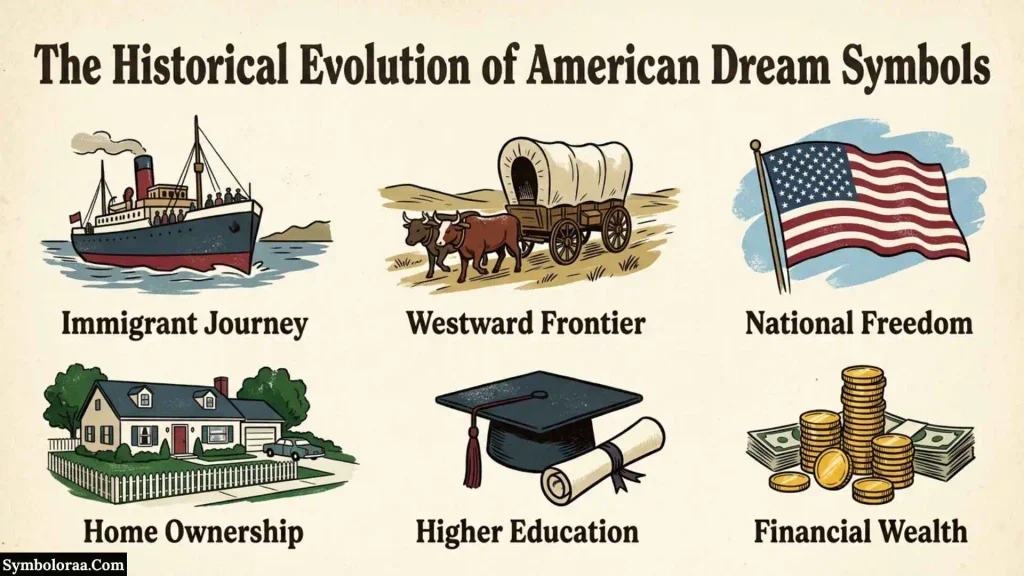
American Dream symbolism changed because the dream itself changed.
Early American Ideas: Land and Independence
Early versions of the dream were closely associated with:
- Land
- Independence
- Self-government
- Personal freedom
- Economic opportunity
Land ownership could represent independence because owning productive property gave people a degree of control over their livelihoods.
The 19th Century: Frontier and Homestead
During the 19th century, frontier settlement and land ownership became powerful cultural images.
The Homestead Act of 1862 strengthened this connection by creating a federal mechanism for eligible settlers to claim public land under specified conditions.
Symbols from this period include:
- Farm
- Homestead
- Wagon
- Land
- Railroad
- Frontier
Immigration and the Statue of Liberty
The Statue of Liberty added another dimension.
The dream was increasingly represented not only as owning land but also as finding freedom and opportunity in a new country.
The monument’s symbolism combined classical liberty imagery with American independence, abolition, migration, and opportunity.
Industrial America: Work and Economic Mobility
Industrialization introduced new symbols:
- Factory
- Worker
- Business
- City
- Railroad
- Machine
The American Dream increasingly became connected with employment and the possibility of economic advancement.
The 1920s: Wealth and Reinvention
The 1920s brought a strong cultural focus on wealth, status, consumption, and self-invention.
F. Scott Fitzgerald’s The Great Gatsby is one of the best-known literary examinations of this version of the American Dream. The Library of Congress describes the novel as exploring class, wealth, social status, ambition, greed, and the promise of new beginnings through Jay Gatsby.
This period introduced an important question:
Can material success actually deliver the happiness promised by the American Dream?
Postwar America: The Suburban Dream
After World War II, the visual image of the American Dream became strongly associated with:
- House
- White picket fence
- Lawn
- Car
- Family
- Suburb
The white picket fence became particularly powerful as a shorthand for this idealized lifestyle.
Civil Rights: Equality as Part of the Dream
The meaning of the American Dream expanded again as civil rights movements challenged the gap between American ideals and lived reality.
The Smithsonian’s history of Brown v. Board of Education explains that the struggle for equal education helped redefine the nation’s ideals and advance the idea of equal opportunity.
This introduced another important group of symbols:
- Marchers
- Books
- Schools
- Voting imagery
- Open doors
- Raised hands
- Equal signs
The American Dream was no longer only about individual advancement.
It could also mean making opportunity available to people who had been excluded from it.
The Modern American Dream
Today, symbols of the American Dream can include:
- College graduation
- Entrepreneurship
- Technology
- Remote work
- Homeownership
- Financial independence
- Creative careers
- Small business
- Travel
- Family
- Community
The dream has become more individualized.
For some people, success means a large home.
For others, it means owning a small business, working independently, spending time with family, or having enough financial security to choose how to live.
Real-World Example: The Great Gatsby
The Great Gatsby provides one of the clearest examples of American Dream symbolism in literature.
Fitzgerald uses wealth, houses, automobiles, parties, social status, and aspiration to explore the desire for success and reinvention.
The Library of Congress describes Gatsby as a self-invented millionaire whose pursuit of Daisy is connected to themes of wealth, class, ambition, greed, and the promise of new beginnings.
What Gatsby Teaches About Symbols
A symbol does not have to represent an idea positively.
A mansion can mean:
Success
but also:
Emptiness
A car can mean:
Freedom
but also:
Danger or excess
Wealth can mean:
Achievement
but also:
Isolation
This is one of the most important principles in interpreting American Dream symbolism.
Real-World Example: The Statue of Liberty and Immigration
The Statue of Liberty provides a different interpretation.
Imagine an immigrant family arriving by ship and seeing the statue.
The visual sequence becomes:
Journey → Statue of Liberty → New country → Opportunity → New life
The symbol therefore communicates hope and possibility.
But historical context matters. The National Park Service also documents the tension between the statue’s ideals and the discrimination experienced by African Americans.
A strong historical interpretation should acknowledge both sides.
Real-World Example: Education and Civil Rights
A school, book, or diploma can represent more than career success.
During the struggle against segregated education, access to schooling became part of the larger fight for equal citizenship and opportunity.
The Smithsonian explains that Brown v. Board of Education helped make equal educational opportunity a central part of the nation’s changing understanding of equality.
So a simple book can carry a much deeper message:
Knowledge → education → citizenship → opportunity → equality
The American Dream Can Be Represented by Contradictory Symbols
This is where American Dream symbolism becomes especially interesting.
The same concept can have a positive and negative visual representation.
| Positive Interpretation | Critical Interpretation |
| House | Debt or financial pressure |
| White fence | Conformity |
| Car | Consumerism |
| Dollar sign | Materialism |
| Ladder | Unequal starting points |
| City | Opportunity or inequality |
| Statue of Liberty | Freedom or unrealized promises |
| Farm | Independence or displacement |
| Diploma | Opportunity or unequal educational access |
This does not make the symbols inaccurate.
It makes them more historically and culturally meaningful.
A Unique Framework for Interpreting American Dream Symbols
A useful way to analyze any symbol is the Seven-Layer American Dream Framework.
Layer 1: Identify the Object
What is actually shown?
Example:
A white picket fence.
Layer 2: Identify Its Literal Function
What does the object physically do?
A fence marks or encloses property.
Layer 3: Identify Its Cultural Association
What has American culture associated with the object?
The white picket fence became associated with suburban life and the idealized middle-class home.
Layer 4: Identify the Dream It Represents
What part of the American Dream does it communicate?
Homeownership, security, family, and prosperity.
Layer 5: Check the Historical Period
Does the meaning belong to a particular period?
The white picket fence became especially powerful in postwar suburban imagery.
Layer 6: Look for the Critical Meaning
Could the same symbol be questioning the American Dream?
Yes. It can suggest conformity or an unrealistic ideal.
Layer 7: Match It to the Intended Audience
A school essay may need historical explanation.
A poster may need immediate visual recognition.
A tattoo may require a more personal interpretation.
This seven-layer process produces a much stronger interpretation than simply saying “a fence means success.”
How to Choose an American Dream Symbol for a School Project
Start with your main argument.
If Your Topic Is Homeownership
Choose:
House + white picket fence
Explain stability, family, ownership, and suburban prosperity.
If Your Topic Is Immigration
Choose:
Statue of Liberty + ship + open door
Explain freedom, arrival, opportunity, and a new beginning.
If Your Topic Is Education
Choose:
Diploma + books + ladder
Explain knowledge, achievement, and upward mobility.
If Your Topic Is Hard Work
Choose:
Worker + tools + business or farm
Explain effort, productivity, independence, and economic opportunity.
If Your Topic Is Freedom
Choose:
Statue of Liberty + open road
Explain liberty, choice, mobility, and opportunity.
If Your Topic Is the Modern American Dream
Choose:
Laptop + small business + home + family
Explain how success today can involve independence, technology, financial security, and personal fulfillment.
How to Create an American Dream Poster
A strong poster should tell one story.
Do not fill the page with every possible American symbol.
Instead, choose three to five connected images.
Traditional Poster
Use:
- House
- White picket fence
- Family
- Car
- American flag
Message:
A stable and prosperous family life.
Immigrant Dream Poster
Use:
- Statue of Liberty
- Ship
- Immigrant family
- Open door
- City skyline
Message:
Freedom and opportunity in a new country.
Education Dream Poster
Use:
- Books
- Diploma
- Ladder
- Student
- City skyline
Message:
Education creates new opportunities.
Critical American Dream Poster
Use:
- Large house
- Dollar sign
- Ladder with missing steps
- Crowded neighborhood
- Person looking upward
Message:
The gap between the ideal of opportunity and unequal access to success.
American Dream Symbols for Tattoos and Personal Art
If you are choosing a symbol for a tattoo or personal artwork, the best choice depends on the story you want the image to tell.
For Freedom
Consider:
- Statue of Liberty
- Open road
- Open door
- Eagle
For Family
Consider:
- House
- Tree
- Family silhouette
- Home with fence
For Achievement
Consider:
- Diploma
- Ladder
- Mountain
- Sunrise
For Immigration
Consider:
- Statue of Liberty
- Ship
- Open door
- Map or travel imagery
For Independence
Consider:
- Open road
- Car
- House
- Eagle
The important question is not “Which symbol looks American?”
It is:
“Which symbol represents my personal definition of opportunity and success?”
Common Mistakes When Interpreting American Dream Symbols
Mistake 1: Saying There Is One Official Symbol
There is no single official American Dream emblem.
The dream is a broad cultural concept.
Mistake 2: Calling Every American Image an American Dream Symbol
The American flag and bald eagle are national symbols first.
Their American Dream meaning depends on context.
Mistake 3: Equating the Dream With Wealth
Money is only one dimension of the concept.
Education, family, freedom, opportunity, and personal fulfillment can be equally important.
Mistake 4: Ignoring Historical Context
A farm in a 19th-century history essay may represent land and independence.
A suburban house in a postwar context may represent middle-class prosperity.
The same object can mean different things in different periods.
Mistake 5: Ignoring Exclusion
A historically accurate discussion should recognize that access to the American Dream has not been equal.
The history of segregation, discrimination, and unequal educational opportunity demonstrates why the idea of opportunity has often been contested.
Mistake 6: Treating Symbols as Fixed Dictionaries
Symbols are contextual.
A car can represent freedom in one image and consumerism in another.
A house can represent security in one story and financial pressure in another.
Mistake 7: Using Too Many Symbols
Ten unrelated symbols can make a poster confusing.
Three well-connected symbols can tell a much clearer story.
A Quick Decision Tree for Choosing the Right Symbol
Use this simple guide:
What part of the American Dream are you discussing?
↓
Home and family?
→ Choose house or white picket fence
↓
Freedom?
→ Choose Statue of Liberty or open road
↓
Immigration?
→ Choose Statue of Liberty, ship, or golden door
↓
Education?
→ Choose diploma or open book
↓
Career advancement?
→ Choose ladder or city skyline
↓
Hard work?
→ Choose workplace, tools, farm, or small business
↓
Financial success?
→ Choose dollar sign, business, or successful home
↓
Hope and new beginnings?
→ Choose rising sun or open door
↓
National identity?
→ Choose American flag or bald eagle
This prevents the common mistake of selecting a symbol simply because it “looks American.”
A Practical Checklist for Accurate Symbol Interpretation
Before using an American Dream symbol, ask:
- Does it represent a specific American Dream value?
- Do I understand its historical context?
- Is it primarily a national symbol or an American Dream symbol?
- Could it have a different meaning?
- Am I confusing wealth with the entire American Dream?
- Can I explain why the symbol fits my topic?
- Does the symbol represent the period I am studying?
- Am I acknowledging important historical contradictions?
- If this is a poster, is the message immediately clear?
- If this is an academic essay, can I support the interpretation with reliable sources?
If you can answer these questions, your interpretation will be much stronger.
Frequently Asked Questions About American Dream Symbols
What is the most famous symbol of the American Dream?
The white picket fence is one of the most recognizable symbols of the traditional American Dream because it represents homeownership, family stability, suburban life, and middle-class prosperity. Smithsonian Magazine documents its strong association with the American Dream beginning in the late 1940s.
What is the best symbol of the American Dream?
There is no single best symbol. The right choice depends on the idea being represented. A white picket fence works well for traditional homeownership, while the Statue of Liberty is stronger for freedom and immigration.
What does a white picket fence symbolize?
It commonly symbolizes homeownership, family stability, security, suburban prosperity, and the traditional middle-class American lifestyle. It can also be used critically to represent conformity or an idealized version of family life.
What does the Statue of Liberty symbolize in the American Dream?
It can represent liberty, immigration, opportunity, hope, freedom, and a new beginning. The National Park Service identifies the monument with liberty and broader ideals including opportunity and human rights.
Is the American flag an American Dream symbol?
It can be, but the flag is primarily a national symbol. In an American Dream context, it may represent freedom, citizenship, belonging, opportunity, and national ideals.
What symbolizes education in the American Dream?
A diploma, graduation cap, school, university, or open book can symbolize education, achievement, opportunity, and upward mobility.
What symbolizes hard work?
A worker, factory, farm, tools, office, or small business can represent hard work and the belief that effort can help create a better life.
What symbolizes social mobility?
A ladder or staircase is one of the clearest conceptual symbols of social mobility because it visually represents movement from one level to another.
What symbolizes financial success?
A dollar sign, business, successful home, or financial imagery can represent the economic side of the American Dream.
Is the American Dream only about becoming rich?
No. The American Dream has historically included broader ideas such as opportunity, freedom, education, family security, meaningful work, personal development, and the pursuit of a better life.
Has the meaning of the American Dream changed?
Yes. Its symbolism has shifted from early ideas about land and independence to immigration, industrial work, suburban homeownership, education, civil rights, entrepreneurship, and modern forms of personal fulfillment.
Why is the American Dream controversial?
The ideal promises opportunity, but American history shows that access to opportunity has often been unequal. Slavery, segregation, discrimination, unequal education, and other barriers created a gap between the ideal and the experience of many Americans. The Smithsonian’s civil rights collections document how struggles for equal citizenship and education became part of the effort to expand the American Dream.
Can a symbol represent both the American Dream and its failure?
Yes. This is one of the most important aspects of American Dream symbolism. A house can represent success but also financial pressure. A ladder can represent opportunity but also unequal starting points. The Statue of Liberty can represent freedom while also raising questions about who historically received that freedom in practice.
What is the American Dream symbol in The Great Gatsby?
Fitzgerald uses several images to explore the American Dream, including wealth, mansions, automobiles, social status, ambition, and the promise of a new beginning. The Library of Congress describes the novel as a critical examination of wealth, class, ambition, greed, and the American Dream of success.
Key Takeaways
The American Dream symbols are not a fixed official collection. They are cultural images that communicate different versions of opportunity, success, freedom, security, and personal fulfillment.
The most important symbols include:
- White picket fence — traditional homeownership and suburban success
- House — security, ownership, and independence
- Statue of Liberty — freedom, immigration, and opportunity
- American flag — national identity and belonging
- Open road — freedom, mobility, and reinvention
- Bald eagle — strength, independence, and national identity
- Diploma — education and achievement
- Ladder — ambition and social mobility
- Family — stability and generational progress
- Car — mobility and independence
- Dollar sign — financial success
- Farm and land — self-sufficiency and ownership
- Rising sun — hope and a better future
- Open door — opportunity and new beginnings
- City skyline — career and economic opportunity
- Books — education and self-improvement
The deeper lesson is that the American Dream is larger than material wealth. Its symbols can represent the desire to own a home, obtain an education, raise a family, start a business, gain freedom, immigrate, achieve equality, or create better opportunities for the next generation.
The strongest interpretation always connects the symbol to its historical period, cultural context, intended meaning, and possible contradictions.
Conclusion
American Dream symbols reflect the many ways people have imagined a better life in the United States. The white picket fence represents the traditional dream of homeownership and family stability. The Statue of Liberty represents freedom, immigration, and opportunity. A diploma represents education and achievement, a ladder represents upward mobility, an open road represents independence, and a rising sun represents hope.
But these symbols become more meaningful when their history is considered.
The American Dream has never been a single, unchanging promise. Its imagery has evolved from land and independence to immigration, industrial work, suburban homes, education, civil rights, entrepreneurship, and personal freedom. At the same time, American history shows that opportunity has not always been equally available to everyone.
That tension is what makes American Dream symbolism so powerful.
A house can represent success and pressure. A ladder can represent opportunity and inequality. A dollar sign can represent achievement and materialism. The Statue of Liberty can represent freedom while also reminding us of the distance between national ideals and historical reality.
For a school project, essay, poster, artwork, or cultural analysis, the strongest approach is therefore not to ask which object is the American Dream symbol. Instead, identify which part of the American Dream you want to express, choose the symbol that communicates that idea most clearly, and explain its historical and cultural context.

I’m Madison Reed, a contemporary American author who writes about love, family, friendship, and second chances. I’m fascinated by the choices that shape our lives and the moments that change us forever. My goal is to create honest, emotional stories with characters readers can connect with long after finishing each book.
Three Books:
When We Find Our Way
The Things We Never Said
Summer in September
 Jackson Miller