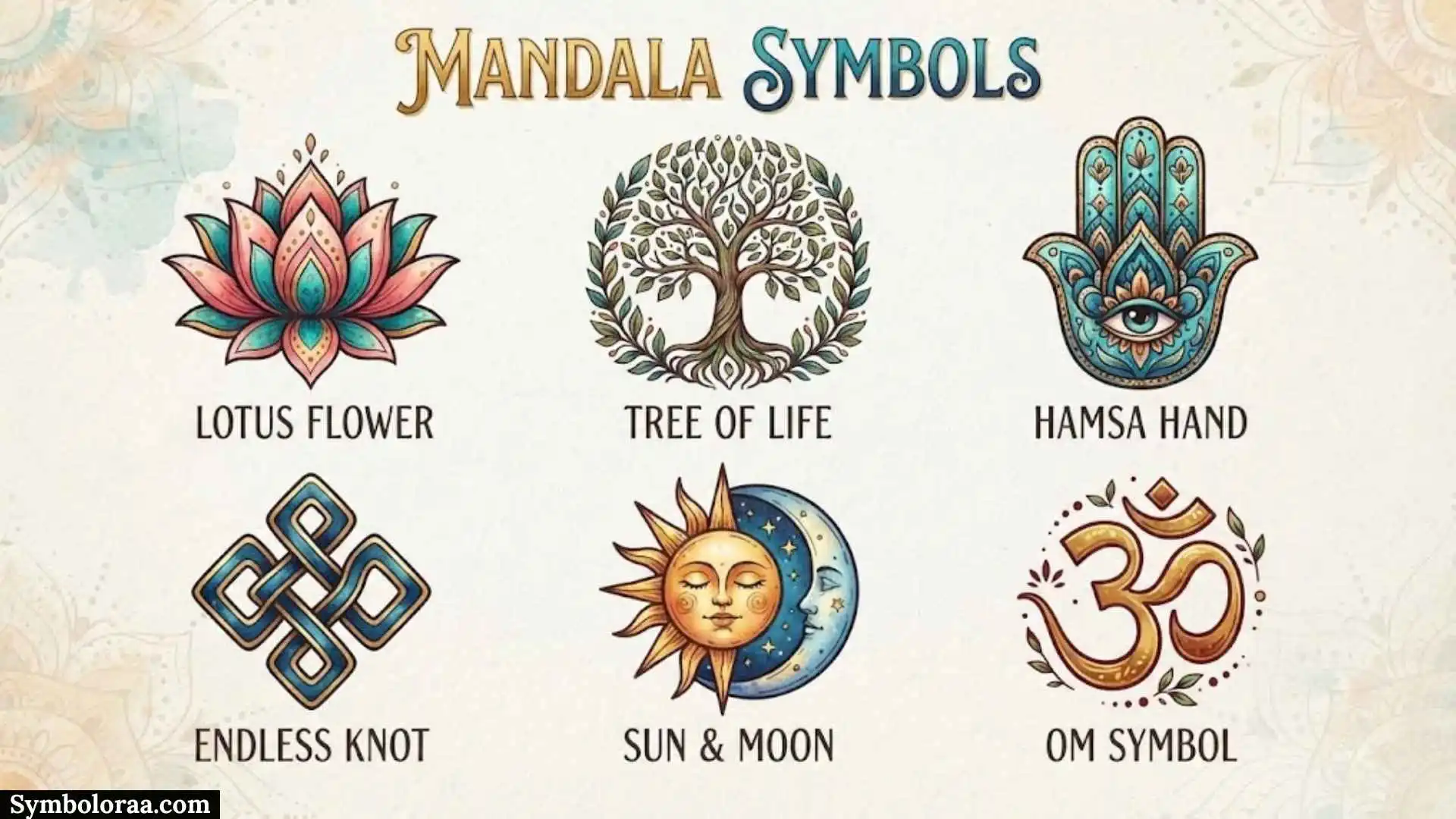
Mandala symbols are circular or radial designs built around a central point, often using repeated shapes, lines, petals, and geometric patterns. They can be found in religious art, meditation traditions, tattoos, decorative artwork, jewelry, coloring designs, and modern digital graphics. While many modern mandalas are decorative, some traditional mandalas have specific religious and cultural meanings.
The meaning of a mandala depends on its design and context. A simple circle may suggest wholeness or unity, while a traditional Buddhist mandala can represent a sacred universe or a structured realm used in religious practice. Hindu traditions also include important sacred diagrams such as yantras, which share geometric features with mandala designs but should not automatically be treated as the same thing.
This guide covers the main types and meanings people search for when looking for mandala symbols. You will find Hindu and Buddhist examples, chakra-inspired designs, family and tattoo ideas, simple and small symbols, Jung’s interpretation of mandalas, and useful Unicode characters that can be copied and pasted into text.
Mandala Symbols And Their Meaning
A mandala is usually organized around a center, with shapes and patterns extending outward in balanced layers. The word mandala comes from Sanskrit and is commonly associated with a circle or circular structure. However, traditional mandalas can contain squares, gates, triangles, lotus petals, figures, and other elements.
There is no single meaning that applies to every mandala. A traditional religious mandala can have a specific meaning within its own tradition, while a modern decorative mandala may simply represent beauty, balance, or creativity.
Common symbolic ideas include:
| Element | Common Interpretation |
| Circle | Wholeness, unity, continuity |
| Center point | Focus, origin, inner awareness |
| Symmetry | Balance and order |
| Lotus petals | Spiritual or symbolic growth |
| Repeated patterns | Harmony and connection |
| Four directions | Structure and spatial balance |
| Concentric circles | Layers, boundaries, or progression |
| Geometric shapes | Order and relationships |
The center is particularly important because many mandalas organize everything around one focal point. In Buddhist mandalas, the center may contain an important Buddha or other sacred figure. The Metropolitan Museum of Art describes Buddhist mandalas as diagrams that can map the universe and provide a focus for religious practice.
This is why it is better to ask “What does this particular mandala mean?” rather than assuming every mandala has one universal definition.
Mandala Art
Mandala art uses radial balance, repetition, geometry, and decorative detail to create a design that expands from a central point. Artists can make mandalas with pencils, pens, paint, digital tools, beads, fabric, sand, or other materials.
Modern mandala art can be divided into several broad styles:
- Geometric mandalas — Focus on circles, triangles, diamonds, lines, and symmetry.
- Floral mandalas — Use petals, leaves, and flower-like forms.
- Dot mandalas — Build patterns from groups of colored or painted dots.
- Spiritual mandalas — Draw inspiration from religious or contemplative traditions.
- Digital mandalas — Created with graphic-design software and repeated shapes.
- Minimalist mandalas — Use fewer lines and larger spaces.
- Decorative mandalas — Made primarily for visual appeal.
Traditional religious mandalas should be distinguished from modern decorative patterns. For example, Buddhist mandalas can contain complex arrangements of sacred figures, gates, directions, colors, and concentric sections. Some are specifically connected with meditation and ritual practice.
A useful way to understand the structure of mandala art is:
Center → Inner Ring → Repeated Pattern → Outer Ring → Border
Changing just one of these layers can produce a completely different visual style.
Mandala Symbol Copy And Paste
There is no single Unicode character that represents a complete mandala. Most detailed mandalas are images or illustrations rather than individual text characters. However, Unicode contains circles, stars, diamonds, geometric shapes, and decorative symbols that can create a similar visual effect.
Copy-And-Paste Mandala-Style Symbols
- ◉ — Bullseye-like circular symbol
- ◎ — Bullseye symbol
- ○ — White circle
- ● — Black circle
- ◌ — Dotted circle
- ◇ — White diamond
- ◆ — Black diamond
- △ — White up-pointing triangle
- ▲ — Black up-pointing triangle
- ▽ — White down-pointing triangle
- ▼ — Black down-pointing triangle
- ✦ — Four-pointed star
- ✧ — White four-pointed star
- ❈ — Decorative asterisk-like symbol
- ❉ — Decorative flower-like symbol
- ❋ — Heavy eight teardrop-spoked propeller asterisk
- ☸ — Wheel of Dharma
- ॐ — Devanagari Om
These symbols can be used in social-media bios, captions, usernames, messages, notes, headings, digital artwork, and decorative text.
For example:
◉ ✦ ◇ ✦ ◉
or
❈ ○ ✦ ○ ❈
These are mandala-inspired text decorations rather than traditional mandalas. Their appearance can also change slightly depending on the font and device.
Hindu Mandala Symbols And Meanings
Hindu traditions include many forms of sacred geometry, diagrams, yantras, and mandala-like structures. Some are associated with deities, meditation, ritual, sacred space, or particular philosophical traditions.
One familiar sacred character is ॐ, commonly written as Om or Aum. It is strongly associated with Hindu religious practice and sacred sound. Although Om is not itself a complete mandala, it can appear within spiritual artwork and mandala-inspired designs.
Another important geometric diagram is the Sri Yantra. It contains interlocking triangles arranged around a central point called the bindu. Because yantras and mandalas can share circular and geometric structures, they are sometimes grouped together in modern discussions, but they are not simply interchangeable terms.
Important elements found in Hindu sacred geometric designs can include:
- Bindu — A central point.
- Lotus petals — Repeated floral forms.
- Triangles — Important elements in several yantra designs.
- Circles — Used as boundaries and layers.
- Square frames — Can define the outer structure of a sacred diagram.
The meaning of each element depends on the specific diagram and tradition. A modern design inspired by Hindu geometry should not automatically be presented as an authentic religious yantra.
Buddhist Mandala Symbols
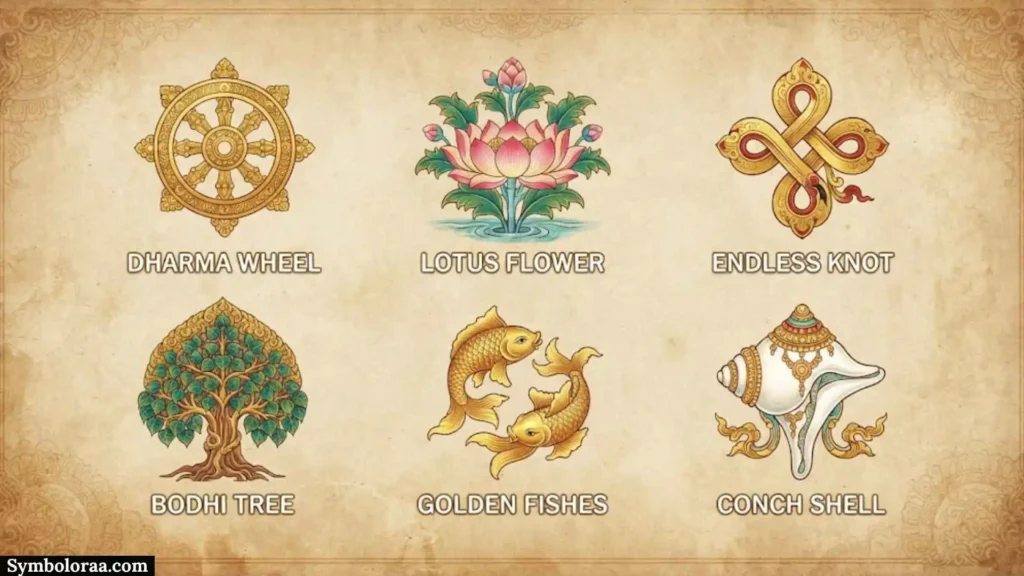
Buddhist mandalas are among the most recognized traditional mandala forms. They are particularly important in Vajrayana and Esoteric Buddhist traditions, where mandalas can serve as visual representations of sacred realms and as focuses for meditation and ritual.
The Metropolitan Museum of Art describes Tibetan mandalas as diagrams of the universe and explains that they can provide a focus for Buddhist religious practice.
Traditional Buddhist mandalas can contain:
- A central Buddha or deity
- Concentric circles
- Lotus petals
- Square palace-like structures
- Gates
- Directional arrangements
- Sanskrit seed syllables
- Protective figures
- Geometric borders
For example, a Japanese Esoteric Buddhist mandala in The Met’s collection contains a central sacred arrangement surrounded by figures and symbolic elements connected with Buddhist ritual practice.
The ☸ Wheel of Dharma is another widely recognized Buddhist symbol. It is not a mandala itself, but its circular form makes it visually compatible with mandala-inspired designs.
Buddhist mandalas should be treated as culturally specific religious works rather than simply decorative circles. Their individual figures and arrangements can have precise meanings within particular Buddhist traditions.
Meaning Easy Mandala Symbols
Easy mandala symbols are simple shapes that can be used to create a mandala-inspired pattern without complicated artwork.
Useful building blocks include:
- ○ — Circle
- ● — Filled circle
- ◇ — Diamond
- ◆ — Filled diamond
- △ — Triangle
- ✦ — Four-pointed star
- ✧ — Open four-pointed star
- ❈ — Decorative star-like symbol
- ❉ — Decorative floral symbol
A very simple pattern could look like:
○ ✦ ○ ✦ ○ ✦ ○
Or you could use a central symbol surrounded by repeated shapes:
◇ ✦ ◇ ◎ ◇ ✦ ◇
These combinations are not traditional mandala diagrams. They simply demonstrate how repeated Unicode shapes can create a radial or decorative feeling.
Simple symbols are useful for beginners, social-media text, journaling, crafts, digital designs, and small decorative projects.
Chakra Mandala Symbols
Chakra mandalas combine mandala-style geometry with imagery associated with the chakra system. These designs often use lotus petals, circles, geometric shapes, and colors connected with different chakras.
A commonly presented seven-chakra framework includes:
| Chakra | Sanskrit Name | Common Modern Association |
| Root | Muladhara | Grounding and stability |
| Sacral | Svadhisthana | Creativity and emotion |
| Solar Plexus | Manipura | Personal power |
| Heart | Anahata | Love and compassion |
| Throat | Vishuddha | Communication |
| Third Eye | Ajna | Awareness and insight |
| Crown | Sahasrara | Spiritual awareness |
These associations are common in modern chakra charts, but they should not be treated as universal definitions shared by every historical Indian tradition.
A chakra-inspired mandala may place a lotus or geometric symbol at the center and surround it with several rings. Colors are often used to distinguish the different chakra concepts.
These designs are popular in:
- Meditation artwork
- Yoga-related graphics
- Journals
- Wall decorations
- Digital illustrations
- Personal artwork
- Tattoos
Mandala Symbols For Family
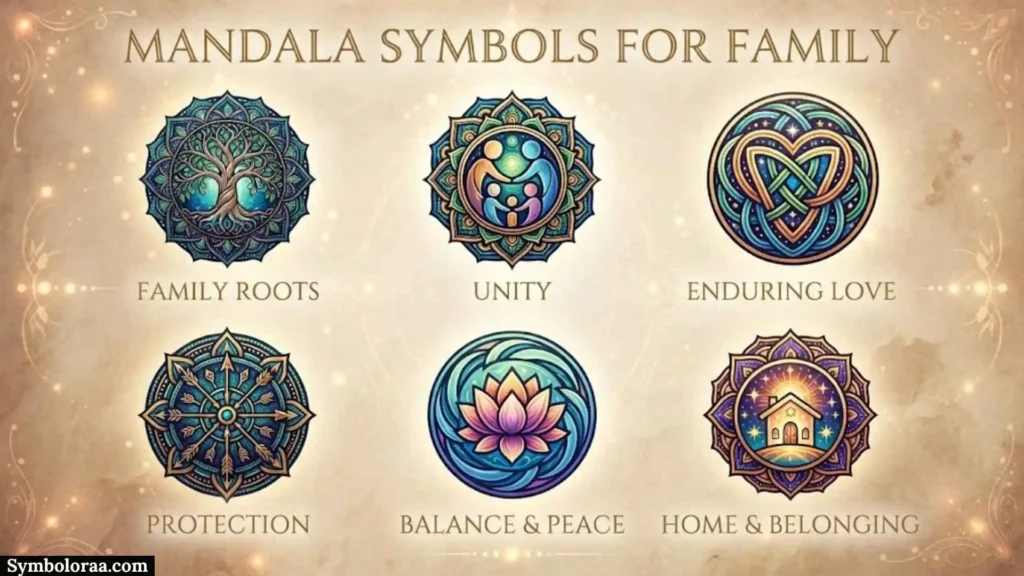
Family mandalas are usually personal designs rather than symbols with one established traditional meaning. They use the circular structure of a mandala to represent relationships, unity, belonging, or family connections.
A family mandala might place one large circle in the center and use smaller circles, petals, leaves, or stars around it to represent individual family members.
For example:
Center = Family Unity
Inner Ring = Parents Or Guardians
Outer Ring = Children Or Extended Family
Common design ideas include:
- Interlocking circles — Connection between family members
- Tree shapes — Roots, generations, and growth
- Leaves — Individual family members
- Hearts — Love and affection
- Stars — Important people or memories
- Repeated petals — Shared family bonds
There is no universal rule that says a particular family mandala symbol must mean one specific thing. The strongest personal designs are often based on the family’s own stories and relationships.
Tattoo Mandala Symbols And Their Meaning
Mandala tattoos use radial symmetry to create designs that can be detailed, minimalist, geometric, floral, or highly personal.
Lotus Mandala Tattoo
A lotus surrounded by geometric rings combines floral imagery with mandala structure. The lotus has important meanings in several Asian religious and artistic traditions, so the interpretation can depend on the cultural context.
Geometric Mandala Tattoo
Geometric tattoos emphasize symmetry, circles, triangles, lines, and repeated shapes. They can be chosen primarily for their balanced visual appearance or given a personal symbolic meaning.
Floral Mandala Tattoo
Floral mandalas replace or combine geometric sections with petals and leaves. They often create a softer appearance than highly angular designs.
Family Mandala Tattoo
A family design can include initials, dates, names, flowers, or repeated shapes representing different family members.
Minimalist Mandala Tattoo
A minimalist version uses fewer lines and larger shapes. This can make the basic radial structure easier to recognize at a small size.
When using a traditional religious symbol as a tattoo, it is worth understanding its original context. A design may have a meaning that goes beyond the decorative interpretation commonly found online.
Simple Mandala Symbols
Simple mandala symbols are based on a few repeating elements rather than dense detail. They can be especially useful when a design needs to remain clear at a small size.
Some useful shapes are:
○ ● ◇ ◆ △ ▲ ✦ ✧ ❈ ❉
A basic design could start with ● as the center, followed by repeated diamonds:
◇ ◆ ● ◆ ◇
For a floral appearance, repeated decorative characters can be arranged around a central circle:
❈ ○ ❈ ○ ❈
These examples are text decorations, not historical religious mandalas. Their main purpose is to show how simple symbols can be arranged to create symmetry.
Small Mandala Symbols
Small mandala designs need fewer details because tiny shapes can become difficult to see. For a small digital icon, tattoo, sticker, or decorative mark, a simple structure is usually easier to recognize.
A compact mandala can contain:
- A central dot or circle
- Four to eight repeated shapes
- One outer ring
- A simple border
Useful Unicode characters for small decorative designs include:
◉ ◎ ○ ● ✦ ✧ ◇ ◆ ❈ ❉
For example:
✦ ◇ ◎ ◇ ✦
A small design can also use four-direction symmetry:
◇ ✦ ◇
✦ ● ✦
◇ ✦ ◇
The actual design should be adjusted for the intended use. A tiny tattoo may need fewer details than a social-media graphic because body placement and long-term readability can affect how fine lines appear.
What Do Mandala Symbols Mean
Mandala symbols can represent different ideas depending on their cultural, religious, artistic, and personal context.
Common interpretations include:
- Wholeness — The complete circular structure can suggest completeness.
- Unity — Different parts arranged around one center can suggest connection.
- Balance — Symmetry creates a strong visual sense of equilibrium.
- Focus — A central point can direct attention inward.
- Harmony — Repetition creates an ordered relationship between shapes.
- Growth — Expanding layers can be interpreted as development.
- Spiritual Practice — Some traditional mandalas are used in religious meditation and ritual.
In Buddhist contexts, these meanings can become much more specific. For example, some mandalas represent complex sacred realms with a central figure and surrounding figures, directions, gates, and symbolic structures.
This is why the phrase “mandala meaning” can have different answers. A modern tattoo, a Hindu sacred diagram, and a Tibetan Buddhist mandala may all use circular geometry while serving very different purposes.
Family Mandala Symbols And Meanings
Family mandala symbols can turn a personal family story into a visual pattern. Instead of relying on a fixed dictionary of meanings, the designer can assign meaning to individual shapes.
For example:
| Symbol Or Element | Possible Personal Meaning |
| Center circle | The family as a whole |
| Connected circles | Family relationships |
| Tree | Family history |
| Roots | Ancestry |
| Leaves | Individual members |
| Flowers | Growth and memories |
| Hearts | Love and care |
| Stars | Special family members or milestones |
A family mandala can also include meaningful colors, initials, birth dates, flowers, or cultural motifs.
The circular format works particularly well because every element can remain connected to the same center. This creates a visual metaphor for a family whose individual members remain part of one larger group.
Because these designs are personal, there is no requirement to follow a standard symbolic dictionary. A shape can have whatever meaning the family intentionally gives it.
Jung Archetypes Mandala Symbols
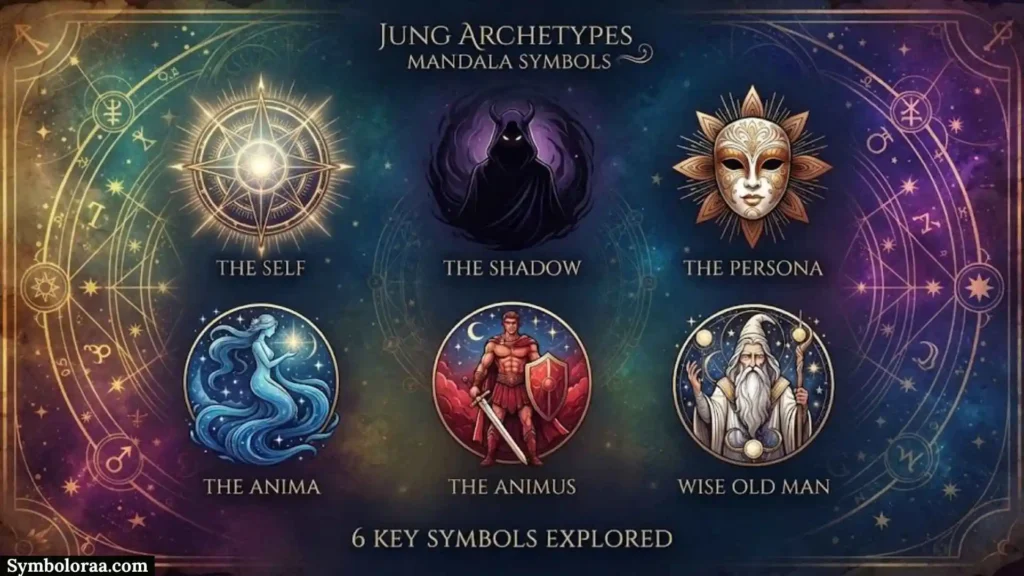
Carl Jung discussed mandalas in analytical psychology and connected mandala imagery with ideas of psychic wholeness and the Self. In his work, circular and symmetrical images could appear as symbolic expressions of psychological organization.
A Jungian interpretation may focus on ideas such as:
- Wholeness
- Integration
- Inner balance
- The Self
- Psychological organization
- Relationship between conscious and unconscious aspects of the mind
The center of a mandala is especially relevant to this interpretation. A structured design surrounding a central point can be understood within Jung’s framework as an image related to the organization of the psyche.
However, it is important not to claim that every mandala automatically has a Jungian meaning. Jung’s interpretation belongs to a particular psychological theory, while many mandalas are created for religious, artistic, decorative, or personal reasons.
The connection between Jung and mandalas is therefore best understood as one influential psychological interpretation rather than a universal definition.
FAQ
What is the spiritual meaning of a mandala?
A mandala can have spiritual meaning when it is used within a particular religious or contemplative tradition. Depending on the tradition, it may represent a sacred realm, cosmic order, meditation focus, or spiritual journey.
What is the most common mandala symbol?
There is no single symbol that represents all mandalas. Circles, lotus petals, geometric shapes, central points, and repeated patterns are common features, but their meanings vary by design and tradition.
Can I copy and paste a mandala symbol?
You can copy and paste individual Unicode characters that have a mandala-like decorative appearance, such as ◉, ◎, ✦, ❈, and ◇. A complete detailed mandala is normally an image rather than one Unicode character.
What does a mandala tattoo symbolize?
A mandala tattoo can symbolize balance, unity, wholeness, focus, growth, or personal meaning. The interpretation depends on the design and the person wearing it, while traditional religious imagery can have more specific meanings.
Are mandalas Hindu or Buddhist?
Mandalas are associated with multiple religious and cultural traditions, including Hindu and Buddhist traditions. Their forms and meanings differ between traditions, so a mandala should not automatically be classified as belonging to only one religion.
Conclusion
Mandala symbols bring together circles, geometric shapes, repeated patterns, and central points to create designs that can communicate ideas of balance, unity, focus, and wholeness. Their meaning is not fixed, and the same visual structure can be used differently in religious art, personal artwork, tattoos, family designs, and modern decoration.
Traditional Hindu and Buddhist mandalas deserve special attention because their symbols and arrangements can have specific cultural and religious meanings. Modern family, tattoo, chakra-inspired, simple, and small mandalas can instead be designed around personal ideas and visual preferences. Understanding this difference helps prevent decorative interpretations from being confused with traditional meanings.
For text and social media, Unicode characters such as ◉, ◎, ✦, ❈, ◇, ☸, and ॐ can provide a symbolic or decorative look. For a detailed mandala, however, an illustration offers much greater freedom. The best choice depends on whether you need a traditional symbol, a personal design, or a simple copy-and-paste character.

I’m Madison Reed, a contemporary American author who writes about love, family, friendship, and second chances. I’m fascinated by the choices that shape our lives and the moments that change us forever. My goal is to create honest, emotional stories with characters readers can connect with long after finishing each book.
Three Books:
When We Find Our Way
The Things We Never Said
Summer in September
 Jackson Miller
 Ethan Brooks