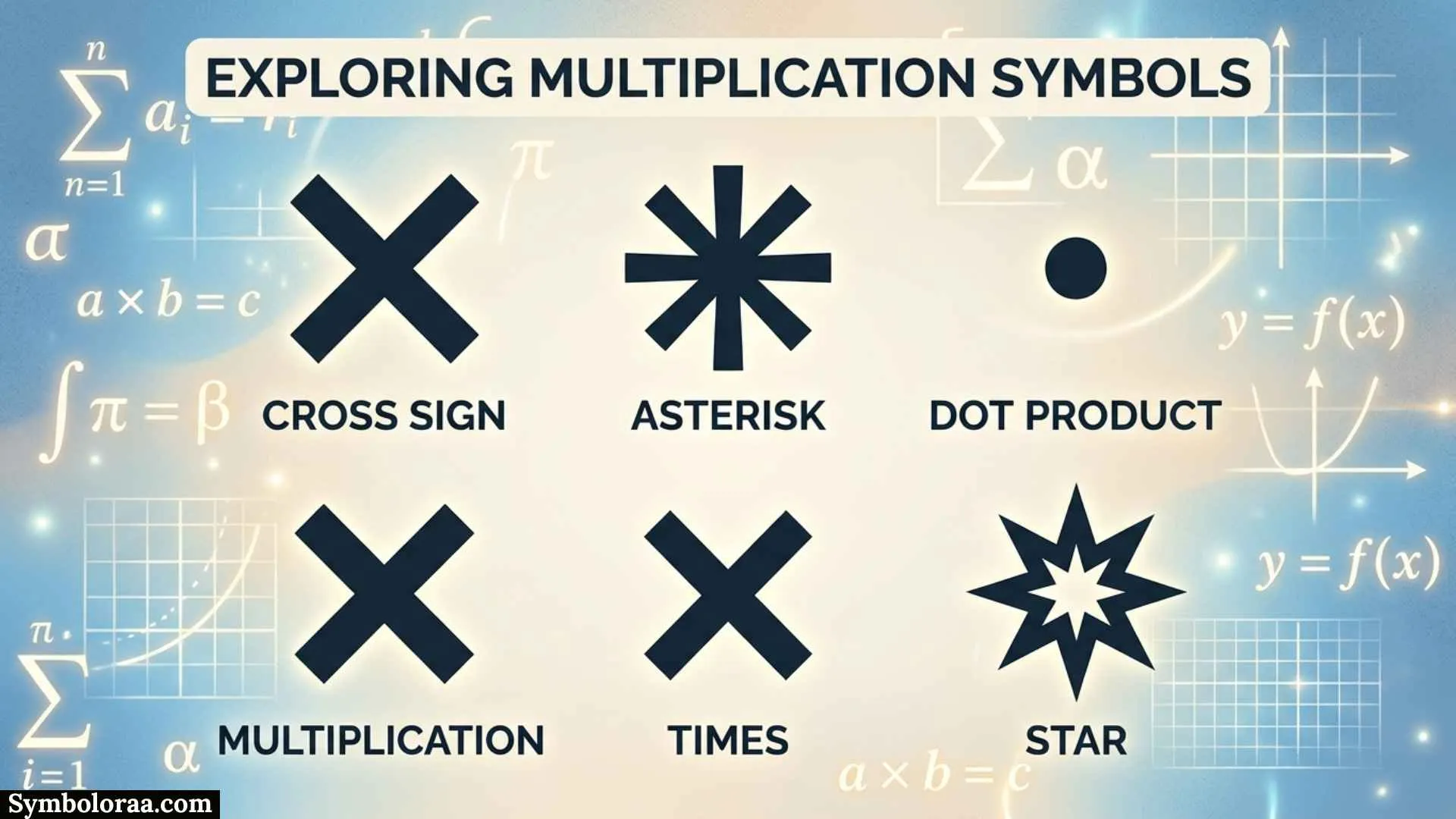
Multiplication symbols are mathematical signs used to show that two or more quantities should be multiplied. The most familiar symbol is ×, but multiplication can also be written with a dot, parentheses, an asterisk, or no visible symbol at all.
For example:
- 6 × 4 = 24
- 6 · 4 = 24
- 6(4) = 24
- 6 × a
- 3ab
- 2(x + 5)
Although these expressions all involve multiplication, the symbol you choose depends on the mathematical setting. The × symbol is common in basic arithmetic, while the dot, parentheses, and implied multiplication are more common in algebra and higher mathematics.
This guide explains the main multiplication symbols, what each one means, where it is used, how the symbols developed, how to type them, and how to avoid common mistakes.
Quick Answer:
The main multiplication symbols are ×, ·, ⋅, *, parentheses such as ( ), and implied multiplication such as 3x. The symbol × is common in arithmetic, while algebra usually prefers a dot, parentheses, or no visible symbol between factors.
What are Multiplication Symbols?
A multiplication symbol tells the reader that two quantities are being combined through multiplication.
In an expression such as:
7 × 5 = 35
the numbers 7 and 5 are called factors, while 35 is the product.
Multiplication can be represented in several equivalent ways:
| Form | Example | Meaning |
| Multiplication sign | 7 × 5 | Seven multiplied by five |
| Dot | 7 · 5 | Seven multiplied by five |
| Dot operator | 7 ⋅ 5 | Seven multiplied by five |
| Parentheses | 7(5) | Seven multiplied by five |
| Juxtaposition | 7x | Seven multiplied by x |
| Asterisk | 7 * 5 | Seven multiplied by five, commonly in computing |
OpenStax identifies the multiplication sign, dot, and parentheses as common ways to represent multiplication. In algebra, multiplication is also frequently written by placing factors next to each other.
Common Multiplication Symbols and Their Meanings
Different mathematical environments use different symbols because clarity matters. A symbol that works well in elementary arithmetic may be less useful in algebra, programming, or technical writing.
The Multiplication Sign ×
The × is the traditional multiplication sign used heavily in elementary arithmetic.
Examples:
4 × 6 = 24
12 × 3 = 36
25 × 8 = 200
It is especially useful when multiplying two numbers because it makes the operation immediately visible.
The Unicode Standard identifies × as U+00D7, officially named MULTIPLICATION SIGN.
The multiplication sign is also useful in word problems:
A box contains 12 pencils. If there are 5 boxes, how many pencils are there?
The calculation is:
12 × 5 = 60
The Multiplication Dot ·
A centered dot can also represent multiplication:
8 · 7 = 56
The dot is particularly common in algebra because the letter x may already be used as a variable.
For example:
5x
is much clearer than:
5 × x
when working with algebraic variables.
OpenStax lists dot notation as a standard way to represent multiplication and explains that the cross symbol is generally avoided in algebra because it can be confused with the variable x.
The Dot Operator ⋅
There is an important technical distinction between · and ⋅.
The character · is Unicode U+00B7, called MIDDLE DOT.
The character ⋅ is Unicode U+22C5, called DOT OPERATOR.
Unicode specifically states that DOT OPERATOR (⋅) is preferred for mathematical multiplication, while the middle dot has several other typographic uses.
So, in professionally typeset mathematics, you may see:
4 ⋅ 9 = 36
rather than:
4 · 9 = 36
Both can visually appear similar, but they are technically different Unicode characters.
Parentheses as a Multiplication Symbol
Parentheses can indicate multiplication when one quantity is placed directly beside another:
5(6) = 30
or:
3(x + 2)
In the second expression, 3 multiplies everything inside the parentheses.
For example:
3(x + 2)
can be expanded using the distributive property:
3x + 6
Parentheses are extremely common in algebra because they make the relationship between factors clear.
Implied Multiplication
Sometimes there is no visible multiplication symbol.
This is called implied multiplication or implicit multiplication.
Examples include:
4x
3ab
2(x + 5)
(x + 2)(x – 3)
In 4x, the meaning is:
4 × x
In 3ab, the meaning is:
3 × a × b
This notation is one of the most important conventions in algebra.
Why are There Different Multiplication Symbols?
There is no single multiplication symbol that is ideal for every situation.
The choice depends on readability, mathematical tradition, and the possibility of confusion.
Arithmetic Uses the × Sign Clearly
Elementary arithmetic often uses the multiplication sign because students need to see the operation explicitly.
For example:
9 × 8 = 72
is immediately recognizable as multiplication.
Algebra Often Avoids ×
In algebra, the letter x frequently represents an unknown number.
Consider:
3 × x
The expression is mathematically understandable, but it can become visually confusing when several variables are present.
Instead, algebra normally uses:
3x
or:
3 · x
OpenStax specifically notes that the cross symbol is generally not used for multiplication in algebra because it may be confused with a variable.
Programming Uses the Asterisk
Most programming languages cannot conveniently use the typographic symbol × as the multiplication operator.
Instead, they commonly use:
*
For example, Python uses:
result = 6 * 7
which produces:
42
Python’s official documentation lists a * b as the syntax for multiplication.
History of Multiplication Symbols
The symbols used for multiplication developed gradually rather than appearing all at once.
William Oughtred and the × Symbol
The cross-shaped multiplication sign is associated with William Oughtred, an English mathematician and clergyman.
Historical records compiled by MacTutor report that Oughtred used the multiplication cross in Clavis Mathematicae, composed around 1628 and published in 1631. An earlier appearance from 1618 is also associated with Oughtred.
The symbol eventually became widely recognized as the familiar × multiplication sign.
Leibniz and the Multiplication Dot
The multiplication dot became strongly associated with Gottfried Wilhelm Leibniz.
MacTutor records that Leibniz advocated the dot because he disliked using the cross, partly because it could be confused with the letter x.
This helps explain why modern algebra often favors dot notation or simply places factors next to each other.
The Asterisk and Earlier Mathematical Notation
The asterisk has also been used historically as a multiplication symbol.
MacTutor records an early use by Johann Rahn in Teutsche Algebra in 1659.
Today, however, the asterisk is especially common in computing and programming.
Multiplication Without a Symbol
Mathematicians have also represented multiplication by simply placing quantities next to one another.
This practice, known as juxtaposition, has a long history.
For example:
3x
means:
3 × x
Modern algebra relies heavily on this compact notation.
Multiplication Symbols in Arithmetic
Multiplication symbols are most visible in basic arithmetic.
Whole Number Multiplication
For whole numbers, the × symbol is easy to read:
14 × 5 = 70
The same calculation can also be written as:
14 · 5 = 70
or:
14(5) = 70
All three expressions have the same mathematical result.
Decimal Multiplication
Decimals can also be multiplied using the same notation:
2.5 × 4 = 10
or:
2.5 · 4 = 10
The multiplication symbol does not change the basic operation.
Fraction Multiplication
Fractions are commonly multiplied by placing them next to each other or using a multiplication dot:
2/3 × 3/4 = 1/2
In formal mathematical typesetting, fractions are often placed side by side:
(2/3)(3/4)
This makes it clear that the fractions are factors.
Negative Number Multiplication
Multiplication symbols also appear when working with negative numbers:
(-4) × 5 = -20
(-4)(-5) = 20
The symbol itself does not determine whether the answer is positive or negative. The signs of the factors determine the sign of the product.
Multiplication Symbols in Algebra
Algebra uses multiplication symbols differently from basic arithmetic.
Number Times a Variable
A number next to a variable indicates multiplication:
7x
means:
7 × x
Here, 7 is the coefficient and x is the variable.
More examples include:
3y
12a
5m
9n
Two Variables Multiplied Together
When two variables appear next to each other, they are multiplied:
xy
means:
x × y
Similarly:
abc
means:
a × b × c
This notation is called juxtaposition.
A Number Times Parentheses
A number placed directly before parentheses means multiplication:
4(x + 3)
The 4 multiplies every term inside the parentheses.
Using the distributive property:
4(x + 3) = 4x + 12
Two Parenthetical Expressions
Two sets of parentheses next to each other also indicate multiplication:
(x + 2)(x + 5)
This means:
(x + 2) × (x + 5)
The expression can then be expanded using algebraic multiplication rules.
Multiplication Symbols and Order of Operations
Multiplication is one of the operations governed by the standard order of operations.
Consider:
5 + 3 × 4
Multiplication is performed before addition:
3 × 4 = 12
Then:
5 + 12 = 17
So:
5 + 3 × 4 = 17
Parentheses can change the order:
(5 + 3) × 4 = 32
The difference comes from the parentheses.
Multiplication and division have the same priority level and are generally evaluated from left to right. OpenStax explains this ordering in its algebra material.
Multiplication Symbols in Geometry
Multiplication is frequently represented by symbols in geometry.
Area Calculations
The area of a rectangle is:
Length × Width
For a rectangle that is 8 meters long and 5 meters wide:
8 × 5 = 40
Therefore, the area is:
40 square meters
Volume Calculations
The volume of a rectangular box is:
Length × Width × Height
For example:
4 × 3 × 2 = 24
The volume is:
24 cubic units
In written formulas, multiplication may be shown using a dot or implied by adjacent variables.
Multiplication Symbols in Science
Scientific formulas use several forms of multiplication.
For example:
F = ma
means:
F = m × a
The multiplication sign is normally omitted because scientific notation favors compact expressions.
Scientific notation also frequently uses multiplication explicitly:
3 × 10⁸
This is the standard form for expressing a number using a power of ten.
The distinction between multiplication and the letter x becomes especially important in science because variables frequently appear in the same equations.
Multiplication Symbols in Matrices and Linear Algebra
Multiplication becomes more specialized when working with matrices.
For example:
AB
can indicate matrix multiplication between matrices A and B.
The multiplication sign is usually omitted because matrix notation relies heavily on juxtaposition.
Matrix multiplication is not the same as multiplying corresponding entries individually. The dimensions and order of the matrices matter.
For example, if:
A is a 2 × 3 matrix
and:
B is a 3 × 2 matrix,
then AB is defined and produces a 2 × 2 matrix.
This is an important example of why the meaning of a multiplication symbol depends on mathematical context.
Multiplication Symbols in Programming
Programming languages often use symbols that are easy to type on a keyboard.
The Asterisk Symbol *
The asterisk is widely used to represent multiplication in programming.
For example:
price = 25
quantity = 4
total = price * quantity
The expression:
price * quantity
means that the two values are multiplied.
Python’s official documentation lists * as the multiplication syntax and also distinguishes it from @, which is used for matrix multiplication.
Why Programming Uses * Instead of ×
The asterisk is available on standard keyboards and is easy for programming languages to parse.
The mathematical symbol:
×
is less convenient for ordinary source code.
Therefore:
8 * 6
is normally used in code rather than:
8 × 6
Multiplication Symbols in Spreadsheets

Spreadsheet applications also commonly use the asterisk.
For example:
=A1*B1
multiplies the value in cell A1 by the value in cell B1.
A spreadsheet formula does not normally use the mathematical × symbol as its multiplication operator.
This is another example of how multiplication notation changes according to the environment.
Multiplication Symbols on a Keyboard
People often search for ways to type the multiplication symbol because × is different from the lowercase letter x.
How to Type the × Symbol
The easiest method is often to copy and paste:
×
The symbol is Unicode U+00D7 MULTIPLICATION SIGN.
How to Type the Multiplication Dot
You can copy these symbols:
·
⋅
The first is MIDDLE DOT, while the second is DOT OPERATOR. Unicode recommends the dot operator for mathematical multiplication.
How to Type the Asterisk
The asterisk is:
*
It is commonly available directly on a computer keyboard and is widely used in programming.
× vs x: What is the Difference?
The symbols × and x may look similar, but they are not the same character.
| Symbol | Meaning | Common Use |
| × | Multiplication sign | Arithmetic |
| x | Letter/variable | Algebra, science, writing |
| ⋅ | Dot operator | Mathematical multiplication |
| · | Middle dot | Typography and some mathematical notation |
| * | Asterisk | Programming and typed notation |
For example:
5 × 4
uses a multiplication sign.
But:
5x
uses the letter x as a variable and means five times x.
Using the correct character improves readability and reduces ambiguity.
Multiplication Sign vs Cross Product
The multiplication sign × should not automatically be interpreted as a vector cross product.
In elementary arithmetic:
4 × 5
means multiplication.
In vector mathematics, a cross product is also traditionally represented using a cross-like symbol, but it has a different mathematical meaning.
Unicode separately identifies ⨯ as the vector or cross product symbol.
Therefore, context matters.
Multiplication Symbol vs Cross Multiplication
The multiplication sign and cross multiplication are related but not identical concepts.
The symbol:
×
simply represents multiplication.
Cross multiplication is a method commonly used when solving proportions.
For example:
a/b = c/d
can be transformed by cross multiplication into:
ad = bc
The term “cross multiplication” describes the procedure, not a special multiplication symbol.
Common Mistakes With Multiplication Symbols
Understanding the symbols is useful, but knowing what not to do is equally important.
Using x Instead of ×
A common mistake is typing:
5 x 8
when the intended mathematical expression is:
5 × 8
In informal writing, lowercase x may be understood, but × is the proper multiplication sign.
Using × Between Algebraic Variables
Writing:
3 × x
is not technically wrong, but algebra usually prefers:
3x
or:
3 · x
This keeps the expression easier to read.
Confusing the Middle Dot and Dot Operator
The characters:
·
and:
⋅
look almost identical, but they are different Unicode characters.
For mathematical typesetting, Unicode recommends ⋅ DOT OPERATOR for multiplication.
Forgetting Implied Multiplication
A learner may see:
4(x + 2)
and forget that the 4 multiplies the entire expression inside the parentheses.
The correct interpretation is:
4 × (x + 2)
Misreading Adjacent Variables
In:
abc
the letters normally represent multiplication:
a × b × c
They are not automatically one three-letter variable unless the context specifically defines abc as a single variable or name.
How to Choose the Right Multiplication Symbol
Use the following simple guide.
| Situation | Recommended Form |
| Elementary arithmetic | × |
| Basic word problems | × |
| Algebra with numbers | · or parentheses |
| Number and variable | 3x |
| Multiple variables | abc |
| Parenthetical expressions | 3(x + 2) |
| Programming | * |
| Python matrix multiplication | @ |
| Scientific formulas | Often implied multiplication |
| Mathematical typesetting | ⋅ when a dot is needed |
A Simple Decision Guide
Ask yourself what kind of content you are writing.
If you are solving basic arithmetic: use ×.
If you are writing algebra: use ·, parentheses, or implied multiplication.
If you are writing code: use the operator required by the programming language, such as * in Python.
If you are writing a scientific formula: check whether multiplication can be implied through adjacent symbols.
If you need a mathematical dot character: ⋅ is the Unicode dot operator preferred for multiplication.
Multiplication Symbols in Word Problems
Word problems do not always show a multiplication symbol directly. Instead, certain words can indicate multiplication.
Common multiplication phrases include:
- times
- groups of
- each
- per group
- repeated addition
- double
- triple
- twice
- product of
For example:
A teacher gives 6 students 4 pencils each. How many pencils are needed?
The important phrase is 4 pencils each.
The calculation is:
6 × 4 = 24
So the teacher needs 24 pencils.
Recognizing multiplication language is just as important as recognizing the symbol.
Multiplication Symbols With Exponents
Multiplication often appears together with exponents.
For example:
3 × 2²
First evaluate the exponent:
2² = 4
Then multiply:
3 × 4 = 12
The multiplication symbol and exponent have different roles.
In algebra, multiplication may also be implied:
3x²
means:
3 × x²
The exponent applies to x, while the coefficient 3 multiplies the resulting quantity.
Special Multiplication Symbols in Advanced Mathematics
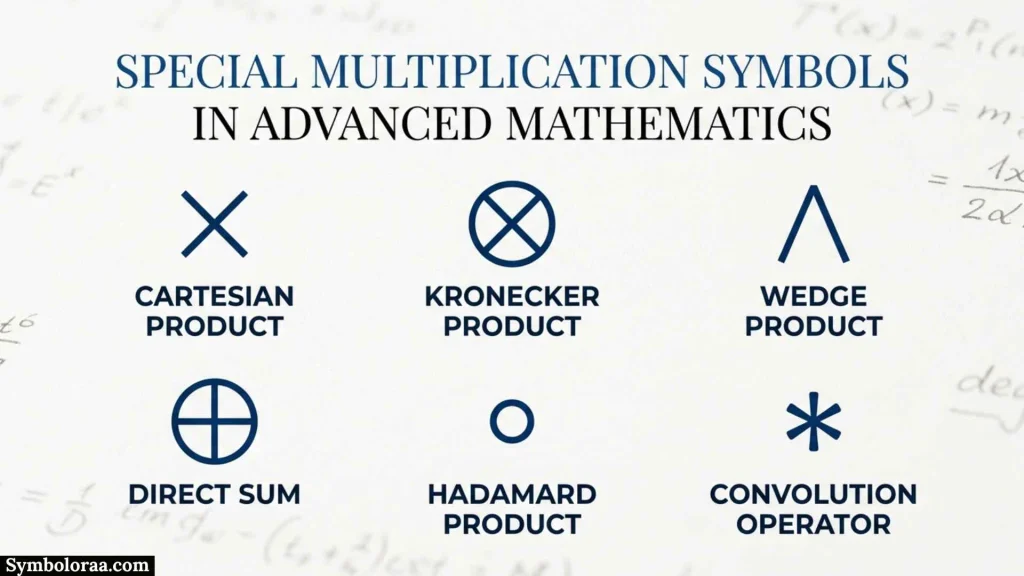
The ordinary multiplication sign is only one member of a much larger family of mathematical operators.
Depending on the field, symbols may represent:
- ordinary multiplication
- scalar multiplication
- vector products
- matrix multiplication
- Cartesian products
- tensor products
- other specialized products
For example, the Unicode Standard notes that × can also be used in specialized mathematical contexts such as the Cartesian product, while ⨯ is identified for vector or cross products.
The important lesson is that a multiplication-looking symbol does not always have the same meaning in every branch of mathematics.
Multiplication Symbols: Quick Reference
Here is a compact reference you can use when choosing a symbol.
| Symbol | Name | Example | Main Use |
| × | Multiplication Sign | 6 × 7 | Arithmetic |
| ⋅ | Dot Operator | 6 ⋅ 7 | Mathematical multiplication |
| · | Middle Dot | 6 · 7 | Some mathematical and typographic contexts |
| * | Asterisk | 6 * 7 | Programming |
| ( ) | Parentheses | 6(7) | Algebra |
| No symbol | Implied Multiplication | 6x | Algebra |
| @ | Matrix Multiplication Operator in Python | A @ B | Python matrix multiplication |
Frequently Asked Questions
What is the Main Multiplication Symbol?
The main multiplication symbol is ×. It is widely used in elementary arithmetic and means that two quantities should be multiplied.
What are the Different Multiplication Symbols?
Common multiplication notations include ×, ⋅, ·, *, parentheses, and implied multiplication such as 3x.
What Does × Mean in Math?
The symbol × means multiplication. For example, 4 × 5 means four multiplied by five.
What Does ⋅ Mean in Math?
The symbol ⋅ is the Unicode DOT OPERATOR and can represent multiplication. Unicode recommends it for mathematical multiplication when a dot is used.
What Does * Mean in Math?
The asterisk * can represent multiplication, especially in programming and computer-based notation.
For example:
8 * 5 = 40
Is x the Same as the Multiplication Sign?
No. The letter x and the multiplication sign × are different characters.
The letter x is often used as a variable, while × is a mathematical operator.
Why Does Algebra Not Usually Use ×?
Algebra generally avoids the cross multiplication symbol because it can be confused with the variable x. Instead, algebra commonly uses a dot, parentheses, or implied multiplication.
What Does 3x Mean?
3x means 3 multiplied by x.
The multiplication is implied because the number and variable are written next to each other.
What Does 2(x + 4) Mean?
2(x + 4) means that 2 is multiplied by the entire quantity inside the parentheses.
It can be expanded as:
2x + 8
What is the Difference Between · and ⋅?
· is Unicode MIDDLE DOT, while ⋅ is Unicode DOT OPERATOR.
Unicode recommends ⋅ for mathematical multiplication because it has clearer mathematical semantics.
Is × Used in Programming?
Most programming languages use another operator, commonly *, for multiplication.
For example, Python uses:
6 * 7
for multiplication.
What is the Multiplication Symbol on a Keyboard?
The easiest multiplication symbol to copy is:
×
For programming, use:
*
For mathematical dot notation, you can use:
⋅
Key Takeaways
- × is the most familiar multiplication sign in elementary arithmetic.
- ⋅ is the Unicode dot operator preferred for mathematical multiplication.
- · is the middle dot and is also used for multiplication in some contexts.
- * is widely used for multiplication in programming.
- Parentheses can indicate multiplication, as in 4(5).
- Adjacent quantities can indicate implied multiplication, as in 4x.
- Algebra usually avoids × because it can be confused with the variable x.
- The letter x and multiplication sign × are different characters.
- Multiplication notation changes depending on whether you are working with arithmetic, algebra, science, matrices, or programming.
- The symbol × can have specialized meanings in advanced mathematics, so context is important.
Conclusion
Multiplication symbols provide a simple way to show how quantities are combined, but the best symbol depends on the mathematical context. × is ideal for clear arithmetic, while ⋅, ·, parentheses, and implied multiplication are especially useful in algebra and technical mathematics. In programming, the asterisk * is commonly used instead.
Understanding these differences can prevent confusion between the multiplication sign and the variable x, improve mathematical formatting, and make equations easier to read. If you are solving a basic multiplication problem, writing an algebraic expression, interpreting a scientific formula, or entering a calculation into a computer, choosing the appropriate multiplication notation makes the meaning clearer.

I’m Jackson Miller, an American author inspired by mystery, adventure, and the unpredictable nature of life. I enjoy writing fast-moving stories filled with memorable characters, unexpected choices, and meaningful moments. Through my books, I want readers to experience new worlds while discovering something about courage, determination, and themselves.
Three Books:
The Edge of Tomorrow
Under a Broken Sky
The Road We Chose
 Madison Reed