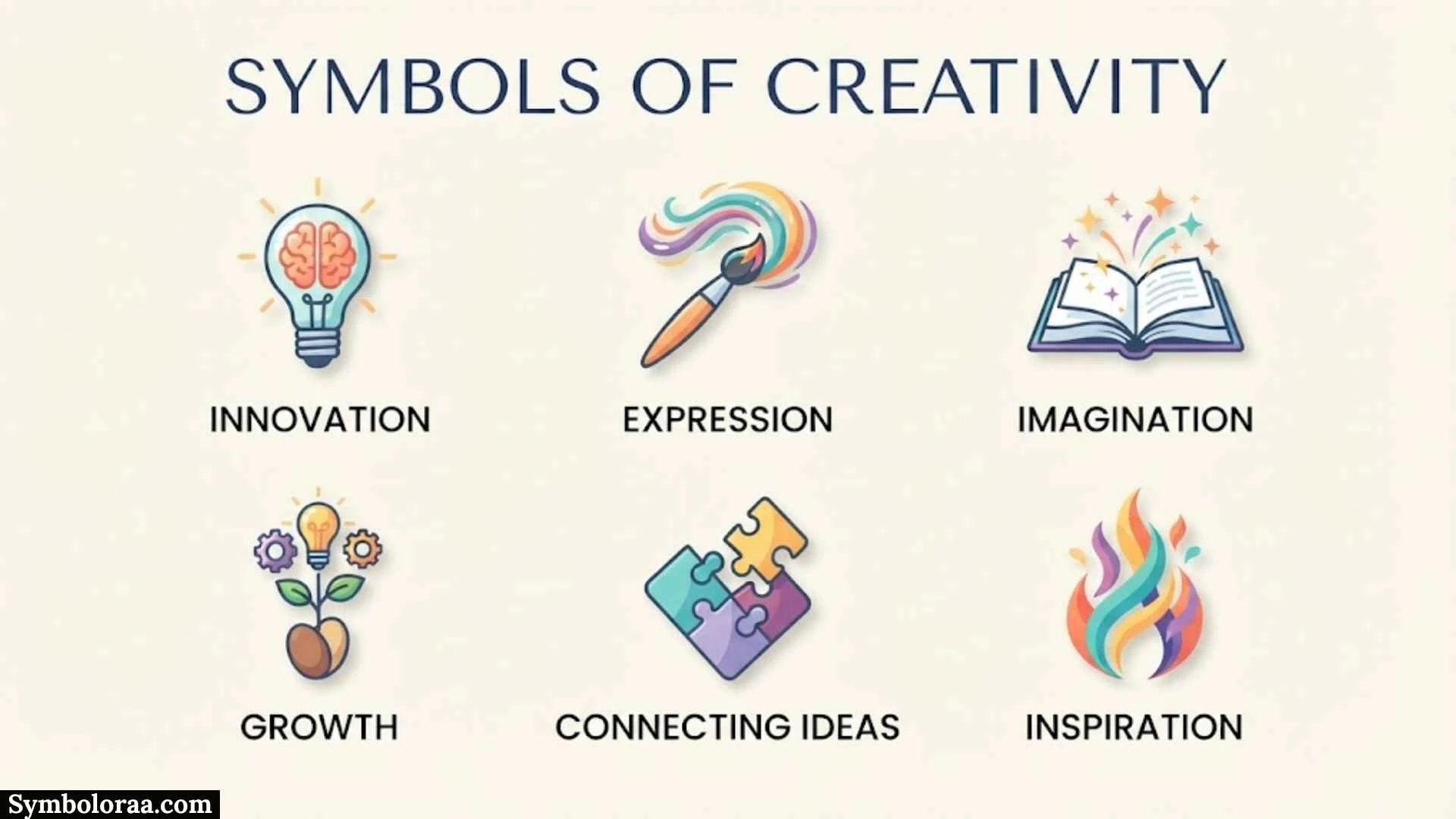
Creativity can appear in a painting, a business idea, a scientific discovery, a story, a useful invention, or even an everyday solution to a simple problem. Because creativity is an abstract idea, people often use visual symbols to communicate it quickly. Common examples include the light bulb, paintbrush, pencil, blank canvas, brain, butterfly, spiral, seed, rainbow, star, and open book.
There is no single symbol that represents creativity in every culture or situation. A light bulb may suggest a new idea, while a paintbrush points more directly toward artistic expression. A seed can represent an idea that needs time to grow, and a butterfly can suggest transformation and creative development.
This guide explains the most meaningful symbols of creativity, what they represent, how they differ, where they are used, and how to choose one for a logo, tattoo, artwork, classroom, business, writing project, or personal design. It also looks at why some symbols become strongly associated with creative thinking and why their meanings can change with context.
Quick Answer:
The light bulb is one of the most recognizable modern symbols of creativity because it represents an idea, inspiration, or sudden insight. However, creativity has no single universal symbol. Paintbrushes, pencils, blank pages, brains, spirals, butterflies, seeds, stars, and other images can represent different parts of the creative process.
What Are Symbols Of Creativity?
Symbols of creativity are visual objects, shapes, images, or motifs that communicate ideas such as imagination, originality, inspiration, artistic expression, innovation, exploration, or creative growth.
Symbolism works by allowing an image to communicate more than its literal appearance. The University of Hong Kong’s University Museum and Art Gallery explains symbolism as the use of visual elements such as objects, colors, and shapes to convey deeper meanings, ideas, emotions, mythology, or cultural references.
Creativity itself is broader than making art. The American Psychological Association describes creativity in terms of producing or developing original work, theories, techniques, or thoughts, while contemporary psychology commonly considers both originality and effectiveness or appropriateness when discussing creative ideas.
That distinction matters when choosing a symbol. A paintbrush may represent artistic creativity, but a light bulb may better represent idea generation. A gear may suggest technical innovation, while a seed may communicate creative potential and growth.
Creativity Symbols Can Represent Different Stages
A useful way to understand these symbols is to connect them with stages of creative activity:
Inspiration → Idea → Exploration → Creation → Development → Expression
Different symbols can represent different points in that process.
| Creative Stage | Suitable Symbol | What It Can Suggest |
| Inspiration | Spark or Light Bulb | Sudden idea or insight |
| Idea Generation | Brain | Thinking and imagination |
| Exploration | Spiral | Discovery and development |
| Creation | Pencil or Paintbrush | Making something |
| Growth | Seed or Tree | Developing an idea |
| Transformation | Butterfly | Change and reinvention |
| Expression | Canvas or Musical Note | Sharing creative work |
| Possibility | Blank Page | Unlimited potential |
This approach is more useful than assuming that every creativity symbol means exactly the same thing.
Why Are Creativity Symbols So Powerful?
A visual symbol can communicate an abstract concept faster than a paragraph of text. When people see a pencil, paintbrush, or light bulb in the right context, they can often understand the intended message without additional explanation.
Visual communication has long been used to compress complex ideas into recognizable forms. Museums and academic institutions use symbols to help viewers interpret objects, stories, cultural references, and artistic themes.
Creativity symbols are particularly useful because creativity has many forms.
A scientist developing a new method, a designer creating a product, a student finding a new way to solve a problem, and a novelist writing a story are all engaging in different forms of creative work.
Symbols Make Abstract Ideas Concrete
You cannot physically point to “creativity” in the same way you can point to a pencil or canvas. A symbol gives the abstract concept a recognizable visual form.
For example:
- A light bulb turns an idea into an image of illumination.
- A seed turns creative potential into an image of growth.
- A blank canvas turns possibility into an empty space waiting for creation.
- A butterfly turns transformation into a visual story.
- A spiral can represent an evolving process rather than a fixed endpoint.
This is why the same creative concept can have many legitimate symbols.
The Most Common Symbols Of Creativity And Their Meanings
Different symbols emphasize different qualities of creative thinking. The following examples cover artistic, intellectual, imaginative, practical, and transformational forms of creativity.
Light Bulb: Ideas And Inspiration
The light bulb is one of the most familiar modern representations of an idea.
It commonly suggests:
- Inspiration
- New ideas
- Insight
- Discovery
- Problem-solving
- Innovation
- Understanding
The image is closely connected with the idea of an “aha” or insight moment. Research on creativity symbolism has also found the light bulb strongly associated with ideas and idea generation.
However, there is an important limitation.
A light bulb can make creativity look like something that suddenly appears. Research and psychological discussions of creativity suggest that creative outcomes often involve preparation, exploration, evaluation, and development rather than a single instant of inspiration.
Best use: Innovation, brainstorming, business ideas, education, problem-solving, and technology.
Paintbrush: Artistic Expression
The paintbrush is one of the clearest symbols of artistic creativity.
It can represent:
- Painting
- Artistic expression
- Imagination
- Visual communication
- Personal style
- Creative freedom
Research examining social representations of creativity found strong associations between creativity and the arts, including paintbrushes, colors, and children’s drawings.
A paintbrush is therefore particularly appropriate when the message is about artistic creativity rather than creativity in general.
Best use: Art studios, artists, painting, design, creative education, and art-related branding.
Pencil: Drawing, Writing, And Making Ideas Visible
A pencil represents the act of turning thoughts into visible marks.
It can symbolize:
- Drawing
- Writing
- Design
- Planning
- Imagination
- Experimentation
- Self-expression
The pencil also has an advantage that a light bulb does not: it represents creative action.
A person can use a pencil to sketch an idea, erase it, change it, and develop it. That makes it a useful metaphor for experimentation.
Best use: Writers, designers, architects, students, illustrators, and creative professionals.
Blank Canvas: Possibility And Creative Freedom
A blank canvas represents a creative space before the final outcome has been decided.
It can symbolize:
- Unlimited possibility
- Freedom
- New beginnings
- Potential
- Imagination
- Artistic choice
For example, an artist standing in front of a blank canvas has not yet committed to the final image. The empty surface represents both opportunity and uncertainty.
Best use: Personal development, art, creative businesses, workshops, and inspirational designs.
Brain: Creative Thinking And Problem-Solving
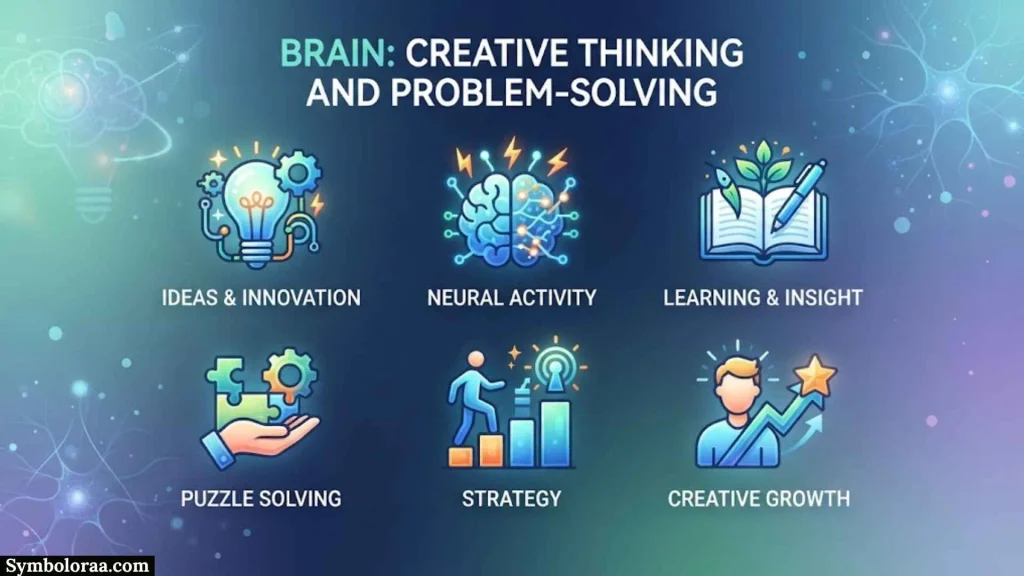
The brain is often used to represent the mental side of creativity.
It can suggest:
- Thinking
- Imagination
- Intelligence
- Problem-solving
- Mental flexibility
- Idea generation
This symbol is especially useful when creativity is being discussed outside traditional art.
A software designer solving a difficult interface problem may be using creativity even though no paintbrush is involved.
The American Psychological Association emphasizes that creativity occurs across different areas of life rather than only in artistic activities.
Best use: Education, science, technology, research, business, psychology, and problem-solving.
Butterfly: Transformation And Creative Growth
The butterfly can represent transformation because its life cycle provides a familiar metaphor for change.
As a creativity symbol, it may suggest:
- Transformation
- Growth
- Reinvention
- Freedom
- Development
- Personal expression
A creative idea may begin in an unfinished or uncertain form and develop into something very different.
Best use: Personal creativity, transformation, artistic projects, tattoos, and inspirational designs.
Spiral: Exploration And Creative Development
A spiral is useful when creativity is viewed as a process rather than a single event.
It can represent:
- Growth
- Movement
- Exploration
- Development
- Evolution
- Continuous discovery
A spiral can also work well in abstract design because it does not force creativity into one specific field such as painting or writing.
Best use: Abstract logos, artwork, personal symbolism, creative development, and educational graphics.
Seed: An Idea With Potential
A seed is a powerful metaphor for creative potential.
A seed begins small but contains the potential for development. Similarly, a creative idea may start as a rough thought and become a finished project after research, testing, revision, and effort.
The seed can therefore represent:
- Potential
- Growth
- Patience
- Development
- New ideas
- Long-term creativity
Research on metaphors for ideas has specifically examined the contrast between the light bulb and the seed, noting that these metaphors can communicate different assumptions about how ideas emerge and develop.
Best use: Education, entrepreneurship, personal growth, innovation, and creative development.
Open Book: Imagination And Knowledge
An open book connects creativity with knowledge, reading, storytelling, and imagination.
It can represent:
- Learning
- Storytelling
- Knowledge
- Imagination
- Discovery
- Literary creativity
A writer may transform information, memories, and observations into a new story. In that sense, the book can represent both the source of ideas and the finished creative work.
Best use: Writers, schools, libraries, publishing, education, and storytelling.
Rainbow: Diversity And Possibility
A rainbow can represent variety, imagination, optimism, and the combination of different elements.
Its many colors can work as a metaphor for the many directions creative thinking can take.
A rainbow may therefore symbolize:
- Diversity
- Imagination
- Possibility
- Expression
- Creativity
- Joy
Its meaning should still be considered in context because colors and natural imagery can have different cultural associations.
Star: Inspiration And Brilliance
A star can symbolize an exceptional idea, inspiration, ambition, or creative achievement.
It is useful when creativity is connected with:
- Excellence
- Inspiration
- Discovery
- Achievement
- Originality
- Vision
A star is also visually simple, making it practical for icons, logos, stickers, and small designs.
Musical Note: Creative Expression Through Sound
A musical note represents creativity through music and sound.
It can suggest:
- Musical composition
- Rhythm
- Performance
- Emotional expression
- Artistic creativity
- Original composition
This is a good example of why creativity symbols should be matched to the creative field. A musical note communicates something more specific than a general light bulb.
Quill: Writing And Literary Creativity
A quill has a strong connection with historical writing and literature.
It can represent:
- Writing
- Storytelling
- Poetry
- Literature
- Imagination
- Communication
A modern pen may communicate writing more directly, while a quill can create a more traditional or literary feeling.
Symbols Of Creativity Compared By Meaning
Not every symbol should be used for the same purpose. This comparison makes the differences easier to understand.
| Symbol | Primary Meaning | Type Of Creativity | Best Context |
| Light Bulb | Idea and insight | Innovation | Business, technology |
| Paintbrush | Artistic expression | Visual art | Art and design |
| Pencil | Making ideas | Writing and design | Education, creative work |
| Brain | Thinking | Intellectual creativity | Science, research |
| Blank Canvas | Possibility | Artistic creativity | Art, personal projects |
| Seed | Potential | Creative growth | Education, business |
| Butterfly | Transformation | Personal creativity | Tattoos, artwork |
| Spiral | Exploration | Abstract creativity | Design, symbolism |
| Open Book | Imagination | Literary creativity | Writing, education |
| Musical Note | Expression | Musical creativity | Music |
| Star | Inspiration | Achievement-oriented creativity | Branding |
| Rainbow | Variety | Expressive creativity | Art and design |
Symbols Of Artistic Creativity
Artistic creativity is one of the most common ways people imagine creativity, but it is only one part of the larger concept.
A 2011 study of social representations of creativity found strong associations with artistic symbols, especially paintbrushes, colors, children’s drawings, and musical imagery. The study also identified natural and abstract symbols connected with ideas such as growth, change, complexity, and possibility.
Visual Art Symbols
For painting and visual design, consider:
- Paintbrush
- Palette
- Pencil
- Canvas
- Color wheel
- Easel
- Camera
- Abstract shapes
These symbols work because they directly connect the visual object with the creative activity.
Writing And Literary Symbols
For writing, use:
- Pen
- Pencil
- Quill
- Open book
- Blank page
- Ink
- Typewriter
A blank page is especially interesting because it represents both the challenge and freedom of starting a new work.
Music And Performance Symbols
For music and performance, consider:
- Musical note
- Treble clef
- Microphone
- Instrument
- Sound wave
- Theater mask
These symbols communicate a particular creative medium rather than creativity as a general concept.
Symbols Of Innovation And New Ideas
Creativity and innovation overlap, but they are not identical.
Creativity generally concerns generating or developing original ideas. Innovation often involves applying ideas in ways that create a useful result or solve a problem.
That difference changes which symbol works best.
Light Bulb For Idea Generation
A light bulb works when the message is:
“We have a new idea.”
It is particularly suitable for brainstorming and ideation.
Rocket For Progress
A rocket can suggest:
- Launching an idea
- Progress
- Ambition
- Exploration
- Rapid development
It is more about moving forward than simply having an idea.
Gear For Practical Innovation
A gear can represent:
- Engineering
- Systems
- Manufacturing
- Technical problem-solving
- Practical application
A gear therefore fits a technology or engineering context better than a paintbrush.
Puzzle For Connecting Ideas
A puzzle can represent:
- Problem-solving
- Combining information
- Finding relationships
- Completing a complex task
However, a puzzle is not necessarily a universal creativity symbol. Research on creativity symbolism has shown that some people interpret puzzles more as intelligence or problem-solving than creativity itself.
Natural Symbols That Represent Creativity
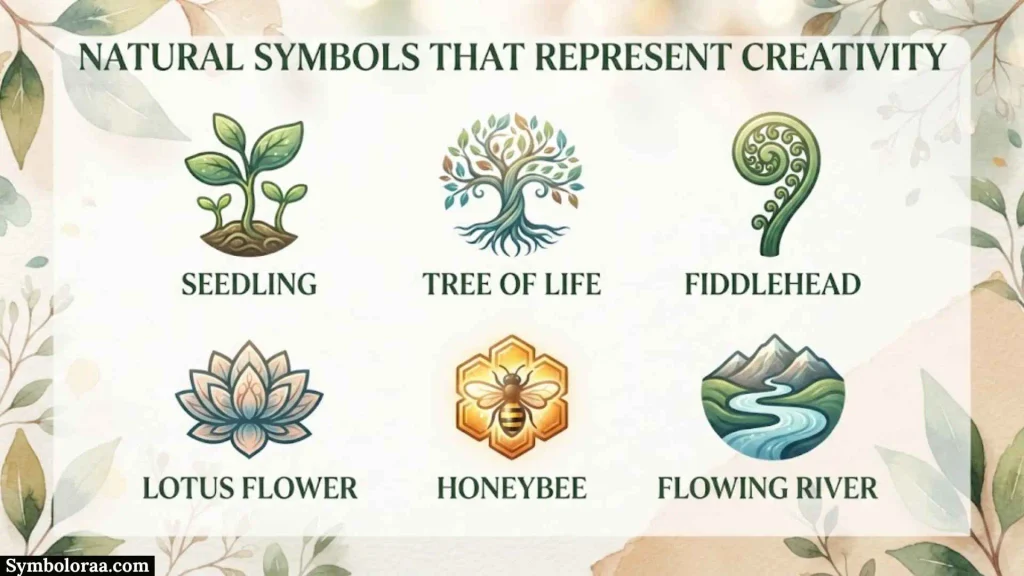
Nature-based symbols can communicate creativity without using traditional artistic objects.
Tree
A tree can represent:
- Growth
- Branching ideas
- Knowledge
- Development
- Creativity over time
Its branches provide a useful visual metaphor for one idea developing into many possibilities.
Flower
A flower can suggest:
- Creation
- Beauty
- Development
- Expression
- Natural growth
Seed
The seed emphasizes the beginning of the creative process.
Butterfly
The butterfly emphasizes transformation.
Rainbow
The rainbow emphasizes variety and visual expression.
These distinctions help make a design more meaningful instead of simply choosing an attractive nature image.
Cultural Context And Creativity Symbols
One of the biggest mistakes in symbolism is assuming that every image has exactly the same meaning everywhere.
Symbols are shaped by culture, history, religion, art, language, media, and personal experience. The University of Hong Kong notes that symbols can carry cultural references and meanings beyond their literal appearance.
This means a symbol should be researched before being used in a culturally specific project.
Why Cultural Context Matters
Imagine using a symbol for a global company logo. A designer may intend it to represent creativity, while an audience in another cultural context may recognize a different historical or cultural association.
For ordinary decorative use, this may not be a major issue. For tattoos, cultural artwork, educational materials, or commercial branding, it deserves more attention.
Creativity Does Not Have One Universal Visual Language
There is also no universal rule saying that a light bulb, butterfly, or paintbrush must represent creativity.
Meanings are learned and reinforced through repeated cultural use.
That is why the safest approach is to explain the intended meaning when a symbol could reasonably have multiple interpretations.
Historical Development Of Creativity Symbolism
The modern visual language of creativity developed from several overlapping traditions rather than from one ancient symbol.
Art, literature, craftsmanship, science, invention, and philosophy have all contributed to how societies imagine creative work.
Historical research on imagery and creativity shows that thinkers have discussed the relationship between mental imagery and creative thought for centuries. A review in the Journal of Creative Behavior traces discussions of imagery through figures and traditions including Plato, Aristotle, Renaissance thinkers, and later psychological theories.
Modern popular culture then gave certain objects, particularly the light bulb, a strong association with ideas and insight.
From Artistic Tools To Abstract Symbols
Early and traditional representations of creativity often focused on things people physically used to make objects:
- Brushes
- Pens
- Pencils
- Tools
- Musical instruments
- Craft materials
Modern design increasingly uses abstract forms as well:
- Spirals
- Sparks
- Networks
- Geometric shapes
- Light
- Brain imagery
- Digital icons
This shift reflects the broader understanding that creativity happens in science, business, technology, education, everyday life, and the arts.
How To Choose The Right Symbol Of Creativity
Choosing a symbol becomes easier when you start with the message instead of the image.
Step 1: Decide What Kind Of Creativity You Mean
Ask:
Is the message about art?
Choose a paintbrush, palette, canvas, or color-related symbol.
Is it about ideas?
Choose a light bulb, spark, or brain.
Is it about writing?
Choose a pencil, pen, quill, book, or blank page.
Is it about growth?
Choose a seed, tree, flower, or spiral.
Is it about transformation?
Choose a butterfly.
Is it about innovation?
Consider a light bulb, gear, rocket, or abstract technology-inspired symbol.
Step 2: Consider Your Audience
A simple light bulb may be immediately understood by a general audience.
A more abstract spiral or geometric mark may need supporting text.
For a professional brand, ask whether someone seeing the symbol for the first time could understand its intended message.
Step 3: Decide Whether You Need A General Or Specific Symbol
Use a general symbol when the message is broad.
Examples:
- Light bulb
- Brain
- Spark
- Spiral
Use a specific symbol when the creative field matters.
Examples:
- Paintbrush for painting
- Musical note for music
- Quill for literature
- Camera for photography
Step 4: Check Cultural And Historical Meaning
Before using an unfamiliar symbol, research its original context.
This is particularly important for:
- Tattoos
- Cultural artwork
- Religious designs
- Indigenous symbols
- Commercial logos
- Educational materials
Step 5: Test The Symbol Without Explanation
Show the design to someone who does not know your intended meaning.
Ask:
“What does this symbol make you think of?”
Their response can reveal whether your visual message is clear.
A Simple Decision Tree For Choosing A Creativity Symbol
Use this quick guide:
What do you want the symbol to communicate?
↓
A new idea or inspiration?
→ Choose a light bulb or spark
Artistic expression?
→ Choose a paintbrush, palette, or canvas
Writing or storytelling?
→ Choose a pencil, pen, quill, or open book
Thinking and problem-solving?
→ Choose a brain or puzzle
Creative growth?
→ Choose a seed, tree, or spiral
Transformation?
→ Choose a butterfly
Freedom of imagination?
→ Consider wings, birds, or a blank canvas
Innovation and progress?
→ Consider a light bulb, gear, rocket, or abstract geometric mark
This decision tree prevents a common design mistake: choosing a symbol because it looks creative without deciding what aspect of creativity it should communicate.
Creativity Symbols For Logos And Branding
A creativity symbol can be useful in branding, but a logo should communicate more than “creative.”
For example, a design agency may want to communicate:
- Originality
- Professionalism
- Innovation
- Simplicity
- Technical skill
- Artistic expression
A paintbrush might communicate art but not necessarily technology. A gear might communicate engineering but not artistic expression.
Better Logo Strategy
Instead of combining five obvious creativity symbols, consider one distinctive visual concept.
For example:
Creative education brand:
Open book + subtle spark
Design studio:
Abstract shape + pencil-inspired form
Technology company:
Geometric network + light-inspired element
Writing brand:
Simple pen or page symbol
The goal is to create a visual identity rather than a collection of generic icons.
Creativity Symbols For Tattoos
Creativity tattoos often work best when the symbol has a personal connection.
For Artists
Consider:
- Paintbrush
- Palette
- Canvas
- Abstract linework
For Writers
Consider:
- Pen
- Quill
- Book
- Blank page
For Innovators
Consider:
- Light bulb
- Spark
- Geometric pattern
- Abstract mechanism
For Personal Growth
Consider:
- Butterfly
- Seed
- Tree
- Spiral
Before getting a tattoo based on a cultural symbol, verify the symbol’s historical meaning rather than relying on a generic internet description.
Creativity Symbols For Students And Education
Creativity symbols can help teachers make abstract concepts easier for students to understand.
A classroom poster might use:
- Light bulb for ideas
- Pencil for expression
- Puzzle for problem-solving
- Seed for learning and growth
- Brain for thinking
- Rainbow for imagination
- Blank page for possibility
For example, a teacher could explain:
“The light bulb represents the idea. The pencil represents turning that idea into something real.”
This gives students a simple visual model of the creative process.
Research in psychology also treats creativity as broader than artistic talent, with creative thinking appearing in everyday activities, learning, professional work, and problem-solving.
Common Misconceptions About Creativity Symbols
Understanding what these symbols do not mean is just as important as understanding what they represent.
The Light Bulb Does Not Mean Creativity Is Instant
A light bulb suggests sudden insight, but creative work often involves preparation, experimentation, revision, and evaluation.
This is one reason the seed can be a useful alternative metaphor: it emphasizes development rather than sudden illumination.
A Paintbrush Does Not Represent All Creativity
Painting is creative, but creativity also occurs in science, technology, writing, business, education, and everyday problem-solving.
There Is No Official Universal Creativity Symbol
Some images are widely recognized, but there is no single globally standardized symbol that everyone must interpret as “creativity.”
Creativity Is Not The Same As Decoration
A visually unusual design is not automatically creative. Creativity is concerned with generating or developing ideas and outcomes that are original and appropriate or effective in context.
Common Mistakes When Using Creativity Symbols
Choosing The Most Popular Symbol Without Considering The Message
A light bulb is recognizable, but it may not be the best choice for a painting business.
Using Too Many Symbols
A logo containing a light bulb, brain, pencil, rocket, butterfly, rainbow, and paintbrush can become visually confusing.
Ignoring Cultural Meaning
A symbol can have meanings beyond the one intended by the designer.
Treating Symbolism As A Fixed Dictionary
Symbolism depends on context. The same object can represent different ideas in different designs.
Copying Another Brand’s Visual Identity
Using a common concept such as a light bulb is different from copying an existing company’s specific logo, typography, arrangement, or distinctive design elements.
How To Make A Creativity Symbol More Original
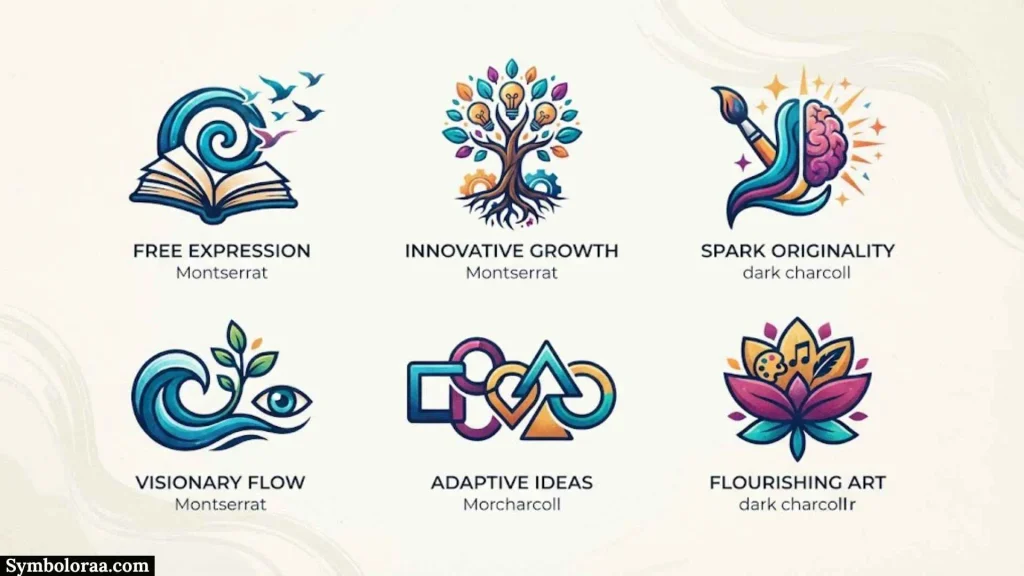
A familiar symbol does not automatically make a design unoriginal. The surrounding visual language can give it a distinctive meaning.
Try these approaches:
- Combine two related concepts carefully.
- Use an unexpected but meaningful shape.
- Create an original abstract mark.
- Use negative space.
- Connect the symbol to the actual creative field.
- Keep the design simple enough to recognize.
- Test the symbol with your target audience.
For example, a writing company could combine a page shape with a subtle growing-branch form. The page communicates writing while the growth element communicates developing ideas.
Expert Insight: Creativity Is More Than Having An Idea
One of the most useful distinctions in creativity research is between having an idea and developing that idea into something meaningful.
The American Psychological Association’s recent discussion of creativity emphasizes that creativity is not limited to flashes of inspiration or artistic talent. It also involves approaching problems differently and bringing ideas into reality.
This distinction changes how we should interpret creativity symbols.
A light bulb represents the idea.
A pencil represents working with the idea.
A blank canvas represents possibility.
A seed represents development.
A finished artwork represents creative output.
Together, these symbols tell a more complete story than any one image alone.
Key Takeaways About Creativity Symbols
- There is no single universal symbol for creativity.
- The light bulb commonly represents ideas, insight, and inspiration.
- The paintbrush strongly represents artistic creativity.
- The pencil represents writing, drawing, design, and creative action.
- The brain represents thinking and intellectual creativity.
- The blank canvas represents possibility and creative freedom.
- The seed represents an idea that develops over time.
- The butterfly represents transformation and creative growth.
- The spiral can represent exploration and continuous development.
- The open book connects creativity with knowledge and storytelling.
- Cultural context can change how a symbol is understood.
- The best symbol depends on the message, audience, medium, and intended meaning.
Frequently Asked Questions About Symbols Of Creativity
What Is The Most Common Symbol Of Creativity?
The light bulb is one of the most recognizable modern symbols associated with creativity, ideas, and inspiration. However, it is not an official universal symbol of creativity. Research into social representations of creativity has also identified artistic imagery such as paintbrushes and colors, along with brain, writing, natural, and abstract symbols.
What Symbol Represents A Creative Idea?
A light bulb is commonly used to represent a creative idea or insight. A spark can communicate a similar meaning. A seed offers a different interpretation by suggesting that an idea can develop gradually rather than appearing instantly.
What Symbol Represents Imagination?
An open book, blank canvas, stars, wings, rainbow, or butterfly can represent imagination depending on the context. The open book is especially useful for storytelling and literary imagination, while a blank canvas emphasizes unlimited creative possibilities.
What Symbol Represents Artistic Creativity?
A paintbrush, palette, pencil, canvas, camera, or musical note can represent artistic creativity. The best option depends on the specific art form being represented.
What Symbol Represents Creative Thinking?
A brain, light bulb, puzzle, or abstract network can represent creative thinking. The brain emphasizes mental activity, the light bulb emphasizes insight, and the puzzle emphasizes connecting information or solving problems.
What Symbol Represents Innovation?
A light bulb, gear, rocket, spark, or abstract geometric design can represent innovation. A light bulb focuses on an idea, while a gear emphasizes practical systems and a rocket suggests progress or launch.
What Symbol Represents Creative Growth?
A seed, tree, spiral, or butterfly can represent creative growth. A seed emphasizes potential, a tree emphasizes development, a spiral emphasizes an ongoing process, and a butterfly emphasizes transformation.
What Animal Symbolizes Creativity?
There is no universally accepted animal symbol for creativity. A butterfly is often used as a metaphor for transformation and growth, while birds can communicate freedom and exploration. Animal symbolism should be interpreted within its cultural and artistic context.
What Color Represents Creativity?
Purple is often associated with imagination and originality in modern design, while yellow can suggest ideas and optimism and orange can suggest energy. Color symbolism varies by culture and context, so no single color universally means creativity.
Is The Light Bulb A Universal Symbol Of Creativity?
No. The light bulb is a widely recognized modern symbol of ideas and inspiration, particularly in Western popular visual culture, but it is not a universal symbol shared identically across every culture. Research also shows that people associate creativity with many different artistic, natural, abstract, and cognitive symbols.
Why Is A Light Bulb Used To Represent Ideas?
The light bulb visually suggests illumination, making it a natural metaphor for understanding or an idea appearing. Research examining creativity symbols has found that people commonly connect the light bulb with insight, idea generation, inspiration, and “aha” moments.
Does A Paintbrush Represent Creativity Better Than A Light Bulb?
They communicate different aspects of creativity rather than one being universally better. A paintbrush points directly toward artistic expression, while a light bulb points toward ideas and insight. Research on creativity symbolism has found strong associations between creativity and artistic symbols such as paintbrushes and colors.
Can A Symbol Have More Than One Meaning?
Yes. Symbolism is highly dependent on context. The same object, color, shape, or animal can communicate different ideas depending on its cultural background, surrounding imagery, and intended use.
Editorial Note On Symbol Meanings
Symbolism should not be treated as a universal dictionary in which every image has one permanent definition. Meanings can change across cultures, historical periods, creative fields, and individual experiences. The interpretations in this article describe common or useful associations rather than claiming that every person or culture interprets each symbol in exactly the same way.
References
- American Psychological Association — Creativity. Provides a psychology-based definition of creativity and explains its relationship with originality, imagination, and expression.
- American Psychological Association — The Science Behind Creativity. Discusses creativity research, originality, effectiveness, divergent thinking, and creative cognition.
- American Psychological Association — Why It Takes Courage To Be Creative. Explores creativity beyond traditional artistic talent and discusses ideas, problem-solving, and bringing ideas into reality.
- University of Hong Kong, University Museum and Art Gallery — Symbolism. Explains how visual objects, colors, and shapes can communicate deeper cultural and conceptual meanings.
- Glăveanu, Vlad Petre — Is The Lightbulb Still On? Social Representations Of Creativity In A Western Context. The International Journal of Creativity & Problem Solving, 2011. Examines how people represent creativity through symbols including light bulbs, paintbrushes, colors, brains, natural imagery, and writing objects.
- Daniels-McGhee & Davis — The Imagery-Creativity Connection. Journal of Creative Behavior. Reviews historical and psychological connections between imagery and creative thinking.
- Elmore & Luna-Lucero — Light Bulbs Or Seeds? How Metaphors For Ideas Influence Judgments About Genius. Social Psychological and Personality Science. Examines how light-bulb and seed metaphors can communicate different ideas about how creativity and ideas develop.
- Goel — Creative Brains: Designing In The Real World. Frontiers in Human Neuroscience. Discusses creativity in design and the role of symbol systems in creative work.
Conclusion
Symbols of creativity give a visual form to ideas that are otherwise difficult to see, such as imagination, inspiration, originality, innovation, artistic expression, and creative growth. The light bulb remains a familiar representation of ideas and insight, while the paintbrush communicates artistic expression, the pencil represents creative action, the seed suggests potential, and the butterfly represents transformation.
The most meaningful choice is not necessarily the most popular symbol. Start by deciding what aspect of creativity you want to communicate, then consider your audience, cultural context, creative field, and design format.
For a new idea, a light bulb may be appropriate. For visual art, a paintbrush or canvas may communicate the message more clearly. For creative growth, a seed or tree can tell a richer story. And when no traditional symbol perfectly represents the concept, an original abstract mark may communicate creativity without relying on a familiar visual cliché.
Ultimately, creativity is broader than any single symbol. It can be found in art, writing, science, technology, education, business, design, and everyday problem-solving. The best creativity symbol is therefore the one that helps your audience understand what kind of creativity you mean and why it matters.

I’m Madison Reed, a contemporary American author who writes about love, family, friendship, and second chances. I’m fascinated by the choices that shape our lives and the moments that change us forever. My goal is to create honest, emotional stories with characters readers can connect with long after finishing each book.
Three Books:
When We Find Our Way
The Things We Never Said
Summer in September
 Ethan Brooks
 Jackson Miller