Healthcare symbols help people recognize medical services, locate facilities, understand warnings, identify emergency resources, and communicate health-related information quickly. A familiar symbol can be understood even when a person does not speak the local language.
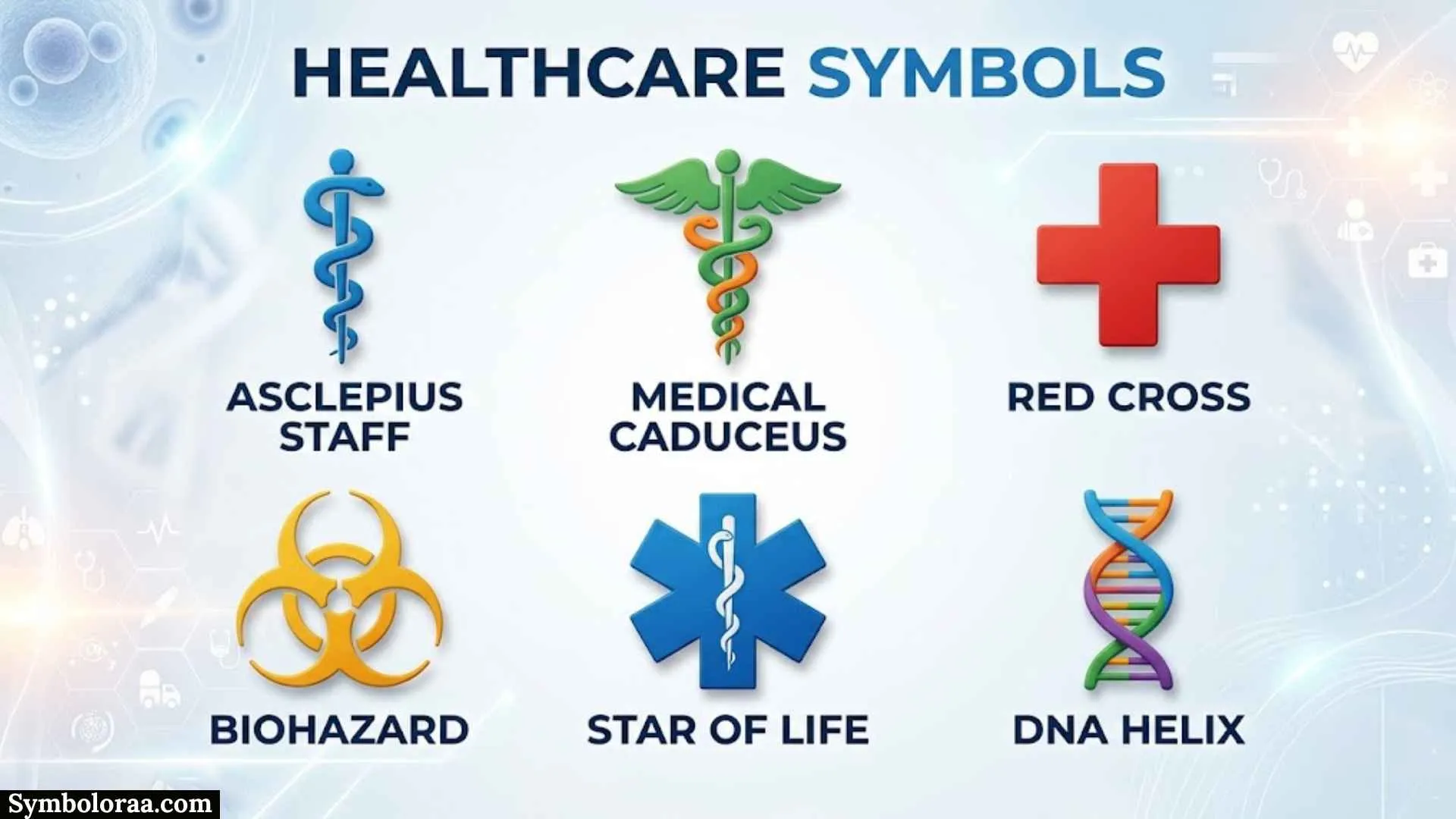
However, not every medical-looking symbol means the same thing. The Rod of Asclepius represents medicine and healing, while the Caduceus has a different historical origin. The Star of Life is strongly associated with emergency medical services, while the Bowl of Hygieia is closely connected with pharmacy. The Red Cross is even more specific: it is a protected emblem under international humanitarian law and should not simply be treated as a generic medical icon.
This guide explains the most common healthcare symbols and their meanings, where they are used, how to distinguish similar symbols, and how healthcare signs work in hospitals, pharmacies, emergency services, digital interfaces, laboratories, and public spaces.
You will also learn the difference between healthcare symbols, medical symbols, healthcare icons, signs, and protected emblems, along with practical examples and a simple method for identifying an unfamiliar symbol.
What Are Healthcare Symbols?
Healthcare symbols are visual signs, pictograms, emblems, or icons used to communicate information about healthcare, medicine, treatment, emergency services, public health, safety, accessibility, or medical facilities.
They can appear on:
- Hospital entrances
- Pharmacy signs
- Ambulances
- Medical equipment
- Emergency department signs
- Healthcare websites
- Mobile applications
- Medical records
- Public information boards
- Laboratory doors
- Safety labels
- First-aid stations
- Health awareness campaigns
The meaning depends on the design and context. A snake around a staff usually points toward a historical medical symbol, while a wheelchair symbol communicates accessibility. A biohazard symbol communicates a biological hazard rather than a medical service.
International standards also show why context matters. ISO 7001 covers registered public-information symbols and includes a specific symbol for a healthcare centre or doctor. The standard notes that text can be added to improve comprehension, demonstrating that symbols are often designed to work together with words rather than replace them completely.
Symbols, Icons, Signs, and Emblems Are Not the Same
These terms are often used interchangeably, but they can describe different things.
A symbol is a visual representation associated with an idea or concept. The Rod of Asclepius is a traditional symbol of medicine.
An icon is usually a simplified visual representation used in interfaces or modern graphic design. A medical app might use a heart or stethoscope icon to represent health information.
A sign communicates information or directs behavior. A hospital wayfinding sign may show where to find emergency services, elevators, or a healthcare facility.
An emblem can have a more specific institutional, legal, or protective meaning. The Red Cross, Red Crescent, and Red Crystal are examples where the use of the emblem is governed by international humanitarian law.
This distinction matters because copying a familiar medical-looking image does not automatically give someone the right to use it as an official emblem.
Common Healthcare Symbols and Their Meanings
Healthcare uses hundreds of symbols and pictograms. Some have ancient historical origins, while others were developed for modern emergency services, safety communication, public information, or digital design.
Rod of Asclepius ⚕
The Rod of Asclepius is one of the most important traditional healthcare symbols.
It consists of a single snake wrapped around a staff. Its history is connected with Asclepius, the ancient Greek figure associated with healing and medicine. The World Health Organization uses the staff with a snake in its emblem and describes it as a longstanding symbol of medicine and the medical profession.
The Rod of Asclepius is commonly associated with:
- Medicine
- Doctors
- Healing
- Healthcare
- Medical professions
- Clinical organizations
When someone searches for a medical symbol with a snake, the Rod of Asclepius is usually the most important symbol to recognize.
Caduceus ☤
The Caduceus is a staff with two snakes, commonly shown with wings near the top.
It is frequently associated with medicine in modern American culture, but its historical origin is different from the Rod of Asclepius. The Caduceus is traditionally connected with Hermes, who was associated with commerce, trade, messengers, and other roles in Greek mythology.
A peer-reviewed historical review describes the Rod of Asclepius as a single-snake staff and the Caduceus as a two-snake staff, sometimes with wings. It also discusses the long-standing controversy surrounding the Caduceus as a medical symbol.
Therefore, the two symbols should not be treated as historically identical.
Rod of Asclepius vs Caduceus
| Feature | Rod of Asclepius | Caduceus |
| Snakes | One | Two |
| Wings | Normally absent | Commonly present |
| Historical association | Asclepius and healing | Hermes, commerce, and messages |
| Traditional medical connection | Strong | Later and more culturally adopted |
| Common modern use | Medicine and healthcare | Sometimes used for medical organizations |
| Easy identification | One snake around staff | Two snakes, often with wings |
A useful rule is simple: one snake usually means Rod of Asclepius; two snakes with wings usually indicate the Caduceus.
Star of Life ⭐
The Star of Life is strongly associated with emergency medical services.
Its familiar design uses a six-pointed blue star with the Rod of Asclepius in the center. It can be seen on emergency vehicles, medical transport equipment, and emergency medical service materials.
The symbol helps distinguish emergency medical services from general healthcare information.
It is particularly useful in situations where people need to identify:
- Emergency medical transport
- Emergency medical personnel
- Prehospital care
- Ambulance services
- Emergency response resources
Red Cross ✚
The Red Cross is one of the most recognizable healthcare-related emblems in the world, but its meaning requires special care.
The International Committee of the Red Cross explains that the red cross, red crescent, and red crystal emblems have specific protective and indicative uses under international humanitarian law. Their protective use identifies protected medical services, equipment, buildings, and certain humanitarian personnel in armed conflict.
The first Red Cross emblem was adopted in 1864 as a distinctive neutral sign intended to protect medical staff and facilities during armed conflict.
For this reason, the Red Cross should not be treated simply as a decorative generic healthcare icon.
Red Crescent and Red Crystal
The Red Crescent and Red Crystal belong to the same family of internationally recognized protective emblems.
They can communicate protection and humanitarian assistance in contexts governed by international humanitarian law. Their use is defined by specific legal rules rather than ordinary graphic-design conventions.
This is an important distinction for healthcare websites, organizations, designers, and publishers: a symbol may look like a general medical icon while actually having a much narrower official meaning.
Pharmacy Symbols and Their Meanings
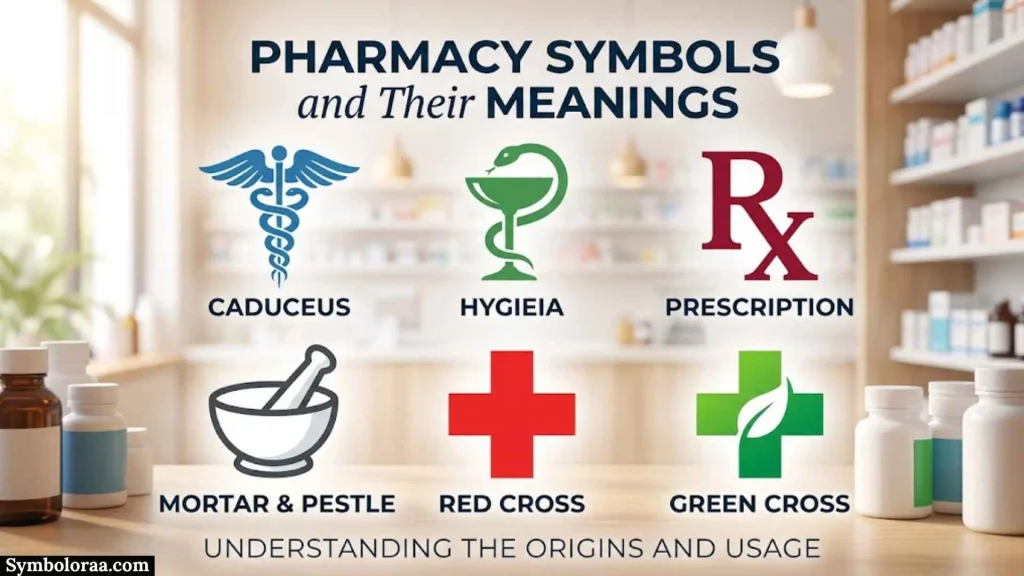
Pharmacy has its own visual language. Several symbols appear on pharmacy signs, prescription materials, pharmaceutical packaging, and professional organizations.
Bowl of Hygieia
The Bowl of Hygieia shows a bowl or cup associated with a serpent.
It is one of the best-known symbols associated with pharmacy. Hygieia was a Greek figure associated with health and cleanliness and was traditionally linked to Asclepius.
The combination of the bowl and serpent became strongly associated with pharmacy and pharmaceutical practice.
If you see a snake wrapped around or drinking from a bowl, pharmacy is a likely interpretation, especially when the symbol appears on a pharmacy sign or professional material.
Mortar and Pestle
The mortar and pestle represents the traditional preparation and compounding of medicines.
Historically, pharmacists used these tools to grind, mix, and prepare substances. Although modern pharmaceutical manufacturing relies heavily on advanced technology, the mortar and pestle remains a recognizable pharmacy symbol.
It can communicate:
- Pharmacy
- Compounding
- Medication preparation
- Pharmaceutical practice
Rx
The abbreviation Rx is widely associated with prescriptions and prescription medicine.
Its history is commonly connected with the Latin recipe, meaning roughly “take” or “receive,” and it became associated with written instructions for medicines. Historical material on pharmacy symbols discusses this development and the relationship between Rx and prescription practice.
Today, Rx may appear in:
- Prescription-related materials
- Pharmacy websites
- Medication information
- Healthcare software
- Prescription services
- Pharmaceutical communication
Hospital and Healthcare Facility Symbols
Hospitals use symbols to help patients and visitors navigate unfamiliar buildings.
Hospital Symbol 🏥
A hospital symbol commonly represents a hospital, medical centre, or healthcare facility.
Modern designs vary by country and organization. Some use a building with a medical cross, while others use a simplified hospital or healthcare pictogram.
The important point is that a hospital icon should be interpreted in context rather than assumed to have one universal design.
Healthcare Centre or Doctor Symbol
ISO 7001 includes a public-information symbol specifically for a healthcare centre or doctor. Its design includes a human figure with a stethoscope and a cross element. ISO notes that accompanying text may improve comprehension and that cultural considerations can affect interpretation.
This is a useful example of why healthcare symbols are not always completely universal. Even a standardized pictogram can benefit from supporting text.
Nurse and Clinical Service Symbols
Hospitals may use symbols or pictograms to identify:
- Nursing stations
- Treatment rooms
- Consultation rooms
- Patient registration
- Waiting areas
- Imaging departments
- Laboratories
- Emergency departments
- Intensive care units
- Operating areas
These symbols are usually designed for wayfinding, meaning their purpose is to help people find the correct location rather than explain medical concepts.
Emergency Healthcare Symbols
Emergency symbols need to be quickly recognizable because users may have little time to read detailed instructions.
Ambulance Symbol 🚑
An ambulance symbol normally communicates emergency medical transportation.
It can appear on:
- Ambulances
- Hospital signs
- Emergency entrances
- Roadway directions
- Emergency service websites
- Healthcare applications
The surrounding context is important because a vehicle icon may identify transportation rather than a specific treatment department.
First Aid Symbol
First-aid symbols identify places, equipment, or services intended for immediate basic medical assistance.
A first-aid symbol may appear near:
- First-aid kits
- Workplace first-aid stations
- Public facilities
- Schools
- Sports venues
- Industrial sites
- Emergency supplies
A first-aid sign should not automatically be interpreted as a full emergency department. First aid and advanced emergency medical care are different levels of service.
Emergency Department Symbols
Emergency departments may be represented by text, a cross, a medical symbol, an emergency label, or a combination of pictograms.
Hospitals often combine symbols with words and arrows because a person in an emergency may need both recognition and precise direction.
Accessibility and Patient Support Symbols
Healthcare facilities must also communicate services that support people with different mobility, communication, and access needs.
Accessibility Symbol ♿
The wheelchair symbol is widely associated with accessibility.
In healthcare settings, it can indicate:
- Accessible entrances
- Accessible toilets
- Accessible parking
- Wheelchair routes
- Mobility-friendly facilities
- Accessible services
The symbol does not mean that a location is itself a medical facility. It communicates an accessibility feature.
Hearing and Communication Symbols
Healthcare facilities may also use symbols to identify hearing assistance, interpretation, communication support, or other accessibility services.
These symbols are especially important in hospitals because effective communication can directly affect a patient’s ability to understand instructions and access care.
Laboratory and Medical Safety Symbols
Not every healthcare symbol represents treatment. Some communicate hazards.
Biohazard Symbol ☣
The biohazard symbol warns about biological hazards.
It may be found in:
- Medical laboratories
- Research facilities
- Clinical waste areas
- Specimen-handling areas
- Certain healthcare workspaces
The key meaning is hazard, not “hospital.”
This distinction prevents a common mistake: assuming that every symbol found in a medical environment is itself a symbol of healthcare.
Radiation Symbol ☢
The radiation symbol warns about ionizing radiation hazards.
It may appear around areas or equipment involving radiation, such as certain imaging or treatment environments.
The symbol communicates a safety warning, so it should be treated differently from a general medical icon.
Medical Waste Symbols
Healthcare facilities generate different types of waste, including materials requiring special handling.
Labels and signs may identify:
- Biohazardous waste
- Sharps
- Contaminated materials
- Pharmaceutical waste
- Laboratory waste
The exact labeling system can vary according to national regulations and facility procedures. Healthcare workers should follow the applicable local rules rather than relying only on a generic icon.
Blood and Donation Symbols
Blood-related symbols are common in hospitals, blood banks, donation campaigns, and public health communication.
Blood Donation Symbol
Blood donation graphics often combine a blood drop with a medical cross, heart, person, or other visual element.
Unlike historical symbols such as the Rod of Asclepius, these designs are often modern communication icons created to make a specific action or service immediately understandable.
They may represent:
- Donate blood
- Blood donation centre
- Blood bank
- Blood collection
- Blood-related awareness campaigns
The exact design is not necessarily universal, so nearby text remains important.
Organ Donation Symbols
Organ donation campaigns may use simplified organ, heart, hand, ribbon, or donor-related imagery.
Their purpose is usually awareness and communication rather than facility navigation.
This makes them an example of a health awareness symbol rather than a traditional medical symbol.
Health Awareness Symbols
Healthcare communication also uses symbols to represent diseases, prevention campaigns, research, and public awareness.
Examples can include:
- Awareness ribbons
- Heart imagery
- Lungs
- Brain symbols
- Cancer-related imagery
- Vaccination icons
- Mental health symbols
- Public health campaign graphics
These symbols often change according to the organization, campaign, country, or audience.
A health awareness symbol should therefore not automatically be treated as an official international healthcare sign.
Healthcare Symbols by Medical Specialty
Different medical specialties often use recognizable visual imagery.
| Specialty | Common Visual Elements |
| Cardiology | Heart, ECG line |
| Neurology | Brain, nerve imagery |
| Ophthalmology | Eye |
| Dentistry | Tooth |
| Dermatology | Skin or face imagery |
| Pediatrics | Child or family imagery |
| Obstetrics | Mother, baby, or pregnancy imagery |
| Pharmacy | Bowl and serpent, mortar and pestle |
| Emergency medicine | Star of Life, emergency imagery |
| Laboratory medicine | Test tube, microscope, laboratory imagery |
| Radiology | Imaging or radiation-related imagery |
| Mental health | Brain, person, speech, or wellbeing imagery |
These are useful visual conventions, but they are not all universally standardized symbols.
For professional signage, the organization should verify whether a particular symbol has an applicable international, national, or institutional standard.
Healthcare Symbols in Hospitals and Wayfinding
A hospital can contain dozens of departments and services. Symbols make navigation faster by reducing the amount of text a visitor must read.
Where Healthcare Wayfinding Symbols Appear
Common locations include:
- Entrance signs
- Corridors
- Elevator areas
- Reception desks
- Emergency departments
- Pharmacy areas
- Restrooms
- Diagnostic imaging departments
- Laboratories
- Waiting rooms
- Patient registration
- Parking areas
A good wayfinding system normally combines symbol + text + directional information where necessary.
ISO 7001 is specifically concerned with public-information symbols and explains that symbols can be used with text to improve comprehension.
Why Healthcare Wayfinding Symbols Matter
Hospitals can be stressful environments. Patients may be in pain, worried, unfamiliar with the building, or dealing with language barriers.
Clear visual communication can reduce the amount of information a visitor has to process.
However, a symbol should not be considered automatically understandable simply because it looks familiar. Research on healthcare wayfinding symbols has found differences in how well people understand different symbols, which supports the use of testing, context, and supporting text when appropriate.
Healthcare Symbols in Digital Design
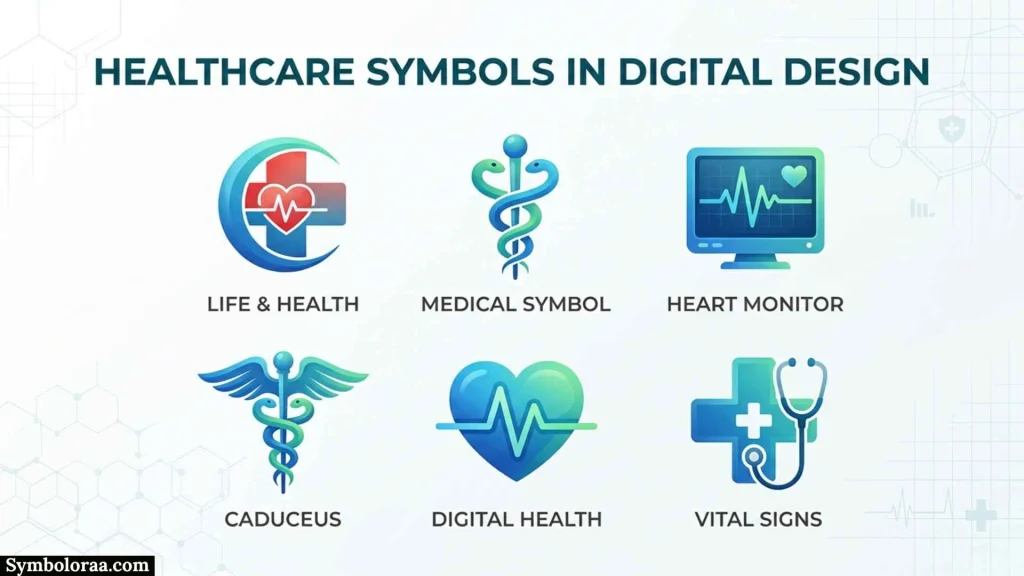
Healthcare symbols are now common in websites, mobile applications, patient portals, telehealth platforms, and electronic systems.
Common Digital Healthcare Icons
Digital interfaces may use:
- 🩺 Stethoscope for medical care
- 💊 Pill for medication
- ❤️ Heart for health or wellness
- 🩹 Bandage for treatment
- 🧑⚕️ Healthcare professional for clinical care
- 🏥 Hospital for facilities
- 🚑 Ambulance for emergency transportation
- 🧪 Laboratory equipment for testing
- 📋 Clipboard for medical records
These icons are useful because they allow users to recognize functions quickly.
However, emojis and decorative icons should not automatically be treated as standardized healthcare symbols. A heart emoji, for example, may mean cardiac care, general health, love, or emotional wellbeing depending on the interface.
Healthcare Symbols and International Communication
One major advantage of pictograms is their ability to communicate across languages.
A person who cannot read the local language may still recognize an ambulance, wheelchair, restroom, or hospital-related pictogram.
But visual communication is not perfectly universal.
Different cultures may interpret shapes, colors, religious imagery, body representations, and medical symbols differently. ISO 7001 specifically recognizes the importance of comprehension and notes that some symbols can benefit from accompanying text.
For international healthcare facilities, the safest approach is usually:
- Use an appropriate recognized symbol where one exists.
- Add clear text when interpretation may be uncertain.
- Use directional arrows for navigation.
- Consider cultural differences.
- Test important signs with representative users.
- Follow applicable local and international standards.
Healthcare Symbols vs Medical Symbols
The terms healthcare symbols and medical symbols overlap, but they are not identical.
Medical symbols often refer specifically to medicine, doctors, treatment, clinical practice, and medical professions.
Healthcare symbols can cover a broader range of services, including:
- Medical treatment
- Public health
- Accessibility
- Emergency services
- Pharmacy
- Patient support
- Healthcare facilities
- Safety
- Health education
- Disease awareness
Therefore, healthcare symbols are best understood as a broader category.
Healthcare Symbols vs Health Awareness Symbols
A health awareness symbol is generally designed to communicate a campaign, condition, cause, or public-health message.
A healthcare symbol can instead identify a service or facility.
For example:
- A hospital pictogram can help someone find a hospital.
- A pharmacy symbol can identify a pharmacy.
- A red ribbon may communicate awareness of a health issue.
- A blood-drop graphic may promote blood donation.
This difference matters when choosing graphics for professional communication.
Official Emblems vs Generic Healthcare Icons
This is one of the most important distinctions for anyone designing a healthcare website or publication.
A generic icon such as a stethoscope can usually function as a visual representation of healthcare.
An official emblem can have specific ownership, legal, institutional, or humanitarian meaning.
The Red Cross is a major example. The ICRC states that the use and misuse of the Red Cross, Red Crescent, and Red Crystal emblems are governed by international humanitarian law, including rules concerning who can use them and how they may be displayed.
The same principle applies to institutional logos. The WHO explains that its logo and emblem have restricted use and are connected to the organization’s official work.
Practical rule: never assume that a recognizable medical emblem is free to use simply because it appears frequently online.
How to Identify an Unknown Healthcare Symbol
When you encounter an unfamiliar healthcare symbol, use its shape, surrounding information, and location together.
Step 1: Look for a Snake
A snake is one of the strongest clues.
- One snake around a staff → likely Rod of Asclepius
- Two snakes → likely Caduceus
- Snake with a bowl → likely Bowl of Hygieia
- Snake with a six-pointed star → likely Star of Life
Step 2: Look for a Star
A six-pointed star containing a Rod of Asclepius strongly suggests the Star of Life and emergency medical services.
Step 3: Look for a Bowl
A bowl combined with a serpent is a strong clue for pharmacy.
Step 4: Look for a Cross
A cross can have many meanings.
It may represent:
- General medical care
- A healthcare facility
- First aid
- A humanitarian emblem
- A religious concept
- A design element
Do not assume that every cross means the same thing.
Step 5: Check the Location
The same graphic can have different meanings depending on where you see it.
For example:
- On an ambulance → likely emergency medical service
- Outside a pharmacy → likely pharmaceutical service
- On a laboratory door → may indicate laboratory or safety information
- On a hospital corridor sign → likely wayfinding
- On a humanitarian vehicle in armed conflict → may have a protected emblem meaning
Step 6: Read Nearby Text
Text is often the fastest way to confirm a symbol.
Look for words such as:
- Emergency
- Pharmacy
- First Aid
- Laboratory
- Radiology
- Blood Bank
- Accessibility
- Doctor
- Clinic
- Ambulance
Step 7: Check Whether It Is an Official Emblem
If the symbol resembles the Red Cross, Red Crescent, Red Crystal, WHO emblem, or another institutional emblem, do not treat it as an ordinary decorative icon.
Check the organization’s official guidance before using or reproducing it.
A Simple Healthcare Symbol Decision Tree
Use this quick decision process when identifying common symbols:
Does the symbol contain a snake?
→ One snake around a staff?
Likely the Rod of Asclepius.
→ Two snakes, often with wings?
Likely the Caduceus.
→ Snake combined with a bowl?
Likely the Bowl of Hygieia, associated with pharmacy.
→ Snake inside a six-pointed star?
Likely the Star of Life, associated with emergency medical services.
Does it show a wheelchair?
→ Likely an accessibility symbol.
Does it show a biological hazard design?
→ Likely a biohazard warning, not a general healthcare symbol.
Does it show the radiation trefoil?
→ Likely a radiation hazard warning.
Does it show a red cross on a white background?
→ Treat it carefully because it may be the protected Red Cross emblem, not a generic medical icon.
Common Healthcare Symbol Mistakes
Understanding what symbols do not mean is just as important as learning their meanings.
Confusing the Caduceus With the Rod of Asclepius
This is one of the most common mistakes.
The Rod of Asclepius has one snake. The Caduceus traditionally has two.
Treating Every Cross as a Medical Symbol
A cross can have medical, humanitarian, religious, cultural, or purely graphic meanings.
Context is essential.
Using the Red Cross as a Generic Medical Logo
This can be a serious mistake because the Red Cross emblem has specific legal and humanitarian significance.
Assuming Every Healthcare Icon Is Universal
A symbol may be obvious to one audience but confusing to another. Standardization and user testing are especially important for public signs.
Confusing Hazard Symbols With Healthcare Symbols
Biohazard and radiation symbols may appear inside hospitals, but they warn about hazards. They do not simply mean “medical care.”
Assuming an Official Logo Is a Generic Symbol
A logo belonging to WHO, a hospital, university, government agency, or professional organization may have rules governing its use.
How to Choose the Right Healthcare Symbol
Choosing a healthcare symbol depends on what you want the user to understand.
For a Hospital or Clinic
Use a recognized healthcare or facility symbol together with clear text when needed.
Goal: help users identify the location of healthcare services.
For Emergency Services
Use an appropriate emergency medical symbol and clear wording.
Goal: communicate urgency and help users find emergency care.
For Pharmacy Services
Consider pharmacy-specific imagery such as the Bowl of Hygieia or a clearly understandable medication-related icon.
Goal: distinguish pharmacy services from general clinical care.
For Accessibility
Use the appropriate accessibility symbol according to applicable standards and local requirements.
Goal: identify accessible services and routes.
For Hazard Warnings
Use the applicable safety symbol rather than a generic medical icon.
Goal: warn people about a specific hazard.
For Health Awareness
Choose imagery that communicates the campaign or condition clearly.
Goal: encourage recognition, education, prevention, or participation.
How Healthcare Organizations Should Use Symbols
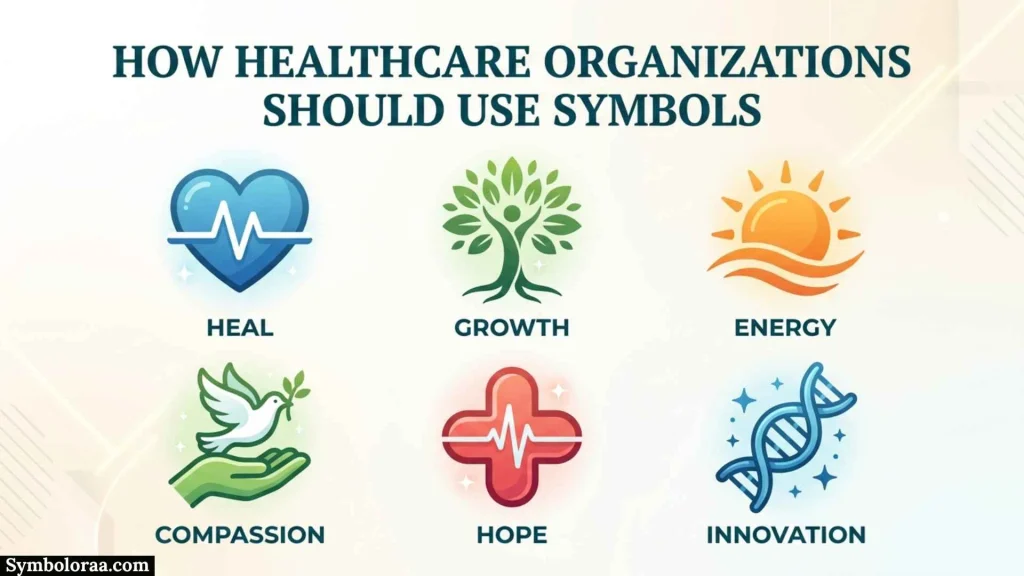
A professional healthcare communication system should prioritize clarity over decoration.
Good practice includes:
- Use recognized symbols where appropriate.
- Pair unfamiliar symbols with text.
- Maintain consistent visual design.
- Use sufficient size and contrast.
- Avoid unnecessary decorative details.
- Consider accessibility.
- Test important signs with users.
- Follow applicable national and international standards.
- Verify restrictions on official emblems and logos.
- Avoid using a symbol simply because it looks “medical.”
ISO 7001 provides an important framework for public-information symbols, while specific safety signs and regulated environments may be subject to other standards or regulations.
Quick Reference: Healthcare Symbols and Meanings
| Symbol | Common Meaning | Typical Use |
| ⚕ Rod of Asclepius | Medicine and healing | Medical profession |
| ☤ Caduceus | Historically linked to Hermes; sometimes used for medicine | Some medical organizations |
| ⭐ Star of Life | Emergency medical services | Ambulances and EMS |
| Red Cross | Protected humanitarian/medical emblem in specific contexts | Humanitarian and protected medical use |
| Red Crescent | Protected humanitarian/medical emblem | Humanitarian and protected medical use |
| Red Crystal | Protected humanitarian/medical emblem | Humanitarian and protected medical use |
| Bowl of Hygieia | Pharmacy | Pharmacies and pharmacy organizations |
| Rx | Prescription medicine | Prescriptions and pharmacy |
| Mortar and Pestle | Medication preparation/pharmacy | Pharmacy |
| 🏥 Hospital | Hospital or healthcare facility | Wayfinding and facility identification |
| 🚑 Ambulance | Emergency medical transport | Vehicles and emergency services |
| ♿ Accessibility | Accessible facilities/services | Entrances, toilets, parking, routes |
| ☣ Biohazard | Biological hazard | Laboratories and waste areas |
| ☢ Radiation | Radiation hazard | Imaging and radiation areas |
| 🩺 Stethoscope | Medical care/clinical examination | Digital and printed healthcare materials |
| ❤️ Heart | Health, cardiac care, or wellbeing | Healthcare and awareness materials |
| 🩹 Bandage | Treatment, wound care, first aid | Healthcare interfaces and educational materials |
Frequently Asked Questions
What Is the Main Symbol for Healthcare?
There is no single symbol that represents every form of healthcare worldwide. The Rod of Asclepius is one of the most important traditional symbols of medicine, while hospitals, emergency services, pharmacies, accessibility services, and public health programs use additional symbols for specific purposes. The WHO itself uses the staff with a snake as part of its emblem.
What Is the Most Recognizable Medical Symbol?
The Rod of Asclepius is among the most widely recognized traditional symbols associated with medicine. It features one snake wrapped around a staff and has a long historical connection with healing and medicine.
What Does ⚕ Mean?
The ⚕ symbol represents the Rod of Asclepius, a traditional symbol of medicine and healing. It features a single snake wrapped around a staff.
What Is the Difference Between the Rod of Asclepius and Caduceus?
The Rod of Asclepius has one snake around a staff. The Caduceus has two snakes and is often shown with wings. Historically, the Rod of Asclepius has the stronger direct connection with medicine and healing, while the Caduceus is associated with Hermes and commerce.
What Does the Star of Life Mean?
The Star of Life is associated with emergency medical services. Its familiar design contains a Rod of Asclepius inside a six-pointed star and is commonly associated with emergency medical personnel and services.
What Does the Bowl of Hygieia Mean?
The Bowl of Hygieia is a traditional pharmacy symbol. It combines a bowl with a serpent and is associated with pharmacy and pharmaceutical practice.
What Does Rx Mean in Healthcare?
Rx is commonly used to identify prescriptions or prescription medicine. Its historical development is associated with the Latin recipe, meaning “take” or “receive.”
Is the Red Cross a General Medical Symbol?
Not exactly. The Red Cross emblem has a specific humanitarian and legal meaning. The ICRC explains that the Red Cross, Red Crescent, and Red Crystal emblems have protective and indicative uses governed by international humanitarian law.
What Symbol Represents Emergency Medical Services?
The Star of Life is strongly associated with emergency medical services. It is commonly used on emergency vehicles, medical transport equipment, and EMS materials.
What Symbol Represents Accessibility in Healthcare?
The wheelchair accessibility symbol is widely used to identify accessible facilities, routes, entrances, parking, and services. Healthcare organizations may use it alongside additional accessibility symbols depending on the service provided.
What Is the Symbol for a Pharmacy?
The Bowl of Hygieia is one of the best-known traditional pharmacy symbols. Other pharmacy-related symbols include the mortar and pestle and Rx.
What Is the Symbol for First Aid?
First-aid signs commonly use a cross or other standardized medical-safety pictogram depending on the applicable standard and country. The exact design should be checked against the relevant local or international signage requirements.
Are Healthcare Symbols Universal?
No. Some symbols have broad international recognition, but comprehension can vary by culture, context, design, and user experience. Standardized symbols can improve consistency, but supporting text may still be useful. ISO 7001 specifically provides public-information symbols and notes the value of text in improving comprehension.
Why Are Symbols Important in Hospitals?
Symbols help patients and visitors quickly identify facilities, departments, emergency services, accessibility features, and safety information. They can reduce dependence on written language and make complex healthcare environments easier to navigate.
Key Takeaways
- The Rod of Asclepius is a major traditional symbol of medicine and healing.
- The Caduceus has two snakes and a different historical origin from the Rod of Asclepius.
- The Star of Life is strongly associated with emergency medical services.
- The Bowl of Hygieia is an important pharmacy symbol.
- Rx is associated with prescriptions and prescription medicine.
- Hospital and healthcare symbols are often used for wayfinding.
- The wheelchair symbol communicates accessibility rather than general medical care.
- Biohazard and radiation symbols are hazard warnings, not general healthcare symbols.
- Healthcare icons are not always universal, so text and context can improve understanding.
- The Red Cross, Red Crescent, and Red Crystal have specific humanitarian and legal meanings and should not be treated as ordinary decorative medical icons.
- International standards such as ISO 7001 can help guide public-information symbol design and use.
- Always distinguish between a traditional symbol, a modern icon, a wayfinding sign, and a protected institutional or humanitarian emblem.
Conclusion
Healthcare symbols make medical information easier to recognize, navigate, and communicate. From the ancient Rod of Asclepius to modern emergency, accessibility, pharmacy, laboratory, and digital icons, these visual elements serve different purposes across the healthcare system.
The most important symbols are not necessarily interchangeable. A single snake around a staff points toward the Rod of Asclepius, while two snakes often identify the Caduceus. The Star of Life is associated with emergency medical services, the Bowl of Hygieia with pharmacy, and accessibility symbols identify services designed for people with access needs.
The biggest practical lesson is to interpret a symbol together with its context. Look at its shape, location, nearby text, intended audience, and whether it is part of an official or legally protected emblem.
For healthcare organizations and designers, the best approach is not simply to choose the most familiar medical-looking icon. Use recognized symbols appropriately, support unclear pictograms with text, consider accessibility and cultural differences, and verify applicable standards or legal requirements before publishing an official-looking emblem.

I’m Madison Reed, a contemporary American author who writes about love, family, friendship, and second chances. I’m fascinated by the choices that shape our lives and the moments that change us forever. My goal is to create honest, emotional stories with characters readers can connect with long after finishing each book.
Three Books:
When We Find Our Way
The Things We Never Said
Summer in September
 Jackson Miller