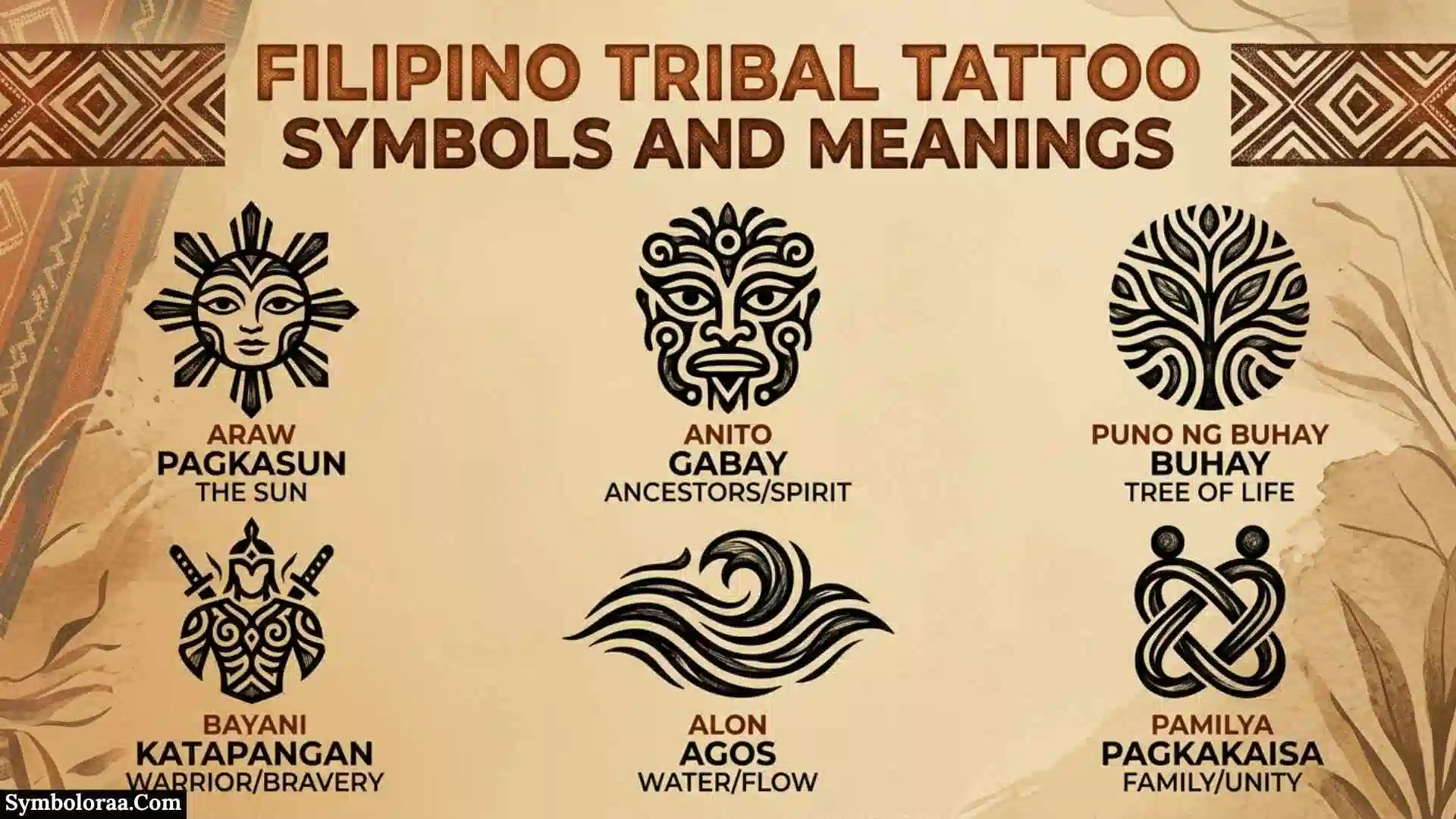
Filipino tribal tattoos are more than bold black patterns on the skin. They are connected to Indigenous identity, community, beauty, protection, social status, rites of passage, ancestry, and in some historical settings warrior achievement. But there is an important distinction between traditional Filipino tattoo symbols with documented cultural histories and modern tattoos that simply use Filipino-inspired geometric designs.
The term “Filipino tribal tattoo” is also broad. Traditional tattooing existed among different Indigenous communities and historical populations across the Philippines, and the meanings were not identical everywhere. Kalinga batok, for example, has its own vocabulary, designs, and cultural history, while early Visayan tattooing associated with the people described as Pintados represents another tradition that should not simply be treated as a copy of Kalinga tattooing.
The National Museum of the Philippines documents tattooing in northern Philippines as a pre-Spanish practice, particularly among Kalinga communities, where tattooing was known by terms including fatok, batok, fatek, and batek and was traditionally performed by a practitioner known as a manbatek.
This guide explains Filipino tribal tattoo symbols and meanings, what batok means, how Kalinga tattoos differ from Visayan traditions, which symbols have documented historical associations, how to recognize questionable “ancient Filipino” designs, and how to approach these tattoos respectfully today.
Quick Answer: What Do Filipino Tribal Tattoo Symbols Mean?
Filipino tribal tattoo symbols do not have one universal meaning. Their significance depends on the Indigenous community, historical period, design, placement, gender, life stage, and cultural context.
Commonly documented associations include:
| Symbol or pattern | Documented cultural association | Important context |
| Centipede-related designs | Protection, fertility, beauty, cultural identity | Particularly documented in Kalinga tattooing |
| Lizard/centipede-eating lizard | Protection and traditional symbolism | Specific meanings depend on the design and context |
| Star or bituwon | Light and guidance during historical night vigils | Associated with Kalinga warrior traditions |
| Moon or sorag | Light during night activities | Kalinga historical context |
| Axe | Warrior symbolism | Connected to historical warfare traditions |
| Snake-like motif | Protection | Documented in northern Philippine tattoo traditions |
| Parallel lines and bands | Status, achievement, or life-stage associations | Meaning depends on the particular design |
| Sinokray | Traditional ornamental tattooing | Associated with necklace/sleeve-like patterns |
| Geometric patterns | Identity, aesthetics, social meaning | Not every geometric design has an ancient fixed meaning |
The National Museum specifically documents Kalinga designs including the star, moon, axe, snake-like protective symbol, centipede-related motifs, and several named tattoo forms.
The most important rule is simple: never assume that every Filipino-looking geometric tattoo has one fixed traditional meaning.
What Is a Filipino Tribal Tattoo?
“Filipino tribal tattoo” is a modern umbrella term often used to describe traditional Indigenous tattooing from the Philippines or contemporary tattoos inspired by those traditions.
Historically, however, communities had their own names, techniques, motifs, and systems of meaning. Treating all of these practices as one single “tribal tattoo style” can erase important cultural differences.
Traditional Indigenous tattooing
Tattooing existed in the Philippines before Spanish colonization. Different communities developed their own practices and visual languages.
In northern Luzon, Kalinga tattooing is especially well documented. The National Museum identifies fatok/batok and fatek/batek as local terms and identifies the traditional practitioner as a manbatek.
Traditional tattooing could communicate things such as:
- Community identity
- Beauty and attractiveness
- Protection
- Fertility
- Rites of passage
- Social position
- Achievement
- Warrior status
- Cultural belonging
- Relationships with ancestors, nature, and the spiritual world
These meanings should not be separated from the community in which the tattoo existed.
Modern Filipino-inspired tattoos
A contemporary tattoo artist may combine traditional Filipino visual elements with modern tattoo techniques.
For example, someone might choose:
- Repeated geometric bands
- Mountain-inspired forms
- Animal imagery
- Ancestral symbolism
- Indigenous-inspired linework
- Modern minimalist interpretations
Such a tattoo can have personal or cultural meaning without being a historically traditional tattoo.
That distinction matters because modern inspiration is not automatically the same thing as historical authenticity.
What Does Batok Mean?
Batok is one of the terms associated with traditional Indigenous tattooing in the Philippines, particularly in Kalinga contexts. Other spellings and related terms include batek, fatek, fatok, and whatok, depending on community, language, and source.
Batok is therefore not simply the name of a decorative tattoo style.
Batok as a cultural practice
Traditional batok involves more than the finished pattern. It can include:
- The tattoo practitioner
- Hand-tapping techniques
- Traditional tools
- Pigment preparation
- Community knowledge
- Design selection
- Social relationships
- Cultural identity
- Historical beliefs
- Ritual or ceremonial context
Research on Indigenous Filipino tattooing describes batok as a hand-tapping practice using traditional implements rather than simply reproducing the appearance of a modern machine tattoo.
Why spelling varies
Readers may encounter:
- Batok
- Batek
- Fatek
- Fatok
- Whatok
- Burik
- Tatak
- Patik
These variations do not necessarily mean that every term refers to exactly the same local practice. Language and community differences matter.
For SEO and research purposes, it is useful to recognize these related terms while avoiding the mistake of treating them as interchangeable in every historical context.
The Four-Layer Meaning Framework for Filipino Tribal Tattoos
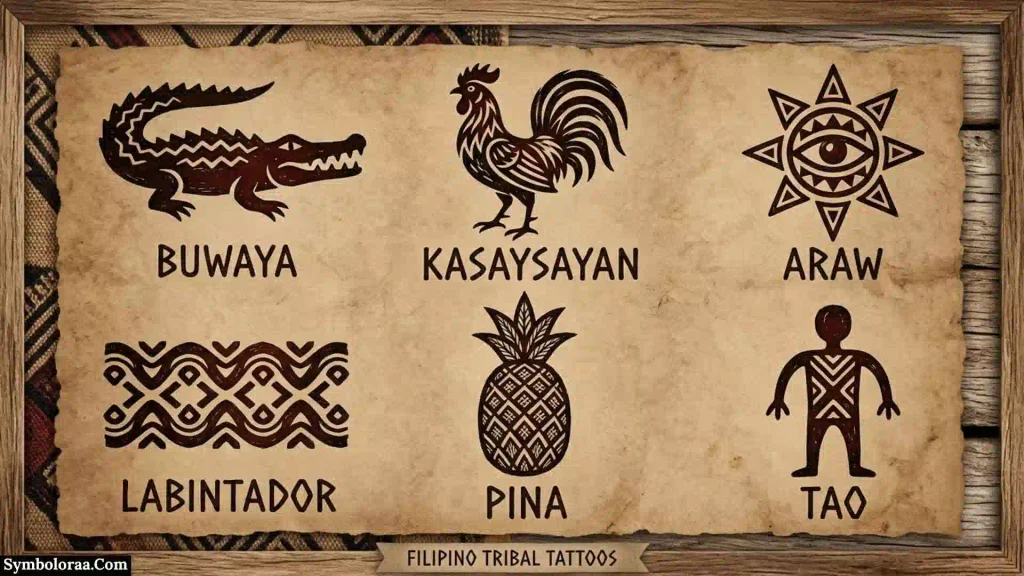
One of the easiest ways to misunderstand Indigenous tattoo symbolism is to ask only, “What does this symbol mean?”
A better approach is to examine four layers.
Layer 1: Historical meaning
Ask:
What did this design mean in the community and period where it was traditionally used?
This is the strongest layer when supported by historical or ethnographic evidence.
Layer 2: Community meaning
The same motif can have significance that depends on a particular Indigenous community.
A Kalinga design should not automatically be assigned a Visayan meaning simply because both traditions come from the Philippines.
Layer 3: Modern cultural meaning
A traditional design can acquire new meanings through cultural revival, diaspora identity, tourism, social media, and contemporary tattoo practice.
Research on Kalinga tattoos in the Filipino diaspora shows that tattoo designs can become expressions of cultural authenticity and connections to an imagined or remembered homeland.
Layer 4: Personal meaning
A modern wearer may choose a design to represent:
- Family
- Heritage
- Strength
- Resilience
- Ancestry
- Personal growth
- Connection to the Philippines
That personal meaning can be meaningful without claiming that it was the original historical meaning.
Kalinga Tattoo Symbols and Meanings
Kalinga tattooing is among the best-known Filipino Indigenous tattoo traditions today, partly because of the continued public interest in Buscalan and traditional tattoo practitioners.
The National Museum of the Philippines documents several Kalinga tattoo forms and their associations.
Centipede and centipede-related motifs
Centipede imagery appears in documented Kalinga tattoo traditions.
For women, the National Museum describes centipede designs known as nirafarafat or inufu-ufug, associated historically with fertility and eligibility for marriage.
The motif should not be reduced to a generic internet definition such as “the centipede always means strength.”
Its meaning belongs to a particular cultural and historical setting.
Lizard motifs
Lizard imagery also appears in descriptions of Kalinga tattoo designs.
The National Museum refers to gayaman nan banas, described as a centipede-eating lizard, among documented tattoo forms.
Academic research also identifies lizard imagery among Kalinga patterns while noting that not every documented pattern was directly associated with headhunting.
Star or Bituwon
The bituwon, or star, is documented by the National Museum as one of the Kalinga symbols associated with light during night vigils before village raids.
This provides a useful example of why context matters.
A modern tattoo website might describe a star as “hope” or “guidance,” but that does not mean those modern interpretations are the historical Kalinga meaning.
Moon or Sorag
The sorag, or moon, is another documented Kalinga motif.
It was associated with providing light during nighttime activities and historical warrior contexts.
Today, someone may personally interpret a moon tattoo as cycles, change, femininity, or renewal. Those can be personal meanings, but they should not automatically be presented as ancient Kalinga meanings.
Axe symbol
The axe is another historically documented Kalinga tattoo symbol connected with warrior traditions.
This is particularly important when discussing “warrior tattoos.” Traditional warrior symbolism should be understood within the social system of the community rather than turned into a generic symbol of toughness.
Snake-like protective motif
The National Museum documents a snake-like symbol associated with protection.
This is one of the clearest examples of a motif where the traditional cultural context is more useful than a generic tattoo dictionary.
Parallel lines and bands
Kalinga tattoo traditions include named patterns involving parallel lines, bands, and geometric structures.
For example, the National Museum describes binulibud as three parallel lines extending from the forearm toward the upper arm and identifies gulot or pinupungol as a stripe-like tattoo associated with a warrior’s first killing.
Academic research likewise notes that some Kalinga tattoo patterns were connected to prestige and successful headhunting, while other patterns had different functions.
Sinokray
Sinokray is described by the National Museum as a necklace- or sleeve-like tattoo pattern associated with women.
This demonstrates why saying “Filipino tribal tattoos were only warrior tattoos” is inaccurate.
Filipino Tribal Tattoo Symbols for Protection
Protection is one of the recurring themes found in discussions of traditional Filipino tattooing.
But “protection” can mean different things depending on the community and historical source.
Physical and spiritual protection
Traditional Indigenous worldviews could connect humans with:
- Animals
- Nature
- Spirits
- Ancestors
- Community
- The surrounding environment
Research on Kalinga whatok describes tattooing as embedded in Indigenous values and relationships among humans, animals, spirits, and ancestors. It also identifies protection, good fortune, well-being, and cultural identity among significant dimensions of the practice.
Do all Filipino tribal tattoos protect the wearer?
No.
This is one of the most important corrections to make when researching Filipino tattoo symbolism.
A symbol may have a protective association in one documented tradition without meaning that every tattoo containing a similar shape is believed to provide protection.
Filipino Tribal Tattoo Symbols for Strength and Bravery
Strength and bravery are frequently associated with traditional tattooing, particularly in discussions of historical Kalinga warrior culture.
The National Museum explains that Kalinga tattoos were historically connected with warfare and that tattooing could record warrior achievement.
Warrior tattoos were social records
Some historical Kalinga tattoo forms were not simply decorative.
They could communicate achievement and social standing.
The National Museum describes tattoos associated with warriors and notes historical relationships between tattooing and participation in kayaw, a form of warfare or headhunting.
Academic research similarly connects some traditional Kalinga tattoos with prestige and power.
Why “warrior tattoo” is an incomplete explanation
It is tempting to summarize all Indigenous Filipino tattooing as:
Tattoo = warrior.
That is historically too narrow.
Research on early Visayan tattooing specifically challenges the tendency to interpret tattooing primarily through warriorship and male valor. Scholars argue that Visayan tattooing had broader meanings involving rite of passage, protection, beauty, gender, and social life.
Filipino Tribal Tattoos for Women
Traditional tattooing was not exclusively a male practice.
The National Museum documents Kalinga tattoos among women and associates certain women’s tattoos with fertility, marriage eligibility, beauty, and other aspects of social life.
Fertility and marriage
Some traditional Kalinga women’s tattoos were historically connected with fertility and eligibility for marriage.
Centipede-related designs such as nirafarafat and inufu-ufug are specifically documented in this context.
Beauty and attractiveness
Tattooing could also contribute to ideas of beauty.
Research on Kalinga whatok emphasizes aesthetics alongside social and cultural significance.
This challenges the modern stereotype that traditional tattoos were primarily military badges.
Filipino Tribal Tattoos for Men
In historical Kalinga contexts, men’s tattoos could be associated with:
- Warrior achievement
- Social status
- Bravery
- Community recognition
- Prestige
The National Museum describes several warrior-associated designs and notes that the amount of tattooing could be connected to warrior achievement in historical accounts.
However, this should not be generalized to every Filipino Indigenous tradition.
Kalinga Tattoos vs Visayan Pintados
One of the most important SEO and accuracy improvements is to separate Kalinga batok from early Visayan tattooing.
They are both part of the history of tattooing in the Philippines, but they belong to different regional and historical contexts.
| Feature | Kalinga traditions | Early Visayan tattooing |
| Main region | Northern Luzon/Cordillera | Central Philippines/Visayas |
| Common terminology | Batok, fatek, batek, fatok, whatok and related terms | Historical sources use terms associated with tattooed Visayans/Pintados |
| Major documented themes | Protection, beauty, identity, warrior achievement, fertility | Rite of passage, protection, beauty, social meanings |
| Warrior association | Strong in historical Kalinga accounts | Important in popular imagery but should not be treated as the only meaning |
| Modern revival | Strongly associated with Kalinga revival and Buscalan | Increasing scholarly and cultural interest |
| Main caution | Do not universalize Kalinga meanings | Do not reduce Pintados to male warrior culture |
A 2023 anthropological study argues that early Visayan tattooing has often been overly associated with warriorship and male valor. Its authors recommend a broader interpretation that considers rite of passage, protection, beauty, gender, and cosmology.
Who Were the Pintados?
The term Pintados is strongly associated with historical Spanish descriptions of tattooed people in the Visayas.
Early colonial encounters made tattooed Visayans especially visible in European accounts.
Modern scholarship warns, however, that colonial descriptions should be read critically rather than treated as complete descriptions of Indigenous society.
Research on early Spanish encounters with tattooed Visayans shows that tattooed bodies challenged European colonial categories and were interpreted through changing Spanish frameworks.
Why Pintados should not simply mean “warrior tattoos”
Popular culture often presents Pintados as heavily tattooed warriors.
That image has historical roots, but recent scholarship argues that it can become too restrictive.
Visayan tattooing should instead be understood as a broader social practice with multiple meanings.
Historical Timeline of Filipino Tattooing
Understanding the timeline makes the symbolism easier to interpret.
Pre-Spanish Philippines
Tattooing existed in Philippine communities before Spanish colonization.
The National Museum identifies tattooing as one of the forms of body modification practiced in the country since pre-Spanish times.
16th and 17th centuries
Spanish encounters with tattooed Visayans produced written descriptions of tattooed Indigenous populations.
Modern researchers are re-examining these records to understand how colonial writers interpreted Indigenous tattooing.
Later colonial and modern periods
Christianization, colonial social changes, modernization, migration, and changing ideas about Indigenous identity affected traditional tattooing.
The practice did not simply disappear everywhere, but its social role changed.
Contemporary revival
Traditional tattooing has experienced renewed visibility through cultural preservation, tourism, diaspora identity, social media, documentaries, and contemporary tattoo culture.
Kalinga tattooing in particular has become internationally recognizable through Buscalan and traditional tattoo practitioners.
What Makes a Filipino Tribal Tattoo Authentic?
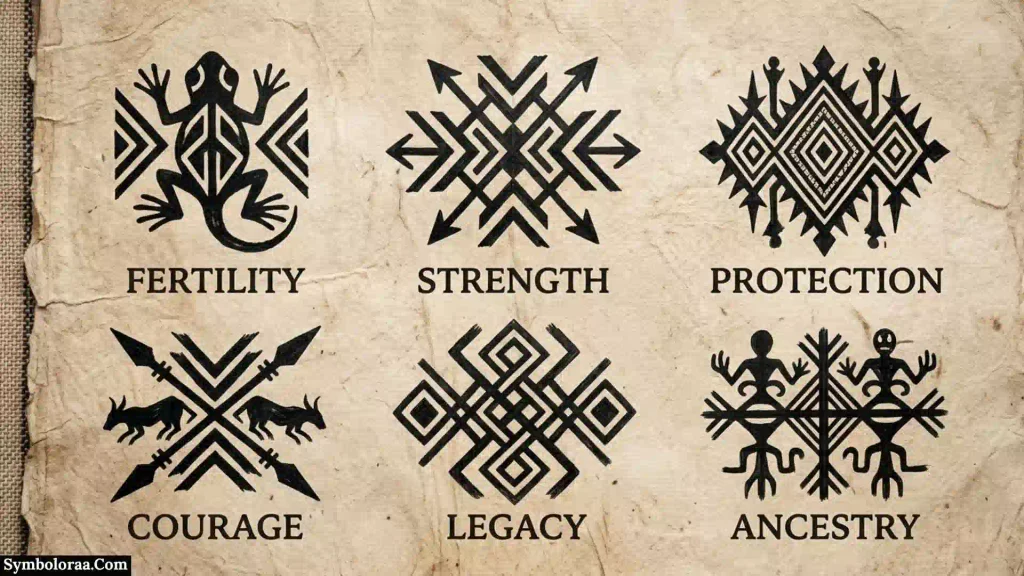
Authenticity is more complicated than whether a tattoo “looks tribal.”
A more reliable test is to ask whether the design can be connected to a specific cultural tradition and documented source.
The Filipino Tribal Tattoo Authenticity Framework
Use these six questions:
1. What community does the design come from?
Is it Kalinga, Visayan, another Cordillera tradition, or simply modern Filipino-inspired artwork?
2. What is the original name of the design?
A credible explanation should identify the traditional term where one is documented.
3. Is the meaning historically documented?
Look for museum, university, ethnographic, or peer-reviewed sources.
4. Was the symbol restricted to a particular group or achievement?
Some designs may have been associated with warrior status, rites of passage, gender, or other specific social conditions.
5. Has the design been modernized?
A contemporary version can be beautiful while still being different from a historical tattoo.
6. Is the artist transparent about the source?
A responsible artist should be able to explain whether the design is traditional, reconstructed, inspired, or entirely modern.
How to Identify a Fake or Misattributed Filipino Tribal Symbol
Be cautious when a tattoo seller makes claims such as:
- “This is an ancient Filipino symbol of unlimited strength.”
- “All Filipino tribes used this symbol.”
- “Every Filipino tribal tattoo means protection.”
- “This design is thousands of years old.”
- “This pattern is identical to traditional Kalinga tattooing.”
- “All Filipino tribal tattoos are warrior symbols.”
These claims may sound authoritative but often lack cultural specificity.
Red flags to watch for
A design deserves further research when:
- No Indigenous community is identified.
- No historical source is provided.
- The meaning sounds like generic motivational language.
- A modern geometric design is presented as ancient.
- Kalinga, Māori, Polynesian, Borneo, and other traditions are mixed together without explanation.
- The artist claims one symbol has the same meaning throughout the Philippines.
- Personal interpretations are presented as documented historical facts.
A good rule is:
If the cultural origin cannot be identified, do not call the meaning historically verified.
Traditional Filipino Tattoos vs Filipino-Inspired Tattoos
Both can be meaningful, but they should not be described in the same way.
| Traditional tattoo | Filipino-inspired tattoo |
| Connected to a specific cultural tradition | May combine traditional and modern ideas |
| Uses documented traditional forms where evidence exists | May use contemporary adaptations |
| Cultural context is central | Personal symbolism may be central |
| May have community-specific meanings | Meaning can be created by wearer and artist |
| Traditional techniques may be important | Usually created with modern tattoo equipment |
| Requires stronger cultural sensitivity | Still requires accurate attribution |
Neither category is automatically “better.”
The key is honest labeling.
Can Non-Filipinos Get Filipino Tribal Tattoos?
There is no single universal answer because different communities and designs have different histories.
The more responsible approach is to avoid treating Indigenous tattoo designs as generic decoration.
Questions to ask before getting one
Consider:
- Do I know which community the design comes from?
- Do I understand its documented meaning?
- Is it associated with a particular achievement or status?
- Am I claiming an identity or experience I do not have?
- Have I spoken with a culturally knowledgeable artist?
- Am I using a traditional design as decoration without understanding it?
- Could I choose a contemporary Filipino-inspired design instead?
For some people, a culturally respectful approach may be to choose an artist with genuine knowledge of the tradition and openly describe the tattoo as inspired rather than pretending to possess a traditional status.
Cultural Appreciation vs Cultural Appropriation
The debate becomes especially important when traditional Indigenous designs become popular internationally.
Cultural appreciation
Appreciation can involve:
- Learning the history
- Naming the community
- Supporting Indigenous artists
- Understanding the original context
- Respecting restrictions
- Avoiding false historical claims
- Giving proper credit
Cultural appropriation
Problems can arise when someone:
- Copies sacred or status-specific designs without context
- Treats Indigenous patterns as costumes
- Invents meanings and calls them ancient
- Profits from cultural designs while excluding Indigenous communities
- Removes the design from its cultural history entirely
There is no universal checklist that determines every situation, but context, attribution, power, intent, and community perspective all matter.
Filipino Tribal Tattoo Tourism and Buscalan
Buscalan has become an important location in the contemporary story of Kalinga tattooing.
Academic research on Buscalan describes a significant change in the meaning and social position of traditional Kalinga tattoos as tourism and commercialization increased. The study argues that the traditional connection between tattoos and successful headhunting has changed while the tattoos have gained new visibility through tourism and digital media.
This creates an interesting tension:
Tourism can help preserve and publicize a tradition, but it can also transform the meaning of that tradition.
That is why modern popularity should not automatically be treated as proof that every modern tattoo has the same meaning as its historical predecessor.
Filipino Tattoo Revival and Diaspora Identity
Traditional tattooing is also important beyond the Philippines.
Research on Kalinga tattoos in the Filipino diaspora shows that people may use tattoo designs to express cultural authenticity, identity, and connections to the homeland.
This gives the tattoo a modern layer of meaning.
A person living far from the Philippines may use a traditional-inspired tattoo as a way of communicating:
- Family heritage
- Ancestral connection
- Cultural memory
- Filipino identity
- Belonging
- Reconnection with homeland
That does not erase the historical meaning of the design; it adds another layer.
Traditional Filipino Tattoo Process and Tools
Traditional tattooing methods differ from modern electric tattoo machines.
Research describes batok as a hand-tapping practice in which pigment is worked into the skin using traditional implements.
Traditional practice may involve:
- Preparing the design
- Selecting appropriate tools
- Preparing pigment
- Positioning the recipient
- Hand-tapping the skin
- Following established design patterns
- Observing cultural practices or protocols
The process itself can therefore be part of the cultural significance.
A modern tattoo that copies only the visual pattern may reproduce the appearance without reproducing the traditional practice.
Filipino Tribal Tattoo Placement
Placement is another area where internet tattoo guides often oversimplify history.
There is no universal rule saying:
“Arm means strength.”
or
“Back means protection.”
Traditional placement should instead be researched within the specific cultural tradition.
Documented Kalinga tattoo forms include designs on the forearms, upper arms, shoulders, chest, back, and hands, with particular patterns having particular contexts.
Placement decision checklist
Before selecting placement, ask:
- Is the historical placement documented?
- Does the design traditionally belong there?
- Is the placement connected to gender or status?
- Am I reproducing a traditional form or making a modern interpretation?
- Will the tattoo remain respectful if separated from its original context?
Filipino Tribal Tattoo Symbols by Intended Meaning
If your goal is to choose a design based on a modern personal meaning, use this framework rather than copying a random “tribal tattoo meaning” list.
For cultural heritage
Look for a design whose community and historical background can be verified.
For protection
Research traditional protective motifs rather than choosing any random animal or geometric symbol.
For strength
Distinguish personal strength from historical warrior status.
For ancestry
A design connected to your actual family or cultural history may be more meaningful than a generic tribal pattern.
For beauty
Traditional tattooing included aesthetic dimensions, especially in discussions of women’s tattooing.
For personal growth
A contemporary Filipino-inspired design may be appropriate if you clearly present the symbolism as your own rather than claiming it as an ancient meaning.
A Better Way to Choose a Filipino Tribal Tattoo
Use this five-step process.
Step 1: Choose the cultural tradition
Start with:
Kalinga? Visayan? Another Indigenous tradition? Modern Filipino-inspired?
Do not begin with Pinterest artwork and work backward.
Step 2: Research the original meaning
Look for:
- National museums
- Universities
- Peer-reviewed anthropology
- Indigenous cultural organizations
- Academic books
- Historical records
Step 3: Check whether the design has social restrictions
Some symbols may historically have been associated with:
- Warrior achievement
- Gender
- Rite of passage
- Community status
- Protection
- Particular life events
Step 4: Decide between traditional and inspired
If you cannot ethically or accurately reproduce a traditional form, consider a contemporary design inspired by Filipino heritage.
Step 5: Choose an informed artist
Ask the artist:
- Where does the design come from?
- What is its documented name?
- Which community used it?
- What is historically known about it?
- What parts are modern adaptations?
Filipino Tribal Tattoo Decision Tree
Do you want a historically traditional tattoo?
→ Yes: Identify the specific Indigenous tradition first.
→ Is the design documented?
→ Yes: Research its original context and any restrictions.
→ No: Do not describe it as historically verified.
Do you mainly want Filipino cultural symbolism?
→ Consider a Filipino-inspired contemporary design.
Do you want a warrior symbol?
→ Research whether the historical design was actually connected with warrior achievement.
Do you want protection symbolism?
→ Identify the specific cultural tradition and documented protective association.
Are you unsure about cultural appropriateness?
→ Speak with a knowledgeable Indigenous or culturally grounded practitioner before copying a traditional design.
Common Mistakes When Researching Filipino Tribal Tattoo Meanings
Mistake 1: Treating all Filipino tribes as one culture
The Philippines contains many Indigenous communities and historical traditions.
Mistake 2: Calling every design Kalinga
A geometric tattoo may look similar to Kalinga patterns without actually being a Kalinga design.
Mistake 3: Assuming every tattoo is a warrior tattoo
Visayan research especially challenges this simplified interpretation.
Mistake 4: Confusing personal meaning with historical meaning
You can give a tattoo your own meaning, but that does not make the meaning historically traditional.
Mistake 5: Mixing Filipino and Polynesian symbolism
Similar visual elements do not prove shared meaning or origin.
Mistake 6: Trusting an unsourced tattoo chart
A graphic circulating online is not automatically an ethnographic source.
Mistake 7: Ignoring modern commercialization
Traditional designs may change when they become part of tourism, social media, or global tattoo culture. Research on Buscalan documents this transformation.
Real-World Examples of How Meaning Changes
Example 1: A traditional Kalinga warrior design
Historically, a particular tattoo may have communicated warrior achievement.
A modern person who copies the pattern because it “looks powerful” is not automatically reproducing that original social meaning.
Example 2: A Filipino living abroad
A descendant of Filipino families may choose a Kalinga-inspired tattoo to express cultural identity and connection to homeland.
Research on Filipino diaspora tattooing documents precisely this broader identity function.
Example 3: A tourist visiting Buscalan
The tattoo may be obtained as a travel experience.
The meaning can therefore become connected to tourism, memory, and personal experience in addition to its traditional cultural background.
Example 4: A modern tattoo artist
An artist might create a geometric design inspired by Philippine Indigenous aesthetics.
That can be a legitimate contemporary artwork, but it should not automatically be advertised as an ancient traditional symbol.
How to Research a Filipino Tattoo Symbol Before Getting It
Use this research checklist:
- Identify the Indigenous community.
- Identify the traditional name if documented.
- Find an academic or museum source.
- Confirm the historical period.
- Research the symbol’s documented meaning.
- Check whether placement matters.
- Check whether gender or status matters.
- Check whether the symbol was connected to achievement or ceremony.
- Find out whether the modern design has been altered.
- Ask the tattoo artist about their source.
- Separate historical meaning from personal meaning.
- Consider whether supporting an Indigenous practitioner is possible.
This approach is much safer than selecting a tattoo solely from a “100 Filipino tribal symbols and meanings” graphic.
Why Filipino Tribal Tattoos Still Matter Today
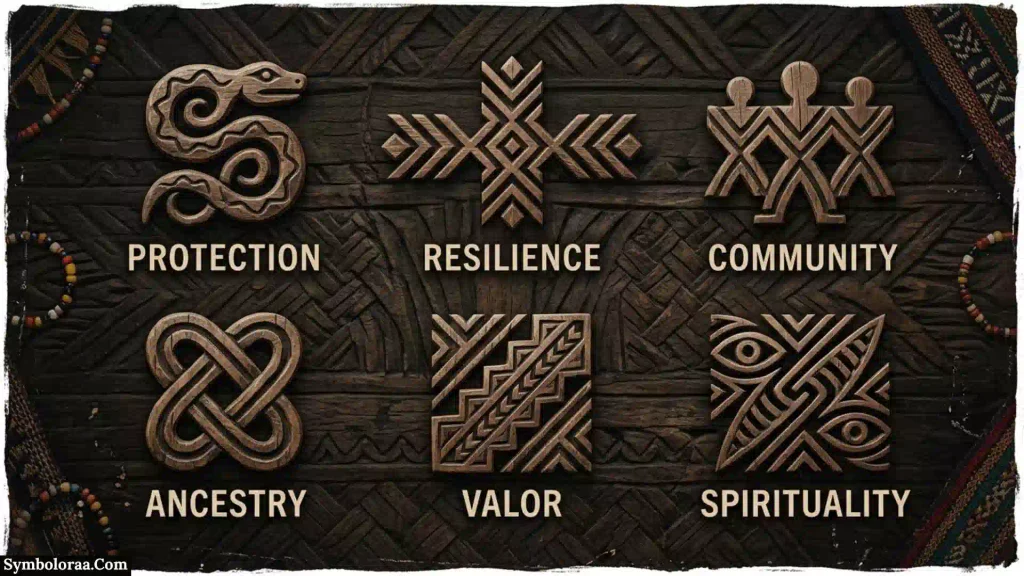
Traditional tattooing is not simply a historical curiosity.
It can function as:
- Cultural preservation
- Identity expression
- Diaspora connection
- Indigenous reclamation
- Artistic practice
- Intergenerational knowledge
- Community memory
Research on batok describes Indigenous Filipino tattooing in terms of identity, community relationships, decolonization, and cultural reclamation.
The National Museum also notes the continuing appreciation of Kalinga tattooing and recognizes the cultural importance of traditional practitioners.
Filipino Tribal Tattoo Symbols: Quick Reference Table
| Topic | What to remember |
| Batok | Traditional Indigenous tattooing term associated especially with Kalinga contexts |
| Batek/Fatek/Fatok | Related terms used in different contexts |
| Manbatek | Traditional Kalinga tattoo practitioner |
| Centipede motif | Documented in Kalinga women’s tattooing and associated with fertility and social meanings |
| Star/Bituwon | Associated with light in historical Kalinga warrior contexts |
| Moon/Sorag | Associated with nighttime light in historical Kalinga contexts |
| Axe | Connected with warrior symbolism |
| Snake-like design | Documented protective association |
| Lizard | Appears among documented Kalinga tattoo motifs |
| Sinokray | Necklace/sleeve-like traditional tattoo pattern |
| Pintados | Historical term associated with tattooed Visayans |
| Warrior symbolism | Important in some traditions but not universal |
| Protection | A recurring traditional association, but not every design means protection |
| Beauty | Important dimension of traditional tattooing |
| Modern Filipino-inspired tattoos | May have contemporary personal meanings rather than historical ones |
Frequently Asked Questions
What is the main Filipino tribal tattoo symbol?
There is no single symbol representing all Filipino tribal tattoo traditions. The Philippines has multiple Indigenous and historical tattoo traditions. Kalinga batok/whatok is one of the most widely recognized today, but it should not be treated as the universal Filipino tattoo tradition.
What does a Kalinga tattoo mean?
Kalinga tattoos can represent different things depending on the design and context, including warrior achievement, protection, beauty, fertility, social identity, and cultural belonging. The National Museum documents multiple named Kalinga tattoo forms with different associations.
What does batok mean?
Batok is a term used for traditional Indigenous tattooing in the Philippines, particularly in Kalinga contexts. Related forms include fatek, batek, and fatok.
What does the Filipino centipede tattoo mean?
In documented Kalinga women’s tattooing, centipede-related designs such as nirafarafat or inufu-ufug were associated with fertility and eligibility for marriage.
What Filipino tattoo symbol represents protection?
Some traditional Kalinga tattoo motifs have documented protective associations, including a snake-like symbol described by the National Museum. However, there is no single universal Filipino protection symbol.
What Filipino tattoo represents bravery?
Some Kalinga tattoo forms historically communicated warrior achievement and status. However, “bravery” should not be assigned to every Filipino tribal tattoo because meanings differed by community and design.
Were Filipino tribal tattoos only for warriors?
No. Traditional tattooing also had associations with beauty, fertility, protection, rites of passage, social identity, and other aspects of community life. Scholarship on early Visayan tattooing specifically argues against reducing the practice to warriorship and masculinity.
What is the difference between Kalinga and Pintados tattoos?
Kalinga tattooing belongs primarily to Indigenous traditions of northern Luzon, while Pintados is associated with historical descriptions of tattooed Visayan populations in the central Philippines. They should be studied as different regional traditions.
Can a non-Filipino get a Kalinga tattoo?
There is no simple universal yes-or-no answer. The responsible approach is to research the design’s cultural context, understand whether it represents a particular status or achievement, and work with culturally knowledgeable practitioners rather than treating Indigenous designs as generic decoration.
Are Filipino tribal tattoos the same as Polynesian tattoos?
No. Philippine and Polynesian tattoo traditions belong to different cultural and historical contexts, even though some visual similarities may exist because of broader Austronesian connections.
Is every geometric Filipino tattoo traditional?
No. Geometric designs can be modern creations, adaptations, or combinations of traditional motifs. A geometric appearance alone does not prove historical authenticity.
What is the most important thing to know before getting a Filipino tribal tattoo?
Identify the specific cultural tradition first. Then verify the design, meaning, historical context, and whether it carries social or ceremonial significance.
Key Takeaways
- Filipino tribal tattooing is not one single universal tradition.
- Traditional tattooing existed in the Philippines before Spanish colonization.
- Kalinga batok/batek/fatek/fatok is one of the best-known Indigenous tattoo traditions.
- Traditional meanings can include protection, beauty, fertility, identity, rites of passage, and warrior achievement.
- Kalinga and Visayan/Pintados tattoo traditions should not be treated as identical.
- Not every Filipino tattoo is a warrior tattoo.
- Not every geometric design is an ancient Filipino symbol.
- Personal meanings should be separated from documented historical meanings.
- Traditional tattooing involves cultural practice, not just visual patterns.
- Tourism and globalization have changed how some traditional tattoos are understood.
- Filipino diaspora communities have also used tattooing to express identity and homeland connections.
- Cultural appreciation begins with research, attribution, and respect.
- The safest way to evaluate a design is to identify its community, source, historical meaning, and context before getting it.
Conclusion
Filipino tribal tattoo symbols are best understood as cultural systems rather than simple collections of decorative shapes.
Kalinga batok, early Visayan tattooing associated with the Pintados, and other Indigenous traditions developed in different communities and historical environments. Their designs could communicate beauty, protection, identity, fertility, social position, rites of passage, and warrior achievement.
The most important lesson for anyone researching Filipino tribal tattoo meanings is to avoid universal claims. A symbol does not automatically have one meaning simply because it appears in a tattoo chart online. Instead, identify the community, investigate the original design, verify its historical context, and separate documented tradition from modern interpretation.
For someone planning a tattoo today, that research can make the final design more meaningful not because every tattoo needs an ancient meaning, but because understanding where a symbol comes from allows you to approach Filipino Indigenous tattoo traditions with greater accuracy and respect.
I’m Jackson Miller, an American author inspired by mystery, adventure, and the unpredictable nature of life. I enjoy writing fast-moving stories filled with memorable characters, unexpected choices, and meaningful moments. Through my books, I want readers to experience new worlds while discovering something about courage, determination, and themselves.
Three Books:
The Edge of Tomorrow
Under a Broken Sky
The Road We Chose
 Madison Reed