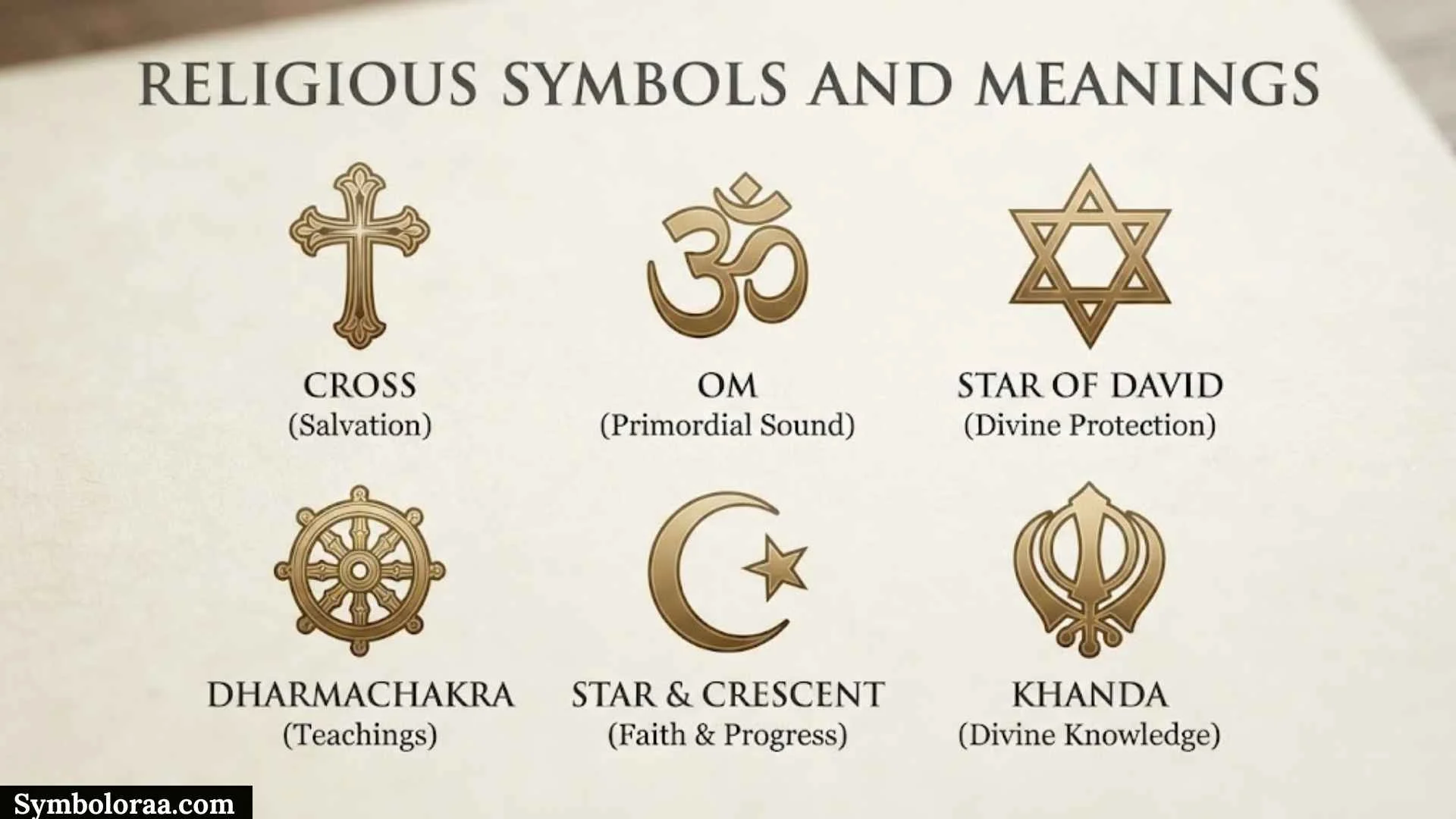
Religious symbols can communicate faith, identity, history, worship, and spiritual ideas through simple shapes, letters, objects, and designs. Symbols such as the cross, Star of David, Om, Wheel of Dharma, Khanda, and Star and Crescent are recognized around the world, although their meanings can depend on religious and cultural context.
This guide covers religious symbols and meanings from Christianity, Catholicism, Judaism, Islam, Buddhism, Hinduism, Sikhism, ancient religions, Greek traditions, Celtic traditions, Indian religions, and Native American cultures. It also includes symbol names, copy-and-paste characters, Unicode information, and practical explanations.
Some religious symbols exist as standardized Unicode characters, while others are better represented by images, religious artwork, sacred objects, or written languages. Unicode currently includes characters such as the Latin Cross, Orthodox Cross, Star and Crescent, Adi Shakti, and other religiously associated symbols.
Religion Symbols With Names
If you are looking for religion symbols with names, the following list provides a useful starting point. It separates the actual character from its common religious or cultural association.
| Symbol | Name | Common Association | Meaning or Use |
| ✝ | Latin Cross | Christianity | Christ, crucifixion, faith |
| ☦ | Orthodox Cross | Eastern Christianity | Orthodox Christian tradition |
| ☧ | Chi Rho | Christianity | Christogram representing Christ |
| ☪ | Star and Crescent | Islam | Common Muslim cultural association |
| ✡ | Star of David | Judaism | Jewish identity |
| 🕎 | Menorah | Judaism | Jewish religious tradition |
| ☸ | Wheel of Dharma | Buddhism | Dharma and Buddhist teachings |
| 🕉 | Om | Hinduism | Sacred sound and spiritual reality |
| ☬ | Adi Shakti | Sikhism | Sikh religious symbol |
| 🪯 | Khanda | Sikhism | Sikh identity and tradition |
| ☥ | Ankh | Ancient Egypt | Life |
| ☯ | Yin Yang | Taoist tradition | Complementary forces |
| 🪬 | Hamsa | Middle Eastern traditions | Protective hand imagery |
| ⛩ | Shinto Shrine | Shinto | Shrine or sacred place |
Unicode officially identifies several of these characters by specific names. For example, ☦ is ORTHODOX CROSS, ☧ is CHI RHO, ☪ is STAR AND CRESCENT, ☬ is ADI SHAKTI, ☥ is ANKH, and ☯ is YIN YANG.
It is important to remember that a Unicode character and a religious emblem are not always the same thing. Some important religious symbols are graphical designs that do not have a dedicated Unicode character.
All Religions Symbols Photo With Names
A visual collection of religious symbols can make them easier to recognize, especially when several designs look similar. A good religious-symbol chart should show the symbol, its name, religious tradition, and a short explanation.
For example:
| Symbol | Name | Religion or Tradition |
| ✝ | Latin Cross | Christianity |
| ☦ | Orthodox Cross | Eastern Christianity |
| ✡ | Star of David | Judaism |
| 🕎 | Menorah | Judaism |
| ☪ | Star and Crescent | Islam-associated |
| ☸ | Wheel of Dharma | Buddhism |
| 🕉 | Om | Hinduism |
| ☬ | Adi Shakti | Sikhism |
| 🪯 | Khanda | Sikhism |
| ☥ | Ankh | Ancient Egyptian religion |
| ☯ | Yin Yang | Taoist tradition |
| ⛩ | Torii | Shinto |
For symbols without a reliable text character, photographs or illustrations are often more accurate. Examples include a physical menorah, Buddhist stupa, Hindu temple artwork, Islamic calligraphy, a Torah scroll, a Christian crucifix, or a ceremonial object.
Do not assume that every similar-looking shape has the same religious meaning. A six-pointed star, for example, does not automatically mean the Star of David, and a crescent does not automatically represent one specific Muslim community.
7 Main Religions Symbols And Meanings
There is no single universally accepted list of the “seven main religions.” Different educational sources group major religions in different ways. For a general symbols guide, seven widely known traditions can be represented as follows:
| Religion | Symbol | Common Meaning or Association |
| Christianity | ✝ | Cross, Christ, sacrifice, resurrection |
| Islam | ☪ | Common Islamic cultural association |
| Judaism | ✡ | Jewish identity and tradition |
| Hinduism | 🕉 | Om and sacred sound |
| Buddhism | ☸ | Dharma and Buddhist teachings |
| Sikhism | ☬ / 🪯 | Sikh identity and religious tradition |
| Jainism | Ahimsa imagery | Nonviolence and spiritual practice |
These symbols should not be treated as official logos for every member of a religion. Some traditions have multiple important symbols, while others place greater emphasis on sacred texts, rituals, architecture, objects, or calligraphy.
A particularly useful distinction is between religious symbol, cultural symbol, and Unicode character. A character such as ☸ is standardized in Unicode, but its encoded existence does not by itself define the complete religious meaning of the symbol.
Christian Religious Symbols And Meanings
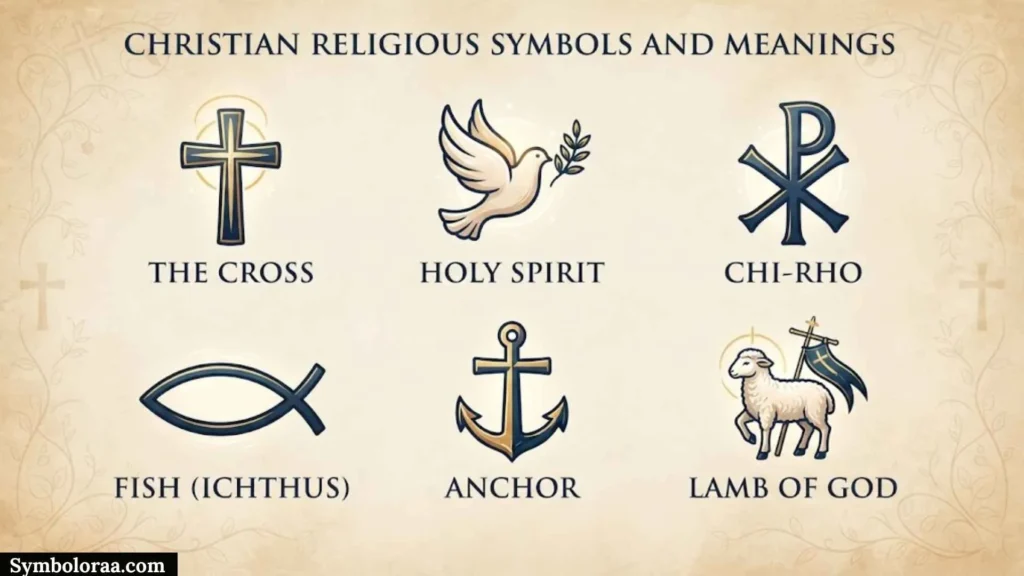
Christianity has a wide range of symbols connected with Jesus Christ, the Bible, salvation, worship, resurrection, and Christian identity.
Common Christian Symbols
✝ — Latin Cross: The cross is the central and most recognizable Christian symbol. It is associated with the crucifixion of Jesus and, within Christian belief, resurrection and salvation.
☦ — Orthodox Cross: This Unicode character is officially named ORTHODOX CROSS and is associated with Eastern Christian traditions.
☧ — Chi Rho: A Christogram formed from Greek letters associated with Christ. Unicode officially names this character CHI RHO.
🐟 — Fish: The fish, often called Ichthys, has a long association with Christianity and Christian identity.
🕊 — Dove: A dove is commonly used in Christian art in connection with the Holy Spirit and peace.
Alpha and Omega — Α Ω: These Greek letters are used together in Christian symbolism to express ideas of beginning and end and are connected with biblical language.
Lamb: The lamb can represent Christ as the Lamb of God.
Not every Christian symbol has a dedicated Unicode character. When a symbol is intended for a website or social media post, a standard character is convenient when available, while detailed religious artwork usually requires an image.
Christianity Religious Symbols And Meanings
Christian symbolism extends beyond the cross. Churches, manuscripts, paintings, jewelry, architecture, and religious objects have used many symbols to communicate biblical ideas.
Some useful examples include:
- ✝ Cross: Christianity, Christ, crucifixion, and salvation.
- ☧ Chi Rho: A Christogram associated with Christ.
- 🐟 Fish: Historic Christian identification and symbolism.
- 🕊 Dove: Commonly associated with the Holy Spirit and peace.
- Α Ω Alpha and Omega: Biblical imagery associated with the beginning and the end.
- Anchor: Historically associated with hope in Christian symbolism.
- Crown: Can represent Christ’s kingship or heavenly reward depending on context.
- Lamb: Associated with Christ and the biblical image of the Lamb of God.
The meaning of a symbol can also vary between Catholic, Orthodox, Protestant, and other Christian traditions. A cross may look different across denominations, but the basic Christian association remains recognizable.
Catholic Religious Symbols And Meanings
Catholic Christianity uses many symbols in worship, churches, art, vestments, architecture, and devotional objects.
Common Catholic Symbols
✝ Cross: Represents Christ’s crucifixion and remains central to Catholic Christian identity.
☦ Cross Variations: Different Christian cross designs can appear in historical and artistic contexts, although not every cross form is specifically Catholic.
Crucifix: A cross showing the figure of Jesus is especially prominent in Catholic devotional and liturgical settings.
Rosary: A devotional object used in Catholic prayer and strongly associated with Marian devotion.
IHS: A Christogram traditionally associated with the name of Jesus and frequently found in Catholic art and architecture.
Chi Rho — ☧: A historic Christogram representing Christ.
Dove: Commonly connected with the Holy Spirit.
Lamb: A traditional Christian image associated with Christ.
Some Catholic symbols are objects rather than single Unicode characters. For example, a rosary or crucifix cannot be accurately represented by simply choosing a random text character.
Jewish Religious Symbols And Meanings
Judaism has a rich symbolic tradition connected with Jewish identity, scripture, worship, holidays, history, and religious practice.
✡ — Star of David: The Star of David, also known as Magen David, is one of the most recognizable symbols of Judaism and Jewish identity.
🕎 — Menorah: The menorah represents the traditional seven-branched lampstand. Unicode also provides a menorah emoji associated with Jewish and Hanukkah contexts.
חי — Chai: These Hebrew letters spell a word associated with “life” and are widely used in Jewish cultural contexts.
Shofar: A ram’s horn used during important Jewish religious observances.
Torah Scroll: Represents the Torah and its central place in Jewish religious life.
Mezuzah: A religious object containing parchment with biblical passages, traditionally placed on Jewish doorposts.
The Star of David is available as the Unicode character ✡, while the menorah is available as 🕎.
Judaism Religious Symbols And Meanings
Jewish symbols can represent religious practice, history, community identity, or specific holidays. They should not all be treated as interchangeable.
Here are several important examples:
- ✡ Star of David: Jewish identity and tradition.
- 🕎 Menorah: Ancient Jewish lampstand and Jewish religious tradition.
- חי Chai: Life and Jewish cultural identity.
- Shofar: Religious instrument used during specific observances.
- Torah Scroll: Torah and Jewish religious teaching.
- Mezuzah: A religious object traditionally placed on doorposts.
- Hamsa: A hand-shaped symbol used in Jewish and other Middle Eastern contexts, with meanings varying by tradition.
For copy-and-paste purposes, ✡ and 🕎 are especially convenient. Other symbols are often better displayed through Hebrew text or images.
Ancient Religious Symbols And Meanings
Ancient religious traditions used symbols to express concepts such as life, protection, fertility, death, nature, kingship, and relationships with deities.
Well-Known Ancient Symbols
☥ Ankh: The ankh is strongly associated with ancient Egyptian religion and is commonly understood as a symbol of life. Unicode officially names ☥ ANKH.
Eye of Horus: An ancient Egyptian symbol associated with protection and well-being.
Thunderbolt: A major attribute of Zeus in ancient Greek religion.
Trident: Associated with Poseidon in Greek mythology and religion.
Owl: Strongly associated with Athena in ancient Greek tradition.
Swastika: A very old symbol used in Hinduism, Buddhism, and Jainism, where it can carry auspicious meanings. Unicode documentation specifically notes its religious use and association with good luck and well-being in South Asian traditions.
Historical context is essential. A symbol used in an ancient religious setting may have a meaning very different from a later political or modern cultural use.
Greek Religious Symbols And Meanings
Ancient Greek religion included numerous gods and goddesses, each with recognizable attributes, animals, plants, weapons, or objects.
| Symbol or Object | Deity | Common Association |
| ⚡ Thunderbolt | Zeus | Sky and divine power |
| 🔱 Trident | Poseidon | Sea and earthquakes |
| 🦉 Owl | Athena | Wisdom |
| 🏹 Bow | Artemis | Hunting |
| 🍇 Grapevine | Dionysus | Wine and celebration |
| 🌾 Grain | Demeter | Agriculture and harvest |
| Lyre | Apollo | Music and arts |
| Peacock | Hera | Royal and divine imagery |
These are primarily attributes and sacred associations, not necessarily standalone Unicode religious symbols. Their meanings come from mythology, religious art, literature, and historical tradition.
Celtic Religious Symbols And Meanings
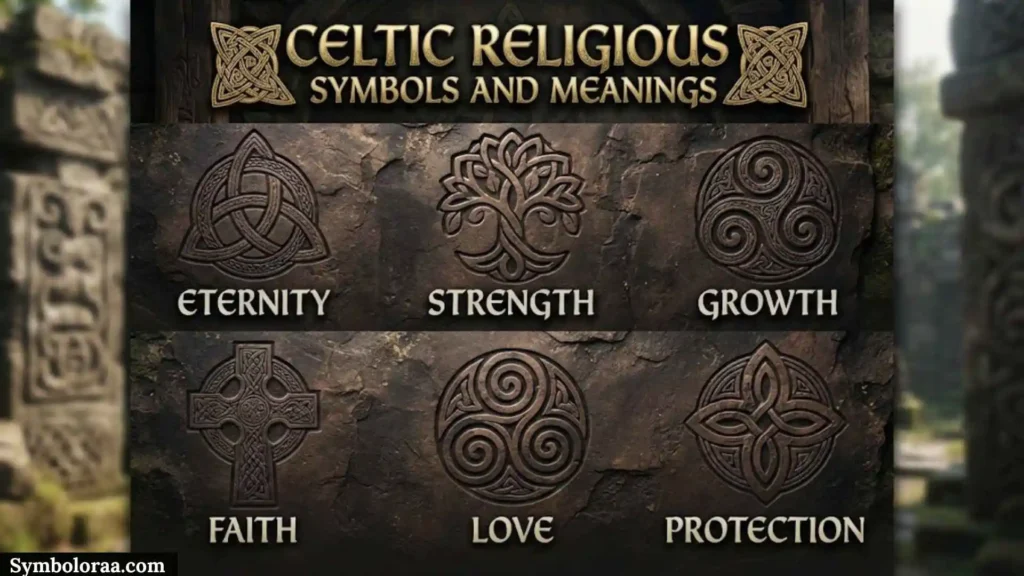
Celtic symbolism includes historical motifs as well as designs that became popular through later Celtic-inspired art. It is important not to assign one fixed ancient meaning to every modern Celtic design.
Triskelion: A three-part spiral motif found in ancient European contexts and strongly associated with Celtic-inspired symbolism.
Triquetra: A three-part interlaced design that appears in historical art and later Christian and Celtic-inspired traditions.
Celtic Knot: Interlaced patterns widely used in Celtic-inspired artwork. Modern interpretations often connect them with continuity or interconnectedness.
Celtic Cross: A cross design featuring a ring around the intersection. It is strongly associated with Irish and Celtic Christian art.
Spiral: Spiral motifs occur in ancient European archaeological art, including sites associated with prehistoric Ireland.
☘ Shamrock: Strongly associated with Ireland and later Christian tradition, although it should not automatically be described as an ancient Celtic religious symbol.
The history of Celtic symbols is complex, so a good explanation should separate documented historical evidence from modern symbolic interpretations.
Muslim Religious Symbols And Meanings
Islam does not have one universally required visual emblem used by all Muslims. The Star and Crescent is widely recognized as an Islamic-associated symbol, but its historical development is more complicated than simply being an original symbol of Islam.
☪ — Star and Crescent: Unicode officially names this character STAR AND CRESCENT. It is commonly associated with Islam and Muslim identity.
Other important Islamic visual elements include:
- Arabic Calligraphy: Quranic verses and religious phrases are often presented through artistic Arabic script.
- Rub el Hizb: An eight-pointed geometric sign used in Islamic manuscripts and design.
- Kaaba: A central sacred structure in Makkah and the direction toward which Muslims pray.
- Mosque: A place of Muslim worship rather than a single religious symbol.
- Prayer Beads: Known as misbaha or related names in different communities and used by some Muslims for devotional practice.
The crescent should not be treated as a universal theological requirement. Many Muslims and Islamic institutions may use different visual traditions.
Islam Religious Symbols And Meanings
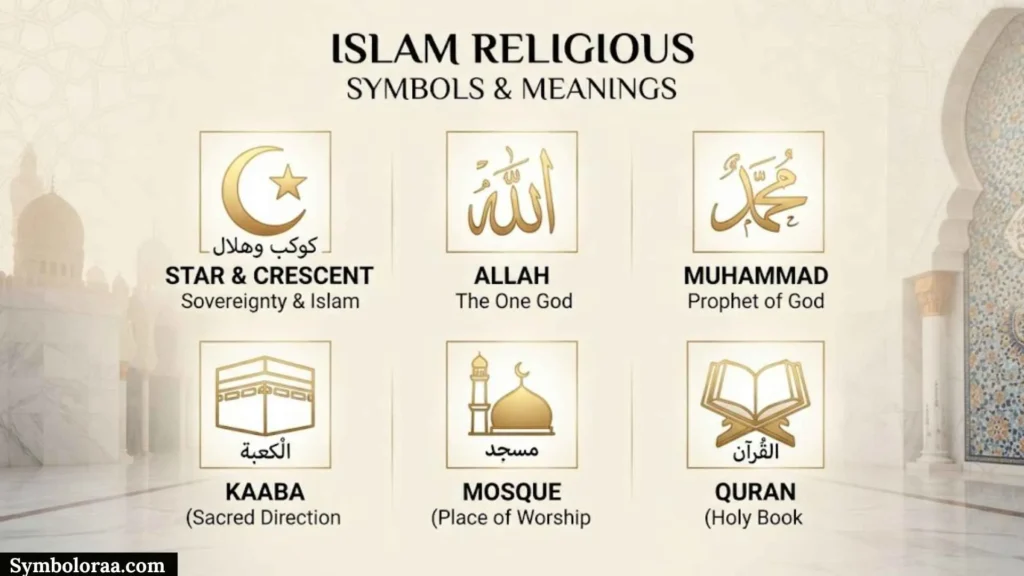
Islamic religious symbolism is often expressed through calligraphy, geometry, architecture, sacred places, and written scripture.
Common Islamic Symbols And Motifs
☪ Star and Crescent: A widely recognized Islamic-associated symbol, particularly in flags, architecture, and popular culture.
Rub el Hizb: An eight-pointed geometric sign used in Islamic textual and visual traditions.
Arabic Calligraphy: A major form of Islamic visual expression, especially for Quranic passages and devotional phrases.
Kaaba: A central sacred site in Islam. Unicode also provides a Kaaba emoji, 🕋, classified among religious-place emoji.
Mosque — 🕌: Unicode provides a mosque emoji representing an Islamic place of worship.
These examples show why “Islamic symbols” should not be limited to one crescent-and-star character. Islamic visual culture is much broader.
Buddhism Religious Symbols And Meanings
Buddhism has many symbols associated with the Buddha, Dharma, meditation, awakening, compassion, and spiritual practice.
☸ — Wheel of Dharma: One of the best-known Buddhist symbols. It represents the Dharma, or the Buddha’s teachings. Unicode officially identifies ☸ as WHEEL OF DHARMA.
Other important Buddhist symbols include:
- Lotus: Commonly associated with purity and spiritual development.
- Bodhi Tree: Associated with the Buddha’s awakening.
- Buddha Footprint: Represents the Buddha and his teachings.
- Endless Knot: Associated with interconnectedness and Buddhist teachings.
- Stupa: A sacred architectural form found throughout Buddhist traditions.
- Dharma Wheel — ☸: Represents Buddhist teachings and the Dharma.
The exact interpretation of Buddhist symbols can vary among Theravada, Mahayana, Vajrayana, and other Buddhist traditions.
Indian Religious Symbols And Meanings
India has given rise to several major religious traditions, so Indian religious symbols include Hindu, Buddhist, Jain, and Sikh examples.
| Symbol | Tradition | Common Association |
| 🕉 / ॐ | Hinduism | Om and sacred sound |
| ☸ | Buddhism | Dharma |
| ☬ / 🪯 | Sikhism | Khanda / Sikh identity |
| 卐 | Hinduism, Buddhism, Jainism | Auspiciousness and well-being |
| Ahimsa Hand | Jainism | Nonviolence |
| Lotus | Several Indian traditions | Purity and spiritual growth |
The svasti or swastika deserves special care. Unicode documentation describes svasti signs as sacred symbols associated with Hinduism, Buddhism, and Jainism and notes their use in religious texts, ceremonies, decorations, and Buddhist temples.
This ancient South Asian religious use is distinct from the twentieth-century Nazi appropriation of a similar symbol. Context, orientation, surrounding design, and cultural setting therefore matter greatly.
Hinduism Religious Symbols And Meanings
Hinduism contains many symbols connected with deities, sacred sounds, philosophy, rituals, temples, festivals, and spiritual practices.
🕉 / ॐ — Om: Om is one of the most recognizable Hindu symbols. It represents a sacred sound and is widely used in Hindu prayer, meditation, scripture, and religious art. Unicode includes an OM character as well as related script-specific forms.
Common Hindu Symbols
- 🕉 Om: Sacred sound and spiritual reality.
- ॐ Devanagari Om: A Devanagari-script form commonly used in Indian religious contexts.
- 卐 Swastika: An ancient auspicious symbol in Hindu tradition.
- 🔱 Trident / Trishula: Associated particularly with Shiva.
- Lotus: Connected with purity, beauty, spiritual development, and several Hindu deities.
- Shankha: A conch shell associated especially with Vishnu and religious ritual.
- Diya: An oil lamp used in Hindu worship and festivals.
- Tilaka: A forehead mark whose form and meaning can vary among Hindu traditions.
Unicode also officially lists religious symbols and explains that svasti signs have long-standing sacred uses in Hinduism, Buddhism, and Jainism.
FAQ
What is the most common religious symbol?
The cross is one of the most widely recognized religious symbols and is strongly associated with Christianity. Other globally recognizable examples include the Star of David, Om, Wheel of Dharma, and Star and Crescent.
What are the main religious symbols?
Common examples include the Christian cross ✝, Star of David ✡, Om 🕉, Wheel of Dharma ☸, Star and Crescent ☪, Menorah 🕎, and Khanda 🪯.
Are religious symbols available as Unicode characters?
Yes. Unicode contains several religiously associated characters, including ✝, ☦, ☧, ☪, ☬, ☸, 🕉, ✡, and 🕎. However, many religious emblems are images or designs rather than individual Unicode characters.
Does every religion have one official symbol?
No. Many religions have several important symbols, while some have no single universal emblem. A symbol can also represent a particular denomination, community, historical period, or cultural tradition rather than an entire religion.
Can I copy and paste religious symbols?
Yes. Unicode characters such as ✝, ✡, ☸, ☪, 🕉, 🕎, ☬, and 🪯 can be copied and pasted as text. Their appearance may vary between devices and fonts, while more detailed religious designs may require an image.
Conclusion
Religious symbols and meanings cover a wide range of traditions, from Christianity, Catholicism, Judaism, Islam, Buddhism, and Hinduism to Sikhism, Jainism, ancient religions, Greek traditions, Celtic-inspired designs, and Indigenous traditions. Each symbol should be understood within the culture and religious context where it is used.
For websites, messages, profiles, and social media, Unicode makes several religious symbols easy to copy and paste. Characters such as ✝, ✡, ☸, ☪, 🕉, 🕎, and 🪯 provide convenient text-based options, while other symbols are better represented through images or traditional scripts. Unicode’s current standard contains dedicated religious and religiously associated characters across several symbol collections.
The best way to use these symbols is to focus on accuracy and context. A symbol may have different meanings across religions, cultures, and historical periods, so understanding its origin and traditional use makes your copy-and-paste collection more useful and respectful.

I’m Jackson Miller, an American author inspired by mystery, adventure, and the unpredictable nature of life. I enjoy writing fast-moving stories filled with memorable characters, unexpected choices, and meaningful moments. Through my books, I want readers to experience new worlds while discovering something about courage, determination, and themselves.
Three Books:
The Edge of Tomorrow
Under a Broken Sky
The Road We Chose
 Madison Reed