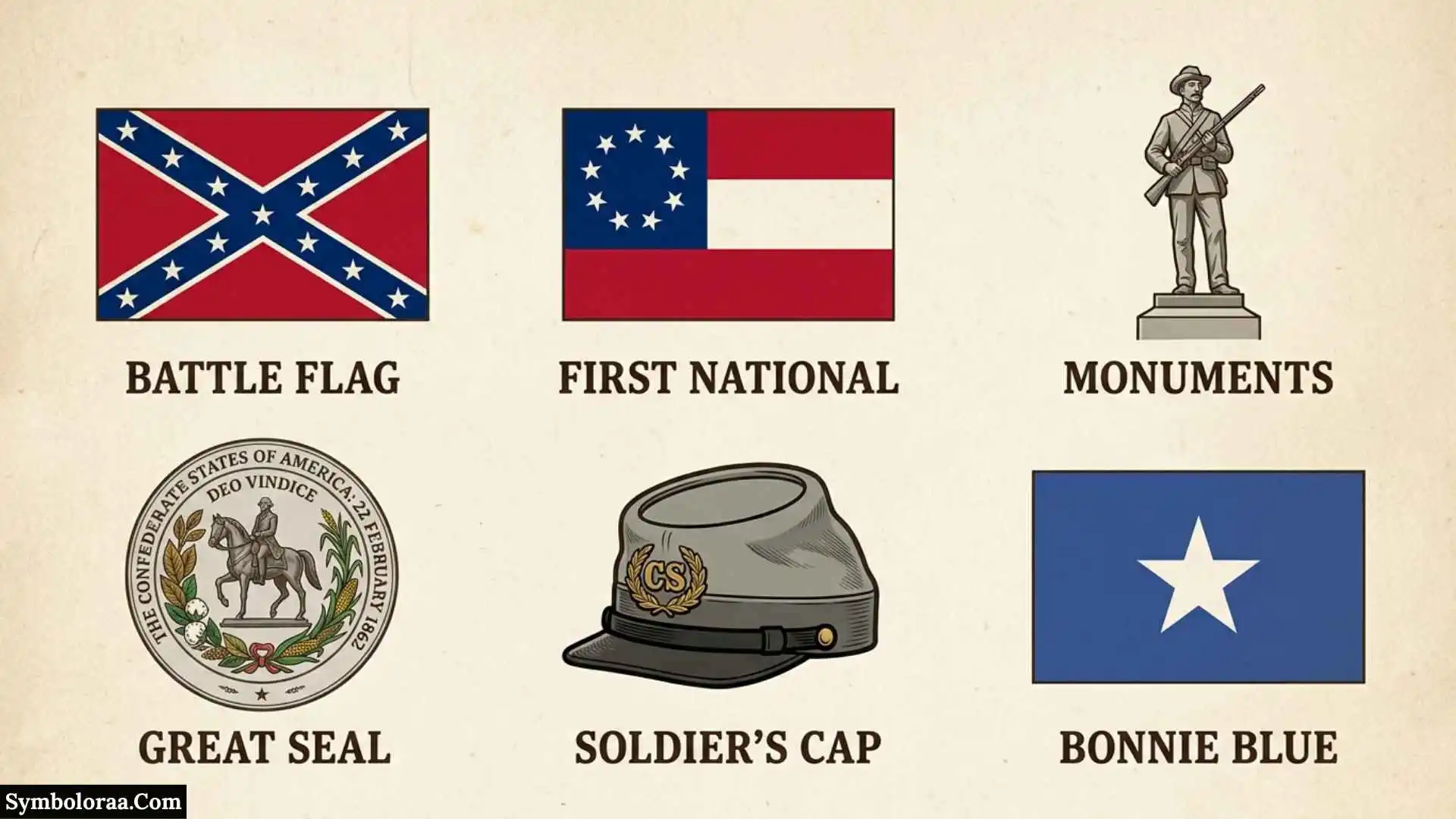
Confederate symbols are among the most debated symbols in American history. The phrase can refer to Confederate flags, military battle flags, stars and insignia, monuments, memorials, uniforms, seals, and other objects associated with the Confederate States of America during the American Civil War.
Understanding these symbols requires more than identifying a flag or monument. Their meanings changed over time. A symbol used by Confederate soldiers during the Civil War could later become part of Lost Cause memorial culture, and decades afterward it could be used in political protests, heritage movements, or expressions of white supremacy.
The most recognizable example is the Confederate battle flag, often called the Confederate flag. However, this distinction is important: the familiar red flag with a blue diagonal cross was primarily a battle flag, not the Confederacy’s only national flag. The Confederate government used several national flags during the Civil War, while armies and regiments carried additional military designs. The National Park Service notes that the Confederate Army did not have one single official battle flag; different armies and corps used designated flags.
This guide explains the major Confederate symbols, what they meant during the Civil War, how their meanings changed after 1865, why they became associated with the Lost Cause and white supremacy, and how to interpret them responsibly today.
Quick Answer: What Do Confederate Symbols Represent?
Confederate symbols originally represented the Confederate States of America, Southern secession, Confederate military organizations, and the political society that the Confederacy sought to preserve.
Their meanings later expanded. During the late 19th and 20th centuries, Confederate flags and monuments became associated with Lost Cause interpretations of the Civil War, Southern identity, segregation, and resistance to racial equality. Today, different people may display Confederate symbols to express ideas such as ancestry, Southern heritage, military history, political protest, or racial ideology.
Because the same symbol can have different meanings in different settings, date, location, purpose, and surrounding imagery are essential when interpreting it.
What Was the Confederacy?
The Confederate States of America was formed in 1861 by Southern states that seceded from the United States. The Confederacy established its own government, constitution, military forces, and national symbols.
The political crisis that produced secession cannot be separated from slavery. For example, Mississippi’s 1861 declaration explaining its secession explicitly described the state’s position as deeply connected to slavery and identified slavery as a central economic and political interest.
The Confederate Constitution also protected slavery. The National Archives notes that the Confederate Constitution permitted slaveholding across the Confederacy’s territories and between states.
This historical context matters because Confederate symbols were not created in an abstract cultural vacuum. They belonged to a government created by seceding slave states during a national conflict over slavery, political power, and the future of the United States.
Confederate Symbols and Secession
Secession itself became an important part of Confederate symbolism.
Flags were displayed over government buildings, military installations, public gatherings, and battlefields to visually distinguish the Confederacy from the United States.
The symbols communicated a new political identity: the idea that the seceding states constituted a separate nation.
For Confederate supporters, a flag could therefore represent loyalty to the new Confederate government, a state, a military unit, or the Southern cause.
Confederate Symbols and Slavery
Slavery is essential to understanding Confederate symbolism.
Although later Lost Cause interpretations frequently emphasized states’ rights, Southern honor, or opposition to federal power, contemporary secession documents show that slavery was a central issue in the secession crisis. Mississippi’s declaration is particularly explicit about the importance of slavery to the state’s economy and political position.
This does not mean every Confederate soldier or every later person who displayed a Confederate symbol had the same personal motivation. Historical interpretation must distinguish between the cause represented by the Confederacy, individual motivations, and later meanings attached to its symbols.
That distinction makes the subject more accurate rather than less clear.
Major Confederate Symbols and Their Meanings
Confederate symbolism was not limited to one flag. The Confederacy used national flags, military flags, state symbols, seals, insignia, monuments, and other visual markers.
The Confederate Battle Flag
The Confederate battle flag is the most recognizable Confederate symbol today.
It generally consists of a red field with a blue diagonal cross outlined in white and decorated with white stars. The design was based on the battle flag associated with the Army of Northern Virginia and related Confederate military formations.
Its original military purpose was practical as well as symbolic.
The Confederacy’s first national flag looked sufficiently similar to the United States flag that soldiers could have difficulty distinguishing the two during battle. The battle flag provided a more recognizable design on smoke-filled battlefields.
Why the Battle Flag Became So Famous
The battle flag became closely associated with major Confederate armies, especially the Army of Northern Virginia.
After the Civil War, however, its meaning changed. It increasingly became a generalized symbol of the Confederacy rather than simply a battlefield identifier.
The National Park Service explains that the familiar rectangular version became especially widespread during postwar veterans’ reunions, in part because rectangular flags were easier for manufacturers to produce.
This is one reason it is misleading to treat every modern display of the battle flag as identical to its original Civil War use.
The Stars and Bars
The Stars and Bars was the first national flag of the Confederate States of America.
It consisted of red and white horizontal stripes with a blue canton containing stars. The initial seven stars represented the seven states that formed the Confederacy at the beginning. Additional stars were later added as more states were claimed by the Confederacy.
The flag was officially used as the Confederate national flag from 1861 until 1863.
Its appearance was problematic on battlefields because it could be confused with the United States flag. That problem helped encourage the development and wider use of distinctive Confederate battle flags.
The Stainless Banner
The Confederate Second National Flag, commonly called the Stainless Banner, was adopted in 1863.
It placed the Confederate battle flag in a canton on a predominantly white field.
The design was intended to provide a clearer national identity, but the large white field could also resemble a surrender flag when hanging limp. This contributed to another change in Confederate national flag design.
The Third Confederate National Flag
The Third National Flag was adopted on March 4, 1865, shortly before the Confederacy collapsed.
It retained the battle-flag canton but added a red vertical bar to the outer edge of the white field. The change helped distinguish it from a white flag of surrender.
The existence of three Confederate national flags is an important fact for anyone researching Confederate symbols. The familiar battle flag should not automatically be identified as the Confederacy’s national flag.
Stars
Stars appeared repeatedly in Confederate flags.
Their basic purpose was to represent states claimed as members of the Confederacy. The number and arrangement could therefore carry political meaning.
The Stars and Bars initially contained seven stars, while later Confederate flags used different numbers, including thirteen-star designs associated with Confederate battle flags.
However, star symbolism should always be interpreted within the specific flag being examined.
The Southern Cross
The diagonal cross in the Confederate battle flag is commonly described as the Southern Cross.
Historically, it was part of a military flag design intended to distinguish Confederate forces on the battlefield.
Over time, however, the symbol became much broader. It was transformed from a military identifier into a major emblem of Confederate memory and later political symbolism.
Its modern meaning therefore depends heavily on when, where, and why it is displayed.
Confederate Military Flags
Many Confederate regiments and military formations carried their own flags.
This is why there was never one universal Confederate battle flag used identically by every Confederate soldier.
The National Park Service explains that individual Confederate armies and corps could have designated battle flags and that multiple designs existed during the war.
A researcher looking at a historic photograph should therefore avoid assuming that every Confederate flag is the familiar modern battle-flag design.
Confederate Symbols, Monuments, and Memorials
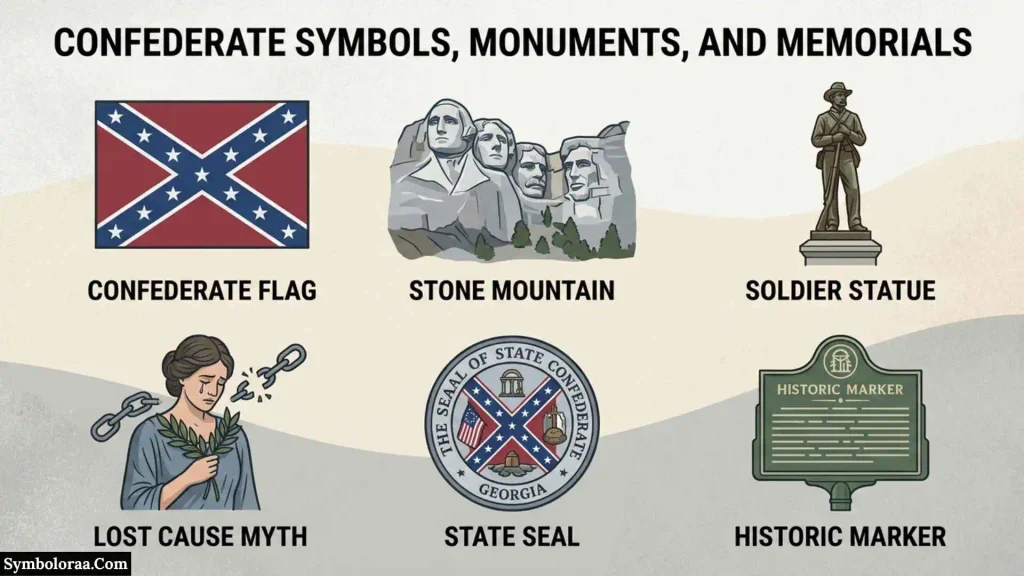
Flags were only one part of Confederate symbolism.
Monuments, statues, plaques, cemeteries, memorial buildings, roads, schools, and public ceremonies also helped shape how the Confederacy was remembered.
Confederate Soldier Monuments
Many Confederate monuments were erected after the Civil War rather than during it.
This distinction is important.
A monument built in the 1880s, 1890s, or early 1900s reflects not only the Civil War itself but also the political and social environment in which the monument was created.
The National Park Service documents how Confederate memorial organizations used monuments and commemorations to promote particular interpretations of the war.
The Lost Cause as a Symbolic System
The Lost Cause was a postwar interpretation of Confederate history that portrayed the Confederate cause in a more favorable light.
It commonly emphasized Southern honor, states’ rights, military heroism, and regional identity while minimizing or denying slavery’s central role in the conflict.
The National Park Service describes Lost Cause memorialization as a historical narrative that defended the Confederate cause and downplayed slavery as a cause of the Civil War.
Confederate symbols became important visual tools within this interpretation.
A statue of a Confederate general, a monument to Confederate soldiers, or a flag displayed at a memorial could therefore communicate more than simple remembrance.
Confederate Cemeteries and Graves
Confederate cemeteries and grave markers have a somewhat different symbolic function.
They may commemorate individuals who died during the Civil War and can serve as sites of mourning and family remembrance.
At the same time, cemetery monuments can become part of broader public narratives about the Confederacy.
This is why researchers should distinguish between mourning a dead person and celebrating the political cause for which that person fought.
Confederate Symbols and White Supremacy
One of the most important developments in the history of Confederate symbols occurred after the Civil War.
Some Confederate symbols became connected to racial segregation and white supremacy.
This association did not emerge solely from the Civil War battlefield. It developed through later political and social uses.
The Smithsonian documents the Confederate battle flag’s complicated history as a symbol that became associated with white supremacy, Southern identity, political movements, and debates about race.
Confederate Symbols During the Jim Crow Era
During the late 19th and early 20th centuries, Southern states established systems of racial segregation and disenfranchisement.
Confederate memorialization existed within this broader environment.
The National Park Service describes how Confederate memorial organizations promoted Lost Cause narratives while public monuments became visible markers of a pro-Confederate Southern identity during the Jim Crow era.
This historical connection is essential when interpreting monuments or flags created long after the Civil War.
Confederate Symbols and the Civil Rights Era
The Confederate battle flag became particularly controversial during the Civil Rights era.
Some segregationists used Confederate imagery in opposition to federal intervention and racial integration.
The Smithsonian’s National Museum of American History notes that white segregationists displayed Confederate flags during the 1960s to oppose federal intervention and defend what they called the Southern way of life.
This later history significantly influenced how many Americans understand the symbol today.
The 1961 South Carolina Capitol Flag
A well-known example is the Confederate battle flag displayed at the South Carolina State House.
The flag was raised in 1961, during the centennial of the Civil War and at a time of intense civil rights activism.
Its later removal became part of the continuing national debate over Confederate symbols.
The Smithsonian has documented the 2015 protest in which Bree Newsome climbed the South Carolina Capitol flagpole and removed the Confederate battle flag.
This example demonstrates why modern Confederate symbolism cannot be understood only by looking at the 1860s.
Confederate Symbols and Southern Heritage
Some people use Confederate symbols to express an idea of Southern heritage, ancestry, family history, regional identity, or interest in Civil War history.
This is one reason the modern debate cannot be reduced to a single interpretation.
However, explaining someone’s intended meaning does not erase the symbol’s historical associations.
A person may intend a flag to represent ancestry while another viewer may reasonably understand it through its associations with the Confederacy, segregation, or white supremacy.
Both the intended meaning and the historical context can be relevant.
Heritage and Historical Context
A useful distinction is:
Heritage describes what a person or community remembers as part of its past.
Historical meaning describes what a symbol represented in a particular historical context.
These concepts can overlap, but they are not identical.
A Confederate symbol may therefore be meaningful to someone’s family history while also having a documented history connected to secession and racial politics.
Why Are Confederate Symbols So Controversial?
Confederate symbols are controversial because they connect several different layers of American history.
They can represent:
- Confederate military service
- Southern regional identity
- Secession
- Civil War memory
- Lost Cause mythology
- White supremacy
- Resistance to federal civil rights enforcement
- Family or ancestral remembrance
- Political protest
- Historical education
The same visual symbol can therefore produce very different reactions depending on context.
Historical Artifact vs Modern Political Symbol
A Confederate flag inside a Civil War museum is not necessarily communicating the same thing as a Confederate flag used at a modern political rally.
The first may be presented as a historical artifact.
The second may function as a contemporary political message.
The physical object is similar, but the surrounding context changes its meaning.
Confederate Symbols Through Different Historical Periods
Understanding the timeline helps prevent oversimplification.
| Period | Common Context of Confederate Symbols |
| 1861–1865 | Secession, Confederate government, military identification, Southern nationalism |
| 1865–late 1800s | Mourning, veterans’ memory, reconciliation, emerging Confederate remembrance |
| Late 1800s–1930s | Lost Cause memorialization, monuments, Southern identity, racial hierarchy |
| 1940s–1950s | Continued Confederate memory and regional symbolism |
| 1960s | Civil rights conflict, segregationist resistance, political symbolism |
| Late 20th century | Heritage movements, political identity, popular culture, racial controversy |
| Today | Historical education, ancestry, protest, heritage claims, political symbolism, and white supremacist use |
The timeline shows why asking simply “What does the Confederate flag mean?” does not have one universal answer.
Confederate Symbols vs Civil War Symbols
Not every Civil War symbol is Confederate.
This distinction is important for students and researchers.
| Symbol Category | What It Refers To |
| Confederate symbol | Something specifically associated with the Confederacy |
| Confederate battle flag | A military flag used by Confederate forces |
| Confederate national flag | One of the official national flags of the Confederacy |
| Union symbol | A symbol associated with the United States or Union cause |
| Civil War symbol | A broader symbol connected to the Civil War |
| Confederate monument | A memorial associated with Confederate people, soldiers, or memory |
| Lost Cause symbol | Imagery associated with later pro-Confederate interpretations |
| Southern symbol | A broader regional symbol that may or may not be Confederate |
This distinction prevents the common mistake of treating every Southern or Civil War object as inherently Confederate.
Symbol, Artifact, Motif, and Political Symbol: What’s the Difference?
These terms are related but should not be used interchangeably.
Historical Artifact
An artifact is a physical object preserved from the past.
Examples include an original flag, uniform, weapon, medal, or document.
Symbol
A symbol communicates an idea beyond its physical form.
A flag can symbolize political allegiance, military identity, regional pride, or historical memory.
Motif
A motif is a recurring visual or conceptual element.
Repeated stars, crosses, military imagery, or Confederate insignia can operate as motifs.
Political Symbol
A political symbol is used to communicate political beliefs or affiliations.
A Confederate flag displayed at a modern political event may therefore function differently from the same type of flag preserved inside a museum.
How to Analyze a Confederate Symbol Correctly
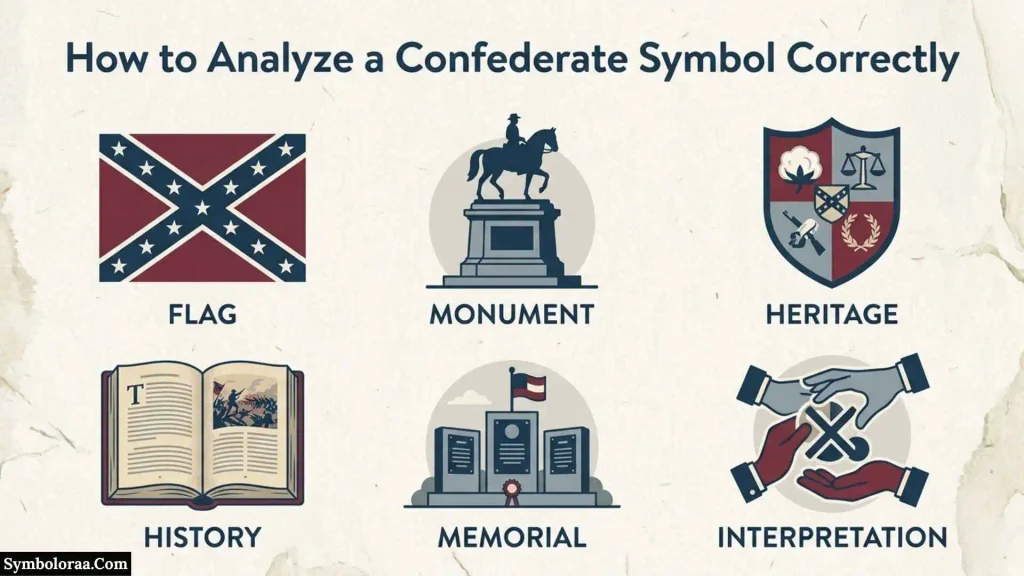
A reliable interpretation should not begin with a guess about what the symbol “must” mean.
Use the following framework.
Step 1: Identify the Symbol
Determine exactly what you are looking at.
Is it:
- Stars and Bars?
- Confederate battle flag?
- Second National Flag?
- Third National Flag?
- Regimental flag?
- Confederate seal?
- Military insignia?
- Monument?
- Cemetery marker?
Correct identification is the first step.
Step 2: Date It
Ask when it was created or displayed.
A flag from 1862 and a monument erected in 1910 belong to different historical contexts.
Step 3: Determine Its Original Purpose
Was it created for:
- military identification?
- government representation?
- commemoration?
- political campaigning?
- memorialization?
- decoration?
Purpose can reveal meaning.
Step 4: Identify the User
Who displayed or created it?
Possible users include:
- Confederate soldiers
- Confederate government officials
- veterans’ organizations
- memorial groups
- state governments
- segregationists
- heritage organizations
- museums
- modern political groups
Step 5: Examine the Historical Context
Look at what was happening when the symbol was used.
Consider:
- secession
- slavery
- Civil War battles
- Reconstruction
- Jim Crow
- Lost Cause memorialization
- Civil Rights Movement
- modern political debates
Step 6: Research Later Uses
A symbol’s history does not stop when its original users disappear.
Determine whether it was later adopted by:
- memorial organizations
- political movements
- segregationists
- heritage groups
- extremist organizations
- museums
- educators
Step 7: Interpret the Modern Context
Finally, ask why the symbol is being displayed now.
This is often the most important step when interpreting a contemporary example.
Confederate Symbol Interpretation Framework
For research, essays, or classroom assignments, this simple formula is useful:
Identify → Date → Original Purpose → User → Historical Context → Later Uses → Modern Context → Interpretation
For example:
Confederate battle flag → Civil War military design → battlefield identification → Confederate army → secession and Civil War → postwar memorialization → later political and racial uses → modern meaning depends on context
This approach produces a much stronger interpretation than simply writing “the Confederate flag represents the South.”
Common Misconceptions About Confederate Symbols
“The Confederate Battle Flag Was the Official Confederate National Flag”
Not exactly.
The Confederacy had multiple national flags. The familiar battle flag was primarily a military design, although it later became widely used as a general symbol of the Confederacy.
“There Was Only One Confederate Flag”
There were multiple Confederate national, military, state, and regimental flags.
The Confederacy changed its national flag design during the war, while different military units used different flags.
“Every Confederate Symbol Has Exactly the Same Meaning”
Historical meanings vary by period and context.
A battlefield flag, a postwar monument, and a modern political display should not automatically be interpreted in exactly the same way.
“Confederate Symbols Have Nothing to Do With Slavery”
This interpretation ignores important historical evidence.
Secession documents explicitly identified slavery as a central concern, and the Confederate constitutional system protected slavery.
“Every Person Who Uses a Confederate Symbol Has the Same Beliefs”
That conclusion goes beyond what the symbol itself can prove.
The symbol may have documented historical associations, but the intent of a particular person or organization should be established through context and evidence.
Real Examples of Confederate Symbolism
Confederate Flags at Civil War Battlefields
At historic battlefields, Confederate flags may appear as part of museum collections, interpretive exhibits, or historical demonstrations.
In these settings, the purpose can be educational: helping visitors understand how armies identified themselves and how flags functioned during combat.
The National Park Service explains that Civil War flags had practical battlefield purposes, including helping soldiers identify units and follow movements when smoke and battlefield noise made commands difficult to hear.
Confederate Monuments
A Confederate monument may commemorate soldiers who died in battle, but the date and circumstances of its construction can reveal additional meanings.
For example, the National Park Service documents a 1914 Confederate monument at Monocacy and explains how its dedication ceremony participated in a Lost Cause interpretation of the war.
Modern Museums
Museums may preserve Confederate uniforms, flags, photographs, weapons, documents, and monuments as historical evidence.
In this setting, displaying an object does not necessarily mean endorsing the cause it once represented.
The important question is how the institution interprets the object and provides historical context.
Why Context Is Essential
Context can completely change how a Confederate symbol should be interpreted.
Consider four hypothetical examples:
Example 1: An original Confederate flag is stored in a Civil War museum.
Likely function: historical artifact.
Example 2: A reproduction Confederate flag appears in a documentary about the Civil War.
Likely function: historical representation.
Example 3: A Confederate flag is displayed at a family gathering to commemorate an ancestor who served in the Confederate army.
Possible function: ancestry or family remembrance.
Example 4: The same flag appears alongside explicitly racist slogans at a political rally.
Likely function: contemporary political or racial messaging.
The visual object may look similar, but the surrounding context changes its communicative purpose.
A Decision Tree for Identifying Confederate Symbols
Use this quick decision process when researching an image, artifact, monument, or flag.
Is it connected specifically to the Confederate States of America?
- No: It may be a broader Southern or Civil War symbol.
- Yes: Continue.
Is it a flag?
- Yes: Determine whether it is a national flag, battle flag, state flag, or regimental flag.
- No: Continue identifying the monument, seal, insignia, or artifact.
Was it created during the Civil War?
- Yes: Examine its original Confederate purpose.
- No: Investigate why it was created later.
Was it created during the Lost Cause era?
- Yes: Examine memorialization, racial politics, and historical interpretation.
- No: Continue.
Is it being used today?
- Yes: Examine the modern setting, accompanying messages, and organization using it.
- No: Treat it primarily as a historical artifact or memorial, depending on evidence.
How to Research Confederate Symbols Responsibly
Good research requires reliable sources and careful language.
Start With Institutional Sources
For historical research, prioritize sources such as:
- National Park Service
- Smithsonian Institution
- Library of Congress
- National Archives
- university archives and museums
- scholarly historical publications
- original historical documents
These sources can help distinguish documented history from later claims.
Separate Evidence From Interpretation
Do not treat every modern opinion as historical evidence.
A strong article should distinguish:
Documented fact: A particular flag was adopted in a specific year.
Historical interpretation: Historians debate or explain how its meaning changed.
Modern opinion: Someone today considers the symbol heritage, protest, or offensive.
Keeping these categories separate makes the writing more credible.
Avoid Overgeneralization
Do not claim that every Confederate symbol has one permanent meaning.
Likewise, do not erase documented associations simply because a modern user claims a different intention.
The strongest historical analysis acknowledges both the documented history and the specific context.
Why Confederate Symbols Still Matter Today
Confederate symbols remain important because the Civil War is not only a story about battles.
It is also a story about national identity, slavery, emancipation, citizenship, race, memory, and the meaning of historical heritage.
The National Archives notes that the Civil War transformed the United States and ultimately contributed to the destruction of slavery.
The Library of Congress also describes the postwar emergence of Lost Cause mythology and the ways Southern memory reshaped interpretations of the Confederacy.
As a result, debates over Confederate symbols are often really debates about which parts of history should be remembered, how they should be remembered, and what public symbols communicate today.
Frequently Asked Questions
What are Confederate symbols?
Confederate symbols are flags, monuments, insignia, seals, military objects, memorials, and other imagery associated with the Confederate States of America or later Confederate remembrance.
What is the most famous Confederate symbol?
The Confederate battle flag is the most recognizable Confederate symbol today. It features a red field with a blue diagonal cross outlined in white and stars on the cross.
Was the Confederate battle flag the Confederate national flag?
No. The Confederacy used several national flags. The familiar battle flag was primarily a military design and was used by Confederate armies and units.
What did the Confederate flag originally represent?
During the Civil War, Confederate flags could represent military units, Confederate political identity, secession, and loyalty to the Confederate cause.
What does the Confederate flag mean today?
Its modern meaning depends on context. It can be used to express Southern heritage or ancestry, historical interest, political opposition, or racial and white-supremacist ideology. Its historical associations with the Confederacy, Lost Cause memory, segregation, and racial politics are central to understanding why it remains controversial.
Why are Confederate symbols controversial?
They are controversial because the Confederacy was created by seceding slave states during a crisis in which slavery was central, while Confederate symbols were later incorporated into Lost Cause memorialization and, in the 20th century, segregationist politics.
What is the Lost Cause?
The Lost Cause was a post-Civil War interpretation that portrayed the Confederate cause in a favorable way, emphasizing ideas such as Southern honor and states’ rights while minimizing slavery’s central role in the conflict.
Are Confederate monuments Confederate symbols?
Yes. Confederate monuments can function as symbols of Confederate remembrance. However, their meanings should be studied according to when they were created, who sponsored them, where they were placed, and what message their inscriptions and ceremonies communicated.
Are all Southern symbols Confederate symbols?
No.
Southern identity includes many symbols that have no direct connection to the Confederacy. A symbol should be identified based on its actual historical origin rather than simply its association with the American South.
Can a Confederate symbol be displayed for educational purposes?
Yes. Museums, historic sites, schools, and researchers may display Confederate artifacts to teach history. The educational context and accompanying interpretation are important.
Why did Confederate flags change during the Civil War?
The Confederacy changed its national flag designs partly because the original design could be confused with the United States flag on the battlefield. The Second National Flag also created visibility problems because its large white field could resemble a surrender flag.
How should students analyze a Confederate symbol?
Students should identify the symbol, determine its date, investigate its original purpose, identify who used it, study its historical context, examine later uses, and then evaluate its modern context.
Key Takeaways
- Confederate symbols include flags, monuments, military insignia, seals, memorials, and other objects associated with Confederate history.
- The Confederate battle flag was primarily a military design, not the sole Confederate national flag.
- The Confederacy used multiple national flags during the Civil War.
- Confederate symbols were connected to the political identity of the Confederacy and the secession crisis.
- Slavery was a central issue in the secession crisis, as demonstrated by contemporary Confederate-state documents.
- Confederate symbolism changed significantly after the Civil War.
- Lost Cause memorialization helped reshape Confederate symbols into broader symbols of Southern memory and identity.
- During the Civil Rights era, Confederate imagery was also used by segregationists resisting federal intervention and racial integration.
- Modern uses can include historical education, ancestry, heritage claims, political protest, and white-supremacist messaging.
- The same symbol can have different meanings in different contexts.
- Historical analysis should distinguish an object’s original meaning from later interpretations and modern uses.
- The best way to interpret a Confederate symbol is to identify it, date it, determine its purpose, research its users, examine its historical context, and then analyze its later and modern uses.
Conclusion
Confederate symbols cannot be understood accurately by looking at a flag, monument, or emblem in isolation.
Their meanings developed across several historical periods. During the Civil War, flags and insignia helped identify Confederate forces and express allegiance to the Confederate government and military cause. After the war, these symbols became part of mourning, veterans’ memory, and increasingly organized Lost Cause interpretations. During the Jim Crow and Civil Rights eras, Confederate imagery also became connected to racial segregation and resistance to civil rights.
Today, Confederate symbols continue to carry multiple meanings, but those meanings exist alongside a well-documented historical record.
The most reliable approach is therefore neither to reduce every symbol to a single modern interpretation nor to ignore its historical associations. Instead, examine what the symbol is, when it was used, who used it, why it was created, how its meaning changed, and what it communicates in its present context.
That approach provides a more accurate understanding of Confederate symbols and explains why they remain such powerful and contested objects in American historical memory.

I’m Jackson Miller, an American author inspired by mystery, adventure, and the unpredictable nature of life. I enjoy writing fast-moving stories filled with memorable characters, unexpected choices, and meaningful moments. Through my books, I want readers to experience new worlds while discovering something about courage, determination, and themselves.
Three Books:
The Edge of Tomorrow
Under a Broken Sky
The Road We Chose
 Ethan Brooks