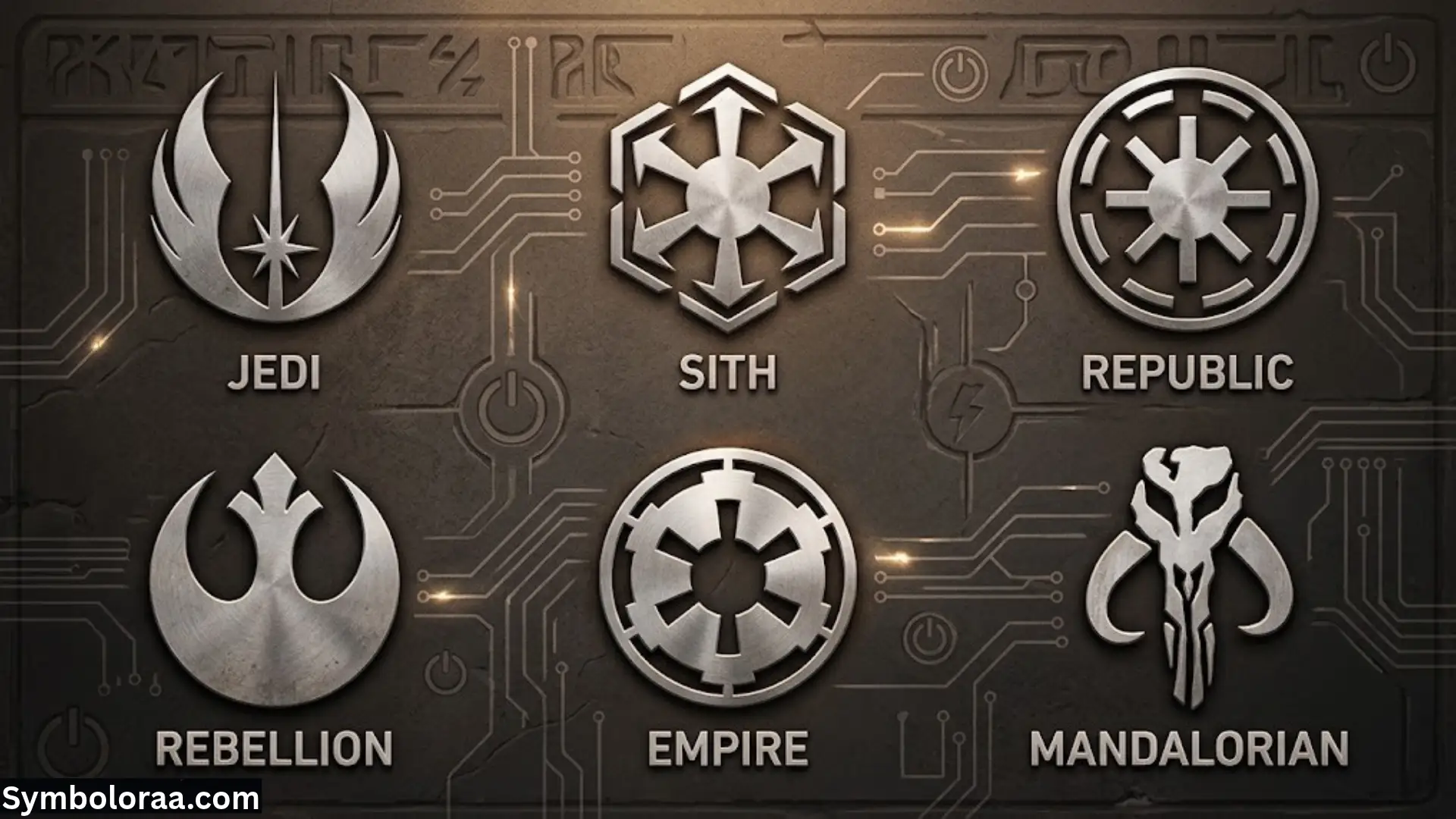
From the Rebel Alliance’s recognizable Starbird to the Galactic Empire’s imposing insignia, Star Wars symbols tell stories that go far beyond their appearance. These marks identify governments, military forces, resistance movements, spiritual traditions, and cultures spread across a galaxy far, far away.
Throughout the films, television shows, books, and games, Star Wars emblems appear on starships, uniforms, helmets, flags, ancient artifacts, and government buildings. A single symbol can reveal who controls a planet, which side a pilot supports, or what beliefs guide a character.
Some symbols also carry a history of political change. The Galactic Empire, for example, adopted a modified version of the Galactic Republic’s crest. Meanwhile, the Rebel Alliance developed a recognizable identity that continued to influence later resistance movements.
Understanding these designs makes the Star Wars universe even more interesting. This guide explores the most important Star Wars faction symbols, their origins, their established meanings, and their roles in galactic history. It also separates confirmed lore from popular interpretations and distinguishes current canon from Legends material.
What Do Star Wars Symbols Mean?
Star Wars symbols are visual marks associated with organizations, governments, cultures, military units, and spiritual traditions. They help audiences identify characters and understand the loyalties that shape the story.
Think of these emblems as the fictional galaxy’s version of national flags, military patches, and organizational logos. Just as a country’s flag identifies its government and people, a faction insignia communicates affiliation within Star Wars.
However, not every recognizable image serves the same purpose.
- Faction emblems identify organizations such as the Rebel Alliance and First Order.
- Government insignia represent political institutions, including the Galactic Republic and Galactic Empire.
- Military markings identify units, ranks, or specialized forces.
- Cultural symbols represent traditions and identities, such as Mandalorian heritage.
- Force-related symbols appear in connection with Jedi, Sith, ancient temples, and spiritual artifacts.
- Fictional writing systems, including Aurebesh, communicate language rather than organizational identity.
These distinctions matter because fans sometimes describe every recognizable design as a logo. A Death Star image, for example, represents an Imperial superweapon, but it isn’t the same thing as the official Imperial insignia.
The meaning of a symbol also depends on context. An emblem that once represented a democratic government might later inspire a new regime with very different political goals.
Star Wars Symbols and Their Meanings at a Glance
The following table provides a quick reference to some of the galaxy’s most recognizable emblems.
| Symbol or emblem | Associated group | Main association |
| Alliance Starbird | Rebel Alliance | Resistance against Imperial rule |
| Republic Cog | Galactic Republic | Republic government and identity |
| Imperial insignia | Galactic Empire | Imperial authority and military control |
| First Order insignia | First Order | Imperial legacy and military expansion |
| Jedi Order symbol | Jedi Order | Jedi identity and tradition |
| Sith-related symbols | Sith traditions | Dark-side allegiance and Sith identity |
| Separatist emblem | Confederacy of Independent Systems | Separatist political and military identity |
| Sith Eternal crest | Sith Eternal | Sith worship and the Final Order |
| New Republic insignia | New Republic | Successor government and galactic representation |
| Resistance crest | Resistance | Opposition to the First Order |
| Mythosaur skull | Mandalorian culture | Heritage and cultural identity |
| Great Galactic Seal | Galactic Senate | Official governmental identity |
Some symbols have clearly documented histories, while others are understood mainly through their appearance and use in the story. Keeping that distinction in mind helps prevent speculation from becoming mistaken for established lore.
The Rebel Alliance Starbird: A Symbol of Resistance
The Alliance Starbird is one of the most recognizable Star Wars emblems. Its stylized, bird-like design appears on Rebel pilot helmets, uniforms, equipment, and other objects associated with the fight against the Galactic Empire.
The Rebel Alliance used the symbol during its campaign to overthrow Emperor Palpatine’s regime and restore democracy to the galaxy.
The Origins of the Alliance Starbird
The Starbird has an especially interesting history because its canon origins connect to Sabine Wren, a Mandalorian warrior and graffiti artist introduced in Star Wars Rebels.
Sabine created a distinctive starbird design that she used to sign her artwork. According to the official Star Wars Databank, her personal mark inspired the symbol later adopted by the Rebel Alliance.
You can explore this history in the official Sabine Wren Databank entry.
This origin gives the emblem a personal connection to the broader Rebellion. A mark created by one individual eventually became the identifying symbol of a movement that brought together people from many different worlds.
Older Legends material offers a different account involving Galen Marek and the Marek family crest. That story belongs to a separate continuity and shouldn’t be presented as the definitive canon origin.
What Does the Rebel Alliance Symbol Represent?
The Starbird’s established association is resistance against the Empire. Its broader interpretation draws on the Alliance’s political goals and the role the symbol plays throughout the story.
Its most common associations include:
- Freedom: The Alliance fights to end Imperial domination.
- Resistance: The emblem identifies those opposing Palpatine’s government.
- Unity: Different Rebel cells rally around a shared cause.
- Hope: The symbol becomes a recognizable sign that Imperial rule can be challenged.
- Renewal: Its later use connects the Rebellion with the restoration of representative government.
The emblem is particularly effective because it appears on practical objects rather than only on flags. A Starbird painted on a pilot’s helmet or displayed on Rebel equipment tells the audience which movement that character supports.
Its connection to the Resistance in the sequel era also reinforces the idea that symbols can survive the organizations that first made them famous.
The Galactic Republic Symbol: The Republic Cog
The Republic Cog is the familiar eight-spoked insignia associated with the Galactic Republic before Palpatine transformed the government into the Galactic Empire.
The Republic governed the galaxy for more than a thousand years. Its institutions included the Galactic Senate, which represented member worlds and systems, and the Jedi Order, whose members served as peacekeepers.
The official Galactic Republic Databank entry explains the government’s role and its eventual collapse during the rise of Palpatine.
What Does the Republic Cog Mean?
The Republic’s insignia identifies the government and its political institutions. Its circular form and eight-spoked design make it visually distinct from the later Imperial crest.
The symbol is often associated with the Republic’s ideals of cooperation, representation, and galactic unity. These associations make sense within the Republic’s stated political identity, although they shouldn’t be mistaken for a documented explanation of every geometric detail.
The Republic’s history also complicates its idealistic image.
During the Clone Wars, corruption, political division, and emergency powers weakened the government. Palpatine exploited those problems to consolidate authority and ultimately declare the first Galactic Empire.
This contrast creates an important distinction between what a symbol represents officially and what the organization does in practice. The Republic’s insignia identifies a government built around representation, but that government ultimately failed to protect its own democratic institutions.
Republic Cog Versus Imperial Insignia
The Imperial insignia retains the general cog-like appearance but uses six spokes rather than the Republic’s eight.
This visual relationship helps communicate political continuity between the two governments. Palpatine didn’t simply replace the Republic with an entirely unrelated institution; he transformed its existing system into an authoritarian empire.
The change in insignia provides a visual reminder that the government has changed, even when some of its administrative structures and military traditions remain familiar.
Claims connecting the Republic Cog to sacred numerology or the Bendu should be attributed to the specific Legends sources that establish them. They shouldn’t be treated as universal explanations for the canon design.
The Galactic Empire Insignia: Authority and Control

The Galactic Empire insignia is among the most familiar symbols in the franchise. Its six-spoked crest appears on Imperial uniforms, flags, military equipment, installations, and propaganda.
When Palpatine reorganized the Republic into the Empire, the new government adopted a modified version of the earlier Republic insignia.
The official Galactic Empire Databank entry describes the regime’s reliance on fear, intimidation, military strength, and tyranny.
What Does the Imperial Symbol Mean?
The Imperial insignia identifies the authority of Palpatine’s government. Its repeated appearance across military and civilian settings makes the Empire’s presence unmistakable.
Its most important associations include:
- Authority: The crest identifies the government and its institutions.
- Military power: It appears on vehicles, uniforms, equipment, and installations.
- Control: Its presence on a world signals Imperial administration or influence.
- Order: The Empire presents itself as a force capable of imposing stability.
- Intimidation: Its widespread use reinforces the regime’s power and reach.
The Empire claims to offer security and stability after the chaos of the Clone Wars. In practice, however, Palpatine’s government rules through coercion and fear.
That contrast is central to the emblem’s significance. The symbol represents a regime that presents authoritarian control as a solution to galactic disorder.
Why Does the Empire Use a Cog-Like Design?
The Imperial crest’s relationship to the Republic insignia helps connect Palpatine’s government to the political system that preceded it.
The familiar shape also makes the new government visually recognizable across different settings. A viewer can identify Imperial equipment without needing to read a label or hear a character explain its ownership.
This is effective Star Wars iconography. The emblem communicates affiliation quickly, while its repeated use makes the Empire feel like a unified organization with a strong visual identity.
The First Order Insignia: An Imperial Legacy Reimagined
The First Order insignia belongs to the military and political movement that emerges from the remnants of the Galactic Empire.
Although the First Order draws heavily on Imperial traditions, it has its own identifying emblem. The design features angular forms and a distinctive radial arrangement within a hexagonal outline.
The First Order’s insignia appears on uniforms, equipment, installations, and military displays throughout the sequel trilogy.
What Does the First Order Symbol Mean?
The emblem communicates the First Order’s organizational identity and its relationship to the Empire’s legacy.
The design has also been described as an explosive force pressing outward against containment. This interpretation connects its visual structure to the faction’s aggressive expansion and desire to dominate the galaxy.
Its major associations include:
- Imperial legacy: The organization draws on the Empire’s military traditions.
- Expansion: The First Order seeks to establish control across the galaxy.
- Military discipline: Its insignia appears throughout a highly organized military structure.
- Ideological continuity: The movement seeks to revive an authoritarian vision of galactic rule.
The First Order shouldn’t be treated as simply another name for the Galactic Empire. Although the organizations share a historical and ideological connection, they operate in different periods and have distinct insignia.
First Order Versus Galactic Empire Insignia
The two designs illustrate how a successor movement can preserve the identity of an earlier regime while developing its own visual language.
The Empire uses a six-spoked cog. The First Order uses a more angular, sixteen-rayed design within a hexagonal border.
Their relationship is important to the story. The First Order’s visual identity signals that the Empire’s defeat didn’t eliminate the ideology that sustained it.
The Jedi Order Symbol: A Mark of Jedi Tradition
The Jedi Order symbol represents one of the galaxy’s oldest and most influential Force traditions.
The Jedi served the Galactic Republic for generations, acting as peacekeepers and using their connection to the Force to guide their actions.
The official Jedi Order Databank entry describes the Jedi as guardians of peace and justice whose history was devastated by Palpatine’s rise and Order 66.
What Does the Jedi Symbol Mean?
The familiar Jedi emblem combines a winged form with a central lightsaber-like element. Its design is often interpreted as a visual expression of the Jedi’s role as guardians.
The symbol’s main associations include:
- Protection: The Jedi defend others and work to preserve peace.
- Service: Jedi training emphasizes responsibility rather than personal gain.
- Wisdom: Members study the Force and develop judgment through training.
- Peace: Jedi are traditionally associated with diplomacy and conflict resolution.
- Tradition: The emblem identifies an order with a long institutional history.
The wings and central element invite interpretations involving guidance, light, and protection. However, not every proposed meaning has an independently documented explanation in official lore.
The Jedi Symbol and the Force
The Jedi’s beliefs center on the Force, a mysterious energy field that connects living things throughout the galaxy.
According to the official Force Databank entry, the Force enables extraordinary abilities and influences the actions of those who learn to understand it.
The Jedi and Sith both draw on the Force, but they approach it differently. Jedi teachings emphasize service, discipline, and restraint, while the Sith pursue power through darker practices and destructive emotions.
The Jedi symbol therefore identifies a particular tradition rather than representing every Force-sensitive individual. Other Force traditions, including the Nightsisters and various ancient groups, have their own identities and practices.
Sith Symbols: The Dark Side of the Force
Unlike the Galactic Empire or Rebel Alliance, the Sith shouldn’t automatically be assigned one universally used emblem across every era and continuity.
Sith symbols appear in different forms across Star Wars media. They can be associated with ancient temples, artifacts, organizations, inscriptions, and Sith-related traditions.
The Sith are an ancient order of Force-wielders who embrace the dark side. Their history includes figures such as Darth Sidious, Darth Vader, Darth Maul, and other Sith Lords.
What Do Sith Symbols Represent?
Sith-related imagery often reflects the order’s pursuit of power and its willingness to use destructive methods.
Common associations include:
- Power: Sith characters seek greater command over the Force and their surroundings.
- Ambition: Sith traditions encourage the pursuit of personal strength and advancement.
- Conflict: Sith history includes rivalries, betrayal, and struggles between masters and apprentices.
- Dark-side allegiance: Sith identity is closely tied to their use of the dark side.
- Forbidden knowledge: Certain artifacts and locations preserve Sith teachings and rituals.
These themes come from Sith history and philosophy. They don’t mean that every angular shape, red design, or circular pattern is automatically a Sith symbol.
Jedi Versus Sith Symbolism
The Jedi and Sith offer a useful comparison because both traditions use the Force but follow different philosophies.
| Feature | Jedi | Sith |
| Force tradition | Light-side-oriented teachings | Dark-side practices |
| Common ideals or goals | Service, peace, discipline | Power, ambition, domination |
| Relationship to others | Protection and cooperation | Often manipulation and rivalry |
| Common visual associations | Jedi robes, lightsabers, order insignia | Red-bladed lightsabers, dark clothing, Sith artifacts |
| Organizational imagery | A recognizable Jedi Order emblem | Multiple Sith-related symbols across different contexts |
The comparison reveals how Star Wars uses visual identity to reinforce differences between competing philosophies. Still, these associations describe recurring themes rather than strict rules for every character or historical period.
The Confederacy of Independent Systems Emblem
The Confederacy of Independent Systems (CIS) was the political and military alliance commonly known as the Separatists during the Clone Wars.
The organization opposed the Galactic Republic and brought together worlds, political movements, and powerful corporate interests. Its forces fought the Republic’s clone army using battle droids and other military assets.
What Does the Separatist Symbol Mean?
The Separatist emblem identifies a coalition that sought to break away from Republic authority.
Its political meaning comes primarily from the organization’s role in the Clone Wars. The Separatists claimed to oppose corruption and central control, although their leadership and military operations were heavily influenced by powerful corporate interests and Darth Sidious’s manipulation.
The emblem is associated with:
- Secession: The Separatists sought independence from the Republic.
- Political opposition: The movement challenged the existing government.
- Military identity: Its insignia distinguished Separatist forces from Republic forces.
- Coalition building: The organization united different groups under a shared political cause.
It’s important not to portray every Separatist as having the same motives. Some systems genuinely wanted greater independence, while other leaders pursued economic, military, or personal interests.
This complexity makes the CIS an interesting example of how Star Wars political symbols can represent a movement whose public ideals differ from the ambitions of some of its leaders.
The Sith Eternal Crest and the Final Order
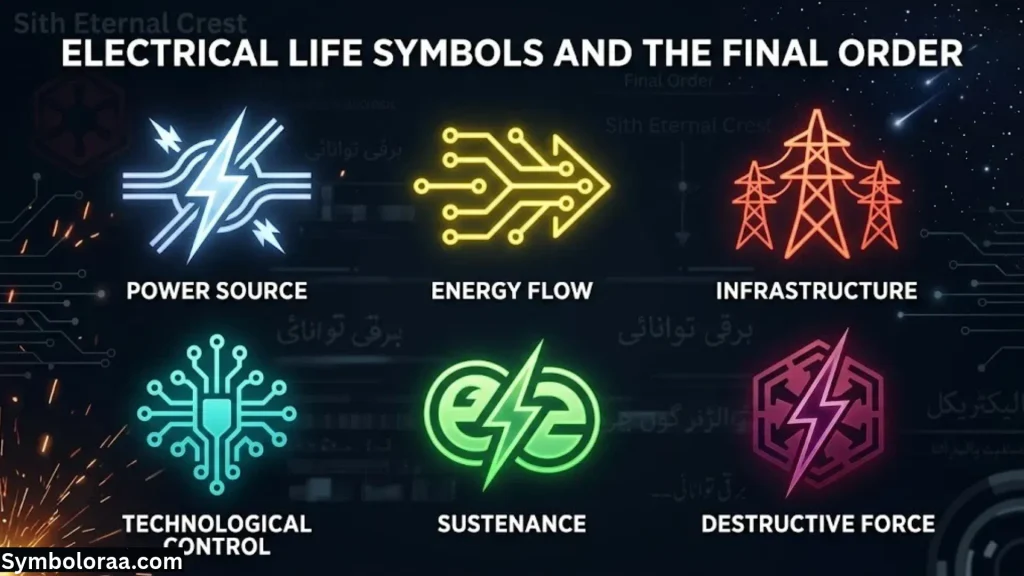
The Sith Eternal crest is associated with the secretive organization devoted to the Sith on Exegol, introduced in Star Wars: The Rise of Skywalker.
The Sith Eternal supports Emperor Palpatine’s return and the creation of the Final Order, a massive military force intended to establish Sith rule over the galaxy.
What Does the Sith Eternal Symbol Mean?
The crest identifies a group organized around Sith worship and the restoration of Palpatine’s power.
Its significance becomes clearer when the organization is distinguished from the First Order.
The First Order is a political and military movement that draws on Imperial traditions. The Sith Eternal is a secretive Sith-following organization that helps Palpatine prepare his return and the Final Order.
Their goals overlap, but they aren’t the same faction.
The Sith Eternal’s emblem is therefore connected to the group’s allegiance, its secretive nature, and its role in the attempted restoration of Sith domination.
Claims about the precise meaning of individual lines or geometric elements should be treated cautiously unless an official source explains them.
The New Republic Insignia: From Rebellion to Government
The New Republic insignia represents the government established after the Rebel Alliance’s victory over the Galactic Empire.
Its relationship to the Rebel Alliance Starbird is significant because it connects the new government to the movement that helped create it.
This continuity illustrates how an emblem can change meaning as an organization evolves. A mark associated with resistance can become part of the identity of a functioning government.
What Does the New Republic Symbol Represent?
The insignia is associated with the New Republic’s political identity and the effort to establish a new government after Imperial rule.
Its broader associations include:
- Reconstruction: The galaxy attempts to rebuild after a period of war.
- Representation: The New Republic seeks to replace Imperial authoritarianism with a different political system.
- Continuity: The symbol preserves a connection to the Rebel Alliance.
- Collective identity: The government represents a wider galactic community rather than a single resistance movement.
The New Republic insignia shouldn’t be confused with the Galactic Republic’s earlier eight-spoked crest. The two governments are historically related, but their symbols and political circumstances differ.
The Resistance Crest: A New Generation of Rebels
The Resistance crest identifies the movement that opposes the First Order in the sequel trilogy.
The Resistance draws inspiration from the earlier Rebel Alliance, and its visual identity reflects that historical connection. The movement includes pilots, soldiers, commanders, and supporters who believe the First Order must be stopped.
How Does the Resistance Symbol Differ From the Rebel Starbird?
The Resistance and Rebel Alliance are separate movements operating in different periods. Their symbols connect them visually, but the organizations aren’t identical.
The Rebel Alliance fought to overthrow the Galactic Empire. The Resistance confronts the First Order, which rises from the Empire’s remnants.
This connection reinforces a recurring theme in Star Wars: defeating an authoritarian regime doesn’t necessarily eliminate the beliefs and ambitions that produced it.
The Resistance crest helps audiences recognize that the struggle for freedom has continued into another generation.
The Mandalorian Mythosaur Symbol
Not all Star Wars faction symbols represent governments or military alliances. Some communicate cultural identity and shared heritage.
The Mythosaur skull is one of the best-known symbols associated with Mandalorian culture. The Mythosaur is a legendary creature connected to Mandalore’s past, and its skull appears in Mandalorian imagery.
What Does the Mythosaur Skull Mean?
The Mythosaur symbol is associated with Mandalorian heritage, tradition, and cultural identity.
Its significance differs from that of the Rebel Starbird or Imperial insignia. The Starbird identifies a political resistance movement, while the Mythosaur represents a broader cultural tradition.
Mandalorian society includes different clans, factions, and political movements. Their symbols can communicate distinct affiliations rather than a single unified political position.
For example, the Mythosaur skull shouldn’t be confused with the Death Watch insignia or the individual markings used by particular Mandalorian groups.
The distinction matters because Star Wars iconography serves many purposes beyond identifying governments. Cultural symbols can preserve identity across generations, even when political leadership changes.
The Great Galactic Seal: A Symbol of Government
The Great Galactic Seal is associated with the Galactic Senate and governmental imagery in Star Wars.
Although it may resemble the Republic Cog, the seal serves a different identifying purpose. The Republic Cog is the familiar emblem associated with the Galactic Republic, while the Great Galactic Seal is a Senate-associated governmental mark.
Why the Great Galactic Seal Matters
Governmental seals often appear in official chambers, documents, and institutional settings. In Star Wars, such symbols help establish the political context of a scene.
They also distinguish an institution from the wider government it serves.
For example, the Galactic Senate is a governing body within the Republic. Its seal can identify the Senate without being interchangeable with every symbol associated with the Republic itself.
This is a useful distinction for anyone researching Star Wars insignia meanings. Similar shapes don’t automatically indicate identical symbols or functions.
Other Important Star Wars Symbols
Beyond the major faction emblems, several other types of imagery help establish identity and meaning throughout the galaxy.
Death Star Imagery
The Death Star is one of the Galactic Empire’s most recognizable weapons. Its spherical design and planet-destroying capability make it a powerful image of Imperial military dominance.
However, the Death Star itself isn’t the same as the Imperial insignia.
Its symbolic importance comes from its role in the story. The station demonstrates the Empire’s willingness to use overwhelming force and terrorize entire populations to maintain control.
The destruction of the first Death Star also becomes a turning point for the Rebel Alliance. The event proves that the Empire’s apparently unstoppable military power can be challenged.
Mandalorian Clan Markings
Mandalorian armor often includes symbols that identify clans, factions, or personal affiliations.
These markings are particularly important because Mandalorian culture places considerable emphasis on heritage, warrior identity, and group belonging.
The Mythosaur skull represents broader cultural heritage, while clan-specific designs communicate narrower affiliations.
Recognizing this difference helps prevent the mistake of treating every Mandalorian marking as a universal symbol for all Mandalorians.
Sith Holocrons and Ancient Force Symbols
Sith holocrons preserve knowledge associated with the dark side and its practitioners. Their appearance and markings can connect them to ancient teachings, hidden locations, or dangerous artifacts.
However, an inscription on a Sith artifact isn’t necessarily an organizational emblem. It may function as writing, a decorative element, a warning, or part of a specific fictional tradition.
The same principle applies to Jedi temples and other Force-related locations. A symbol’s purpose depends on the object and the context in which it appears.
Aurebesh: The Star Wars Writing System
Aurebesh is a fictional writing system used throughout the Star Wars galaxy.
It appears on displays, signs, documents, equipment, and other objects. Because its characters have distinctive shapes, viewers sometimes mistake Aurebesh lettering for decorative symbols.
The difference is straightforward:
- A logo identifies an organization, product, or other entity.
- An emblem represents a group or institution.
- A written character represents part of a writing system.
- An inscription may communicate a message or identify an object.
Recognizing Aurebesh adds another layer to the study of Star Wars visual design. It also helps distinguish actual writing from faction insignia.
How Star Wars Symbols Evolved Through Galactic History
The history of Star Wars symbols reflects the changing political and cultural landscape of the galaxy.
The Galactic Republic and the Clone Wars
Before the Clone Wars, the Galactic Republic used its own insignia to identify government institutions and associated forces.
As the Separatist movement grew, its emblem helped distinguish its political and military identity from the Republic. The two sides used recognizable markings on equipment, vehicles, and military assets.
These symbols became especially important during a conflict involving countless worlds, species, and military units.
The Fall of the Republic and the Rise of the Empire
Palpatine’s transformation of the Republic into the Empire created a major shift in galactic political identity.
The Imperial crest retained the general structure of the Republic Cog but adopted a different design. That visual change mirrored the political transformation taking place across the galaxy.
The Empire’s repeated use of its insignia reinforced its authority across military, administrative, and public settings.
The Rebel Alliance and the Restoration of Government
The Rebel Alliance developed a recognizable symbol that helped unite resistance groups against Imperial rule.
The Starbird appeared on equipment and pilot helmets, connecting individual fighters to a wider movement.
After the Empire’s defeat, the New Republic carried forward elements of the Alliance’s visual identity. The symbol’s continued use connected the new political order to the struggle that helped establish it.
The First Order, Resistance, and Final Order
The sequel-era factions demonstrate that galactic conflict doesn’t end with the fall of one regime.
The First Order adopts a distinct insignia while drawing on Imperial traditions. The Resistance develops its own identity while retaining a connection to the Rebel Alliance. The Sith Eternal supports Palpatine’s attempt to restore Sith rule through the Final Order.
These organizations have different roles, but their symbols help audiences understand their historical and ideological relationships.
What Star Wars Symbols Reveal About Power, Identity, and Belief

The best Star Wars emblem meanings emerge when their designs are considered alongside the organizations that use them.
Symbols of Government and Authority
The Republic Cog, Imperial insignia, and First Order emblem all identify political or military institutions.
Their meanings differ because the organizations themselves have different goals and histories. The Republic presents itself as a representative government, while the Empire and First Order pursue authoritarian control.
This contrast demonstrates that a symbol communicates identity, but the story provides the context needed to judge the organization behind it.
Symbols of Resistance and Freedom
The Alliance Starbird and Resistance crest connect people who oppose authoritarian rule.
Their significance comes partly from their ability to unite individuals who might otherwise remain isolated. A shared emblem helps turn scattered resistance groups into recognizable movements.
The symbols also preserve a sense of continuity. Even when one generation’s struggle ends, its visual identity can inspire another.
Jedi and Sith: Different Philosophies
Jedi and Sith imagery reflects the contrast between two competing traditions of Force use.
The Jedi traditionally emphasize service, discipline, and the protection of others. The Sith pursue power through the dark side and often embrace manipulation, domination, and destructive ambition.
These differences are rooted in their fictional histories and philosophies. Their visual designs reinforce those differences, but not every element has a separately documented symbolic meaning.
Color, Geometry, and Visual Design
Color and shape help make Star Wars logos recognizable.
The Republic and Imperial crests use radial designs, while the First Order’s insignia relies on a more angular structure. The Starbird uses an organic, bird-like form that contrasts with the geometric marks of the major governments.
These design differences make it easier to recognize organizations quickly, even when their names aren’t visible.
However, color symbolism requires care. Red, black, blue, and other colors may carry associations in particular scenes or designs, but their meanings aren’t universal rules that apply to every Star Wars emblem.
Why Symbols Matter in Star Wars Storytelling
Symbols allow Star Wars to communicate information without lengthy explanations.
An Imperial crest on a uniform identifies a character’s affiliation. A Starbird on a pilot’s helmet signals resistance. A familiar insignia appearing after a political transition can suggest continuity, conflict, or the return of an old ideology.
This is part of the franchise’s effective visual storytelling. Its symbols make the galaxy feel connected, with recognizable institutions and histories that extend beyond individual scenes.
Star Wars Symbols Compared: Key Differences
The following comparisons help distinguish symbols that viewers often confuse.
| Symbols | Main difference |
| Republic Cog vs. Imperial insignia | Related designs associated with different governments |
| Rebel Starbird vs. Resistance crest | Separate movements connected by a shared legacy |
| Republic Cog vs. Great Galactic Seal | Republic insignia versus a Senate-associated seal |
| Jedi emblem vs. Sith symbols | Different traditions with distinct histories and visual identities |
| Imperial insignia vs. First Order emblem | Separate organizations with an ideological connection |
| Sith Eternal crest vs. First Order insignia | A Sith-following organization versus a political and military movement |
| Mythosaur skull vs. Death Watch insignia | Cultural heritage versus a specific faction |
| Faction emblem vs. rank badge | Organizational identity versus military status |
| Logo vs. Aurebesh | Graphic identification versus written language |
How to Identify an Unfamiliar Star Wars Symbol
When you encounter an unfamiliar design, a few simple checks can help you identify it accurately.
- Study its shape. Look for distinctive features such as spokes, wings, angular borders, or animal imagery.
- Check the context. A symbol on a government building may serve a different purpose from one on a warrior’s armor.
- Identify the historical period. Republic-era symbols differ from those used by the Empire, First Order, or Resistance.
- Find the original source. Official Databank entries and licensed reference books can establish names and affiliations.
- Check continuity. Determine whether the symbol belongs to current canon, Legends, a specific game, or promotional material.
- Separate fact from interpretation. A design’s documented history is stronger evidence than a theory based only on its shape.
These steps are especially useful when researching obscure emblems that appear in only one episode, game, comic, or reference book.
Frequently Asked Questions About Star Wars Symbols
What Is the Most Recognizable Star Wars Symbol?
The Rebel Alliance Starbird and Galactic Empire insignia are among the franchise’s most recognizable symbols. The Starbird represents resistance to Imperial rule, while the Imperial crest identifies Palpatine’s government and military forces.
What Does the Rebel Alliance Symbol Mean?
The Alliance Starbird identifies the Rebel Alliance and its fight against the Galactic Empire. Its canon history connects the design to Sabine Wren’s personal starbird artwork, which inspired the emblem adopted by the wider Rebellion.
What Does the Galactic Empire Symbol Represent?
The Imperial insignia represents the Galactic Empire and its authority. Its six-spoked crest appears on uniforms, military equipment, flags, and installations, making it a consistent marker of Imperial control.
What Is the Difference Between the Republic and Imperial Symbols?
The Republic Cog uses an eight-spoked design, while the Imperial insignia uses six spokes. The Empire’s crest adapts the earlier Republic design, reflecting the political transformation that occurred when Palpatine replaced the Republic with authoritarian rule.
What Does the Jedi Symbol Mean?
The Jedi Order symbol identifies the Jedi tradition and is commonly associated with protection, peace, and service. Its winged design and central lightsaber-like element invite interpretations of guidance and guardianship, although not every proposed meaning is officially documented.
Do the Sith Have an Official Symbol?
Sith-related symbols appear across Star Wars media, but a single universally used emblem shouldn’t be assumed for every era. Different Sith organizations, artifacts, and traditions may use distinct imagery.
What Does the First Order Symbol Mean?
The First Order insignia identifies the movement that seeks to revive the Galactic Empire’s legacy. Its angular design has been interpreted as an explosive force pushing against containment, reflecting the organization’s aggressive expansion.
Is the Rebel Alliance Starbird the Same as the Resistance Symbol?
The symbols are closely related, but the Rebel Alliance and Resistance are different movements. The Rebel Alliance fought the Galactic Empire, while the Resistance opposed the First Order in a later period.
What Is the Mandalorian Skull Symbol?
The Mythosaur skull is a symbol associated with Mandalorian culture and heritage. It represents a broader cultural tradition and shouldn’t be confused with the insignia of a particular Mandalorian faction.
Are All Star Wars Symbols Part of Official Canon?
No. Star Wars includes current canon and Legends material, as well as designs created for particular games and other media. Always check a symbol’s source before treating its name, origin, or meaning as established canon.
Where Can You Find Reliable Information About Star Wars Symbols?
Start with the official Star Wars Databank for information about major organizations, characters, and historical events. Wookieepedia can help trace obscure symbols and Legends material, but check its references before relying on detailed claims about origins or symbolism.
Conclusion: Why Star Wars Symbols Matter
Star Wars symbols do more than decorate starships, uniforms, and ancient temples. They help explain the galaxy’s political conflicts, cultural traditions, and competing philosophies.
The Alliance Starbird identifies resistance to Imperial rule. The Republic Cog and Imperial insignia connect two governments with sharply different outcomes. The Jedi and Sith represent opposing Force traditions, while the First Order and Resistance carry earlier conflicts into a new generation.
Other designs serve different purposes. The Mythosaur skull communicates Mandalorian heritage, the Great Galactic Seal identifies a governmental institution, and Aurebesh provides a written language for the fictional galaxy.
The key to understanding Star Wars symbolism is to examine each emblem in context. Its organization, historical period, and source matter more than an unsupported interpretation of its shapes.
Once you recognize those connections, familiar symbols become more than visual details. They become a guide to the history, beliefs, and struggles that make the Star Wars universe so compelling.

I’m Ethan Brooks, an American writer passionate about stories that explore modern life, relationships, ambition, and personal growth. I love creating characters who feel real and face challenges readers can recognize. Through my writing, I hope to entertain, inspire, and encourage readers to see everyday experiences from a different perspective.
Three Books:
The City Between Us
After the Last Goodbye
A Different Tomorrow
 Madison Reed