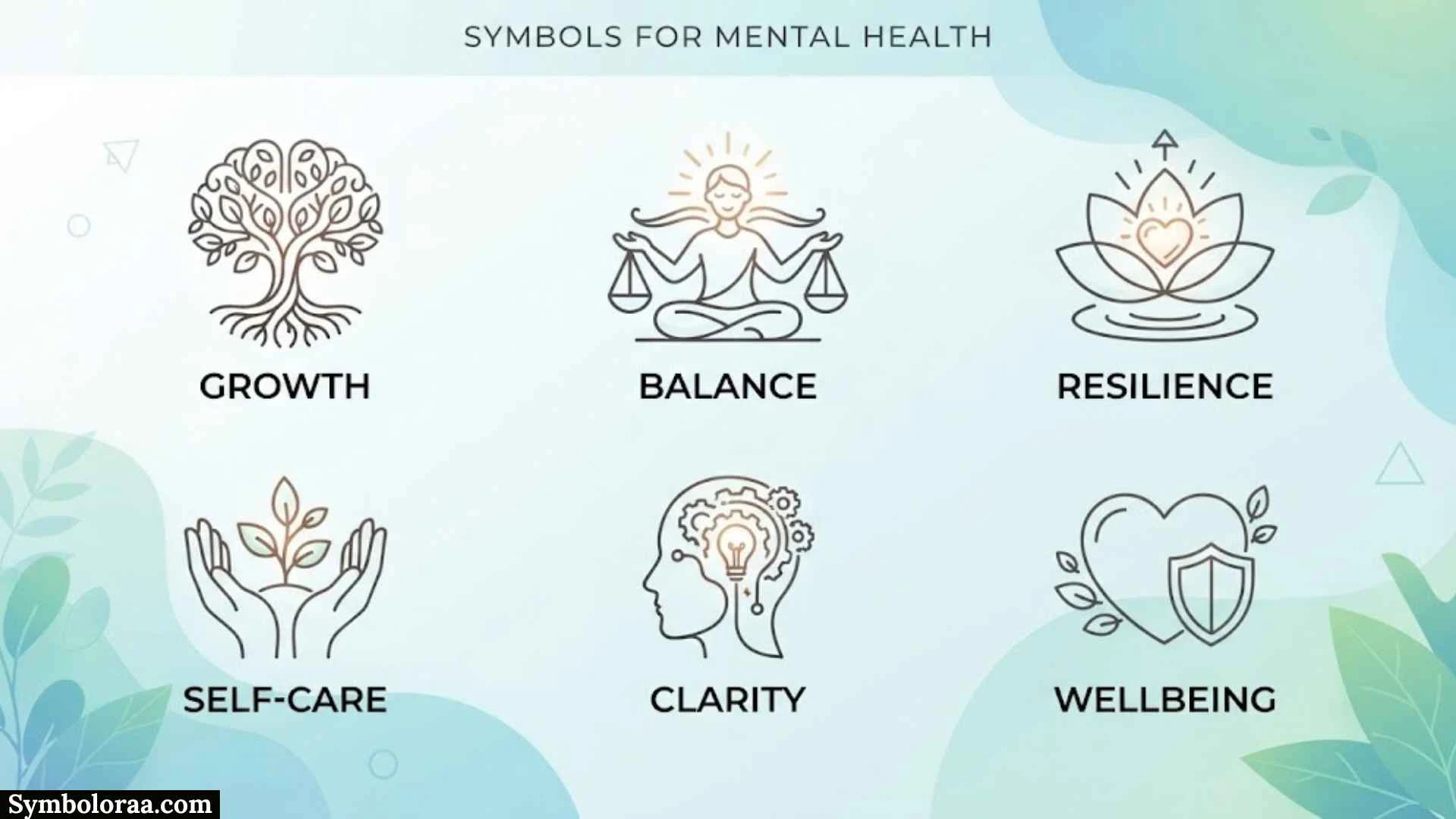
People search for symbols for mental health for many different reasons. Some want to understand the meaning of a green ribbon, while others are looking for a mental health tattoo, an awareness symbol for a school or workplace, a social media graphic, or a simple way to represent hope and recovery.
The most clearly documented general symbol is the green ribbon, which the Mental Health Foundation identifies as the international symbol of mental health awareness. The semicolon (;) has a different but closely related history and is strongly associated with mental health awareness, suicide prevention, and the idea of continuing one’s story.
Other images, including brains, hearts, butterflies, plants, helping hands, and sunrise imagery, are commonly used to communicate particular ideas such as mental health education, compassion, growth, connection, and hope. These should not automatically be treated as official or universal symbols.
This guide explains the names, meanings, history, uses, differences, and limitations of mental health symbols. It also shows how to choose an appropriate symbol for a tattoo, poster, school campaign, workplace, website, or social media post.
Quick Answer:
The green ribbon is a widely recognized international symbol of mental health awareness. The semicolon is associated with mental health and suicide-prevention awareness and represents a story that continues rather than ends. Other imagery, such as hearts, brains, butterflies, plants, and helping hands, can represent care, education, recovery, growth, and support depending on the context.
What Are Symbols for Mental Health?
Mental health symbols are visual signs used to communicate ideas about mental well-being, awareness, support, recovery, hope, suicide prevention, and reducing stigma.
They can appear as:
- Ribbons
- Colors
- Punctuation marks
- Tattoos
- Logos
- Emojis
- Illustrations
- Posters
- Campaign graphics
- Jewelry
- Social media images
Mental health itself is broader than the absence of mental illness. The World Health Organization describes mental health as a state of well-being that helps people cope with life’s stresses, develop their abilities, learn and work well, and contribute to their communities. WHO also emphasizes that mental health exists on a complex continuum and is influenced by individual, family, community, and structural factors.
That broader understanding explains why mental health symbolism can include much more than images of illness. Symbols may communicate well-being, connection, prevention, support, resilience, recovery, or awareness.
Why Do Mental Health Symbols Matter?
A visual symbol can communicate a message before someone reads a paragraph.
For example, a person may immediately recognize a green ribbon as a mental-health-awareness message. A semicolon may prompt a conversation about personal struggles, hope, or suicide prevention.
Symbols can therefore help:
- Start conversations
- Raise awareness
- Show solidarity
- Encourage people to talk
- Make campaigns easier to recognize
- Reduce silence around mental health
- Connect people with educational resources
- Create a visual identity for awareness events
The Mental Health Foundation specifically describes its green ribbon as a way to show that you care about people’s mental health and encourage conversation.
Mental Health Symbols at a Glance
Not every mental-health-related image has the same level of recognition. This distinction is important when choosing a symbol.
| Symbol | Common Meaning | Recognition |
| 🟢 Green Ribbon | Mental health awareness | Widely recognized |
| ; Semicolon | Continuing one’s story; mental health and suicide-prevention awareness | Strongly associated with the movement |
| 🧠 Brain | Mind, psychology, mental health education | Common illustrative symbol |
| 💚 Green Heart | Care, support, mental health awareness | Informal/digital |
| ❤️ Heart | Compassion, care, emotional support | General symbol |
| 🦋 Butterfly | Transformation, growth, recovery | Common symbolic imagery |
| 🌱 Plant | Growth, healing, development | Informal symbolic imagery |
| 🤝 Helping Hands | Connection, support, community | General supportive symbol |
| ☀️ Sunrise/Sun | Hope, renewal, positivity | General symbolic imagery |
| 🌈 Rainbow | Hope, diversity, or inclusion depending on context | Context-dependent |
The green ribbon has a particularly well-documented status because the Mental Health Foundation explicitly identifies it as the international symbol of mental health awareness.
The semicolon also has a documented history through Project Semicolon, which explains its development as a symbol connected to mental health and suicide prevention.
The remaining images are better described as common symbolic representations rather than universal official mental-health symbols.
The Green Ribbon: The Main Symbol for Mental Health Awareness
The green ribbon is the most important symbol to understand if someone asks, “What is the symbol for mental health awareness?”
The Mental Health Foundation states directly that the green ribbon is the international symbol of mental health awareness. It encourages people to wear the ribbon to show that they care about mental health and to create opportunities for conversation.
What Does the Green Ribbon Mean?
The green ribbon can communicate:
- Mental health awareness
- Support for good mental health
- Solidarity
- Openness to conversations about mental health
- Efforts to reduce stigma
- Remembrance of someone affected by mental health difficulties
The meaning is broad. Wearing a green ribbon does not tell you that the person has a particular diagnosis.
Someone may wear it because:
- They want to support a friend.
- A family member has experienced mental health difficulties.
- They work in mental health.
- They are participating in an awareness campaign.
- They want to encourage people to talk about mental health.
- They simply want to show support.
The Mental Health Foundation’s own supporter stories illustrate this range of personal meanings, including awareness, remembrance, support, and encouraging conversation.
How Did the Green Ribbon Become a Mental Health Symbol?
The green ribbon is now used by the Mental Health Foundation as a central public-awareness symbol. The organization uses green ribbon campaigns, pins, digital graphics, and awareness activities to encourage discussion of mental health.
This history is important because the green ribbon is not simply a color chosen randomly by internet users. Its current recognition comes from organized mental-health awareness work.
At the same time, different countries and organizations may use additional colors, ribbons, or campaign logos for particular causes. Therefore, green ribbon = broad mental health awareness is a safer interpretation than assuming every green symbol has exactly the same meaning.
Where Is the Green Ribbon Used?
The green ribbon can appear in:
- Mental health awareness campaigns
- Schools
- Workplaces
- Community events
- Fundraising activities
- Social media
- Posters
- Websites
- Awareness merchandise
- Public events
The Mental Health Foundation specifically provides green ribbon materials for schools, workplaces, events, and other settings.
The Semicolon: Mental Health and Suicide-Prevention Symbol
The semicolon (;) is one of the most recognizable personal symbols associated with mental health awareness and suicide prevention.
Its meaning comes from punctuation. A semicolon can separate two closely connected parts of a sentence when the writer chooses not to end the sentence. Project Semicolon developed this idea into a metaphor for continuing a person’s story.
What Does the Semicolon Mean?
The semicolon may represent:
- Continuing one’s story
- Hope
- Perseverance
- Survival
- Mental health awareness
- Suicide-prevention awareness
- Remembering difficult experiences
- Personal resilience
Project Semicolon traces its semicolon movement to 2013 and explains that the original idea used the punctuation mark as a metaphor for a sentence that was not finished—and therefore a life that was not finished.
This gives the semicolon a more specific personal history than many general mental-health graphics.
Is the Semicolon an Official Medical Symbol?
No.
The semicolon is a symbol used by an awareness movement, not a clinical diagnostic symbol.
This distinction matters. A semicolon tattoo cannot tell you whether someone has depression, anxiety, PTSD, or another condition.
Its meaning belongs to the person wearing or using it.
Project Semicolon also explains that the symbol has evolved beyond one specific interpretation and can represent different forms of struggle and perseverance.
Green Ribbon vs. Semicolon
These two symbols are often confused because both are associated with mental health.
| Feature | Green Ribbon | Semicolon |
| Main association | Mental health awareness | Mental health and suicide-prevention awareness |
| Origin of meaning | Organized awareness campaign | Punctuation-based awareness movement |
| Main message | Awareness and support | Continuing one’s story |
| Common use | Campaigns, pins, events, posters | Tattoos, personal stories, awareness campaigns |
| Meaning | Broad | More personal and specific |
| Official medical symbol? | No | No |
The simplest distinction is:
Green ribbon → broad mental health awareness
Semicolon → continuing the story and suicide-prevention awareness
Both are awareness symbols rather than diagnostic or treatment symbols.
Brain Symbol for Mental Health
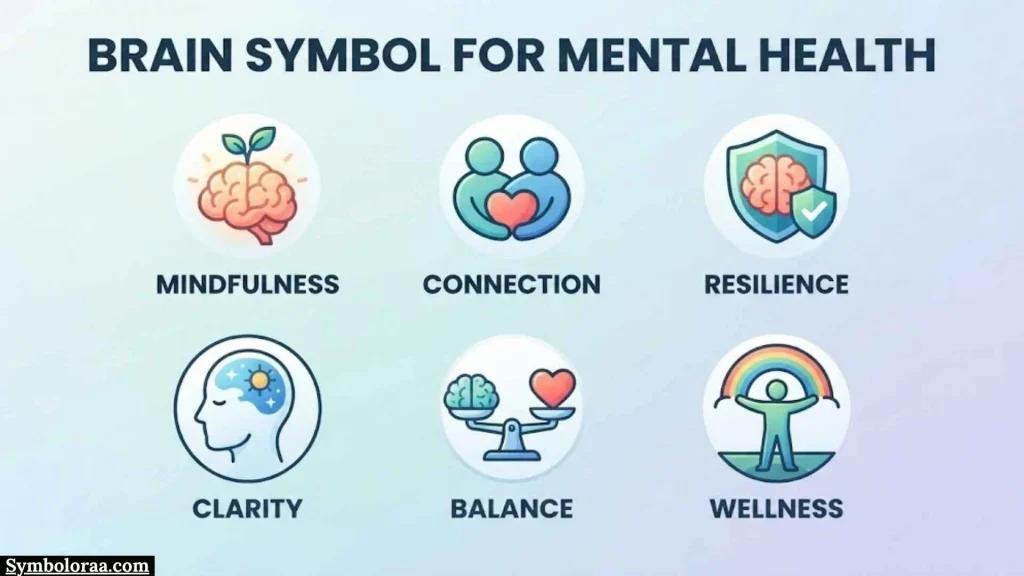
The brain 🧠 is one of the easiest images to understand in mental-health education.
It represents the mind, thinking, emotions, memory, behavior, and psychological processes. Because of this connection, brain illustrations appear frequently in educational material about psychology and mental health.
What Does the Brain Symbol Represent?
Depending on the context, a brain image can communicate:
- Mental health education
- Psychology
- Cognitive health
- Emotional well-being
- Brain health
- Mental processes
- Learning and memory
However, the brain is not a universal official symbol for mental health.
A website about psychology may use a brain because it immediately tells readers that the content concerns the mind. A clinical organization may use a completely different logo.
When Should You Use a Brain Symbol?
A brain symbol works particularly well for:
- Educational articles
- School presentations
- Psychology resources
- Mental health workshops
- Infographics
- Mental-health education websites
For example, a school poster titled “Understanding Mental Health” could use a brain illustration to signal that the material is educational.
Heart Symbols and Mental Health Support
The heart ❤️ is a general symbol of care and compassion.
When used with mental-health messaging, it can communicate:
- Emotional support
- Kindness
- Compassion
- Caring for others
- Self-care
- Friendship
- Emotional well-being
A heart is not specifically a mental-health symbol by itself. Its meaning comes from the surrounding message.
For example:
Heart + “You Are Not Alone”
can communicate emotional support.
Heart + “Mental Health Matters”
can communicate care and awareness.
This makes the heart useful for supportive content but less precise than the green ribbon.
Green Heart Meaning in Mental Health
The green heart 💚 combines two visual ideas: the heart’s association with care and the green color associated with mental health awareness.
It is commonly used informally on:
- TikTok
- Messages
- Mental-health awareness posts
- Supportive comments
A green heart can mean:
- “I support you.”
- “Mental health matters.”
- “I care about your well-being.”
- “You are not alone.”
However, it should be treated as an informal digital symbol, not a standardized medical or organizational emblem.
Butterfly Symbol for Mental Health
The butterfly 🦋 is often used to represent transformation.
Its life cycle makes it a natural metaphor for:
- Change
- Personal growth
- Recovery
- Transformation
- Freedom
- New beginnings
- Hope
For someone designing a recovery-themed poster, a butterfly can communicate the idea that change takes time.
Is the Butterfly an Official Mental Health Symbol?
Not in the same documented sense as the green ribbon.
The butterfly is better understood as symbolic imagery. Its meaning can be personal, artistic, or campaign-specific.
This distinction prevents a common mistake: treating every popular mental-health image as though it has a universal official definition.
Plant, Flower, and Tree Symbols
Nature imagery is frequently used in mental-health designs because growth provides a simple visual metaphor.
🌱 Seedling
A seedling can represent:
- New beginnings
- Personal growth
- Healing
- Development
- Hope
🌻 Flower
A flower can represent:
- Positivity
- Growth
- Care
- Beauty
- Renewal
🌳 Tree
A tree can represent:
- Stability
- Strength
- Connection
- Growth
- Resilience
These meanings are interpretive rather than standardized. The designer should explain the intended meaning when precision matters.
Helping Hands and Community Symbols
Hands 🤝 can represent support and connection.
They are especially appropriate when a mental-health message focuses on:
- Community
- Peer support
- Friendship
- Family
- Counseling
- Helping someone seek support
- Social connection
This symbolism fits the broader understanding of mental health because WHO identifies individual, family, community, and structural factors as relevant to mental well-being.
For example, a workplace campaign might use two hands with the message:
“Support Starts With a Conversation.”
The hands make the idea of connection immediately understandable.
Sunrise, Sun, and Light Symbols
Sunrise and light imagery are often used to communicate:
- Hope
- Renewal
- A new beginning
- Optimism
- Progress
- Moving forward
These are not official mental-health symbols, but they can be effective in recovery-oriented designs.
A sunrise can be particularly useful when the message focuses on hope after a difficult period rather than a specific diagnosis.
Rainbow Symbol and Mental Health
The rainbow 🌈 has several meanings depending on context.
It may represent:
- Hope
- Diversity
- Inclusion
- Community
- Acceptance
- Personal identity
Because the rainbow is also strongly associated with other social and cultural movements, it should not automatically be interpreted as a general mental-health symbol.
If you are designing an awareness campaign, add text explaining the intended message.
Mental Health Symbols for Different Purposes
The best symbol depends on what you are trying to communicate.
| Purpose | Suitable Symbol | Why |
| General awareness | Green ribbon | Clearly associated with mental health awareness |
| Continuing one’s story | Semicolon | Established metaphor within Project Semicolon |
| Suicide-prevention awareness | Semicolon | Strong association with the movement |
| Mental-health education | Brain | Clearly communicates mind/psychology |
| Emotional support | Heart | Familiar symbol of care |
| Recovery | Butterfly | Common metaphor for transformation |
| Growth | Plant/flower | Communicates development and renewal |
| Community support | Helping hands | Represents connection |
| Hope | Sunrise/light | Suggests renewal and possibility |
| Social media support | Green heart | Simple informal digital expression |
This table should be treated as a meaning guide, not a list of medical standards.
Official Symbols vs. Informal Symbols
One of the most important things to understand about mental-health symbolism is that not all symbols have the same authority.
Widely Recognized Awareness Symbols
The green ribbon has a clear documented role as an international mental-health-awareness symbol through the Mental Health Foundation.
The semicolon also has a documented association with mental health and suicide prevention through Project Semicolon.
Organization-Specific Logos
A mental health organization may create its own logo.
That logo belongs to the organization and should not automatically be treated as a universal mental-health symbol.
Informal Symbolic Images
Images such as:
- Butterflies
- Flowers
- Hearts
- Trees
- Sunrises
- Hands
can communicate mental-health themes without being official symbols.
Personal Symbols
A person may create a completely personal symbol based on their own experience.
For example, someone might choose:
- A specific flower
- A meaningful date
- A semicolon
- A combination of colors
- A family symbol
- A personal drawing
Its meaning may be known only to that person.
Symbols for Specific Mental Health Conditions
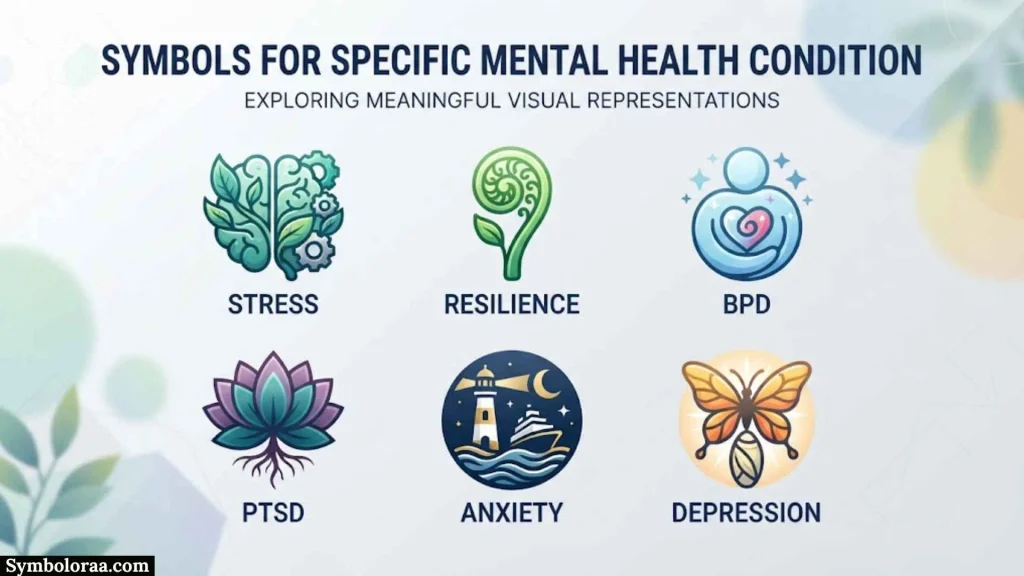
There is no single universal symbol for every mental health condition.
Mental health includes many different conditions and experiences. WHO distinguishes mental health as a broader concept from mental disorders, which involve clinically significant disturbances that can affect cognition, emotional regulation, behavior, distress, or functioning.
This matters because a general mental-health symbol should not be used as though it identifies a diagnosis.
For example:
Green ribbon: broad mental health awareness.
It does not mean:
“This person has depression.”
Likewise, a semicolon tattoo does not establish a diagnosis.
Why Context Matters
Suppose a poster contains a green ribbon.
If the headline says:
“Mental Health Awareness Week”
the intended meaning is clear.
If the same ribbon appears next to a specific diagnosis, readers may interpret it differently.
That is why text and context are important when using mental-health imagery.
Mental Health Symbols for Tattoos
Mental-health symbols are popular tattoo choices because a small image can carry a deeply personal meaning.
Common choices include:
- Semicolon
- Green ribbon
- Butterfly
- Brain
- Heart
- Flower
- Tree
- Sunrise
- Combination symbols
What Does a Semicolon Tattoo Mean?
A semicolon tattoo is commonly associated with the idea that a person’s story continues.
Project Semicolon describes the semicolon as a symbol connected with mental health and suicide prevention and traces the movement’s origins to 2013.
However, the person wearing the tattoo may attach additional personal meaning to it.
Does Tattoo Placement Change the Meaning?
There is no universal rule that a semicolon or mental-health tattoo must be placed on a particular part of the body.
Project Semicolon states that there is no official placement for its semicolon tattoo.
Therefore, placement is usually a personal choice.
Mental Health Symbols for Schools
Schools can use symbols to make mental-health education more visible and approachable.
Useful options include:
- Green ribbons
- Brain illustrations
- Hearts
- Helping hands
- Plants
- Simple conversation graphics
Example School Campaign
Imagine a school planning a mental-health awareness week.
A practical design might include:
Green ribbon
“Mental Health Matters”
“Talk to Someone You Trust”
The ribbon identifies the awareness theme, while the text tells students what the campaign is about.
This is more effective than displaying a symbol without explanation.
Mental Health Symbols for Workplaces
Workplaces may use mental-health symbols in:
- Employee newsletters
- Posters
- Internal websites
- Training presentations
- Awareness events
- Social media campaigns
- Well-being programs
The Mental Health Foundation specifically promotes green ribbon materials for workplaces and events.
Example Workplace Use
A company could place a green ribbon beside:
“Mental Health Matters at Work.”
A second line could direct employees toward available workplace support or trusted resources.
The important point is that the symbol should lead to real information or support, not simply decoration.
Mental Health Symbols for Social Media
Symbols work particularly well on social media because they communicate quickly.
Examples include:
- 💚 for informal mental-health support
- 🧠 for mental-health education
- 🦋 for transformation or recovery
- 🤝 for support and connection
- 🌱 for growth
- ☀️ for hope
- ; for the semicolon movement
The Mental Health Foundation itself provides a virtual green ribbon for social-media use, showing how awareness symbols can be adapted for digital platforms.
Best Practice for Social Media
Do not post a symbol without context when the subject is sensitive.
Instead of:
💚
consider:
“Mental health matters. If you are struggling, reaching out to someone you trust can be an important first step. 💚”
For educational posts, provide a reliable source when discussing symptoms, diagnosis, treatment, or suicide prevention.
Real-World Scenarios: Which Symbol Fits?
Scenario 1: General Awareness Poster
A community center wants to promote mental-health awareness.
Suitable choice: Green ribbon.
Reason: It has a documented connection with broad mental-health awareness.
Scenario 2: Personal Recovery Tattoo
Someone wants a tattoo representing the idea of continuing through a difficult period.
Possible choice: Semicolon.
Reason: Its established metaphor centers on continuing a story.
Scenario 3: School Mental Health Lesson
A teacher is preparing an educational presentation about the mind and emotional well-being.
Possible choice: Brain illustration.
Reason: The brain is immediately recognizable as an educational representation of the mind.
Scenario 4: Community Support Campaign
A nonprofit wants to communicate that people should support one another.
Possible choice: Helping hands.
Reason: Hands provide a simple visual metaphor for connection and support.
Scenario 5: Recovery-Themed Artwork
An artist wants to represent personal transformation.
Possible choice: Butterfly or growing plant.
Reason: Both are familiar metaphors for change and development.
How to Choose the Right Mental Health Symbol
Use this simple decision guide when choosing a symbol.
Do you want broad mental health awareness?
↓
Choose the green ribbon.
Do you want to represent continuing your story or a personal connection with suicide-prevention awareness?
↓
Consider the semicolon.
Do you want to represent mental-health education or the mind?
↓
Consider a brain symbol.
Do you want to communicate care and compassion?
↓
Consider a heart.
Do you want to represent transformation or recovery?
↓
Consider a butterfly.
Do you want to represent growth?
↓
Consider a plant, flower, or tree.
Do you want to communicate community support?
↓
Consider helping hands or people connected together.
Do you want to communicate hope or renewal?
↓
Consider sunrise or light imagery.
This framework matches the symbol to the intended message, rather than assuming that every symbol has a universal definition.
How to Use Mental Health Symbols Responsibly
Mental-health imagery can be meaningful, but it should be used carefully.
Explain the Symbol
If a symbol has multiple meanings, explain what it means in your campaign.
For example:
“Our green ribbon represents mental health awareness and support.”
This eliminates ambiguity.
Do Not Use Symbols to Diagnose People
Never assume that someone has a mental health condition because they:
- Wear a ribbon
- Use a semicolon
- Share a mental-health graphic
- Have a tattoo
- Use a green heart
A symbol communicates a message; it does not provide a diagnosis.
Do Not Present Informal Symbols as Medical Standards
Calling every butterfly or heart an “official mental health symbol” can mislead readers.
Use precise language such as:
- “Commonly used to represent…”
- “Often associated with…”
- “In this campaign, the symbol represents…”
- “A widely recognized awareness symbol…”
Connect Awareness With Reliable Information
A symbol is more useful when it leads to accurate information.
For example, a poster can contain:
Green Ribbon
Mental Health Awareness
Learn More → [reliable organization or local resource]
That approach turns visual awareness into practical education.
Common Mistakes When Using Mental Health Symbols
Mistake 1: Calling Every Symbol Official
A butterfly or heart may be popular imagery without being an official universal symbol.
Better approach: identify whether the symbol comes from an established organization, campaign, community, or personal interpretation.
Mistake 2: Confusing Mental Health With a Diagnosis
Mental health is a broad concept. It is not synonymous with one particular disorder.
WHO explains that mental health exists on a continuum and that mental disorders are a distinct clinical category.
Better approach: use broad language for broad awareness.
Mistake 3: Treating a Symbol as Treatment
A ribbon, tattoo, or emoji cannot treat a mental health condition.
Better approach: use symbols to promote awareness and connect people with appropriate information and support.
Mistake 4: Ignoring Cultural and Personal Meaning
Symbols can have different meanings across communities.
Better approach: explain the intended meaning instead of assuming everyone interprets the image identically.
Mistake 5: Using Sensitive Symbols Without Context
The semicolon can have deeply personal associations.
Better approach: use respectful language and avoid making assumptions about someone’s history.
Why Context Is More Important Than the Image Alone
A symbol rarely communicates its complete meaning by itself.
Consider a green ribbon.
It could mean:
- Mental health awareness
- Support for someone
- Participation in a campaign
- Remembrance
- Personal advocacy
The accompanying words clarify the message.
The same principle applies to a butterfly.
Without context, it could represent:
- General transformation
- Nature
- Beauty
- Personal growth
- Recovery
- Mental health
Therefore, strong mental-health communication uses symbol + explanation + appropriate resource.
Mental Health Awareness Symbols vs. Medical Symbols
These terms should not be treated as interchangeable.
| Awareness Symbol | Medical/Clinical Concept |
| Communicates awareness | Describes a health condition or clinical concept |
| Used in campaigns | Used in assessment, diagnosis, treatment, or professional communication |
| May be broad | Usually has a defined technical meaning |
| Can be symbolic | Requires appropriate clinical context |
| Example: green ribbon | Example: diagnostic terminology |
A green ribbon can tell someone that an event concerns mental health. It cannot tell them what condition someone has.
That distinction is especially important in health-related content.
How Mental Health Symbols Can Support Better Conversations
The strongest use of a symbol is often not the symbol itself but the conversation it starts.
For example:
“I noticed your green ribbon. What does mental health awareness mean to you?”
That question can create space for discussion without assuming anything about the person’s diagnosis or experience.
Likewise, a school might use:
“It’s okay to ask for help.”
A workplace might use:
“Let’s make mental health part of the conversation.”
A community organization might use:
“You do not have to handle everything alone.”
The symbol provides recognition; the words provide meaning.
Frequently Asked Questions About Symbols for Mental Health
What Is the Main Symbol for Mental Health Awareness?
The green ribbon is widely recognized as an international symbol of mental health awareness. The Mental Health Foundation explicitly identifies it as the international symbol of mental health awareness.
What Color Represents Mental Health?
Green is strongly associated with mental health awareness because of the green ribbon. The exact meaning of colors can vary between campaigns, so the campaign’s context should always be considered.
What Does the Green Ribbon Mean?
The green ribbon represents mental health awareness and support. It can be worn to show that mental health matters and to encourage conversations about mental well-being.
What Does a Semicolon Mean in Mental Health?
The semicolon is associated with mental health and suicide-prevention awareness. Project Semicolon developed its use as a metaphor for continuing a sentence and, symbolically, continuing one’s story.
What Does a Semicolon Tattoo Mean?
A semicolon tattoo commonly represents perseverance, continuing one’s story, hope, or a personal connection to mental-health and suicide-prevention awareness. The meaning can vary from person to person.
Is the Semicolon an Official Mental Health Symbol?
It is an established awareness symbol associated with Project Semicolon and the broader mental-health and suicide-prevention movement, but it is not a medical diagnostic symbol.
Is the Green Ribbon a Medical Symbol?
No. The green ribbon is an awareness symbol, not a diagnostic or treatment symbol. It communicates mental-health awareness and support.
What Symbol Represents Mental Health Recovery?
There is no single universal recovery symbol. Butterflies, plants, flowers, sunrise imagery, and semicolons may be used to represent growth, transformation, hope, or continuing one’s story.
What Symbol Represents Hope in Mental Health?
Hope can be represented through many images, including sunrise, light, butterflies, plants, hearts, and semicolons. These meanings are generally symbolic rather than standardized.
Is a Butterfly an Official Mental Health Symbol?
No universal official status should be assumed for the butterfly. It is commonly used as symbolic imagery for transformation, growth, and recovery.
Is a Brain a Mental Health Symbol?
A brain is commonly used to represent the mind, psychology, brain health, and mental-health education. It is primarily an illustrative symbol rather than one universal official mental-health emblem.
What Emoji Represents Mental Health?
There is no single universal mental-health emoji. Common choices include 💚, 🧠, ❤️, 🦋, 🌱, and 🤝, depending on the intended message.
What Symbol Represents Mental Health Support?
The green ribbon is a widely recognized general mental-health-awareness symbol. Hearts and helping hands are also commonly used to communicate care and support.
Is There One Symbol for Every Mental Health Condition?
No. Mental health includes many different conditions and experiences, and symbols can vary by organization, campaign, community, and country.
Can Mental Health Symbols Be Used for Tattoos?
Yes. People use symbols such as semicolons, green ribbons, butterflies, hearts, flowers, and other imagery for personal tattoos. The meaning should be understood as personal or awareness-related rather than diagnostic.
Can a Mental Health Symbol Tell You If Someone Has a Mental Illness?
No. A symbol cannot establish whether someone has a mental health condition. Only appropriate clinical assessment can address diagnosis.
Why Are Mental Health Symbols Used in Schools and Workplaces?
They provide an easy visual way to identify awareness activities and encourage conversations about mental well-being. The Mental Health Foundation specifically promotes green ribbon use in settings such as workplaces, schools, events, and communities.
Are Mental Health Symbols the Same in Every Country?
No. Some symbols have broad international recognition, while others are associated with specific organizations, campaigns, cultures, or communities. Always check the source and context.
Key Takeaways
- The green ribbon is the most clearly documented broad symbol for mental health awareness.
- The semicolon is strongly associated with mental health and suicide-prevention awareness and represents the idea of continuing one’s story.
- A brain is commonly used for mental-health education and psychology.
- A heart can communicate care, compassion, and emotional support.
- A butterfly often symbolizes transformation, growth, and recovery.
- Plants and flowers can represent growth and renewal.
- Helping hands can communicate connection and community support.
- Sunrise and light are commonly used as symbols of hope and renewal.
- Not every popular mental-health image is an official or standardized symbol.
- Awareness symbols should never be treated as diagnostic indicators.
- The meaning of a symbol can depend on its organization, campaign, culture, and personal context.
- A strong awareness campaign combines the symbol with clear language and reliable information.
Conclusion
Symbols for mental health provide a simple visual language for subjects that can sometimes be difficult to discuss. They can communicate awareness, support, hope, recovery, connection, and the importance of caring for mental well-being.
Among the many images used today, the green ribbon has the clearest documented role as an international mental-health-awareness symbol. The semicolon has a different history and is closely connected with mental health and suicide-prevention awareness through Project Semicolon.
Other symbols including brains, hearts, butterflies, plants, flowers, helping hands, and sunrise imagery can also be meaningful. Their meanings are generally more contextual and should not automatically be presented as official standards.
The most useful way to choose a mental-health symbol is to begin with the message you want to communicate. If the goal is broad awareness, the green ribbon provides a clear choice. If the goal is a personal message about continuing one’s story, the semicolon may carry a more specific meaning. For education, support, growth, or hope, other imagery can be appropriate when its intended meaning is explained clearly.
Most importantly, a symbol should open the door to understanding and conversation. It should support accurate information rather than replace it.

I’m Madison Reed, a contemporary American author who writes about love, family, friendship, and second chances. I’m fascinated by the choices that shape our lives and the moments that change us forever. My goal is to create honest, emotional stories with characters readers can connect with long after finishing each book.
Three Books:
When We Find Our Way
The Things We Never Said
Summer in September
 Ethan Brooks
 Jackson Miller