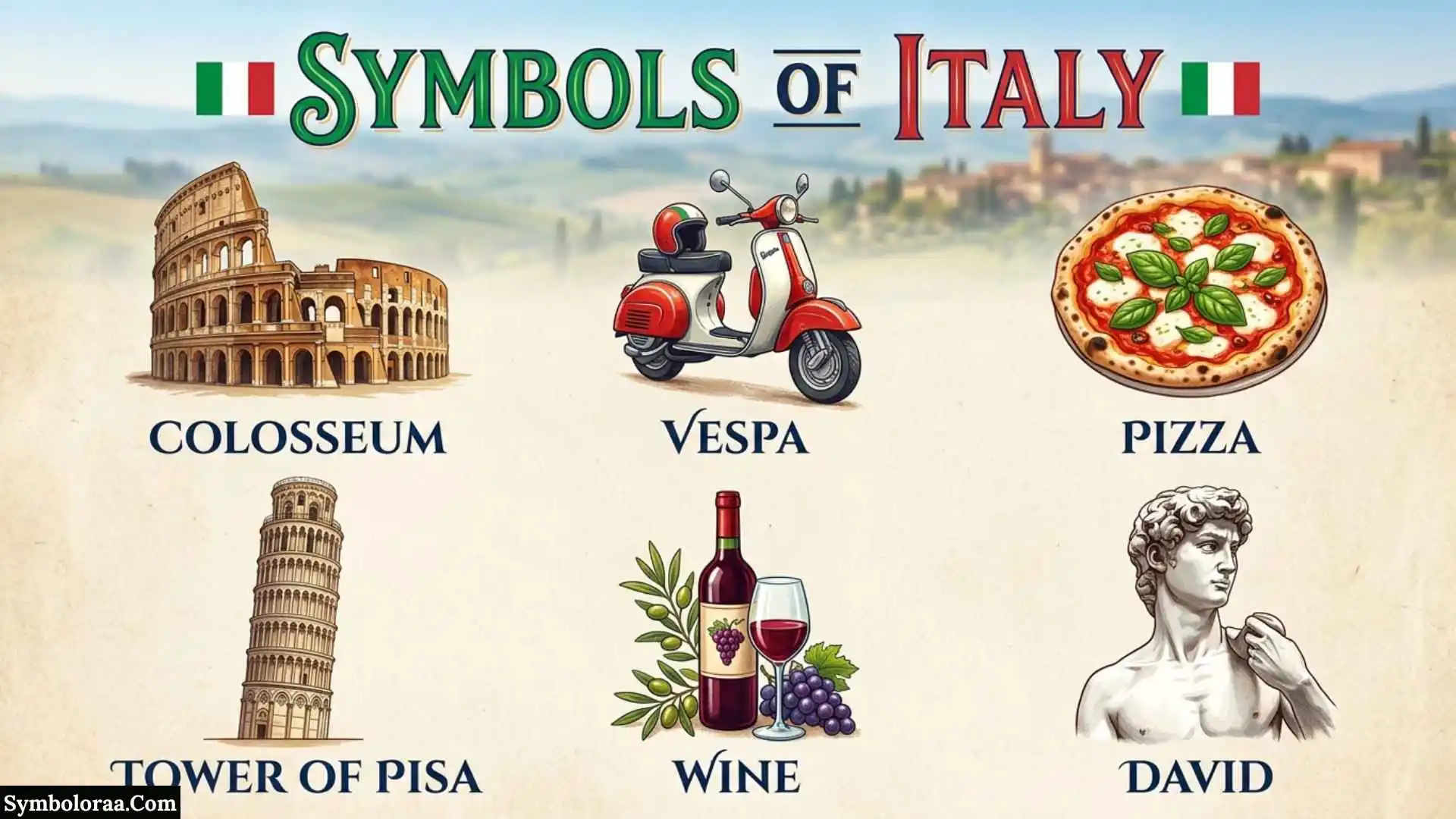
Italy is represented by far more than the green, white, and red tricolour. Its identity appears in official state symbols, historic monuments, Roman imagery, Renaissance art, food, fashion, architecture, landscapes, and everyday cultural icons.
If you are searching for symbols of Italy and their meanings, the most important distinction is between official national symbols and cultural symbols. The Italian Republic officially recognizes the Tricolore, national anthem, Republic emblem, and presidential standard among its principal republican symbols. Other famous images, such as the Colosseum, Capitoline Wolf, Vespa, pizza, gondolas, and Renaissance art, are powerful representations of Italian history and culture but are not official state symbols.
This guide explains what the major Italian symbols mean, where they came from, how their meanings developed, and which symbol is appropriate for different purposes such as school projects, tattoos, logos, travel designs, cultural presentations, and national celebrations.
Quick Answer: What Are the Main Symbols of Italy?
The most recognizable symbols associated with Italy include the Italian Tricolore, Republic emblem, national anthem, presidential standard, Colosseum, Capitoline Wolf, Vittoriano, Roman columns, Renaissance art, olive branches, laurel wreaths, pizza, pasta, espresso, Vespa, Italian fashion, sports cars, Venetian gondolas, and Italy’s mountains and Mediterranean landscape.
However, these symbols do not all have the same status.
| Symbol | Type | Common meaning or association |
| Italian Tricolore | Official national symbol | Italian national identity and unity |
| Republic emblem | Official republican symbol | Work, peace, strength, dignity and Italy |
| National anthem | Official national symbol | Patriotism and national unity |
| Presidential standard | Official institutional symbol | Presidency, state authority and national unity |
| Vittoriano | National monument | Unity, liberty and national memory |
| Colosseum | Historical/cultural symbol | Ancient Rome and Roman civilization |
| Capitoline Wolf | Historical symbol | Rome, Romulus and Remus |
| Renaissance art | Cultural symbol | Art, creativity, learning and innovation |
| Laurel wreath | Classical cultural symbol | Victory, achievement and honor |
| Olive branch | Cultural and official emblem element | Peace and concord |
| Oak branch | Official emblem element | Strength and dignity |
| Pizza | Culinary symbol | Italian food culture |
| Pasta | Culinary symbol | Italian cuisine and tradition |
| Espresso | Culinary/lifestyle symbol | Italian coffee culture |
| Vespa | Design/cultural symbol | Italian design and postwar mobility |
| Fashion | Cultural/economic symbol | Style, craftsmanship and design |
| Italian cars | Design/engineering symbol | Performance, craftsmanship and innovation |
| Gondola | Regional symbol | Venice and Venetian culture |
| Alps and Mediterranean | Geographic symbols | Italy’s diverse natural landscape |
The key point is that “symbol of Italy” can mean an official state emblem, a historical image, a regional icon, or a cultural association. Understanding that distinction makes explanations more accurate.
What Do Symbols of Italy Mean?
An Italian symbol is an image, object, place, sound, plant, artistic tradition, or cultural practice that helps communicate something about Italy.
Some symbols have an official legal or institutional role. Others became meaningful through centuries of history and popular recognition.
Official symbols vs. cultural symbols
The Italian Presidency identifies four principal republican symbols: the Tricolore, national anthem, emblem, and presidential standard. The Quirinal’s official presentation also treats the Vittoriano, or Altare della Patria, as a major symbolic monument.
By contrast, the Colosseum, pizza, Vespa, Renaissance paintings, and gondolas are better described as cultural or historical symbols.
This distinction matters because calling every famous Italian object an “official national symbol” creates an inaccurate impression.
Why Italy has so many recognizable symbols
Italy’s symbolic identity developed through several historical layers:
- Ancient Roman civilization
- Medieval cities and regional traditions
- Renaissance art and learning
- The Risorgimento and Italian unification
- The establishment of the modern Republic
- Contemporary Italian design, food, fashion and popular culture
Italy therefore does not have one single image that explains the entire country. Different symbols represent different parts of its story.
The Italian Tricolore: Green, White and Red
The Italian Tricolore is the clearest official visual symbol of the country.
It consists of three equal vertical bands of green, white, and red. Article 12 of the Italian Constitution defines the flag as the Italian tricolour with green, white, and red vertical bands of equal size.
The history of the Italian flag
The modern Italian tricolour has roots in the political changes of the late eighteenth century. On January 7, 1797, the Parliament of the Cispadane Republic adopted a three-colour flag of green, white, and red at Reggio Emilia.
The flag continued to evolve through the Napoleonic period and became strongly connected with the Risorgimento, the nineteenth-century movement associated with Italian national unification.
When the Kingdom of Italy was proclaimed in 1861, the tricolour continued as a central national symbol. After the creation of the Republic, its design was confirmed constitutionally in 1947 and became part of the Constitution.
What do the three colors mean?
A common popular explanation assigns specific moral meanings to green, white, and red, but these should not automatically be presented as the official historical meaning of the flag.
The safest interpretation is that the Tricolore represents Italian national identity, unity and the historical development of the Italian nation.
Its meaning comes largely from the historical events in which the flag was used, especially the Risorgimento and the creation of a unified Italy.
The Emblem of the Italian Republic
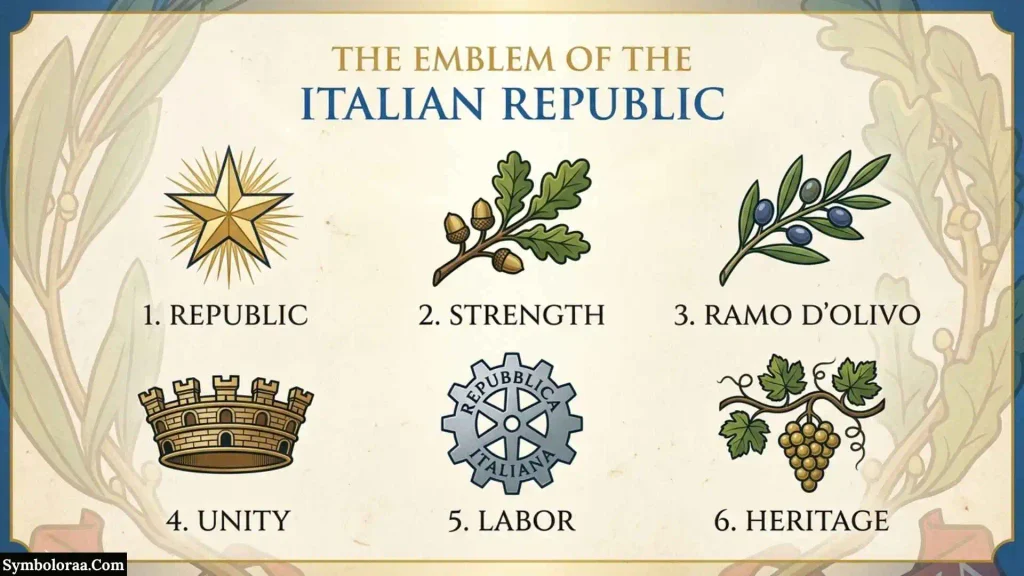
The Emblem of the Italian Republic is one of Italy’s most important official symbols.
It was approved in 1948 following a national design process. The official emblem contains a five-pointed white star outlined in red, a steel cogwheel, an olive branch, and an oak branch, with a red ribbon bearing the words “Repubblica Italiana.”
The star of Italy
The star is one of the oldest elements of Italian national imagery.
According to the Quirinal, the star had long been associated with the personification of Italy and appeared in Risorgimento imagery. It was also used in the symbolism of the former Kingdom of Italy.
In the Republic’s emblem, it provides a strong visual focus and connects modern Italy with earlier traditions of representing the nation.
The steel cogwheel
The cogwheel represents work.
This is not simply a decorative interpretation. It directly connects with Article 1 of the Italian Constitution, which describes Italy as a democratic republic founded on work. The cogwheel therefore links the national emblem to citizenship, labor and the constitutional foundations of the Republic.
The olive branch
The olive branch represents the nation’s desire for peace and concord, including internal harmony and international fraternity.
This makes the olive branch especially useful when explaining Italian symbols related to peace rather than military power.
The oak branch
The oak branch represents the strength and dignity of the Italian people. It also reflects native Italian vegetation.
Together, the olive and oak create a deliberate contrast: peace and concord on one side, strength and dignity on the other.
Why the emblem is important
The emblem is particularly useful when you need a symbol representing modern Italy as a republic, rather than Italy as an ancient civilization or tourist destination.
The design itself also has an interesting history. The official account describes a process lasting 24 months, involving two public competitions and around 800 sketches submitted by approximately 500 citizens. Paolo Paschetto’s design ultimately became the basis for the emblem adopted in May 1948.
The Italian National Anthem: Il Canto degli Italiani
The Italian national anthem is Il Canto degli Italiani, commonly called Inno di Mameli or Fratelli d’Italia.
The text was written by Goffredo Mameli in 1847, when he was a young student and patriot. Michele Novaro later composed the music. The song emerged during the patriotic atmosphere that preceded the struggle against Austrian rule.
Why the anthem became a national symbol
The song became closely associated with the Italian unification movement and remained an important patriotic song after the Risorgimento.
It became the national anthem of the Italian Republic on October 12, 1946.
Its significance is therefore connected not just to music but also to the historical idea of Italy becoming a unified nation.
When is the anthem used?
You may hear it during:
- National ceremonies
- State events
- Sporting occasions
- Military ceremonies
- Official commemorations
- International events involving Italian representation
For a project about national identity, the anthem is one of the strongest examples of a symbol that communicates Italy through sound rather than an image.
The Presidential Standard
The presidential standard is another official symbol of the Italian Republic.
It identifies the presence of the President of the Republic in military and ceremonial settings. It can be displayed on vehicles, ships, aircraft, and at official locations during presidential visits.
What does the presidential standard represent?
The current standard connects the office of the President with:
- The Italian Tricolore
- The Risorgimento
- National unity
- The Italian Armed Forces
- The constitutional state
Its design draws inspiration from the flag of the Italian Republic of 1802–1805. The blue border is associated with the Armed Forces, of which the President is commander-in-chief.
This is a useful example of why not every Italian flag-like design should be treated as the national flag. Different flags and standards have specific institutional purposes.
The Vittoriano and Altare della Patria
The Vittoriano, also known as the Altare della Patria, is one of Rome’s most recognizable national monuments.
It is closely associated with national memory, Italian unity and civic ideals.
The monument uses inscriptions such as “Patriae Unitati” and “Civium Libertati,” referring to the unity of the homeland and the liberty of citizens.
Symbolism within the Vittoriano
The monument contains several layers of symbolic imagery.
Its quadrigas represent unity and liberty, while its plant decorations use traditional symbolic meanings. The Quirinal identifies recurring plant symbolism within the monument as:
- Palm — victory
- Oak — strength
- Laurel — valor and victorious peace
- Myrtle — sacrifice
- Olive — peace and concord
This makes the Vittoriano especially interesting for anyone studying how a single monument can combine multiple symbols.
The Colosseum: A Symbol of Ancient Rome
The Colosseum is not an official symbol of the Italian Republic, but it is one of the world’s strongest visual associations with Italy.
It represents Ancient Rome, architecture, engineering, archaeology and the long historical influence of Roman civilization.
UNESCO’s description of Rome’s historic center identifies the Colosseum among the major monuments of antiquity within a historic landscape that reflects thousands of years of development.
Why the Colosseum represents Italy
The Colosseum connects modern Italy with the Roman world.
When someone sees its distinctive arches, they may immediately think of:
- Rome
- Ancient history
- Roman architecture
- Archaeology
- Classical civilization
- Italy’s historic heritage
For travel graphics and cultural designs, it can therefore communicate Italy faster than a complicated official emblem.
The Capitoline Wolf and Romulus and Remus
The Capitoline Wolf is another powerful symbol associated with Rome.
The image of a she-wolf nursing Romulus and Remus comes from the legendary foundation story of Rome.
It therefore represents:
- Rome
- Roman mythology
- Ancient origins
- The legendary founding of the city
- Classical heritage
It is more specifically a symbol of Rome and Roman identity than of the modern Italian Republic.
That distinction is important: an image can be strongly associated with Italy without being an official national emblem.
Roman Columns and Classical Architecture
Roman columns, arches, domes, aqueducts and other classical architectural forms are frequently used to represent Italy’s ancient heritage.
Their symbolism usually centers on:
- Civilization
- Engineering
- Architecture
- Power
- Law
- Classical culture
- Historical continuity
Rome’s historic center demonstrates how ancient, Renaissance, Baroque and later architectural layers exist within the same urban environment. UNESCO describes this architectural layering as a defining feature of Rome’s historic character.
Renaissance Art: A Symbol of Italian Creativity
The Renaissance is one of the strongest cultural associations with Italy.
Florence, Rome, Venice and other Italian centers played major roles in the development of Renaissance art, architecture, literature and intellectual culture.
Famous artists such as Leonardo da Vinci, Michelangelo and Raphael are frequently connected with this period.
What does Renaissance imagery represent?
Renaissance symbolism can communicate:
- Artistic excellence
- Creativity
- Humanism
- Learning
- Science
- Architecture
- Cultural heritage
- Intellectual achievement
However, it is better to avoid saying that the Renaissance was simply “an Italian invention.” It was a broader European cultural movement, even though Italian cities were central to its development.
UNESCO recognizes the historic importance of Italian Renaissance centers and describes major Italian sites as exceptional expressions of Renaissance artistic and architectural culture.
The Laurel Wreath
The laurel wreath has deep classical roots and is strongly associated with victory, achievement and honor.
Because of its connection with Ancient Greece and Rome, it is not exclusively Italian. Still, its classical associations make it particularly relevant when representing Italy’s Roman and Mediterranean heritage.
When should you use a laurel wreath?
A laurel wreath works well for:
- Academic achievement
- Historical designs
- Classical themes
- Victory
- Honor
- Roman-inspired artwork
For a school project about Ancient Rome, it may be more appropriate than the modern Italian Republic emblem.
Olive Branches and Olive Trees
The olive branch is an important symbol in Italian imagery.
In the Republic emblem, it specifically represents peace and concord.
The olive tree also has broader Mediterranean associations with:
- Peace
- Agriculture
- Longevity
- Food
- Rural landscapes
- Mediterranean culture
Because olive branches appear in both official and cultural contexts, they are particularly versatile symbols.
Italian Food as a Cultural Symbol
Italy’s cuisine is so recognizable that food itself functions as a major cultural symbol.
The most common examples include pizza, pasta, espresso, gelato, olive oil, cheese, tomatoes and regional dishes.
These are not official state symbols, but they strongly communicate Italian cultural identity.
Pizza
Pizza is one of the most recognizable foods associated with Italy.
When used in branding, travel content or illustrations, pizza usually communicates:
- Italian cuisine
- Hospitality
- Informal social life
- Culinary tradition
- Naples and southern Italian food culture
Its strongest meaning is cultural rather than political.
Pasta
Pasta represents one of the broadest ideas of Italian food culture.
Different regions have developed their own pasta shapes, sauces and preparation traditions, so pasta can also communicate the diversity of Italian regional cuisine.
Espresso
Espresso represents a different side of Italian food culture.
It is closely associated with:
- Coffee bars
- Everyday routines
- Social interaction
- Urban life
- Italian café culture
A small espresso cup can therefore communicate Italian lifestyle without using a flag.
Vespa: A Symbol of Italian Design
The Vespa has become an internationally recognizable representation of Italian design and postwar popular culture.
Its rounded shape and association with urban mobility make it particularly useful in visual designs about:
- Italian lifestyle
- Travel
- Design
- Fashion
- Cities
- Youth culture
- Postwar Italy
Unlike the Tricolore or Republic emblem, the Vespa is a commercial and cultural icon, not a national state symbol.
That difference makes it useful for lifestyle branding but inappropriate as a replacement for Italy’s official emblem.
Italian Fashion as a Symbol
Italian fashion is another major cultural representation of the country.
Italian fashion is commonly associated with:
- Craftsmanship
- Luxury
- Tailoring
- Design
- Creativity
- High-quality materials
- Milan
- Contemporary style
A fashion-related Italian symbol may therefore be more suitable for a design project about modern Italian culture than a Roman monument.
Italian Cars and Engineering
Italian automobiles are often used to represent a combination of design, engineering, performance and craftsmanship.
Sports cars, classic vehicles and racing imagery can communicate an image of modern Italian creativity.
This is particularly useful when the subject is:
- Automotive design
- Engineering
- Industrial heritage
- Motorsport
- Luxury
- Innovation
Again, these are cultural and industrial associations rather than official state symbols.
Venice and the Gondola
The gondola is one of the most recognizable regional symbols of Italy.
It specifically represents Venice and Venetian culture.
A gondola may communicate:
- Venice
- Canals
- Romance
- Traditional craftsmanship
- Tourism
- Venetian history
It is therefore best described as a regional Italian symbol, not a symbol of the entire country in the same official sense as the Tricolore.
The Leaning Tower of Pisa
The Leaning Tower of Pisa is another famous Italian architectural icon.
Its strongest association is with:
- Pisa
- Italian architecture
- Medieval architecture
- Tourism
- Engineering
- Tuscany
Piazza del Duomo in Pisa is recognized by UNESCO as a World Heritage site, making the tower part of an internationally significant architectural landscape.
Italy’s Mountains and Mediterranean Landscape
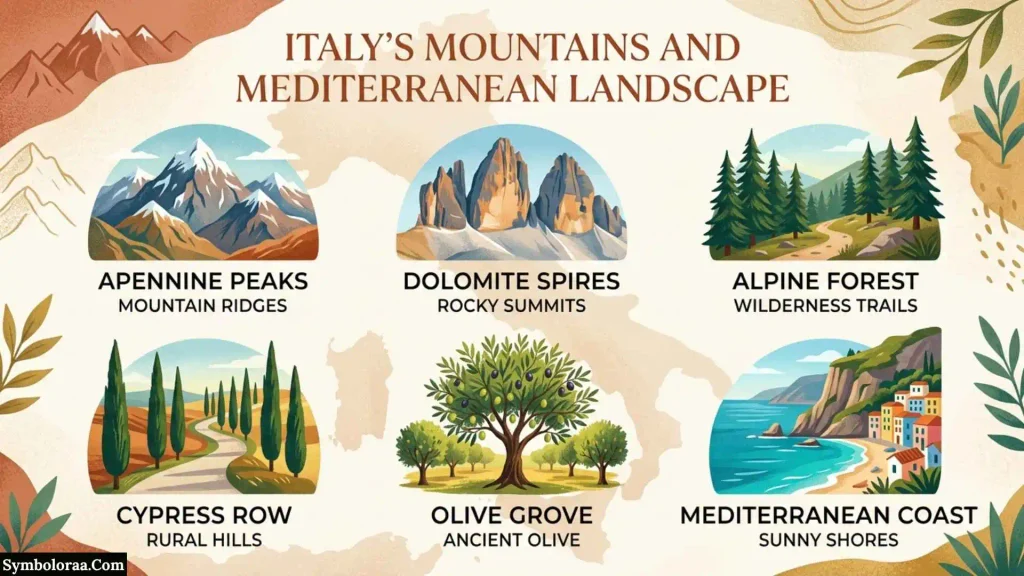
Italy’s geography can also act as a symbolic language.
The country combines the Alps, Apennines, Mediterranean coastline, islands, lakes, vineyards, olive groves and historic cities.
Mountains
Mountain imagery can represent:
- The Alps
- The Apennines
- Nature
- Adventure
- Northern Italy
- Geographic diversity
Mediterranean coastline
Coastal imagery can represent:
- Mediterranean culture
- Southern Italy
- Islands
- Tourism
- Sea-based traditions
- Regional diversity
This is particularly useful when an image needs to communicate Italy without relying on political symbols.
How Italian Symbols Changed Through History
Italy’s symbols make more sense when viewed as a timeline rather than a random collection.
Ancient Rome
The earliest major symbolic layer comes from Roman civilization.
Roman architecture, military imagery, mythology, columns, arches and the Capitoline Wolf belong to this period.
These symbols communicate Rome and classical civilization.
Medieval Italy
Medieval Italy was divided among many political and cultural centers.
City-states and regional identities became important, producing distinctive symbols, architecture and traditions.
This explains why modern Italian culture still contains strong regional identities.
Renaissance Italy
The Renaissance added a new symbolic language centered on:
- Art
- Humanism
- Science
- Architecture
- Literature
- Patronage
- Intellectual achievement
Florence, Rome, Venice and other centers became internationally influential.
The Risorgimento
The nineteenth-century Risorgimento created a stronger connection between symbols and the idea of a unified Italian nation.
The Tricolore and patriotic songs became powerful expressions of national unity. The history of the Tricolore and national anthem is closely tied to this period.
The Italian Republic
After the monarchy ended and the Republic was established, Italy developed a new official symbolic system.
The Republic emblem was adopted in 1948, and the Constitution formally established the Tricolore. The national anthem and presidential standard further defined the symbolic language of the Republic.
This produced an important distinction between symbols of the Italian state and older symbols inherited from Roman, medieval and Renaissance history.
Official Italian Symbols vs. Famous Cultural Symbols
One of the most useful ways to understand the subject is to separate symbols into categories.
| Category | Examples | What they communicate |
| Official republican | Tricolore, emblem, anthem, presidential standard | Modern Italian state |
| National historical | Vittoriano, Risorgimento imagery | Unity and national memory |
| Roman | Colosseum, Capitoline Wolf, columns | Ancient Rome |
| Renaissance | Paintings, architecture, classical art | Creativity and learning |
| Culinary | Pizza, pasta, espresso, olive oil | Food and everyday culture |
| Design | Vespa, Italian fashion, automobiles | Modern Italian creativity |
| Regional | Gondola, Tower of Pisa | Specific Italian regions or cities |
| Geographic | Alps, Apennines, Mediterranean | Nature and landscape |
This classification prevents a common mistake: assuming that the most famous image of Italy must also be an official national symbol.
Which Italian Symbol Should You Choose?
The best symbol depends on what you want to communicate.
Decision guide
Do you want to represent the Italian Republic?
↓
Choose the Tricolore or Republic emblem.
Do you want to represent national unity or the Risorgimento?
↓
Choose the Tricolore, national anthem or Vittoriano.
Do you want to represent Ancient Rome?
↓
Choose the Colosseum, Capitoline Wolf, Roman column or laurel wreath.
Do you want to represent Renaissance culture?
↓
Choose Renaissance art or architecture.
Do you want to represent Italian food?
↓
Choose pizza, pasta, espresso or olive oil.
Do you want to represent modern Italian design?
↓
Choose Vespa, fashion or Italian automotive design.
Do you want to represent Venice?
↓
Choose a gondola or Venetian imagery.
Do you want to represent Italian nature?
↓
Choose Alpine mountains, Mediterranean scenery, olive groves or coastal landscapes.
This approach is more accurate than choosing a symbol simply because it “looks Italian.”
Symbols of Italy for a School Project
For a school project, choose symbols according to the subject.
For Italian history
Use:
- Tricolore
- Risorgimento imagery
- Vittoriano
- National anthem
- Republic emblem
For Ancient Rome
Use:
- Colosseum
- Capitoline Wolf
- Roman columns
- Laurel wreath
- Roman architecture
For Italian culture
Use:
- Pizza
- Pasta
- Espresso
- Fashion
- Vespa
- Renaissance art
For Italian geography
Use:
- Alps
- Apennines
- Mediterranean Sea
- Italian coastline
- Regional landmarks
A strong project can combine several categories while clearly explaining what each one represents.
Symbols of Italy for Tattoos, Logos, and Designs
Choosing an Italian symbol for a tattoo or logo requires more thought than simply selecting a recognizable image.
If you want national identity
The Tricolore is the clearest choice.
If you want history
The Colosseum or Roman imagery works well.
If you want peace
An olive branch is particularly meaningful because it is part of the official Republic emblem and represents peace and concord.
If you want strength
An oak branch has a stronger connection to strength and dignity within the Republic emblem.
If you want achievement
A laurel wreath is appropriate for victory, honor or academic achievement.
If you want modern Italian style
A Vespa, fashion-inspired design or Italian automotive imagery may fit better.
The important question is not simply “Which symbol looks Italian?” but “What part of Italy do I want this design to represent?”
Common Misconceptions About Italian Symbols
Is the pizza an official symbol of Italy?
No. Pizza is a famous cultural and culinary symbol, not an official republican emblem.
Is the Colosseum Italy’s national emblem?
No. The Colosseum is an internationally recognized historical symbol of Rome and Italy, but it is not the official emblem of the Italian Republic.
Do green, white and red officially mean hope, faith and charity?
This is a popular interpretation, but it should not be presented as the definitive official historical meaning of the Italian flag without qualification. The official history emphasizes the flag’s development through Italian political and national history.
Is the Capitoline Wolf a symbol of modern Italy?
It is more accurately a symbol of Rome and Roman origins. It can represent Italy culturally because Rome is central to Italian history, but it is not one of the Republic’s principal official symbols.
Are all Italian symbols national symbols?
No. They can be:
- Official
- Historical
- Cultural
- Regional
- Artistic
- Culinary
- Commercial
- Geographic
Recognizing these categories makes your explanation much more precise.
A Practical Checklist for Identifying an Italian Symbol
Before describing an image as a symbol of Italy, ask:
- Is it officially recognized by the Italian state?
- Does it represent the modern Republic or an earlier historical period?
- Is it associated with Rome rather than Italy as a whole?
- Is it regional?
- Is it mainly cultural or commercial?
- What idea does it communicate?
- Is that meaning documented or simply a popular association?
- Would another symbol communicate the intended idea more accurately?
This simple checklist helps separate historical fact from popular symbolism.
Why Italian Symbols Matter Today
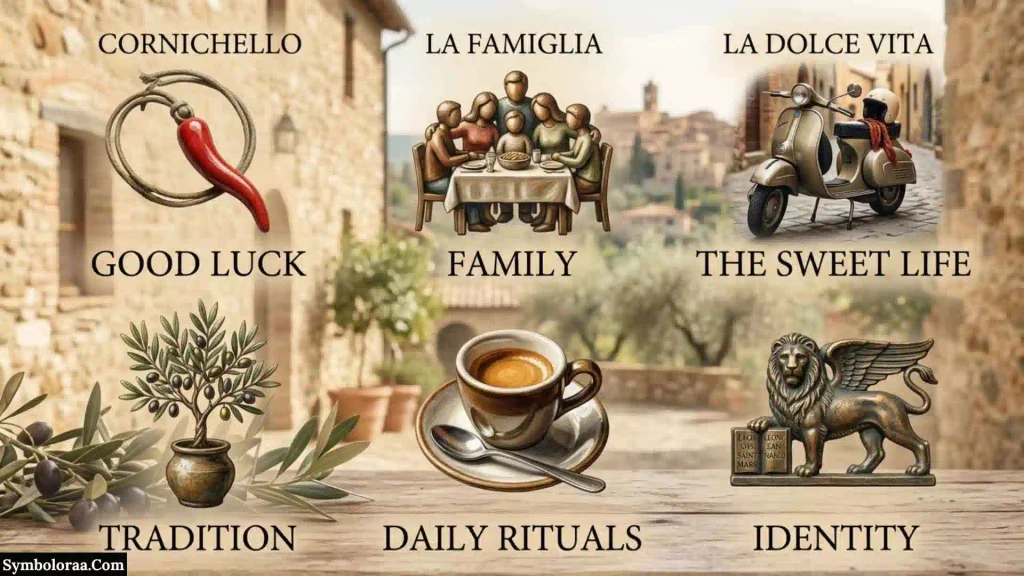
Italian symbols continue to work because they connect different periods of history.
The Tricolore represents the modern nation. The Republic emblem connects constitutional ideals with older national imagery. The Colosseum points toward Ancient Rome. Renaissance art represents creativity and intellectual heritage. Food, fashion and design communicate contemporary Italian culture.
In other words, Italian identity is not represented by one period alone.
It is a combination of ancient heritage, regional diversity, national unity, artistic achievement, everyday traditions and modern creativity.
Frequently Asked Questions About Symbols of Italy
What is the most important symbol of Italy?
The Italian Tricolore is arguably the clearest official visual symbol of the country because it is the national flag and is constitutionally defined as the flag of the Italian Republic.
What are the four main official symbols of Italy?
The Italian Presidency identifies the Tricolore, national anthem, Republic emblem and presidential standard as the principal symbols of the Republic.
What does the Italian flag symbolize?
The Tricolore represents Italian national identity and unity and has a history strongly connected with the Risorgimento and the development of a unified Italian nation.
What does the Italian Republic emblem mean?
The emblem combines several meanings. The star connects with historic Italian imagery, the steel cogwheel represents work, the olive branch represents peace and concord, and the oak branch represents strength and dignity.
What is the symbol of Rome?
Several symbols represent Rome, including the Colosseum and Capitoline Wolf. These are symbols of Roman history rather than official symbols of the modern Italian Republic.
What represents Italian culture?
There is no single answer. Common cultural symbols include pizza, pasta, espresso, Renaissance art, fashion, Vespa, Italian automobiles and regional architecture.
What flower or plant represents Italy?
There is no single official national flower that functions like the Republic’s principal symbols. However, olive and oak branches are especially significant because they form part of the official Republic emblem. The olive represents peace and concord, while the oak represents strength and dignity.
What symbol represents Italian unity?
The Tricolore is the strongest choice for national unity. The Vittoriano also has explicit symbolism connected with the unity of the homeland.
What symbol represents Italian history?
The answer depends on the period. For Ancient Rome, the Colosseum is highly recognizable. For the Risorgimento, the Tricolore and national anthem are stronger choices. For the Renaissance, Italian art and architecture are more appropriate.
What symbol represents Italian peace?
The olive branch is the clearest choice because the official Republic emblem specifically associates it with the nation’s desire for peace and concord.
What symbol represents Italian strength?
The oak branch is particularly appropriate because the official explanation of the Republic emblem associates the oak with the strength and dignity of the Italian people.
Is the Vespa an Italian national symbol?
The Vespa is best described as a cultural and design icon of Italy, rather than an official national symbol. It is especially useful for representing Italian lifestyle, design and modern popular culture.
Key Takeaways
- The Italian Tricolore is the country’s official national flag and one of its strongest national symbols.
- The Republic emblem combines the star, steel cogwheel, olive branch and oak branch to communicate important ideas about Italy and its constitutional identity.
- Il Canto degli Italiani is Italy’s national anthem and has deep connections with the Risorgimento.
- The presidential standard represents the presence and authority of the President of the Republic.
- The Vittoriano represents national unity, liberty and civic memory.
- The Colosseum and Capitoline Wolf are powerful symbols of Rome and Ancient Roman heritage.
- Renaissance art represents an important part of Italy’s artistic and intellectual heritage.
- Pizza, pasta and espresso represent Italian culinary culture rather than official state identity.
- Vespa, fashion and Italian cars represent modern Italian design and lifestyle.
- Gondolas and the Leaning Tower of Pisa are strong regional symbols.
- The most accurate way to discuss Italian symbolism is to distinguish official, historical, cultural, regional and commercial symbols.
Conclusion
The symbols of Italy tell a story that stretches from Ancient Rome to the modern Italian Republic.
The Tricolore communicates national identity and unity. The Republic emblem connects work, peace, strength and historic Italian imagery. The national anthem carries the patriotic memory of the Risorgimento, while the presidential standard represents the modern head of state.
Beyond official symbols, Italy’s cultural identity appears through the Colosseum, Capitoline Wolf, Renaissance art, Roman architecture, olive branches, Italian cuisine, Vespa, fashion, automobiles, Venice’s gondolas and the country’s diverse landscapes.
The most useful way to understand these symbols is to ask what part of Italy they represent. Some represent the Republic, some represent Rome, some represent a particular region, and others represent Italian creativity, food or everyday life.
That distinction turns a simple list of famous Italian images into a much deeper understanding of Italy’s history, identity and culture.

I’m Jackson Miller, an American author inspired by mystery, adventure, and the unpredictable nature of life. I enjoy writing fast-moving stories filled with memorable characters, unexpected choices, and meaningful moments. Through my books, I want readers to experience new worlds while discovering something about courage, determination, and themselves.
Three Books:
The Edge of Tomorrow
Under a Broken Sky
The Road We Chose
 Madison Reed