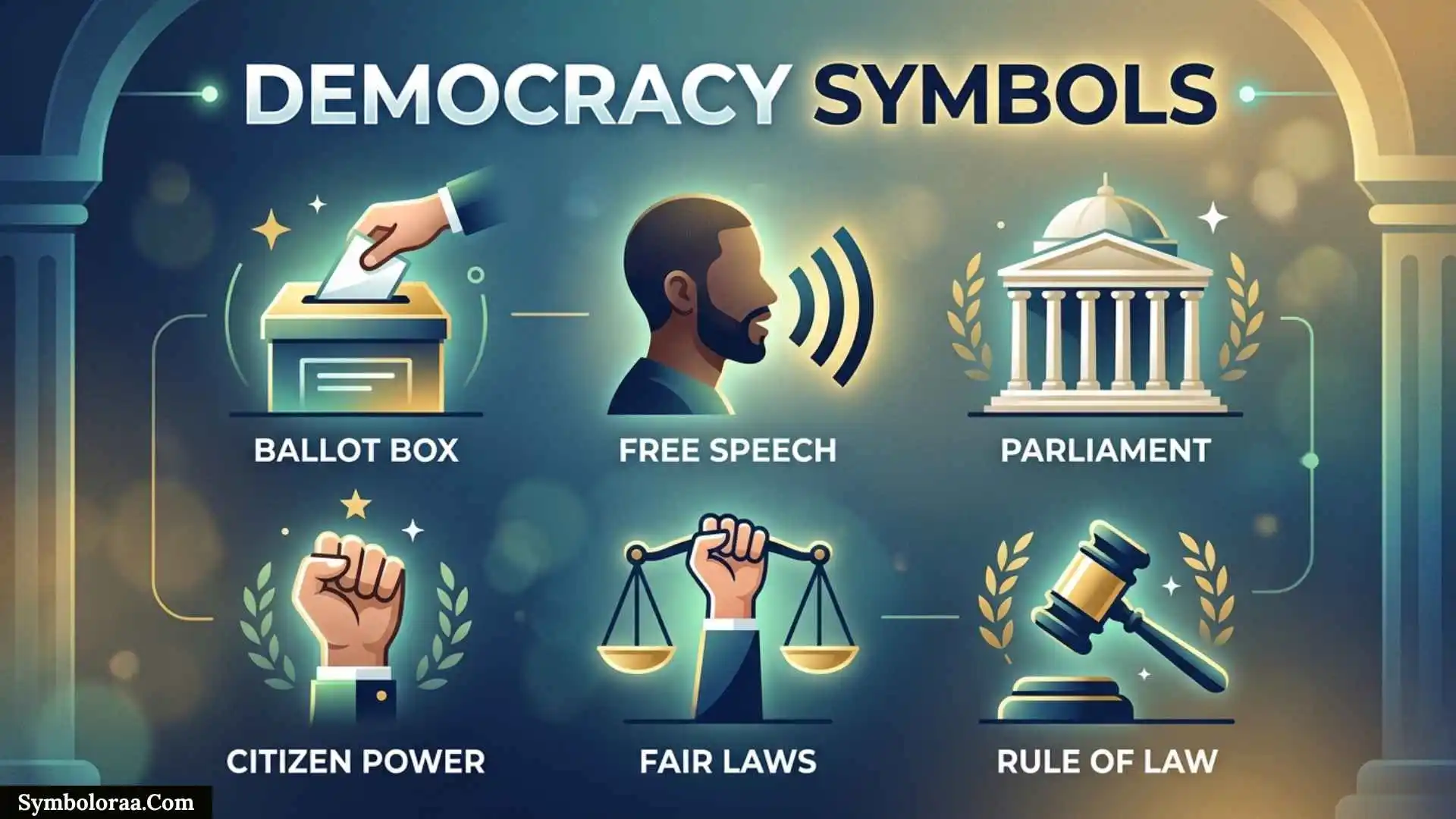
If you are searching for democracy symbols, the most important thing to know is that democracy does not have one universal official symbol. Instead, different images represent different parts of democratic life, including voting, political participation, equality, freedom, representation, justice, peace, human rights, accountability, and the rule of law.
The ballot box is one of the clearest symbols of democracy because it directly represents elections and voting. Other commonly associated symbols include the voting hand, scales of justice, constitution, parliament building, torch, olive branch, dove, broken chains, open hand, raised hand, people standing together, open book, and pen.
But there is an important distinction: some of these are symbols of democracy itself, while others are symbols of freedom, justice, peace, human rights, or political activism that are often used in democratic contexts.
This guide explains what the major democracy symbols mean, where their meanings come from, how they differ from related political symbols, and which symbol is best for a school project, poster, logo, tattoo, presentation, civic campaign, or educational design.
Quick Answer: What Are the Main Democracy Symbols?
The most recognizable symbols associated with democracy include:
| Symbol | What it commonly represents |
| Ballot box | Voting, elections, citizen participation |
| Ballot paper | Political choice and electoral participation |
| Voting hand | Individual political participation |
| Raised hand | Having a voice and taking part |
| Parliament building | Representation and lawmaking |
| Constitution or law book | Rights, laws, and limits on government |
| Scales of justice | Equality, fairness, and rule of law |
| Torch | Liberty, enlightenment, and hope |
| Broken chains | Liberation and freedom from oppression |
| Olive branch | Peace, cooperation, and reconciliation |
| Dove | Peace and nonviolence |
| Open hand | Openness, inclusion, and participation |
| People together | Citizenship, equality, and collective participation |
| Open book | Education and informed citizenship |
| Pen | Expression, communication, and civic voice |
| Bridge | Dialogue, cooperation, and consensus |
| Raised fist | Solidarity, resistance, and political activism |
The ballot box is usually the best single symbol when the subject is specifically democracy and voting. However, the best choice depends on which democratic value you want to communicate.
What Is a Democracy Symbol?
A democracy symbol is a visual image, object, gesture, building, or design used to communicate an idea connected with democratic government or democratic values.
Democracy contains many abstract concepts. People cannot physically see ideas such as popular sovereignty, political equality, representation, accountability, civic participation, or consent of the governed.
Symbols make these ideas visible.
For example:
Ballot box → elections → participation → citizen choice
Likewise:
Scales → equality before the law → fairness
And:
Parliament → representatives → public decision-making
The symbol therefore works as a visual shortcut for a larger political idea.
Why There Is No Single Universal Democracy Symbol
The United Nations describes democracy as a system based on principles such as participation, equality, human rights, fundamental freedoms, free and fair elections, accountability, and the rule of law. It also emphasizes that there is no single model of democracy.
Because democratic systems differ across countries and historical periods, their visual languages also differ.
A ballot box may be almost universally understandable as an election symbol, while a flag, eagle, building, or political emblem may represent one particular nation or organization.
This is why it is more accurate to talk about symbols associated with democracy rather than claiming that every democracy uses the same official emblem.
Direct Democracy Symbols vs Related Symbols
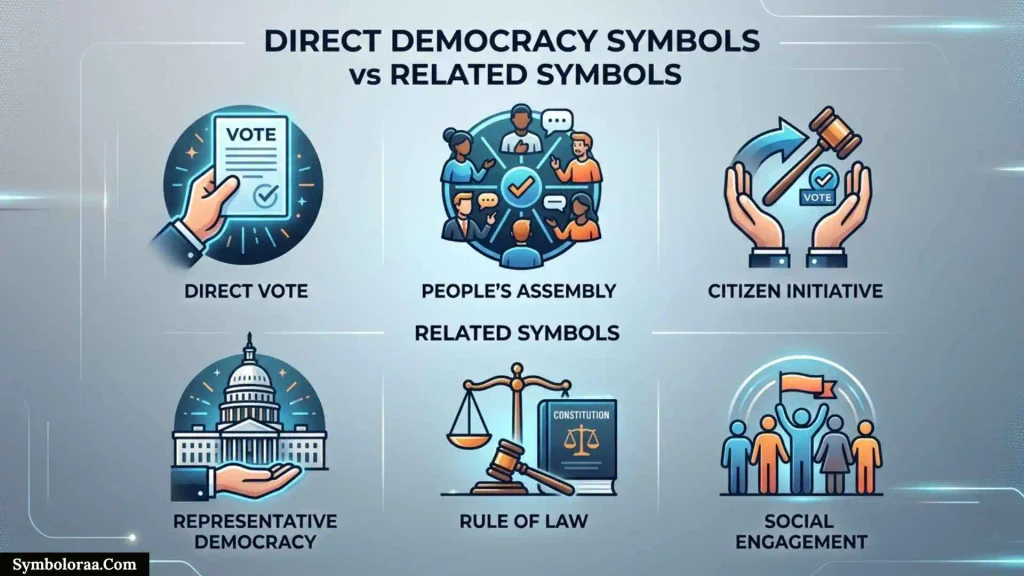
One of the most useful ways to understand this topic is to classify symbols according to how directly they relate to democracy.
Direct Democratic Symbols
These have a strong connection to democratic participation:
- Ballot box
- Ballot paper
- Voting hand
- Election booth
- Voter check mark
- People voting
These are especially appropriate for election-related content.
Institutional Democracy Symbols
These represent the institutions through which democratic government operates:
- Parliament
- Legislative assembly
- Constitution
- Courthouse
- Government chamber
- Public records
They are useful when discussing representative government, lawmaking, constitutional government, and accountability.
Democratic Value Symbols
These represent principles associated with democracy:
- Scales → fairness
- Torch → liberty
- Open hand → participation
- Broken chains → liberation
- People together → equality and citizenship
- Open book → education
Broader Political Symbols
Some symbols appear in democratic movements but are not exclusively democratic:
- Raised fist
- Protest signs
- National flags
- Eagles
- Liberty figures
- Political party symbols
Their meaning depends heavily on context.
The Ballot Box: The Clearest Symbol of Democracy
The ballot box is arguably the most direct visual representation of democratic participation.
It represents the place where votes are collected during an election and therefore connects directly with the act of citizens choosing among candidates, parties, or options.
What Does a Ballot Box Symbolize?
A ballot box can represent:
- Voting
- Elections
- Citizen participation
- Political choice
- Representation
- Civic responsibility
- Consent of the governed
- Peaceful political change
The United Nations identifies periodic, genuine elections based on universal and equal suffrage and secret voting as essential elements of democracy.
Why the Ballot Box Works So Well
The strength of the ballot box is its direct connection to democratic procedure.
A torch requires interpretation.
A dove requires interpretation.
A broken chain requires interpretation.
A ballot box immediately suggests voting.
For that reason, it is usually the safest choice for:
- Democracy school projects
- Election posters
- Civic education
- Voting campaigns
- Infographics
- Democracy logos
- Educational presentations
The Ballot Paper and Check Mark
A ballot paper or a check mark inside a voting box represents the individual act of making a political choice.
The ballot paper can symbolize:
- Electoral choice
- Political voice
- Voting rights
- Citizen participation
- Representation
A check mark adds a sense of action.
The combination:
Ballot paper + check mark + ballot box
creates one of the strongest visual formulas for an election-themed democracy design.
Voting Hand and Raised Hand
A hand placing a ballot into a box emphasizes the citizen, while the ballot box emphasizes the electoral institution.
This distinction can make a design more meaningful.
Voting Hand
A voting hand represents:
- Participation
- Choice
- Voting rights
- Civic responsibility
- Individual political voice
Raised Hand
A raised hand can communicate:
- Having a voice
- Participation
- Asking to be heard
- Public engagement
- Political involvement
Unlike the ballot box, a raised hand is more metaphorical. Its meaning depends on context.
For example, a raised hand beside a ballot box strongly suggests voting. A raised hand in a protest image may instead represent activism or resistance.
Parliament Building: Representation and Lawmaking
A parliament, congress, legislative assembly, or similar public institution can symbolize representative democracy.
Democratic representation means citizens participate in government not only through voting but also through representatives and institutions that make public decisions.
What Does a Parliament Symbolize?
A parliament building can represent:
- Representation
- Lawmaking
- Public debate
- Government
- Political deliberation
- Accountability
- Institutional democracy
The symbol is particularly useful when the topic is representative government rather than direct voting.
Parliament vs Ballot Box
These two symbols communicate different parts of the democratic process:
Ballot box → citizens participate in elections
Parliament → elected representatives deliberate and make laws
Using both gives a more complete picture of representative democracy.
Constitution or Law Book: Rights and Limits on Power
A constitution, law book, legal document, or scroll can symbolize constitutional government and the legal framework within which political power operates.
It may represent:
- Constitutional rights
- Rule of law
- Legal equality
- Government accountability
- Limits on state power
- Civil liberties
- Institutional rules
The United Nations describes the rule of law as requiring public and private actors, including the state, to be accountable to publicly promulgated laws that are equally enforced and independently adjudicated. It also connects the rule of law with participation, equality, fairness, transparency, and separation of powers.
Why This Symbol Matters
Voting alone does not explain the full meaning of constitutional democracy.
A constitution represents the rules and rights that structure political power.
That makes the law book particularly appropriate for:
- Constitutional democracy
- Civic education
- Government studies
- Political science projects
- Human-rights education
Scales of Justice: Equality and Rule of Law
The scales of justice are primarily a symbol of justice and fairness rather than democracy itself.
However, they become strongly relevant to democracy when used to communicate:
- Equality before the law
- Fairness
- Impartiality
- Rule of law
- Accountability
- Legal rights
The United Nations specifically identifies equality before the law, accountability, fairness, transparency, and participation as important components of the rule of law.
Democracy and Justice Are Not Identical
This distinction is important.
Democracy → who participates in political decision-making
Justice → whether people are treated fairly under law
The two ideas overlap, but they should not be treated as synonyms.
Torch: Liberty, Knowledge, and Enlightenment
The torch has long been used in political and civic imagery to represent liberty, enlightenment, knowledge, hope, and guidance.
It is therefore commonly used alongside democracy symbolism.
What Does the Torch Represent?
Depending on context, a torch can symbolize:
- Freedom
- Liberty
- Knowledge
- Enlightenment
- Hope
- Progress
- Guidance
The Library of Congress documents the long use of liberty imagery in American political art, including liberty figures, liberty caps, columns, and related classical imagery.
Is the Torch an Official Symbol of Democracy?
No universal rule makes the torch an official global symbol of democracy.
It is better described as a symbol of liberty and enlightenment frequently used in democratic and civic imagery.
That wording is more historically and semantically accurate.
Broken Chains: Freedom From Oppression
A broken chain or broken shackle is primarily a symbol of liberation.
It can communicate:
- Freedom
- Emancipation
- Liberation
- Release from oppression
- Political independence
The imagery has a long history in political art. The Library of Congress records historical works in which broken shackles represented emancipation and freedom.
Broken Chain vs Democracy
The distinction is:
Broken chain → freedom from oppression
Ballot box → democratic participation
A broken chain can therefore support a democracy message, but it should not automatically be labeled a direct symbol of democracy.
Olive Branch: Peaceful Political Cooperation
The olive branch is one of the oldest widely recognized symbols of peace.
In democratic imagery, it can communicate:
- Peaceful disagreement
- Cooperation
- Reconciliation
- Compromise
- Dialogue
- Peaceful political transition
Why Peace Is Relevant to Democracy
Democracy does not eliminate disagreement.
People may hold very different political beliefs while still participating in the same political system.
The olive branch therefore works well when the message is:
“We can disagree peacefully.”
It is especially useful for campaigns about:
- Political dialogue
- National reconciliation
- Peaceful elections
- Community cooperation
- Democratic stability
Dove: Peace and Nonviolence
The dove is primarily a peace symbol.
It can be used in democratic contexts to represent:
- Peace
- Nonviolence
- Reconciliation
- Hope
- Cooperation
However, calling the dove an exclusive “democracy symbol” would be inaccurate.
Its stronger meaning is peace, which can support a broader message about peaceful democratic processes.
Open Hand: Inclusion and Participation
The open hand is a flexible symbol.
Depending on its design and context, it can represent:
- Participation
- Openness
- Inclusion
- Welcome
- Cooperation
- Public engagement
It works especially well for modern civic graphics because the human hand creates an immediate sense of personal involvement.
Open Hand vs Voting Hand
The difference is simple:
Voting hand → voting and political choice
Open hand → participation, openness, or inclusion
If the article, poster, or campaign is specifically about elections, the voting hand is more precise.
People Together: Citizenship and Equality
Groups of people are frequently used in modern civic and democratic designs.
They can represent:
- Citizens
- Equality
- Diversity
- Community
- Collective participation
- Inclusion
- Shared responsibility
This symbol is particularly useful for explaining the idea that democracy is not only an institution but also a system involving citizens.
The United Nations describes popular participation, political equality, and citizen engagement as essential parts of democracy.
Open Book: Education and Informed Citizenship
An open book is not an exclusive democracy symbol, but it can represent a major supporting idea: civic knowledge.
It can symbolize:
- Education
- Literacy
- Knowledge
- Learning
- Civic awareness
- Informed participation
For a school project, combining an open book with a ballot box creates a useful message:
Knowledge + participation = informed citizenship
This is more meaningful than using the book as decoration alone.
Pen: Expression and Civic Voice
A pen can represent writing, communication, public debate, journalism, lawmaking, and freedom of expression.
It can therefore support democratic themes involving:
- Free expression
- Political communication
- Journalism
- Public debate
- Writing laws
- Civic participation
The Universal Declaration of Human Rights recognizes freedom of opinion and expression and the right to seek, receive, and impart information. It also recognizes participation in government and elections.
Bridge: Dialogue and Consensus
A bridge is a metaphorical rather than institutional democracy symbol.
It represents the idea of connecting people or groups that may otherwise be separated.
It can communicate:
- Dialogue
- Cooperation
- Compromise
- Reconciliation
- Consensus
- Shared goals
A bridge is particularly useful when a design focuses on democratic dialogue rather than elections alone.
Raised Fist: Solidarity and Political Resistance
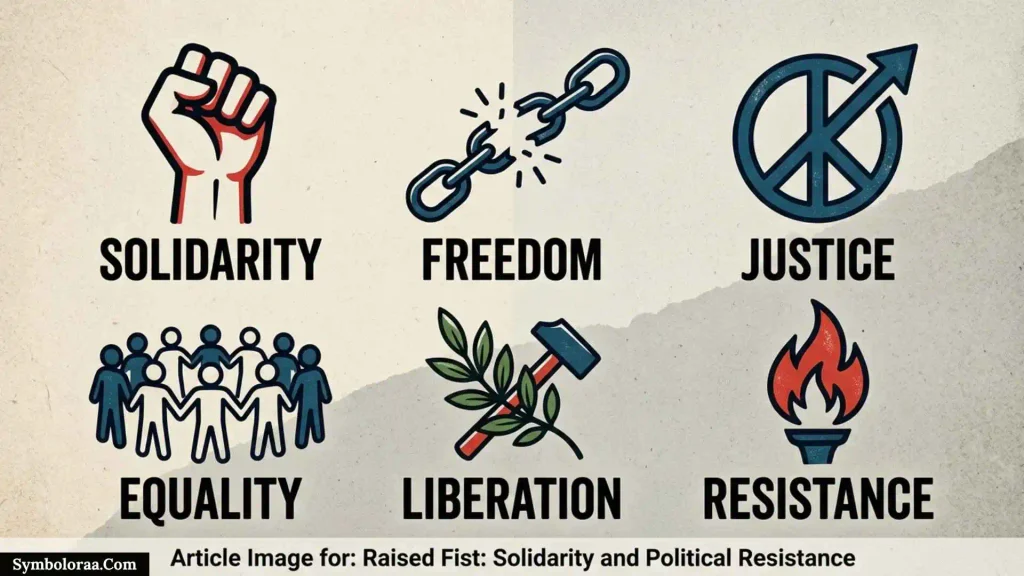
The raised fist is a powerful political symbol, but its meaning is more complicated than that of a ballot box.
It can represent:
- Solidarity
- Resistance
- Collective action
- Protest
- Political activism
- Opposition to oppression
Because many movements have used the raised fist for different political purposes, it should not be presented as a universal or neutral symbol of democracy.
When Should You Use a Raised Fist?
Use it when your message specifically concerns:
- Activism
- Political resistance
- Civil rights
- Collective action
- Protest
- Social movements
For a neutral election poster, a ballot box is usually more precise.
Democracy Symbols by Meaning
Different symbols work better for different democratic concepts.
| Democratic idea | Best symbolic choices |
| Voting | Ballot box, ballot paper, voting hand |
| Participation | Raised hand, people, voting hand |
| Representation | Parliament, ballot box, people |
| Equality | Scales, people together |
| Justice | Scales, courthouse, law book |
| Rule of law | Constitution, law book, scales |
| Freedom | Torch, broken chain |
| Peace | Dove, olive branch |
| Inclusion | Open hand, diverse people |
| Education | Open book |
| Expression | Pen, microphone, speech bubble |
| Dialogue | Bridge, joined hands |
| Activism | Raised fist, protest sign |
| Civic responsibility | Ballot, people, constitution |
Democracy vs Freedom: What Is the Difference?
These concepts are closely connected but not interchangeable.
Democracy concerns how people participate in and influence government.
Freedom concerns the ability of individuals to act, speak, believe, associate, or live without unjust restrictions.
The UN links democracy with human rights and fundamental freedoms but treats these as related concepts rather than identical terms.
Symbol Comparison
| Concept | Stronger symbol |
| Democracy | Ballot box |
| Freedom | Torch or broken chain |
| Justice | Scales |
| Peace | Dove or olive branch |
| Representation | Parliament |
| Rule of law | Constitution or scales |
| Participation | Voting hand |
| Human rights | People or open hand |
This distinction is useful for SEO because people searching for “democracy symbols” may actually be trying to find a symbol for freedom, equality, justice, or human rights.
Democracy vs Human Rights Symbols
Human rights and democracy are deeply connected.
The Universal Declaration of Human Rights states that everyone has the right to take part in government directly or through freely chosen representatives and that the will of the people should form the basis of governmental authority. It also recognizes freedoms of expression, peaceful assembly, and association.
Still, the concepts are different.
Democracy → political participation and government by the people
Human rights → fundamental rights and freedoms belonging to people
A design about human rights might therefore emphasize people, open hands, equality, or freedom, while an election-focused democracy design would more naturally use a ballot box.
Democracy vs Justice Symbols
Justice is one of democracy’s supporting principles, but justice has a broader meaning.
Democracy Symbols
- Ballot
- Parliament
- Voting hand
- Citizens
Justice Symbols
- Scales
- Gavel
- Courthouse
- Law book
Where They Overlap
The scales can appear in a democracy design when the message concerns:
- Equality before law
- Fair elections
- Accountability
- Legal protection
- Rule of law
This contextual approach is more accurate than claiming that the scales universally mean democracy.
Symbol vs Sign vs Emblem vs Logo
These terms are often mixed together, but they are not identical.
Symbol
A symbol represents a broader idea.
Example:
Broken chain → liberation
Sign
A sign usually communicates a more direct or immediate message.
Example:
Check mark → selected or approved choice
Emblem
An emblem is a distinctive visual representation associated with an institution, organization, group, or identity.
Logo
A logo is a designed identifier used by an organization, campaign, business, or project.
Electoral Symbol
An electoral symbol is used to help identify a political party, candidate, or electoral choice.
This last category is especially important because an electoral symbol is not automatically a symbol of democracy.
Electoral Symbols vs Democracy Symbols
Political systems often use visual symbols during elections.
These might include:
- Animals
- Objects
- Geometric shapes
- Tools
- Plants
- Everyday objects
- National imagery
Their primary purpose may be to identify a party or candidate.
Why the Difference Matters
Consider this logical distinction:
Political party symbol → identifies a political organization
Election symbol → identifies an electoral choice
Democracy symbol → represents a principle or institution associated with democratic government
One image may perform more than one function, but the categories should not be confused.
Historical Development of Democratic Symbolism
Democratic symbolism has developed over centuries rather than coming from one single tradition.
Ancient Civic and Classical Imagery
Ancient Greek and Roman political traditions influenced later European and American political imagery.
Later artists frequently used classical figures and objects to personify concepts such as:
- Liberty
- Justice
- Peace
- Victory
- Civic virtue
- Government
Revolutionary and Enlightenment Era
The political revolutions of the 18th century expanded the use of symbols connected with:
- Liberty
- Equality
- Rights
- Citizenship
- Popular sovereignty
- Constitutional government
The Library of Congress preserves historical political artwork using liberty figures, scales, olive branches, liberty caps, books, flags, and other allegorical imagery.
Modern Democratic Era
Modern democracy introduced increasingly direct imagery:
- Ballot boxes
- Voting papers
- Election booths
- Voters
- Public assemblies
- Parliament buildings
- Political campaigns
- Civic organizations
This shift made democratic symbolism easier for ordinary voters to understand.
Democracy Symbols Around the World
There is no single global visual language for democracy.
Different countries combine universal democratic concepts with local political and cultural imagery.
United States
American political imagery has historically included liberty figures, the Constitution, ballot imagery, eagles, olive branches, chains, and other classical or national symbols.
The Library of Congress documents how political art used allegorical imagery to communicate liberty, union, peace, emancipation, and government.
Pakistan
Pakistan provides an important example of the difference between electoral symbols and democracy symbols.
Political parties and candidates can be identified through electoral symbols. These symbols have practical importance during elections, but an individual party symbol should not automatically be described as a universal symbol of democracy.
The broader democratic symbolism would instead include:
- Voting
- Ballots
- Citizens
- Elections
- Representation
- Parliament
- Constitutional government
International Democracy Imagery
International civic organizations commonly use combinations of:
- People
- Ballots
- Hands
- Public institutions
- Dialogue
- Equality
- Rights
The exact design varies because democracy itself takes different institutional forms. The United Nations explicitly notes that there is no single model of democracy.
What Is Not Specifically a Democracy Symbol?
This is one of the most important distinctions when researching the subject.
A National Flag
A flag normally represents a country or national identity.
It can appear in democratic contexts, but it does not automatically mean democracy.
An Eagle
An eagle can represent:
- Power
- Sovereignty
- Strength
- National identity
- Authority
The Library of Congress documents the eagle’s historical use as a symbol of power and authority.
Therefore, an eagle should not automatically be labeled a democracy symbol.
A Dove
A dove primarily represents peace.
A Broken Chain
A broken chain primarily represents liberation or freedom.
A Raised Fist
A raised fist commonly represents solidarity, resistance, or activism.
A Political Party Logo
A party logo identifies a political organization.
The key lesson is:
Context determines symbolic meaning.
How to Identify an Accurate Democracy Symbol
Before calling an image a democracy symbol, use this six-question test.
Question 1: Is It Directly Connected to Democratic Participation?
If yes, it may be a direct democracy symbol.
Example:
Ballot box
Question 2: Does It Represent a Democratic Institution?
If yes, classify it as institutional.
Example:
Parliament
Question 3: Does It Represent a Democratic Value?
If yes, it may be a value-based symbol.
Example:
Scales → equality and justice
Question 4: Does It Primarily Represent Something Else?
If yes, do not overstate its connection.
Example:
Dove → peace
Question 5: Is It Specific to a Political Movement or Organization?
If yes, identify the context.
Example:
Party logo → political identity
Question 6: Is the Meaning Historically or Institutionally Documented?
If a claim says an object is an “ancient universal symbol of democracy,” check the evidence before repeating it.
This prevents one of the most common problems with symbolism content: turning modern interpretations into supposedly ancient facts.
A Four-Layer Democracy Symbol Interpretation Framework
For a more accurate interpretation, analyze each symbol through four layers.
Layer 1: Literal Object
What is the image?
Example:
A ballot box
Layer 2: Immediate Meaning
What does the object directly communicate?
Voting
Layer 3: Democratic Principle
What broader principle does it represent?
Political participation
Layer 4: Context
How is it being used?
It might appear in:
- An election poster
- A school textbook
- A government campaign
- A political movement
- A logo
- A personal artwork
This final layer matters because the same symbol can have different meanings in different settings.
Democracy Symbols by Purpose
Choosing a symbol becomes easier when the purpose is clear.
For a School Project
Use:
- Ballot box
- Voting hand
- Open book
- Scales
- People
These provide clear educational meanings.
For a Democracy Poster
A strong combination is:
Ballot box + people + scales
This communicates:
Participation + citizens + equality
For an Election Campaign
Use:
Ballot box + ballot paper + check mark
This is direct and easy to understand.
For Constitutional Democracy
Use:
Constitution + parliament + scales
This emphasizes:
Law + representation + justice
For Freedom and Democracy
Use:
Torch + ballot box + broken chain
This combines:
Liberty + participation + liberation
For Peace and Democracy
Use:
Olive branch + people + ballot box
This communicates:
Peace + citizens + democratic participation
For Civic Education
Use:
Open book + ballot box + people
This communicates the relationship between knowledge and participation.
Democracy Symbols for Tattoos
People sometimes choose democracy-related imagery as tattoos to represent personal beliefs about freedom, civic participation, equality, or political engagement.
Possible designs include:
- Ballot box
- Voting hand
- Torch
- Broken chain
- Scales
- Constitution
- Olive branch
- People in a circle
Important Tattoo Consideration
A tattoo’s personal meaning does not have to be identical to a symbol’s historical meaning.
For example:
Broken chain
Historical/common meaning → liberation
Personal tattoo meaning → overcoming a personal limitation
Both interpretations can coexist.
If the goal is to communicate democracy specifically, however, a ballot, voting hand, or combination of democratic imagery is less ambiguous.
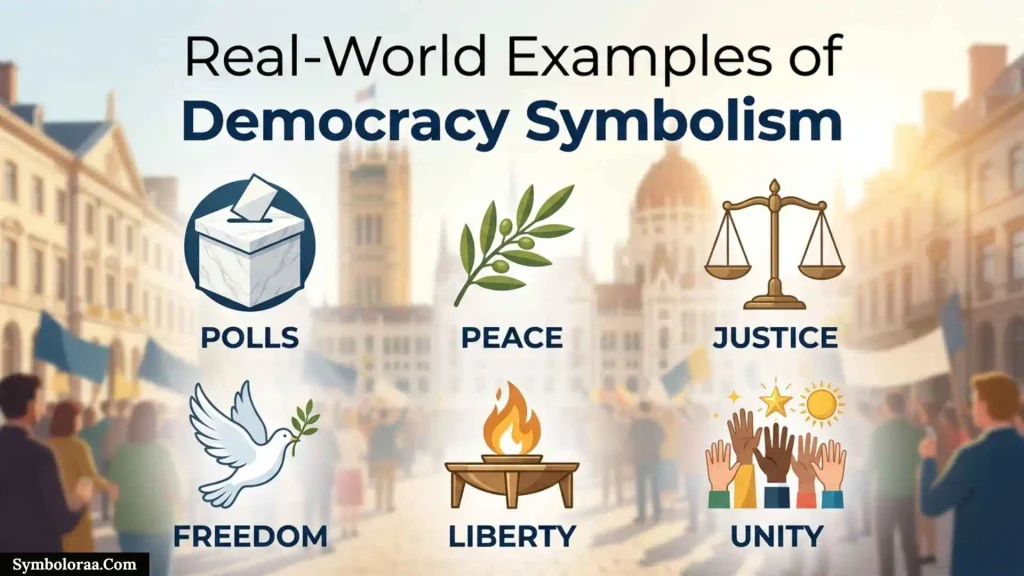
Real-World Examples of Democracy Symbolism
Historical Political Art
The Library of Congress preserves political artworks that combine liberty figures, scales, olive branches, books, chains, flags, and other allegorical elements. These works show that political symbolism has often communicated several ideas at once rather than assigning one fixed meaning to each object.
The Statue of Liberty
The Statue of Liberty provides a well-known example of layered symbolism.
Its torch is strongly associated with liberty and enlightenment, while the tablet connects the monument with law and the date of American independence. Earlier designs also included a broken chain and shackle, which were later placed at the statue’s feet. The Library of Congress documents this evolution.
The lesson is important:
One monument can contain several symbols, each contributing a different part of the overall meaning.
Modern Election Materials
Modern election graphics often use the ballot box, ballot paper, check mark, voter, or polling station because these images communicate the voting process directly.
This is an example of functional symbolism: the image is designed to be understood quickly rather than interpreted through complex historical allegory.
Common Misconceptions About Democracy Symbols
Misconception 1: There Is One Official Global Democracy Symbol
There is no single universal symbol used by every democracy.
Misconception 2: Every Freedom Symbol Is a Democracy Symbol
Freedom and democracy are related but different concepts.
Misconception 3: The Dove Means Democracy
The dove primarily means peace.
Misconception 4: The Scales Mean Democracy
The scales primarily represent justice and fairness.
Misconception 5: Every Political Logo Represents Democracy
A political logo usually identifies a party, candidate, or organization.
Misconception 6: A National Flag Automatically Represents Democracy
A flag primarily represents national identity.
Misconception 7: Voting Alone Defines Democracy
Voting is central to democratic participation, but broader democratic principles also include rights, participation, accountability, representation, equality, freedom, and rule of law.
Common Mistakes When Using Democracy Symbols
Using Too Many Symbols
A design containing every possible symbol can become confusing.
Choose two to five symbols that support one clear message.
Ignoring Context
Do not assume that an eagle, fist, flag, or dove means the same thing everywhere.
Confusing Political Identity With Democracy
A party emblem and a democracy symbol serve different purposes.
Presenting Modern Meanings as Ancient Facts
If a website claims that a particular geometric shape has represented democracy “for thousands of years,” verify the historical evidence before repeating the claim.
Choosing a Symbol Without Defining the Message
First decide:
What do I want the viewer to understand?
Then choose the symbol.
Democracy Symbol Decision Tree
Use this quick guide when selecting a symbol.
What is the main message?
↓
Voting or elections?
→ Choose a ballot box, ballot paper, or voting hand.
↓
Citizen participation?
→ Choose people, raised hands, or voting hands.
↓
Representation and government?
→ Choose a parliament or legislative building.
↓
Equality and fairness?
→ Choose scales of justice.
↓
Rule of law and constitutional rights?
→ Choose a constitution or law book.
↓
Freedom?
→ Choose a torch or broken chain.
↓
Peaceful cooperation?
→ Choose an olive branch or dove.
↓
Political activism or resistance?
→ Consider a raised fist, while making the political context clear.
A Simple Checklist for Choosing a Democracy Symbol
Before using an image, ask:
- Does it match the message?
- Is it actually connected with democracy?
- Could it primarily represent another concept?
- Does its meaning change by country or movement?
- Is it institutional, value-based, or metaphorical?
- Is its historical meaning documented?
- Would a ballot box or voting symbol communicate the idea more clearly?
- Am I confusing a party symbol with a democracy symbol?
- Does the design remain understandable without a long explanation?
This checklist is especially useful for students, graphic designers, educators, bloggers, and campaign creators.
Frequently Asked Questions About Democracy Symbols
What is the main symbol of democracy?
The ballot box is one of the clearest symbols of democracy because it directly represents voting and elections. However, there is no single universal official symbol of democracy.
What symbol represents democracy and freedom?
A combination of a ballot box and torch can communicate democracy and freedom together. The ballot box represents participation, while the torch is more closely associated with liberty and enlightenment.
What symbol represents democratic freedom?
The torch and broken chain are strong symbols of freedom that can be used in democratic contexts. A ballot box is more directly connected with democracy itself.
What symbol represents equality in democracy?
The scales of justice are commonly used to represent equality, fairness, and impartiality. They are more specifically justice symbols than universal democracy symbols.
What represents people’s power in democracy?
A group of citizens, voting hands, ballots, or raised hands can represent the political participation and collective voice of people.
Is a ballot box a symbol of democracy?
Yes. The ballot box is one of the most direct and widely understandable visual representations of democratic elections and political participation.
Is there an official international symbol for democracy?
There is no single universal emblem that officially represents democracy in every country. International democratic principles are expressed through a variety of institutional and civic symbols.
What are good democracy symbols for a school project?
A ballot box, voting hand, people, scales of justice, constitution, and open book are strong choices because each can represent a clear part of democratic life.
What symbol represents peace and democracy?
An olive branch or dove can represent peace, while a ballot box can add the democratic dimension. Combining them communicates peaceful democratic participation.
What symbol represents freedom from oppression?
A broken chain or broken shackle is a strong symbol of liberation and freedom from oppression.
Is a raised fist a democracy symbol?
A raised fist can appear in democratic movements, but it more directly represents solidarity, resistance, activism, or collective action. Its meaning depends on political context.
Are flags symbols of democracy?
Flags usually represent nations, communities, or political identities. A national flag can be displayed in a democratic context without being a universal symbol of democracy.
Are political party symbols democracy symbols?
Not necessarily. A political party symbol primarily identifies a political party or candidate. It may function within an election but should not automatically be described as a universal democracy symbol.
What is the best symbol for a democracy logo?
For a neutral democracy-focused logo, a simple ballot box, ballot, voting hand, or group of people is usually easier to understand than a highly symbolic historical image.
What are the symbols of representative democracy?
Strong examples include the ballot box, parliament building, constitution, citizens, and voting hand because they represent elections, representation, lawmaking, rights, and participation.
What is the difference between a democracy symbol and a freedom symbol?
A democracy symbol usually communicates political participation, representation, elections, or democratic institutions. A freedom symbol usually communicates liberty or release from restriction. The two can overlap but are not identical.
Key Takeaways
- There is no single universal official symbol of democracy.
- The ballot box is one of the clearest direct symbols of democratic participation.
- A ballot paper and voting hand emphasize individual political choice.
- A parliament building represents representation and lawmaking.
- A constitution or law book represents legal rights and limits on government power.
- Scales of justice represent fairness, equality, and rule of law.
- A torch commonly represents liberty, enlightenment, and hope.
- Broken chains represent liberation and freedom from oppression.
- An olive branch and dove primarily represent peace.
- People together can represent citizenship, equality, and participation.
- An open book can represent education and informed civic engagement.
- A pen can represent expression and communication.
- A raised fist is more closely associated with activism, resistance, and solidarity.
- Political party or electoral symbols should not automatically be treated as universal democracy symbols.
- The meaning of a symbol depends on historical period, country, political movement, institution, and context.
- The most accurate way to interpret a symbol is to examine its object, immediate meaning, democratic connection, and context.
Conclusion
Democracy is too broad an idea to be represented accurately by one universal image. Its symbolism is better understood as a visual vocabulary of participation, representation, rights, equality, freedom, justice, peace, and accountability.
For elections and voting, the ballot box is usually the strongest choice. For participation, use a voting hand or people. For representative governments, a parliament building works well. For constitutional government, choose a constitution or law book. For justice and equality, the scales are appropriate. For freedom, the torch or broken chain can communicate the idea, while the dove and olive branch are better suited to peace.
The most important lesson is to match the symbol with the exact idea you want to communicate. A dove is not automatically a democracy symbol, a flag is not automatically a freedom symbol, and a political party logo is not automatically a symbol of democratic government.
When historical origin, institutional meaning, democratic principle, and modern context are considered together, democracy symbols become much easier to understand and much harder to misrepresent.

I’m Ethan Brooks, an American writer passionate about stories that explore modern life, relationships, ambition, and personal growth. I love creating characters who feel real and face challenges readers can recognize. Through my writing, I hope to entertain, inspire, and encourage readers to see everyday experiences from a different perspective.
Three Books:
The City Between Us
After the Last Goodbye
A Different Tomorrow
 Jackson Miller
 Madison Reed