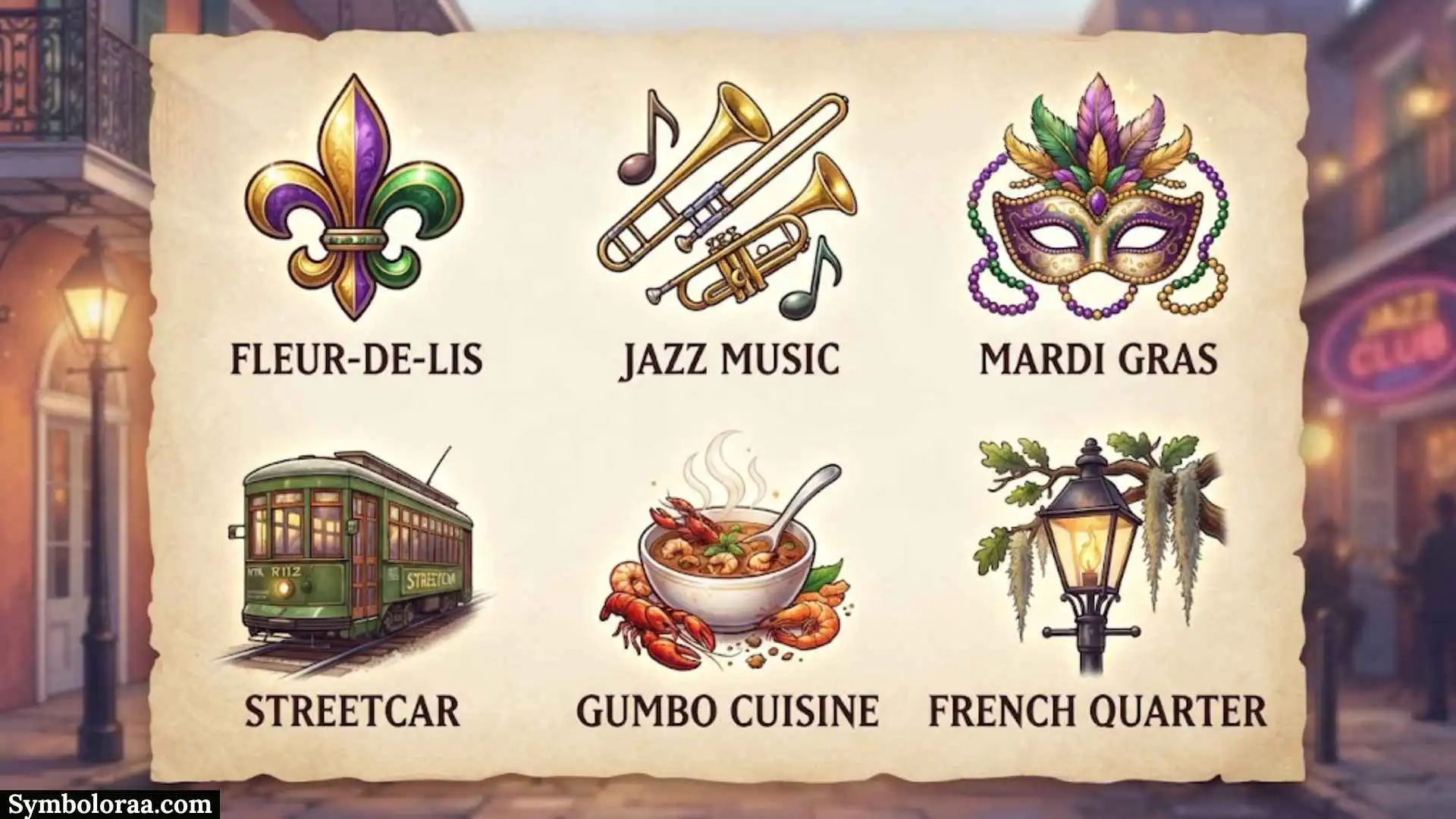
New Orleans is one of the most visually recognizable cities in the United States. Its identity appears in the shape of the fleur-de-lis, the colors of Mardi Gras, the sound of jazz, the historic streetcars, French Quarter balconies, live oak trees, riverboats, king cakes, and many other cultural images.
But there is an important distinction: not every image associated with New Orleans is an official city symbol. Some are civic or governmental symbols, some belong to Louisiana as a state, and others developed through Mardi Gras, music, architecture, food, transportation, and local traditions.
Quick Answer: The most recognizable New Orleans symbols include the fleur-de-lis, Mardi Gras masks, beads, purple-green-gold colors, jazz instruments, streetcars, French Quarter architecture, live oak trees, riverboats, and king cake. The pelican is closely associated with the region but is more accurately identified as an official Louisiana state symbol, rather than an exclusive symbol of New Orleans.
Understanding this difference makes it easier to interpret New Orleans symbols accurately. This guide explains their meanings, historical background, cultural importance, and practical uses.
What Are New Orleans Symbols?
New Orleans symbols are images, objects, colors, architectural features, foods, traditions, and cultural references that help represent the city’s identity.
Some have a direct civic connection. Others are associated with major events such as Mardi Gras. Still others represent parts of the city’s history, including its relationship with the Mississippi River, French and Spanish colonial influences, Creole culture, African American heritage, and the development of jazz.
A useful way to classify them is into six groups:
| Category | Examples |
| Civic and local identity | Fleur-de-lis |
| Mardi Gras | Masks, beads, colors, crowns |
| Music | Trumpet, trombone, jazz bands |
| Architecture | Iron balconies, courtyards, Creole buildings |
| Transportation and geography | Streetcars, riverboats, Mississippi River |
| Food and traditions | King cake, Mardi Gras foods |
This classification is important because it prevents a common mistake: assuming that every famous New Orleans image has official municipal status.
Fleur-de-Lis: The Most Recognizable New Orleans Symbol
The fleur-de-lis is one of the strongest visual representations of New Orleans.
Its connection to the city reflects the area’s French historical heritage, but its meaning has expanded over time. Today, the fleur-de-lis can communicate New Orleans identity, Louisiana heritage, tradition, history, and local pride.
The City of New Orleans continues to use fleur-de-lis imagery in its official public-facing identity, making it especially important when discussing civic representations of the city.
What Does the Fleur-de-Lis Mean in New Orleans?
The fleur-de-lis can represent several related ideas:
- French heritage
- Louisiana history
- New Orleans identity
- Tradition
- Local pride
- Cultural continuity
- Historical connection
Its meaning depends on context. A fleur-de-lis on a city document has a different function from one used on jewelry, artwork, clothing, or a souvenir.
Why Is the Fleur-de-Lis Associated With New Orleans?
New Orleans was founded during the French colonial period, and French influence became an important part of the city’s historical identity.
However, modern New Orleans culture cannot be explained by French influence alone. Spanish rule, African and Caribbean cultural traditions, Indigenous influences, Creole communities, immigration, and later American development all contributed to the city’s character.
The fleur-de-lis is therefore best understood as one important visual thread in a much larger cultural story.
Mardi Gras Mask: A Symbol of Carnival and Mystery
The Mardi Gras mask is one of the most recognizable symbols of New Orleans Carnival.
Masks add mystery and theatricality to Mardi Gras celebrations. Historically, masking also gave participants greater freedom to interact outside their usual social identities.
Today, masks remain closely connected with Carnival traditions and are particularly associated with parade riders and Mardi Gras costumes.
What Does the Mardi Gras Mask Represent?
A Mardi Gras mask can symbolize:
- Mystery
- Carnival
- Celebration
- Transformation
- Freedom
- Theater
- Playfulness
- Tradition
For example, a decorative mask in purple, green, and gold immediately suggests Mardi Gras even when no words are present.
Mardi Gras Beads: A Symbol of Celebration
Mardi Gras beads are another defining New Orleans symbol.
During Carnival parades, riders throw beads and other objects, commonly called throws, to spectators. This makes beads more than decorations; they are part of the interactive nature of Mardi Gras.
Purple, green, and gold beads are particularly recognizable because they reflect the traditional Carnival color scheme.
What Do the Mardi Gras Colors Mean?
The traditional Mardi Gras colors are:
| Color | Traditional Meaning |
| Purple | Justice |
| Green | Faith |
| Gold | Power |
These meanings are traditionally attributed to Rex, the king of Carnival.
The combination is now so strongly connected with Mardi Gras that purple, green, and gold alone can communicate a New Orleans Carnival theme.
Why Are Mardi Gras Beads Important?
Beads represent participation.
A parade is not simply something spectators watch. The exchange of throws between riders and crowds creates an active relationship between the parade and the people watching it.
That makes beads a particularly useful symbol when a design needs to communicate celebration, community, Carnival, and New Orleans.
Purple, Green, and Gold: The Visual Language of Mardi Gras
The three traditional Mardi Gras colors are among the easiest New Orleans symbols to recognize.
A design containing:
Purple + Green + Gold
can immediately suggest Carnival.
These colors commonly appear on:
- Parade decorations
- Costumes
- Beads
- King cakes
- Posters
- Flags and banners
- Event graphics
- Jewelry
- Mardi Gras masks
For a Mardi Gras-themed design, using the three colors together is often enough to establish the subject without adding many other symbols.
Jazz Instruments: Symbols of New Orleans Musical Heritage
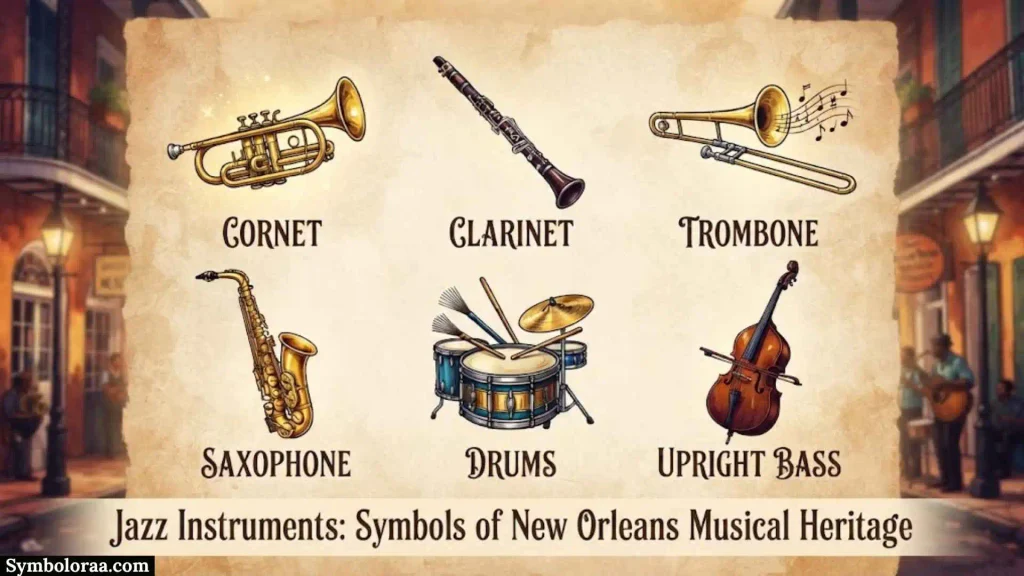
New Orleans is deeply associated with jazz, so musical instruments have become important symbols of the city.
Common examples include:
- Trumpet
- Cornet
- Trombone
- Clarinet
- Saxophone
- Piano
- Drums
- Tuba
A trumpet is particularly effective as a visual shorthand for New Orleans jazz.
Why Is Jazz a New Orleans Symbol?
Jazz developed through the interaction of many musical and cultural traditions. New Orleans’ African American communities, Caribbean connections, marching-band traditions, blues, ragtime, church music, and other influences contributed to the city’s musical environment.
The exact moment when jazz began cannot be reduced to one date. Historians and cultural institutions describe its development as a gradual process.
New Orleans musicians such as Louis Armstrong, Jelly Roll Morton, and other early performers helped establish the city’s lasting association with jazz.
A Real-World Example of the Jazz Symbol
Imagine a poster containing:
Trumpet + Musical Notes + French Quarter Balcony
Even without the words “New Orleans,” the combination strongly suggests the city’s musical and architectural identity.
That is why musical imagery is often used in travel posters, event branding, murals, restaurant décor, and cultural artwork.
New Orleans Streetcar: A Symbol of Historic Transportation
The New Orleans streetcar is one of the city’s most recognizable transportation symbols.
The St. Charles Avenue line is particularly famous for its historic character, oak-lined route, and surrounding historic homes.
A streetcar can represent:
- New Orleans transportation
- Historic neighborhoods
- St. Charles Avenue
- Local heritage
- Tourism
- Historic urban life
The streetcar is especially powerful visually because it can place several New Orleans ideas into one image.
Why Does the Streetcar Represent New Orleans?
A streetcar moving beneath large live oak trees beside historic houses creates a scene that is strongly associated with New Orleans.
This is why streetcars frequently appear in:
- Travel photography
- Tourism advertisements
- Posters
- Souvenirs
- Illustrations
- City-themed artwork
The symbol communicates both place and history.
Live Oak Trees: A Symbol of New Orleans Streetscapes
Live oak trees are another important visual element of New Orleans.
Large oaks line several historic streets and parks. St. Charles Avenue is particularly recognizable for its oak canopy.
The trees can represent:
- Historic neighborhoods
- Southern landscapes
- Shade and natural beauty
- Long-term continuity
- New Orleans streetscapes
Why Are Oak Trees Important in New Orleans Imagery?
An oak tree is rarely an official emblem of the city by itself. Its importance is visual and cultural.
Consider this combination:
Streetcar + oak trees + historic houses
The three elements together create a highly recognizable New Orleans scene.
This is an example of how several ordinary objects can become powerful cultural symbols when they are consistently associated with a particular place.
French Quarter Architecture as a New Orleans Symbol
The French Quarter, also called the Vieux Carré, is one of the most important architectural symbols of New Orleans.
Its visual identity includes:
- Cast-iron balconies
- Wrought-iron details
- Courtyards
- Narrow streets
- Historic façades
- Creole townhouses
- Shutters
- Carriageways
- Decorative ironwork
The National Park Service describes the French Quarter as a place where French, Spanish, American, and Creole influences can be seen in the built environment.
Iron Balconies and Railings
Iron balconies are among the easiest architectural features to recognize.
They can symbolize:
- The French Quarter
- Historic New Orleans
- Creole architecture
- Colonial heritage
- Urban elegance
An illustration showing an ornate iron balcony can therefore communicate New Orleans without showing a famous landmark.
Courtyards and Creole Architecture
Courtyards are another important feature of historic New Orleans architecture.
They reflect the way buildings were designed around local climate, urban space, and cultural traditions.
This makes architecture more than decoration. It is evidence of how different cultural influences adapted to the city’s environment.
Mississippi River: A Geographic and Historical Symbol
The Mississippi River is fundamental to understanding New Orleans.
The city was established along the river because of its strategic location and relationship with river transportation and commerce.
For centuries, the river influenced:
- Trade
- Transportation
- Settlement
- Port activity
- Economic development
- Regional connections
This makes the Mississippi River a powerful symbol of New Orleans history.
Riverboats and Steamboats
Riverboats and steamboats are commonly used to represent the city’s connection with the Mississippi.
They can symbolize:
- River commerce
- Travel
- Transportation
- Trade
- Maritime history
- New Orleans’ location on the Mississippi
A riverboat image is especially useful when the intended message is historical rather than specifically related to Mardi Gras.
Pelican: A Louisiana Symbol Often Associated With New Orleans
The pelican needs careful classification.
The pelican is an official Louisiana state symbol, not an exclusive official symbol of New Orleans.
The Louisiana state flag features a mother pelican with three chicks in a nest. The design also includes the state motto, “Union Justice Confidence.”
What Does the Pelican Represent?
The pelican imagery has traditionally been associated with:
- Care
- Sacrifice
- Protection
- Nurturing
- Louisiana identity
Because New Orleans is such a prominent Louisiana city, pelican imagery can appear in designs connected with New Orleans.
However, if accuracy matters, it is better to describe the pelican as a Louisiana state symbol associated with the broader cultural identity of New Orleans, rather than calling it the official symbol of the city.
This distinction improves both historical accuracy and semantic clarity.
King Cake: A Symbol of New Orleans Carnival Season
King cake is strongly associated with Mardi Gras and Carnival season in New Orleans.
The cake is usually decorated in purple, green, and gold, making it both a food tradition and a visual symbol.
A small plastic baby is commonly hidden inside or beneath a slice.
What Does the King Cake Baby Mean?
The person who finds the baby traditionally takes on a responsibility connected with the next celebration, commonly including providing the next king cake or hosting a gathering.
This turns the cake into a symbol of:
- Community
- Celebration
- Sharing
- Carnival tradition
- Continuity
The tradition is especially useful for understanding why food can function as a cultural symbol just as effectively as an object or image.
Mardi Gras Throws and Parade Symbols
Mardi Gras has a much broader symbolic vocabulary than beads alone.
Common parade-related symbols include:
- Beads
- Cups
- Doubloons
- Masks
- Costumes
- Parade floats
- Crowns
- Scepters
- Marching bands
- King cake
- The traditional Carnival colors
Different krewes also have their own traditions and signature throws.
Why Are Parade Throws Important?
Throws make Carnival interactive.
Instead of simply watching a parade, spectators participate by calling to riders and receiving objects from floats.
This helps explain why beads have become such a powerful symbol of New Orleans Mardi Gras.
New Orleans Symbols and Creole Cultural Heritage
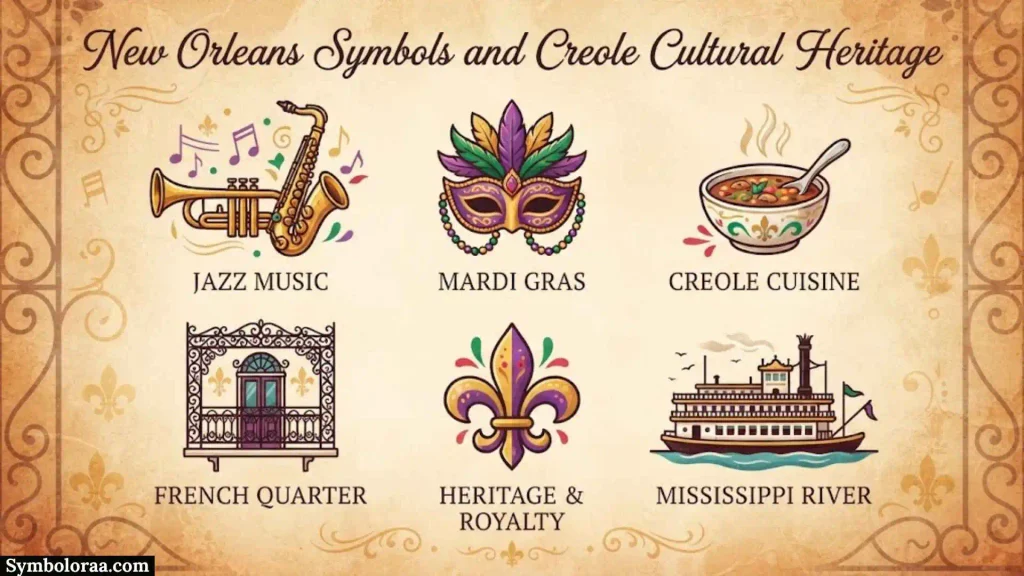
New Orleans symbols cannot be fully understood without discussing Creole culture.
The term Creole has been used in different historical and cultural contexts, and its meaning is not limited to one race or single tradition.
New Orleans Creole culture developed through multiple influences, including French, Spanish, African, Caribbean, Indigenous, and other communities.
This cultural mixture is visible in:
- Architecture
- Food
- Language
- Music
- Religion
- Festivals
- Family traditions
- Art
The National Park Service describes the French Quarter as a visible record of the city’s Creole and colonial past.
Why Cultural Context Matters
A symbol can lose meaning when removed from its historical context.
For example, an iron balcony may look like simple decoration to a visitor. In New Orleans, however, it can be part of a larger architectural tradition shaped by climate, urban planning, and multiple cultural influences.
The same principle applies to music, food, festivals, and street scenes.
How New Orleans History Shaped Its Symbols
New Orleans was founded in 1718 during the French colonial period.
Its location near the Mississippi River made it strategically important, while later French, Spanish, African, Caribbean, Creole, and American influences shaped the city’s development.
The original city layout became the basis of what is now the French Quarter.
Over time, the city’s identity developed through multiple layers rather than one single cultural source.
French and Spanish Influence
French colonial origins helped establish one layer of New Orleans identity.
Spanish rule also left an important architectural and cultural influence.
This is one reason the city’s historic architecture cannot always be described as purely French.
African and Caribbean Influences
African and Caribbean cultural traditions played a major role in the development of New Orleans music, food, festivals, and social life.
The history of jazz is especially connected with these cultural interactions.
This broader context helps explain why New Orleans symbols are so diverse.
American Influence
After the Louisiana Purchase, New Orleans became increasingly connected with the expanding United States.
New neighborhoods developed, architectural styles changed, and the city became a major center of trade and culture.
As a result, modern New Orleans symbolism combines older European and Creole traditions with later American influences.
New Orleans Symbols vs Louisiana Symbols
This is one of the most important distinctions for anyone researching the topic.
| Symbol | Best Classification |
| Fleur-de-lis | New Orleans and Louisiana cultural identity |
| Mardi Gras mask | New Orleans Carnival symbol |
| Mardi Gras beads | Carnival symbol |
| Purple, green, gold | Mardi Gras symbol |
| Jazz trumpet | New Orleans musical symbol |
| Streetcar | New Orleans transportation symbol |
| French Quarter balcony | New Orleans architectural symbol |
| Live oak | New Orleans landscape symbol |
| Mississippi River | Geographic and historical symbol |
| King cake | New Orleans/Louisiana Carnival tradition |
| Pelican | Official Louisiana state symbol |
| Louisiana state flag | Louisiana state symbol |
The table shows why “New Orleans symbols” should not be treated as one official list.
Some symbols belong specifically to the city, some represent a cultural tradition, and some belong to Louisiana as a whole.
Official Symbols vs Cultural Symbols
Another useful distinction is between official and associated symbols.
Official or Civic Symbols
These are connected with government or civic identity.
The fleur-de-lis is particularly important because it appears in City of New Orleans public-facing identity.
Cultural Symbols
These develop through community traditions.
Examples include:
- Jazz instruments
- King cake
- Mardi Gras beads
- Masks
- Streetcars
- Iron balconies
State Symbols
These officially represent Louisiana.
The pelican and Louisiana state flag belong in this category.
This classification prevents a common factual mistake: calling every popular New Orleans image an “official city symbol.”
How to Choose the Right New Orleans Symbol
The best symbol depends on what you want the image to communicate.
| Your Purpose | Symbol to Consider | Why |
| General New Orleans identity | Fleur-de-lis | Strong local association |
| Mardi Gras | Mask or beads | Immediately signals Carnival |
| Carnival colors | Purple, green, gold | Recognizable visual shorthand |
| Jazz | Trumpet or other brass instrument | Represents musical heritage |
| Historic transportation | Streetcar | Strong city-specific image |
| French Quarter | Iron balcony | Architectural association |
| Louisiana identity | Pelican | Official state connection |
| River history | Steamboat | Mississippi River connection |
| Carnival food | King cake | Food and festival tradition |
| Historic streetscape | Oak trees + streetcar | Strong visual New Orleans scene |
This approach is more useful than simply listing symbols because it helps you choose an image based on its intended meaning.
New Orleans Symbol Decision Guide
Use this quick decision tree when identifying or selecting a symbol.
What message do you want to communicate?
↓
Mardi Gras or Carnival?
→ Choose mask, beads, king cake, or purple-green-gold colors
Music or jazz?
→ Choose trumpet, trombone, clarinet, or jazz-band imagery
Historic New Orleans?
→ Choose streetcar, French Quarter architecture, riverboat, or fleur-de-lis
French Quarter?
→ Choose iron balcony, courtyard, historic façade, or Creole townhouse
Louisiana rather than New Orleans specifically?
→ Consider the pelican or Louisiana state flag
General city identity?
→ Consider the fleur-de-lis
This framework helps avoid using a symbol whose meaning does not match the intended message.
New Orleans Symbols in Tattoos, Jewelry, and Artwork
New Orleans symbols are frequently used in personal and decorative designs.
Fleur-de-Lis Designs
The fleur-de-lis works well in:
- Tattoos
- Necklaces
- Rings
- Posters
- Clothing
- Home décor
It provides a compact visual reference to New Orleans and Louisiana heritage.
Mardi Gras Designs
Masks, beads, crowns, and purple-green-gold patterns are suitable for:
- Carnival invitations
- Party decorations
- Posters
- Event graphics
- Costumes
- Festival artwork
Music-Based Designs
Trumpets and other brass instruments are useful when the intended theme is:
- Jazz
- Music history
- New Orleans nightlife
- Performance
- Cultural heritage
Architectural Designs
Iron balconies and French Quarter façades can create a more historic or sophisticated New Orleans theme.
This is particularly useful when you want the design to suggest the city without relying on a generic fleur-de-lis.
Common Mistakes When Interpreting New Orleans Symbols
Mistake 1: Calling Every Symbol Official
A symbol can be culturally important without having official city status.
Always distinguish between civic, state, cultural, and commercial imagery.
Mistake 2: Treating New Orleans Culture as Only French
French history is important, but New Orleans developed through many cultural influences.
African, Caribbean, Spanish, Creole, Indigenous, and American influences are essential to understanding the city’s identity.
Mistake 3: Calling the Pelican an Official New Orleans Symbol
The pelican is officially associated with Louisiana.
It can be used in New Orleans-related imagery, but it should not automatically be labeled the city’s official symbol.
Mistake 4: Assuming Mardi Gras Is the Whole Identity of New Orleans
Mardi Gras is a major part of the city’s cultural identity, but New Orleans also has deep connections with music, architecture, food, river commerce, literature, neighborhoods, and history.
Mistake 5: Using Symbols Without Context
A fleur-de-lis, mask, or trumpet may have different meanings depending on where and how it is used.
Context is essential when explaining symbolism.
Real-World Examples of New Orleans Symbolism
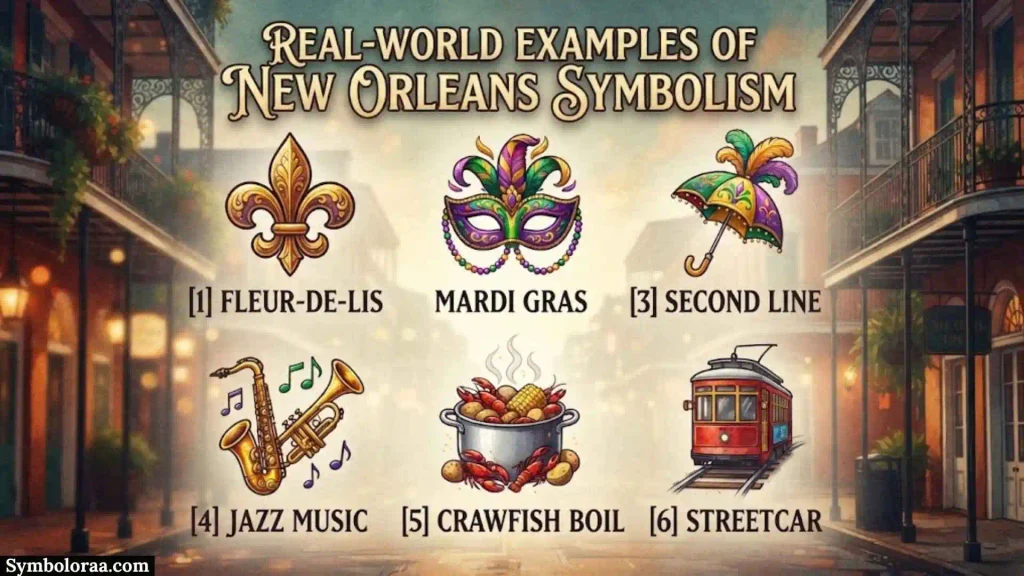
Example 1: Travel Poster
A poster shows a streetcar moving beneath oak trees with historic homes in the background.
Likely message: Historic New Orleans.
The design does not need to use the city’s name because the combination of visual elements is strongly associated with the city.
Example 2: Mardi Gras Invitation
An invitation uses:
Purple + Green + Gold + Mask + Beads
Likely message: New Orleans Mardi Gras.
The symbols reinforce one another and make the event’s theme immediately recognizable.
Example 3: Jazz Festival Poster
A poster shows a trumpet beside a French Quarter balcony.
Likely message: New Orleans jazz and cultural heritage.
The combination connects music with place.
Example 4: Louisiana Heritage Design
A design features a pelican and Louisiana imagery rather than a streetcar or Mardi Gras mask.
Likely message: Louisiana state identity.
This distinction matters because the pelican points more directly toward Louisiana as a whole.
Frequently Asked Questions About New Orleans Symbols
What Is the Main Symbol of New Orleans?
The fleur-de-lis is one of the most recognizable symbols associated with New Orleans. It has strong historical and cultural connections with Louisiana and French heritage and is also used in the City of New Orleans’ public identity.
What Does the Fleur-de-Lis Mean in New Orleans?
The fleur-de-lis can represent French heritage, Louisiana history, New Orleans identity, tradition, and local pride. Its precise meaning depends on context.
What Are the Main Symbols of Mardi Gras?
Common Mardi Gras symbols include masks, beads, parade floats, crowns, king cake, and the traditional colors purple, green, and gold.
What Do Purple, Green, and Gold Mean in New Orleans?
In traditional Mardi Gras symbolism, purple represents justice, green represents faith, and gold represents power.
Why Is a Trumpet a Symbol of New Orleans?
The trumpet is strongly associated with the city’s jazz heritage. New Orleans played an important role in the development of jazz, and musicians from the city helped spread the music nationally and internationally.
Is the Pelican a New Orleans Symbol?
The pelican is more accurately classified as an official Louisiana state symbol. It can appear in New Orleans-related designs because New Orleans is part of Louisiana, but it is not exclusively a city symbol.
What Architecture Represents New Orleans?
French Quarter buildings, cast-iron and wrought-iron balconies, courtyards, Creole townhouses, shutters, and historic façades are among the architectural features most strongly associated with New Orleans.
Why Is the Streetcar a Symbol of New Orleans?
Historic streetcars, especially the St. Charles Avenue line, are closely associated with New Orleans’ transportation history and recognizable streetscapes.
What Food Symbolizes New Orleans Mardi Gras?
King cake is one of the strongest food symbols of New Orleans Carnival season. Its purple, green, and gold decoration and the traditional hidden baby make it particularly recognizable.
What Symbol Represents the French Quarter?
There is no single object that represents the entire French Quarter, but iron balconies, courtyards, Creole architecture, historic façades, and narrow streets are strong visual references.
What Symbol Represents New Orleans Jazz?
A trumpet is one of the most recognizable choices, although trombones, clarinets, drums, saxophones, and complete brass-band imagery can also represent the city’s musical heritage.
Are New Orleans Symbols Official?
Some have civic connections, but many are cultural or historical symbols rather than legally designated city emblems. This is why it is important to distinguish official symbols from commonly associated imagery.
Key Takeaways About New Orleans Symbols
New Orleans has no need for a single image to express its identity. The city’s symbols form a collection of history, culture, architecture, music, food, transportation, and celebration.
The most important points are:
- The fleur-de-lis is one of the strongest symbols associated with New Orleans.
- Mardi Gras masks and beads represent Carnival and celebration.
- Purple, green, and gold are the traditional Mardi Gras colors.
- Jazz instruments, especially brass instruments, represent the city’s musical heritage.
- The streetcar is a powerful symbol of historic New Orleans transportation.
- Live oak trees help create recognizable New Orleans streetscapes.
- French Quarter balconies and Creole architecture represent the city’s architectural heritage.
- The Mississippi River and riverboats reflect New Orleans’ geographic and commercial history.
- King cake represents Carnival season and community tradition.
- The pelican is an official Louisiana symbol rather than an exclusive New Orleans symbol.
- New Orleans identity developed through French, Spanish, African, Caribbean, Creole, Indigenous, and American influences.
- The most accurate approach is to separate official, civic, state, cultural, architectural, musical, and festival symbols.
Conclusion
New Orleans symbols are much more than decorative images. Each one points toward a different part of the city’s history and cultural identity.
The fleur-de-lis connects strongly with New Orleans and Louisiana heritage. Mardi Gras masks, beads, and traditional colors represent Carnival. Jazz instruments reflect the city’s musical history, while streetcars and live oaks create recognizable images of historic neighborhoods. French Quarter balconies and Creole architecture preserve visible evidence of the city’s complex cultural past. The Mississippi River and riverboats point toward geography, transportation, and commerce, while king cake connects food with Carnival tradition.
The most important distinction is between official symbols and symbols that are culturally associated with New Orleans. Once that distinction is understood, it becomes much easier to interpret, research, and use New Orleans symbols accurately.
Whether you are studying New Orleans history, choosing a symbol for artwork, researching a tattoo design, creating educational content, or simply trying to understand what a particular image means, looking at the symbol within its historical and cultural context provides a much clearer picture of the city.

I’m Jackson Miller, an American author inspired by mystery, adventure, and the unpredictable nature of life. I enjoy writing fast-moving stories filled with memorable characters, unexpected choices, and meaningful moments. Through my books, I want readers to experience new worlds while discovering something about courage, determination, and themselves.
Three Books:
The Edge of Tomorrow
Under a Broken Sky
The Road We Chose
 Madison Reed