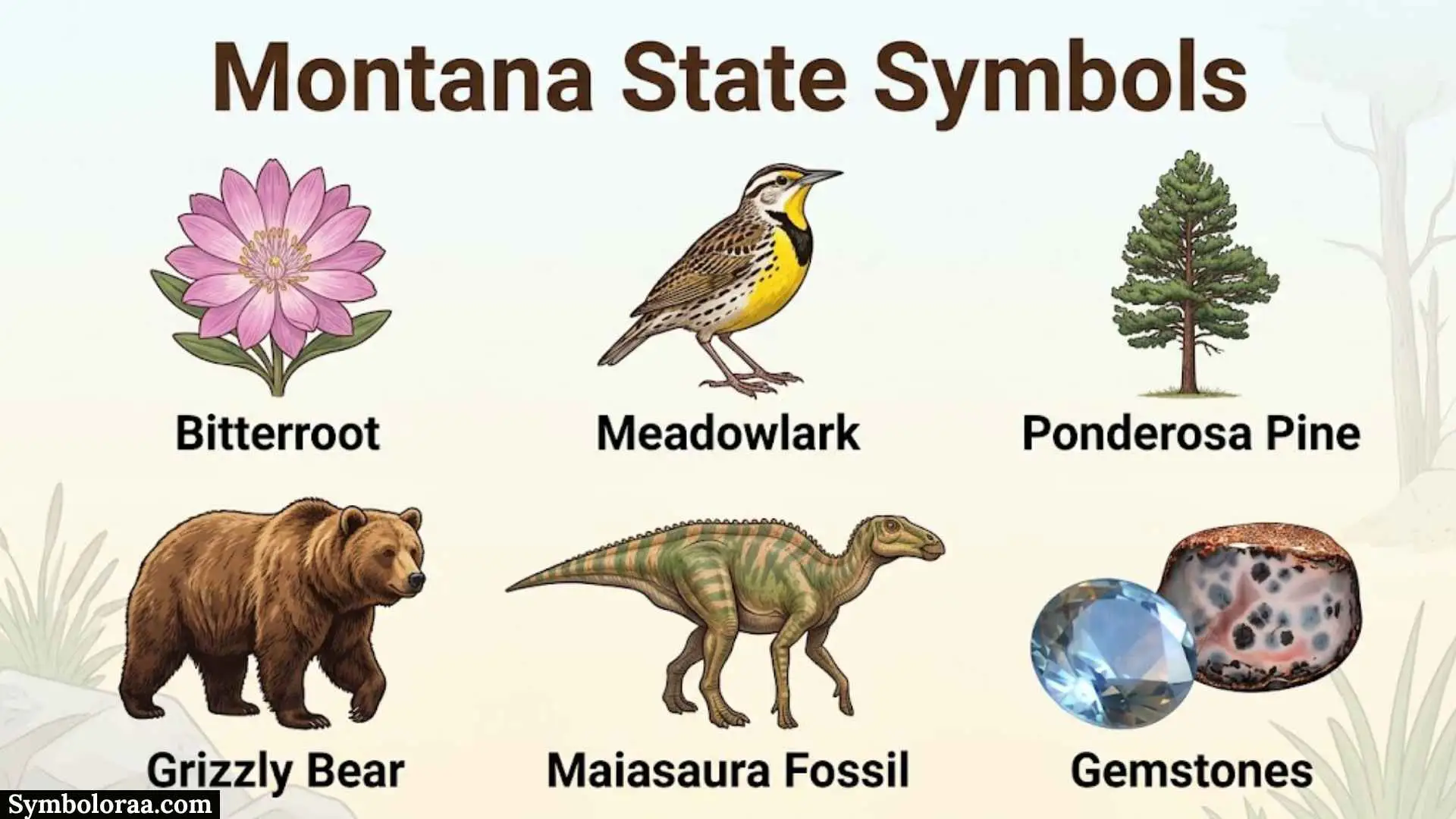
If you are looking for Montana state symbols, you will find much more than a list of a state flower, bird, animal, and tree. Montana’s official symbols tell stories about its landscapes, wildlife, agriculture, mining history, geology, paleontology, and civic life.
Montana has 15 official state symbols, according to the Montana Historical Society. The state seal was adopted in 1893, while Scobey soil became the most recently adopted symbol in 2015. These symbols include the state animal, bird, fish, flower, fossil, gemstones, grass, tree, songs, ballad, flag, seal, and other official designations.
Some symbols are especially interesting because Montana schoolchildren helped choose them. Others have connections to Indigenous history, mining, ranching, agriculture, or major scientific discoveries.
This guide explains the official Montana state symbols, what each one means, when it was adopted, and the historical reasons behind the selections.
Quick Answer: What Are Montana State Symbols?
Montana state symbols are officially recognized plants, animals, natural resources, geological materials, cultural items, and civic emblems that represent Montana’s history and identity.
The most commonly searched Montana symbols include:
- State flower: Bitterroot
- State bird: Western Meadowlark
- State animal: Grizzly Bear
- State fish: Blackspotted Cutthroat Trout
- State tree: Ponderosa Pine
- State butterfly: Mourning Cloak
- State fossil: Maiasaura
- State gemstones: Sapphire and Agate
- State grass: Bluebunch Wheatgrass
- State soil: Scobey Soil
- State motto: Oro y Plata
- State nickname: Treasure State
- State song: “Montana”
- State ballad: “Montana Melody”
- State seal and flag: Official emblems representing Montana’s landscape, resources, and history
The official state government identifies the Bitterroot, Western Meadowlark, Grizzly Bear, Blackspotted Cutthroat Trout, Sapphire and Agate, Scobey Soil, and “Oro y Plata” among Montana’s official symbols and designations.
Complete Montana State Symbols List
The following table provides a quick reference before exploring the history and meaning of each symbol.
| Montana Symbol | Official Symbol | Main Connection |
| State Flower | Bitterroot | Native plants and Indigenous history |
| State Bird | Western Meadowlark | Grasslands and prairie |
| State Animal | Grizzly Bear | Wildlife and wilderness |
| State Fish | Blackspotted Cutthroat Trout | Rivers, streams, and fishing |
| State Tree | Ponderosa Pine | Forests and timber |
| State Butterfly | Mourning Cloak | Native wildlife |
| State Fossil | Maiasaura | Paleontology |
| State Gemstones | Sapphire and Agate | Geology and mining |
| State Grass | Bluebunch Wheatgrass | Prairie and rangeland |
| State Soil | Scobey Soil | Agriculture |
| State Motto | Oro y Plata | Gold and silver |
| State Nickname | Treasure State | Mineral wealth |
| State Song | “Montana” | State identity and music |
| State Ballad | “Montana Melody” | Montana culture |
| State Seal | Montana State Seal | Agriculture, mining, water, and landscape |
| State Flag | Montana State Flag | State identity and official emblem |
Montana Historical Society describes the state as having fifteen official symbols and explains that these symbols can be used to understand different periods of Montana’s history.
Montana State Flower: Bitterroot
What Is Montana’s State Flower?
The bitterroot (Lewisia rediviva) is Montana’s official state flower. The legislature sanctioned it as the state flower in 1895, making it one of Montana’s earliest official symbols.
The bitterroot is a small flowering plant with attractive pink, rose, or whitish flowers. It is particularly associated with western Montana and the Bitterroot Valley.
The plant has significance beyond its appearance. The Montana Historical Society notes that the bitterroot was an important food source for the Salish and Pend d’Oreille peoples.
Why Was Bitterroot Chosen?
The campaign to make bitterroot Montana’s state flower was strongly associated with Mary Long Alderson, who advocated for its selection in the 1890s. The Montana Historical Society explains that Alderson also saw the campaign as an opportunity to teach women about political organization and voting.
This makes the bitterroot an especially interesting state symbol because its history connects botany, Indigenous food traditions, women’s civic participation, and Montana politics.
Montana State Bird: Western Meadowlark
What Is Montana’s State Bird?
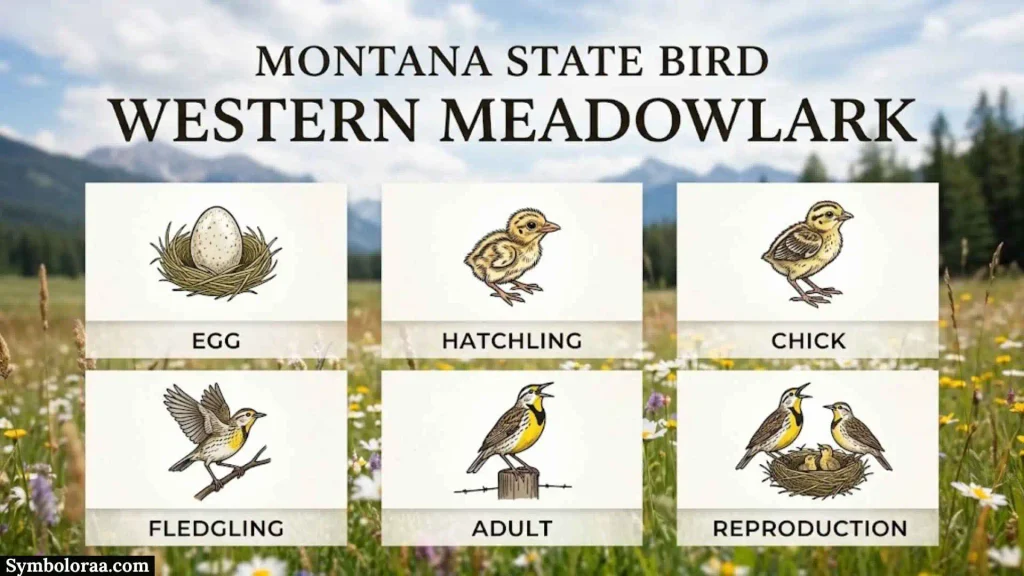
The western meadowlark is Montana’s official state bird.
It is a familiar grassland bird recognized by its yellow breast, dark V-shaped marking, and distinctive song. Its association with open prairie makes it a natural representation of Montana’s grassland environment.
How Was the Western Meadowlark Selected?
In 1930, Montana schoolchildren were asked which bird best represented the state. The meadowlark received overwhelming support, and the legislature officially approved it in 1931.
This is one of several examples showing that Montana’s state symbols were sometimes selected through public or educational participation rather than simply being chosen by legislators.
Montana State Animal: Grizzly Bear
What Is Montana’s State Animal?
The grizzly bear is Montana’s official state animal.
The grizzly is closely associated with Montana’s mountains, forests, and wild landscapes. It is also an important part of the state’s wildlife heritage.
How Did the Grizzly Become Montana’s State Animal?
The selection process began in 1982 as a civic education project involving Montana schoolchildren. Students nominated more than 74 animals, followed by primary and general elections.
The grizzly bear was officially named the state animal on April 7, 1983.
This history makes the grizzly a useful example of how a state symbol can also become a lesson in elections and civic participation.
Montana State Fish: Blackspotted Cutthroat Trout
What Is Montana’s State Fish?
Montana’s official state fish is the blackspotted cutthroat trout.
The fish represents Montana’s extensive freshwater environments and its long connection with fishing and outdoor recreation.
The Montana Historical Society records that the state fish designation was added by the 45th Legislature in 1977, following a campaign led by Norma B. Ashby.
Why Does the State Fish Matter?
Montana’s rivers, streams, lakes, and reservoirs support a wide variety of fish species. Montana Fish, Wildlife & Parks maintains extensive fisheries-management resources and information about fish species and aquatic habitats across the state.
The state fish therefore connects the symbolic side of Montana with a real part of the state’s outdoor economy and recreational culture.
Montana State Tree: Ponderosa Pine
What Is Montana’s State Tree?
The Ponderosa pine (Pinus ponderosa) is Montana’s official state tree.
It is a widespread western conifer that grows in forests, mountain foothills, dry slopes, and areas bordering grasslands.
When Was Ponderosa Pine Named the State Tree?
The story begins in 1908, when Helena schoolchildren held a referendum to determine which tree best represented Montana. The Ponderosa pine won over the Douglas fir, American larch, and cottonwood.
However, the legislature did not officially designate it until 1949.
Ponderosa pine also has an economic history. Its timber was used for products including mine supports, railroad ties, and buildings. Its forests also provide habitat for numerous Montana wildlife species.
Montana State Butterfly: Mourning Cloak
What Is Montana’s State Butterfly?
The mourning cloak butterfly is Montana’s official state butterfly.
Its dark wings and lighter-colored borders make it distinctive among Montana’s butterflies.
The mourning cloak became Montana’s state butterfly in 2001. It is another example of a natural species being used to represent the state’s biodiversity.
The symbol is also useful for understanding that Montana’s official natural symbols are not limited to large mammals and famous landscapes. Smaller organisms can represent the state’s ecological diversity as well.
Montana State Gemstones: Sapphire And Agate
What Are Montana’s Official Gemstones?
Montana has two official state gemstones: sapphire and agate.
They were officially designated in 1969.
This is an unusual feature because many states have a single designated gemstone, while Montana officially recognizes two.
Why Does Montana Have Two State Gemstones?
The two gemstones also have geographic significance.
Sapphires are strongly associated with western Montana, while Montana agates are especially associated with eastern parts of the state. The Montana Historical Society explains that selecting both represented different geographic regions of Montana.
Montana’s sapphire history is particularly notable. Montana FWP’s historical account describes the discovery of sapphires in Yogo Creek and the later importance of Yogo sapphires to the state’s gemstone history.
The two-gemstone designation therefore provides an example of how a state symbol can represent geology as well as regional diversity.
Montana State Fossil: Maiasaura
What Is Montana’s State Fossil?
Montana’s state fossil is Maiasaura, a duck-billed dinosaur.
Maiasaura is one of the most recognizable dinosaur discoveries connected with Montana and is especially important because of evidence concerning dinosaur nesting and parental behavior.
Why Is Maiasaura Important To Montana?
In 1978, fossils associated with a nesting colony of duck-billed dinosaurs were discovered west of Choteau. Paleontologists Jack Horner and Bob Makela later identified and named the species Maiasaura, meaning “good mother lizard.”
The discovery became scientifically important because the fossil evidence provided insight into dinosaur nesting and the raising of young.
Montana officially adopted its state fossil in 1985. The campaign even involved schoolchildren, who wrote letters, created educational materials, and encouraged legislators to support the designation.
Montana Department of Transportation also identifies Maiasaura as the state fossil in its geological interpretation resources.
Montana State Grass: Bluebunch Wheatgrass
What Is Montana’s State Grass?
Bluebunch wheatgrass is Montana’s official state grass.
It occurs widely across the state and is closely associated with Montana’s grasslands, rangelands, and dry landscapes.
The Montana Historical Society records that the 43rd Legislature designated bluebunch wheatgrass as the state grass in 1973.
Why Is Bluebunch Wheatgrass Significant?
Grasslands are an important part of Montana’s landscape and agricultural history. A native grass is therefore a particularly fitting symbol for a state where prairie, ranchland, and open country play major roles in its geography.
It also complements the western meadowlark, which is similarly associated with Montana’s open grassland environment.
Montana State Soil: Scobey Soil
What Is Montana’s State Soil?
Scobey Soil is Montana’s official state soil.
It was adopted in 2015, making it the newest state symbol identified in the Montana Historical Society’s state-symbols educational material.
Why Was Scobey Soil Chosen?
Scobey soil is associated with north-central Montana’s agricultural region. The Montana Historical Society notes its importance to the fertile Golden Triangle, an area between Havre, Conrad, and Great Falls.
The state soil demonstrates that Montana’s official symbols are not only about visually impressive wildlife or scenery. Soil can represent something less obvious but essential: agricultural productivity and the physical foundation of farming.
Montana State Motto: “Oro Y Plata”
What Does “Oro Y Plata” Mean?
Montana’s official motto is “Oro y Plata,” which translates from Spanish as “Gold and Silver.”
The motto reflects Montana’s historic mineral wealth and is closely connected to the state’s mining history.
The words appear on the Montana state seal, which was officially adopted in 1893.
Why Does Montana’s Motto Mention Gold And Silver?
Mining played a major role in Montana’s development. Gold, silver, and copper helped shape the state’s economy and its public identity.
This history also explains the nickname “Treasure State.” Montana Historical Society explains that the nickname gained wide appeal in 1895 because of Montana’s reputation for producing metallic resources.
Montana State Nickname: Treasure State
Why Is Montana Called The Treasure State?
Montana is commonly known as the Treasure State.
The nickname became widely used in 1895 and was connected to Montana’s production of gold, silver, copper, and other mineral resources.
The nickname is closely related to the motto “Oro y Plata,” but the two should not be treated as exactly the same thing.
“Oro y Plata” is the official state motto, while “Treasure State” is the state’s established nickname.
Another phrase commonly associated with Montana is “Big Sky Country.” Montana Historical Society notes that the tourism department began using that phrase in the 1960s, reflecting the growing importance of tourism and the state’s expansive landscapes.
Montana State Seal And What Its Symbols Mean
What Is Shown On The Montana State Seal?
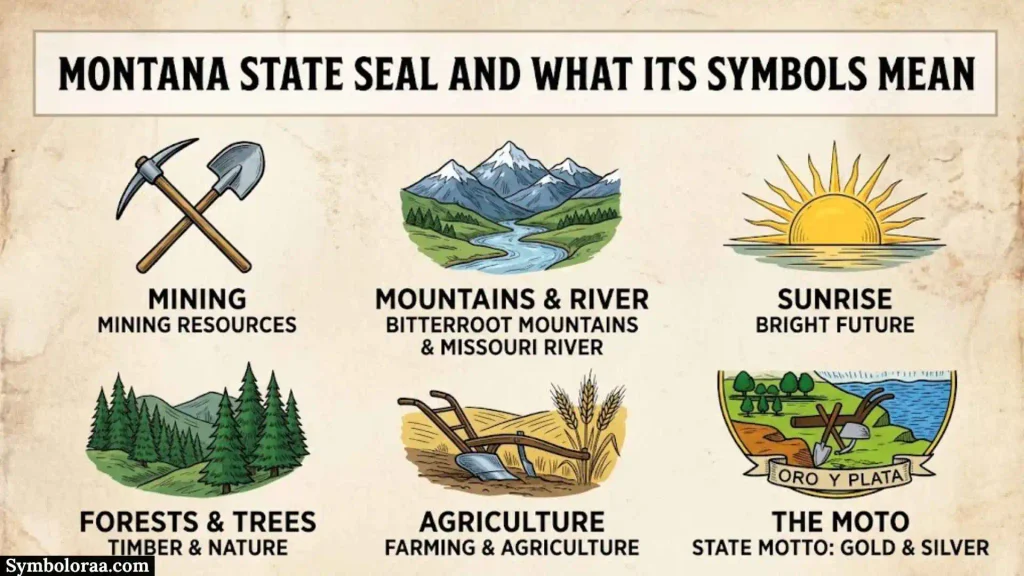
Montana’s state seal contains imagery connected to the state’s natural resources and economic history.
The seal includes mountains, the Missouri River and Great Falls, as well as agricultural and mining tools.
The imagery includes the plow, pick, and shovel, which help represent agriculture and mineral extraction. Great Falls and the river represent Montana’s water resources and landscape.
When Was The Montana State Seal Adopted?
Montana adopted its state seal in 1893, four years after statehood.
The Montana Legislature’s historical guide identifies the 1893 adoption of the seal and the motto “Oro y Plata” as Montana’s first state symbol.
This is important because the seal predates many of the state’s better-known natural symbols.
Montana State Flag And Its Meaning
What Does The Montana Flag Look Like?
The Montana state flag features a blue field with the Montana state seal and the word “Montana” displayed above the seal.
Because the seal itself contains mountains, water, agriculture, mining tools, and the state motto, the flag combines several major themes of Montana’s history into one design.
The Montana Historical Society directs readers to the Montana Secretary of State for detailed information about the official state flag and seal.
What Does The Flag Represent?
The flag can be understood as a visual summary of Montana’s early state identity.
Its imagery emphasizes:
- Mountains and natural scenery
- Water resources
- Agriculture
- Mining
- Economic development
- The state’s “Gold and Silver” motto
The Montana Historical Society explains that the seal and flag reflect ideas about prosperity, growth, mineral wealth, agriculture, and natural resources during the period in which they were created.
Montana State Songs And Musical Symbols
What Is Montana’s State Song?
Montana’s official state song is “Montana.”
The lyrics were written by Charles C. Cohan, with music by Joseph E. Howard. The song was written in 1910 and officially became the state song on February 20, 1945.
What Is Montana’s State Ballad?
“Montana Melody” is Montana’s official state ballad.
It was written by LeGrande and Carleen Harvey and was designated the state ballad in 1983. The legislation originally involved changing the state’s song designation, but a compromise resulted in “Montana Melody” becoming the official state ballad.
Does Montana Have A State Lullaby?
Yes. Montana also has an official state lullaby, “Montana Lullaby.”
This is important when researching Montana symbols because not every official designation is a plant, animal, geological object, or emblem. Montana’s symbolic system also includes cultural and musical traditions.
Why Did Montana Create So Many State Symbols?
State Symbols Reflect Montana’s History
The symbols were adopted during different periods, so they do not all represent the same idea of Montana.
The state seal and motto emphasize agriculture, mining, water, and economic development. Later symbols highlight wildlife, ecology, paleontology, geology, and agriculture.
This makes the complete list more useful than simply memorizing individual symbols.
Schoolchildren Played An Important Role
One of the most interesting features of Montana’s symbols is the participation of schoolchildren.
Children helped select the western meadowlark, participated in the selection of the grizzly bear, and played roles in campaigns involving other symbols.
The Montana Historical Society explains that state-symbol projects have also been used to teach civics and demonstrate how government decisions are made.
What Montana State Symbols Reveal About The State
Montana’s symbols can be grouped into several broader themes.
Wildlife And Biodiversity
The grizzly bear, western meadowlark, blackspotted cutthroat trout, and mourning cloak represent Montana’s animal life.
Together, they cover very different environments, from forests and mountains to grasslands and freshwater ecosystems.
Agriculture And Grasslands
Bluebunch wheatgrass and Scobey soil point toward Montana’s agricultural landscape.
The state seal also includes a plow, showing how farming was considered central to Montana’s development.
Mining And Natural Resources
Sapphire, agate, “Oro y Plata,” and the Treasure State nickname connect Montana’s identity to geology and mineral resources.
Paleontology
Maiasaura represents Montana’s international importance for dinosaur discoveries.
Montana Department of Transportation’s geological resources continue to interpret dinosaur and geological history at sites around the state.
Forests And Mountain Landscapes
The Ponderosa pine and grizzly bear help represent Montana’s forested and mountainous regions.
Together, these symbols show that Montana’s identity is not based on one landscape alone.
Official Symbols Vs. Montana Nicknames: What Is The Difference?
A common mistake is to treat every popular phrase associated with Montana as an official state symbol.
For example:
- Bitterroot = official state flower
- Western Meadowlark = official state bird
- Grizzly Bear = official state animal
- Oro y Plata = official state motto
- Treasure State = state nickname
- Big Sky Country = widely used Montana phrase, particularly associated with tourism
Montana Historical Society lists nicknames separately from the formal symbol categories.
This distinction matters when writing a school assignment, preparing a quiz, or creating educational material about Montana.
A Simple Montana State Symbols Decision Guide
If you only need one answer, use the following guide:
Looking for Montana’s flower?
→ Bitterroot
Looking for Montana’s bird?
→ Western Meadowlark
Looking for Montana’s animal?
→ Grizzly Bear
Looking for Montana’s fish?
→ Blackspotted Cutthroat Trout
Looking for Montana’s tree?
→ Ponderosa Pine
Looking for Montana’s butterfly?
→ Mourning Cloak
Looking for Montana’s fossil?
→ Maiasaura
Looking for Montana’s gemstones?
→ Sapphire and Agate
Looking for Montana’s grass?
→ Bluebunch Wheatgrass
Looking for Montana’s soil?
→ Scobey Soil
Looking for Montana’s motto?
→ “Oro y Plata”
Looking for Montana’s nickname?
→ Treasure State
Looking for Montana’s state song?
→ “Montana”
This format is particularly useful for students who need to identify the correct symbol quickly.
Common Misconceptions About Montana State Symbols
Is The Grizzly Bear Montana’s State Bird?
No. The grizzly bear is the state animal, while the western meadowlark is the state bird.
Is The Bitterroot A Montana Nickname?
No. The bitterroot is Montana’s state flower.
Does Montana Have Only One State Gemstone?
No. Montana officially recognizes both sapphire and agate as state gemstones.
Is Big Sky Country The Official State Motto?
No. Montana’s official motto is “Oro y Plata,” meaning “Gold and Silver.” “Big Sky Country” is a well-known phrase associated with Montana but should not be confused with the official motto.
Is Montana’s State Fossil A Tyrannosaurus Rex?
No. Montana’s official state fossil is Maiasaura.
T. rex is strongly associated with Montana’s dinosaur discoveries, but it is not the official state fossil. Maiasaura was designated in 1985.
How To Use Montana State Symbols In School Projects
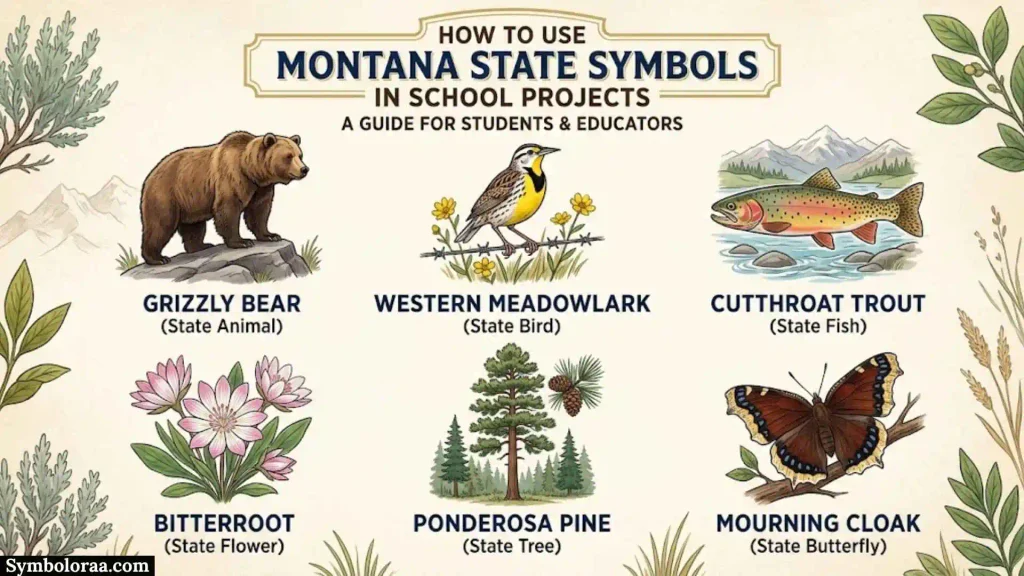
Montana’s symbols work particularly well for educational projects because each one can be connected to a larger topic.
For A Science Project
Choose Maiasaura, the Ponderosa pine, bitterroot, or mourning cloak and explain its biology, habitat, and importance to Montana.
For A History Project
Study “Oro y Plata,” the state seal, the Treasure State nickname, or Montana’s gemstones to explore mining and economic development.
For A Civics Project
Research how schoolchildren participated in selecting symbols such as the western meadowlark and grizzly bear.
For A Geography Project
Compare symbols associated with different regions. For example, the Montana Historical Society notes the geographic distinction between western Montana’s sapphires and eastern Montana’s agates.
Why Montana State Symbols Are Useful For Understanding Montana
The real value of Montana’s state symbols is that they can be studied as a group rather than as isolated facts.
The bitterroot points toward Indigenous food traditions and western Montana. The meadowlark represents prairie environments. The grizzly reflects wildlife. The Ponderosa pine represents forests and timber. Scobey soil connects the symbols to agriculture, while sapphire and agate highlight Montana’s geology.
Maiasaura adds an entirely different dimension by representing the state’s paleontological importance.
Taken together, these symbols create a picture of Montana shaped by land, wildlife, natural resources, agriculture, science, history, and civic participation.
Frequently Asked Questions About Montana State Symbols
What Is Montana’s Most Famous State Symbol?
There is no official ranking of Montana’s symbols by popularity. However, symbols such as the grizzly bear, bitterroot, western meadowlark, Ponderosa pine, and state flag are among the most recognizable official representations of Montana.
What Is Montana’s State Flower And Why Was It Chosen?
The bitterroot is Montana’s state flower. It was sanctioned by the legislature in 1895, and Mary Long Alderson played an important role in the campaign for its selection. The plant also has historical significance for the Salish and Pend d’Oreille peoples.
What Is Montana’s State Animal?
The grizzly bear is Montana’s official state animal. It was selected through a statewide process involving schoolchildren and officially designated in 1983.
What Is Montana’s State Bird?
Montana’s state bird is the western meadowlark. Montana schoolchildren selected the bird in 1930, and the legislature approved the choice in 1931.
What Is Montana’s State Tree?
The Ponderosa pine is Montana’s state tree. Helena schoolchildren selected it in a 1908 referendum, while the legislature made the designation official in 1949.
What Is Montana’s State Fossil?
Montana’s state fossil is Maiasaura, a duck-billed dinosaur. It became the official state fossil in 1985 following a campaign that included Montana schoolchildren.
What Are Montana’s State Gemstones?
Montana officially recognizes sapphire and agate as its state gemstones. They were designated in 1969.
What Is Montana’s State Motto?
Montana’s official motto is “Oro y Plata,” which means “Gold and Silver.” The motto reflects the state’s historic connection with mineral resources.
What Is Montana’s State Nickname?
Montana’s established nickname is “Treasure State.” It became widely used in the late 19th century because of Montana’s mineral wealth.
Does Montana Have An Official State Soil?
Yes. Scobey Soil is Montana’s official state soil. It was adopted in 2015 and is associated with an important agricultural area of north-central Montana.
Why Does Montana Have So Many Natural State Symbols?
Montana’s official symbols were adopted at different times and for different reasons. Some reflect natural resources, others represent wildlife or agriculture, while several were selected through educational and civic campaigns. The Montana Historical Society describes state symbols as useful evidence of how Montanans have viewed themselves and their state across different historical periods.
Key Takeaways About Montana State Symbols
The most important facts to remember are:
- Bitterroot is Montana’s state flower.
- Western Meadowlark is the state bird.
- Grizzly Bear is the state animal.
- Blackspotted Cutthroat Trout is the state fish.
- Ponderosa Pine is the state tree.
- Mourning Cloak is the state butterfly.
- Maiasaura is the state fossil.
- Sapphire and Agate are Montana’s state gemstones.
- Bluebunch Wheatgrass is the state grass.
- Scobey Soil is the state soil.
- “Oro y Plata” is the official state motto.
- Treasure State is Montana’s established nickname.
- “Montana” is the official state song.
- Montana’s seal and flag combine imagery connected to its landscape, agriculture, water, and mineral resources.
- Montana’s symbols collectively reflect wildlife, geology, agriculture, paleontology, natural resources, culture, and civic history.
References
- Montana Historical Society — Facts and State Symbols: Official information about Montana’s symbols, nicknames, motto, adoption dates, and historical background.
- Montana Historical Society — Montana State Symbols Educational Guide: Historical context explaining why symbols were adopted and how they relate to Montana’s geography, culture, economy, and civic history.
- State of Montana — Montana Government: Official state information listing major state symbols and designations.
- Montana Fish, Wildlife & Parks: Official fisheries information and resources concerning Montana’s fish and aquatic ecosystems.
- Montana Department of Transportation — Geologic Road Signs: Official information about Montana’s geological and paleontological heritage, including Maiasaura.
- Montana Legislature — Legislative History: Historical information about the adoption of the state seal, motto, and early state symbols.
Conclusion
Montana state symbols provide a compact way to understand the state’s natural environment, history, economy, and culture. The bitterroot connects the state’s official identity with plant life and Indigenous history, while the western meadowlark, grizzly bear, and blackspotted cutthroat trout represent different parts of Montana’s wildlife heritage.
The Ponderosa pine, bluebunch wheatgrass, and Scobey soil highlight forests, grasslands, and agriculture. Sapphire, agate, and the motto “Oro y Plata” point to Montana’s geological and mining history. Meanwhile, Maiasaura represents the state’s important role in paleontology.
Perhaps the most interesting feature is how many symbols were connected to civic education. Montana schoolchildren participated in selecting several official symbols, demonstrating that these designations can teach more than state trivia. They can also show how citizens participate in government and how different generations have chosen to represent their home.
Understanding the symbols as a complete collection therefore gives readers a deeper picture of Montana: a state shaped by mountains, prairie, forests, wildlife, agriculture, mineral resources, fossils, and the people who have lived there.

I’m Madison Reed, a contemporary American author who writes about love, family, friendship, and second chances. I’m fascinated by the choices that shape our lives and the moments that change us forever. My goal is to create honest, emotional stories with characters readers can connect with long after finishing each book.
Three Books:
When We Find Our Way
The Things We Never Said
Summer in September
 Ethan Brooks
 Jackson Miller