If you searched for Alaska symbols, you’re probably looking for more than a simple list of state emblems. You may want to know which symbols are officially recognized, why they were chosen, what they represent, and how they connect to Alaska’s culture, history, wildlife, geography, and Indigenous heritage.
Alaska’s symbols are different from those of many other U.S. states. Rather than focusing primarily on political history, Alaska’s official emblems highlight vast wilderness, Arctic ecosystems, natural resources, exploration, transportation, and cultural traditions. The state’s symbols also reflect the influence of Alaska Native communities and one of the most unique environments on Earth.
In this comprehensive guide, you’ll learn about Alaska’s official symbols, their historical origins, their cultural significance, and the stories behind them. You’ll also discover the difference between official state symbols and the images most people commonly associate with Alaska, such as glaciers, the Northern Lights, Denali, and grizzly bears.
What you’ll learn:
- Alaska’s official state symbols
- The history behind each symbol
- The meaning of the state flag and seal
- Alaska’s wildlife and natural symbols
- The role of Indigenous culture
- Common misconceptions
- Practical examples
- Expert insights
- Frequently asked questions
Quick Answer: What Are Alaska’s Official Symbols?
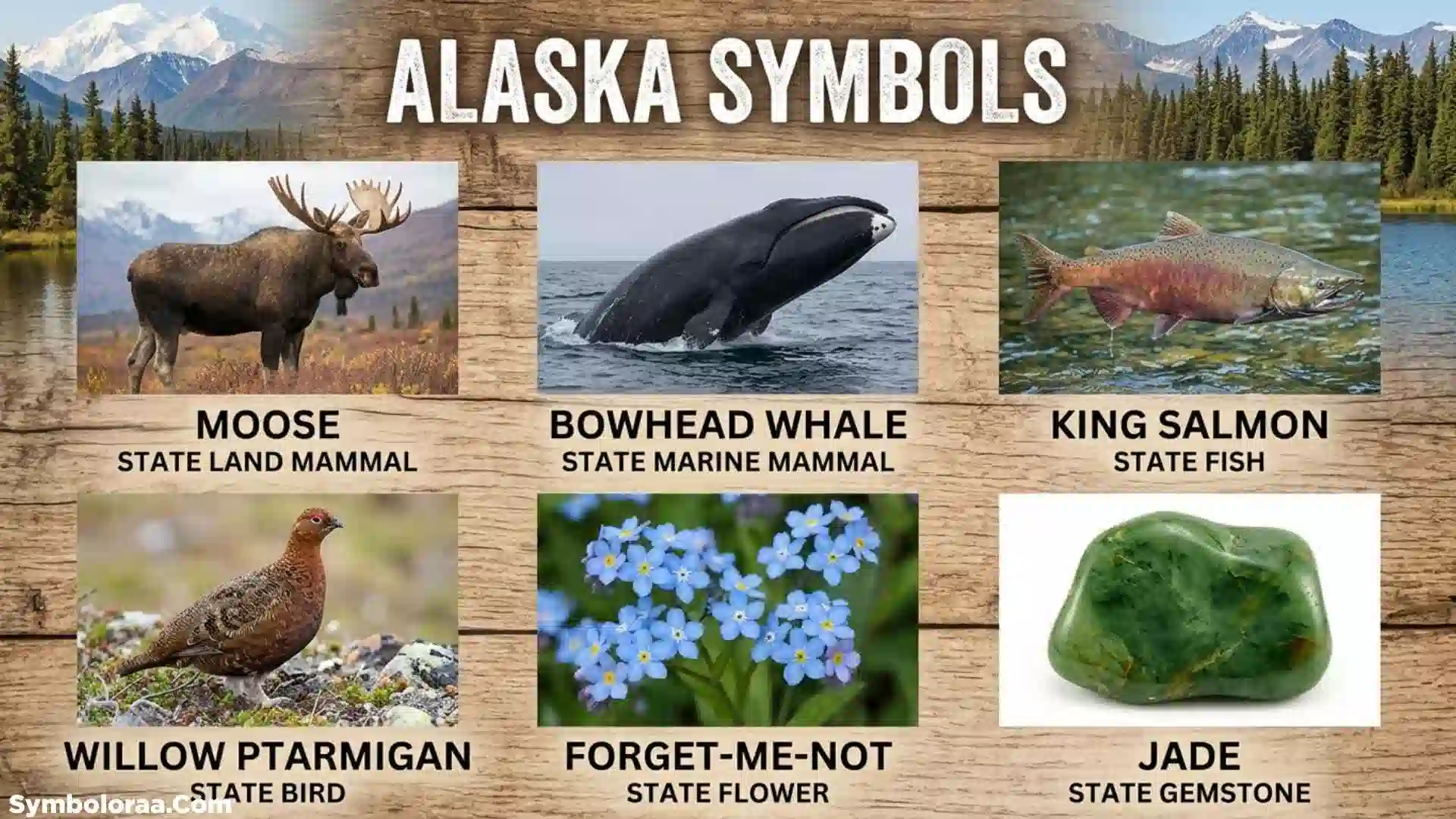
Alaska has dozens of officially recognized state symbols. These include the state flag, seal, flower, tree, bird, fish, mammals, gemstone, mineral, fossil, song, sport, dog, and insect.
The most recognizable Alaska symbols include:
| Official Symbol | Designation |
| State Flag | Big Dipper and North Star |
| State Flower | Forget-me-not |
| State Bird | Willow ptarmigan |
| State Tree | Sitka spruce |
| State Fish | King salmon |
| State Land Mammal | Moose |
| State Marine Mammal | Bowhead whale |
| State Gem | Jade |
| State Mineral | Gold |
| State Fossil | Woolly mammoth |
| State Sport | Dog mushing |
| State Dog | Alaskan malamute |
| State Insect | Four-spot skimmer dragonfly |
| State Motto | North to the Future |
These symbols represent Alaska’s environment, history, economy, and cultural identity.
Key takeaway: Alaska’s official symbols tell the story of a state shaped by wilderness, resilience, and exploration.
Understanding the Difference Between Official Symbols and Popular Alaska Icons
Many people mistakenly assume that every famous image associated with Alaska is an official state symbol.
That isn’t always true.
Official Alaska Symbols
Official symbols are established through legislation and recognized by the state government.
Examples include:
- The forget-me-not
- The moose
- The king salmon
- The Sitka spruce
- The bowhead whale
Popular Symbols Associated With Alaska
These symbols are strongly connected to Alaska but are not necessarily official state emblems.
Examples include:
- Denali
- The Northern Lights
- Glaciers
- Polar bears
- Icebergs
- Snow-covered mountains
Understanding this distinction helps researchers, students, and educators avoid common mistakes.
Alaska’s State Flag: Eight Stars That Define an Entire State
The Remarkable Story of Benny Benson
One of the most inspiring stories behind Alaska’s symbols involves a 13-year-old student named Benny Benson.
In 1926, Alaska organized a contest to create a territorial flag. Students from across the territory submitted designs.
Benson’s design won.
His creation eventually became Alaska’s official flag.
This story continues to inspire students because it demonstrates how a young person permanently shaped Alaska’s identity.
What the Alaska Flag Represents
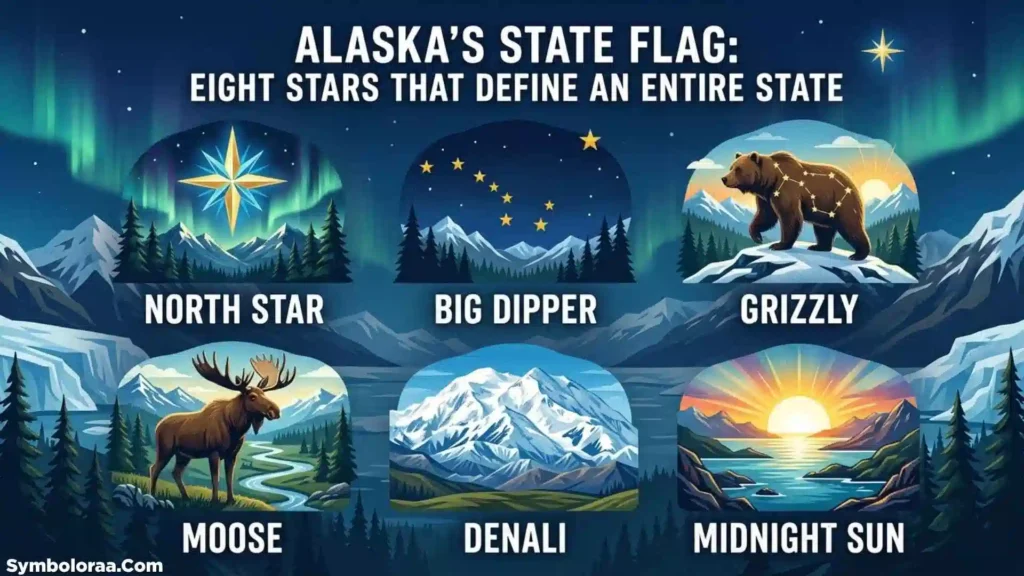
The flag contains eight gold stars on a blue background.
Each element carries symbolic meaning.
| Flag Element | Symbolic Meaning |
| Seven stars | The Big Dipper |
| Eighth star | The North Star |
| Blue background | The sky, sea, lakes, and wildflowers |
| Big Dipper | Strength |
| North Star | Alaska’s future |
Unlike many state flags that include seals and official emblems, Alaska’s design is simple and immediately recognizable.
Why the Flag Is an Effective Symbol
From a design perspective, Alaska’s flag follows several important principles:
- Simplicity
- Strong symbolism
- Easy recognition
- Memorable imagery
Graphic designers often point to Alaska’s flag as one of the strongest examples of symbolic communication in the United States.
Alaska’s State Seal: A Visual History Lesson
The Historical Background of the State Seal
Alaska adopted its territorial seal in 1910.
When Alaska became the 49th U.S. state in 1959, the seal remained an official symbol.
Decoding the Symbols Within the Seal
The state seal contains multiple images.
Each one represents an important part of Alaska’s economy and geography.
| Seal Symbol | Meaning |
| Northern Lights | Natural beauty |
| Mountains | Geography |
| Trees | Forest resources |
| Smelter | Mining |
| Railroad | Transportation |
| Ship | Maritime trade |
| Fish | Commercial fisheries |
| Farmer | Agriculture |
Unlike the state flag, which focuses on identity, the state seal tells a story about economic development.
Alaska’s Natural Symbols and What They Represent
The Forget-Me-Not: Alaska’s State Flower
The forget-me-not became Alaska’s official flower in 1917.
Although it’s a small flower, it survives in challenging environments.
The flower symbolizes:
- Loyalty
- Remembrance
- Endurance
Its resilience reflects the spirit of Alaska itself.
The Sitka Spruce: Alaska’s State Tree
The Sitka spruce became the official state tree in 1962.
This evergreen species can reach impressive heights.
Historically, the tree supported:
- Construction
- Shipbuilding
- Forest industries
Today, the Sitka spruce continues to symbolize strength and longevity.
King Salmon: Alaska’s State Fish
King salmon, also called Chinook salmon, became Alaska’s official fish in 1962.
Salmon are more than a food source.
They influence:
- Tourism
- Commercial fishing
- Indigenous traditions
- Local economies
King salmon symbolize abundance and survival.
Alaska’s Wildlife Symbols: Animals That Define the Last Frontier
The Willow Ptarmigan
The willow ptarmigan became Alaska’s state bird in 1955.
Its most fascinating characteristic is seasonal adaptation.
The bird changes color throughout the year:
- Brown during warmer months
- White during winter
This adaptation helps it survive in harsh Arctic conditions.
The Moose
The moose became Alaska’s official land mammal in 1998.
The animal represents:
- Independence
- Wilderness
- Physical strength
Visitors frequently identify moose as the animal most strongly associated with Alaska.
The Bowhead Whale
The bowhead whale became Alaska’s state marine mammal in 1983.
The whale symbolizes:
- Arctic ecosystems
- Cultural traditions
- Marine biodiversity
For many Indigenous communities, the bowhead whale carries historical and cultural importance.
Geological Symbols: Gold, Jade, and the Woolly Mammoth
Gold and the Legacy of the Gold Rush
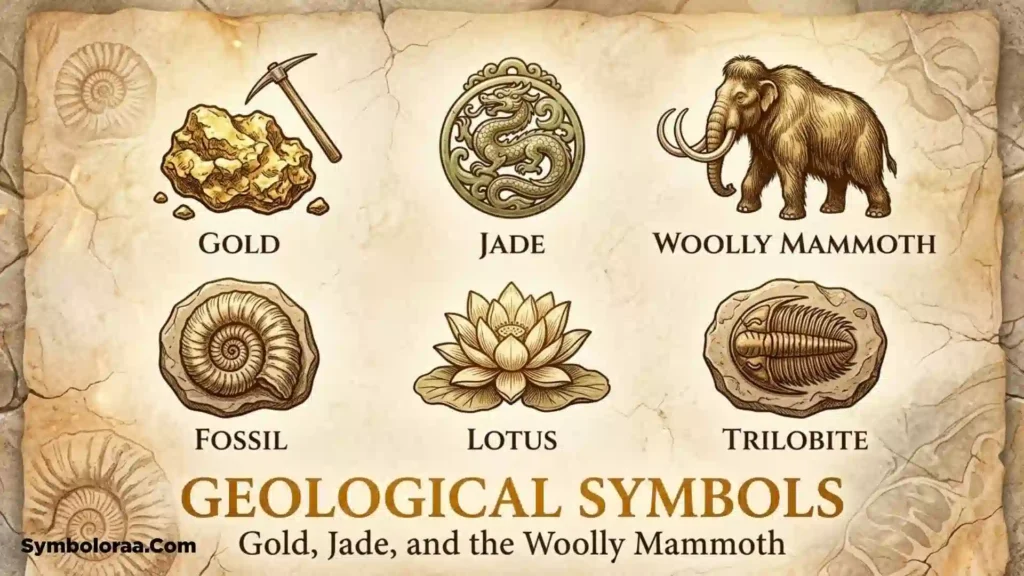
Gold became Alaska’s official mineral in 1968.
The Gold Rush transformed Alaska.
It influenced:
- Migration
- Settlement
- Transportation
- Economic development
Without gold discoveries, Alaska’s history would look very different.
Jade: Alaska’s State Gem
Alaska adopted jade as its official gemstone in 1968.
Large deposits exist in several regions.
Jade symbolizes:
- Beauty
- Durability
- Natural wealth
The Woolly Mammoth
The woolly mammoth became Alaska’s state fossil in 1986.
This symbol connects modern Alaska with its prehistoric past.
The fossil reminds us that Alaska’s story extends far beyond human history.
Cultural Symbols That Reflect Alaska’s Identity
Dog Mushing: The Official State Sport
Dog mushing became Alaska’s official sport in 1972.
Before airplanes and highways, sled dogs were essential for transportation.
Dog mushing represents:
- Survival
- Teamwork
- Endurance
The tradition remains alive through events such as long-distance sled races.
The Alaskan Malamute
The Alaskan malamute became the official state dog in 2010.
The breed played an important role in transportation across snowy terrain.
The malamute symbolizes:
- Loyalty
- Hard work
- Adaptability
Alaska’s Official State Song
“Alaska’s Flag” became the official state song in 1955.
The song celebrates:
- The state flag
- Alaska’s landscape
- The northern sky
The song helps preserve historical and cultural traditions.
Alaska Native Heritage and State Symbolism
Alaska Native cultures have influenced many aspects of the state’s identity.
It’s important to recognize that Alaska Native communities are diverse.
Major cultural groups include:
- Inupiat
- Yup’ik
- Aleut
- Tlingit
- Haida
- Athabascan
Many official symbols reflect relationships between people and the natural environment.
Examples include:
- Marine mammals
- Salmon
- Traditional transportation
- Wildlife
Understanding Indigenous perspectives provides a more complete understanding of Alaska’s symbolic landscape.
How Alaska Symbols Compare With Symbols From Other States
| Category | Alaska | Many Other States |
| Flag design | Simple stars | Complex seals |
| Wildlife emphasis | Extremely high | Moderate |
| Arctic influence | Significant | Minimal |
| Marine symbolism | Strong | Limited |
| Transportation symbolism | Dog mushing | Traditional sports |
This comparison explains why Alaska’s symbols feel unique.
They reflect geography unlike that of any other state.
Common Mistakes People Make When Learning About Alaska Symbols
Assuming Every Famous Landmark Is an Official Symbol
Denali is closely associated with Alaska.
However, association doesn’t automatically create official recognition.
Always verify whether a symbol is legally designated.
Ignoring Historical Context
Symbols don’t exist in isolation.
Understanding history explains why certain symbols were chosen.
Overlooking Indigenous Contributions
Many discussions focus exclusively on government decisions.
A complete understanding requires recognizing Alaska Native traditions.
Expert Tips for Students, Travelers, and Researchers
For Students
Start with the state flag.
It provides the easiest introduction to Alaska’s symbolism.
For Travelers
Look beyond tourist attractions.
Museums and historical sites often provide valuable information about state symbols.
For Researchers
Use government publications whenever possible.
Primary sources provide the most reliable information.
A Simple Decision Guide for Choosing Which Alaska Symbols to Study
Are you interested in history?
↓
Study the flag and state seal.
Are you interested in wildlife?
↓
Focus on the moose, whale, salmon, and ptarmigan.
Are you interested in culture?
↓
Learn about dog mushing and Alaska Native traditions.
Are you interested in natural resources?
↓
Explore gold, jade, and the woolly mammoth.
Practical Checklist for Understanding Alaska Symbols
- Identify whether the symbol is officially recognized.
- Learn its historical background.
- Understand its cultural significance.
- Examine its connection to Alaska’s environment.
- Compare it with similar symbols.
- Review government sources.
Following this checklist will help you interpret Alaska’s symbols more accurately.
Frequently Asked Questions
What is the most recognizable Alaska symbol?
The state flag is Alaska’s most recognizable symbol because of its simple design and powerful imagery.
Who designed Alaska’s state flag?
Benny Benson, a 13-year-old student, created the winning design in 1926.
Why is the North Star important to Alaska?
The North Star represents Alaska’s future and reflects the state’s northern location.
What is Alaska’s official flower?
The forget-me-not is Alaska’s official flower.
Why is the moose an Alaska symbol?
The moose represents wilderness, independence, and Alaska’s natural environment.
Is Denali an official Alaska symbol?
No.
Although Denali is one of Alaska’s most famous landmarks, it isn’t one of the state’s officially designated symbols.
Why is dog mushing Alaska’s official sport?
Dog mushing played a critical role in transportation before modern infrastructure developed across Alaska.
Conclusion
Alaska’s symbols are much more than government designations. They preserve stories about survival, exploration, wildlife, culture, and the people who shaped the state’s history.
The Big Dipper, the forget-me-not, the moose, the king salmon, and the bowhead whale each represent a different chapter in Alaska’s identity. Together, they create a visual language that explains why Alaska remains unlike any other place in the United States.
If you’re a student, traveler, researcher, or simply curious about the Last Frontier, understanding Alaska’s symbols offers a deeper appreciation of the state’s remarkable heritage.

I’m Ethan Brooks, an American writer passionate about stories that explore modern life, relationships, ambition, and personal growth. I love creating characters who feel real and face challenges readers can recognize. Through my writing, I hope to entertain, inspire, and encourage readers to see everyday experiences from a different perspective.
Three Books:
The City Between Us
After the Last Goodbye
A Different Tomorrow
 Jackson Miller
 Madison Reed