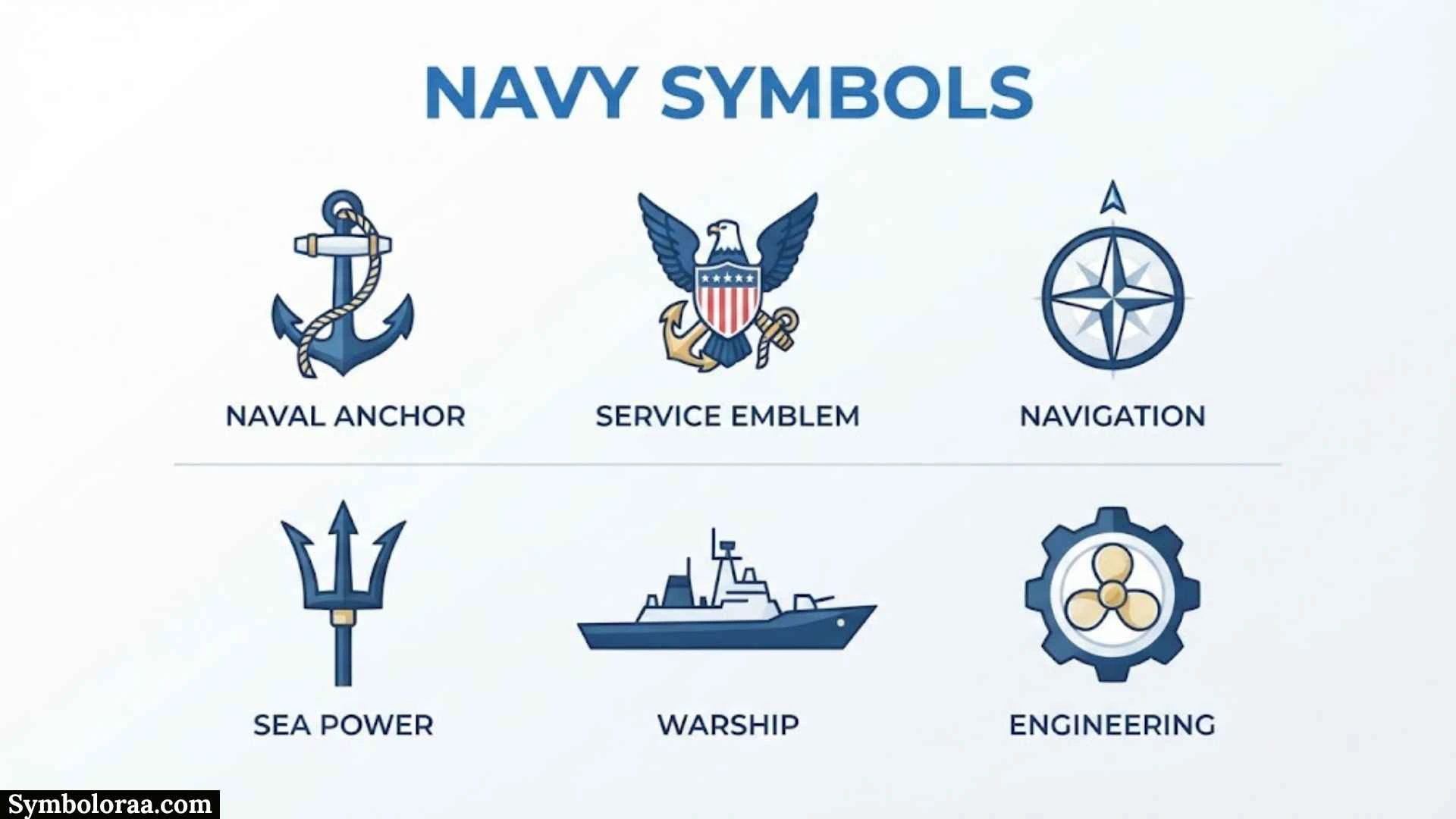
Navy symbols are visual signs used to identify naval organizations, ranks, ships, units, specialties, flags, and maritime traditions. They can appear on uniforms, flags, ship badges, aircraft, medals, documents, buildings, and official emblems.
The anchor is probably the most recognizable naval symbol, but navy symbolism goes much further. Stars, eagles, shields, swords, crowns, ropes, ships, waves, and other devices can communicate different information depending on the country, organization, historical period, and context.
This guide explains the meaning of common navy symbols, the difference between naval insignia and general maritime symbols, how rank symbols work, how naval flags and badges are used, and how to identify an unfamiliar symbol without assuming that every anchor or star has the same meaning.
Quick Answer:
Navy symbols are visual identifiers associated with naval service. They can represent maritime identity, rank, authority, military specialties, ships, units, national identity, or naval heritage. Their exact meaning depends on the navy and the context in which the symbol appears.
What Are Navy Symbols?
Navy symbols are official or traditional visual elements connected with naval organizations and maritime military service. They are sometimes called naval symbols, naval insignia, naval emblems, navy badges, maritime insignia, or naval heraldry, although these terms are not always interchangeable.
A symbol may have a practical purpose, such as identifying an officer’s rank, or a ceremonial purpose, such as representing a navy at an official event.
Common forms include:
- Rank insignia
- Rating badges
- Unit badges
- Ship badges
- Naval flags
- Jacks and ensigns
- Command pennants
- Cap and collar devices
- Medals and decorations
- Aircraft markings
- Official seals and emblems
The important point is that “navy symbols” is a broad category rather than one standardized international symbol system.
Why Navy Symbols Matter
Naval organizations operate in environments where quick recognition can be important. A person may need to identify a rank, unit, vessel, or national affiliation without reading a long description.
Symbols provide that information visually.
For example, the U.S. Navy’s current uniform regulations divide insignia into categories such as officer rank insignia, enlisted rate and rating insignia, service stripes, and headgear insignia.
This means a symbol on a naval uniform should not automatically be interpreted as decoration. It may communicate an individual’s official position, specialty, qualification, or service status.
Navy Symbols vs. Maritime Symbols
Navy symbols and maritime symbols overlap, but they are not identical.
| Feature | Navy Symbols | Maritime Symbols |
| Main purpose | Naval identity and military communication | General identification of sea-related activities |
| Typical users | Naval forces and military organizations | Ships, ports, sailors, shipping organizations, maritime businesses |
| Examples | Rank insignia, naval badges, fleet emblems | Anchors, waves, navigation symbols, ship imagery |
| Context | Military and naval service | Broader maritime environment |
| Meaning | Often officially defined | Can be traditional, commercial, decorative, or technical |
An anchor can therefore be both a navy symbol and a general maritime symbol.
Common Navy Symbols and Their Meanings
Several visual elements appear frequently in naval insignia. However, their meaning should be treated as context-dependent rather than universal.
| Symbol | Common Association | Important Context |
| ⚓ Anchor | Naval service, ships, stability | May also be a general maritime symbol |
| ⭐ Star | Rank, distinction, authority | Meaning varies by navy and insignia |
| 🦅 Eagle | Leadership, national identity, authority | Not exclusively naval |
| ⚔ Swords | Military service and combat | Often combined with other devices |
| 🛡 Shield | Protection and defense | Frequently used in organizational emblems |
| 🔱 Trident | Sea power and maritime heritage | Often influenced by classical symbolism |
| 🌊 Waves | Sea and maritime environment | Common in logos and emblems |
| 🚢 Ship | Naval or maritime activity | May identify a particular vessel or unit |
| 🪢 Rope | Maritime tradition | Frequently used around badges and emblems |
| 👑 Crown | Authority or naval heraldry | Meaning depends on the organization |
The safest way to interpret one of these symbols is to examine the complete emblem rather than one isolated element.
The Anchor Symbol and Its Naval Meaning
The anchor is one of the strongest visual associations with naval service.
It can represent:
- Ships
- The sea
- Naval duty
- Stability
- Strength
- Maritime tradition
- Service and reliability
The anchor is especially useful as a symbol because it has a direct relationship with ships. An actual anchor keeps a vessel in position, which also makes it a natural metaphor for stability.
Foul Anchor Symbols
A foul anchor is an anchor with a rope or chain wrapped around or crossing it.
This design appears in naval insignia and maritime heraldry. It should not automatically be treated as a generic decorative anchor.
For example, historical U.S. Navy uniform records document foul anchors in several official insignia. The historical Navy Library records crossed foul anchors among devices used for particular naval officers and ratings.
This illustrates an important identification rule:
The shape of the anchor, its surrounding elements, and its location can matter as much as the anchor itself.
Anchor Combinations
An anchor may be combined with other elements.
An anchor and eagle may emphasize naval and national identity.
An anchor and crossed swords may emphasize military service.
An anchor surrounded by rope can reinforce maritime heritage.
An anchor with stars may appear in rank or organizational insignia.
The exact official meaning must be determined from the organization using the design.
Star Symbols in Naval Insignia
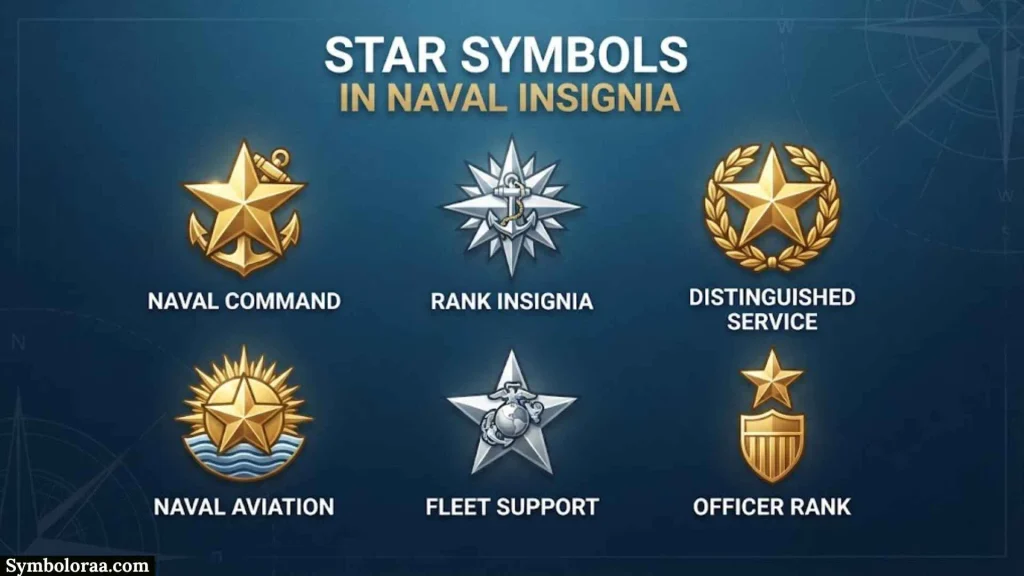
Stars are common in military and naval insignia, but they do not have one universal naval meaning.
A star may indicate:
- Rank
- Command level
- Distinction
- Qualification
- National identity
- Organizational affiliation
In the U.S. Navy, stars appear in specific officer insignia systems. Current U.S. Navy uniform regulations define the sleeve insignia used to identify officer ranks, while historical Navy documentation explains how stars and other devices have been used with rank insignia.
Why the Number of Stars Matters
When stars appear on naval insignia, their number and arrangement may be significant.
For example, a single star may have a completely different official meaning from several stars arranged around an anchor or emblem.
Therefore, identifying a navy symbol from “it has a star” is not enough. You should examine:
- The number of stars
- Their position
- Their size
- The other symbols around them
- The uniform or object where they appear
- The navy or country involved
Eagle Symbols in Navy Emblems
The eagle is another important military symbol found in naval organizations.
It may represent:
- National identity
- Leadership
- Vigilance
- Authority
- Strength
- Military service
An eagle is not exclusively a naval symbol. It also appears in governmental and military emblems outside naval organizations.
The surrounding design is therefore important. An eagle positioned above an anchor communicates something different from an eagle used alone on a national emblem.
Crossed Swords and Military Symbols
Crossed swords generally communicate a connection with armed military service.
In naval emblems, swords can symbolize:
- Combat readiness
- Military authority
- Defense
- Courage
- Armed service
A sword combined with an anchor creates a visual connection between maritime service and military force.
However, this is a general symbolic interpretation, not a universal official definition. Individual naval organizations may assign specific meanings to their insignia.
Shield Symbols in Naval Emblems
Shields commonly represent protection and defense.
A naval shield may contain additional symbols that identify:
- A country
- A fleet
- A naval command
- A ship
- A geographical region
- A specialized unit
This makes shields particularly useful for organizational emblems because they provide a space for several identifying elements.
When researching a shield-shaped navy emblem, look inside the shield before trying to identify the organization.
Trident Symbols and Sea Power
The trident is closely associated with the sea and maritime authority.
Its symbolism is often connected with classical traditions involving the sea. In modern naval imagery, a trident can suggest:
- Sea power
- Maritime authority
- Naval heritage
- Strength
- Command of the maritime environment
A trident alone does not prove that an emblem belongs to a military navy. It can also appear in civilian, historical, cultural, and decorative maritime designs.
Wave Symbols and Maritime Identity
Waves are among the easiest symbols to associate with the sea.
They can represent:
- Oceans
- Coastal waters
- Maritime operations
- Naval environments
- Seafaring
- Connection with the water
Waves are especially common in modern logos because they communicate maritime identity quickly.
Unlike rank insignia, however, wave imagery is often symbolic rather than a standardized indication of authority.
Rope and Nautical Symbols
Rope is another recurring feature in naval badges and emblems.
It can represent:
- Seafaring
- Shipboard traditions
- Maritime craftsmanship
- Naval heritage
- Connection with ships
Rope may also be used as a decorative border around an emblem.
Its presence alone is therefore not enough to identify a particular navy.
Navy Rank Symbols and Insignia
One of the most important categories of navy symbols is rank insignia.
Rank insignia identify an individual’s position within a naval command structure.
Depending on the country and service, rank can be represented using:
- Stripes
- Stars
- Bars
- Eagles
- Crowns
- Anchors
- Oak leaves
- Other official devices
The systems differ between countries, so a rank symbol should always be interpreted within its own naval system.
U.S. Navy Officer Rank Symbols
The U.S. Navy provides a useful example of a formal rank-insignia system.
Current regulations state that officer sleeve insignia consist of gold stripes of specified widths that indicate rank.
The U.S. Navy’s regulations separately define sleeve insignia, sleeve devices for line and staff corps, shoulder insignia, and collar grade insignia.
Historical U.S. Navy documentation also shows that officer rank has been displayed through sleeves, shoulders, collars, caps, and other uniform components.
This demonstrates why the phrase “navy symbol” should not be treated as synonymous with “logo.” A small stripe or metal device can be an official rank marker.
Enlisted Rating Badges
Enlisted naval personnel may also wear specialized rating or rate insignia.
For example, current U.S. Navy regulations identify rating badges for E-4 through E-6 personnel and specify the colors and components used with different uniforms.
These badges can combine an eagle, chevrons, and a specialty mark.
That combination can communicate more information than a simple rank symbol.
Navy Flags, Ensigns, Jacks, and Pennants
Naval flags are another major category of navy symbolism.
Different flags can have different functions, including:
- National identification
- Naval identification
- Command indication
- Ceremonial display
- Maritime communication
The terms ensign, jack, pennant, and flag should not be treated as interchangeable.
What Is a Naval Ensign?
An ensign is a flag associated with the identity of a vessel or nation. National naval ensigns may have designs specifically associated with naval service.
The exact rules differ by country.
What Is a Navy Jack?
A jack is a flag flown from a designated position on a vessel and can have a specific national or naval function.
The U.S. Navy’s historical documentation explains that the Union Jack, commission pennant, admiral’s broad pennant, and national ensign have distinct uses aboard naval vessels.
The U.S. Navy Flag
The official U.S. Navy flag provides a useful real-world example of how multiple symbols can work together.
The Department of the Navy seal became the central feature of the official U.S. Navy flag, which was authorized in 1959. The design includes a dark blue field, yellow fringe, the Department of the Navy seal imagery, a circular rope border, and a scroll identifying the United States Navy.
The official Navy flag should also be distinguished from other flags flown aboard U.S. naval vessels. The historical source specifically notes that the Navy flag is reserved for display purposes and ceremonial use rather than being interchangeable with the national ensign or other shipboard flags.
Navy Ship Badges and Unit Emblems
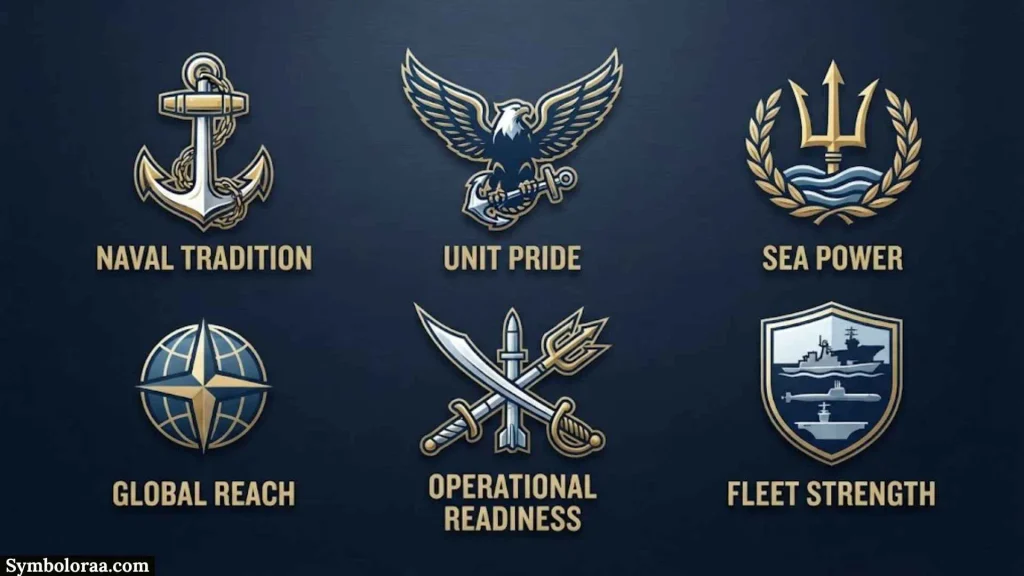
Naval symbols can identify individual ships and naval units.
A ship badge or unit emblem may include:
- The ship’s name
- A distinctive animal
- A historical reference
- A geographic reference
- A naval weapon
- An anchor
- A shield
- A motto
- A crown or other heraldic feature
These elements can help connect a modern unit with its history.
Why Ship Badges Are Different From Rank Insignia
A ship badge identifies an organization or vessel.
A rank insignia identifies a person and their position.
This distinction is important when researching photographs of naval uniforms or ships.
If the same emblem appears on multiple members of a unit, it may be a unit identifier rather than a rank indicator.
Navy Aircraft Markings and Symbols
Naval symbolism is not limited to ships and uniforms.
Aircraft operated by naval forces can also carry identifying markings.
Historical U.S. Navy records show that naval aircraft used distinguishing markings from the early period of naval aviation. Early aircraft carried an anchor design on the vertical tail before a standardized national aircraft insignia was adopted in 1917.
This is a good example of how navy symbols can change over time.
A symbol that appears on a historical aircraft should therefore be interpreted according to the period in which the aircraft operated.
Navy Symbols in Medals and Decorations
Naval medals and decorations often use maritime imagery.
Possible elements include:
- Anchors
- Ships
- Waves
- Stars
- Eagles
- Shields
- Swords
- National emblems
These designs can reinforce the relationship between an award and naval service.
However, the meaning of a symbol on a medal should be checked against the official description of that specific decoration rather than assumed from the image alone.
Navy Symbols by Country
There is no single worldwide system of navy symbols.
Each country develops its own naval traditions, rank structures, badges, flags, and heraldic conventions.
United States Navy Symbols
The United States Navy provides extensive official documentation covering uniforms, rank insignia, rating badges, flags, aircraft markings, and historical naval traditions.
Its current uniform regulations separate officer insignia from enlisted rate and rating insignia, showing how detailed a national naval symbol system can be.
Royal Navy Symbols
The Royal Navy also has its own traditions of badges, heraldry, crowns, anchors, and unit identification.
This provides an important reminder that naval symbolism should be researched within the specific national system. A symbol that has one formal meaning in the United States may have a different meaning in the United Kingdom or another country.
Navy Symbols vs. Navy Logos
A navy logo is usually a broader visual identity for an organization.
A navy symbol can be much more specific.
For example:
| Type | Main Purpose |
| Navy logo | Overall organizational identity |
| Rank insignia | Identifies rank |
| Rating badge | Identifies enlisted rating or specialty |
| Ship badge | Identifies a ship |
| Unit emblem | Identifies an organization |
| Naval flag | Represents or identifies a naval organization or function |
| Medal symbol | Represents service or achievement |
| Aircraft marking | Identifies aircraft or national affiliation |
This distinction is useful when researching images because a symbol on a uniform may not be the navy’s main logo.
How to Identify an Unknown Navy Symbol
If you find a symbol on an old uniform, ship, photograph, medal, or flag, use a structured identification process instead of guessing.
Step 1: Identify Where the Symbol Appears
First ask where you found it.
Is it on:
- A sleeve?
- A shoulder?
- A collar?
- A hat?
- A flag?
- A ship?
- An aircraft?
- A medal?
- A document?
- A building?
The location can immediately narrow down the possibilities.
Step 2: Separate Rank From Organization
Ask whether the symbol is likely to identify a person or an organization.
A symbol worn by one person in a specific position may be rank or specialty insignia.
A symbol repeated across an entire unit may be an organizational emblem.
Step 3: Examine Every Element
Do not focus only on the anchor.
Record:
- Anchor
- Star
- Eagle
- Sword
- Shield
- Crown
- Rope
- Ship
- Number
- Letter
- Motto
- Color
- Border
The combination can be much more informative than any single element.
Step 4: Determine the Country
Look for clues such as:
- National colors
- Flag design
- Language
- Uniform style
- National emblem
- Lettering
Country identification can eliminate many possible interpretations.
Step 5: Determine the Time Period
Historical uniforms and flags can differ from modern versions.
For example, U.S. Navy historical sources document changes in officer insignia and uniform practices over time.
A symbol from 1900 should not automatically be interpreted using today’s regulations.
Step 6: Verify Against an Official Source
Once you have a likely identification, compare it with an official naval archive, uniform regulation, museum collection, or government source.
This final step is especially important for historical symbols.
Navy Symbol Identification Decision Guide
Use this simple decision process when you encounter an unfamiliar design:
Is the symbol on a uniform?
→ Yes: Check whether it indicates rank, rating, specialty, qualification, or unit.
→ No: Continue.
Is it on a flag?
→ Yes: Determine whether it is an ensign, jack, command flag, pennant, or ceremonial flag.
→ No: Continue.
Is it attached to a ship or naval building?
→ Yes: Look for a ship badge, command emblem, unit insignia, or national identification.
→ No: Continue.
Does it contain an anchor, ship, waves, or rope?
→ Yes: It may have maritime or naval associations, but verify the organization before calling it an official naval insignia.
→ No: Examine the complete design and identify the country, organization, and historical period.
This approach reduces one of the most common mistakes: assuming that a familiar maritime image automatically has an official military meaning.
Historical Development of Navy Symbols
Naval symbolism developed as maritime organizations needed ways to communicate identity and authority.
Before modern electronic communication, flags and visual signals were particularly important at sea. Naval organizations developed systems for displaying flags, signals, and other identifying marks.
Uniform insignia also evolved.
Historical U.S. Navy records show that officers have used different forms of rank identification over time, including epaulettes, shoulder straps, sleeve stripes, and metal insignia.
This history explains why an old naval symbol may look very different from a modern one while serving a similar identification purpose.
Why Historical Context Matters
A symbol can change meaning when:
- A navy changes its uniform regulations
- A country changes its government
- A naval branch is reorganized
- A unit is renamed
- A ship receives a new commission
- A flag design is replaced
- A historical badge becomes obsolete
For historical research, the date is therefore just as important as the picture.
Common Misconceptions About Navy Symbols
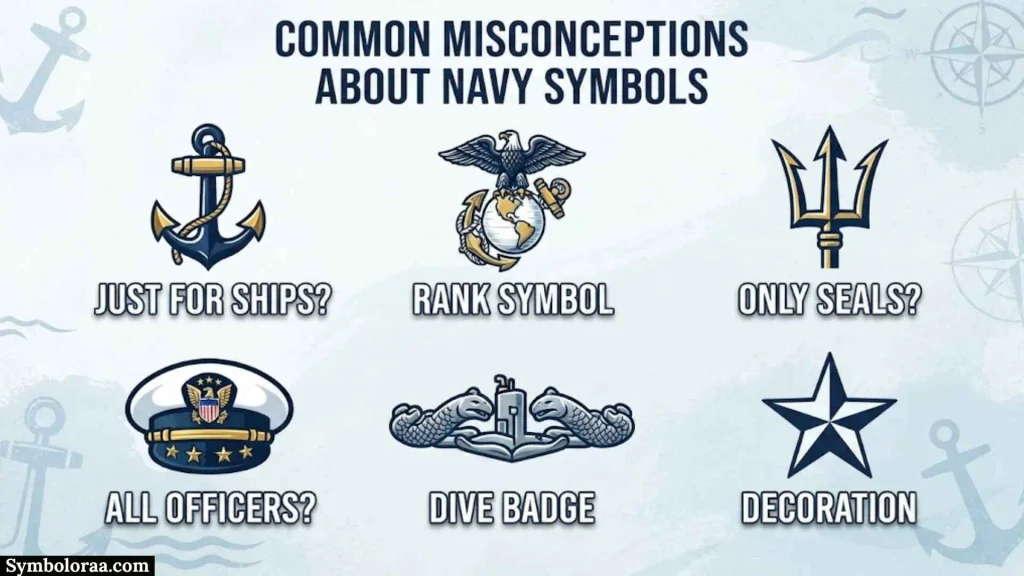
Every Anchor Is an Official Navy Symbol
An anchor is strongly associated with naval service, but it is also used by civilian maritime organizations, sailing clubs, shipping companies, ports, tattoo artists, clothing brands, and decorative designs.
All Naval Symbols Have Universal Meanings
They do not.
A symbol can have a formal meaning within one navy and a different meaning elsewhere.
A Navy Logo and Rank Insignia Are the Same Thing
They are not.
A logo generally represents an organization, while rank insignia identifies an individual’s position.
A Star Always Means Admiral
Not necessarily.
Stars can have different functions depending on the navy, uniform, emblem, and context.
Old Navy Symbols Are the Same as Modern Ones
Historical insignia can differ considerably from current designs.
Official historical records are therefore more reliable than modern image collections when identifying an old symbol.
Common Mistakes When Researching Naval Symbols
Mistake 1: Identifying a Symbol From One Element
Seeing an anchor and immediately calling it a specific navy emblem can produce a false identification.
Better approach: Identify the complete design.
Mistake 2: Ignoring the Country
Naval insignia are national and organizational systems.
Better approach: Establish the country before assigning an official meaning.
Mistake 3: Ignoring the Date
Historical insignia can change.
Better approach: Determine approximately when the symbol was used.
Mistake 4: Confusing Maritime and Military Symbols
An anchor or ship does not automatically mean military service.
Better approach: Look for official evidence connecting the design to a naval organization.
Mistake 5: Relying Only on Image Searches
Image results can contain incorrect labels and copied descriptions.
Better approach: Use official naval regulations, government archives, museums, and recognized historical institutions for verification.
Expert Tips for Understanding Navy Symbols
When researching naval symbols, five questions can solve many identification problems:
- Who uses the symbol?
- Where does the symbol appear?
- When was it used?
- What other symbols appear with it?
- What does the official source say about it?
This five-question method is more reliable than interpreting symbolism based only on visual appearance.
For modern U.S. Navy insignia, official uniform regulations are particularly useful because they distinguish officer rank insignia, staff corps devices, enlisted rating badges, service stripes, and headgear insignia.
For historical U.S. Navy questions, the Naval History and Heritage Command provides historical material on uniforms, flags, aircraft markings, and other naval traditions.
Frequently Asked Questions About Navy Symbols
What Is the Most Common Navy Symbol?
The anchor is one of the most recognizable symbols associated with naval service because of its direct connection with ships and the sea. It can represent naval duty, maritime service, stability, or tradition depending on the context.
What Does the Anchor Symbol Mean in the Navy?
An anchor commonly represents naval or maritime service, stability, and connection with ships. A specific navy may give an anchor a more precise official meaning when it appears in a particular badge or insignia.
What Do Stars Mean on Navy Uniforms?
Stars can indicate rank or form part of another official insignia. Their meaning depends on the naval service and the exact design.
What Is a Foul Anchor?
A foul anchor is an anchor crossed or wrapped with a rope or chain. It is a traditional naval and maritime design and appears in various official naval insignia.
Are Navy Symbols the Same in Every Country?
No. Naval forces have different uniform regulations, rank structures, flags, badges, and heraldic traditions. A symbol should therefore be interpreted according to the relevant country and organization.
What Is the Difference Between a Naval Symbol and a Naval Insignia?
“Naval symbol” is a broad term for imagery associated with naval service. “Naval insignia” usually refers to an official identifying mark, such as rank, rating, qualification, unit, or organizational insignia.
What Does a Trident Mean in Naval Symbols?
A trident commonly suggests the sea, maritime authority, or naval heritage. Its exact meaning depends on the organization using it.
Why Do Navy Symbols Use Anchors?
Anchors have a direct relationship with ships and also symbolize stability and steadfastness. These qualities make them natural imagery for naval organizations.
Can a Navy Symbol Be Used by a Civilian Organization?
Yes. Many maritime symbols, including anchors, ships, ropes, and waves, are also used by civilian organizations. An image should not be described as official military insignia without evidence.
How Can I Identify a Navy Symbol From an Old Photograph?
Start with the country, approximate date, uniform or object, placement of the symbol, and other visible elements. Then compare the design with official historical naval archives or uniform regulations.
Do Navy Symbols Change Over Time?
Yes. Uniform regulations, organizational structures, national identities, and naval traditions can change. Historical U.S. Navy records provide several examples of changes to rank and uniform insignia.
Key Takeaways About Navy Symbols
- Navy symbols are visual identifiers connected with naval organizations and maritime military service.
- The anchor is one of the most recognizable naval symbols, but it is not exclusively military.
- Stars, eagles, swords, shields, tridents, waves, ropes, and ships are common elements in naval and maritime imagery.
- Rank insignia identify a person’s position, while unit and ship badges identify organizations or vessels.
- Naval flags include different categories such as ensigns, jacks, pennants, and ceremonial flags.
- The meaning of a symbol depends on its country, context, design, and historical period.
- Official regulations and historical archives are more reliable than assumptions based on appearance.
- A symbol on a uniform should be analyzed differently from a symbol on a ship, flag, medal, or aircraft.
- Historical naval symbolism can differ significantly from modern insignia.
- The most reliable identification method is to examine the complete design and verify it against an authoritative source.
Conclusion
Navy symbols are much more than decorative images of anchors and ships. They form a visual language used to communicate rank, identity, authority, specialty, organizational affiliation, national connection, and naval heritage.
The most important lesson is that there is no single universal dictionary for every navy symbol. An anchor may be a general maritime image, a formal insignia, part of a rank device, or simply decorative artwork. The surrounding symbols, location, country, and historical period determine its meaning.
For accurate identification, start with the complete design, determine where and when it was used, identify the relevant navy or organization, and then verify the interpretation through official regulations or historical sources. This method provides a much more reliable understanding of navy symbols than relying on the appearance of an individual icon alone.

I’m Madison Reed, a contemporary American author who writes about love, family, friendship, and second chances. I’m fascinated by the choices that shape our lives and the moments that change us forever. My goal is to create honest, emotional stories with characters readers can connect with long after finishing each book.
Three Books:
When We Find Our Way
The Things We Never Said
Summer in September
 Jackson Miller