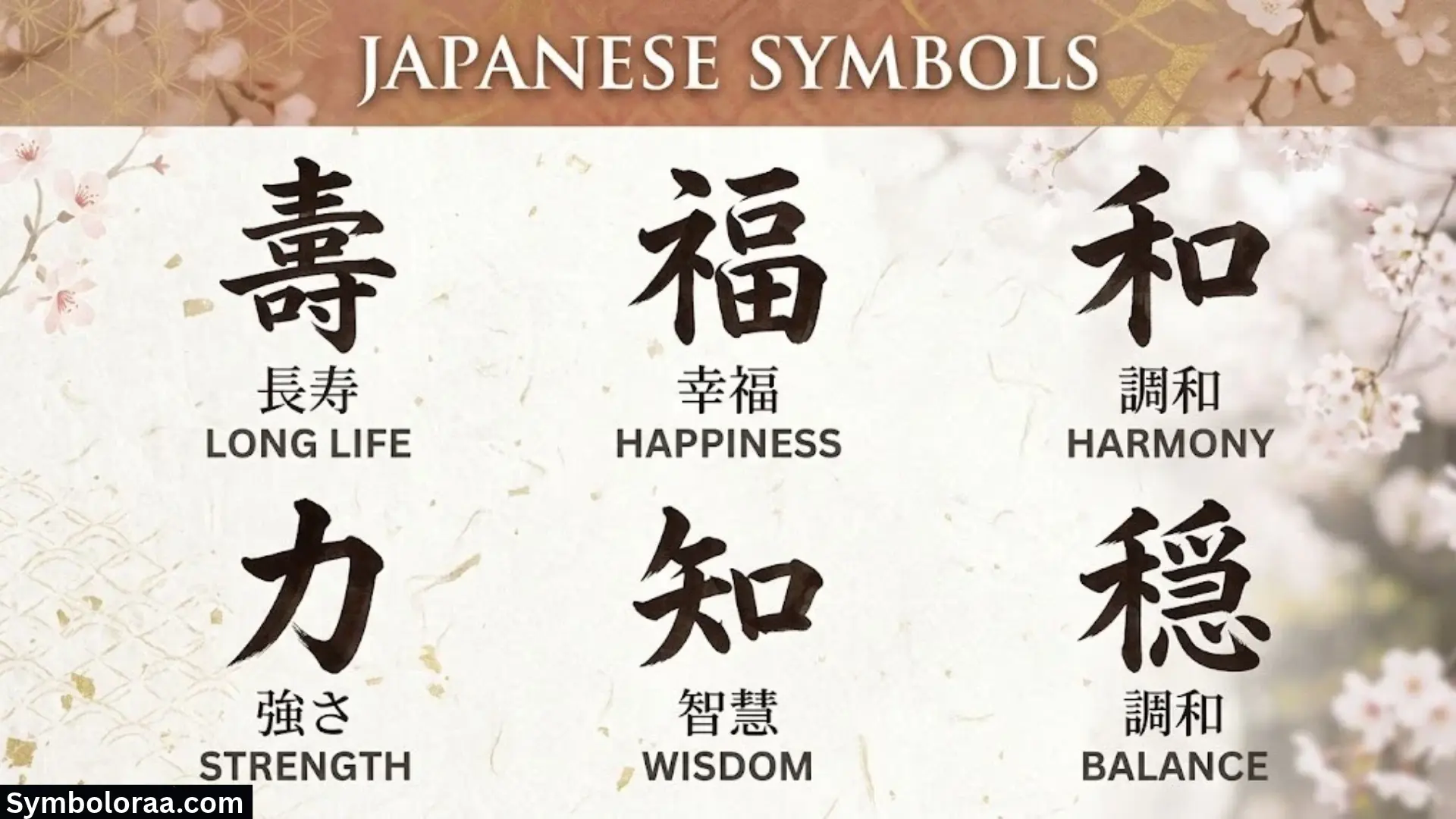
Japanese symbols have fascinated people around the world for centuries. From beautiful kanji characters to traditional cultural designs, these symbols represent language, history, nature, spirituality, and Japanese identity.
Some Japanese symbols communicate words and sounds, while others express ideas such as love, strength, peace, and good fortune. You may see them in books, artwork, clothing, architecture, tattoos, and everyday Japanese writing.
However, understanding Japanese symbols requires more than memorizing their English translations. Some characters have multiple pronunciations, and their meanings can change depending on the words surrounding them. Cultural symbols also carry different associations depending on their historical and religious contexts.
This guide explains the most common Japanese symbols, their meanings, the Japanese writing systems, traditional cultural symbols, and practical tips for learning Japanese characters.
What Are Japanese Symbols?
Japanese symbols include written characters, punctuation marks, decorative designs, and cultural emblems. Each category serves a different purpose.
Japanese writing uses three main scripts: hiragana, katakana, and kanji. These scripts work together to express words, grammatical relationships, names, and complete sentences.
Japanese culture also features recognizable symbols such as cherry blossoms, koi fish, torii gates, and the national flag. These images can represent ideas connected with nature, spirituality, identity, and tradition.
Main Types of Japanese Symbols
Japanese symbols can be divided into several categories:
- Hiragana: A phonetic script used for grammatical elements and many Japanese words.
- Katakana: A phonetic script commonly used for foreign words, names, and emphasis.
- Kanji: Characters that represent words or meaningful parts of words.
- Romaji: Japanese words written with Latin letters.
- Punctuation marks: Symbols that organize sentences and quotations.
- Cultural symbols: Images associated with Japanese history, nature, religion, and customs.
- Traditional emblems: Designs connected with institutions, families, and national identity.
Understanding these categories helps you distinguish a written character from a traditional Japanese symbol.
The Three Main Japanese Writing Systems
Japanese uses hiragana, katakana, and kanji in everyday writing. Although each script looks different, they work together to make Japanese sentences clear and meaningful.
Hiragana (ひらがな)
Hiragana is one of the first writing systems Japanese learners study. Its rounded characters represent Japanese sounds and appear throughout everyday writing.
Modern Japanese has 46 basic hiragana characters. These include the five vowels: あ, い, う, え, and お.
Hiragana commonly appears in:
- Grammatical particles.
- Verb and adjective endings.
- Native Japanese words.
- Children’s reading materials.
- Pronunciation guides above kanji.
For example, ありがとう (arigatō) means “thank you.” The word is written entirely in hiragana.
Another example is 食べます (tabemasu), meaning “eat” or “will eat” in a polite form. The character 食 is kanji, while べます is hiragana.
This combination allows Japanese writers to express meaning and grammar within the same word.
Katakana (カタカナ)
Katakana is the second phonetic script. Its characters generally have more angular shapes than hiragana, but both scripts represent the same basic set of Japanese sounds.
Katakana commonly represents borrowed words, foreign names, scientific terms, and selected sound effects.
Examples include:
- コーヒー (kōhī) — coffee.
- テレビ (terebi) — television.
- アメリカ (Amerika) — America.
- ケーキ (kēki) — cake.
- コンピューター (konpyūtā) — computer.
Katakana also appears in advertising, manga, product packaging, and modern Japanese design.
Writers sometimes use it to emphasize a word or create a particular visual effect. Therefore, katakana doesn’t always indicate that a word comes from another language.
Kanji (漢字)
Kanji are characters historically adopted from Chinese writing and adapted to Japanese. Unlike hiragana and katakana, many kanji communicate a recognizable meaning as well as contributing to pronunciation.
Common examples include:
- 山 — mountain.
- 水 — water.
- 火 — fire.
- 木 — tree or wood.
- 花 — flower.
- 人 — person.
- 愛 — love.
- 心 — heart or mind.
- 夢 — dream.
- 力 — strength or power.
Kanji can have several readings. The character 日, for example, can mean “sun” or “day,” depending on its use.
Japanese readings generally include on’yomi, historically associated with Chinese pronunciations, and kun’yomi, associated with native Japanese words.
For example, 山 can be read as yama when it means mountain on its own. In 富士山 (Fujisan), the name of Mount Fuji, it is read as san.
Japan’s standard list of kanji for common use, called jōyō kanji, contains 2,136 characters. However, Japanese writing also includes characters beyond this list.
Romaji (ローマ字)
Romaji represents Japanese words using the Latin alphabet. It helps beginners understand pronunciation before they become comfortable reading Japanese characters.
Examples include:
| Japanese | Romaji | Meaning |
| さくら | Sakura | Cherry blossom |
| みず | Mizu | Water |
| やま | Yama | Mountain |
| ねこ | Neko | Cat |
| ありがとう | Arigatō | Thank you |
Romaji appears in travel materials, some signs, language-learning resources, and digital keyboard input.
However, learning hiragana, katakana, and kanji provides a stronger foundation for reading Japanese. Romaji is useful, but it doesn’t fully represent the visual and grammatical features of Japanese writing.
Common Japanese Symbols and Their Meanings
Many people search for Japanese characters because they want to understand a particular symbol or choose one for artwork.
The following table covers frequently encountered kanji and their common meanings.
| Japanese Symbol | Common Meaning | Example Reading |
| 日 | Sun or day | Hi |
| 月 | Moon or month | Tsuki |
| 山 | Mountain | Yama |
| 水 | Water | Mizu |
| 火 | Fire | Hi |
| 木 | Tree or wood | Ki |
| 花 | Flower | Hana |
| 人 | Person | Hito |
| 愛 | Love or affection | Ai |
| 力 | Strength or power | Chikara |
| 心 | Heart or mind | Kokoro |
| 夢 | Dream | Yume |
| 空 | Sky or emptiness | Sora |
| 光 | Light | Hikari |
| 神 | Deity or god | Kami |
| 雨 | Rain | Ame |
| 海 | Sea or ocean | Umi |
| 道 | Road or way | Michi |
| 友 | Friend | Tomo |
| 和 | Harmony | Wa |
These English translations describe common meanings rather than every possible interpretation. The reading and meaning can change when a character appears in a compound word.
Japanese Symbols for Love
The Japanese character 愛 (ai) means love or affection. It appears in words connected with emotional attachment, care, and close relationships.
Another important character is 心 (kokoro), which can mean heart, mind, or inner feelings. It often expresses emotional or psychological ideas that don’t translate neatly into one English word.
For example, 愛情 (aijō) means affection or love. The word contains 愛, but its complete meaning comes from the combination of characters.
People often choose 愛 for jewelry, artwork, or tattoos because of its association with love. Before using it in a permanent design, make sure the character and surrounding wording express the intended message.
Japanese Symbols for Strength
The character 力 (chikara) represents strength, power, or force. It can refer to physical strength, the ability to accomplish something, or power in a broader sense.
Japanese also uses other words related to strength:
- 強さ (tsuyosa) — strength.
- 強い (tsuyoi) — strong.
- 勇気 (yūki) — courage or bravery.
- 能力 (nōryoku) — ability or capability.
These expressions have different grammatical functions. 力 is a single character, while 勇気 and 能力 are complete words made from two kanji.
Japanese Symbols for Peace and Hope
平和 (heiwa) means peace or peaceful conditions. It can describe harmony in society or the absence of conflict.
希望 (kibō) means hope or a desired outcome. People use this word when discussing aspirations, possibilities, and future goals.
Another meaningful character is 夢 (yume), meaning dream. It can describe a dream during sleep or an ambition someone hopes to achieve.
These words often appear in Japanese art, messages, and decorative designs. Their meanings are most accurate when you consider the complete word rather than translating each character separately.
Japanese Number Symbols
Japanese uses kanji for numbers as well as Arabic numerals. Number characters appear in traditional writing, names, dates, and formal documents.
| Number | Japanese Symbol | Reading |
| 1 | 一 | Ichi |
| 2 | 二 | Ni |
| 3 | 三 | San |
| 4 | 四 | Yon or shi |
| 5 | 五 | Go |
| 6 | 六 | Roku |
| 7 | 七 | Nana or shichi |
| 8 | 八 | Hachi |
| 9 | 九 | Kyū or ku |
| 10 | 十 | Jū |
| 100 | 百 | Hyaku |
| 1,000 | 千 | Sen |
| 10,000 | 万 | Man |
Some numbers have multiple readings, depending on the word and situation. For instance, four can be read as yon or shi.
Learning number characters is useful for reading dates, prices, addresses, and common Japanese expressions.
Japanese Diacritical Marks and Modified Characters
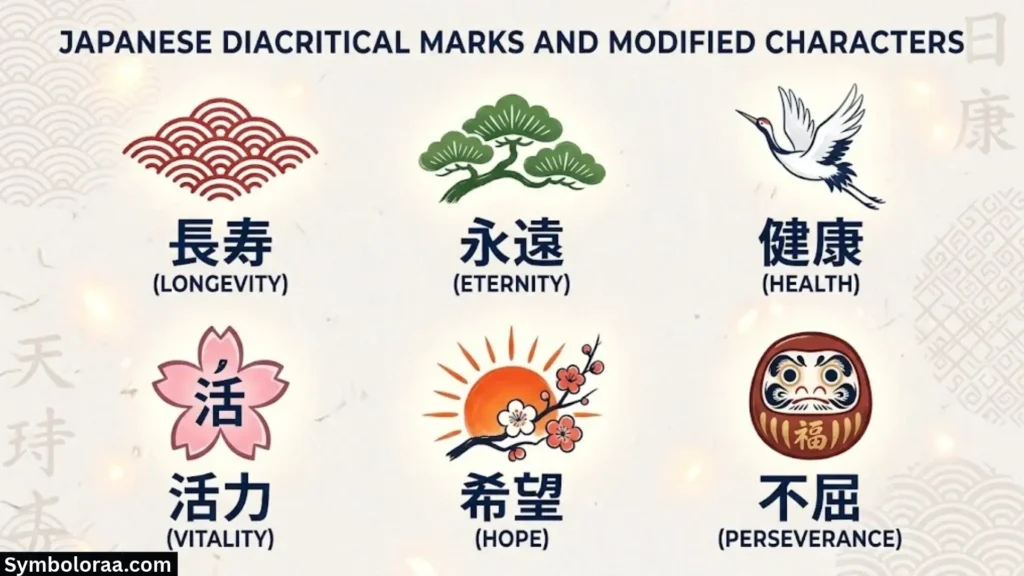
Japanese kana sometimes include small marks that change their pronunciation. These marks may look decorative, but they carry important linguistic information.
Dakuten (゛)
Dakuten consists of two small strokes placed near the upper-right corner of certain kana. It changes the pronunciation of the character.
Examples include:
- か becomes が.
- さ becomes ざ.
- た becomes だ.
- は becomes ば.
For example, か represents ka, while が represents ga. The difference matters because the two sounds can distinguish different words.
Handakuten (゜)
Handakuten is a small circle placed on certain kana from the h-row. It changes the sound to the corresponding p-row sound.
Examples include:
- は becomes ぱ.
- ひ becomes ぴ.
- ふ becomes ぷ.
These marks are common in both hiragana and katakana.
Sokuon (っ and ッ)
The small tsu character marks a doubled consonant or brief closure before the next consonant.
For example, きて (kite) and きって (kitte) have different pronunciations.
Similarly, がっこう (gakkō) means school. The small っ changes the pronunciation and must not be confused with the full-size character つ.
Chōonpu (ー)
The chōonpu is a horizontal line used to indicate a long vowel, especially in katakana words.
Examples include:
- コーヒー — coffee.
- スーパー — supermarket.
- ケーキ — cake.
Vowel length matters in Japanese, so these marks help readers pronounce words correctly.
Small Kana and Combined Sounds
Japanese combines small versions of や, ゆ, and よ with certain kana to produce contracted sounds.
Examples include:
- きゃ — kya.
- きゅ — kyu.
- きょ — kyo.
- キャ — kya.
- キュ — kyu.
- キョ — kyo.
These combinations are common in Japanese vocabulary and appear in both hiragana and katakana.
Japanese Punctuation and Special Symbols
Japanese punctuation helps organize sentences, quotations, and explanations. Some marks resemble English punctuation, while others have distinct Japanese forms.
Common Japanese Punctuation Marks
| Symbol | Name or Description | Main Use |
| 。 | Kuten | Ends a sentence |
| 、 | Tōten | Separates phrases or clauses |
| 「 」 | Japanese quotation brackets | Marks quotations |
| 『 』 | Double quotation brackets | Marks nested quotations or selected titles |
| ( ) | Parentheses | Adds explanatory information |
| 【 】 | Japanese brackets | Highlights labels or important text |
| ・ | Nakaguro | Separates elements in certain expressions |
| ! | Exclamation mark | Expresses emphasis |
| ? | Question mark | Marks questions in contexts where it’s used |
For example:
彼は「こんにちは」と言いました。
This sentence means, “He said, ‘Hello.’”
The quotation brackets surround the spoken words, while the final punctuation completes the sentence.
The Japanese Repetition Symbol 々
The symbol 々 repeats the preceding kanji in certain words. It doesn’t have one independent pronunciation.
Examples include:
- 時々 (tokidoki) — sometimes.
- 人々 (hitobito) — people.
- 様々 (samazama) — various or diverse.
This mark saves space and follows established Japanese writing conventions.
Other repetition marks include ゝ, ゞ, ヽ, and ヾ. These marks are less common in ordinary modern writing and may appear in particular names or specialized contexts.
Other Japanese Typographic Symbols
Several special marks appear in everyday Japanese documents.
- ※: Introduces a note or additional explanation.
- 〒: Identifies Japanese postal codes and postal addresses.
- 〆: Appears in certain traditional writing contexts and expressions.
- 〄: A specialized mark associated with Japanese industrial standards.
- 〓: Used as a placeholder in some Japanese text conventions.
Each symbol has a specific function. Learning the most common ones can help you read addresses, notices, forms, and printed materials more confidently.
Traditional Japanese Cultural Symbols and Their Meanings
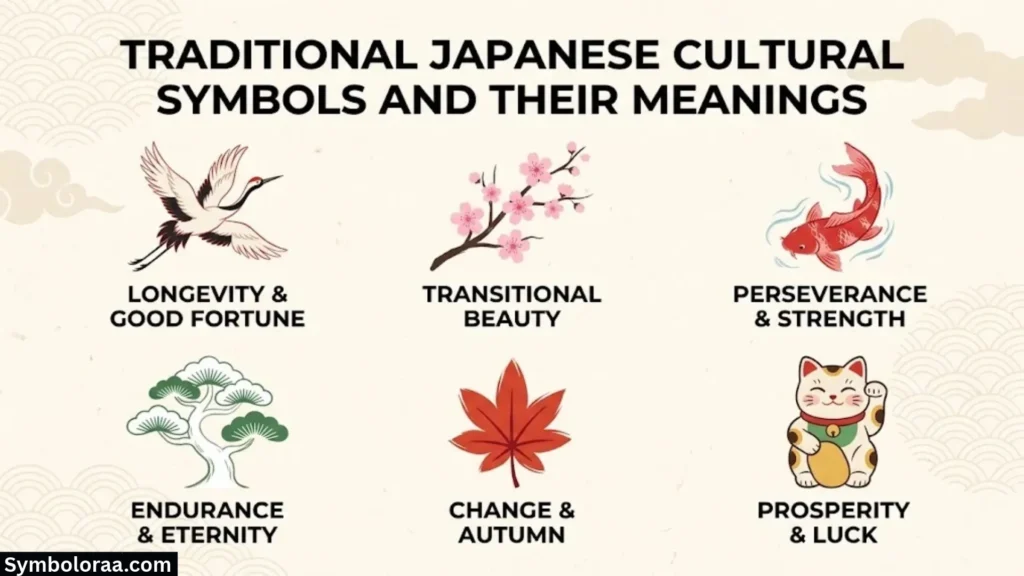
Japanese culture features many recognizable images connected with nature, history, religion, and seasonal traditions.
Unlike written characters, cultural symbols often communicate ideas through their appearance and traditional use. Their meanings may also vary between regions, historical periods, and artistic settings.
Sakura: Cherry Blossoms
Sakura, or cherry blossoms, are among the most recognizable symbols associated with Japan. Their delicate flowers appear in spring and have inspired poetry, paintings, festivals, and traditional celebrations.
Cherry blossoms commonly represent:
- Renewal: Their appearance signals the arrival of spring.
- Beauty: Their delicate flowers are celebrated in Japanese art.
- Impermanence: Their short blooming season reminds people that beauty doesn’t last forever.
- New beginnings: Their seasonal appearance coincides with important life transitions in Japan.
Hanami, or cherry blossom viewing, is a popular seasonal tradition. Friends, families, and colleagues gather beneath blooming trees to enjoy the flowers.
Sakura can express happiness, but they can also suggest reflection because their beauty is temporary.
Hinomaru: The Japanese National Flag
The Hinomaru is Japan’s national flag. It features a red disc centered on a white background and is closely associated with Japan’s historical connection to the rising sun.
The flag represents Japanese national identity and appears during official ceremonies, national events, and international sporting competitions.
Japan formally established the national flag’s legal status in 1999. Its standard proportions have a height-to-width ratio of 2:3, and the red disc sits in the center.
The Hinomaru is different from the Rising Sun Flag, which features a central sun with radiating rays.
The Chrysanthemum Crest
The chrysanthemum crest is associated with Japan’s Imperial House. Its familiar Imperial design features sixteen petals arranged around a central point.
Chrysanthemums also appear in gardens, paintings, seasonal decorations, and traditional art. The flower can symbolize longevity, refinement, and autumn.
However, not every chrysanthemum design represents the Imperial House. The specific emblem and its context determine its association.
The Paulownia Crest
The paulownia crest, known as kiri mon, is another recognizable Japanese emblem. Its design commonly features leaves and clusters of flowers arranged in a balanced pattern.
Historically, paulownia imagery has appeared in Japanese heraldry and official symbolism. It can be associated with prominent families and institutions.
Unlike a single kanji, a crest communicates identity through a complete visual design.
Mount Fuji: A Symbol of Japan’s Natural Beauty
Mount Fuji is one of Japan’s most famous natural landmarks. Its symmetrical volcanic shape has inspired generations of artists, poets, pilgrims, and photographers.
Mount Fuji can represent:
- Natural beauty.
- National identity.
- Spiritual significance.
- Artistic inspiration.
- The relationship between people and nature.
The mountain appears prominently in traditional Japanese paintings and prints. Its image remains popular in modern photography, souvenirs, and decorative designs.
Koi Fish: Perseverance and Good Fortune
Koi are ornamental carp commonly found in Japanese gardens and ponds. Their bright colors and graceful movement have made them popular subjects in paintings, textiles, and tattoos.
Koi commonly symbolize perseverance, strength, achievement, and good fortune.
Their association with determination reflects stories and traditions about overcoming obstacles. However, koi symbolism also appears in broader East Asian cultures, so it isn’t exclusive to Japan.
The Japanese Crane
The crane, called tsuru, is a familiar motif in Japanese art, clothing, and decorative objects.
It commonly represents longevity, good fortune, and hope. Cranes often appear in celebratory designs, including wedding decorations and special gifts.
Origami cranes are especially recognizable. Folding one thousand paper cranes is associated with wishes and peace, although the meaning depends on the occasion.
Other Japanese Nature Symbols
Nature has a central place in Japanese art and seasonal traditions. Flowers, trees, animals, and landscapes often carry cultural associations.
| Symbol | Japanese Name | Common Association |
| Pine | Matsu | Longevity and resilience |
| Bamboo | Take | Flexibility and upright character |
| Plum blossom | Ume | Early spring and endurance |
| Chrysanthemum | Kiku | Autumn and longevity |
| Maple leaves | Momiji | Autumn and seasonal change |
| Waves | Nami | Movement and the power of water |
These meanings are common interpretations rather than universal definitions. The same motif may communicate different ideas depending on the design and occasion.
Japanese Mythological and Spiritual Symbols
Japanese spiritual traditions and folklore have influenced architecture, art, festivals, and popular culture. Shinto and Buddhism are particularly important, although they have distinct histories and practices.
Torii Gates
A torii is a traditional gate commonly found at the entrance to a Shinto shrine or a sacred area associated with one.
Its recognizable structure often consists of two upright posts supporting horizontal beams. Many torii gates are painted vermilion, although their designs and colors vary.
Torii gates mark a transition into a sacred space. They appear in shrine architecture, traditional paintings, travel photography, and Japanese-inspired artwork.
Their religious context distinguishes them from ordinary decorative gates.
The Manji Symbol (卍)
The manji is an ancient symbol used in Buddhist traditions, including Japanese Buddhist art and architecture. It may also appear on Japanese maps to identify Buddhist temples.
Although its shape resembles the swastika used by Nazi Germany, the symbols have different historical and cultural contexts.
The Buddhist manji has a much older history and remains an important religious symbol in several Asian traditions. Its meaning should be interpreted through its setting rather than its shape alone.
The Tomoe Symbol
The tomoe is a curved, comma-like motif found in Japanese decorative designs, crests, and religious settings.
One familiar variation is the mitsudomoe, which contains three curved forms arranged around a center.
Tomoe designs appear on traditional emblems, drums, shrine decorations, and other objects. Their swirling shapes create a sense of movement and visual energy.
However, the motif doesn’t have one universal meaning across every setting.
Kami: Spirits and Sacred Beings
The word kami refers to sacred beings, powers, or presences within Shinto traditions. Depending on the context, it may refer to deities, natural forces, or revered presences connected with particular places and traditions.
The character 神 is commonly translated as “god” or “deity,” but these English words don’t capture every aspect of the Japanese concept.
Shinto traditions may associate kami with mountains, waterfalls, trees, historical figures, and other aspects of the natural or human world.
Yokai: Japanese Folklore Creatures
Yokai refers to a broad category of supernatural beings, mysterious entities, and strange occurrences in Japanese folklore.
Some yokai appear frightening, while others are playful, mischievous, or helpful. Famous examples include the kitsune, or fox spirit, and the kappa, a water-associated creature.
Yokai appear in traditional illustrations, folklore stories, manga, anime, and video games. Their designs are important parts of Japanese storytelling and visual culture.
Daruma Dolls
Daruma dolls are traditional round figures associated with perseverance, determination, and good fortune.
A popular custom involves painting one eye when setting a goal and completing the second eye when achieving it. People may use Daruma dolls to mark personal ambitions, business goals, or other important milestones.
Their rounded design allows many Daruma dolls to return upright when tipped over. This feature supports their association with persistence and the idea of continuing after setbacks.
Japanese Calligraphy and Artistic Symbols
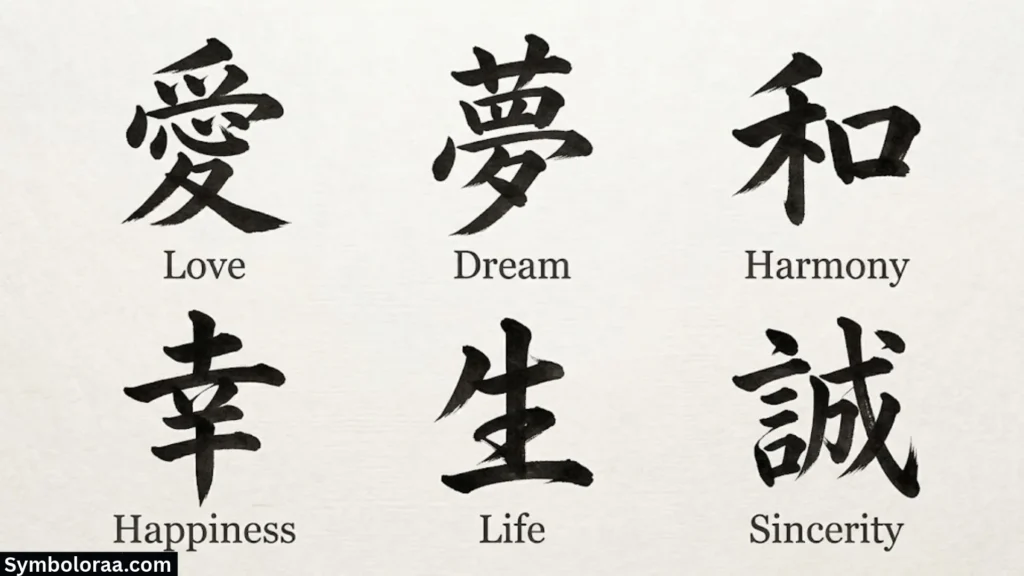
Japanese characters can function as both writing and visual art. Their shapes, brushstrokes, and arrangement often influence the appearance and emotional impact of a design.
Shodō: The Art of Japanese Calligraphy
Shodō means “the way of writing” and refers to traditional Japanese calligraphy.
Calligraphers use brushes, ink, and paper to create characters that balance structure, movement, spacing, and visual expression.
Important elements include:
- Brush control: Pressure and movement influence line thickness.
- Stroke order: The sequence of strokes helps maintain character structure.
- Ink: Black ink creates contrast and reveals changes in brush pressure.
- Paper: Traditional Japanese paper absorbs ink in distinctive ways.
- Composition: The spacing and placement of characters affect the overall design.
The same kanji can look different depending on the calligraphy style. Some styles emphasize clear, regular forms, while others feature flowing or highly cursive strokes.
This is why handwritten Japanese characters may look different from printed versions without representing different words.
Japanese Symbols in Traditional Art
Japanese art often combines written characters with flowers, animals, landscapes, and other cultural motifs.
Common examples include:
- Ukiyo-e prints featuring landscapes and historical subjects.
- Traditional crests associated with families or institutions.
- Seasonal images featuring cherry blossoms or maple leaves.
- Nature-inspired designs showing waves, mountains, birds, and fish.
- Calligraphic lettering arranged for artistic effect.
The meaning often comes from the entire composition. A kanji placed beside cherry blossoms may create a different impression from the same character used in a formal document.
Japanese Symbols for Tattoos
Japanese characters are popular tattoo choices because a small design can communicate a meaningful word or idea.
Common options include:
| Japanese Text | Reading | Meaning |
| 愛 | Ai | Love |
| 力 | Chikara | Strength or power |
| 夢 | Yume | Dream |
| 心 | Kokoro | Heart or mind |
| 勇気 | Yūki | Courage |
| 平和 | Heiwa | Peace |
| 希望 | Kibō | Hope |
Before choosing a Japanese tattoo, check the exact character, pronunciation, and intended meaning.
A single character may have several readings, and a combination that looks attractive may not sound natural to Japanese speakers. Ask a fluent Japanese reader to verify the complete design before making a permanent decision.
Religious symbols and traditional emblems also deserve careful consideration because they may carry meanings beyond their appearance.
Japanese Symbols in Everyday Writing
Japanese writers regularly combine kanji and kana within the same sentence. Each script has a particular role, making the writing system more efficient and expressive.
Consider these examples:
| Japanese Sentence | Romaji | English Meaning |
| 日本語を勉強します。 | Nihongo o benkyō shimasu. | I study Japanese. |
| これはコーヒーです。 | Kore wa kōhī desu. | This is coffee. |
| 桜がきれいです。 | Sakura ga kirei desu. | The cherry blossoms are beautiful. |
| 水を飲みます。 | Mizu o nomimasu. | I drink water. |
In the first sentence, 日本語 means Japanese language, を marks the object, and 勉強します expresses studying in a polite form.
The mixture of scripts is completely normal. Kanji carries much of the lexical meaning, while hiragana represents grammatical elements and endings.
Japanese Writing Direction
Japanese writing appears in both horizontal and vertical layouts.
Horizontal writing generally runs from left to right. It is common in websites, textbooks, digital interfaces, and many modern documents.
Vertical writing runs from top to bottom, with columns progressing from right to left. It appears in some novels, literary works, traditional publications, and selected artistic layouts.
Both formats are valid. Writers choose between them according to the purpose, design, and conventions of the publication.
Japanese Names and Place Names
Kanji frequently appears in personal names, cities, and geographic locations. However, a character’s reading in a name may differ from its most familiar reading elsewhere.
For example, 東京 is read Tōkyō, and 東京駅 means Tokyo Station.
Personal names can be more complicated because Japanese names sometimes use uncommon readings or individual naming conventions. You shouldn’t assume that every kanji in a person’s name follows the most common pronunciation.
How to Learn Japanese Symbols as a Beginner
Learning Japanese symbols becomes easier when you divide the process into manageable stages. Start with the basic scripts, then gradually introduce kanji through useful words and sentences.
Follow a Simple Learning Order
Begin with hiragana. Learn the vowels and basic characters. Practice reading short words instead of memorizing shapes without context.
Study katakana next. Pay attention to similar-looking characters and practice common loanwords.
Learn modified kana. Add dakuten, handakuten, small kana, and long-vowel marks.
Introduce common kanji. Start with useful characters such as 日, 月, 山, 水, 人, and 木.
Practice complete sentences. Reading helps you understand how the different scripts work together.
Build vocabulary steadily. Learn complete words instead of treating every character as an isolated definition.
Use the Gojuon Chart
The gojuon chart organizes Japanese kana according to vowel and consonant patterns. Its name refers to the traditional fifty-sound arrangement, although the modern basic chart contains fewer than fifty distinct basic characters.
| a | i | u | e | o | |
| — | あ | い | う | え | お |
| k | か | き | く | け | こ |
| s | さ | し | す | せ | そ |
| t | た | ち | つ | て | と |
| n | な | に | ぬ | ね | の |
| h | は | ひ | ふ | へ | ほ |
| m | ま | み | む | め | も |
| y | や | — | ゆ | — | よ |
| r | ら | り | る | れ | ろ |
| w | わ | — | — | — | を |
The standalone nasal ん is usually listed separately.
The chart helps beginners recognize sound patterns. Once you understand the arrangement, learning the corresponding katakana characters becomes easier.
Use Effective Memorization Techniques
Several study methods can improve your ability to remember Japanese characters:
- Spaced repetition: Review characters at increasing intervals.
- Handwriting practice: Write characters carefully to learn their structure.
- Flashcards: Test your knowledge of readings and meanings.
- Reading practice: Recognize characters in complete words and sentences.
- Memory associations: Connect unfamiliar shapes with memorable images.
- Vocabulary groups: Learn related words together.
For kanji, include example words and readings in your notes. This approach helps you understand how a character behaves in real Japanese rather than memorizing one English translation.
Learn Kanji Through Complete Words
Consider the character 日. Learning that it can mean “sun” or “day” is useful, but complete words reveal how its readings change.
- 日 (hi) — day or sun in relevant contexts.
- 日本 (Nihon) — Japan.
- 日曜日 (nichiyōbi) — Sunday.
- 毎日 (mainichi) — every day.
These examples show why context is essential. A kanji’s pronunciation depends on the word in which it appears.
Consistent practice with real vocabulary is more effective than trying to memorize hundreds of isolated characters at once.
Frequently Asked Questions About Japanese Symbols
What are the three main Japanese writing systems?
The three main scripts are hiragana, katakana, and kanji. Hiragana handles many grammatical elements and Japanese words, katakana commonly represents loanwords, and kanji represents words or meaningful parts of words.
How many Japanese symbols are there?
There is no single total because Japanese writing includes kana, thousands of kanji, punctuation marks, and specialized symbols.
Hiragana and katakana each have 46 basic characters. The jōyō kanji list contains 2,136 characters designated for common use, but Japanese writing also includes characters outside that list.
Is Japanese an alphabet?
Japanese doesn’t use an alphabet in the same way English does. Hiragana and katakana are syllabaries, while kanji represents meaningful linguistic units.
Japanese also uses romaji to write Japanese words with Latin letters.
What does 愛 mean in Japanese?
愛 commonly means love or affection and is read ai in many contexts. It appears in words connected with emotional attachment and close relationships.
Which Japanese symbol means strength?
力 commonly means strength, power, or force. Other related words include 強さ (tsuyosa), meaning strength, and 強い (tsuyoi), meaning strong.
What does 々 mean?
The symbol 々 repeats the preceding kanji in certain words. For example, 時々 means sometimes, while 人々 means people.
Are Japanese symbols the same as Chinese symbols?
Japanese kanji originated through the historical adoption of Chinese characters, but Japanese and Chinese writing aren’t identical.
Japanese uses kanji alongside hiragana and katakana. Kanji also has Japanese readings that differ from Chinese pronunciations.
Which Japanese cultural symbols are most recognizable?
Common examples include the Hinomaru flag, cherry blossoms, Mount Fuji, koi fish, torii gates, Daruma dolls, and the chrysanthemum crest.
These symbols have different histories and functions. Some represent national or institutional identity, while others carry cultural, artistic, or religious associations.
Which Japanese symbols are suitable for tattoos?
Characters such as 愛 (love), 力 (strength), 夢 (dream), and 希望 (hope) are popular choices.
Always verify the complete wording and intended meaning with a fluent Japanese reader before choosing a permanent design.
What is Japanese calligraphy?
Japanese calligraphy, known as shodō, is the art of writing characters with a brush and ink. It emphasizes stroke movement, spacing, balance, and artistic expression.
How can beginners learn Japanese symbols quickly?
Start with hiragana, move to katakana, and then learn common kanji through complete words. Daily practice, flashcards, handwriting, and simple reading exercises help build recognition over time.
Conclusion
Japanese symbols offer a fascinating way to explore Japan’s language, history, and cultural traditions. Some symbols represent sounds or words, while others communicate ideas connected with nature, spirituality, national identity, and everyday life.
The three main writing systems—hiragana, katakana, and kanji—work together to form modern Japanese writing. Characters such as 愛, 力, 心, and 夢 have recognizable meanings, but their exact readings and uses depend on context.
Traditional symbols add another dimension. Cherry blossoms represent seasonal beauty and impermanence, koi often suggest perseverance, and torii gates mark sacred spaces associated with Shinto shrines.
The most important principle is to look beyond appearance. Understanding a Japanese symbol means considering its meaning, pronunciation, cultural background, and actual use.
If you’re learning Japanese, researching cultural traditions, or choosing a character for a design, this knowledge will help you interpret Japanese symbols with greater accuracy and appreciation.

I’m Madison Reed, a contemporary American author who writes about love, family, friendship, and second chances. I’m fascinated by the choices that shape our lives and the moments that change us forever. My goal is to create honest, emotional stories with characters readers can connect with long after finishing each book.
Three Books:
When We Find Our Way
The Things We Never Said
Summer in September