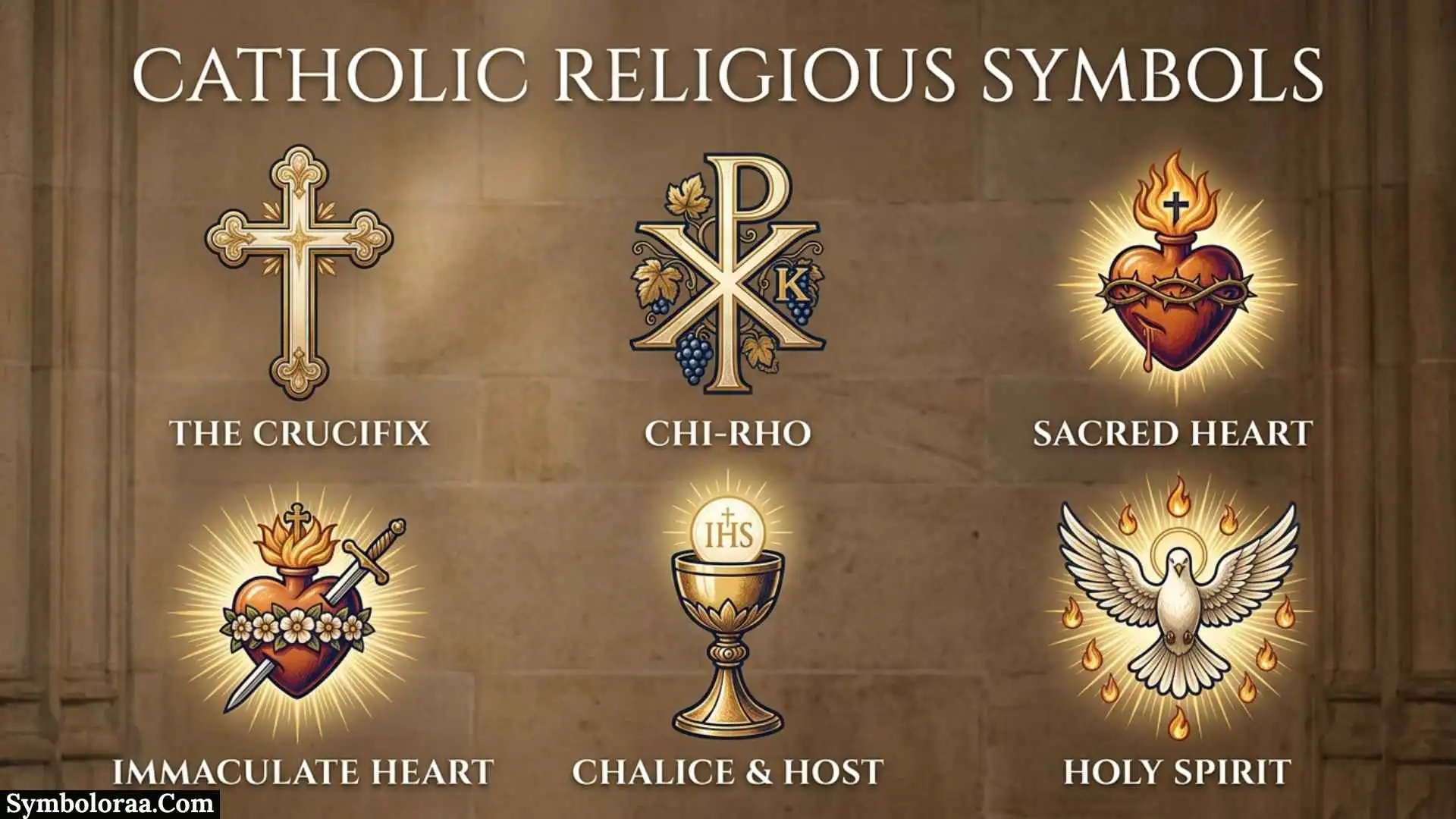
Catholic religious symbols help turn important teachings of the faith into something people can see, touch, remember, and recognize. The cross, crucifix, rosary, Sacred Heart, dove, water, candles, bread and wine, liturgical colors, and images of Mary and the saints all communicate different aspects of Catholic belief and worship.
If you are trying to understand Catholic religious symbols and their meanings, the most useful starting point is to look at both the symbol itself and the context in which Catholics use it. A cross in a church, for example, points to Christ’s Passion and salvation, while water recalls Baptism and new life. A red vestment may communicate something different from a white or violet one because liturgical colors correspond to particular celebrations and seasons.
The Catholic Church does not treat these signs simply as decoration. The Catechism explains that liturgy is woven from signs and symbols whose meanings draw from creation, human life, the Old Covenant, and the life and work of Christ.
This guide explains the most important Catholic symbols, what they mean, where they are found, how they developed, and how to avoid common misunderstandings when interpreting Catholic religious imagery.
Quick Answer: What Are Catholic Religious Symbols?
Catholic religious symbols are visible objects, images, colors, gestures, materials, and actions that communicate or recall important truths of Catholic faith.
Some symbols are directly connected with Jesus Christ and the Bible. Others developed through centuries of Catholic liturgical and devotional tradition.
Common examples include:
- Cross and crucifix
- Chi-Rho
- IHS
- Alpha and Omega
- Sacred Heart of Jesus
- Immaculate Heart of Mary
- Rosary
- Dove
- Water
- Bread and wine
- Lamb
- Fish
- Anchor
- Crown
- Crown of thorns
- Candles and light
- Incense
- Holy water
- Liturgical colors
- Images of Mary and the saints
- Symbols associated with the seven sacraments
The important point is that not every Catholic symbol has only one meaning. Its meaning can depend on the biblical tradition, liturgical setting, saint, feast, artwork, or devotional practice in which it appears.
Why Are Symbols Important in Catholicism?
Symbols matter in Catholicism because Christian faith involves both spiritual realities and physical human experience.
People naturally communicate through visible actions. A handshake can express friendship, a wedding ring can represent a marriage covenant, and a national flag can represent a country. Catholic worship similarly uses physical signs to communicate realities that cannot always be seen directly.
The Catechism teaches that human beings use signs and symbols to communicate spiritual realities and that creation itself contains things such as light, fire, water, earth, and trees that can point toward God’s work. Catholic liturgy takes up many of these elements and gives them a place within Christian worship.
Symbols Connect Visible Things With Invisible Realities
A Catholic symbol often works on more than one level.
Water is physically water, but in the context of Baptism it also recalls cleansing, new life, and entry into Christian life.
A candle produces physical light, but within Christian worship light can point toward Christ and spiritual illumination.
Bread and wine are ordinary foods and drinks, yet in the Eucharistic celebration they have a sacramental significance that goes far beyond their everyday use.
This is why removing a symbol from its context can lead to an incomplete interpretation.
Symbols Help People Remember Catholic Teachings
A person may forget a paragraph of theological explanation but remember the image of a crucifix, a baptismal font, or a Paschal candle.
Sacred images and liturgical signs can therefore reinforce teaching through visual memory. The Catechism says sacred images in churches and homes are intended to awaken and nourish faith in the mystery of Christ.
The Cross: The Central Catholic Symbol
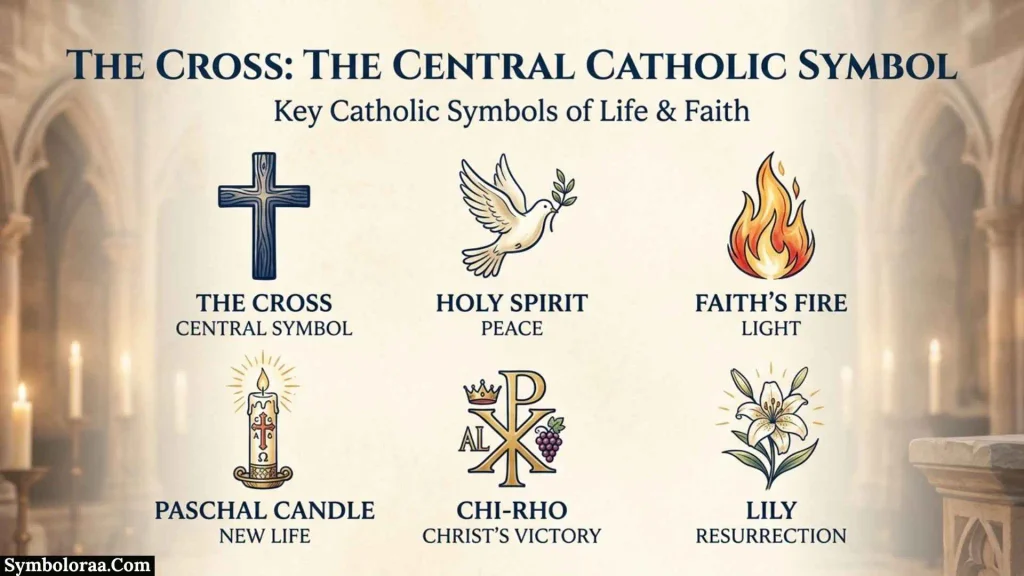
The cross is the most recognizable symbol associated with Catholic Christianity.
It points to the Passion and death of Jesus Christ and, within Christian faith, to salvation and the hope of the Resurrection.
Catholics may encounter crosses on church buildings, altars, rosaries, necklaces, graves, prayer cards, vestments, artwork, and in private homes.
The cross is therefore both a public sign of Christian identity and a deeply religious reminder of Christ’s sacrifice.
What Does the Cross Represent?
The cross can point to several closely connected ideas:
- The Passion of Jesus
- Christ’s sacrifice
- Salvation
- God’s love
- Christian discipleship
- Hope beyond suffering
- The Resurrection
The meaning becomes even clearer when the cross is considered alongside the Resurrection. Catholic symbolism does not treat Christ’s death as the final event. The cross belongs within the larger story of Christ’s Passion, death, Resurrection, and victory over death.
Why Do Catholics Make the Sign of the Cross?
The Sign of the Cross is a gesture that invokes the Father, Son, and Holy Spirit while physically making the sign of the cross.
Catholics commonly make it at the beginning and end of prayer, during Mass, and in other devotional settings.
It combines words, movement, and belief into one short action. It is therefore both a prayer and a visible expression of Christian identity.
The Vatican’s recent teaching on signs and symbols also highlights bodily actions such as kneeling and the sign of peace as meaningful elements of liturgical participation.
The Crucifix: Why Is Jesus Shown on the Cross?
A crucifix is a cross that includes a representation of Jesus’ body.
This is particularly associated with Catholic tradition because it places the suffering and sacrifice of Christ directly before the viewer.
A plain cross can emphasize Christ’s death and Resurrection, while a crucifix makes the Passion visually prominent. Neither should be treated as a completely separate theological message; both belong to the same Christian understanding of Christ’s saving work.
Cross vs. Crucifix
| Feature | Cross | Crucifix |
| Main image | Cross alone | Cross with Christ’s body |
| Main visual emphasis | Cross and Christian faith | Christ’s Passion and sacrifice |
| Common Catholic use | Churches, jewelry, artwork, prayer | Churches, homes, classrooms, prayer spaces |
| Main association | Christ’s death and salvation | Christ crucified and his sacrifice |
This distinction is especially useful for people who are unfamiliar with Catholic churches and wonder why a crucifix is displayed so prominently.
Ancient Christian Symbols Used in Catholic Tradition
Not all Catholic symbols originated in recent Catholic devotional practice. Some belong to the much older Christian symbolic tradition.
The Chi-Rho
The Chi-Rho is formed from two Greek letters associated with the name of Christ.
It has been used in Christian art since antiquity and can appear on church decorations, manuscripts, religious objects, and artwork.
Its basic function is to identify Christ and communicate a connection with Christianity.
The IHS Monogram
IHS is a traditional Christian monogram associated with the name of Jesus.
It appears in Catholic churches, artwork, vestments, religious medals, books, and devotional objects.
Because it represents the name of Jesus, it can serve as a compact visual reminder of Christ.
Alpha and Omega
Alpha and Omega are the first and last letters of the Greek alphabet.
In Christian symbolism, they represent completeness and are associated with God’s eternity and Christ.
You may find them on crosses, Paschal candles, church artwork, and Easter-related imagery.
These letters are particularly meaningful when viewed alongside the Christian understanding of Christ as Lord over the beginning and end of history.
Symbols Associated With Jesus Christ
Catholic religious imagery contains many symbols specifically connected with Jesus.
The Sacred Heart of Jesus
The Sacred Heart of Jesus is one of the most important Catholic devotional symbols.
It is often shown as a heart surrounded by flames and may include a cross and crown of thorns.
The image represents the love of Christ and points toward the mystery of his person and saving work.
The Vatican’s Directory on Popular Piety and the Liturgy describes the Sacred Heart devotion as focusing on the mystery of Christ and his love, while noting its long-standing place in Catholic devotional life.
The Lamb of God
The lamb is an ancient Christian image associated with Christ.
The title “Lamb of God” is deeply connected with Catholic worship and biblical language.
A lamb shown in religious artwork can therefore point toward Christ’s sacrificial role and the mystery of salvation.
The Crown of Thorns
The crown of thorns represents Christ’s suffering during his Passion.
Unlike a royal crown, which commonly communicates kingship or glory, the crown of thorns specifically recalls humiliation, suffering, and the events leading to the Crucifixion.
It frequently appears in artwork depicting Christ and in Sacred Heart imagery.
Symbols Associated With Mary
Catholic churches often contain imagery associated with the Virgin Mary.
These symbols are not meant to replace Christ. Catholic teaching understands Mary in relation to her role as the Mother of Jesus and within the mystery of Christ.
The Immaculate Heart of Mary
The Immaculate Heart of Mary is traditionally shown as a heart associated with Mary’s love, interior life, faithfulness, and relationship with God.
Artistic representations can include flowers, flames, or a sword.
The exact artistic details may vary, so the surrounding imagery should be considered when interpreting the symbol.
The Lily
The lily is commonly associated with purity and is frequently used in Catholic artwork connected with Mary.
It can also appear alongside saints, particularly when an artwork emphasizes purity or virginity.
The Rose
The rose has several meanings in Christian and Catholic art.
Depending on context, it can suggest beauty, love, purity, or martyrdom. Marian traditions also contain important associations with the rose.
Because flowers can have multiple symbolic meanings, the identity of the person shown and the surrounding imagery should be considered before assigning one fixed interpretation.
The Crown
A crown associated with Mary can represent her heavenly honor and traditional title as Queen.
In Catholic art, Mary may be shown crowned, especially in images connected with her glorification.
Symbols of the Holy Spirit
The Holy Spirit is often represented through physical images that communicate ideas found in Scripture and Christian tradition.
The Dove
The dove is perhaps the most recognizable visual symbol of the Holy Spirit.
It is particularly connected with the Baptism of Jesus, where the Holy Spirit is described using dove imagery.
Catholic artwork may therefore show a dove above Christ, near a baptismal scene, or within representations of the Trinity.
Fire
Fire is strongly associated with the Holy Spirit, especially Pentecost.
Flames can represent divine presence, spiritual transformation, and the coming of the Holy Spirit.
Fire may also appear in religious art connected with Pentecost and Confirmation.
Wind
Wind can also represent the Holy Spirit because biblical descriptions connect the Spirit with breath and wind.
This is less visually standardized than the dove or flame but remains an important part of Christian symbolism.
Water as a Catholic Religious Symbol
Water has a major place in Catholic sacramental symbolism.
Its strongest association is with Baptism.
Water naturally suggests washing, cleansing, life, and renewal. In Catholic theology, these ordinary meanings become connected with the sacramental life of the Church.
The Catechism identifies water among the fundamental signs used in Christian liturgy and connects sacramental signs with the history of salvation.
Holy Water
Holy water is blessed water used in Catholic liturgical and devotional practice.
Catholics may encounter holy water fonts at the entrances of churches or use holy water in particular prayers and blessings.
The Catechism specifically explains that sprinkling with holy water recalls Baptism.
This is an important distinction: holy water is not considered a magical substance. Its religious use belongs to Catholic sacramental practice and points believers back toward God and the grace associated with Baptism.
Bread and Wine in Catholic Symbolism
Bread and wine are central signs in the Catholic Eucharistic celebration.
They are not merely decorative symbols placed around a church. They are integral to the Eucharistic liturgy.
Catholic teaching understands the Eucharist in relation to Christ’s institution of the sacrament and the Church’s celebration of his saving mystery.
The Catechism explains that liturgy uses visible signs and that sacramental celebrations involve both words and actions.
Why Are Bread and Wine Important?
Bread and wine have several layers of biblical and liturgical meaning.
They are connected with:
- The Last Supper
- Christ’s sacrifice
- The Eucharist
- Communion
- Thanksgiving
- The life of the Church
For someone observing a Catholic Mass, understanding this context makes the significance of the altar and Eucharistic celebration much easier to recognize.
Candles and Light
Candles are common in Catholic churches and are used in many liturgical and devotional settings.
Light naturally provides a powerful image of guidance, hope, life, and God’s presence.
The Catechism lists candles among the elements from creation that can function as signs within Christian liturgy.
The Paschal Candle
The Paschal candle has a particularly important role during the Easter season.
It is associated with Christ’s Resurrection and the light of Christ.
Its use demonstrates how a physical object can become part of a much larger liturgical story. The candle is not simply a source of light; its place within the Easter liturgy gives it a specific Christian meaning.
Incense and Its Meaning
Incense is used during certain Catholic liturgical celebrations.
Its smoke rises visibly, making it a natural image of prayer ascending to God. It can also contribute to the solemn character of a celebration.
The use of incense is especially noticeable during more solemn Masses and certain processions.
It is another example of how Catholic worship involves the senses rather than relying only on spoken explanations.
Catholic Liturgical Colors and Their Meanings
Liturgical colors provide visual information about the character of different celebrations and seasons.
The United States Conference of Catholic Bishops explains that the colors used for sacred vestments express outwardly the character of the mysteries being celebrated and the movement of Christian life through the liturgical year.
| Color | Common Catholic Meaning or Use |
| White | Christmas, Easter, celebrations of Christ, Mary, angels, and non-martyr saints |
| Red | Passion celebrations, Pentecost, apostles, evangelists, and martyrs |
| Green | Ordinary Time |
| Violet | Advent, Lent, and certain Masses for the Dead |
| Rose | Used on specific Sundays of Advent and Lent |
| Black | May be used for Masses of the Dead |
| Gold or Silver | May replace white on particularly solemn occasions in some settings |
The exact rules can vary according to the liturgical norms and local practice. The USCCB summarizes the principal colors and notes additional permitted colors such as rose, black, and gold or silver.
How to Read Liturgical Colors
If you enter a Catholic church and notice the priest wearing green, that does not mean the color is chosen randomly.
The color provides a clue about where the Church is in the liturgical calendar and what kind of celebration is taking place.
This makes liturgical color one of the easiest symbols for a visitor to use when trying to understand a Catholic service.
Symbols Associated With the Seven Sacraments
The seven sacraments are central to Catholic life, and each has visible signs associated with its celebration.
| Sacrament | Common Signs and Symbols |
| Baptism | Water, candle, white garment |
| Confirmation | Anointing with oil, laying on of hands |
| Eucharist | Bread and wine |
| Reconciliation | Words of absolution, priest’s ministry, penitential actions |
| Anointing of the Sick | Anointing with oil, prayer, laying on of hands |
| Holy Orders | Laying on of hands, prayer, liturgical vestments |
| Matrimony | Exchange of consent and rings |
These should not be confused with simple decorative symbols. Sacramental signs have a specific place within Catholic liturgical celebrations.
The Catechism explains that sacramental celebrations use perceptible signs and that the Church’s sacramental signs continue the work of sanctification.
Symbols Used in Catholic Churches
A Catholic church can contain a large number of symbols because architecture, artwork, liturgy, and devotional practices overlap.
The Altar
The altar is central to the Eucharistic celebration.
Its meaning cannot be reduced to simply being a table. Within Catholic worship, it is connected with the Eucharistic sacrifice and the celebration of the Mass.
The Tabernacle
The tabernacle is the place where the Blessed Sacrament is reserved.
A sanctuary lamp is commonly associated with the presence of the Blessed Sacrament.
This means that a visitor who sees a lamp burning near the tabernacle can understand it as a significant devotional and liturgical sign rather than ordinary church lighting.
Stations of the Cross
The Stations of the Cross are a devotional practice centered on events associated with Christ’s Passion.
They are especially common during Lent but can be used at other times.
The stations allow Catholics to move through a sequence of scenes and meditate on Christ’s suffering and death.
The Vatican identifies the Stations of the Cross among forms of popular piety that accompany sacramental life.
The Rosary as a Catholic Symbol
The rosary is one of the objects most strongly associated with Catholic devotion.
Its beads provide a physical structure for prayers and meditations centered on Christ and associated with the Virgin Mary.
Although many people recognize a rosary simply as a string of beads, its purpose is devotional rather than decorative.
The Vatican’s guidance on popular piety describes the rosary as a form of prayer that can maintain a Christ-centered orientation through meditation on the mysteries of Christ’s life.
Is the Rosary Only About Mary?
No.
Mary has a major role in the rosary, but its prayers and mysteries repeatedly direct attention toward Jesus Christ.
This is one of the most common points newcomers misunderstand. The rosary is a Marian devotion, but it is also structured around events in the life, death, and Resurrection of Christ.
Symbols of Saints and Martyrs
Catholic religious art often gives saints recognizable attributes.
An artist may include an object associated with a saint’s life, occupation, mission, or martyrdom.
Common examples include:
- Palm branch for martyrdom
- Book for teaching or Scripture
- Cross for Christian witness
- Sword in particular saintly or martyr imagery
- Staff for certain bishops or shepherd imagery
- Crown for martyrdom or heavenly glory
These attributes are useful because they can help a viewer identify a saint without needing a written label.
Why Are Saints Shown With Symbols?
Sacred images of saints are intended to point beyond the artwork toward the person represented and, ultimately, toward Christ.
The Catechism explains that sacred images of the Mother of God, angels, and saints are connected to Christ and help make the communion of witnesses visible to believers.
Other Important Catholic Religious Symbols
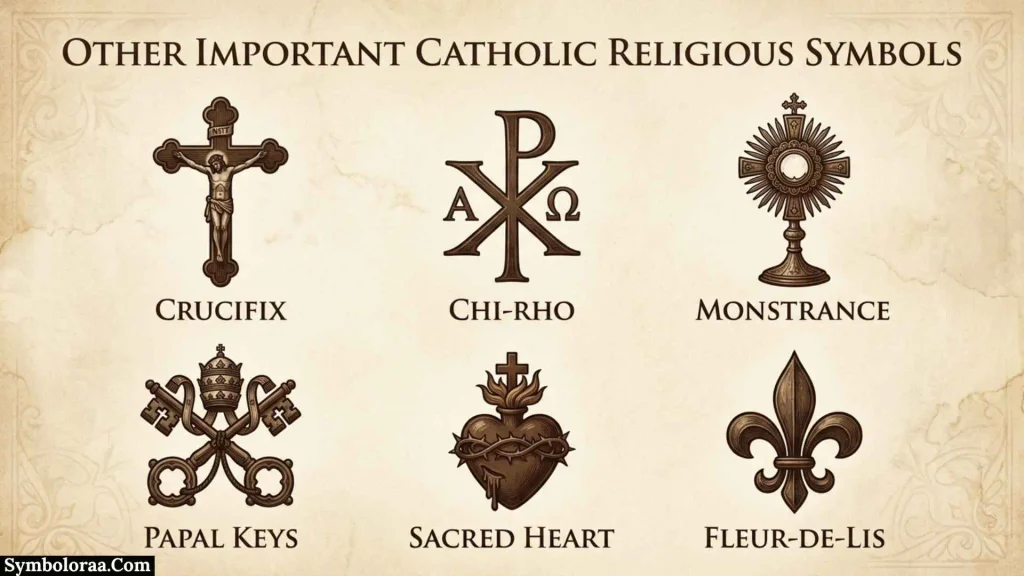
Some symbols are less immediately recognizable but still appear in Catholic art and tradition.
The Fish
The fish is an ancient Christian symbol associated with Jesus and early Christian identity.
The Greek word ichthys became connected with a Christian confession concerning Jesus Christ.
The fish may appear on Christian jewelry, artwork, church decorations, and historical artifacts.
The Anchor
The anchor is associated with hope and stability.
It became an important image in early Christian symbolism.
The visual idea is straightforward: an anchor keeps a ship secure, making it a natural image for steadfast hope.
The Fleur-De-Lis
The fleur-de-lis has a long history in Christian and European art.
In Catholic contexts, it can be associated with purity and Marian imagery.
However, because it is also used in heraldry and secular contexts, it should not automatically be interpreted as a specifically Catholic symbol every time it appears.
The Pelican
The pelican appears in historical Christian symbolism as an image associated with self-sacrifice and the Eucharist.
Its traditional meaning comes from older beliefs about the bird’s relationship with its young rather than from modern zoological understanding.
This is a useful example of why historical symbolism should be interpreted according to the tradition in which it developed.
Catholic Symbols for Christmas
Christmas symbolism focuses on the mystery of Christ’s birth.
Common Catholic Christmas symbols include:
- Nativity scene
- Manger
- Infant Jesus
- Mary
- Joseph
- Star
- Angels
- Shepherds
- Light
The Nativity Scene
The Nativity scene presents the birth of Jesus through figures and a physical setting.
It can include the Holy Family, shepherds, angels, animals, and the Magi depending on the tradition and stage of the Christmas season.
Its purpose is not simply to recreate a historical scene for decoration. It provides a visual way to meditate on the Incarnation and the birth of Christ.
Catholic Symbols for Easter
Easter symbolism centers on Christ’s Resurrection.
Common symbols include:
- Cross
- Empty tomb
- Paschal candle
- Light
- Lamb
- Water
- Alpha and Omega
The contrast between darkness and light is especially important during the Easter liturgy.
The Paschal candle, in particular, gives the celebration a strong visual focus on Christ as light and on the mystery of the Resurrection.
Catholic Symbols and Their Meanings at a Glance
| Symbol | Main Association | Where You May See It |
| Cross | Christ, sacrifice, salvation | Churches, homes, jewelry |
| Crucifix | Christ’s Passion | Churches, prayer spaces |
| Sacred Heart | Christ’s love | Statues, paintings, devotional items |
| Immaculate Heart | Mary’s interior life and devotion | Marian artwork |
| Dove | Holy Spirit | Baptism and Pentecost imagery |
| Water | Baptism and new life | Fonts, Baptismal rites |
| Bread and wine | Eucharist | Mass |
| Candle | Light, Christ, prayer | Churches and liturgy |
| Lamb | Christ as Lamb of God | Church art |
| Fish | Ancient Christian identity | Art and jewelry |
| Anchor | Hope and stability | Christian artwork |
| Rosary | Catholic prayer and devotion | Personal prayer, churches |
| Crown of thorns | Christ’s Passion | Crucifixes and paintings |
| Alpha and Omega | Beginning and end, Christ | Easter candles and artwork |
| IHS | Jesus | Altars, vestments, artwork |
| Chi-Rho | Christ | Ancient and modern Christian art |
How to Identify an Unfamiliar Catholic Symbol
If you see a symbol in a Catholic church and do not know what it means, do not rely on the object alone.
Use the surrounding context.
Step 1: Look at Who or What Is Shown
Is the symbol next to Jesus, Mary, a saint, an angel, or the altar?
This can immediately narrow down its meaning.
Step 2: Check the Liturgical Setting
Look at the vestment color, season, candles, altar, and other objects.
A symbol used during Easter may have a different context from a similar image displayed during Lent.
Step 3: Look for Biblical Connections
Many Catholic symbols have roots in Scripture.
Water, fire, bread, wine, the lamb, the dove, and the cross are good examples.
Step 4: Consider the Saint
If the symbol appears next to a statue or painting of a saint, it may be an attribute used to identify that particular person.
Step 5: Avoid Assuming One Meaning
Some symbols have multiple interpretations.
The crown is a good example. It can communicate kingship, heavenly glory, or martyrdom depending on the image.
A Simple Decision Guide for Understanding Catholic Symbols
Do you see a cross?
→ If Jesus is shown on it → Crucifix: focus on Christ’s Passion and sacrifice.
→ If there is no figure → Cross: focus on Christ, Christian faith, salvation, and the Resurrection.
Do you see water?
→ If it is being used in Baptism → Think Baptism and new life in Christ.
→ If it is in a holy water font → Think remembrance of Baptism and devotional use.
Do you see a dove?
→ In a Christian setting → Usually consider the Holy Spirit.
Do you see a heart with flames and a cross?
→ Likely the Sacred Heart of Jesus.
Do you see a heart associated with Mary?
→ Likely the Immaculate Heart of Mary.
Do you see a particular liturgical color?
→ Check the Church calendar and celebration before interpreting it.
This simple approach prevents many common mistakes.
Catholic Symbols vs. General Christian Symbols
One important SEO and knowledge distinction is that Catholic symbols are not always exclusively Catholic symbols.
Christianity has a shared symbolic heritage.
| Symbol | Used in Catholicism | Used More Broadly in Christianity |
| Cross | Yes | Yes |
| Dove | Yes | Yes |
| Fish | Yes | Yes |
| Lamb | Yes | Yes |
| Alpha and Omega | Yes | Yes |
| Anchor | Yes | Yes |
| Rosary | Strong Catholic association | Also used by some other Christians |
| Sacred Heart | Strong Catholic association | Less central in many other traditions |
| Liturgical colors | Yes | Varies by tradition |
| Crucifix | Very prominent | Also used by some other Christian traditions |
This distinction makes an article about Catholic religious symbols more accurate because it avoids suggesting that every Christian symbol belongs exclusively to Catholicism.
Common Misconceptions About Catholic Religious Symbols
Catholics Do Not Worship the Physical Object
One common misunderstanding is that Catholics worship statues, crosses, or other physical objects.
Catholic teaching makes a distinction between worship owed to God and the veneration associated with sacred images.
The Catechism teaches that sacred images direct attention toward the persons represented rather than making the physical object itself a god.
Not Every Religious Object Is a Symbol of the Same Kind
A crucifix, a sacramental sign, a devotional medal, a liturgical color, and a saint’s attribute do not all function in exactly the same way.
Some belong directly to liturgy. Others belong to popular devotion or sacred art.
The Church’s teaching on sacramentals describes them as sacred signs instituted by the Church that help sanctify different circumstances of Christian life.
A Symbol Can Have More Than One Meaning
Avoid treating symbolism like a dictionary in which every object has only one permanent definition.
Context matters.
A crown in one painting may represent Christ’s kingship. In another image, it may represent heavenly glory associated with a saint.
Common Mistakes When Interpreting Catholic Symbols
Understanding Catholic symbolism becomes easier when you avoid a few common errors.
Mistake 1: Assuming every Christian symbol is uniquely Catholic.
Many Catholic symbols belong to the wider Christian tradition.
Mistake 2: Treating symbols as magical objects.
Catholic sacramentals and devotional objects have a religious purpose, but Catholic teaching does not reduce them to magical charms.
Mistake 3: Ignoring historical context.
A symbol developed hundreds of years ago may not have exactly the same cultural associations as it does today.
Mistake 4: Looking at the object without its surroundings.
A crown, heart, color, or animal can mean different things depending on the accompanying imagery.
Mistake 5: Assuming decoration has no religious purpose.
Church artwork can serve teaching, remembrance, devotion, and contemplation. The Catechism explicitly describes sacred images as helping nourish faith.
How Catholic Symbols Work Together During Mass
One of the best ways to understand Catholic symbolism is to stop looking at individual objects in isolation.
During Mass, words, gestures, architecture, clothing, colors, music, objects, and actions can work together.
For example, the altar, vestments, candles, Scripture readings, incense, gestures, and Eucharistic elements all form part of the wider liturgical experience.
The Catechism describes liturgy as involving signs, symbols, words, actions, music, sacred images, and bodily participation.
This is why someone who understands several symbols at once can often understand what is happening in a Catholic church much more easily.
Why Catholic Sacred Art Uses So Many Images
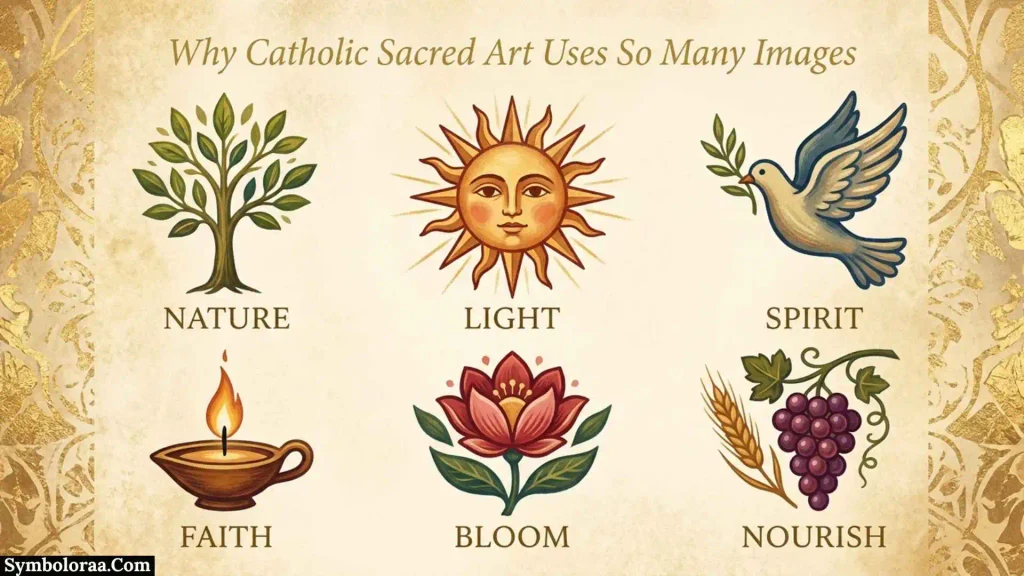
Catholic sacred art developed partly because visual communication can teach people who may not have access to extensive written theological education.
A painting of Christ, a statue of Mary, an image of a martyr, or a scene from the Passion can communicate a religious story at a glance.
The Catechism explains that Christian iconography communicates the Gospel message through images and that sacred images of Christ, Mary, angels, and saints have a recognized place in Catholic worship and devotion.
This does not mean every Catholic artwork has exactly the same status or purpose. Some images are liturgical, some devotional, and others primarily artistic or historical.
Frequently Asked Questions About Catholic Religious Symbols
What Is the Most Important Catholic Religious Symbol?
The cross is the central and most recognizable symbol of Catholic Christianity. It points to Christ’s Passion, death, sacrifice, and the Christian hope of salvation and Resurrection.
What Is the Difference Between a Cross and a Crucifix?
A cross normally shows the cross without Christ’s body. A crucifix includes a representation of Jesus on the cross and therefore places particular visual emphasis on Christ’s Passion.
What Does the Sacred Heart Mean in Catholicism?
The Sacred Heart of Jesus represents Christ’s love and is a major Catholic devotional image. Catholic sources connect the devotion with the mystery and love of Christ.
What Does the Dove Represent in Catholic Art?
The dove commonly represents the Holy Spirit, especially in artwork connected with Jesus’ Baptism and Pentecost.
What Does Water Symbolize in Catholicism?
Water is strongly associated with Baptism and can signify cleansing, new life, and Christian initiation. Holy water also recalls Baptism when used in Catholic devotional practice.
Why Do Catholic Churches Have Statues?
Statues and other sacred images can help believers remember Christ, Mary, the saints, and important events in salvation history. Catholic teaching distinguishes the veneration associated with sacred images from worship given to God.
What Does the Rosary Symbolize?
The rosary is a Catholic devotional aid used for prayer and meditation. Its structure encourages reflection on mysteries connected with Christ and Mary rather than serving merely as a decorative necklace.
What Do Catholic Church Colors Mean?
Liturgical colors help communicate the character of the celebration or liturgical season. White, red, green, and violet are the principal colors, while rose, black, and gold or silver have specific permitted uses.
What Does the Crown of Thorns Symbolize?
The crown of thorns recalls the suffering and humiliation of Jesus during his Passion before the Crucifixion.
What Does IHS Mean in Catholic Churches?
IHS is a traditional Christian monogram associated with the name of Jesus. It can appear on church furnishings, artwork, vestments, and devotional objects.
Are Catholic Religious Symbols the Same as Christian Symbols?
Some are shared throughout Christianity, including the cross, dove, fish, lamb, and Alpha and Omega. Other symbols have particularly strong associations with Catholic devotion, such as the rosary and Sacred Heart.
Are Catholic Statues Worshiped?
Catholic teaching does not treat statues as gods. Sacred images are intended to direct attention toward the persons represented, while worship belongs to God alone.
Why Are Catholic Symbols Important Today?
They provide a visual language for faith and help connect worshippers with Scripture, Christ, the sacraments, saints, feast days, and the history of Christian belief.
Key Takeaways About Catholic Religious Symbols
If you only need the main points, remember these:
- The cross points to Christ’s Passion, sacrifice, and salvation.
- The crucifix emphasizes Christ’s suffering and death on the cross.
- The Sacred Heart represents Christ’s love.
- The Immaculate Heart of Mary is associated with Mary’s love and devotion.
- The dove commonly represents the Holy Spirit.
- Water is strongly connected with Baptism.
- Bread and wine have a central place in the Eucharistic celebration.
- Candles and light can communicate Christ, hope, prayer, and divine presence.
- Liturgical colors help communicate the character of seasons and celebrations.
- The rosary is a Catholic devotional aid centered on prayer and meditation.
- Saints’ attributes help identify individuals and recall their lives or witness.
- Catholic symbols are not all exclusive to Catholicism; many come from the wider Christian tradition.
- Context is essential because one symbol can have more than one meaning.
- Catholic teaching distinguishes sacred images and sacramentals from worship owed to God.
Conclusion
Catholic religious symbols form a rich visual language that connects faith, Scripture, worship, history, and devotion. The cross and crucifix point toward Christ’s Passion and salvation, while the Sacred Heart expresses Christ’s love. Water recalls Baptism, bread and wine belong to the Eucharistic celebration, the dove represents the Holy Spirit, and liturgical colors help communicate the character of different seasons and celebrations.
The deeper lesson is that Catholic symbolism is not simply a collection of pictures with fixed definitions. Symbols work within a larger setting. A visitor who considers the object, the biblical connection, the liturgical season, the person represented, and the surrounding artwork will usually gain a much more accurate understanding.
The Catholic Church itself describes liturgy as being woven from signs and symbols that draw meaning from creation, human culture, salvation history, and Christ. In this sense, Catholic symbols do more than decorate churches: they help make the language of faith visible and memorable.

I’m Jackson Miller, an American author inspired by mystery, adventure, and the unpredictable nature of life. I enjoy writing fast-moving stories filled with memorable characters, unexpected choices, and meaningful moments. Through my books, I want readers to experience new worlds while discovering something about courage, determination, and themselves.
Three Books:
The Edge of Tomorrow
Under a Broken Sky
The Road We Chose
 Madison Reed